
Quick Overview
- Priming sends fuel into the carb before you pull the cord.
- Most mowers need 3 to 5 presses of the primer bulb. Not more.
- EFI mowers skip priming. A small computer does that job.
- Cold mornings need a few extra presses. Hot days need fewer.
- Too many presses can flood the engine. That’s the top mistake I see.
One cold March morning, I stood in my Minnesota garage. I yanked the pull cord twelve times. My arm gave up first. The mower coughed once. Then it went quiet.
I knew how to prime a lawn mower. I had done it many times. But that day I skipped a step. I was lazy. The cold engine made me pay for it. I remember the smell of raw gas in the cold air. I remember the quiet after the cough. Just my own breath and a dead engine.
That’s the thing about priming. It looks easy. Press a small rubber bulb a few times. Pull the cord. Done. But small details matter. Too few presses, and the engine won’t catch. Too many, and you flood it with gas.
This guide is for you. Maybe you own a push mower. Maybe you have a riding mower. Either way, you want it to start fast. I’ve worked on Toro, Honda, Briggs & Stratton, and Craftsman engines. I’ve used them in three very different US climates. I’ll show you what works. I’ll also share my mistakes, so you can skip them.
Why Priming Matters (and What It Actually Does)
Priming pushes a small shot of fuel into the carb. This gives the spark plug fuel right away. The engine doesn’t have to wait. It fires faster.
What “Priming” Really Means
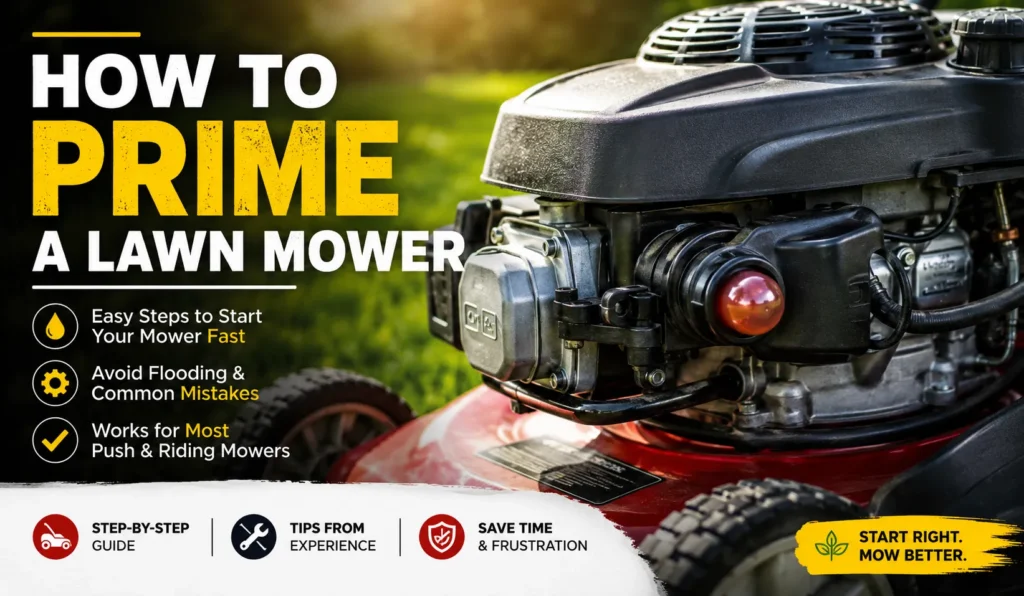
Priming moves gas from the tank to the carb. You do this with the primer bulb. It’s a small rubber button on the engine.
Press the bulb. It pulls gas through the fuel line. That gas lands in the carb. The carb mixes fuel and air. Then it sends that mix to the spark plug.
Without that fuel ready, the engine has to pull gas up on its own. On a cold day, that takes more pulls. Maybe ten. Maybe fifteen.
Think of it like this. Priming is like warming up a car on a freezing day. You’re not driving yet. You’re just getting things ready.
You can often hear the priming work. Listen close after a press. You may hear a tiny gurgle in the fuel line. That’s the gas moving where it needs to go.
Do All Mowers Need Priming?
No. Only mowers with a carb need priming. EFI mowers do this step on their own.
Many old Toro push mowers use a carb. So do many old Craftsman mowers. Old Briggs & Stratton engines use one too. All of these need a primer bulb.
EFI stands for electronic fuel injection. It’s just fuel run by a small computer. No bulb. No hand pumping. It’s common on riding mowers now. Brands like Cub Cadet and Kawasaki use it a lot.
Push mowers are different. Many Honda mowers skip the bulb. They use an auto-choke instead. You set a lever. The engine does the rest.
Check your owner’s manual. Or look at the engine yourself. A small rubber bulb near the air filter means you have a carb. No bulb usually means auto-choke or EFI.
I’ve owned both types of Toro mowers over the years. One had a bulb. One had auto-choke. Honestly, the auto-choke model was easier for guests to start. But the bulb model gave me more control on really cold mornings.
What You Need Before You Start
Check a few basics first. This step matters. I skipped it once and flooded my own mower.
Finding the Primer Bulb
The primer bulb sits near the carb. Look on the side of the engine. Check close to the air filter cover. It’s small and round. It’s made of black, orange, or green rubber.
My old Craftsman M110 had it right next to the air filter. Easy to spot. My Honda GCV160 has it lower down. It sits closer to the carb itself.
Can’t find it? Check the engine cover. Many brands print a small diagram there. Toro often labels the bulb right on the plastic housing.
Some Honda mowers have no bulb at all. Don’t waste time hunting for one on those models. If your manual says “auto-choke,” skip this whole step.
Checking Fuel and Oil First
Check your fuel and oil first. Old fuel is the top reason mowers won’t start. Priming won’t fix that.
Ethanol gas starts to break down fast. Jeff Taylor at STIHL says it can go bad in 30 days (STIHL, 2026). As it breaks down, it forms gum. That gum clogs the carb and fuel line.
Did your mower sit all winter with old gas? Priming alone won’t help. Drain the tank first. Add fresh gas.
Also check your oil. Low oil can shut some Honda and Toro engines down. No amount of priming starts a mower stuck on low oil.
I learned this in my Florida backyard one spring. I primed the bulb five times. I pulled the cord until my shoulder hurt. I never checked the oil. It was almost empty.
Now I add a fuel stabilizer to any gas I plan to store. It’s a small step. It saves a lot of pulling come spring.
Tools and Safety Basics
You don’t need much gear. A few basics help.
- A clean rag. Use it to wipe spilled gas off the engine.
- Fresh gas. Get new gas if yours is over a month old.
- Work gloves. Cold metal parts can hurt bare hands in spring.
- Safety glasses. Wear them if you check the spark plug or air filter too.
Always prime your mower outside. Or use a garage with the door open. Gas fumes build up fast in a closed space. That smell tells you when to open the door.
Comparison Table for Common Mower Brands
| Brand | Typical Priming Method | Primer Bulb Location | Notes from My Experience |
|---|---|---|---|
| Toro | Manual bulb on most push mowers | Side of the carb | Some self-propelled models have a bulb. Some 22-inch models use auto-choke instead. |
| Honda | Auto-choke on many models | No bulb on auto-choke models | Smooth starts. But no bulb to check if fuel flow fails. |
| Briggs & Stratton | Manual bulb on most carb engines | Near the air filter | Common on Craftsman and Murray mowers. Bulbs crack often. |
| Craftsman | Manual bulb on most gas models | Side of engine | My M110 needs 3 presses on cool days. 2 in summer. |
Step-by-Step: How to Prime a Lawn Mower
Find your mower type below. Follow those steps.
Gas Push Mowers
- Put the mower on flat ground.
- Check the oil and fuel first.
- Find the primer bulb near the carb.
- Press it firmly 3 times. Hold each press for one second.
- Set the throttle to “fast” or “start.”
- Pull the cord with one firm pull.
Engine won’t catch after two pulls? Press the bulb once more. Don’t press it five more times right away. That floods the engine.
I run a Toro Recycler. Three presses starts it nine times out of ten, even on a cool day.
I also own an old Craftsman push mower. It needs one extra pull, no matter the weather. Every mower has its own quirks. Yours will too, once you get to know it.
Riding Mowers
- Sit in the seat. Set the parking brake.
- Make sure the blade lever is off.
- Set the throttle to fast. Set the choke on, if you have one.
- Press the primer bulb, if you have one, 2 or 3 times.
- Turn the key to start.
Most newer riding mowers skip the bulb. They use EFI or auto-choke. My neighbor’s Cub Cadet starts with one key turn. No priming step at all.
Got a bulb on your riding mower? Don’t press it while the engine runs. Don’t press it on a warm engine either. That floods it fast.
I made that mistake once on a borrowed John Deere tractor. I primed it out of habit between mowing passes. It flooded right there in the yard. I had to wait ten minutes before it would start again.
Older Carbureted Models
Older mowers need more priming than new ones. Think 1990s and early 2000s models. They don’t have auto-choke.
- Use fresh gas. Old carbs hate old ethanol gas.
- Press the bulb 4 to 5 times on a cold engine.
- Set the choke to “cold start.”
- Pull the cord with steady force.
- Once it starts, open the choke slowly as it warms up.
I rebuilt one old Briggs & Stratton carb twice. Turns out the bulb itself had a tiny crack. It looked fine. It just wasn’t pulling fuel right.
A cracked bulb is easy to miss. Press it and watch closely. If it doesn’t spring back firm and fast, it’s likely cracked. A new bulb costs just a few dollars at most hardware stores.
Newer Fuel-Injected Models
EFI mowers have no primer bulb. A small computer handles fuel on its own. Even in cold weather.
- Check your oil and fuel.
- Turn the key, or press the start button.
- Let the engine run a few seconds before you mow.
There’s nothing to prime here. Won’t start? It’s rarely about priming. Check the battery first. Then check the spark plug. Then check the fuel.
Comparison Table for Priming Steps by Mower Type
| Mower Type | Primer Presses | Choke Needed? | Common Mistake |
|---|---|---|---|
| Gas push mower | 3 presses | Sometimes | Pressing the bulb too many times |
| Riding mower | 2 to 3 presses, if it has a bulb | Often automatic | Priming a warm engine after a short break |
| Older carb model | 4 to 5 presses | Yes, by hand | Forgetting to open the choke once it starts |
| Newer EFI model | None | No | Blaming priming for a non-fuel problem |
How Priming Differs in Real Conditions
Weather changes how much priming you need. A mower that starts fast in July may need more help in February.
Cold Mornings (Midwest, Northeast Spring Starts)
Cold engines need more fuel to fire. Gas doesn’t turn to vapor as fast in cold air. So the engine needs more raw fuel ready in the carb.
On a 40-degree Minnesota morning, I press the bulb 4 or 5 times. Not my usual 3. The mower still takes one extra pull most days. But it starts.
Store your mower in a cold garage all winter? Expect the first spring start to take more effort than a summer one.
I keep a small note taped inside my garage door each fall. It just says “press 5, not 3” for the first start of spring. It saves me from forgetting every single year.
Hot, Humid Climates (Florida, Texas, Southeast)
Heat helps you here. Warm air helps gas turn to vapor fast. So the engine needs less raw fuel.
In my Florida backyard, I press the bulb just twice most mornings. By July, I sometimes skip priming if I used the mower the day before.
The real risk in humid spots isn’t under-priming. It’s old gas sitting too long in a damp shed. Moisture and ethanol don’t mix well. That causes hard starts later.
In Phoenix summers, I’ve also seen the flip side. Some folks over-prime out of habit, even in 100-degree heat. The mower floods fast in that kind of warmth. Less is almost always more once the temperature climbs.
After Long Storage (Winterized Mowers)
A mower that sat for months needs a different plan. Old fuel and a dry carb change things.
Did you drain the tank before storage? Add fresh gas first. Then press the bulb 5 or more times. The whole fuel line is likely dry, not just low.
I once pulled a mower out of a Phoenix shed. It had sat for four months. It took eight bulb presses and a new spark plug before it caught.
That day taught me something. Priming alone could not fix four months of neglect. The spark plug was fouled with old gas residue. No amount of pressing the bulb was going to clear that on its own.
Comparison Table
| Condition | Primer Presses Needed | Why |
|---|---|---|
| Cold morning, 30 to 45°F | 4 to 5 presses | Gas turns to vapor slowly in cold air |
| Hot, humid afternoon | 1 to 2 presses, or none | Gas turns to vapor fast in warm air |
| After long storage | 5 or more presses | The fuel line is dry, not just low |
| Daily summer use | 0 to 1 press | The carb already has fuel from last use |
Common Mistakes People Make When Priming
Most priming problems come from two habits. I’ve made both myself. More than once.
Pressing the Bulb Too Many Times
This is the top mistake I see. I made it a lot when I was new to this. Each press adds more raw fuel to the carb.
Press the bulb ten times instead of three? You flood the carb. The engine can’t burn all that fuel at once. The spark plug gets wet. It won’t fire until it dries out.
Won’t start after 3 to 5 pulls? Don’t add more priming. Wait 5 minutes. Let the extra fuel clear. Then try again. Skip the extra priming this time.
You can also pull the spark plug and dry it off by hand. That speeds up the process if you’re in a hurry to mow before it rains.
Priming an Already-Warm Engine
A warm engine already has fuel in the carb. It just ran. Press the bulb again, and you add fuel it doesn’t need.
I made this mistake all the time in Arizona summer heat. I’d stop to empty the bag. I’d come back five minutes later. Then I’d prime out of habit before I restarted.
The engine flooded almost every time. Now I only prime a mower that’s been off for 30 minutes or more. Not one I just shut off.
This rule has saved me a lot of frustration since. It’s a small habit. But it makes a real difference in how often the mower starts on the first try.
Frequently Asked Questions About Priming a Lawn Mower
What happens if you prime a lawn mower too much?
Too many presses flood the carb with extra fuel. The spark plug gets wet. The engine won’t start until the fuel clears or you clean the plug. Most of the time, waiting a few minutes is all it takes.
How many times should you press a primer bulb?
Most push mowers need 3 to 5 presses. Cold mornings may need one or two more. Warm engines need none at all. When in doubt, press less and check your manual.
Do riding mowers need priming?
Some do. Many new riding mowers use EFI or auto-choke instead. Check your manual to see if your model has a bulb. If you’re not sure, look near the engine for a small rubber button.
Why won’t my mower start even after priming?
Old fuel, low oil, a dirty spark plug, or a cracked bulb are common reasons. Priming only fixes a fuel problem. Not these other issues. Work through each cause one at a time.
Can you damage a mower by over-priming it?
A little flooding won’t hurt the engine. It just delays the start. Heavy flooding over and over can foul the spark plug faster than normal. A spare spark plug is cheap insurance either way.
My Final Recommendation
After years of doing this in three climates, here’s my advice. Prime less than you think you need. Most people over-prime out of nerves. Not because the engine needs it.
Start with 3 presses on a cold push mower. Try 2 on a warm one. Skip it on most EFI machines. Watch how your mower responds over a season. You’ll learn its rhythm faster than any guide can teach you.
If you take one thing from this guide, take this. Priming buys you an easier pull. It’s not a guaranteed start. Fresh fuel, good oil, and a clean spark plug matter just as much.
I still get it wrong sometimes. Last fall, I over-primed my own Toro out of pure habit. I knew better. I did it anyway. We’re all a little stubborn with the machines we know well. Just try to catch yourself before the fifth press, not after.
Pros and Cons Table: Priming vs. Skipping It
| Approach | Pros | Cons |
|---|---|---|
| Manual priming (carb mowers) | Easier cold starts; you control the fuel | Easy to flood the engine; bulbs crack over time |
| Skipping priming on a warm engine | No flooding; faster restart | May need extra pulls if the engine cooled more than you thought |
| Auto-choke (no bulb) | No guesswork; steady starts | Less to check by hand if the choke fails |
| EFI, no priming at all | Works in nearly all weather; no bulb to maintain | Costs more upfront; needs computer tools to fix, not a wrench |