

Quick Overview
- A mower blade spins at roughly 200 mph – a hidden rock becomes a projectile in under a second
- Walk the entire lawn before every single mow to clear debris; this one habit prevents most injuries
- Kids and pets must stay at least 75 feet away from a running mower, indoors if possible (CPSC, 2023)
- Slopes steeper than 15 degrees tip riding mowers and slide push mowers – technique matters as much as terrain
- Eye protection, hearing protection, and sturdy closed-toe shoes are required every time – not just on “risky” days
The closest I ever came to a serious injury wasn’t on a commercial job. It was a Wednesday afternoon in a backyard in Portland, Oregon – a flat, quiet lawn I’d mowed a dozen times. I caught a half-buried garden stake with the blade. The stake didn’t just stop the mower. It launched. Straight through a wooden fence panel six feet away.
Nobody was behind that fence. That time.
I’ve been working in lawn care for over 15 years – residential yards, youth sports fields, steep hillside lots in Asheville, North Carolina, open suburban lawns in central Ohio, tight urban backyards in Brooklyn. I’ve also trained landscaping crews on ANSI B71.1 mower safety standards. In all that time, I’ve seen people get hurt, and I’ve seen people get very lucky. Most of the accidents I’ve witnessed came down to one thing: somebody thought mowing was just mowing.
This guide is for homeowners, parents with kids who want to help, first-time mower users, and anyone who’s never had a close call – yet.
Why Lawn Mowing Is More Dangerous Than Most People Realize
Most people treat mowing like vacuuming the carpet. You push the machine around, the grass gets shorter, you put the mower away. That mental model is what gets people hurt.
The Injuries Nobody Talks About
About 85,000 Americans go to the emergency room every year for lawn mower injuries (CPSC, 2022). That number doesn’t include the people who treat cuts at home, or the hearing damage that builds up over years.
The injuries that don’t make the news are foot and hand lacerations from reaching under a running deck. They’re eye injuries from flying debris – gravel, wire staples, acorns in the Northeast, pine cones in the South. They’re carbon monoxide poisoning from running a gas mower in a partially enclosed space like a garage. They’re hearing loss from years of skipping ear protection.
Blade contact injuries are the worst category. A spinning mower blade doesn’t slow down when it hits your foot. It’s moving at over 200 mph (ANSI B71.1). At that speed, it doesn’t matter if contact lasts half a second.
Who’s Most at Risk – And It’s Not Who You’d Expect
Children under 15 account for roughly 17% of lawn mower ER visits annually (CPSC, 2022). That statistic usually surprises people – they assume riding mower accidents happen to elderly adults. Both are true.
The group nobody talks about is experienced homeowners in their 40s and 50s. They’ve mowed hundreds of times. They’ve stopped checking. Overconfidence is a real hazard. I’ve seen it more times than I can count.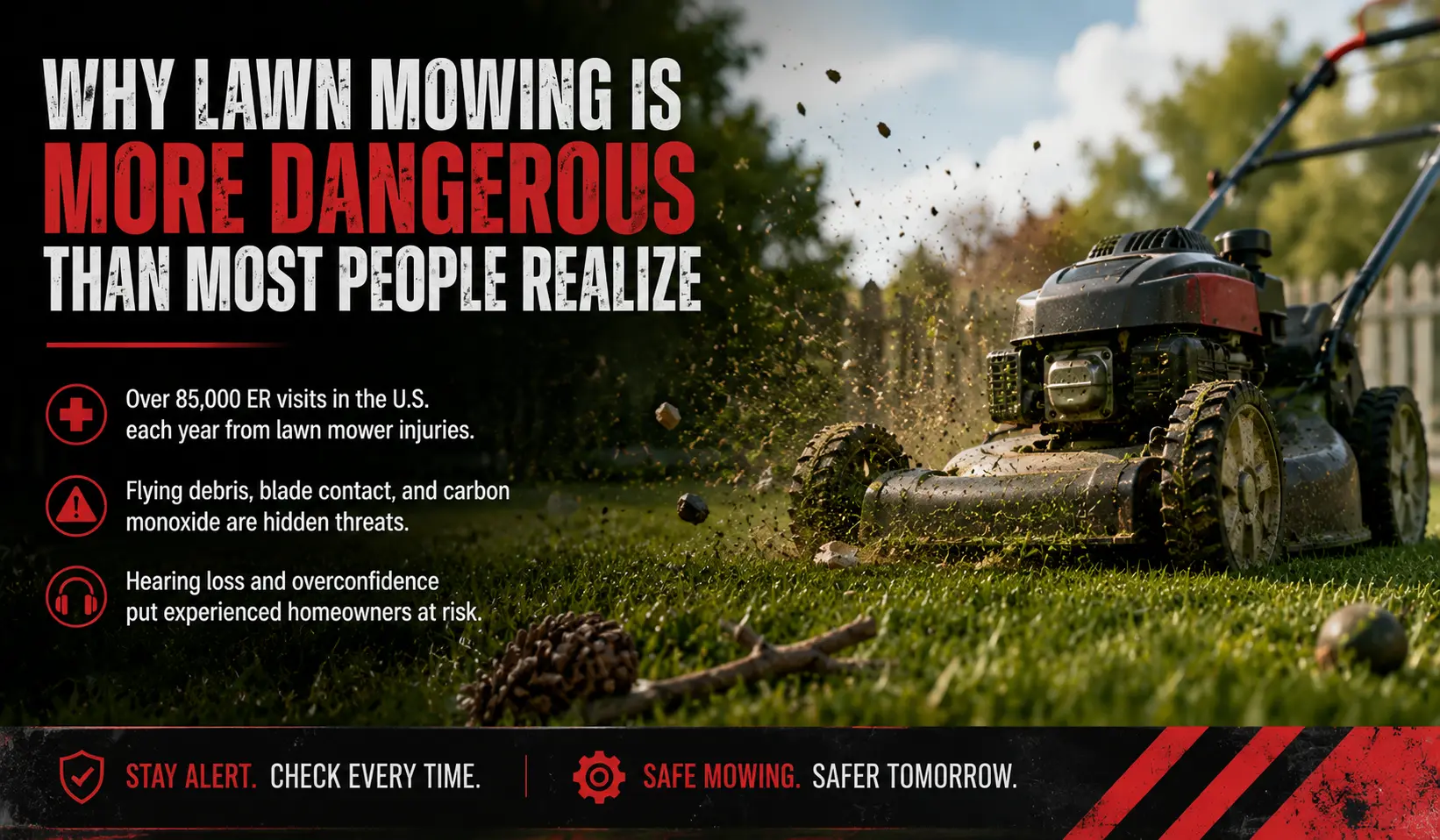
Before You Even Start the Mower
Everything that happens during a mow is shaped by what you do before you pull the cord or press the start button. The pre-mow routine matters more than any single technique.
Walk the Lawn First – Every Single Time
Walk the entire area you’re about to mow and remove anything that shouldn’t be there. Every single time, even if you mowed the same lawn three days ago.
Children leave toys. Irrigation heads pop up or get knocked loose. A neighbor’s dog drops a tennis ball. Acorns fall overnight. I found a length of steel rebar in a lawn in Asheville that had been invisible under two weeks of growth. If I’d hit that at blade speed, we wouldn’t be having this conversation.
The walk takes three to five minutes. Don’t skip it.
Dress for the Job, Not the Weather
I’ve mowed in 95-degree heat in Ohio in July. I understand the urge to wear sandals and shorts. Don’t.
You need: sturdy closed-toe shoes (leather boots are better), long pants, safety glasses or goggles, and hearing protection rated at least 25 dB NRR. Gas mowers run at 85-95 dB. That’s enough to cause permanent hearing damage within two hours of regular exposure (OSHA, 2022).
Gloves help with vibration on long mows and protect your hands if you have to clear a clog. The one safety rule most careful homeowners skip? Hearing protection. I ignored it for three years early in my career. My audiologist noticed the difference by the time I was 35.
Check Your Equipment Before Each Use
Before every mow, do a 60-second equipment check. Look for:
- Blade condition – cracks, heavy nicks, or uneven wear mean it needs replacement
- Loose fasteners on the deck and handle
- Fuel and oil levels on gas mowers (no gas near open flame or running engines)
- Battery charge and connection on electric models
- Clear discharge chute – a blocked chute builds up pressure and can kick debris back toward you
- Blade guards in place on all applicable models
The discharge chute is the one thing people forget most often. It’s not there to look tidy. It directs debris away from you. Remove it or let it get damaged and you’ve turned your mower into a side-facing projectile launcher.
Pre-Mow Safety Checklist by Yard Type
| Yard Type | Extra Hazards to Check | Recommended PPE |
|---|---|---|
| Flat suburban | Toys, hoses, irrigation heads, pet waste | Safety glasses, hearing protection, closed-toe shoes |
| Sloped yard | Loose soil edges, wet patches, exposed roots | All of above + ankle-support boots, gloves |
| Wooded edge | Rocks, branches, pine cones, acorns, buried stumps | All of above + face shield on high debris days |
| Near road | Gravel thrown from road, traffic sight lines | All of above + high-visibility vest |
Safe Mowing Techniques Most People Skip
Technique is where most experienced homeowners have the biggest gaps. They know how to start the mower. They don’t always know how to use it safely on anything other than a flat open lawn.
Mowing Slopes and Hills the Right Way
On a push or self-propelled mower, always mow across the slope – side to side, not up and down. If you slip going downhill, your feet go toward the blade. Mowing across gives you lateral stability and keeps the blade pointed away from your body if you fall.
On a riding mower or zero-turn, do the opposite: go up and down the slope, not across. Riding mowers tip sideways on cross-slope passes. The CPSC reports that tip-overs on slopes cause hundreds of deaths and serious injuries annually (CPSC, 2022). The rollover doesn’t come with a warning. It happens in under a second.
If a slope is steeper than 15 degrees, reconsider whether a standard riding mower should be on it at all.
How to Handle Obstacles – Rocks, Roots, and Sprinkler Heads
When you see an obstacle, stop. Disengage the blade before you get close enough that the discharge chute could throw debris. Then go around.
Sprinkler heads are a major hazard in the Southwest and in any irrigated lawn. They sit at or just below grass level and can snap off clean if you catch them with a blade. A broken plastic irrigation head becomes a sharp projectile at 200 mph. Mark them with small flags at the start of the mowing season if you can’t map them from memory.
Tree roots that have surfaced are just as dangerous. The blade will jump on contact. You lose steering control for a fraction of a second – long enough to matter on a slope or near a fence.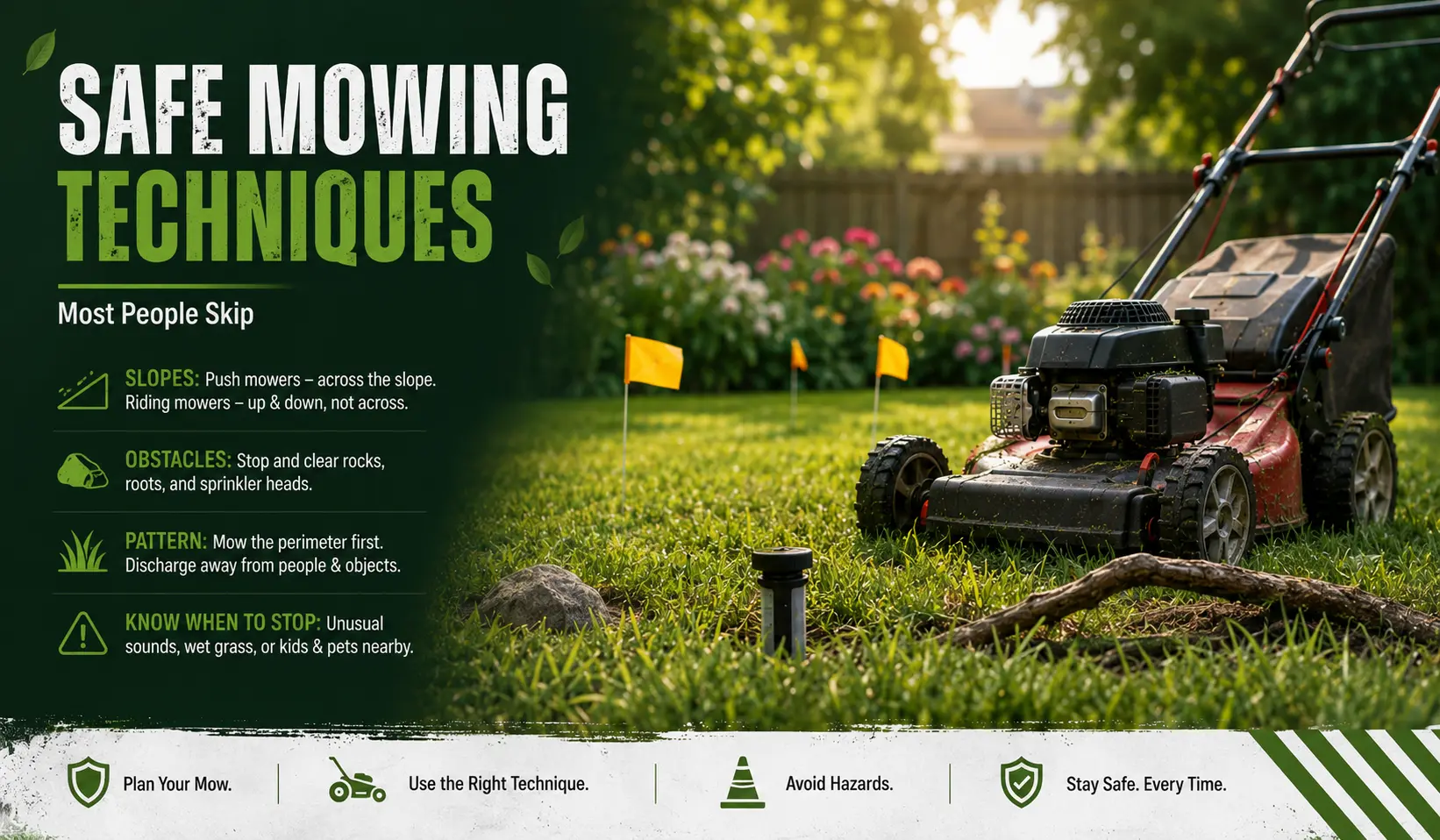
Mowing Patterns That Reduce Risk
Start by mowing a perimeter strip around the full yard. This gives you a clear exit path and removes the compressed row of clippings that can build up along fences and create discharge hazards.
When mowing in rows, always discharge away from people, structures, and the street. On gas mowers, check which side the chute faces before you start. Change your row direction if needed.
Avoid mowing toward the same edges every pass. Alternating your pattern reduces rut formation and keeps you alert – it’s easy to go on autopilot on a familiar lawn, and autopilot is when accidents happen.
When to Stop and When to Keep Going
Stop mowing immediately if: a child or pet enters the yard, you hear an unusual sound from the blade, you smell burning from the motor or deck, the mower starts to vibrate abnormally, or you’re mowing on wet grass that’s making the machine slip.
Many people push through when they smell an overheating motor because they’re almost done. That’s the moment to stop. An overheated gas engine on dry summer grass is a fire risk – not a theoretical one.
Technique Risks by Mower Type
| Mower Type | Top Safety Risk | Most Common Mistake |
|---|---|---|
| Push mower | Foot contact with blade on hills | Mowing downhill instead of across |
| Self-propelled | Loss of control on descent | Releasing handle on slope (blade stays engaged) |
| Riding mower | Tip-over on slopes and tight turns | Cross-slope passes on grades above 10-15 degrees |
| Robotic mower | Sensor override, child/pet contact | Assuming sensors always detect small objects |
Keeping Kids and Pets Safe While You Mow
This is the section I feel most strongly about. I’ve trained homeowners across the country on this topic, and I will tell you straight: the rules here are not suggestions.
The Safe Distance Rule – And Why It’s Non-Negotiable
Children and pets must stay at least 75 feet away from any running mower. Indoors is better. The CPSC recommends keeping all bystanders out of the mowing area entirely (CPSC, 2023).
A standard mower blade can throw a piece of gravel at over 100 mph. At 75 feet, that projectile still has enough velocity to cause a serious eye injury. The discharge chute reduces risk – it does not eliminate it. “He was standing in the side yard watching” is something I’ve heard from parents in the ER waiting room. The side yard is not safe enough.
What to Do If a Child or Pet Enters the Mowing Zone
Stop the blade the instant you see anyone enter the mowing area. Not “slow down and watch them.” Stop the blade.
Most modern mowers have a blade brake clutch (BBC) – a dead-man handle that stops the blade when you release grip. Use it exactly as designed. On riding mowers, the operator presence system should stop the blade when you leave the seat – make sure yours works before each season.
The moment that tests you is the moment a child runs out laughing, thinking it’s a game. Your panic reaction is to stop moving. That’s not enough. Stop the blade first.
Age Guidelines for Kids Using Mowers
These are the minimums, not recommendations. Every child develops differently.
- Push mower operation: age 12 and older, with adult supervision, on flat terrain only
- Self-propelled mower: age 14 and older
- Riding mower or zero-turn: age 16 and older
The American Academy of Pediatrics supports these guidelines (AAP, 2023). The hidden hazard most parents overlook: a child old enough to ride the mower but not yet strong enough to react to a tip or obstacle. Physical strength and reaction speed matter as much as age.
Safety Differences by Mower Type
Not all mowers carry the same risks. Understanding what’s specific to your machine changes how you approach every mow.
Gas Mowers – Fuel, Fumes, and Kickback
Gas mowers have blade kickback risk when the blade contacts a solid object and deflects back. Keep a firm grip on the handle at all times, especially near hardscaped edges.
Never add fuel to a hot engine or a running mower. Let it cool for at least 10 minutes first. Spilled fuel on a hot engine is a fire hazard – not a small one. Store fuel in approved containers, away from heat sources.
Running a gas mower in an enclosed or semi-enclosed space produces carbon monoxide. Carbon monoxide has no smell. A garage with one door open is not ventilated enough. Mow outdoors only.
Battery-Powered Mowers – Quieter, But Not Risk-Free
Battery-powered mowers are quieter, which creates a different hazard: people nearby don’t hear them coming. Neighbors’ kids, your own kids, pedestrians near a fence line – they may not realize the mower is running.
Battery fires are rare but real. Don’t charge lithium-ion batteries overnight or near flammable materials. If a battery pack swells, makes crackling sounds, or gets hot to the touch, stop using it and follow the manufacturer’s disposal guidance.
The blade on a battery mower spins at the same speed as a gas mower. “Electric” does not mean lower blade risk.
Riding Mowers and Zero-Turns – A Different Level of Danger
Riding mowers add complexity that most homeowners underestimate. The operator presence system – the switch that stops the blade if you leave the seat – wears out over time. Test it at the start of every season by briefly rising from the seat with the blade engaged. It should disengage immediately.
Zero-turn mowers have almost no natural stopping resistance. They respond to steering lever input fast. New operators consistently overcorrect, especially near drop-offs, retaining walls, and water features. Get comfortable with the controls in an open area before mowing near edges.
Never carry passengers. Not adults. Not children. One bump and a passenger has no way to hold on.
Robotic Mowers – The Hidden Hazards Nobody Warns You About
Robotic mowers seem like the safest option. In most conditions, they are. But their sensors have real limits.
Most robotic mowers use lift sensors and blade-contact sensors to detect obstacles. What they often can’t reliably detect: small children sitting or lying on the grass, animals below sensor height, and objects that don’t break the perimeter wire or trigger the lift sensor. In Germany, where robotic mower adoption is high, pediatric blade injuries from robotic mowers have prompted safety guidelines recommending that robotic mowers only run when children and pets are supervised or indoors (DGKS, 2021).
The emergency shutoff on most robotic mowers works when the unit is lifted or the blade contacts significant resistance. It is not designed to detect a sleeping cat.
Safety Comparison Across Mower Types
| Mower Type | Blade Speed | Tip-Over Risk | Noise Level | Key Unique Hazard |
|---|---|---|---|---|
| Gas push | ~200 mph | Low | 85-95 dB | Kickback, carbon monoxide, fuel fire |
| Battery push | ~200 mph | Low | 70-80 dB | Silent approach, lithium battery heat |
| Riding/zero-turn | ~200 mph | High on slopes | 85-95 dB | Tip-over, operator presence system failure |
| Robotic | ~110 mph | Very low | 55-65 dB | Sensor limitations, child/pet detection gaps |
Common Mistakes That Lead to Accidents
In 15 years of this work, I’ve seen the same mistakes come up again and again. None of them are dramatic. All of them cause injuries.
Mowing Wet Grass
Wet grass is slippery. The blade clogs more easily. Clippings stick to the deck and chute, which increases discharge pressure when they finally clear. Slopes that are manageable when dry become genuinely dangerous when wet.
There’s also an electrical risk with battery mowers in standing water. Most are weather-resistant, not waterproof.
Wait until the grass is dry. On a heavily irrigated lawn in Arizona or the Pacific Northwest, that might mean waiting until mid-morning. It’s worth it.
Mowing Too Fast or Too Late in the Day
Speed reduces your reaction time. At walking pace, you have roughly one second to respond to an obstacle you notice 10 feet ahead. At a jog, that drops to half a second. On a riding mower at full speed, it’s less than that.
Mowing in low light – late evening or early morning – is common in summer when temperatures are high. The hazard is visibility. You can’t see that the neighbor’s dog has left a chew toy in the side yard. You can’t see the edge of the property slope. Mow in daylight, with your full attention on the lawn. 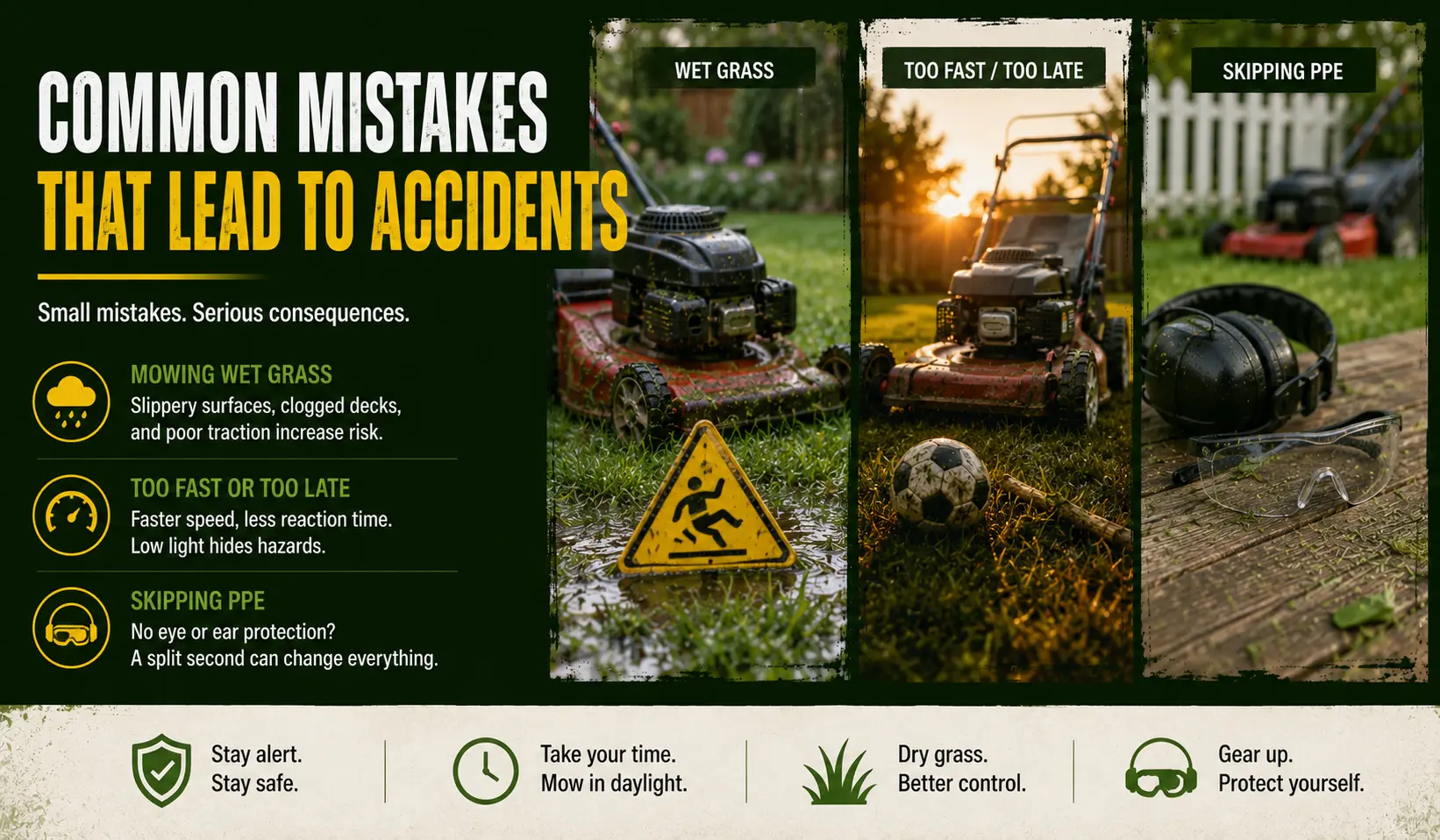
Skipping Personal Protective Equipment
Safety glasses take 10 seconds to put on. Hearing protection takes five. I’ve talked to homeowners who’ve been mowing for 20 years without either and haven’t had a problem yet. That streak will end.
Eye injuries are among the leading causes of lawn mower ER visits (CPSC, 2022). A piece of gravel from a discharge chute doesn’t give you time to close your eyes. The injury happens before your nervous system finishes processing what it saw.
PPE is the last line of protection after everything else goes right, and everything doesn’t always go right.
My Final Thoughts
I still remember the feeling of that garden stake hitting the fence in Portland. The sound was like a gunshot. My hands were shaking for about 20 minutes afterward. I walked back and looked at the hole in the fence for a long time.
That was a good day, because I learned something from it instead of losing a tooth or worse. I got lucky. Luck is not a safety strategy.
Most of the lawn mowing safety tips in this guide are not complicated. Walk the lawn first. Wear your PPE. Keep kids and pets inside. Check your equipment. Know your slope limits. The hard part isn’t knowing these things – it’s doing them consistently, every mow, even on the familiar lawns you’ve done a hundred times. Especially on those lawns.
The homeowners I’ve seen get hurt weren’t reckless people. They were comfortable people. Comfort is the hazard nobody puts on the warning label.
Safe Habits vs. Common Shortcuts – What Each Costs You
| Safe Habit | Common Shortcut | Real Risk of the Shortcut |
|---|---|---|
| Walk the lawn before mowing | Skip it on familiar lawns | Hidden debris becomes a projectile |
| Wear eye protection every mow | Skip it on quick mows | No such thing as a low-risk discharge |
| Wear hearing protection | Skip it because it’s only 30 minutes | Cumulative hearing loss over years |
| Keep children 75+ feet away | Let them watch from the side yard | Discharge range easily reaches 50-60 feet |
| Stop the blade when anyone enters the area | Slow down and wave them off | Blade reaction time is measured in milliseconds |
| Mow slopes on the correct axis | Use whatever direction is faster | Tip-overs and slides happen with no warning |
| Check blade and chute before each use | Check once per season | Cracked blades fail, blocked chutes back-pressure |
| Let wet grass dry before mowing | Push through because you’re already out there | Slipping on slopes, clogged deck, discharge buildup |
| Use full PPE | Dress for weather, not the job | The injury you’re not dressed for is the one you regret |
Frequently Asked Questions About Lawn Mowing Safety
What are the most important lawn mowing safety tips for beginners?
The three most important are: walk the lawn before every mow to clear debris, always wear eye protection and closed-toe shoes, and keep everyone out of the mowing area entirely while the blade is running. Beginners tend to focus on operating the machine and forget to prepare the space.
How far away should children be when someone is mowing?
At minimum, 75 feet – and indoors is better. Mower discharge can throw debris at over 100 mph, and the effective range of a discharge chute is not limited to the immediate area of the mower. The CPSC recommends keeping all bystanders outside the mowing area entirely (CPSC, 2023).
Is it safe to mow wet grass?
No. Wet grass reduces traction on slopes, clogs the blade deck, and increases discharge pressure when buildup finally clears. On battery mowers, standing water adds electrical risk. Wait until grass is dry before mowing.
What personal protective equipment do I need to mow the lawn?
Safety glasses or goggles, hearing protection rated at least 25 dB NRR, sturdy closed-toe shoes, and long pants. Gloves are useful for vibration on long mows. This applies every time – not just on days when conditions seem risky.
Can a riding mower tip over?
Yes, and it happens without warning. Riding mowers and zero-turns tip most often on cross-slope passes – when you drive across a hill rather than up and down it. Slopes above 15 degrees are high risk. Tip-overs on slopes are one of the leading causes of serious lawn mower injuries and deaths in the US (CPSC, 2022).
At what age can a child safely operate a lawn mower?
The American Academy of Pediatrics recommends age 12 as the minimum for push mowers, 14 for self-propelled models, and 16 for riding mowers (AAP, 2023). These are minimums, not guarantees. Physical strength, maturity, and the specific terrain all factor in.
What should I do if the mower blade hits something hard?
Stop the mower immediately and disengage the blade. Check the blade for cracks or damage before continuing. A hard impact can crack a blade or bend it out of balance – a cracked blade running at speed can fail and fragment. If you hear any unusual vibration after impact, don’t restart until you’ve inspected the blade.