
Quick Overview
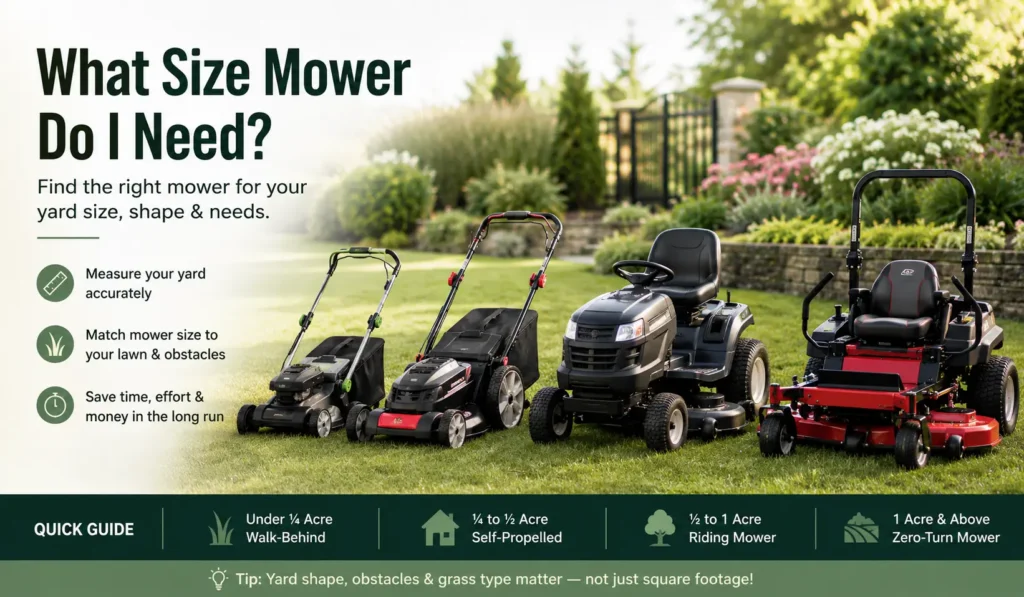
- The right mower size depends on yard acreage, shape, obstacles, and grass type — not just square footage alone.
- Under ¼ acre: a 21-inch push or self-propelled mower is almost always the right call.
- ¼ to ½ acre: a 22–30 inch self-propelled mower handles most suburban yards without issue.
- ½ acre to 1 acre: a riding mower or wide-deck self-propelled starts to make real sense.
- 1 acre and above: a riding mower or zero-turn is worth every dollar you spend on it.
Why Mower Size Actually Matters More Than Most People Think
Most people treat mower size like a speed question — bigger deck, faster job, done. But size affects more than mowing time. It changes how well your mower handles tight corners, how much strain you put on your lawn, and how much money you end up spending over five years.
The Real Cost of Getting It Wrong
I’ve seen this play out more times than I can count. A homeowner in suburban Columbus, Ohio buys a 54-inch zero-turn because it was on sale and looked impressive. Two weeks later, they’re calling me because the thing can’t get through the gate into their backyard. The front lawn takes 12 minutes. The back lawn — which is actually bigger — takes 45 minutes because they’re pushing a 21-inch push mower by hand.
That’s the wrong-size mistake in both directions at once.
On the other side: a retiree in Tampa buys the cheapest 20-inch push mower thinking she’ll “just take her time.” Her yard is a third of an acre with thick St. Augustine grass. She’s mowing for two hours in Florida heat, stopping every 20 minutes because the mower bogs down. Her neighbor has a self-propelled 28-inch mower and finishes in 35 minutes.
Wrong size costs you time, effort, and sometimes the mower itself when you return it or it burns out early from overwork.
How Yard Shape Changes Everything (Not Just Square Footage)
A flat, open 10,000-square-foot yard and a heavily landscaped 10,000-square-foot yard are completely different mowing jobs. The open yard suits a wide deck and fast passes. The landscaped yard — with raised beds, trees, a pergola, and a curved pathway — calls for a narrower deck with a tight turning radius.
Square footage tells you how much ground to cover. Shape tells you how hard it is to cover it.
A long, rectangular yard rewards wide decks and straight lines. An irregular yard with lots of curves, islands, and obstacles rewards maneuverability over raw width. I’ve watched people with 38-inch decks spend more time turning and backing up than a neighbor with a 30-inch deck who just flows through the obstacles.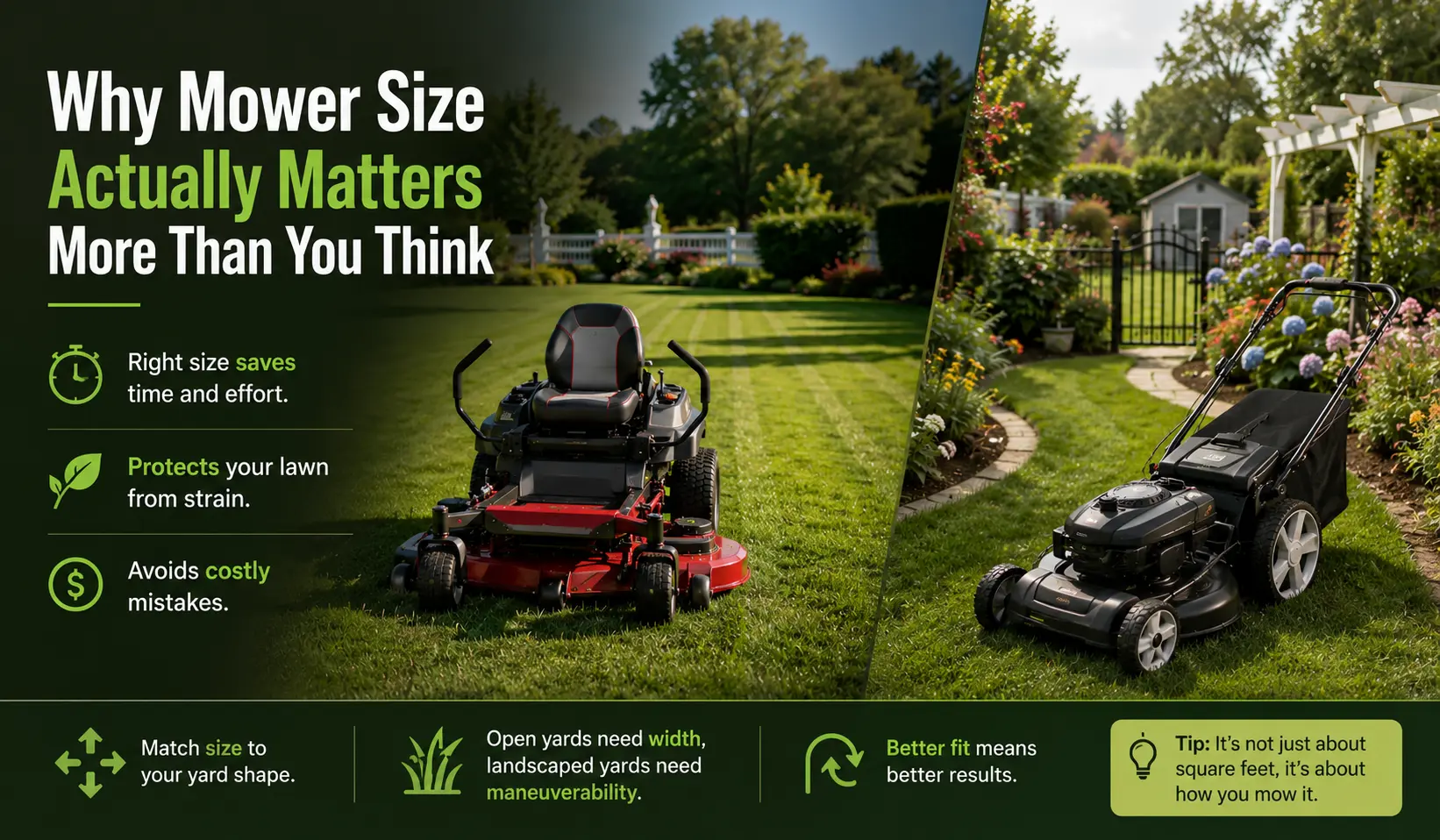
How to Measure Your Lawn the Right Way
Most people guess their yard size. And most people guess wrong — usually by 30 to 50 percent. Getting this number right matters because every mower category is calibrated around real acreage ranges, not approximate ones.
Simple Methods to Estimate Yard Size at Home
The easiest method for most homeowners is the pacing method. Walk the length of your yard in normal strides. Each stride is roughly 2.5 feet for an average adult. Count your paces, multiply by 2.5 to get feet, then do the same for the width.
Multiply length by width. You get square footage.
To convert to acres: divide by 43,560. That’s the number of square feet in one acre.
So a 100 x 150 foot yard = 15,000 square feet = 0.34 acres.
A faster method: use Google Maps satellite view. Right-click on your property line and use the “Measure distance” tool to trace your yard’s perimeter. It gives you a usable approximation in minutes.
Neither method is perfect. But either one beats guessing.
Accounting for Obstacles: Trees, Beds, Fences, and Slopes
Your mowable area is almost always smaller than your total yard area. Subtract anything the mower can’t or shouldn’t cross: garden beds, patios, tree rings, gravel sections, the house footprint.
A yard that looks like half an acre on paper might have 15 percent of that area in beds, a concrete patio, and a storage shed. Your actual mowing area is closer to 0.42 acres. That changes which mower makes sense.
Also: slopes reduce effective deck width. On a steep hill, a wide-deck riding mower handles poorly and can tip on grades above 15 degrees. If a significant portion of your yard is sloped, that slope constrains your mower choice beyond what square footage alone suggests.
Compression Table: Yard Size Ranges and Recommended Mower Categories
| Yard Size | Square Footage | Recommended Category |
|---|---|---|
| Small | Under 5,000 sq ft | Push or electric walk-behind |
| Medium-small | 5,000–10,000 sq ft | Self-propelled walk-behind |
| Medium | 10,000–20,000 sq ft | Wide-deck self-propelled or small riding |
| Large | 20,000–43,560 sq ft | Riding mower or zero-turn |
| Very large | 1 acre+ | Zero-turn or rear-engine riding |
Mower Size Guide by Yard Size
These are starting-point recommendations, not hard rules. Your yard’s obstacles, shape, and grass type can shift you one category in either direction. Use these as your baseline and adjust from there.
Under ¼ Acre – Small Yards and Tight Spaces
A standard 21-inch walk-behind mower handles the vast majority of yards under ¼ acre with no real strain. This is the most common residential mower size in the US for a reason — it fits through standard 36-inch gates, turns easily around raised beds and trees, and stores in a small shed or even a corner of a two-car garage.
If your yard is flat, an electric push mower from EGO or Greenworks works fine. If you have any slope or thick grass, step up to a self-propelled model.
The one situation where a 21-inch starts to feel limiting under ¼ acre: a completely open, rectangular yard with no obstacles. In that case, a 24-inch self-propelled mower cuts your time by about 15 percent. Not life-changing, but noticeable.
¼ to ½ Acre – The Most Common Suburban Yard
This is the range where most American homeowners live — literally. The typical suburban lot in Ohio, Georgia, or the Midwest falls in this bracket.
A 22–30 inch self-propelled mower is the sweet spot. A 22-inch handles obstacles well. A 28 or 30-inch deck cuts mowing time significantly — we’re talking 40 minutes down to 25 on an open ½-acre yard.
Riding mowers in this range are overkill unless you have a physical limitation that makes walking behind a mower difficult. They’re harder to maneuver in smaller spaces and more expensive to maintain.
Battery-powered options from Toro and EGO now cover yards up to ½ acre on a single charge, which eliminates the cord frustration without adding gas maintenance.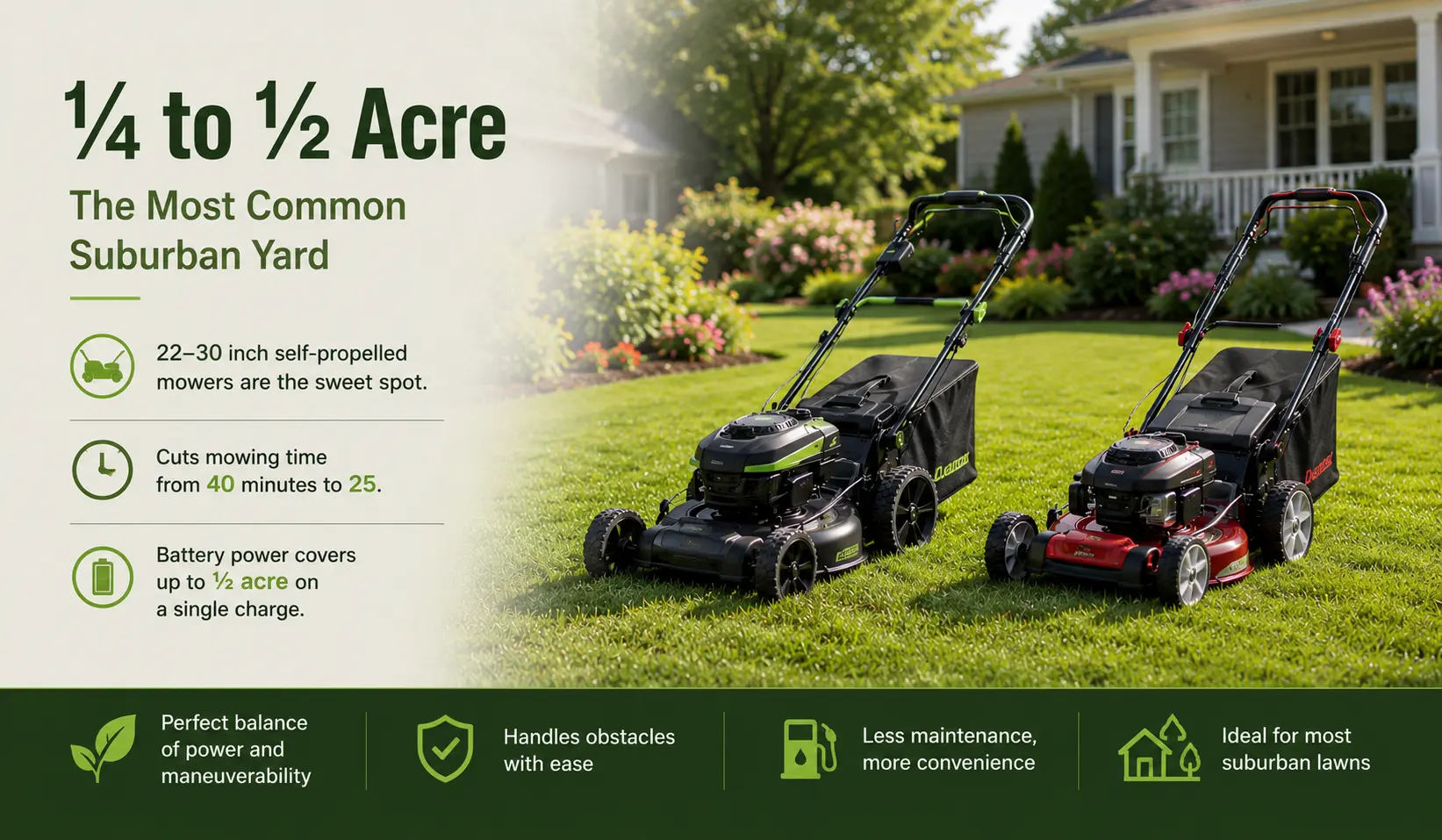
½ Acre to 1 Acre – Where Walk-Behind Mowers Start to Struggle
At ½ acre, a self-propelled walk-behind mower is still doable — but it’s a 45-to-60-minute job. At ¾ acre, you’re looking at 60 to 80 minutes. For most people, that’s where mowing starts to feel like a part-time job rather than a chore.
A riding mower with a 38–42 inch deck cuts that time roughly in half. It’s a meaningful quality-of-life improvement, not just a convenience.
That said: if your yard in this range has lots of trees, beds, or a fenced-in back section with a narrow gate, a wide-deck rider causes more frustration than it solves. In that case, a 30-inch self-propelled walk-behind — or a combination of a self-propelled for the back and a rider for the open front — is more practical.
1 Acre and Above – When You Need a Riding Mower or Zero-Turn
At 1 acre, a walk-behind mower is not a reasonable choice for weekly mowing. You’re committing 90 minutes to two hours every time. That’s not sustainable for most people.
A 42-inch riding mower from Husqvarna, Cub Cadet, or John Deere handles 1 acre in roughly 45 to 55 minutes. A zero-turn with a 48 or 54-inch deck cuts that to 30 to 40 minutes.
Zero-turns earn their higher price at 1 acre and above. Their turning radius lets them hug obstacles closely and eliminate the need for a separate trim pass in many areas. On open, obstacle-free acreage, a zero-turn from brands like Husqvarna or Toro is genuinely worth the extra $500 to $1,000 over a comparable riding mower.
At 2 acres and above, the zero-turn is less of an upgrade and more of a necessity if you want mowing to take under an hour.
Compression Table: Yard Size vs. Recommended Deck Width, Mower Type, and Estimated Mow Time
| Yard Size | Mower Type | Deck Width | Estimated Mow Time |
|---|---|---|---|
| Under ¼ acre | Push or self-propelled | 20–22 inches | 20–30 min |
| ¼ to ½ acre | Self-propelled | 22–30 inches | 25–45 min |
| ½ to 1 acre | Self-propelled or riding | 28–42 inches | 35–60 min |
| 1 to 2 acres | Riding or zero-turn | 42–54 inches | 40–70 min |
| 2 acres+ | Zero-turn | 48–60 inches | 45–90 min |
Times assume flat, moderately open terrain with no extended obstacles. Add 20–30% for sloped or heavily landscaped yards.
Cutting Deck Size Explained
Deck width is the spec most homeowners misread. They see a bigger number and assume a better mower. That’s not how it works. Deck width is a throughput number — it tells you how many inches of grass you cut in one pass. Nothing more.
What Deck Width Actually Means for Mowing Time
The math is straightforward. A 21-inch deck covers 21 inches per pass. A 42-inch deck covers 42 inches — exactly twice as much. On a completely flat, open lawn, a 42-inch deck is roughly twice as fast.
In a real yard with turns, obstacles, and overlapping passes, the difference narrows. You don’t get perfect pass coverage. You back up, you re-angle, you trim around edges. In a yard with moderate obstacles, a 42-inch deck might be 60 to 70 percent faster than a 21-inch — not 100 percent.
That 60 to 70 percent still matters when you’re mowing ¾ of an acre.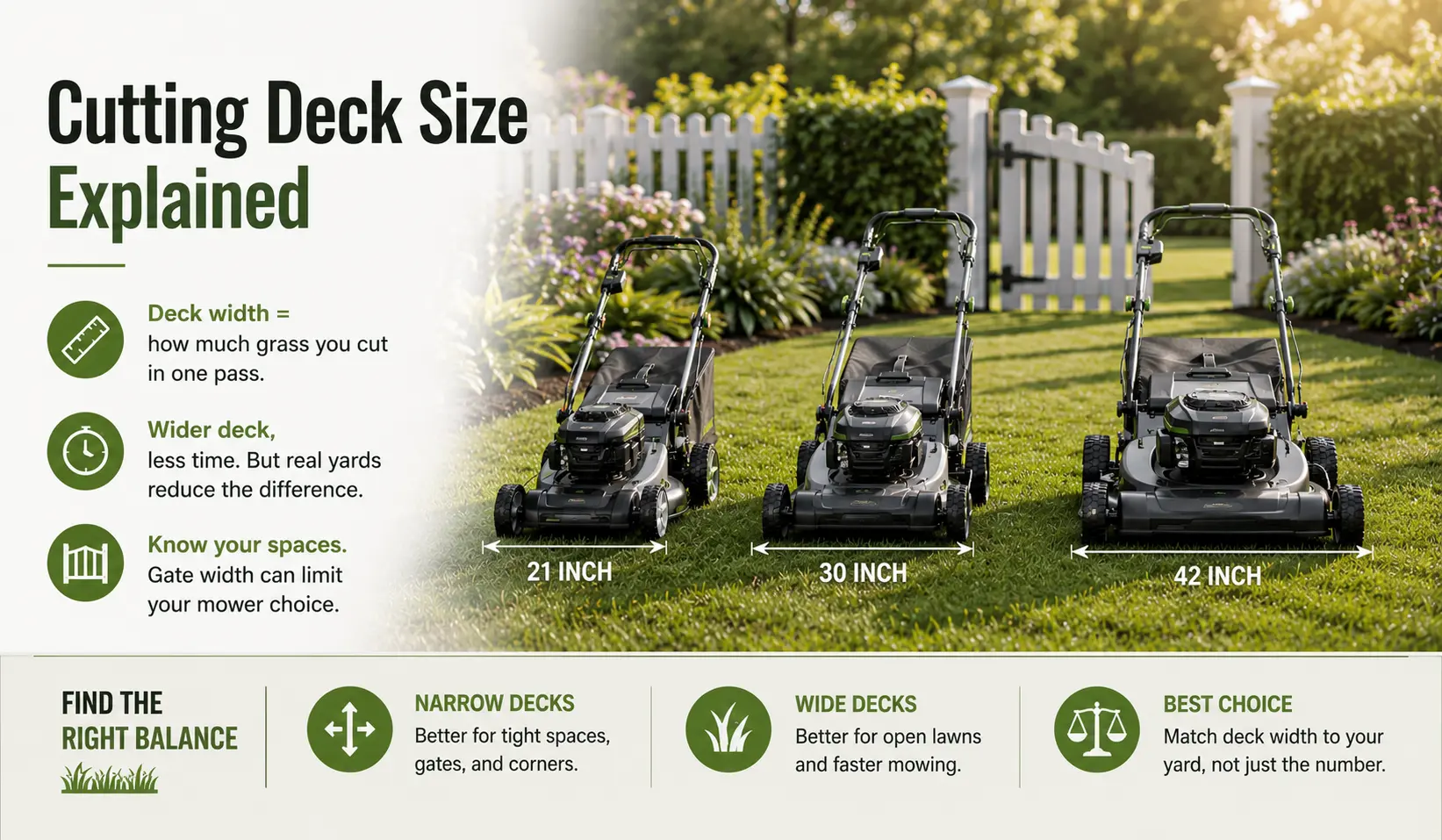
Narrow Decks vs. Wide Decks: Maneuverability Trade-Offs
A narrow deck fits through gates, turns tightly around beds, and reaches into corners. A wide deck does not.
The standard residential gate is 36 inches. A 21-inch deck goes through with room to spare. A 30-inch deck fits. A 36-inch deck is tight. A 42-inch deck does not fit through a 36-inch gate without removing the mower deck — which no one actually does.
If you have a fenced yard with a standard gate, your deck width is constrained to 30 inches or less for the back yard. Full stop. No amount of performance justifies a mower that can’t access 60 percent of your property.
Does a Wider Deck Always Mean a Better Cut?
No. Cut quality depends on blade speed, blade design, deck airflow, and engine power — not deck width alone.
An underpowered mower with a wide deck cuts poorly in thick grass because the engine can’t spin wide blades fast enough under load. You’ll see uneven cuts, clumping, and missed patches in dense St. Augustine or Zoysia.
A properly matched mower — where engine power aligns with deck width — cuts consistently. An oversized deck on an underpowered mower cuts worse than a narrower deck on a well-matched engine.
When comparing mowers, check the engine’s horsepower or wattage relative to the deck width. Husqvarna and John Deere publish recommended horsepower ranges for their deck sizes. Use those as a sanity check.
Mower Types and Which Size Fits Each One
Mower type and mower size work together. A zero-turn at the wrong size is just as problematic as a push mower on the wrong yard. Here’s how type and size interact across the main categories.
Push Mowers – Best Sizes and When They Make Sense
Push mowers are manual-propulsion machines — you provide the forward motion. Standard sizes run 20 to 22 inches. A few wider-deck push models exist, but past 22 inches, the effort required makes them impractical for most users.
Push mowers make sense for yards under 5,000 square feet that are flat and have no thick grass. They’re the lightest, simplest, and cheapest option in the category.
The honest trade-off: they’re physically demanding. On a warm Minnesota spring afternoon, 30 minutes of pushing is manageable. On a Phoenix summer morning, it’s brutal. If you’re mowing more than 30 minutes at a stretch, a self-propelled model is worth the $80 to $120 price difference.
Self-Propelled Mowers – Ideal Deck Widths and Terrain Fit
Self-propelled mowers drive themselves forward. You steer and guide. Standard sizes range from 21 to 30 inches, with some commercial models hitting 33 inches.
For most homeowners, 21 to 24 inches works best for yards with obstacles. Twenty-six to 30 inches is ideal for open yards in the ¼ to ½ acre range.
Self-propelled mowers handle moderate slopes well — better than riding mowers on grades above 10 to 15 degrees. If a meaningful part of your yard is sloped, a self-propelled is often the safer and more practical choice even on larger yards.
The limitation: past 30 inches and ½ acre, your arms and legs are doing a lot of work even when the mower pulls itself forward. It’s manageable, not ideal.
Riding Mowers – Minimum Yard Size Before They’re Worth It
Riding mowers make practical sense starting at about ½ acre. Below that, the maneuverability limitations and storage footprint outweigh the time savings.
Entry-level riding mowers start around 30-inch decks. The most common residential riding mowers run 38 to 46 inches. Above 50 inches, you’re in commercial or semi-pro territory.
The trade-off with riding mowers: they struggle in yards with lots of tight spaces. A 42-inch riding mower needs about a 6-foot turning radius to complete a three-point turn. In a yard with trees every 15 feet, you spend as much time maneuvering as cutting.
Brands like Cub Cadet and John Deere offer entry-level riding mowers in the $1,500 to $2,500 range that cover most ½-acre to 1-acre yards reliably.
Zero-Turn Mowers – When Size and Speed Come Together
Zero-turn mowers use two independently-driven rear wheels to spin in place. Their turning radius is essentially zero — they can pivot on the spot. This speed-plus-precision combination changes mowing dynamics at 1 acre and above.
Residential zero-turns typically start at 42 inches and run up to 60 inches. The most common residential sizes are 48 and 54 inches.
They’re fast on open ground and nimble around obstacles when operated by someone who’s practiced. The learning curve is real — zero-turns feel counterintuitive for the first two to four hours. Most people get it. Some don’t.
The real limitation: zero-turns perform poorly on slopes above 10 degrees. Their rear-wheel drive design can lose traction on wet or sloped terrain, and the lack of a traditional steering wheel makes corrections harder on a hill. If your yard is significantly sloped, a riding mower with a steering wheel is safer.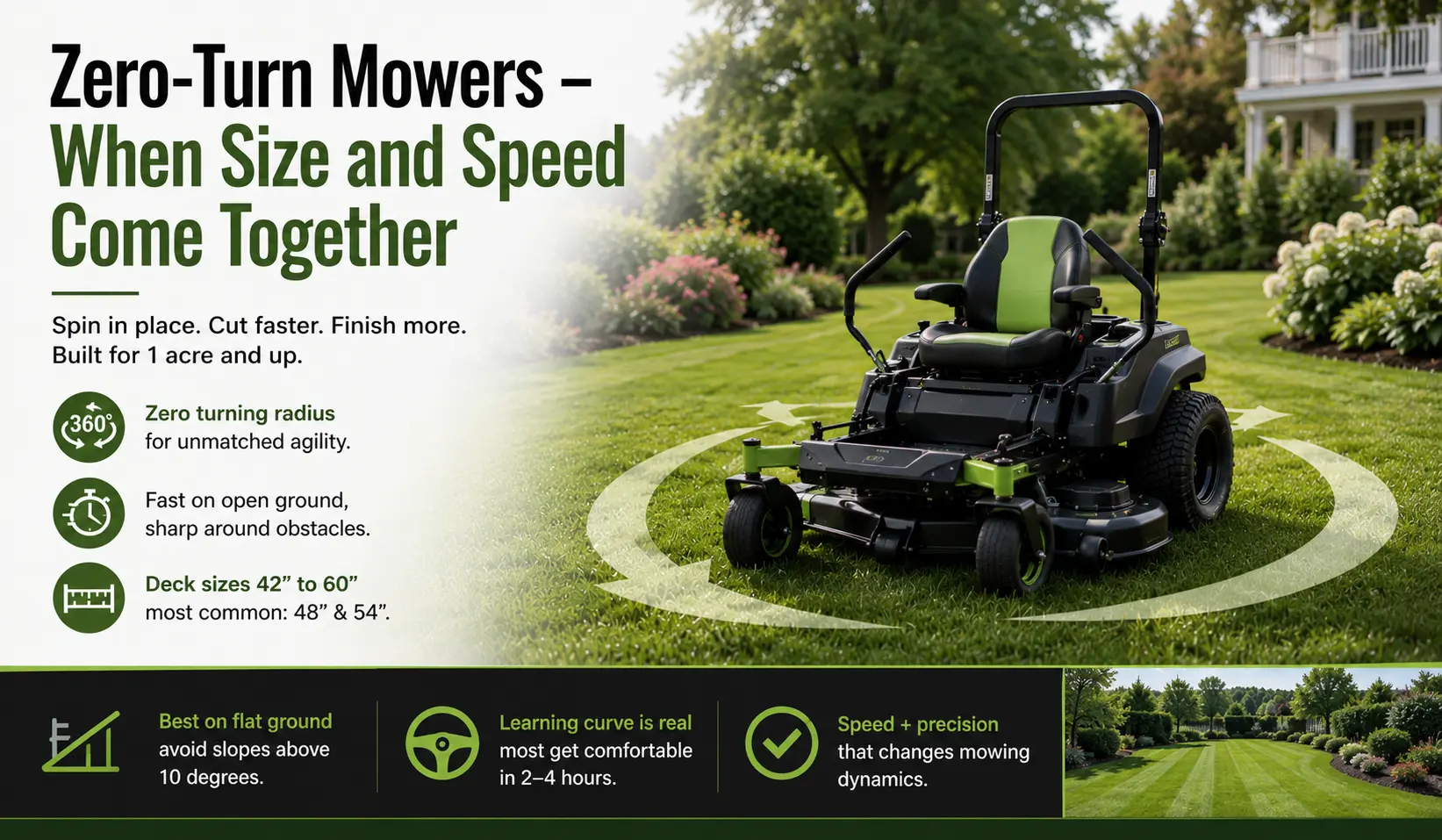
Robotic Mowers – Do Coverage Ratings Match Reality?
Robotic mowers like the Husqvarna Automower or EGO POWER+ Nexus run autonomously on a scheduled pattern. They’re quiet, electric, and require almost no direct operation.
Coverage ratings are technically accurate but optimistic. A mower rated for 1/3 acre handles 1/3 acre of simple, flat, open lawn. Add slopes, dense grass, multiple zones, or complex layouts and effective coverage drops 20 to 40 percent.
For small, simple yards under ¼ acre, robotic mowers work well. For anything more complicated, they require significant setup, perimeter wire installation, and realistic expectations about what “fully automated” means in practice.
Compression Table: Mower Type vs. Recommended Yard Size, Deck Width, and Terrain
| Mower Type | Recommended Yard Size | Deck Width | Best Terrain |
|---|---|---|---|
| Push | Under 5,000 sq ft | 20–22 inches | Flat, obstacle-free |
| Self-propelled | 5,000–20,000 sq ft | 21–30 inches | Flat to moderate slope, obstacles |
| Riding | 20,000 sq ft to 2 acres | 38–46 inches | Flat to gentle slope, open |
| Zero-turn | 1 acre+ | 42–60 inches | Flat, open, semi-complex |
| Robotic | Under ¼ acre (simple) | N/A | Flat, simple layout |
Special Situations That Change the Size Equation
Yard size gets you 80 percent of the way to the right mower. The other 20 percent comes from these situations — and they matter enough to change your recommendation entirely.
Hilly or Sloped Yards
Slope changes your safe mower options more than almost anything else. Consumer riding mowers and zero-turns are not rated for slopes above 15 degrees. On those grades, they can slide sideways or tip — both of which happen more than manufacturers like to admit.
Walk-behind self-propelled mowers are safer on slopes. They’re lower to the ground, lighter, and easier to control during a slide. A four-wheel-drive self-propelled mower handles slopes better than a two-wheel-drive model.
If your yard has sections steeper than 15 degrees, don’t buy a riding mower to handle them. Use a walk-behind for those sections and a riding mower for the flat areas if the total size warrants it.
Narrow Gates and Fenced-In Backyards
Measure your gate before you buy any mower. Seriously — measure it. Standard residential gates are 36 inches wide. A few are 32 inches. Some older properties have 28-inch gates.
A 21-inch mower fits through all of them. A 28-inch mower fits a 32-inch gate with a careful angle. A 30-inch mower needs a 34-inch gate minimum.
If your gate is narrow and your back yard is large, your options are: a narrow-deck mower for the back and a wider-deck mower for the front, or a wider gate. I’ve had clients install a wider gate because it was cheaper than the dual-mower setup. That’s not a bad call.
Thick, Dense Grass Types (St. Augustine, Zoysia, Bermuda)
Thick grass types like St. Augustine, Zoysia, and Bermuda resist cutting. They demand more engine power per inch of deck width than cool-season grasses like Kentucky bluegrass or fescue.
On these grass types, downsize your deck width by one step from what your yard size would otherwise suggest. A ½-acre yard with St. Augustine is effectively harder to mow than a ½-acre yard with fescue. A 28-inch self-propelled on thick Bermuda struggles where a 22-inch does the job cleanly.
The sensory difference is obvious. A too-wide deck on thick Bermuda creates drag, uneven cut height, and that characteristic engine-bogging sound that means the blade is fighting the grass rather than cutting it cleanly.
Storage Space Constraints
A riding mower needs at least a 5 x 8 foot footprint in your garage or shed — more like 6 x 10 for a zero-turn. If your garage is full and you have a one-door shed with a 4-foot opening, a riding mower doesn’t fit.
This sounds obvious. But I’ve had clients decide on a mower before checking whether it physically fits in their storage. One family in suburban Atlanta had to return a 46-inch riding mower because their shed door was 44 inches wide.
Measure your storage before you buy. A self-propelled mower that fits your storage beats a riding mower that lives outside and rusts.
Common Sizing Mistakes I See All the Time
People make the same three mistakes over and over. Knowing them in advance costs you nothing. Ignoring them can cost you a return, a replacement, or years of mowing frustration.
Going Too Big Because It Seems Efficient
The logic makes sense: bigger deck, fewer passes, less time. But bigger mowers don’t maneuver in smaller spaces. They can’t get through gates. They overshoot the edges of beds and strip corners. You end up hand-trimming or re-mowing those sections with a push mower anyway.
A 54-inch zero-turn on a ½-acre suburban yard with landscaping is almost always the wrong call. The mower spends half its operating time turning and repositioning rather than cutting. A 30-inch self-propelled does the same job in similar time with a fraction of the complexity.
Bigger is better only on open, obstacle-free ground above 1 acre.
Going Too Small to Save Money Upfront
A 20-inch push mower costs $250. A 28-inch self-propelled costs $450. On a ¼-acre yard with moderate obstacles, the push mower adds 20 to 25 minutes per mow. Over a 30-mow season, that’s 10 to 12 hours. Over five years, that’s 50 to 60 hours of extra work.
The $200 difference bought you 50 hours of your life back. On a per-hour basis, that’s $4 an hour. It’s almost always worth it.
Going too small also risks early mower burnout. A 21-inch push mower working through ½ acre of thick Bermuda every week runs hot, strains the engine, and wears out faster than a properly sized mower doing the same job.
Forgetting About Attachments and Accessories
Many riding mowers and zero-turns accept attachments: baggers, mulching kits, dethatchers, aerators, snow blowers. If you plan to use any of these, confirm compatibility before you buy.
Not all decks accept all accessories. A 42-inch Husqvarna bagger doesn’t fit a 42-inch Cub Cadet without an adapter — and some adapters don’t exist. Check the manufacturer’s accessory compatibility list before committing to a platform.
If year-round use matters to you, the attachment ecosystem is as important as the mower itself.
My Final Recommendation
Here’s the honest version of this guide in three sentences: measure your yard, measure your gate, and buy the largest deck that fits through that gate and handles your worst terrain. Don’t buy up because a bigger mower looks more capable. Buy the mower that fits the actual job.
For most homeowners — a ¼ to ½ acre suburban yard with a standard fence and a few trees — a 22 to 28-inch self-propelled mower is the right answer. It handles 90 percent of residential properties without the storage, cost, or maneuverability problems that come with riding mowers. If you’re on a battery budget, EGO’s 21 and 24-inch self-propelled models now match or beat gas in power and outlast most suburban yards on a single charge.
If you’re still unsure, go one size smaller than you think you need. You can always return a mower that’s too small before you’ve used it more than once. You cannot undo the frustration of a mower that won’t fit through your gate, can’t handle your slope, or strips the edges off every landscaping bed on your property.
Quick Reference: Lawn Mower Size Chart
| Yard Size | Square Footage | Mower Type | Deck Width | Best For |
|---|---|---|---|---|
| Very small | Under 3,000 sq ft | Push mower | 20–21 inches | Flat, simple, obstacle-free yards |
| Small | 3,000–5,000 sq ft | Self-propelled | 21–22 inches | Compact suburban lots, tight gates |
| Medium-small | 5,000–10,000 sq ft | Self-propelled | 22–26 inches | Typical suburban yards with some obstacles |
| Medium | 10,000–20,000 sq ft | Self-propelled or small riding | 26–38 inches | Open ¼ to ½ acre yards |
| Medium-large | 20,000–43,560 sq ft | Riding mower | 38–46 inches | Open ½ to 1 acre, flat terrain |
| Large | 1–2 acres | Riding or zero-turn | 46–54 inches | Open 1 acre+, minimal obstacles |
| Very large | 2 acres+ | Zero-turn | 48–60 inches | Large open properties, speed matters |
Frequently Asked Questions About Lawn Mower Size
What size lawn mower do I need for ¼ acre?
A 22 to 24-inch self-propelled mower handles a ¼-acre yard well in most cases. If the yard is open and flat, you can go up to 28 inches and cut your mowing time by 15 to 20 percent. If the yard has a lot of obstacles, a 21-inch model gives you more control without a significant time penalty at this yard size.
Is a riding mower worth it for ½ acre?
Generally, no — unless you have a physical limitation that makes walking behind a mower difficult. A ½-acre yard takes about 35 to 45 minutes with a 28-inch self-propelled mower. A riding mower saves perhaps 10 to 15 minutes on that size yard but costs more to buy, maintain, and store. The math changes above ½ acre, where the time savings become more meaningful.
What deck size fits through a standard gate?
A standard 36-inch residential gate accommodates a mower deck up to 30 inches without difficulty. A 32-inch gate fits a 26-inch deck comfortably. Anything above 30 inches risks fitting problems with standard gates. Measure your gate before buying any mower wider than 22 inches.
Does a wider mower deck always cut faster?
On open, flat terrain — yes. In a yard with obstacles, turns, and tight sections — not as much. Real-world speed gains from a wider deck narrow significantly in yards with landscaping, trees, and irregular shapes. A 42-inch deck on a complicated ½-acre yard may not be meaningfully faster than a 30-inch deck that maneuvers more freely.
What mower size works best for slopes?
Self-propelled walk-behind mowers in the 21 to 24-inch range handle slopes better than riding mowers and zero-turns. Riding equipment is not recommended for grades above 15 degrees. Four-wheel-drive self-propelled mowers handle slopes more safely than two-wheel-drive models. If your yard has significant slope, prioritize traction and weight distribution over deck width.
How do I choose between a riding mower and a zero-turn?
Yard size and terrain decide this. If your yard is 1 acre or larger with open, mostly flat sections, a zero-turn is faster and more maneuverable around obstacles. If your yard has significant slopes above 10 degrees or you’re not comfortable with the lap-bar steering learning curve, a standard riding mower with a steering wheel is safer and more predictable. Zero-turns earn their price difference at 1.5 acres and above.
Can a robotic mower handle ½ acre?
Some high-end robotic mowers are rated for ½ acre, but that rating assumes a simple, flat, single-zone layout with no significant obstacles. In a typical ½-acre suburban yard with trees, beds, and multiple zones, effective coverage drops to 0.3 to 0.35 acres. Budget-to-mid-range robotic mowers work best at ¼ acre or below with straightforward layouts.