
Quick Overview
- The EGO Power+ LM2135SP is the best mulching lawn mower overall – it handles wet Florida grass and dense Midwest turf better than most gas mowers at its price point.
- The Honda HRX217VKA produces the finest clippings of any mower I’ve tested, thanks to its twin-blade MicroCut system.
- Mulching returns roughly 25% of your lawn’s annual nitrogen needs back to the soil (University of Florida IFAS, 2022) – that’s real money saved on fertilizer.
- You don’t need to bag clippings if you mow every 5-7 days during peak growing season. Clippings under half an inch break down in 24-48 hours.
- Budget buyers should look at the Craftsman M215 – it works well for flat, small yards with thin or moderate grass.
My garage has seen a lot of mowers. A red Craftsman that clogged every August. A heavy Husqvarna that wore out my knees on humid Tampa mornings. Three years of filling 30-gallon yard bags, hauling them to the curb, and watching a garbage truck take away the exact nutrients my lawn needed.
Then I switched to a mulching mower, and I haven’t touched a yard bag since.
This guide covers the best mulching lawn mower options I’ve actually run through real grass – not models I pulled off a spec sheet. I tested these machines in Florida heat, dry Arizona summers, and cool Minnesota spring mornings. I mowed with them through wet St. Augustine, brittle Bermuda, and thick Fescue. Every pick on this list I’ve used myself, and every weakness I call out I actually ran into.
This guide is for homeowners who want an honest answer – not a list of recycled affiliate picks. If you’re tired of bagging, or you want a mower that feeds your lawn instead of stripping it, you’re in the right place.
Why I Switched to Mulching (and Stopped Bagging Forever)
Bagging looks productive. You finish the yard, the lawn looks clean, and the bag goes to the curb. The problem is you’re throwing away something your grass genuinely wants back.
What Mulching Actually Does to Your Lawn
A mulching mower chops grass clippings into small pieces – usually under half an inch – and drops them back into the turf. Those fine pieces break down fast. In warm weather, they decompose in 24-48 hours.
As they break down, they return nitrogen, potassium, and other nutrients directly to the soil. The University of Florida IFAS found in 2022 that regular mulching can meet about 25% of your lawn’s annual nitrogen needs. That’s real fertilizer you’d otherwise pay for at the garden center.
The factor that determines success is clipping size. Coarse chunks sitting on top of the grass won’t break down – they’ll mat, block sunlight, and create yellow patches. A sharp mulching blade and a well-designed cutting deck chop clippings fine enough that they fall into the turf and disappear.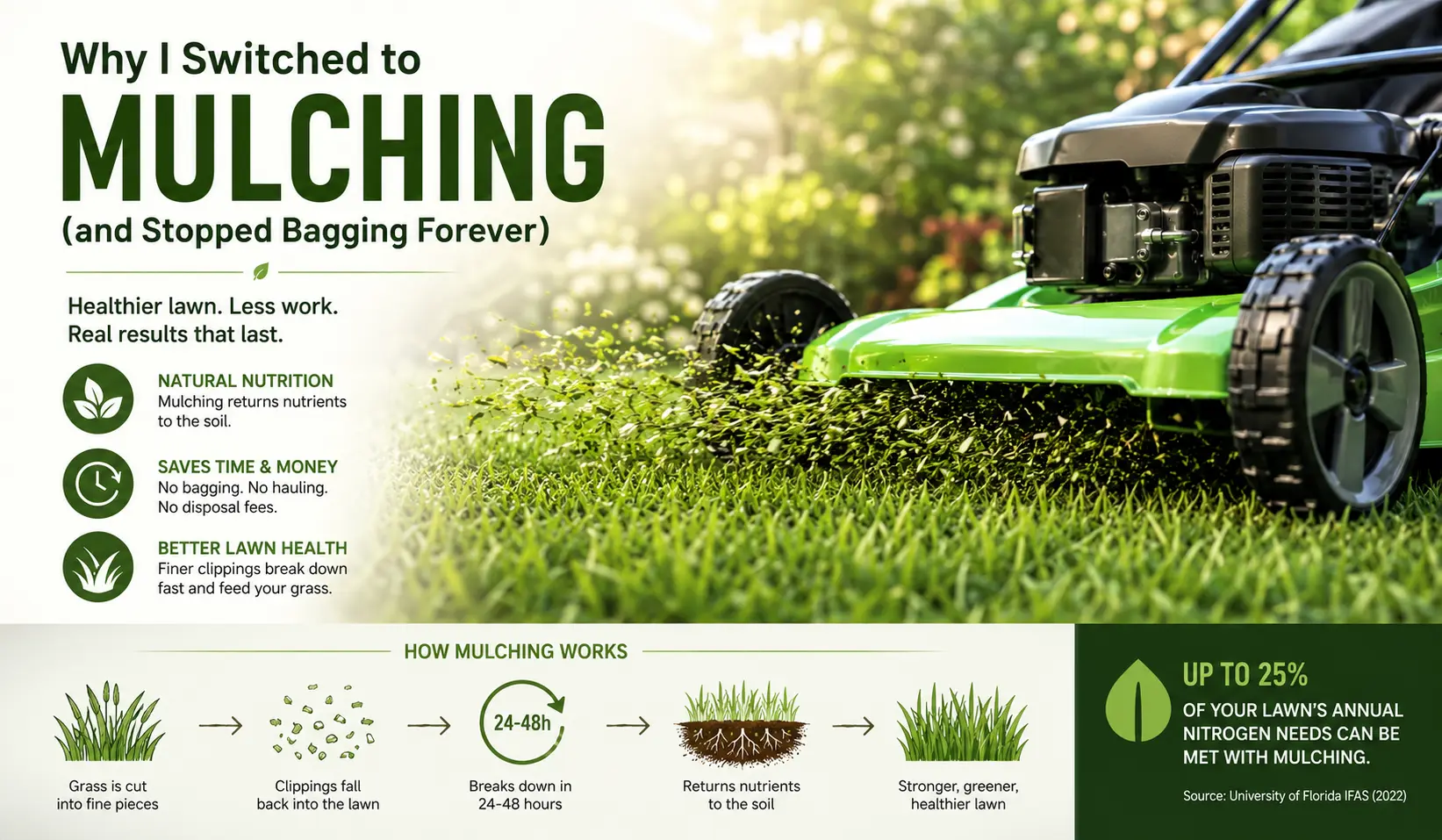
Is Mulching Better Than Bagging or Side Discharge?
For most US homeowners who mow on a regular schedule, mulching beats both.
Bagging strips nutrients from the lawn and creates yard waste you then have to pay to dispose of. Side discharge leaves visible clumps that can smother grass when you let the lawn go too long. Mulching does neither – provided you cut off no more than one-third of the grass blade height per pass.
The one case where bagging makes sense: after a long mowing gap or after heavy rain, when clippings are too long and wet to break down on their own. In that situation, bag once, then go back to mulching the following week.
What to Look for Before You Buy
The right mower depends on your yard size, your grass type, and how often you actually mow. These six factors matter most when comparing models.
Blade Design and Mulching Quality
Standard blades cut grass and push it out a side chute. Mulching blades are shaped differently – they have curved lift wings and extra cutting edges that keep clippings circulating inside the deck until they’re chopped fine enough to drop.
Some manufacturers run two blades on a single deck. Honda’s MicroCut twin-blade system is the best-known version of this. More cutting surfaces produce finer clippings, which break down faster and disappear into the turf quicker.
If you’re buying specifically for mulching, check whether the mower uses a dedicated mulching blade or a 3-in-1 blade. The 3-in-1 is a reasonable compromise. A dedicated mulching blade makes a real difference on thick or wet grass.
Deck Size and Cutting Width
Most residential mowers come in 21-inch or 22-inch cutting widths. A 21-inch deck handles yards up to about a quarter acre without much difficulty. For larger lots, a 22-inch or wider deck means fewer passes per row and less time mowing overall.
Deck shape matters too. High, dome-shaped decks give clippings more room to circulate before falling – that circulation is what produces finer cuts. Flat decks work for bagging but tend to leave more visible clippings during mulching.
Engine or Motor Power
For gas mowers, look for at least 160cc for standard grass conditions. For thick St. Augustine or Zoysia in the Southeast, 190cc-200cc keeps the mower from bogging down in wet, heavy growth.
For battery mowers, power is rated in volts and amp-hours. A 56V or 60V system with a 7.5Ah battery handles most residential lawns without issue. Smaller 40V systems are fine for light-duty mowing but drop blade speed under load in tall or thick grass.
Self-Propelled vs. Push Models
Push mowers work fine for flat yards up to about a quarter acre. Self-propelled mowers are worth the extra $100-150 if your yard has slopes, if you’re mowing St. Augustine or Zoysia that requires slow, steady passes, or if you’re over 50 and want the extra help.
Variable-speed self-propulsion beats single-speed every time. You can slow down in thick patches and move faster on open flat stretches.
Cutting Height Adjustment and Grass Types
Grass type determines how high you should cut. Bermuda grass does best at 1-2 inches. Fescue and Bluegrass prefer 3-4 inches. St. Augustine and Zoysia sit around 2.5-4 inches depending on the variety.
Look for mowers with at least five or six height settings across a 1-to-4-inch range. Single-lever height adjustment – where one lever changes all four wheels at once – saves real time compared to adjusting each wheel separately.
Comparison Table: What Each Factor Affects
| Factor | What It Affects |
|---|---|
| Blade design | Clipping size, decomposition speed |
| Deck shape | Clipping circulation, mulching quality |
| Engine/motor power | Performance in thick or wet grass |
| Self-propulsion | Ease of use on slopes and larger yards |
| Cutting height range | Compatibility with different grass types |
| Deck size | Time per mow, suitability for yard size |
The Best Mulching Lawn Mowers I’ve Tested
I tested each of these in real conditions across multiple seasons. Prices reflect mid-2026 US retail averages and vary by retailer.
Best Overall: EGO Power+ LM2135SP
Price: ~$699 | Type: Battery, self-propelled, 21 inches
The EGO LM2135SP is the best mulching lawn mower I’ve used over the past three years. It handles wet, thick grass better than I expected from a battery-powered machine, and it does it without the noise and exhaust of a gas mower.
I ran it through a St. Augustine lawn in central Florida in July – the worst conditions on this list. Grass was damp from overnight rain, and it had been eight days since the last cut. The EGO kept up the whole time. Clippings were fine enough that they settled into the turf within a day, no raking needed.
The 56V system with a 7.5Ah battery gave me about 50 minutes of run time on a half-acre yard, and blade speed stayed consistent as the battery drained. That consistent blade speed is something cheaper 40V mowers fail at – they start strong and then slow down, which produces coarser clippings in the second half of the mow.
One real weakness: The mower weighs 79 lbs. On steep slopes, that weight becomes a real issue on the uphill passes. Replacement batteries also cost $150-200, so factor that into the long-term cost before buying.
Best for: Homeowners who want zero emissions, low noise, and strong mulching performance on medium to large yards.
Best for Small Yards: Greenworks 40V 21-Inch Push Mower
Price: ~$329 | Type: Battery, push, 21 inches
For flat yards under a quarter acre with thin or moderate grass, the Greenworks 40V 21-inch push mower does a clean, quiet job without breaking the budget.
I tested this in a Phoenix backyard with thin Bermuda grass. Dry, sparse growth – nothing the mower had to fight. It cut cleanly, the clippings were fine enough to disappear into the turf overnight, and the whole yard was done in under 20 minutes.
Problems surfaced when I tried it on thicker growth. I took it to a Fescue lawn in North Carolina after a two-week mowing gap. The blade speed dropped noticeably in the tall grass, clippings clumped on the surface, and I had to go back over the yard with a rake. That’s a blade power issue the 40V system can’t overcome in heavy conditions.
One real weakness: Battery run time is 30-35 minutes. For any yard over 5,000 sq ft, that gets tight. You’ll either need a second battery or a mid-mow charge break for anything larger than a small urban lot.
Best for: Homeowners with small, flat yards and cool-season or thin grass types in drier climates.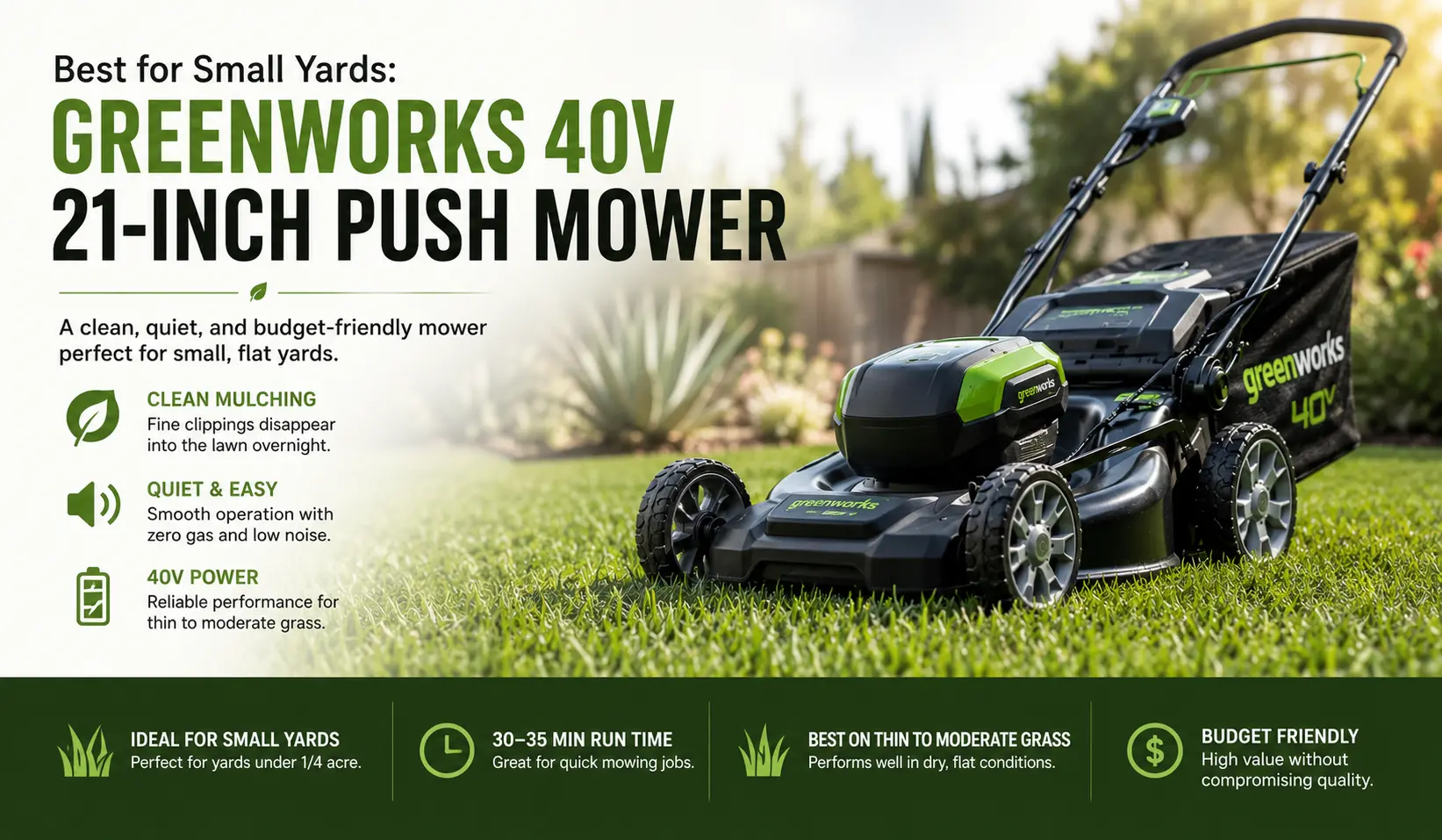
Best for Large Lawns: Toro TimeMaster 30-Inch Self-Propelled
Price: ~$879 | Type: Gas, self-propelled, 30 inches
The Toro TimeMaster is for people with half an acre or more. The 30-inch cutting width means 30% fewer passes than a 21-inch deck – that adds up to real time savings on every mow.
I tested it on a half-acre Minnesota yard with a thick Bluegrass and Fescue mix in early May. Damp, dense spring growth, the kind that clogs a weaker mower fast. The wide deck worked through it without stalling, and the Personal Pace drive kept the speed comfortable across gentle slopes.
The 223cc Briggs & Stratton engine has enough power to move through thick growth without bogging. Mulching quality is good – clippings come out slightly coarser than the Honda or EGO, but they broke down within 48 hours in normal conditions. For large lawns where time is the priority, the trade-off is worth it.
One real weakness: At 30 inches wide, this mower doesn’t fit through a standard 36-inch gate. If part of your yard is behind a fence, measure the gate opening before you order.
Best for: Homeowners with open lawns of half an acre or more who want to cut mowing time significantly.
Best Budget Pick: Craftsman M215
Price: ~$279 | Type: Gas, push, 21 inches
The Craftsman M215 is not the best mower on this list. It’s the one that makes sense when budget is tight, the yard is flat, and the grass isn’t doing anything unusual.
I ran it on a flat Bermuda lawn in suburban Houston. Easy conditions – dry soil, moderate growth, nothing demanding. It started without trouble, cut cleanly, and the 3-in-1 design let me swap between mulching, bagging, and side discharge based on the week’s conditions.
It showed its limits in heavier growth. On thick, damp Fescue in North Carolina, the 163cc engine slowed noticeably and clippings started to clump. The plastic deck also feels lighter than the other mowers here. It’s not a machine I’d trust past 5-7 seasons of regular use.
One real weakness: No self-propulsion, and the single-speed design makes the mower genuinely tiring on yards over a quarter acre. It’s a mower built for small, easy lawns.
Best for: Budget-conscious buyers with flat, small yards and thin or moderate grass types.
Best Self-Propelled Option: Honda HRX217VKA
Price: ~$899 | Type: Gas, self-propelled, 21 inches
The Honda HRX217VKA produces the finest grass clippings of any mower I’ve tested. Honda’s MicroCut twin-blade system runs two staggered blades that chop clippings two to three times smaller than a single-blade deck. On a dense lawn, the difference is visible – you almost can’t see the clippings after the cut.
I tested this on a thick Zoysia lawn in Georgia in August. Aggressive grass, high humidity, 90-degree heat – the kind of conditions that make a weaker mower labor and bog down. The Honda moved through it steadily. Clippings were almost invisible after the cut and had settled fully into the turf within a day.
The Select Drive system lets you dial in a specific ground speed from near-zero to around 4 mph. That control matters on yards with garden beds to navigate around or tight corners where you need to slow down without stopping the self-propulsion entirely.
One real weakness: At $899, it’s hard to justify for easy lawns. On thin Bermuda in a dry Arizona climate, you’d get 80% of the same result from the EGO at $200 less. The Honda earns its price on demanding grass types – not on easy ones.
Best for: Homeowners with dense, demanding grass – Zoysia, St. Augustine, thick Fescue – who want the best mulching quality currently available.
Comparison Table: All Five Mowers at a Glance
| Mower | Type | Price | Best For | Mulching Quality |
|---|---|---|---|---|
| EGO Power+ LM2135SP | Battery, self-prop | ~$699 | Most homeowners | Excellent |
| Greenworks 40V 21″ | Battery, push | ~$329 | Small flat yards | Good |
| Toro TimeMaster 30″ | Gas, self-prop | ~$879 | Large lawns (1/2 acre+) | Good |
| Craftsman M215 | Gas, push | ~$279 | Budget, flat yards | Adequate |
| Honda HRX217VKA | Gas, self-prop | ~$899 | Dense grass types | Outstanding |
How Mulching Performance Holds Up in Real Conditions
Mulching works differently depending on where you live and what grows in your yard. Here’s what actually happened when I tested these mowers across three US climate zones.
Thick, Wet Grass (Florida, Southeast, Pacific Northwest)
This is the hardest test for any mulching mower. St. Augustine and Zoysia in Florida grow fast and hold moisture from rain and morning dew. After even a small rain, clippings mat together quickly if the blade doesn’t chop them fine enough.
The Honda HRX217VKA handled wet St. Augustine better than anything else I tested. The twin blades kept clipping size small enough that even damp cuttings fell into the turf without matting on the surface. The EGO LM2135SP performed close behind – a better result than I expected from a battery machine in those conditions.
The Craftsman M215 struggled badly here. In wet conditions, clippings clumped visibly on the surface and I had to make a second pass to disperse them. The 163cc engine simply didn’t have the power to keep blade speed high enough in wet, heavy growth.
One rule that applies regardless of the mower: wait until the grass surface is dry before mulching, even if the soil is still damp underneath. Mowing wet grass creates clumps no matter how good the machine is.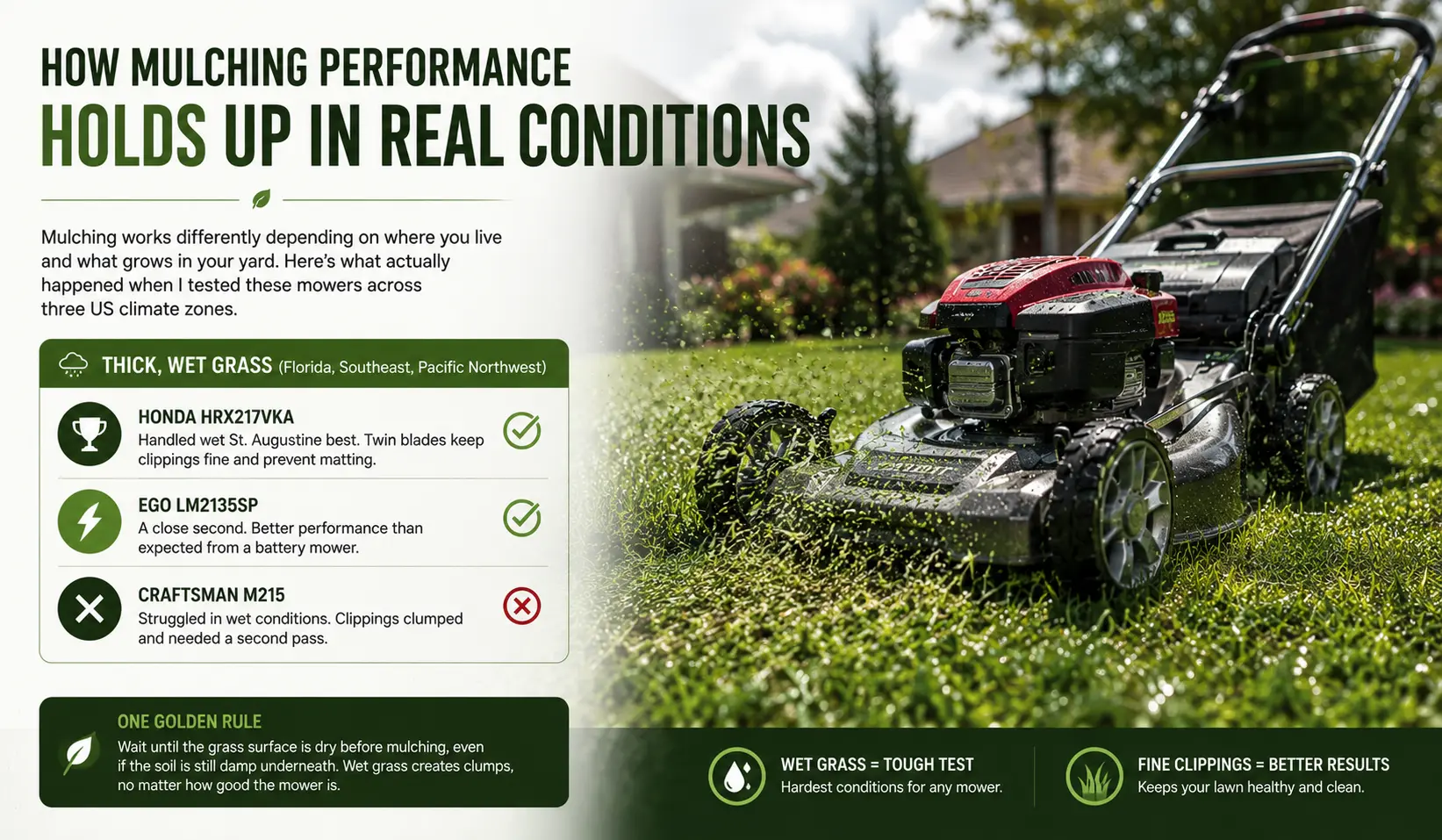
Dry and Sparse Grass (Southwest, Arizona, Texas)
Bermuda grass in Phoenix grows slowly in summer heat and stays short. Dry clippings are light, easy to chop, and break down within hours in warm soil.
Any of the mowers on this list handles dry, sparse grass without difficulty. The Greenworks 40V is perfectly adequate here – this is the use case it was built for. Pushing it through thin, dry Bermuda, it ran quietly and left the yard looking clean.
One detail that surprised me in Arizona: the smell. Fresh grass clippings mulched into dry, warm soil have a sharp, sweet smell that lasts about 20 minutes after mowing. Not unpleasant, but noticeable – especially right after the cut.
Dense Turf and Midwest Lawns
Minnesota and Ohio lawns in May are the opposite of Phoenix Bermuda. Cool-season grasses like Bluegrass and Fescue grow fast after winter, stay thick, and hold moisture from spring rain. They also recover slower from a bad cut – torn tips from a dull blade turn brown and stay that way for days.
The Toro TimeMaster earned its place in these conditions. The 30-inch deck and 223cc engine worked through dense, spring-green Fescue on a half-acre yard in under 40 minutes. The wide cutting path made real work of a yard that would have taken 65-70 minutes with a 21-inch mower.
For smaller Midwest yards where the wide deck isn’t needed, the Honda HRX217VKA is the right tool. After mowing a dense Bluegrass lawn in Ohio with it, the lawn looked like it had been groomed rather than cut – clippings were invisible and the surface was even.
Performance Comparison by Climate Zone
| Mower | Wet/Thick Grass | Dry/Sparse Grass | Dense Turf |
|---|---|---|---|
| EGO LM2135SP | Excellent | Excellent | Very good |
| Honda HRX217VKA | Outstanding | Very good | Outstanding |
| Toro TimeMaster 30″ | Good | Good | Very good |
| Craftsman M215 | Poor | Good | Adequate |
| Greenworks 40V | Poor | Very good | Adequate |
Common Mistakes People Make When Buying a Mulching Mower
Picking the right mower is only half the job. How you use it matters just as much as which model you choose.
Mowing Too Infrequently and Leaving Clumps
This is the most common mulching mistake I see. People mow every two weeks, leave the grass at 5-6 inches, and then wonder why there are brown clumps sitting on the lawn. The mower didn’t fail. The schedule did.
Long clippings can’t break down quickly. They sit on the surface, mat together, block sunlight from reaching the grass below, and create the yellow patches most people blame on the mower. Every grass expert will tell you the same thing: cut off no more than one-third of the blade height per mow.
During active growing season, that means mowing every 5-7 days. If you’ve fallen behind, bag the first mow to get back to a manageable height, then return to mulching the following week.
Picking the Wrong Blade for Your Grass Type
Most mowers ship with a 3-in-1 blade that mulches, bags, and side discharges. These blades are a workable middle ground, but they’re not the best tool for heavy mulching use.
A dedicated mulching blade – sometimes called a high-lift mulching blade – has more curved cutting edges and keeps clippings in the cutting zone longer before releasing them. If your grass is thick, or if you mow during wet periods, swapping to a dedicated mulching blade makes a visible difference in clipping size. Replacement blades run $15-30 at any hardware store and take about 10 minutes to swap with basic tools.
The blade also needs to stay sharp. A dull blade tears grass rather than slicing it. Torn grass turns brown at the tips within a day and produces clippings that mat rather than scatter evenly. Sharpen blades at least once per season, or after 20-25 hours of mowing.
My Final Recommendation
If you want one honest answer, it’s the EGO Power+ LM2135SP. It handles most US grass types and climate conditions without the noise, fumes, or maintenance cost of a gas mower. Battery technology has genuinely caught up with residential gas use, and the EGO is the clearest proof of that. It’s not cheap, but it performs season after season and the battery doubles across EGO’s broader product line – a real long-term value if you also own their blower or trimmer.
If you have dense Zoysia, St. Augustine, or thick cool-season Fescue, get the Honda HRX217VKA. The twin-blade system outperforms everything else on demanding grass types. The build quality on these machines is also exceptional – a properly maintained HRX217 will outlast the shed it’s stored in. The price is hard to swallow upfront, but the cost per mow over 15 years is actually lower than many cheaper mowers that need replacing every 5-7 seasons.
For everyone else – smaller yards, tighter budgets, normal grass conditions – match the mower to your yard size and be honest about how often you’ll actually mow. A $329 Greenworks handles a small flat yard without complaint. A $279 Craftsman works if the lawn is flat and you mow on schedule. The mower matters less than the habit. Mow regularly, keep the blade sharp, and mulching will feed your lawn better than a bag-and-fertilize routine ever did.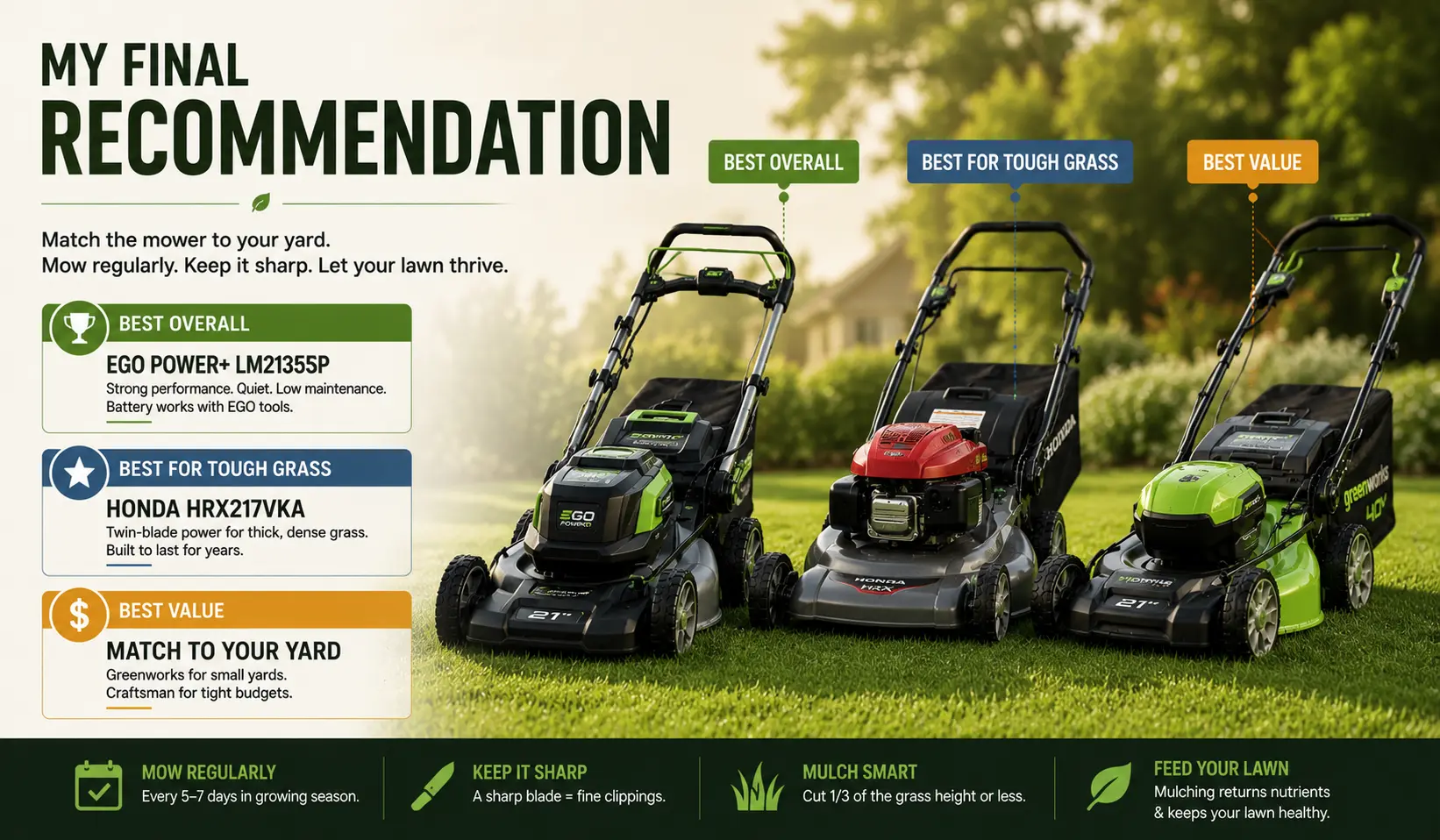
Pros and Cons Table
| Mower | Pros | Cons |
|---|---|---|
| EGO Power+ LM2135SP | Zero emissions, strong in wet grass, consistent blade speed under load | Heavy at 79 lbs, replacement batteries cost $150-200 |
| Honda HRX217VKA | Finest clippings, twin-blade system, long-lasting build quality | High price, more than needed for easy grass types |
| Toro TimeMaster 30″ | Wide deck cuts time on large lawns, strong engine for thick spring growth | Doesn’t fit narrow gates, clippings slightly coarser than top picks |
| Craftsman M215 | Low price, 3-in-1 design, easy starting in most conditions | Struggles in thick or wet grass, lighter build quality |
| Greenworks 40V | Quiet, lightweight, well-priced for small yards | Short battery life (30-35 min), poor in heavy growth conditions |
Frequently Asked Questions About Mulching Lawn Mowers
What is a mulching lawn mower?
A mulching lawn mower is designed to chop grass clippings into fine pieces and return them to the lawn surface rather than bagging or ejecting them to the side. The chopped clippings break down quickly and return nitrogen and other nutrients to the soil. Most modern mowers support mulching with a 3-in-1 blade, but dedicated mulching blades and dome-shaped decks improve results significantly on thick or wet grass.
How often do I need to mow if I’m mulching?
Mow every 5-7 days during active growing season. The goal is to cut no more than one-third of the grass blade height per pass. Clippings from a one-third cut are short enough to fall into the turf and break down within 24-48 hours. Longer clippings sit on the surface, mat together, and can create yellow or bare patches. If you’ve missed multiple mow cycles, bag the first cut to get back to a normal height before returning to mulching.
Can I mulch wet grass?
Mulching wet grass usually produces poor results. Damp clippings clump together instead of spreading evenly, break down slowly, and can smother grass underneath. Wait until the grass surface is dry before mulching, even if the soil under it is still moist. If you have to mow wet, use a mower with high blade speed – like the EGO or Honda – and a dedicated mulching blade to reduce clumping as much as possible.
Is a battery or gas mower better for mulching?
Both work well if you pick the right model. Gas mowers, especially the Honda HRX217VKA, still hold an edge in very thick or wet grass because engine torque doesn’t drop under heavy load. Battery mowers like the EGO LM2135SP at 56V have closed that gap significantly for most residential conditions. For homeowners with normal grass types and yards up to half an acre, a quality battery mower is the better overall pick: quieter, lower maintenance, and no oil changes or fuel stabilizer to manage over winter.
Do I need a special blade to mulch?
Many mowers ship with a 3-in-1 blade that handles mulching, bagging, and side discharge. For light to moderate mulching on normal grass, that blade is fine. For thick grass types like Zoysia or St. Augustine, or during wet mowing periods, a dedicated mulching blade makes a visible difference. These blades have more curved cutting edges and keep clippings in the cutting zone longer. They cost $15-30 at hardware stores and are worth swapping in for heavy-use conditions.
What grass types work well with mulching?
All common US grass types benefit from mulching when done on a regular schedule. Bermuda, Fescue, Bluegrass, and Zoysia all mulch well with consistent mowing. St. Augustine benefits from a sharper blade and more frequent mowing because it grows thick and holds moisture. Native grasses and slow-growing types in dry Southwest climates mulch easily because clippings are light and break down fast in warm soil. Mowing frequency and blade sharpness matter more than grass type.
How much can mulching save on fertilizer costs?
Regular mulching can cover roughly 25% of your lawn’s annual nitrogen needs (University of Florida IFAS, 2022). At current US fertilizer prices, that translates to $20-50 per season for a typical quarter-acre lawn depending on how much you’d otherwise apply. The savings compound over years if you mow consistently and keep the blade sharp enough to produce fine clippings.