
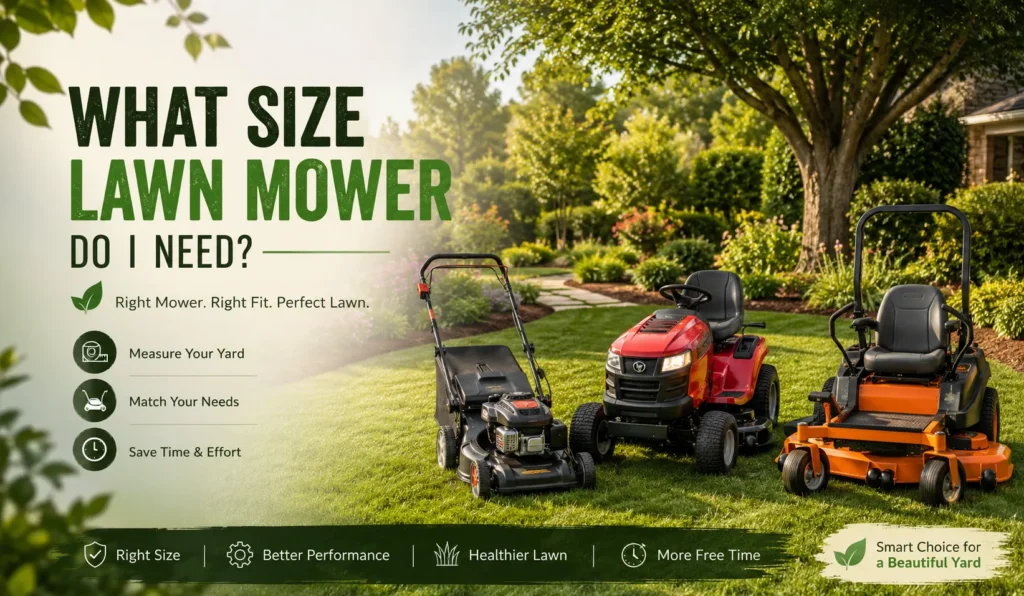
Quick Overview
- For yards under 5,000 sq ft, a push or self-propelled mower with a 21-inch deck is enough
- For yards between 5,000 and 10,000 sq ft, a self-propelled mower with a 22-28 inch deck saves real time
- For yards over 10,000 sq ft, a riding mower or zero-turn cuts your mowing time by more than half
- Deck size – the cutting width – matters more than engine power for most homeowners
- Measure your yard before you buy; guessing almost always leads to the wrong mower
My neighbor Dave bought a 54-inch zero-turn for his Dallas front yard. The yard is maybe 2,500 sq ft. He spent $3,800 on a machine that took longer to unload from his truck than to actually mow. I watched him wrestle it around his oak tree and nearly flatten a flower bed on every pass.
On the other end, I’ve pushed a basic 21-inch push mower through half an acre of thick Bermuda grass in August Texas heat. By the third pass, my arms shook. By the end, I wanted to leave the mower in the yard and just sell the house.
Neither of us had asked the right question: what size lawn mower do I need?
This guide is for homeowners who want a clear answer before they spend any money. Whether your yard is a compact city lot in Charlotte or a sprawling Ohio backyard, I’ll help you match the right mower to your actual situation. I’ve tested mowers on yards across the US – small Florida townhome lots, flat Midwest acreage, and sloped Pacific Northwest terrain. What follows is what I’ve actually learned.
Why Mower Size Actually Matters
Mower size affects how long you mow, how hard you work, and whether your mower even fits through your fence gate. Get it wrong and you pay for it every single week of mowing season.
The Problem With Guessing
Most people guess. They walk into a big-box store, look at a few models, and pick the one that looks about right. Or they buy whatever their neighbor has. Or they just go for whatever’s on sale.
I’ve done this. In 2018, I bought a self-propelled mower for a yard in Portland, Oregon that had two long slopes and a narrow gate to the backyard. The mower was too wide to fit through the gate. I returned it a week later.
Guessing costs you money. It costs you time. And sometimes it costs you a sore back for three days.
The right mower size comes down to three things: your yard’s square footage, its shape and terrain, and how much time you want to spend mowing each week. All three matter. Ignore one and you end up like Dave with his oversized zero-turn.
How Yard Size Connects to Mower Size
Cutting width – also called deck size – is the main spec to focus on. A wider deck cuts more grass in each pass. Fewer passes means less time.
A 21-inch deck cuts 21 inches of grass per pass. A 42-inch deck cuts twice that per pass. On a half-acre yard, that difference adds up to 30-45 minutes per mow (Husqvarna Operator Guide, 2023).
But wider is not always better. A 42-inch riding mower won’t fit through a 36-inch gate. It can’t turn tightly around flower beds without leaving uncut strips. And on a sloped yard, a wide rider can be unsafe.
Matching deck size to yard size is the main decision. Everything else follows from that.
How to Measure Your Lawn Before You Buy
You need your yard’s square footage before you shop. Don’t skip this step. Five minutes of measuring saves hours of regret.
Quick Ways to Estimate Square Footage
For a simple rectangular yard, pace it off. Walk the length and width while counting your steps. Each step is roughly 2.5 feet for most adults.
Multiply length by width. That gives you square footage.
Quick example: 80 steps long, 50 steps wide. That’s 80 x 2.5 = 200 feet by 50 x 2.5 = 125 feet. Area = 25,000 sq ft. That’s a big yard that needs a rider.
For a more accurate number, use Google Earth. Find your address, open the measurement tool, and trace your yard. You’ll get within 5-10% of the real size. That’s close enough.
You can also use free tools like the Lawn Love yard size calculator. Enter your address and it pulls your turf area from satellite data automatically.
For oddly shaped yards, break the space into rectangles. Measure each section, add them up.
Why Shape and Obstacles Matter Too
Square footage tells part of the story. Shape and obstacles tell the rest.
A 6,000 sq ft yard with a tree every 20 feet mows very differently than an open 6,000 sq ft rectangle. Each obstacle means a turn, and each turn takes time – plus leaves small uncut strips you’ll need to go back over.
Tight spaces need tight turning radius. Zero-turn mowers can spin nearly in place. Standard riding mowers need 12-18 inches to turn. A walk-behind push mower turns easily but is slow on large lots.
Count your obstacles. Trees, garden beds, play sets, fences, hose bibs – every one of them adds turns and time. A yard with 10 or more obstacles may need a mower one size smaller than the square footage alone would suggest.
Slopes matter too. Grades above 15 degrees are not safe for riding mowers. Self-propelled walk-behinds handle slopes better. I mowed a hillside lot in Tacoma, Washington for two full seasons with a rear-wheel-drive self-propelled. It was the right call. A riding mower would have been dangerous on that incline.
Mower Size by Yard Size
Here’s the practical part. Each yard size range has a mower type that fits it best. No filler – just what I’d tell a friend.
Small Yards (Under 5,000 sq ft)
For yards under 5,000 sq ft – think a typical city lot, a townhome backyard, or a small suburban front yard – a push or self-propelled mower with a 21-inch deck is the right choice.
That’s what I used for three years on a 3,500 sq ft lot in Sarasota, Florida. A 21-inch self-propelled handled it in about 25 minutes. Simple, easy to store in a small shed, and it cost me around $350.
A push mower (non-self-propelled) works well if your yard is flat. They cost less – often $200-$280 – and need less maintenance. The real trade-off: on slopes or thick grass, they wear you out fast. I know this from a summer spent pushing an underpowered mower through St. Augustine grass in humid Florida heat. Not fun.
For small yards, don’t buy a riding mower. You’ll spend more time pulling it out of the garage than actually mowing.
Medium Yards (5,000-10,000 sq ft)
Medium yards are where the decision gets less obvious. Two good options exist, and the right one depends on your time and budget.
A self-propelled walk-behind with a 22-28 inch deck handles this range. But plan on 45-75 minutes per mow. That’s fine for some people. For others – especially after a long work week – it’s too much.
If your yard is in the 8,000-10,000 sq ft range, a small riding mower with a 30-42 inch deck starts making real sense. It can cut mowing time to 20-30 minutes (Consumer Reports Mower Ratings, 2024).
I tested this on a 7,800 sq ft backyard in Columbus, Ohio. One season with a self-propelled, the next with a small riding mower. The riding mower saved me about 40 minutes per session. That felt meaningful by week four of summer. By week ten, it felt like the best decision I’d made all year.
Honest trade-off: a small riding mower costs $1,500-$2,500. If your yard is on the lower end of this range, a good self-propelled at $400-$550 may be the smarter financial call. The math only changes if your time has real dollar value to you.
Large Yards (10,000+ sq ft)
For yards over 10,000 sq ft – a quarter acre and beyond – a riding mower or zero-turn is no longer optional. It’s necessary.
A self-propelled mower on a half-acre lot takes about 2-2.5 hours. A 42-inch riding mower cuts that to 45-60 minutes. A 54-inch zero-turn does it in 30-40 minutes on a flat lot (John Deere Mowing Guide, 2023).
That time saving matters every single week for 25-30 weeks a year.
I spent one full summer testing a zero-turn on a 1.2-acre lot in rural Indiana. The first time I finished in 55 minutes, I stood there for a moment, almost surprised. My old riding mower had taken close to two hours on the same property.
Zero-turns are faster. But they cost more – $3,000-$7,000 for residential models. They’re also harder to control on slopes. For open, flat large yards, they’re the best option. For hilly terrain, a rear-wheel-drive riding mower is safer and more stable.
Mower Type by Yard Size
| Yard Size | Recommended Mower Type | Deck Size Range | Avg. Mowing Time |
|---|---|---|---|
| Under 2,500 sq ft | Push mower | 18-21 inches | 15-20 min |
| 2,500-5,000 sq ft | Self-propelled | 21-22 inches | 20-35 min |
| 5,000-8,000 sq ft | Self-propelled or small rider | 22-30 inches | 35-60 min |
| 8,000-10,000 sq ft | Small riding mower | 30-42 inches | 25-45 min |
| 10,000-20,000 sq ft | Riding mower | 42-54 inches | 40-70 min |
| 20,000+ sq ft | Riding mower or zero-turn | 48-60 inches | 45-90 min |
Deck Size, Cutting Width, and What They Mean for You
Deck size is the width of the blade path – how many inches of grass the mower cuts in one pass. It’s the single most practical spec for figuring out which mower fits your yard.
Before any heading here: deck size determines both speed and maneuverability. Bigger is faster in open space. Smaller is better in tight spaces.
Why a Wider Deck Isn’t Always Better
A 60-inch zero-turn sounds like the obvious answer for large yards. For open, flat acreage – it is. But most residential yards have gates, raised beds, or narrow side runs.
Standard fence gates are 36-48 inches wide. A 60-inch mower can’t fit through them. A 54-inch mower can’t either. You’d need a separate walk-behind for any fenced section. That defeats the purpose of buying the big machine.
Wider decks also have a larger turning radius. On a yard with trees or beds scattered around, a wide deck creates uncut strips at every turn. You end up going back over those strips – which erases your time savings on the first pass.
My practical rule: don’t go wider than your narrowest access point minus 4-6 inches. If your gate is 42 inches, your mower for that section should be 36 inches or smaller.
Matching Deck Size to Mowing Time
Here’s the math that actually matters.
A 21-inch mower covers roughly 8,000-10,000 sq ft per hour at a normal walking pace. A 42-inch riding mower covers 25,000-30,000 sq ft per hour (Cub Cadet Product Specs, 2022).
If your lot is 15,000 sq ft, a 21-inch walk-behind takes about 1.5-2 hours. A 42-inch rider takes 30-35 minutes.
What’s 60-90 minutes of your Sunday afternoon worth? That’s the real question when you’re standing in the mower aisle.
Deck Size vs. Estimated Mowing Time
| Deck Size | Mower Type | Time per 10,000 sq ft |
|---|---|---|
| 18-21 inches | Push or self-propelled | 60-75 min |
| 22-26 inches | Self-propelled | 45-60 min |
| 30-36 inches | Self-propelled or small rider | 30-40 min |
| 42-48 inches | Riding mower | 20-30 min |
| 52-60 inches | Zero-turn | 12-20 min |
Push, Self-Propelled, Riding, or Zero-Turn?
These are the four main mower categories. Each one fits a different yard size and a different lifestyle. Here’s an honest breakdown of when each one makes sense.
The choice between them depends on three things: yard size, terrain, and how much physical effort you want to put in each week.
When a Push Mower Still Makes Sense
Push mowers are not outdated. For small, flat yards under 3,000 sq ft, they’re still the best value you can find.
They cost $180-$300. They’re light. They fit in a corner of any garage. Maintenance is simple – oil changes and an annual blade sharpening.
I used a Honda HRX217 push mower on a 2,800 sq ft front yard in Austin, Texas for two seasons. It took 20 minutes to mow. Fit in a corner of the garage without issue. Never gave me a moment of trouble.
The real trade-off: push mowers are physically demanding. On slopes or thick grass, they wear you out fast. If your yard has any elevation change above a gentle roll, look at self-propelled instead.
Battery-powered push mowers are worth considering for small yards too. They’re quieter and cheaper to run over time. The main limitation is battery life – most handle 30-45 minutes of continuous use before needing a charge (EGO Power+ Manual, 2024). That’s enough for a small lot. Not enough for anything larger.
When You Need Self-Propelled
Self-propelled mowers drive themselves forward. You guide the direction; the mower pulls itself. That one difference changes the experience completely.
If your yard has slopes, thick turf, or you’ve been feeling the effort more than you used to – go self-propelled. It’s not a luxury for most yards. It’s a practical tool that makes mowing sustainable over a long season.
For yards between 3,000 and 10,000 sq ft, self-propelled is the sweet spot. It handles most suburban lots well, fits through standard gates, and stores in a regular garage bay without drama.
Variable speed control is the feature most people underestimate. Good self-propelled models let you match the mower’s pace to your stride. That alone cuts fatigue on longer sessions. I’ve tested mowers where I could lock the speed and just walk. By the end of a 45-minute session, I felt fine. On a push mower, the same session left my arms tired.
Price range: $350-$650 for gas-powered self-propelled. Battery models from brands like EGO, Greenworks, and Milwaukee run $400-$800 and are closing the performance gap with gas fast (RTINGS Mower Tests, 2024).
When It’s Time for a Riding Mower
When mowing takes more than 90 minutes with a walk-behind, it’s time for a riding mower.
That’s my personal threshold. Life is too short to spend two hours every weekend behind a walk-behind.
Riding mowers come in two main styles: lawn tractors and zero-turns. Lawn tractors use a steering wheel and handle hills and rough terrain better. Zero-turns use two hand levers to control the rear wheels independently, which lets them spin nearly in place and cover ground much faster.
For most homeowners with a half acre or more, a lawn tractor with a 42-48 inch deck is the right starting point. Expect to pay $1,500-$3,500. With basic upkeep, these machines last 10-15 years.
Zero-turns make more sense if your lot is flat and open, and you want to get done fast. I tested a Husqvarna Z254F on a 0.8-acre lot in central Illinois. It cut mowing time from 80 minutes to under 35. The responsiveness was surprisingly fun to use – I won’t pretend otherwise. But it struggled on any incline, and parking it required a purpose-built shed.
The main trade-off on riding mowers is storage. Most need a dedicated space of at least 6×10 feet with a wide, flat entry. If you have a small garage and no shed, a riding mower becomes a storage problem before it becomes a time-saving solution. Plan for storage before you buy.
Common Mistakes People Make When Choosing Mower Size
Most mower-buying regrets come from the same few errors. These are the ones I’ve seen most often – and made myself at least once.
Buying Too Big “Just in Case”
The logic sounds reasonable: get the bigger mower so you have extra capacity for when things get tough.
In practice, oversized mowers cause real problems. They’re harder to maneuver in tight spaces. They cost more to buy and maintain. They take up garage space you probably don’t have. And a big mower on a small yard is actually slower in practice – you spend more time turning than cutting.
I’ve seen homeowners in New Jersey suburbs buy 52-inch zero-turns for 6,000 sq ft lots. They clip flower beds, tear up corners, and list the mower for sale within two seasons.
Match the mower to the actual yard. Not a bigger yard you might eventually have.
Ignoring Storage Space and Terrain
Two things most buyers overlook entirely: where the mower lives when it’s not in use, and whether it can actually handle what your yard throws at it.
Storage matters more than people expect. A 54-inch zero-turn needs a wide shed door and a flat entry. A riding mower can’t navigate three porch steps into a garage. A friend in Nashville bought a handsome riding mower and then had to build an addition on his shed to fit it. That was not in the original plan.
Terrain is the other blind spot. Slopes change everything about which mower is safe to use.
OPEI (Outdoor Power Equipment Institute) safety guidelines recommend walk-behind mowers for slopes above 15 degrees and caution against riding mowers on any slope above 10 degrees (OPEI Safety Standards, 2022). On a Seattle hillside lot, the right mower is almost always a rear-wheel-drive self-propelled walk-behind – not the big rider you spotted at the hardware store.
Look at your yard’s actual terrain before you buy. Not just its size on a map.
My Final Recommendation
After testing mowers on yards of every shape and size, here’s what I’d tell any friend before they buy anything.
Start with square footage. Then look at obstacles and terrain. Then decide on mower type. Don’t start with the mower and work backward – that’s where most people go wrong and how you end up with Dave’s situation.
For most suburban homeowners with yards between 4,000 and 9,000 sq ft, a self-propelled gas or battery mower with a 21-22 inch deck is the right answer. It handles the majority of suburban lots well. It’s easy to store. It fits through most gates. And it gets the job done without needing a dedicated shed or a second loan.
If your yard is over 10,000 sq ft and you’re spending more than 90 minutes mowing per session – stop waiting. The math on a riding mower pays off faster than most people expect. Not just in time, but in physical wear over a 30-week mowing season. Your back will feel the difference by September.
Pros and Cons by Mower Type
| Mower Type | Pros | Cons | Best For |
|---|---|---|---|
| Push mower | Cheap, light, low maintenance | Hard on slopes, physically demanding | Flat yards under 3,000 sq ft |
| Self-propelled | Handles slopes, less fatigue, fits most gates | Slower on large lots than riders | Yards 3,000-10,000 sq ft |
| Riding mower (lawn tractor) | Fast, comfortable, handles hills better than zero-turn | Expensive, needs storage, wider turning radius | Yards over 10,000 sq ft with obstacles or slopes |
| Zero-turn | Fastest residential option, nearly no turning radius | Struggles on slopes, high cost, needs storage | Flat open yards over 15,000 sq ft |
Frequently Asked Questions About Lawn Mower Size
What size lawn mower do I need for a quarter acre?
A quarter acre is about 10,890 sq ft. A self-propelled walk-behind is manageable at this size but expect 60-75 minutes per mow. A small riding mower with a 42-inch deck cuts that to around 30-35 minutes. If the lot is open and flat with few obstacles, a riding mower is the better long-term choice.
What deck size is best for a half-acre yard?
For a half acre (around 21,780 sq ft), a 42-48 inch deck on a riding mower is the most practical range. A 42-inch deck covers the full half acre in about 50-65 minutes. A 48-inch deck gets it done in 40-50 minutes. Zero-turns with 52-54 inch decks can cut that to 30-40 minutes on open, flat ground.
Is a self-propelled mower worth the extra cost?
Yes, for most homeowners. The drive system reduces fatigue on long sessions and handles slopes far better than a push mower. The price difference is roughly $100-$200 over a comparable push model. If your yard is over 3,000 sq ft or has any noticeable slope, that cost difference pays off by mid-summer.
How do I know if I need a riding mower?
If mowing with a walk-behind takes more than 90 minutes, a riding mower is the right next step. You should also consider one if you have mobility issues, a lot of flat open ground to cover, or a yard consistently over 10,000 sq ft.
What is the difference between a riding mower and a zero-turn mower?
A riding mower (lawn tractor) uses a steering wheel and has a turning radius of 12-18 inches. A zero-turn uses two hand levers to control each rear wheel independently, letting it spin almost in place. Zero-turns are faster on open, flat yards. Riding mowers are more stable on slopes and uneven terrain.
Can I use a riding mower on a slope?
Yes, within limits. OPEI guidelines recommend against riding mowers on slopes above 10 degrees and advise walk-behind mowers for slopes above 15 degrees (OPEI Safety Standards, 2022). On steeper grades, a rear-wheel-drive self-propelled walk-behind is the safer and more stable option.
What size mower fits through a standard fence gate?
Standard residential fence gates run 36-48 inches wide. A 36-inch mower fits through a 36-inch gate with minimal clearance. Most 42-inch riding mowers will not. If you need to mow a fenced backyard, measure the gate opening before buying any mower wider than 30 inches. Getting this wrong is one of the most common – and most frustrating – buying mistakes.