
Quick Overview
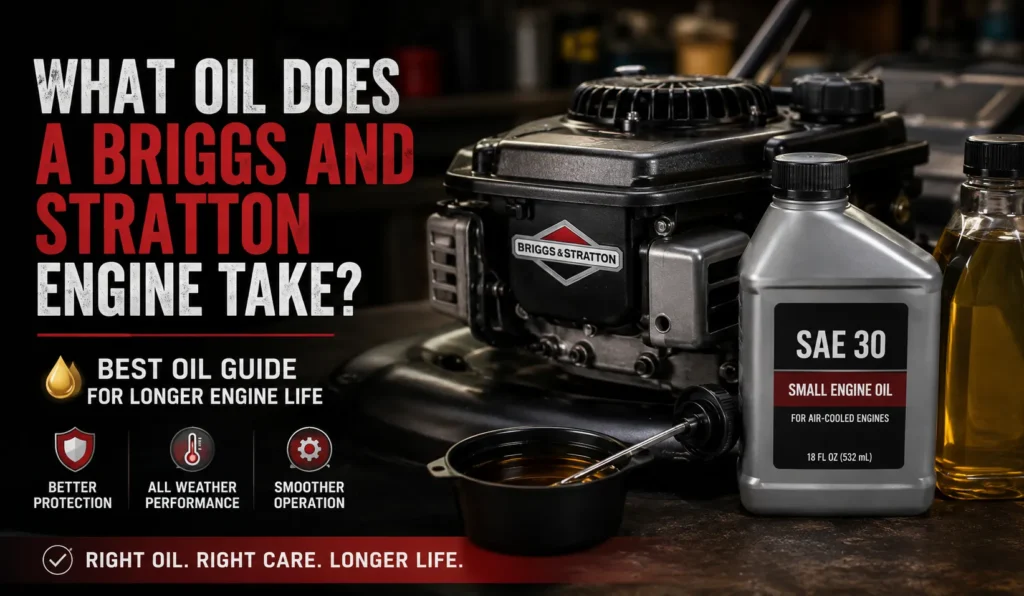
- Most air-cooled Briggs and Stratton engines take SAE 30 in warm weather and 5W-30 synthetic in cold or variable temps.
- 10W-30 is the safe year-round pick if you only want to buy one bottle.
- Synthetic 5W-30 protects better below 40°F and above 90°F, but costs more per quart.
- Always check your dipstick or owner’s manual first. Some newer engines specify full synthetic only.
- Oil capacity runs 18 to 20 ounces for most single-cylinder mowers, more for twin-cylinder riding engines.
What Oil Goes in a Briggs and Stratton Engine
I still remember the smell. Burnt oil, hot metal, and a little bit of panic coming off a customer’s riding mower in my Ohio garage.
He’d used whatever quart was sitting on his shelf. Turned out it was straight 5W-20 car oil, the wrong weight for a July afternoon. The engine seized two weeks later. He called me sounding almost embarrassed, like he’d made some obvious mistake he should’ve caught.
That’s the short version of why oil choice matters so much on small engines. If you’re asking what oil does a Briggs and Stratton engine take, the quick answer is SAE 30 for warm weather and synthetic 5W-30 for wide temperature swings.
This guide is for anyone staring at a dipstick, confused by the oil aisle, or trying to keep a mower, generator, or pressure washer running longer. I’ve serviced Briggs and Stratton engines on push mowers, riding mowers, and generators for years. Here’s what actually works, not just what the bottle label promises.
Why Oil Choice Actually Matters for Briggs and Stratton Engines
The right oil keeps metal parts from grinding against each other at startup. Pick the wrong one and you speed up wear every single time you pull the cord or turn the key.
Briggs and Stratton engines run hotter than most people expect. A push mower engine can hit 300°F at the cylinder head on a summer afternoon in Georgia. Oil has to hold up under that heat without breaking down.
What Happens When You Use the Wrong Oil
I’ve pulled apart engines with scored cylinder walls because someone used oil that was too thin for summer heat. The oil couldn’t hold a protective film, so metal touched metal.
One customer brought in a Toro push mower that sounded like gravel in a blender. Popped the valve cover and found metal shavings sitting right in the oil. That engine was maybe three seasons old.
I’ve also seen the opposite problem in Minnesota. Thick oil left in a generator all winter turned nearly solid. The starter motor strained just to turn the engine over.
The owner had to hand-crank it three times before it caught. He told me later he thought the whole unit was dead and almost bought a new one.
Wrong oil doesn’t always kill an engine right away. Sometimes it just shortens its life by a few years and you never know why. You mow every Saturday for three summers, then one day it just won’t start, and you blame the carburetor instead of the oil sitting in the crankcase the whole time.
Air-Cooled Engines and Why They’re Picky About Oil
Briggs and Stratton engines are air-cooled, not water-cooled like your car. That means the oil does double duty. It lubricates parts and also carries heat away from the engine.
Without a radiator or coolant to help, oil viscosity matters more here than in a car engine. Too thin and it burns off or loses its film at high heat. Too thick and it can’t circulate fast enough on a cold start.
Pop the cover off any Briggs and Stratton engine and you’ll see fins running along the cylinder. Those fins move air across hot metal, but they only do half the job. Oil handles the rest, soaking up heat from the piston and rings and carrying it back down into the crankcase.
That’s the whole reason Briggs and Stratton publishes a viscosity chart based on temperature, not just one universal oil for every engine they make. I keep a laminated copy of that chart taped inside my shop cabinet. Customers are always surprised it exists at all.
The Right Oil Type for Your Briggs and Stratton Engine
The right oil comes down to two things: viscosity and whether it’s synthetic or conventional. Get the viscosity right first, since that’s the bigger factor in engine protection.
Viscosity is just a number that tells you how thick the oil is and how it thins out as it heats up. SAE 30 stays steady at high heat. 10W-30 flows easier in cold starts but still protects when hot.
SAE 30 vs. 10W-30 vs. Synthetic 5W-30
SAE 30 is the classic choice for small engines running above 40°F. It’s simple, cheap, and does the job in consistent warm weather. I still reach for it on my own push mower every spring, mostly out of habit and because it’s what I learned on.
10W-30 flows better on cold mornings, which matters if you’re starting a mower in early spring or a generator during a winter storm. The tradeoff is slightly more oil consumption at high temperatures in some older engines. I’ve noticed this on engines with more than 300 hours on them, where the rings have worn just enough to let a thinner oil slip past.
Synthetic 5W-30 handles both extremes better than conventional oil. It stays fluid in cold weather and resists breaking down in extreme heat. It costs about twice as much per quart, though. For a homeowner who changes oil once a season, that difference is maybe four dollars a year. For a landscaping crew running engines five days a week, it adds up faster.
How Temperature Changes What Oil You Should Use
Temperature is the single biggest factor in picking oil weight. Briggs and Stratton’s own viscosity chart splits by degrees Fahrenheit, not by engine model.
Above 40°F, SAE 30 or 10W-30 both work fine. Below 40°F, you want 5W-30, ideally synthetic, so the oil doesn’t thicken up and strain the starter.
I explain it to customers this way. Think of cold oil like cold honey. It barely pours. Warm it up and it flows easily. Your engine’s oil pump has to push that fluid through tiny passages the moment you start it, so a cold, thick oil makes that first minute of running the hardest on the engine.
If your temperatures swing wildly, like a Kansas spring that goes from 30°F to 75°F in a week, synthetic 5W-30 saves you from constantly swapping oil types.
Comparison Table: Oil Types for Briggs and Stratton Engines
| Oil Type | Best Temperature Range | Cost per Quart | Downside |
|---|---|---|---|
| SAE 30 | Above 40°F | $6-8 | Thickens badly below freezing |
| 10W-30 | 0°F to 100°F | $7-9 | Slightly more oil burn in older engines |
| Synthetic 5W-30 | Below 0°F to 100°F+ | $10-14 | Higher upfront cost |
| SAE 5W-30 conventional | 0°F to 90°F | $8-10 | Less heat resistance than synthetic |
Oil Recommendations by Engine and Equipment Type
Different Briggs and Stratton equipment puts different demands on oil. A push mower engine and a generator engine don’t run the same way, so the best oil isn’t always identical.
Engine size, run time, and how often the equipment sits idle all factor into the recommendation below.
Push Mowers and Walk-Behind Engines
Most push mower engines, like the Briggs and Stratton 725EXi I service constantly, take SAE 30 in warm months. These are simple single-cylinder engines that run in short bursts.
I tell homeowners to switch to 10W-30 if they mow year-round in a milder climate like coastal California. It saves you from keeping two different oils on the shelf.
I had a customer in San Diego who mowed every other week, twelve months a year. He kept buying SAE 30 out of habit and wondered why his mower struggled on the rare 45°F morning. Switching him to 10W-30 solved it in one conversation.
Oil capacity on most walk-behind mowers runs 18 to 20 ounces. Always check your specific model, since some larger push mowers hold slightly more. Overfilling is just as bad as underfilling. Too much oil can foul the spark plug or leak past the breather.
Riding Mowers and Larger Engines
Riding mowers, especially twin-cylinder Briggs and Stratton engines found in Cub Cadet and Craftsman models, often specify synthetic 5W-30 straight from the factory.
These engines run longer sessions and generate more sustained heat. Synthetic oil handles that better over a three-hour mowing session than conventional oil does. I’ve checked dipsticks on riding mowers right after a long cut and the oil is noticeably warmer to the touch than on a push mower.
A landscaper I work with runs four Cub Cadet riding mowers across a full summer schedule. He switched his whole fleet to synthetic 5W-30 two years ago after burning through two engines on conventional oil. He hasn’t had a failure since.
Oil capacity on twin-cylinder riding mower engines usually runs 48 to 64 ounces, almost double a push mower. Check your owner’s manual before topping off, since underestimating capacity on these bigger engines is a common mistake.
Generators and Pressure Washers
Generators are the trickiest case I run into. They often sit unused for months, then get thrown into hard use during a storm.
SAE 30 works fine if you run a generator seasonally and store it properly. If it sits through a Minnesota winter in an unheated garage, synthetic 5W-30 starts easier when you finally need it.
I think about the guy who called me during an ice storm, generator refusing to start, power out for two days. Turned out the oil had gone thick as syrup in his unheated shed. We didn’t have time to swap it that night, just warmed the unit up near a space heater until it would turn over.
Pressure washer engines run hot and fast during short bursts. I recommend 10W-30 or synthetic 5W-30 here, since the quick heat spikes are tough on conventional oil. These engines rev higher than a typical mower engine, which pushes oil temperature up faster than you’d expect from something that small.
Comparison Table: Oil by Equipment Type
| Equipment | Typical Engine | Recommended Oil | Oil Capacity |
|---|---|---|---|
| Push mower | Single-cylinder | SAE 30 or 10W-30 | 18-20 oz |
| Riding mower | Twin-cylinder | Synthetic 5W-30 | 48-64 oz |
| Generator | Single-cylinder | SAE 30 or synthetic 5W-30 | 20-24 oz |
| Pressure washer | Single-cylinder | 10W-30 or synthetic 5W-30 | 18-20 oz |
How Climate Affects Oil Performance in Real Use
Your local climate matters as much as your equipment type. I’ve serviced the same engine model in three different states and given three different oil recommendations.
Heat, cold, and dust each stress oil in different ways. Here’s what I’ve seen firsthand in each region.
Hot and Humid Climates (Florida, Texas, Southeast)
In Florida heat, oil breaks down faster from constant high temperatures. I’ve had customers in Tampa change oil every 25 hours instead of the usual 50, just because of how hard their mowers work in summer.
Humidity adds moisture into the crankcase over time, especially if equipment sits outside uncovered. Synthetic oil resists that breakdown better than conventional oil in these conditions.
A landscaper down in Houston told me he checks his dipstick every single job site, not just at oil changes. His mowers run six to eight hours a day in August heat, and he’s learned the hard way that oil level drops faster than the manual suggests.
SAE 30 still works fine here since temperatures rarely drop below 40°F. Just don’t stretch oil change intervals in this kind of heat.
Cold Mornings and Winter Storage (Midwest, Northeast)
I’ve watched a customer in Minnesota fight with a generator that wouldn’t turn over in January. The oil was so thick from the cold that the starter couldn’t budge the engine.
Switching him to synthetic 5W-30 fixed it completely. Cold mornings need thinner oil so the engine can actually crank fast enough to start.
I’ve heard the same story from customers in Vermont and upstate New York. A mower that ran fine every fall suddenly refuses to start on the first cold snap of spring, simply because the oil never got swapped out after winter storage.
If you store equipment through winter, drain old oil or add fresh oil before storage. Old, dirty oil left sitting through a Michigan winter causes more starting problems than the cold itself.
Dry Heat and Dusty Conditions (Southwest, Arizona)
Phoenix summers bring a different challenge. Dust and grit get into everything, including your oil, if air filters aren’t checked often.
Dry heat also means oil evaporates and thins out faster than in humid climates. I check dipsticks more often on customer equipment out here, sometimes every few mowing sessions.
I once pulled a foam air filter from a customer’s mower in Tucson that was so caked with dust it barely let air through. The oil underneath had a gritty texture instead of a smooth film, all from dust bypassing the clogged filter.
SAE 30 or synthetic 5W-30 both handle Arizona heat fine. The bigger issue is usually a clogged air filter letting dust contaminate the oil, not the oil weight itself.
Comparison Table: Oil Choice by Climate
| Climate | Recommended Oil | Change Interval | Watch For |
|---|---|---|---|
| Hot/Humid (FL, TX) | SAE 30 or synthetic | Every 25-40 hours | Faster breakdown from heat |
| Cold (MN, Northeast) | Synthetic 5W-30 | Every 50 hours | Thick oil, hard starts |
| Dry Heat (AZ, Southwest) | SAE 30 or synthetic 5W-30 | Every 25-50 hours | Dust contamination |
Common Mistakes People Make When Choosing or Changing Oil
I see the same handful of mistakes over and over in my shop. Most of them are easy to avoid once you know what to look for.
Using Car Oil Instead of Small Engine Oil
Car oil often contains detergents and additives built for a completely different engine design. Small engines lack the oil filtration systems cars have, so those additives can build up differently.
I always tell customers to buy oil labeled for small engines or verify it meets Briggs and Stratton specs. It’s not worth risking an engine to save two dollars a quart. I’ve had customers argue with me about this, insisting a quart is a quart. Then they come back six months later wondering why the engine is smoking.
Ignoring Oil Change Intervals and Break-In Period
New Briggs and Stratton engines need their first oil change after just 5 hours of run time. That first change clears out metal particles from initial break-in wear.
After that, most engines need an oil change every 50 hours or once a season, whichever comes first. Skipping this is the single most common mistake I see leading to early engine failure.
I keep a small notebook in my shop with run hours for every customer engine I service. Most homeowners never track this themselves, which means oil sits in the crankcase far past its useful life, slowly turning dark and gritty with combustion byproducts.
Pros and Cons: Conventional vs. Synthetic Oil
| Factor | Conventional Oil | Synthetic Oil |
|---|---|---|
| Cost | Lower, $6-9 per quart | Higher, $10-14 per quart |
| Cold weather performance | Thickens below 40°F | Stays fluid below 0°F |
| Heat resistance | Breaks down faster above 90°F | Holds up better in extreme heat |
| Change interval | Standard 50 hours | Can sometimes stretch slightly longer |
| Best for | Mild, consistent climates | Extreme heat, cold, or heavy use |
My Final Recommendation
If you mow in a place with real seasons, get synthetic 5W-30 and stop worrying about swapping oil twice a year. It costs more upfront but saves you the hassle of tracking temperature charts.
If you live somewhere warm and steady, like most of Florida or coastal Texas, SAE 30 does the job and saves you a few dollars every oil change. I still use it in my own push mower.
I’ve changed my mind on this over the years. When I started in this trade, I pushed conventional oil on almost everyone, mostly because that’s what I was taught. After watching enough engines struggle through cold starts and heat waves, synthetic earned its place in my own recommendations, at least for anyone dealing with real temperature swings.
Whatever you pick, check your dipstick before every mowing session and stick to your change interval. That habit alone prevents most of the engine failures I see walk into my shop.
Frequently Asked Questions
What oil does a Briggs and Stratton engine take?
Most Briggs and Stratton engines take SAE 30 above 40°F or synthetic 5W-30 for cold weather and wide temperature swings. Always confirm against your specific model’s manual.
Can I use synthetic oil in an older Briggs and Stratton engine?
Yes. Synthetic oil is safe in older engines and often improves cold starts and heat protection. There’s no need to switch back once you start using it.
How often should I change oil in a Briggs and Stratton engine?
Change oil after the first 5 hours on a new engine, then every 50 hours or once per season after that. Hot climates may need more frequent changes.
Can I mix synthetic and conventional oil?
Yes, they can be mixed without engine damage. I don’t recommend it as a regular habit, since you lose the full benefit of synthetic oil that way.
What happens if I use the wrong oil weight?
Wrong oil weight can cause hard starts in cold weather or reduced protection in heat. It won’t always cause immediate damage, but it shortens engine life over time.
How much oil does a Briggs and Stratton engine hold?
Most single-cylinder engines hold 18 to 20 ounces. Twin-cylinder engines in riding mowers typically hold 48 to 64 ounces. Check your dipstick or manual for your exact model.
Is 10W-30 good for a Briggs and Stratton mower?
Yes, 10W-30 works well as a year-round choice in moderate climates. It handles cold starts better than SAE 30 while still protecting during summer heat.
Does Briggs and Stratton require their own branded oil?
No. Any oil meeting the viscosity and API service classification specified in your manual will work. Briggs and Stratton branded oil is convenient, not mandatory.
Can I use 5W-20 car oil in my mower?
I don’t recommend it. Car oils are formulated differently and 5W-20 is too thin for most small engine applications above freezing temperatures.
How do I know if my oil is low without a dipstick reading clearly?
Wipe the dipstick clean, reinsert it fully without threading it in, then pull it back out to read the level. A quick glance without wiping first almost always gives a false low reading.
Should I change oil before or after storing equipment for winter?
Change it before storage. Fresh oil has fewer combustion byproducts and acids that can sit against internal metal parts through months of inactivity.