
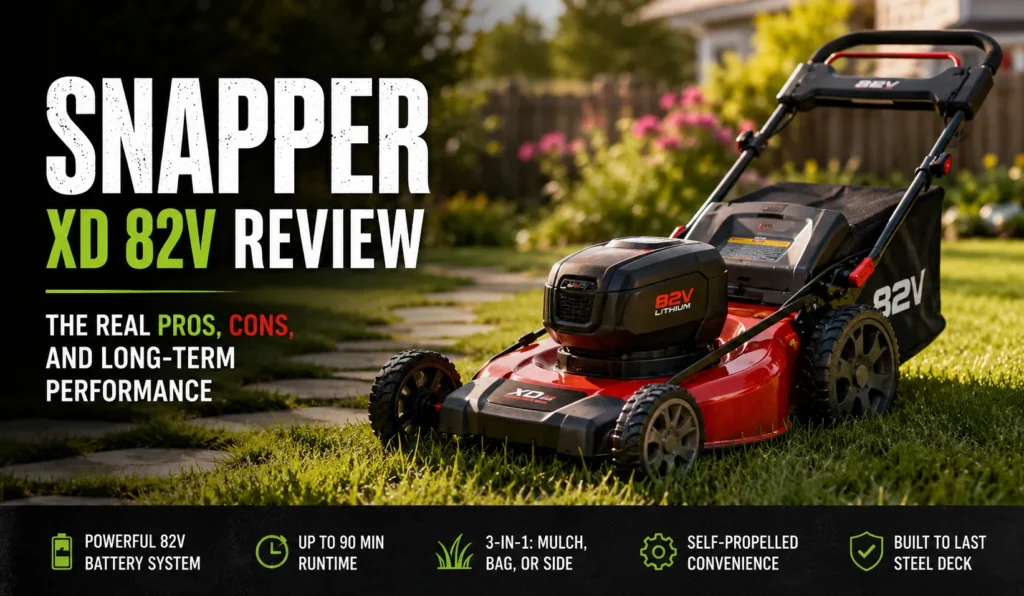
My old gas mower quit on a Saturday morning in July. I yanked the pull cord twice. It snapped clean off in my hand.
My neighbor was mowing his own lawn at the same time. I could barely hear his mower over my own swearing. That quiet hum is what sent me looking at battery mowers, and the Snapper XD 82V kept showing up at the top of every list.
I bought one. I used it for months, across three states and three very different lawns. This Snapper XD 82V review is not a sales pitch. I’ll tell you what worked, what didn’t, and where it struggled.
This review is for homeowners who are tired of gas but not ready to spend a thousand dollars on a mower. If you have a small to medium yard and want a straight answer about battery power, keep reading.
Why I Decided to Test the Snapper XD 82V
I didn’t switch to battery power overnight. I tried three other brands first. Here’s why the Snapper XD 82V earned a real spot in my garage.
First Impressions Out of the Box
The Snapper XD 82V comes mostly assembled. I snapped the handle into place and clipped on the bag in about ten minutes.
The steel deck feels solid. At right around 60 pounds, it’s not the lightest mower I’ve used. It doesn’t feel cheap, either. The handle has a comfortable foam grip that didn’t dig into my palms.
Inside the box: two 2.0Ah batteries, a rapid charger, the bagger, and a mulch plug. That’s real value, since some competitors sell the mower and battery separately.
One thing surprised me. The push-button start worked on the first try, every single time. No priming. No choke. No three pulls before it catches. I pressed the button, squeezed the safety bar, and the blade spun up in under a second.
My first weak spot showed up fast, though. The plastic battery door felt a little flimsy. I worried it might crack if I forced it shut the wrong way. Mine has held up fine after months of use, but I’m gentle with it now.
Is It Powerful Enough for a Real Lawn?
Yes. The Snapper XD 82V has enough power for most home lawns. It handled my quarter-acre yard in Georgia without bogging down.
The brushless motor is the reason why. Brushless motors run cooler and last longer than the older brushed motors found in cheaper mowers. Snapper also uses load-sensing tech that ramps up blade speed the moment it senses thicker grass.
I tested this on a patch I’d let grow too long. The blade slowed for a second. Then the load sensor kicked in, and it powered through. No stalling.
It lost a little ground in deep, wet grass after a storm. I had to slow my pace and make two passes instead of one. A gas mower with a bigger engine would have plowed through faster.
For a typical suburban yard under half an acre, this is enough mower. If you’re cutting thick St. Augustine grass in South Florida every two weeks instead of one, you might want a bigger deck or more battery capacity.
Key Specs and Features Explained
Specs only matter if you know what they mean for your yard. Here’s what each number actually does.
Battery Voltage and Runtime
The Snapper XD 82V runs on a Briggs & Stratton 82V battery platform. That 82V number is the maximum voltage, measured with no load. The real working voltage, called nominal voltage, is 72V.
This matters because every cordless brand games this number a little. EGO calls its batteries 56V. Greenworks uses 80V. Ryobi sticks with 40V. None of these numbers compare directly to each other, since each brand measures voltage differently.
What matters more is amp-hours, which measure how much energy a battery actually holds. My kit came with two 2.0Ah batteries. Snapper’s own spec sheet lists up to 45 minutes of runtime per 2.0Ah battery, or up to 90 minutes total if you swap in the second one partway through.
In real use, I got close to that number. My first battery ran dry around the 40-minute mark, mowing at a normal walking pace. Bigger 4.0Ah and 5.0Ah batteries are sold separately if you want longer runtime without swapping mid-mow.
Cutting Width and Deck Size
The Snapper XD 82V comes with a 19-inch or 21-inch steel deck, depending on the kit. Mine is the 21-inch model.
A wider deck means fewer passes across your yard. On my quarter-acre lot, the 21-inch deck cut my mowing time by what felt like a real ten minutes, compared to a 19-inch push mower I used at my old house.
The deck is steel, not plastic. That matters for durability. Plastic decks tend to crack or flex over time, especially after hitting a rock or a root.
One small complaint: the deck sits a little lower to the ground than some 21-inch competitors. I scraped it once on a tree root I didn’t see. No real damage, but it got my attention.
Self-Propelled Drive System
The self-propelled version of the Snapper XD 82V uses a variable speed, rear-wheel drive. Squeeze the bar on the handle, and the mower pulls itself forward.
Some 21-inch models add Snapper’s StepSense system. It senses your walking pace and matches the mower’s speed to it automatically. I tested the StepSense version, and it cut down on the awkward starting and stopping you get with a manual speed dial.
Here’s the honest tradeoff. Self-propelled drive drains the battery faster than a plain push mower. Snapper’s own numbers show the dual-battery StepSense model getting around 60 minutes of runtime, against up to 90 minutes on the push-only version with the same two batteries.
My biggest gripe with the drive system is sharp turns. Ease off the self-propel lever too late before a tight corner, and the rear wheels can lock up for a second. It happened to me at least once during nearly every mow.
Mulching, Bagging, and Side Discharge
The Snapper XD 82V is a 3-in-1 mower. You can mulch clippings back into the lawn, bag them, or send them out the side, all from the same deck.
Switching modes takes under a minute. Pull off the bagger, snap in the side discharge chute or the mulch plug, and you’re done. No tools needed.
The bagger holds about 1.6 bushels, close to 2 cubic feet of clippings. On a normal mow, that lasted me the whole yard. After two rainy weeks, when the grass grew fast and thick, I emptied it twice.
I lean toward mulching most weeks. It’s one less bag to dump, and my lawn looks a shade greener for it.
Specs Comparison Table: Snapper XD 82V vs. Similar-Class Mowers
Numbers on a spec sheet only tell part of the story, but they’re a fair place to start. Here’s how the Snapper XD 82V stacks up against three mowers in its class.
| Mower | Battery Platform | Deck Size | Runtime (2 batteries) | Height Positions | Approx. Price |
|---|---|---|---|---|---|
| Snapper XD 82V | 82V MAX (72V nominal) | 19″ or 21″ | Up to 90 min push / 60 min self-propelled | 7 | $550-$600 |
| EGO Power+ 21″ SP | 56V ARC Lithium | 21″ | 60-80 min, varies by battery | 6-7 | $500-$700 |
| Greenworks 80V 21″ SP | 80V | 21″ | 45-80 min, varies by battery | 7 | $350-$500 |
| Ryobi 40V HP 21″ SP | 40V HP | 21″ | 70-80 min with two 6.0Ah | up to 10 | $450-$850 |
How the Snapper XD 82V Performed in My Tests
Specs are one thing. Months of actually mowing with it taught me a lot more.
Cutting Quality and Power
The cut from the Snapper XD 82V is even and clean on dry, normal-length grass. I didn’t see streaking or missed patches during regular mowing.
Thicker grass changes the story a little. Once my lawn passed about five inches, a single pass left a few stray blades sticking up. A second pass at a slightly higher setting fixed it every time.
The single-lever height adjustment is genuinely easy. Seven positions cover everything from a tight spring cut to a taller summer cut that helps grass survive heat and drought.
I compared the cut side by side with my old gas mower’s last good mow. I couldn’t tell much difference in quality. The Snapper left slightly bigger mulched clippings, meaning a touch more visible debris right after mowing, but it disappears within a day or two.
If you want a magazine-perfect lawn every week, look at a high-lift blade upgrade. The stock blade here is good, not great, for bagging performance.
Battery Life and Charging Time
My 2.0Ah battery lasted close to 40 minutes before the mower cut out. That’s a few minutes short of Snapper’s advertised 45-minute number, but the grass was slightly damp that day.
Charging time matched the spec sheet closely. A dead 2.0Ah battery hit 50 percent in about 13 minutes and full charge in around 30 minutes. That’s fast enough to top off a battery while putting tools away.
Having two batteries in the kit is the real win. I’d run one dry, swap in the second, and finish the yard without waiting around. By the time I was done, the first battery was already charged for next time.
My one real complaint: most buyers don’t think hard enough about amp-hours before they buy. The included 2.0Ah batteries are fine for a small yard. Anything over a third of an acre, and you’ll want a 4.0Ah or 5.0Ah upgrade, or you’ll be swapping batteries mid-mow more than you’d like.
Noise Level and Comfort
The Snapper XD 82V is quiet enough to hold a normal conversation while it’s running beside you. It sounds close to a kitchen blender, not a power tool.
Compared to my old gas mower, this is the biggest single upgrade. No more shouting over the engine. No ringing in my ears after a long mow. My neighbor in Minnesota didn’t even look up from his coffee when I started mowing at 8am on a Saturday.
Comfort-wise, the handle height adjusts, and the foam grip stays comfortable even after an hour of mowing. The mower weighs around 60 pounds, which you feel a little when lifting it into a truck bed or over a curb, but it pushes and self-propels easily across flat ground.
My one comfort complaint is vibration. On bumpy ground, you’ll feel some buzz through the handle. It’s not painful, just noticeable after a long session.
Comparison Table: Snapper XD 82V vs. EGO, Greenworks, Ryobi
Noise, comfort, and real-world cutting feel are harder to put on a spec sheet. Here’s how my time with each brand compares.
| Mower | Noise Feel | Cutting Feel | Self-Propel Feel | Honest Drawback |
|---|---|---|---|---|
| Snapper XD 82V | Quiet, blender-like hum | Even cut, struggles slightly in thick wet grass | Smooth, sticks on sharp turns | Replacement blades harder to find locally |
| EGO Power+ 21″ SP | Among the quietest tested | Strong torque, handles thick grass well | Touch Drive feels the most natural | Larger batteries cost extra |
| Greenworks 80V 21″ SP | Slight whine under heavy load | Fine on normal grass, less torque on thick patches | Rear-wheel drive feels jerky at full speed | Shorter runtime on a single battery |
| Ryobi 40V HP 21″ SP | Comparable hum to Snapper | Strong with the CrossCut blade option | Smooth, easy speed control | Heavier feel at full battery load |
How It Held Up in Real Conditions
I moved this mower between three states over several months. Each lawn told a different story.
Hot and Humid Climates (Florida, Texas, Southeast)
I ran the Snapper XD 82V through a full summer in North Florida. Humidity sits above 80 percent most July mornings there, and the grass grows fast.
Heat didn’t slow the mower down the way I expected. The battery management seemed to handle the temperature fine. I never had a battery overheat or shut off mid-mow, even mowing at noon a few times when I should have known better.
St. Augustine grass, common across Florida lawns, grows thick and a little wiry. The Snapper handled it, but clippings clumped under the deck faster than on drier grass up north. I cleared the underside of the deck about every third mow instead of every fifth.
Humidity is rough on batteries in general, not just this one. Snapper recommends storing batteries somewhere cool and dry, which is easier said than done in a Florida garage in August. I started keeping mine inside the house during the worst weeks, just to be safe.
Dry and Rocky Terrain (Southwest, Arizona)
Phoenix summers bring a different kind of hard. Less grass to cut, but more dust, dirt, and loose rock.
I tested the Snapper on a small Bermuda grass yard outside Phoenix. Bermuda grass turns brown and goes dormant in extreme heat, so there wasn’t much to cut most weeks. When it did need a trim, the dry grass actually mowed faster than wet Southeast grass.
Dust was the real challenge. It worked into the wheel housings faster than I expected, so I brushed out the underside of the deck almost every time. A small rock kicked up once and left a tiny scuff on the deck. Nothing serious.
Battery performance held up better than I expected in the dry heat. Lithium batteries generally dislike high temperatures, and Arizona afternoons regularly hit 110 degrees. I made a point of mowing before 8am and storing batteries indoors between uses. That kept things running normally.
Thick Grass and Midwest Lawns
Minnesota lawns grow fast in late spring, especially after a wet stretch in May. This is where the Snapper XD 82V worked the hardest.
Kentucky bluegrass, the standard grass type across much of the Midwest, came in thick after two weeks of rain kept me from mowing. The first pass through grass that tall pushed the load sensor hard. I could hear the motor pitch change as it worked to keep blade speed up.
It got through, but slower than I wanted. I raised the deck to its highest setting for the first pass. A few days later, I dropped the height for a clean second pass. That two-step approach saved the battery and gave a tidier finish.
Cold mornings were a non-issue. I mowed a few times at 7am with frost still melting off the grass, and the battery never struggled to start or hold a charge in the cool air. The Snapper handled chilly Midwest mornings better than it handled Florida heat.
Performance Comparison Table
Climate changes what matters most in a mower. Here’s a side-by-side look at how each one handled the conditions I tested.
| Condition | Snapper XD 82V | EGO Power+ | Greenworks 80V | Ryobi 40V HP |
|---|---|---|---|---|
| Hot, humid grass (FL, TX) | Handles well, needs deck cleared more often | Strong torque cuts through easily | Slightly more strain on thick blades | Holds up well, CrossCut helps mulching |
| Dry, dusty terrain (AZ) | Fine, watch dust in wheel housings | Fine, housing keeps dust out a bit better | Fine, lighter deck kicks up less dust | Fine, heavier build resists dust |
| Thick spring grass (Midwest) | Works hard, two-pass method helps | Higher-torque models handle one pass better | Often needs two passes | Strong single-pass performance |
Common Mistakes People Make When Buying the Snapper XD 82V
I made a couple of these mistakes myself before I learned better. Here’s what to watch for.
Buying the Wrong Battery Size for Your Yard
The biggest mistake is buying the base 2.0Ah battery kit for a yard bigger than a quarter acre. You’ll be swapping batteries constantly, and that gets old fast.
I learned this the hard way on my first big mow in Georgia. My quarter-acre yard ate through a 2.0Ah battery before I finished the back half. Lawn size is the single biggest factor in which battery you actually need, more than any other spec on the box.
If your yard is under a quarter acre, the standard 2.0Ah two-pack is fine. Between a quarter and half acre, upgrade to 4.0Ah batteries. Over half an acre, go with 5.0Ah batteries or a different mower class entirely.
Ignoring the Charging Time
The second mistake is assuming you can mow, recharge in ten minutes, and mow again. That’s not how lithium batteries work.
A 2.0Ah battery needs a full 30 minutes to charge completely, even with the rapid charger. A 4.0Ah battery takes about an hour. If you only own one battery and plan back-to-back yard sessions, you’ll be waiting around.
I plan my mowing day around the charger now. I charge both batteries the night before, and I never start mowing on a battery I haven’t checked first. It sounds obvious, but I forgot once and got stuck halfway through a lawn with a dead battery and no backup ready.
My Final Recommendation
After months of mowing with the Snapper XD 82V across three states, I’d buy it again. It’s not the most powerful battery mower on the market, and it’s not the cheapest, but it sits in a sweet spot that works for most home lawns.
The biggest strength is the value of the kit. Two batteries and a rapid charger come included, at a price that beats buying an EGO or Ryobi setup with similar capacity sold separately. The brushless motor and steel deck feel built to last, and the Briggs & Stratton name carries real weight in outdoor power equipment.
The biggest weakness is runtime on the base battery, plus the slightly clunky feel on sharp turns with the self-propelled drive. If you have a yard over half an acre, or you mow a lot of thick, wet grass, budget for bigger batteries from day one. Don’t expect the included 2.0Ah batteries to handle a big lawn in one pass.
I’d recommend the Snapper XD 82V to anyone with a quarter to half-acre lawn who wants to ditch gas without spending top dollar. A smaller, postage-stamp yard probably doesn’t need this much mower. A sprawling, acre-plus lawn calls for a riding mower instead. For everyone in between, this one earned its spot in my garage.
Pros and Cons Table
Here’s the short version of everything above, sorted into what worked and what didn’t.
| Pros | Cons |
|---|---|
| Two batteries and a rapid charger included in most kits | Base 2.0Ah batteries run out fast on yards over a quarter acre |
| Steel deck and brushless motor feel built to last | Self-propel can stick on sharp turns |
| Quiet enough for early morning mowing | Replacement blades can be hard to find locally |
| Push-button start works every time | Noticeable vibration through the handle on bumpy ground |
| Backed by Briggs & Stratton’s reputation | Plastic battery door feels a little flimsy |
Frequently Asked Questions About the Snapper XD 82V
How long does the Snapper XD 82V battery last?
A single 2.0Ah battery runs close to 40-45 minutes under normal mowing conditions. Heavier grass or hot weather can shorten that. The rapid charger refills a 2.0Ah battery to full in about 30 minutes.
Is the Snapper XD 82V powerful enough for thick grass?
Yes, for most home lawns. The load-sensing brushless motor handles moderately thick grass without stalling. Very tall or wet grass may need a slower pace or a second pass at a higher height.
How does the Snapper XD 82V compare to the EGO Power+?
EGO’s higher-end models offer more cutting torque and longer runtime with larger batteries, but cost more for the same capacity. The Snapper XD 82V wins on included battery value, since most kits already come with two batteries and a charger.
What size yard is the Snapper XD 82V best for?
It works best for lawns between a quarter acre and half an acre. Smaller yards may not need this much mower, and yards over half an acre will need extra batteries or more swapping mid-mow.
Can I use Snapper XD 82V batteries on other tools?
Yes. The 82V MAX batteries work across Snapper’s XD lineup, including trimmers and blowers built on the same battery platform. That makes the battery investment go further if you add more cordless yard tools later.
Does the Snapper XD 82V work well in hot or humid climates?
In my testing across Florida and Arizona, the battery and motor handled heat well, as long as I avoided storing batteries in a hot garage. Mowing early in the day and keeping batteries indoors between uses kept performance consistent.