
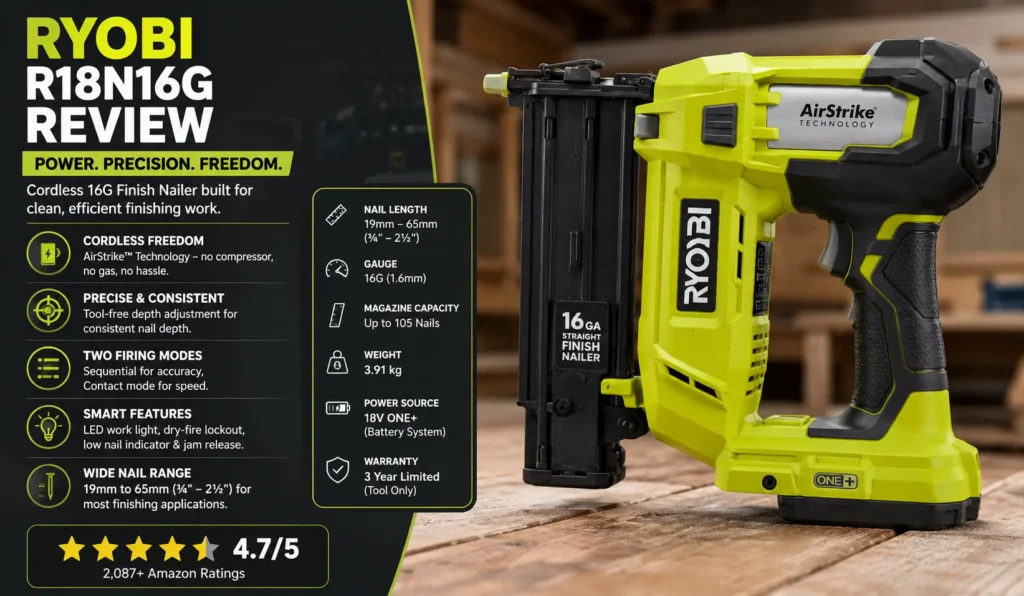
If you’ve been searching for a reliable cordless finish nailer, the Ryobi R18N16G review results are hard to ignore — this tool keeps coming up at the top. I picked one up after months of wrestling with my old air compressor setup, and honestly, it changed the way I tackle finishing projects around the house. Whether you’re a weekend DIYer or a seasoned woodworker, keep reading because I’m sharing everything I’ve learned from using this nailer hands-on.
Table of Contents
- Quick Overview: Ryobi R18N16G Review at a Glance
- Key Specifications
- What I Like About the Ryobi R18N16G
- What Could Be Better
- My Personal Experience with the Ryobi R18N16G
- Comparing With Other Brands
- Ryobi R18N16G vs Milwaukee M18 vs DeWalt DCN660: Quick Comparison
- Who Should Buy It? Recommendation
- FAQs for Ryobi R18N16G Review
Quick Overview: Ryobi R18N16G Review at a Glance
The Ryobi R18N16G is a cordless 16-gauge finish nailer powered by Ryobi’s 18V ONE+ battery system. It uses AirStrike technology — no compressor, no gas cartridge, no hose. Just grab the tool, load your nails, and go. It fires nails from 19mm (¾ inch) all the way up to 65mm (2½ inch), making it flexible enough for baseboards, door casings, crown molding, cabinet work, and furniture projects.
The tool is sold as body only, so you’ll need a compatible 18V ONE+ battery and charger. If you’re already in the Ryobi ecosystem, this is a no-brainer addition. If you’re coming from another brand, a battery adapter could make this work for you — some Milwaukee users have done exactly that with great results.
At around £125 (often on sale), this nailer delivers performance that competes with tools costing two to three times as much.
Key Specifications
| Specification | Detail |
|---|---|
| Model | R18N16G-0 |
| Gauge | 16G (1.6mm) |
| Nail Length Range | 19mm – 65mm (¾” – 2½”) |
| Power Source | 18V DC (Ryobi ONE+ battery) |
| Firing Modes | Sequential (precision) + Contact/Bump (rapid) |
| Weight | 3.91 kg |
| Dimensions | 36.6 × 11 × 33 cm |
| Magazine Capacity | Up to 105 nails |
| LED Work Light | Yes (grip-activated) |
| Dry-Fire Lockout | Yes |
| Tool-Free Jam Release | Yes |
| Depth Adjustment | Tool-free dial |
| Rating (Amazon) | 4.7/5 stars (2,087+ reviews) |
| Sold As | Body only (no battery or charger) |
What I Like About the Ryobi R18N16G
No Compressor, No Fuss — Real Freedom
The biggest win with the Ryobi R18N16G is the freedom it gives you. I used to drag an air compressor and a coil of hose into every room. Setting up took longer than the actual nailing. With this nailer, I just grab the tool and go. I’ve used it in the garage, in the bedroom fitting new baseboards, and out in the garden building a raised bed frame — no extension cord, no compressor noise, no lugging equipment. That alone is worth a lot.
AirStrike technology eliminates the need for a gas cartridge too, which is something I genuinely appreciate. Gas-powered nailers are expensive to run over time. This one just needs a charged battery.
Surprisingly Consistent Nail Depth
One thing that drives me crazy with cheap nailers is inconsistent depth. You drive twenty nails and half of them are proud, half are sunken — you spend more time filling holes than working. The Ryobi R18N16G has been remarkably consistent for me. The tool-free depth adjustment dial is smooth and easy to set. Once I dialled it in for my softwood trim, every nail went in at the same depth. On harder wood it took a slight power adjustment, but again, the dial made that quick.
I tested it on thin backing board too — some nails were sitting just a hair proud, which is something to watch on very light-duty work at low power settings. But on standard trim and cabinet work? Spot on, every time.
Two Firing Modes That Actually Help
The sequential (single fire) mode is great for precise placement — you line up the nose exactly where you want it, press the safety against the work surface, and pull the trigger. One nail, exactly where you want it. This is what I use for mitre joints and tight corners.
The contact (bump) mode is where the speed comes in. You hold the trigger and just press the nose against the work repeatedly. I used this to run a long baseboard quickly and it was satisfying. The firing delay is a little longer than an air gun — I’ll be honest about that — but it’s not a dealbreaker at all. You get used to the rhythm quickly.
The Grip-Activated LED Light Is Genuinely Useful
I did not expect to love this feature as much as I do. The LED activates just by gripping the handle. No button to press. When I’m working in a dark corner of a cabinet or under a staircase, that little light makes a real difference for lining up the nailhead accurately. It’s a small thing but it shows thoughtful design.
Nail Range That Covers Most Finishing Work
Going from 19mm to 65mm covers the vast majority of finish carpentry work. In the US, that’s roughly ¾ inch to 2½ inch — which lines up with common brad nailer and finish nailer nail sizes used for baseboards, chair rails, window and door casings, wainscoting, and cabinet installation. I’ve used both 25mm (1 inch) nails for thin panels and 50mm (2 inch) nails for thicker trim without any issues. The magazine loading is simple — press the release button, slide the channel back, drop the nails in, and release. Easy.
Built Into the Ryobi ONE+ Ecosystem
If you already own any Ryobi 18V ONE+ tool, your battery works here. The ONE+ system now covers hundreds of tools, from drills to circular saws to garden tools. In the US, Ryobi is widely available at Home Depot, which makes battery and charger availability easy. Having one battery platform across all your tools is a huge convenience and a real money saver over time.
Dry-Fire Lockout and Low Nail Indicator
These two safety and convenience features matter more than you’d think. The dry-fire lockout stops the tool from firing when the magazine runs empty, which protects both the work surface and the mechanism. The low nail indicator gives you a visual heads-up before you run out mid-run. It’s the kind of detail that makes a tool feel professional.
What Could Be Better
It’s Heavy — No Getting Around That
The Ryobi R18N16G weighs 3.91 kg with a battery. That is significantly heavier than a comparable pneumatic nailer. If you’re driving nails overhead — crown molding, ceiling trim, soffit work — your arms will feel it after a while. I’ve done extended overhead sessions and honestly, it’s tiring. A pneumatic nailer, even accounting for dragging the hose, is noticeably lighter in the hand.
If most of your work is at eye level or below, this isn’t a real problem. But for overhead-heavy projects, just be aware.
The Firing Speed Is Slower Than Air
This is a known characteristic of battery-powered AirStrike nailers, not a defect. But I want to be upfront: if you’re used to an air nailer where you can fire as fast as your wrist moves, this will feel slower. There is a brief cycle time between shots. In bump mode it’s faster, but still not air-gun speed.
For most home woodworking and DIY finishing work, this doesn’t matter. You’re not running production lines. But if you’re on a large commercial project driving hundreds of nails rapidly, the speed difference is worth considering.
It Cannot Stand Upright
This one genuinely puzzles me as a design choice. The nailer has no flat surface to stand on. If you set it down on a workbench, it tips to one side. You have to lay it flat. It’s not a safety issue, just a mild inconvenience that you’d hope a tool at this price point would solve.
Sold Without Battery or Charger
The “body only” format is standard in the cordless tool industry, but it still adds cost if you’re new to the Ryobi platform. A 4Ah 18V ONE+ battery will add roughly £40–60 to the purchase. If you’re in the US and shopping at Home Depot, Ryobi frequently runs bundle deals that soften this. Just factor it into your budget if you’re starting fresh.
Soft Wood Can Over-Sink on Lower Settings
On very soft wood — pine, MDF, thin ply — even the lowest power setting can sink nails a millimetre or two deeper than you might want. This isn’t a massive issue since those surfaces typically get filled and painted anyway, but for natural wood with no finish planned, you’ll need to be a little careful with depth adjustment calibration.
My Personal Experience with the Ryobi R18N16G
I first picked up the Ryobi R18N16G to build a light box for my wife — a small project with thin timber and MDF backing board. I’d been using an 18-gauge air nailer with a compressor for years, so I was sceptical about whether a battery-powered nailer could match it for feel and reliability. What I found surprised me.
Here’s what stood out across various jobs I’ve used it for:
- Light box build (thin MDF and pine): On the lowest power setting, the nails sat beautifully flush. No tearout, no over-sink on the faces. I was done in under 20 minutes with no hose in my way.
- Baseboard installation (softwood skirting boards): Loaded up with 50mm (2-inch) nails. The bump firing mode let me work quickly along a long wall. Every nail landed consistently. I adjusted depth once and didn’t touch it again.
- Harder hardwood trim test: I cranked the power up and used 65mm nails on some denser wood. The nailer handled it well, though I could feel the tool working harder. The nail seated fully with no blow-through.
- Backing board (thin ply, light duty): This is where I’d say be careful. At low power the nails were sitting just slightly proud — maybe half a millimetre. Not a deal-breaker but worth a test nail before committing to a long run.
- Overhead crown molding: This is where the weight becomes noticeable. I took breaks more often than I would with my air gun. Not a flaw, just physics.
- Using it in bump mode for the first time: I was nervous the tool would double-fire or skip. It didn’t. Every press of the nose drove one clean nail.
- LED light in a dark cabinet: Genuinely one of my favourite features. Saved me from having to hold a torch and a nailer simultaneously.
- Jam clearance: I haven’t had a single jam yet. The tool-less release mechanism is there if I need it, but it hasn’t been called into service.
- Battery life: I’ve run two full afternoons of finish nailing on a single 4Ah charge without running out. Very impressed.
- Compared to my air nailer: The air gun is faster and lighter. But this nailer goes places the air gun can’t — and it’s quieter than you’d expect.
Overall, this nailer has earned a permanent place in my toolkit. I’d confidently recommend it to anyone doing home improvement, woodworking, or finish carpentry. It removed the friction from every project I’ve taken on since buying it.
Comparing With Other Brands
I’ve also used the Milwaukee M18 fuel nailer and, briefly, the DeWalt DCN660 cordless finish nailer on a friend’s job site. Both are capable tools — but the price difference is substantial. The Milwaukee M18 brad nailer runs around £360 as a bare tool and has a notably inconsistent reputation in user reviews, with recurring reports of misfires and depth inconsistency. The DeWalt DCN660 is better regarded but sits in a similar premium price tier. Neither offers meaningful performance advantages for typical DIY and light professional finishing work that would justify their cost premium over the Ryobi.
If you’re heavily invested in the Milwaukee M18 or DeWalt 20V platform and need to share batteries, those nailers make sense. But if you’re open to the Ryobi ONE+ system — or can use a battery adapter as some Milwaukee users have done — the R18N16G is a genuinely excellent value proposition.
Ryobi R18N16G vs Milwaukee M18 vs DeWalt DCN660: Quick Comparison
| Feature | Ryobi R18N16G | Milwaukee M18 Fuel Brad Nailer | DeWalt DCN660 |
|---|---|---|---|
| Gauge | 16G | 18G | 16G |
| Nail Range | 19–65mm (¾”–2½”) | 15–50mm (⅝”–2″) | 32–64mm (1¼”–2½”) |
| Battery Platform | Ryobi 18V ONE+ | Milwaukee M18 | DeWalt 20V MAX |
| Firing Modes | Sequential + Contact | Sequential + Contact | Sequential + Contact |
| Weight (approx) | 3.91 kg | 2.9 kg | 3.4 kg |
| Tool-Free Depth Adjust | Yes | Yes | Yes |
| Dry-Fire Lockout | Yes | Yes | Yes |
| LED Work Light | Yes (grip-activated) | Yes | Yes |
| Approx. Bare Price (UK) | ~£125 | ~£360 | ~£280 |
| Approx. Bare Price (US) | ~$159 | ~$349 | ~$249 |
| User Rating | 4.7/5 (2,000+ reviews) | 3.8/5 | 4.5/5 |
| Reliability Reports | Excellent | Mixed (misfire reports) | Good |
| Best For | DIY, home improvement, ONE+ users | Milwaukee platform users | DeWalt platform users |
Ryobi R18N16G vs DeWalt DCN660: Nail Spec Comparison
| Spec | Ryobi R18N16G | DeWalt DCN660 |
|---|---|---|
| Gauge | 16G (1.6mm) | 16G (1.6mm) |
| Min Nail Length | 19mm (¾”) | 32mm (1¼”) |
| Max Nail Length | 65mm (2½”) | 64mm (2½”) |
| Lower End Flexibility | Better — handles shorter nails | Limited — minimum 32mm |
| Price Advantage | ~£155 cheaper (bare tool) | — |
| Platform | Ryobi ONE+ | DeWalt 20V MAX |
Ryobi R18N16G vs Milwaukee M18 Brad Nailer: Value Comparison
| Factor | Ryobi R18N16G | Milwaukee M18 Brad Nailer |
|---|---|---|
| Price (bare, UK) | ~£125 | ~£360 |
| Price (bare, US) | ~$159 | ~$349 |
| Gauge | 16G | 18G |
| Reliability | Excellent (no misfire reports) | Mixed reviews |
| User Score | 4.7/5 | ~3.8/5 |
| Value Verdict | Outstanding | Overpriced for the reliability |
The numbers here are striking. For the price of one Milwaukee bare nailer, you could buy the Ryobi nailer AND a 4Ah battery AND a charger and still have money left over. That’s not a small gap.
Who Should Buy It? Recommendation
Buy the Ryobi R18N16G if you:
- Already own Ryobi 18V ONE+ batteries and tools
- Do regular finish carpentry work — baseboards, door casings, crown molding, cabinet installation
- Want to eliminate your air compressor setup for lighter jobs
- Are a US-based DIYer who shops at Home Depot (Ryobi’s US primary retailer — bundles are frequently on sale)
- Want outstanding reliability without spending £300+
- Work in spaces where running a compressor and hose is inconvenient
- Do varied nail sizes from thin panel work up to thick trim
Do more research before buying if you:
- Are a professional carpenter running high volumes of nails per day — the firing delay may slow your workflow compared to a pneumatic setup
- Do heavy overhead work for extended periods — the weight is real and will tire your arms
- Are deeply invested in Milwaukee M18 or DeWalt 20V MAX and have no interest in another platform (though a battery adapter is an option)
- Need an 18-gauge nailer specifically for brad nail work on very delicate trims — the 16-gauge is slightly more aggressive
A note for US buyers:
In the US, the Ryobi R18N16G-0 is available on Amazon and at Home Depot. US pricing sits around $159 for the bare tool, which is excellent value for a 16-gauge cordless finish nailer. The Ryobi ONE+ platform has deep availability at Home Depot stores nationwide, making it easy to pick up batteries, chargers, or replacement nails locally. Ryobi USA also runs frequent promotional bundles — check Home Depot’s site before buying bare, as a battery kit deal may be only a few dollars more.
My honest take: I went in hoping this would be “good enough” to replace my compressor setup for indoor finishing work. It turned out to be better than good enough. It’s genuinely excellent for the price. I’ve now done a light box, full skirting board runs, cabinet installation, and decorative panel work with it — all without touching my compressor once.
FAQs for Ryobi R18N16G Review
Does the Ryobi R18N16G need a compressor?
No. The R18N16G uses Ryobi’s AirStrike technology, which is completely cordless and compressor-free. It runs on any Ryobi 18V ONE+ battery. There’s no air hose, no gas cartridge, and no compressor required. This is the main reason many users switch to it from pneumatic nailer setups.
What size nails does the Ryobi R18N16G use?
It fires 16-gauge (1.6mm) nails from 19mm to 65mm long. In US measurements, that’s ¾ inch to 2½ inch. This range covers most finish carpentry tasks including baseboards, crown molding, door casings, window trims, and cabinet installation.
Is the Ryobi R18N16G sold with a battery and charger?
No. It is sold as a “body only” or “bare tool.” You will need a compatible Ryobi 18V ONE+ battery and charger separately. If you already own any Ryobi 18V ONE+ tool, your existing battery works with this nailer. A 4Ah battery is a good choice for extended use.
How does the Ryobi R18N16G compare to an air nailer?
An air nailer is lighter and fires faster. The Ryobi R18N16G is heavier and has a slight delay between shots. However, the Ryobi wins on portability — no hose, no compressor, no setup time. For most DIY and light professional finishing work, the Ryobi’s convenience easily outweighs the speed difference.
Can I use the Ryobi R18N16G with Milwaukee batteries?
Not directly. The battery connector formats are different. However, some users have successfully used third-party battery adapters to run Milwaukee M18 batteries in Ryobi ONE+ tools. Results vary by adapter brand. For the best experience, using a genuine Ryobi 18V ONE+ battery is recommended. Ryobi’s platform is compatible across all their 18V ONE+ tools, so adding a battery gives you flexibility across the whole range.
What is the firing delay on the Ryobi R18N16G?
There is a short cycle time between shots — noticeably longer than a pneumatic nailer. It’s a characteristic of AirStrike battery-powered nailers, not a defect. In sequential mode it is most apparent. In contact (bump) mode you can fire faster, though still not at pneumatic speed. For DIY and general finishing work, most users find this acceptable and adjust to the rhythm quickly.
Is the Ryobi R18N16G good for crown molding?
Yes, it works well for crown molding. The 16-gauge nail provides good holding power for molding installation, and the depth adjustment helps set the nail correctly without marring the surface. The main consideration is the tool’s weight — extended overhead work will tire your arms more quickly than with a lighter pneumatic nailer. For occasional crown molding on home projects, it’s absolutely suitable.
Final Verdict
The Ryobi R18N16G review verdict is straightforward: this is one of the best value cordless finish nailers on the market right now. It’s not the lightest tool and it’s not the fastest. But it’s reliable, accurate, versatile, and genuinely well built. For anyone in the Ryobi ONE+ ecosystem — or anyone willing to join it — this nailer makes a compelling case for going cordless on your finish carpentry work.
At roughly £125 (or ~$159 in the US), you’re getting a 4.7-star tool with over 2,000 verified reviews behind it. The Milwaukee equivalent costs nearly three times as much and has worse reliability scores. The math on that is hard to argue with.
If you’re ready to ditch the air compressor for your finishing work, the Ryobi R18N16G is the tool to do it with.
Deep Dive: Understanding AirStrike Technology
One of the most common questions I get when people see me using the Ryobi R18N16G is: “How does it work without a compressor?” It’s a fair question. Traditional finish nailers are pneumatic — they use compressed air to drive a piston that pushes the nail into the workpiece. That requires a compressor, a hose, and a regulator. It’s an effective system, but it’s also a system with a lot of parts that can go wrong.
AirStrike technology works differently. Inside the nailer, the 18V battery powers a motor that compresses a small internal air chamber on each firing cycle. When you pull the trigger, that stored compressed air is released rapidly — driving the nail in much the same way a pneumatic system would. The key difference is that the compression happens inside the tool itself, right before each shot.
This is why there’s a slight delay between shots. The tool needs a fraction of a second to recharge the internal chamber. It’s a tiny trade-off for eliminating the entire compressor and hose ecosystem. Once you internalise that rhythm, you barely notice it.
The benefit of this approach over gas-cartridge systems (like those used in some Paslode models) is significant. Gas cartridges cost money, need replacing, require the tool to warm up in cold weather, and produce fumes in enclosed spaces. AirStrike has none of those issues. Cold garage in winter? No problem. Working indoors with limited ventilation? Fine. The only consumable is the nails themselves.
I’ve seen some people dismiss battery nailers as a gimmick compared to pneumatic tools. In my experience, that’s simply not accurate for finishing work. For framing, sheathing, and decking — high-volume, high-force applications — pneumatic still wins on sheer speed. But for finish carpentry? The Ryobi R18N16G is more than capable.
Setting Up the Ryobi R18N16G: First Use Guide
If you’ve just unboxed the R18N16G, here’s how to get up and running quickly.
Step 1: Install your battery. Slide your Ryobi 18V ONE+ battery into the base of the grip until it clicks. The green battery indicator on the battery tells you charge level. Charge it fully before first use.
Step 2: Load your nails. Look for the release button on the side of the magazine. Press it and pull the loading channel back until it locks. Drop your nails into the channel — they’ll slide all the way down. Release the channel and it will feed the first nail into position. The magazine indicator window lets you see how many nails remain.
Step 3: Select your firing mode. There’s a switch on the tool body. One setting is sequential (single fire) — you press the nose against the workpiece, then pull the trigger. The other is contact/bump — you hold the trigger and press the nose repeatedly. Start with sequential until you’re comfortable.
Step 4: Set your nail depth. There’s a dial at the front of the tool near the nose. Turn it to adjust how deep the nail is driven. I always do a test nail in a scrap piece of the same material first. One or two adjustments and you’ll dial it in perfectly.
Step 5: Activate the safety. The tool has a contact safety at the nose — it must be pressed against the work surface before the trigger will fire. This is standard on all finish nailers. Don’t try to fire it in the air; it simply won’t work.
Step 6: Fire your first nail. Press the nose firmly against your workpiece, hold the tool steady, and pull the trigger. The grip-activated LED will light up as soon as you grasp the handle. Your first nail should drive cleanly. Adjust depth if needed.
That’s genuinely all there is to it. No priming, no oiling, no bleeding air lines. Pick it up and work.
Best Use Cases for the Ryobi R18N16G
Having used this nailer across a wide range of projects, I’ve developed a clear picture of where it truly shines and where it does its job well but isn’t necessarily the only option.
Baseboards and Skirting Boards
This is where the R18N16G earns its money. Long runs of skirting board are exactly the kind of work where a compressor and hose become genuinely annoying — you’re moving along a wall, the hose is catching on furniture, you’re constantly repositioning the compressor. With the Ryobi, you walk the room freely. I used 50mm (2-inch) nails for my skirting work and every nail went in flush and consistent. The bump mode made quick work of long straight runs.
Door and Window Casings
Casings require precision. You’re often working in tight spots around door frames, getting into corners, and making sure the nail placement looks intentional. Sequential mode is perfect here. The LED light is a genuine help in the shadows around door openings. A 16-gauge nail gives you solid holding power in casing material without splitting thinner profiles.
Crown Molding
16-gauge nails are ideal for crown molding — they hold the molding firmly against the wall and ceiling without the risk of blow-through that smaller gauge nails can have. The trade-off, as I mentioned earlier, is the weight of the tool on overhead work. Take breaks. Use a prop stick to hold the molding in place rather than holding it with one hand and nailing with the other. That’s good practice with any nailer, not just this one.
Cabinet Installation
Securing cabinet boxes to walls, attaching face frames, and tacking trim details are all well within the R18N16G’s comfort zone. I used it to install a run of kitchen cabinets and the tool made the process noticeably quicker and cleaner than pre-drilling and screwing. Combined with some construction adhesive, the results are solid.
Chair Rails and Dado Rails
These shorter, horizontal trim pieces are a perfect match for this nailer. The 16-gauge nail holds well in wall studs and the depth control means you won’t blow through thinner rail profiles. In the US, chair rails and wainscoting are common DIY projects and this nailer handles them effortlessly.
Furniture Building and Repair
For furniture work — assembling carcasses, attaching backs, tacking on mouldings — the R18N16G works well at the smaller nail sizes (19–32mm range). The lower power settings give you control to avoid splitting thinner components.
Light Structural Work in a Pinch
While this is primarily a finish nailer and not a framing nailer, the 65mm maximum nail length does give you some capability for light structural assembly — attaching timber battens, building lightweight frames for garden structures, that kind of thing. Don’t use it in place of a framing nailer for anything load-bearing, but for garden projects and workshop builds, it’s a handy addition to its finishing capabilities.
Nail Buying Guide for the Ryobi R18N16G
The R18N16G uses standard 16-gauge straight finish nails. These are widely available in the UK and US, in a range of lengths. Here’s a quick guide to choosing the right nail for the job:
| Nail Length | Best Used For |
|---|---|
| 19mm (¾”) | Very thin trim, panel edging |
| 25mm (1″) | Thin backing boards, light panels |
| 32mm (1¼”) | Standard door casings, light skirting |
| 38mm (1½”) | Heavier casings, dado rails, chair rails |
| 50mm (2″) | Skirting boards, window architraves, cabinet faces |
| 65mm (2½”) | Crown molding into studs, thick timber trim |
In the UK: Brands like Tacwise, DeWalt, and Paslode make compatible 16-gauge straight nails widely available at Screwfix, B&Q, and Amazon.
In the US: Hitachi (now Metabo HPT), Bostitch, and Senco all make compatible 16-gauge finish nails available at Home Depot and Lowe’s. Look for “16G DA angle” nails — the R18N16G uses straight magazine nails, so confirm “straight” or “DA” angle before buying.
Galvanised nails are a good choice for any work near exterior walls or in humid environments like kitchens and bathrooms, as they resist rust better than plain steel.
Long-Term Reliability: What to Expect
The Ryobi R18N16G has over 2,000 reviews on Amazon with a 4.7-star average — that’s exceptional for a power tool. The most common themes in positive reviews are consistency, no misfires, and excellent value. Negative reviews typically focus on the weight and the firing speed delay, both of which I’ve discussed honestly above. What’s notable is the relative absence of mechanical failure reports — users aren’t returning these tools because they broke; they’re complaining about characteristics that are inherent to the design.
For long-term care, the main considerations are:
- Keep the magazine clean. Sawdust and debris can cause feeding issues. A quick brush-out every few sessions keeps things running smoothly.
- Store with the battery removed. Don’t leave the battery in the tool during long storage. This preserves battery life.
- Use quality nails. Cheap nails can have inconsistent heads or shanks that cause feed issues. Stick to reputable brands.
- Lubricate occasionally. A tiny drop of light machine oil at the driver tip every 50,000 nails or so (or whenever the tool feels sluggish) keeps the mechanism smooth. Check your manual for the recommended lubrication point.
- Check the nose for wear. The non-marring pads on the nose tip protect your work surface. Two are included with the tool. Replace them if they become damaged or compressed.
I’ve put this tool through a lot of use in a relatively short time and haven’t needed any maintenance beyond keeping the magazine clean. Based on both personal use and the broader review record, reliability looks solid.
Is the Ryobi R18N16G Worth It for Professionals?
I want to address this honestly. The Ryobi R18N16G is an outstanding consumer and prosumer tool. For DIYers, hobbyist woodworkers, and light trade use, it’s genuinely excellent. For full-time professional finish carpenters driving several thousand nails a week, there are factors to consider.
Where it holds up professionally:
- Consistent depth and nail placement — professional-grade accuracy
- Dry-fire lockout prevents surface damage — important on client sites
- Cordless freedom is genuinely valuable when working across a home renovation
- The battery ecosystem is deep enough to support an all-Ryobi cordless workflow on site
Where professionals might want more:
- Firing speed — high-volume production finishing will feel slow compared to pneumatic
- Weight over a full working day will fatigue experienced nailers used to lighter air tools
- The brand perception in some professional circles, though this is changing as the tool’s performance becomes better known
For a solo contractor, remodeller, or someone running a small finishing business, I’d argue the Ryobi R18N16G is entirely viable — especially if you’re already on the ONE+ platform or running projects where compressor portability is a challenge. For a large crew doing production finish work? You’ll want pneumatic for the volume throughput.
In the US, Ryobi has made significant inroads among small contractors precisely because the tool quality has improved so dramatically while the price remains accessible. The “Ryobi is just for homeowners” narrative is increasingly outdated.
Environmental and Noise Considerations
Two factors that don’t get discussed enough in tool reviews: noise and environmental impact.
The Ryobi R18N16G is significantly quieter than running a compressor. A typical portable air compressor runs at 70–90 decibels — loud enough to require hearing protection and annoying to neighbours. The nailer itself makes a sharp crack on each shot, but without the continuous compressor motor noise, the overall working environment is much quieter. This matters when working in occupied homes, on renovation projects near neighbours, or in noise-restricted areas.
From an environmental standpoint, the AirStrike approach eliminates gas cartridges, which are single-use items that go to landfill. Battery-powered tools have their own environmental footprint (lithium battery production and disposal), but a battery that powers dozens of tools over many years is far more resource-efficient than hundreds of individual gas cartridges.
Accessories and Add-Ons Worth Considering
A few things that pair well with the R18N16G:
Ryobi 18V ONE+ 4Ah Compact Battery: The 2Ah battery will power the nailer but you’ll run out of charge faster. A 4Ah battery is the sweet spot — lightweight enough not to add much to the tool’s weight, but with enough capacity for a full day of finish nailing on most projects.
Ryobi Rapid Charger: The standard charger is fine. The dual-port rapid charger is worth the upgrade if you have multiple ONE+ tools — you can rotate batteries quickly on busy project days.
Nail Punch / Nail Set: For any nails that sit slightly proud after driving, a nail punch lets you tap them below the surface cleanly before filling. Keep one in your apron pocket on finishing days.
Wood Filler: Coloured wood fillers in a range of shades are your best friend on natural wood trim. Once you’ve driven the nails, fill and sand — the marks disappear completely.
Non-Marring Pads (spares): The R18N16G includes two. Pick up a spare pair — they wear down with heavy use and the last thing you want is tool marks on a freshly painted casing.
Common Mistakes to Avoid
After using this nailer extensively and reading through hundreds of user reviews, these are the mistakes that come up most often:
Not doing a test nail on scrap first. Every material behaves differently. Always dial in your depth on a matching scrap piece before committing to the actual workpiece.
Using worn or mixed nails. Mixing nail lengths in the magazine causes feed problems. Load one size at a time and clear the magazine when switching.
Holding the trigger before pressing the nose. In sequential mode, the safety must contact the surface before the trigger fires. Some people pull the trigger and then press — the shot won’t go off. Press the nose first, then trigger.
Not checking battery charge before a session. Nothing more frustrating than stopping mid-run because the battery died. Charge before you start.
Pressing too lightly against the workpiece. The contact safety needs firm pressure to activate. Press the nose confidently against the surface — don’t be tentative. A light touch can cause misfires or partial drives.
Using the wrong nail angle. Some 16-gauge nails are angled (DA type) and some are straight. The R18N16G uses straight 16G nails. Angled nails will not feed correctly.
The Final Word on the Ryobi R18N16G
The Ryobi R18N16G review conclusion is simply this: buy it. If you do any kind of finish carpentry — regularly or occasionally — this nailer makes that work easier, faster, and less stressful. The cordless freedom is real. The reliability is real. The accuracy is real.
Yes, it’s heavier than an air nailer. Yes, it fires a little slower. These are the physics of battery-powered nailers and they apply to every brand in this category. What sets the R18N16G apart is that it delivers consistent, professional results at a price that doesn’t require you to commit to a premium brand ecosystem at premium brand prices.
For US buyers, it’s available at Home Depot — one of the most convenient retail channels for home improvement tools — and the ONE+ battery system gives you access to hundreds of other compatible tools. For UK buyers, it regularly goes on sale at Homebase, B&Q, and Amazon, often significantly below the already-reasonable list price.
I went in sceptical. I came out impressed. That’s the most honest review I can give you.