
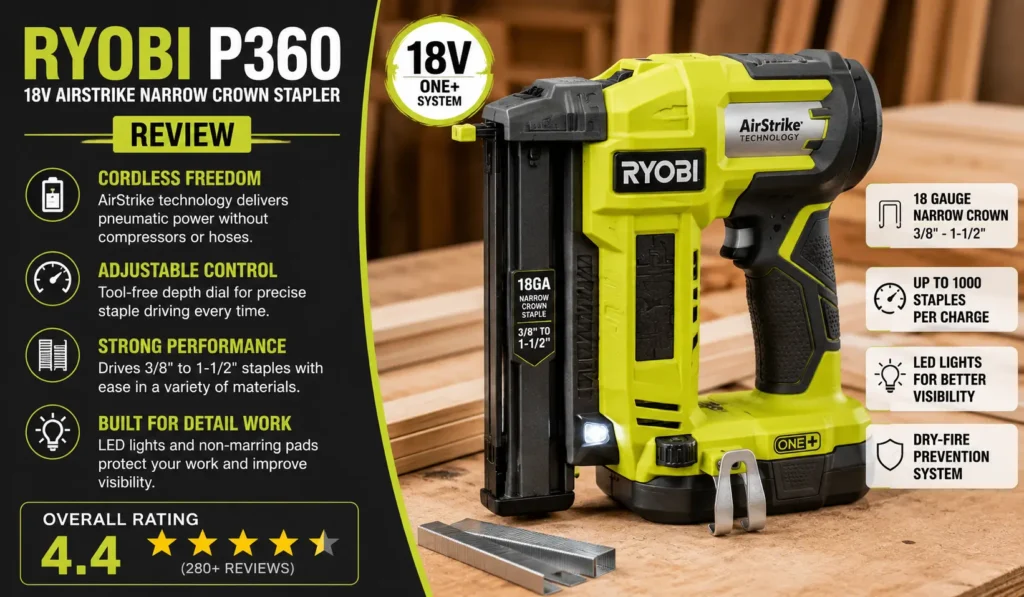
The ryobi p360 review most people want is simple: does this cordless stapler really replace an air compressor setup? After using it for trim panels, plywood, fencing, and workshop projects, my answer is yes for most jobs. It saves time, cuts noise, and feels far more convenient than dragging hoses across a garage or job site. If you want a reliable narrow crown stapler for DIY work or light pro use, this tool deserves serious attention.
What Is the Ryobi P360?
The Ryobi P360 AirStrike Narrow Crown Stapler is an 18V cordless narrow crown stapler made for trim work, plywood, upholstery, fencing, paneling, and light construction jobs. It uses Ryobi ONE+ batteries and removes the need for hoses or air compressors.
This tool fires 18-gauge 1/4-inch narrow crown staples from 3/8 inch to 1-1/2 inches long. It also includes tool-free depth adjustment, LED lights, and dry-fire protection.
In simple terms, this stapler gives you pneumatic-style power without the mess of air hoses.
Ryobi P360 Review: Quick Answer
If you want the short version of this ryobi p360 review, here it is: the tool works very well for DIY users, workshop builders, trim carpenters, and homeowners who want cordless convenience.
The biggest win is freedom. You pick it up, load staples, and start working. There is no compressor noise, no setup delay, and no tangled hose behind your feet.
The main downside is weight. With a battery attached, it feels heavier than a pneumatic stapler during long overhead work.
Still, for most users in the USA doing home repairs, RV builds, trim installs, fencing, or workshop projects, the Ryobi P360 offers excellent value.
Key Features and Specifications
Ryobi P360 Specifications
| Feature | Details |
|---|---|
| Battery Platform | Ryobi ONE+ 18V |
| Staple Type | 18 Gauge Narrow Crown |
| Crown Width | 1/4 inch |
| Staple Length | 3/8″ to 1-1/2″ |
| Magazine Capacity | 105 Staples |
| Weight | 5 lbs bare tool |
| Weight with Battery | About 6.8 lbs |
| Firing Modes | Sequential + Contact |
| LED Light | Yes |
| Dry Fire Protection | Yes |
| Staples Per Charge | Around 1000 |
| Warranty | 3 Years |
This table gives a fast overview for buyers comparing cordless staplers.
Build Quality and Design
The first thing I noticed during this ryobi p360 review was the solid build. The tool feels durable and job-site ready. The rubber overmold helps protect finished surfaces and also improves grip.
The magazine loading system feels secure. After a few reloads, it becomes second nature. I also liked the depth adjustment dial because it works fast without tools.
The LED light is more useful than I expected. It helps when working inside cabinets, garages, RV interiors, or darker corners of a workshop.
This stapler clearly feels designed for real work instead of occasional hobby use.
Real-World Performance
The Ryobi P360 performs best when fastening thin material to wood. That is where narrow crown staples shine.
I tested it on:
- Thin plywood
- Trim panels
- Fence sections
- Workshop storage builds
- Plastic panels
- Upholstery backing
- Wood strips
The stapler drove staples cleanly into pine without trouble. Even hardwoods like oak worked better than I expected with longer staples.
The best part was consistency. Most staples sat flush with very few misfires.
That consistency matters because uneven staple depth ruins clean trim work.
Ryobi P360 Review for DIY Projects
For DIY users, this tool feels almost perfect.
Many homeowners in the USA do projects in garages, sheds, basements, or backyards. Dragging around a loud compressor in those spaces gets annoying fast.
The P360 removes that hassle.
I especially liked it for:
- Accent walls
- Wainscoting
- Chicken coop repairs
- RV panel work
- Decorative trim
- Storage shelving
- Wood signs
The cordless setup makes quick jobs much easier. You grab the stapler, finish the task, and put it away.
That speed changes how often you actually complete projects.
Ryobi P360 Review for Professional Use
Professional trim carpenters may still prefer pneumatic systems for all-day production work. Pneumatic guns remain lighter and slightly faster.
Still, the Ryobi P360 makes sense for:
- Punch list jobs
- Small remodeling work
- Occupied homes
- Repair calls
- Mobile contractors
One huge advantage is noise reduction. In occupied homes, offices, or apartments, avoiding a compressor is a major benefit.
The cordless setup also improves safety because there are no hoses creating trip hazards.
For light professional work, the tool performs surprisingly well.
Battery Life and Power
Battery performance was better than expected.
Ryobi claims around 1000 staples per charge, and that feels realistic with larger batteries.
I tested it using:
- 2Ah battery
- 4Ah battery
The larger battery improved both runtime and driving consistency.
If you are working on:
- Fence installation
- Long trim sessions
- Workshop production
then a 4Ah or 6Ah battery makes more sense.
For small household tasks, the compact battery works fine and keeps the tool lighter.
Ease of Use
This is one of the easiest cordless staplers I have used.
The controls are simple:
- Power adjustment dial
- Depth adjustment
- Mode switch
- Easy magazine release
The learning curve is short. Even first-time users can start using it quickly.
The contact firing mode speeds up repetitive work, while sequential mode improves accuracy for finish projects.
The easy controls make this stapler beginner friendly.
Safety Features
Ryobi included several useful safety features.
Dry-Fire Protection
This stops the tool from firing when empty. That protects both the driver blade and work surface.
LED Grip Light
The light activates when gripping the handle. It helps improve accuracy in dark spaces.
Non-Marring Pads
These pads help protect finished wood from scratches.
These small features improve the overall experience more than people expect.
What I Like
Strong Cordless Convenience
I loved not dragging hoses across the floor. During trim work and plywood installs, the Ryobi P360 saved setup time every single day.
Reliable Staple Driving
The stapler drove clean and consistent staples into pine, plywood, and hardwood trim. I rarely dealt with jams or crooked staples.
Great Value for DIY Users
Compared to expensive cordless staplers from DeWalt or Milwaukee, the Ryobi P360 delivers impressive performance for the price.
Excellent for Thin Panels
This stapler works especially well with plywood, wall panels, RV materials, and workshop builds. Staples hold thin material better than brad nails in many cases.
Good Battery Ecosystem
If you already own Ryobi ONE+ batteries, this tool becomes even more affordable and convenient.
What Could Be Better
It Feels Heavy Overhead
At nearly 7 pounds with a battery, the stapler becomes tiring during overhead jobs or long trim sessions.
Safety Nose Needs Pressure
The contact safety sometimes requires firm pressure before firing. That can feel awkward during delicate work.
Occasional Under-Driven Staples
Very hard wood may occasionally leave a staple slightly proud. It does not happen often, but it can happen.
Large Battery Adds Bulk
Big batteries improve power but also increase weight. A compact battery improves balance for lighter jobs.
My Personal Experience with Ryobi P360
I started using the Ryobi P360 during a workshop wall project. I needed something faster than screws but cleaner than a hammer stapler.
The first thing I noticed was how quiet the workspace became without a compressor running. That alone changed the experience.
I used the stapler on plywood panels, trim strips, and plastic sheeting. The staple depth stayed very consistent.
I also tested it outdoors on fence repairs. The cordless design helped a lot because I could move around freely.
After several weeks, here are the biggest things I noticed:
- Setup time became much faster
- I finished trim jobs quicker
- Battery life lasted longer than expected
- The stapler rarely jammed
- The depth adjustment worked well
- Thin plywood held tighter than with brad nails
- It handled pine with ease
- Hardwood needed higher power settings
- The LED light helped in darker corners
- The tool felt heavy after long sessions
- Contact firing improved speed
- Sequential mode improved precision
- The nose safety took time to get used to
- It worked well for RV interior projects
- The Ryobi battery system kept costs lower
Overall, this stapler made woodworking projects feel easier and cleaner.
Comparing With Other Brands
I’ve also used staplers from DeWalt, Milwaukee, and traditional pneumatic brands like Bostitch.
Each tool has strengths. Pneumatic guns remain lighter. DeWalt feels more premium. Milwaukee offers strong power. But the Ryobi P360 wins on value and ease of entry for most DIY users.
Ryobi P360 vs DeWalt Stapler
Ryobi P360 vs DeWalt: Quick Comparison
| Feature | Ryobi P360 | DeWalt Cordless Stapler |
|---|---|---|
| Power | Very Good | Excellent |
| Weight | Heavy | Slightly Better Balance |
| Price | Lower | Higher |
| Battery System | Ryobi ONE+ | DeWalt 20V |
| DIY Value | Excellent | Good |
| Professional Use | Light-Medium | Medium-Heavy |
| Noise | Low | Low |
| Runtime | Very Good | Very Good |
The DeWalt model feels more refined, but the Ryobi delivers better value for many homeowners.
Ryobi P360 vs Milwaukee Stapler
Ryobi vs Milwaukee Comparison Table
| Feature | Ryobi P360 | Milwaukee M18 Stapler |
|---|---|---|
| Price | Budget Friendly | Expensive |
| Build Quality | Good | Excellent |
| Weight | Heavy | Heavy |
| Power | Strong | Very Strong |
| Trim Work | Excellent | Excellent |
| Fence Work | Good | Very Good |
| Battery Cost | Lower | Higher |
| Best For | DIY + Home Projects | Professional Use |
Milwaukee feels more contractor focused, while Ryobi fits homeowners and hobby builders better.
Ryobi P360 vs Pneumatic Staplers
Cordless vs Pneumatic Stapler Comparison
| Feature | Ryobi P360 | Pneumatic Stapler |
|---|---|---|
| Compressor Needed | No | Yes |
| Hose Needed | No | Yes |
| Portability | Excellent | Limited |
| Weight | Heavier Tool | Lighter Tool |
| Setup Time | Fast | Slow |
| Noise | Lower | Loud |
| Maintenance | Lower | Higher |
| Best Use | Mobile Work | Production Work |
For garages, homes, RVs, and repair jobs, cordless staplers feel much more convenient.
Best Projects for the Ryobi P360
The Ryobi P360 works best on:
- Wainscoting
- Plywood backing
- Decorative trim
- RV interiors
- Upholstery repairs
- Fence sections
- Cedar shingles
- Plastic panels
- Workshop cabinets
- Craft projects
- Beehive construction
- Sign installation
It is especially effective when attaching thin material to wood.
Who Should Buy This Tool?
This stapler works best for:
- DIY homeowners
- Workshop builders
- RV owners
- Woodworkers
- Trim installers
- Mobile contractors
- Furniture repair users
It may not fit:
- Heavy framing crews
- Full-time production carpenters
- Users needing ultra-light overhead tools
The target user is someone who values convenience and portability.
Recommendation
After completing this ryobi p360 review, I would recommend this tool to homeowners, DIY builders, workshop users, and light professional contractors who want cordless convenience without spending premium contractor-level money.
If you already own Ryobi ONE+ batteries, the value becomes even stronger.
I think this stapler is especially useful in the USA for:
- Garage workshops
- Shed projects
- RV remodeling
- Backyard fence repairs
- Basement finishing
- Accent wall installations
I would still suggest pneumatic staplers for crews doing nonstop production trim work every day. They remain lighter for all-day use.
But for most real-world users, the Ryobi P360 feels practical, capable, and reliable.
Final Verdict
The Ryobi P360 AirStrike Narrow Crown Stapler succeeds because it solves a real problem. It removes compressors, hoses, and setup delays while still delivering strong fastening performance.
That convenience changes how people work.
The tool is not perfect. It feels heavy during long sessions, and the nose safety can feel stiff at first.
Still, the overall experience remains excellent for DIY users and light professional work.
If you want a cordless stapler that handles trim, plywood, fencing, and workshop builds with reliable power, the Ryobi P360 is one of the best value options available today.
FAQs for Ryobi P360 Review
Is the Ryobi P360 good for trim work?
Yes. The Ryobi P360 works very well for trim panels, plywood backing, and wainscoting. It drives staples cleanly and saves setup time.
Does the Ryobi P360 need an air compressor?
No. The Ryobi P360 uses AirStrike cordless technology, so it runs on Ryobi ONE+ batteries without hoses or compressors.
How heavy is the Ryobi P360?
The tool weighs about 6.8 pounds with a battery attached. It feels solid but may become tiring during overhead work.
Can the Ryobi P360 drive staples into hardwood?
Yes. It can drive staples into hardwood like oak, though very dense wood may need maximum power settings.
Is the Ryobi P360 worth buying for DIY users?
Yes. For DIY projects, workshop builds, fencing, and home repairs, the Ryobi P360 offers strong value and excellent convenience.
What staples does the Ryobi P360 use?
The Ryobi P360 uses 18-gauge 1/4-inch narrow crown staples from 3/8 inch to 1-1/2 inches long.
How long does the battery last?
Ryobi claims around 1000 staples per charge. Real-world runtime depends on battery size and material hardness.
Is the Ryobi P360 better than pneumatic staplers?
For portability and convenience, yes. Pneumatic staplers remain lighter for all-day production work, but cordless use feels easier for most users.