
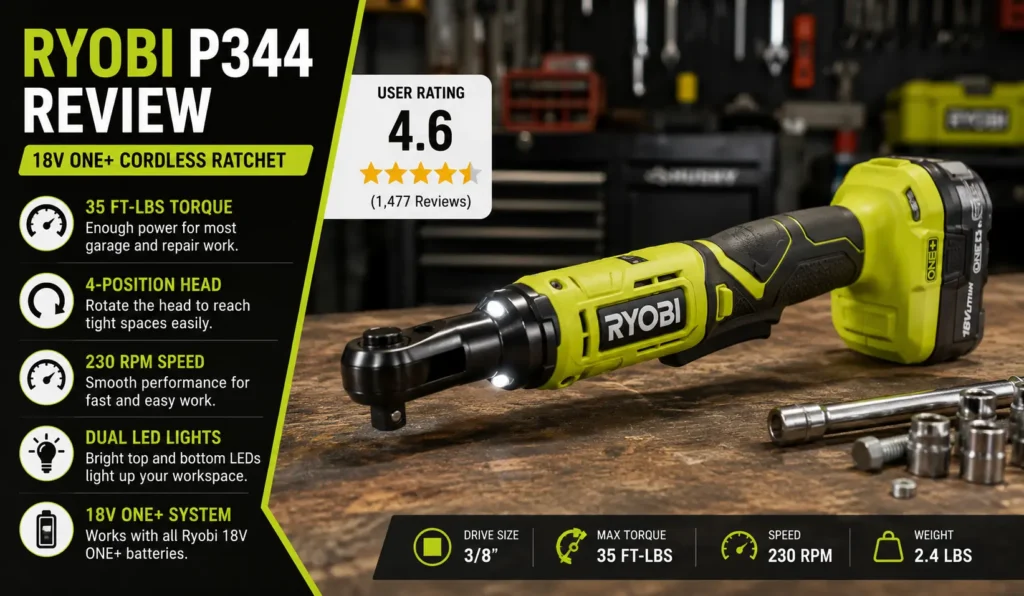
Ryobi P344 Review is worth reading if you want a low-cost cordless ratchet for car work, garage jobs, and small repairs. The Ryobi P344 gives you 35 ft-lbs of torque, 230 RPM speed, and a 4-position rotating head. I like it most for tight spots where a normal ratchet feels slow. But it is not a full impact wrench, so let’s see where it wins and where it falls short.
Ryobi P344 Review Quick Verdict
The short answer is simple. The Ryobi P344 is a smart buy if you already use Ryobi 18V ONE+ tools. It is best for light to medium fastening work.
It is not made to break loose very tight bolts. For that, I would still use an impact wrench first. Then I would use this ratchet to spin the bolt out fast.
The best feature is the 4-position head. It lets you move the battery out of the way. This matters a lot under a hood or inside a tight wheel well.
Key Specs
| Feature | Ryobi P344 |
|---|---|
| Tool Type | Cordless ratchet |
| Platform | Ryobi 18V ONE+ |
| Drive Size | 3/8 inch |
| Max Torque | 35 ft-lbs |
| Speed | 230 RPM |
| Head | 4-position rotating head |
| Lights | Dual LED |
| Battery Included | No, tool only |
| Best Use | Auto work, DIY, garage repair |
Home Depot lists the Ryobi P344 with 35 ft-lbs of torque, 230 RPM, dual LEDs, and ONE+ 18V battery support.
What I Like
- The rotating head feels useful: I like that I can turn the head and move the battery away from the part I am working on. This makes the tool easier to use in tight spots.
- The ONE+ battery system saves money: If I already have Ryobi batteries, I do not need to buy a new charger or pack. That makes the Ryobi P344 Review more positive for budget buyers.
- The torque is enough for many small jobs: I would not use it as a bolt breaker. But for spinning loose nuts and bolts, 35 ft-lbs feels fine.
- The dual LED lights help: The lights are not a gimmick. They help when I work under a hood, under a seat, or in a dark garage.
- The price is fair: For many USA buyers, Home Depot access is a real plus. It is easy to check stock, return, or compare with other Ryobi tools.
What Could Be Better
- The battery makes it bulky: The 18V battery is useful, but it also adds size. In some tight spots, a smaller 12V ratchet may feel easier.
- It needs more torque for stuck bolts: The Ryobi P344 is not the tool I would grab first for rusty suspension bolts. It works better after the fastener is already loose.
- No battery in the box: Since it is often sold as a bare tool, new Ryobi users may need to buy a battery and charger.
- A clutch would be nice: An adjustable clutch could help reduce the risk of over-tightening small fasteners.
My Personal Experience with Ryobi P344
When I first used the Ryobi P344, I noticed the size before the power. The battery makes it look larger than many small ratchets.
But after a few minutes, the rotating head made sense. I could turn the head and place the battery where it did not hit nearby parts.
Here is what stood out to me:
- It felt good for basic car work.
- It saved time on long bolts.
- It worked well after I cracked bolts loose by hand.
- The paddle trigger was easy to press.
- The LED lights helped in dark spots.
- The tool felt stronger than I expected for the price.
- It was not ideal for very tight bolts.
- It felt best with a smaller 2Ah battery.
- It made repeated fastening less tiring.
- It felt like a good garage helper, not a heavy-duty shop tool.
My simple view is this: the Ryobi P344 makes small jobs faster. It does not replace every ratchet, but it earns a place in the toolbox.
Ryobi P344 Review: Features Explained
The main feature is the 4-position rotating head. You pull the collar, rotate the head, and lock it back in place.
This solves one common issue with 18V tools. The battery can get in the way. Ryobi’s design lets you move the tool body into a better angle.
The 3/8-inch anvil is also a good middle ground. It works with many common sockets. That makes it useful for cars, lawn equipment, bikes, and home repair.
Performance and Torque
The Ryobi P344 gives up to 35 ft-lbs of torque. That is enough for many small and medium fasteners.
But you should know what that means. This is not the same as an impact wrench. It will not replace a breaker bar.
For best results, I would use it like this:
- Break the bolt loose by hand or with an impact.
- Use the Ryobi P344 to remove it fast.
- Start the bolt by hand when reinstalling.
- Use the ratchet to snug it down.
- Finish with a torque wrench when needed.
This method is safer and cleaner. It also helps protect threads.
Battery and Runtime
The Ryobi P344 uses the 18V ONE+ battery system. This is a big win if you already own Ryobi tools.
For comfort, I would use a compact battery. A 2Ah pack feels better than a large pack. A big battery may last longer, but it can make the tool feel heavy.
For USA DIY users, this is one of the best reasons to buy it. Ryobi ONE+ batteries are easy to find at Home Depot, and many homeowners already have them.
Comfort and Design
The tool has a long paddle switch. I like this because I can press it with different fingers.
The head is metal, and the body feels like a normal Ryobi ONE+ tool. It is not tiny, but it feels solid.
The biggest comfort issue is balance. With a large battery, it can feel bottom-heavy or bulky. With a small battery, it feels much better.
Comparing With Other Brand
I’ve also used the Milwaukee M12 3/8 cordless ratchet style tools. Milwaukee feels more compact in tight spaces because the battery system is smaller. But Ryobi makes more sense if you already own ONE+ batteries and want to spend less.
Ryobi P344 vs Milwaukee M12: Quick Comparison
| Feature | Ryobi P344 | Milwaukee M12 3/8 Ratchet |
|---|---|---|
| Battery Platform | 18V ONE+ | 12V M12 |
| Best For | Ryobi users, DIY garages | Compact auto work |
| Torque Feel | Good for light-medium work | Good for tight spaces |
| Size | Larger due to 18V battery | More compact |
| Value | Strong if you own Ryobi batteries | Strong if you own M12 tools |
| My Pick | Best budget ONE+ choice | Better compact choice |
Comparison Table 2: Ryobi P344 vs Ryobi PRC01
| Feature | Ryobi P344 | Ryobi PRC01 |
|---|---|---|
| Drive Size | 3/8 inch | 1/4 inch |
| Torque | 35 ft-lbs | 30 ft-lbs |
| Speed | 230 RPM | 250 RPM |
| Best Use | General garage work | Small fasteners |
| Better For | Cars, mower repair, DIY | Trim, small bolts, light work |
Pro Tool Reviews lists the P344 at 230 RPM and 35 ft-lbs, while the PRC01 is listed at 250 RPM and 30 ft-lbs.
Comparison Table 3: Ryobi P344 vs Ryobi Extended Reach 3/8
| Feature | Ryobi P344 | Ryobi PBLRC25 Extended Reach |
|---|---|---|
| Motor | Brushed | Brushless |
| Torque | 35 ft-lbs | 55 ft-lbs |
| Speed | 230 RPM | 230 RPM |
| Length | Shorter | Longer |
| Best Use | General use | Deeper engine bay access |
| Price | Lower | Higher |
The extended reach 3/8 model offers more torque and a longer body, but it costs more and may feel less handy for basic jobs.
Recommendation
I recommend the Ryobi P344 if you already own Ryobi 18V batteries. It gives good value, useful power, and a smart rotating head.
You should buy it if:
- You work on cars at home.
- You do mower or small engine repair.
- You already own Ryobi ONE+ batteries.
- You want a budget cordless ratchet.
- You need help in tight spots.
You should do more research if:
- You need pro-level daily use.
- You work with rusty bolts often.
- You want the smallest ratchet possible.
- You need more than 35 ft-lbs of torque.
- You do not own Ryobi batteries yet.
For many USA buyers, the best part is simple access. Home Depot carries Ryobi tools, so checking price, stock, and returns is easy.