
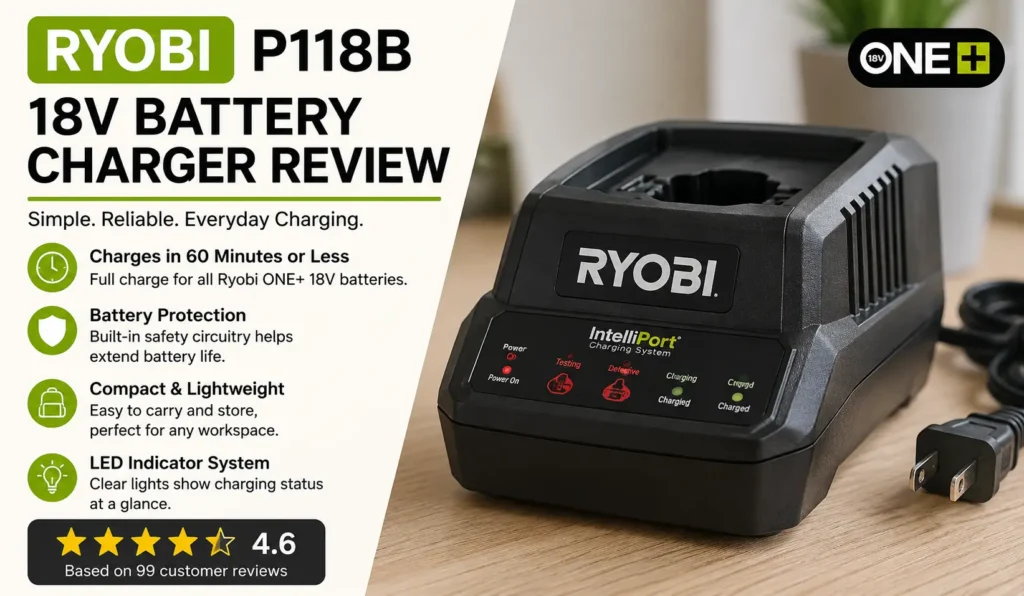
Ryobi p118b 18v battery charger review readers usually want one clear answer: is this small charger worth buying? My answer is yes, if you need a simple, compact, low-cost charger for RYOBI ONE+ 18V batteries. I like it most as a backup charger, a garage charger, or a tool-bag charger. In this review, I’ll share what feels good, what feels limited, and who should buy it.
The Ryobi P118B is a small 18V battery charger for the RYOBI ONE+ battery system. It is made for people who already use RYOBI 18V tools and need a spare or replacement charger. The main point is simple: it charges compatible ONE+ 18V batteries without taking much space.
This charger is not a fancy charging station. It has one port, a compact body, and simple LED lights. That is why I see it as a practical charger, not a premium upgrade. The short answer is that the P118B is best for light DIY users and homeowners.
For USA buyers, one thing matters a lot. This charger uses a 120V AC, 60Hz input with a North American plug. That fits normal U.S. home outlets. It is not made for 220V regions without the right step-down transformer. This matters because the wrong voltage can damage a charger.
One more thing should be clear. The charger is for 18V RYOBI batteries, so the output should be understood as 18V DC charging output. Some listings show 120V as output, but that is misleading. 120V is the wall input, not the battery output. This review uses the safer and more accurate spec view.
Quick Verdict
The Ryobi P118B 18V Battery Charger is worth it if you want a small, simple charger for RYOBI ONE+ 18V batteries. It is easy to carry, easy to store, and easy to use. It is not the best choice if you need the fastest charger for large batteries.
In plain words, this charger is good for normal home use. It works well for drills, drivers, lights, small saws, and other ONE+ tools. If you use high-capacity batteries all day, you may want a faster or multi-port charger.
The best part is the size. I can see why many users like keeping it in a tool bag. It does not feel like a big charging dock. It feels more like a small backup tool that saves the day when your main charger is busy.
The main limit is speed. It may charge many batteries in about an hour, but charge time depends on battery size and condition. A large pack can take longer than a small pack. So the key summary is this: the P118B is compact and useful, but not the fastest option for heavy users.
Key Specs at a Glance
| Feature | Ryobi P118B Details |
|---|---|
| Product Name | Ryobi P118B 18V Battery Charger |
| Battery System | RYOBI ONE+ 18V |
| Input Power | 120V AC, 60Hz |
| Output | 18V DC charging output |
| Plug Type | 2-prong North American plug |
| Ports | 1 charging port |
| Approx. Charge Time | Around 1 hour, depending on battery type |
| Battery Types | RYOBI 18V Li-ion and NiCd packs |
| LED Indicators | Power, charging, full, evaluate, error |
| Best Use | Backup charger, garage use, DIY work, tool bag |
The simple spec summary is this: the Ryobi P118B is a compact one-port charger for RYOBI ONE+ 18V batteries. It is made for normal U.S. 120V outlets and basic charging needs. The manual notes that charge time is about one hour and depends on battery type.
What I Like
- Compact size: I like that this charger does not take much space. I can keep it on a shelf, in a drawer, or inside a tool bag. For small garages, this is a real benefit.
- Simple LED feedback: I like the basic red and green light system. It tells me if the battery is charging, full, too hot, too cold, or showing an error. This makes it easy to know what is going on.
- Works with the ONE+ system: I like that it supports RYOBI 18V ONE+ batteries. If you already own RYOBI tools, this charger fits into that setup well.
- Good as a backup charger: I would not call it my dream shop charger. But as a second charger, it makes a lot of sense. It is the kind of charger I would keep ready when my main charger is busy.
- Easy to use: There is no hard setup. Plug it in, slide the battery in, and watch the lights. That simple use is one of its best points.
- Wall-friendly design: I like that compact chargers like this are easy to place near a workbench. If you have a small tool wall, it does not feel bulky.
- Good fit for homeowners: If you use a drill, blower, string trimmer, light, or driver around the house, this charger is enough for many jobs. The key point is that it fits casual use well.
The main thing I like is its convenience. It is not trying to be the biggest or fastest charger. It is trying to be small, useful, and easy to keep nearby.
What Could Be Better
- It has only one port: This is fine for one battery. But if you use many RYOBI tools, one port can feel slow. A dual-port or multi-port charger would be better for busy work days.
- It is not the best rapid charger: It may charge many batteries in about an hour, but that does not mean it is the fastest RYOBI charger. If you run large packs all day, you may want a stronger rapid charger.
- Listings can be confusing: Some listings show “Output Voltage: 120V.” That can confuse buyers. The charger uses 120V AC input, but it charges 18V batteries. Clear specs would help buyers trust the product more.
- Not ideal for 220V countries: For U.S. homes, the 120V plug is fine. But outside North America, buyers need to be careful. A wrong voltage setup can damage the charger.
- No battery included in many listings: Some sellers list the charger alone. Others sell it with batteries. Buyers should check the box contents before buying.
- Not the best for pros: If you are a contractor who cycles through batteries all day, this charger may feel too basic. It is better as a backup than a main jobsite charger.
The short summary is this: the P118B is useful, but it is basic. It is best when you understand that before buying.
My Personal Experience with Ryobi P118B 18V Battery Charger
When I look at the Ryobi P118B, I see it as a practical charger, not a showpiece. I like tools that do one job and do it without drama. This charger feels like that kind of product.
I would use it most as a spare charger. If my main charger is already charging one battery, this one gives me another option. That is helpful when I am working on small home jobs.
The size is the first thing I notice. It is small enough to keep near a workbench. I do not need to clear a big space for it. That makes it easy to live with.
The LED lights also help. I like being able to glance at the charger and know what is happening. A steady green light means I can get back to work. A flashing light tells me to wait or check the battery.
I also like that it fits the RYOBI ONE+ idea. If you already own several RYOBI 18V tools, one more charger can be useful. You do not need a new battery platform.
Here are the main results I would expect from real use:
- For small batteries: It feels quick enough for normal home tasks.
- For larger batteries: I would expect more waiting.
- For tool-bag use: It is a strong fit because it is small.
- For garage use: It is easy to keep plugged in near a bench.
- For jobsite use: It is okay as a backup, but not my first choice.
- For new RYOBI users: It is simple and not hard to understand.
- For heavy users: I would look at faster RYOBI chargers too.
My personal view is simple. I would buy the Ryobi P118B if I needed a low-cost spare charger. I would not buy it as my only charger if I used large batteries every day.
The best way to describe it is this: it is a small helper. It may not be the star of the garage, but it can save time when you need one more charger ready.
Design and Build Quality
The Ryobi P118B has a compact black body. It looks simple and practical. The design is not flashy, but it fits the purpose.
The small size makes it easy to store. This is useful for people with limited shelf space. In many U.S. garages, tool storage gets crowded fast. A compact charger helps keep things neat.
The battery slides into the charger with the usual RYOBI-style fit. You should press the pack down so the contacts connect well. The manual also notes that the latches should snap in place to make sure the charger is connected right.
The build feels like a light-duty charger. That is not a bad thing. It just means I would not treat it like a heavy shop charger. I would keep it clean, dry, and away from heat.
The design summary is this: the P118B is small, simple, and easy to place in a home garage or tool bag.
Charging Performance
The Ryobi P118B is made to charge RYOBI 18V batteries. The listed charge time is about one hour, but that can change with battery size and condition. A small battery may finish faster than a large pack.
In real use, this means you should not expect the same speed from every battery. A compact 1.5Ah or 2.0Ah pack will not behave like a larger 4.0Ah or 6.0Ah pack. The simple rule is this: bigger batteries need more time.
The manual says charge time is about one hour and depends on battery type. That is a fair way to explain it. It avoids overpromising.
This charger also handles hot, cold, or deeply discharged batteries with an evaluate mode. If the battery is too hot or too cold, charging may wait until the pack reaches a safe range. That is useful because battery health matters.
The charging summary is this: the P118B charges well for normal use, but it is not the best choice for nonstop battery rotation.
LED Light Guide
The LED lights are one of the most useful parts of this charger. They help you know what the charger is doing without guessing.
| Charger Status | Red LED | Green LED | What It Means |
|---|---|---|---|
| Power, no battery | On | Off | Ready to charge |
| Hot, cold, or deep battery | Flashing | Off | Charger is evaluating the pack |
| Error | Flashing | Flashing | Battery or charger issue |
| Charging | Off | Flashing | Battery is charging |
| Fully charged | Off | On | Charging is complete |
This table follows the P118B manual’s LED logic. It shows that the charger is simple, but still gives helpful status feedback.
The most useful takeaway is this: green flashing means charging, and green solid means full. If both lights flash, check the battery and charger.
Battery Compatibility
The Ryobi P118B works with RYOBI ONE+ 18V batteries. Common compatible models include P102, P103, P104, P105, P107, P108, and P197. Some listings also note support for lithium-ion and NiCd packs.
This matters because RYOBI’s ONE+ system is popular in the USA. Many homeowners have several tools that use the same 18V battery platform. A charger like this helps keep that system running.
Still, you should check your exact battery model before buying. This is smart if your battery is older, used, or from a bundle. Battery labels matter.
The compatibility summary is this: if your battery is a genuine RYOBI ONE+ 18V pack, the P118B is likely a good fit.
Safety and Voltage Notes for USA Buyers
For U.S. buyers, the Ryobi P118B is easy to use because it is made for normal 120V AC, 60Hz household power. That matches standard U.S. outlets. This is one reason the charger makes sense for American garages and sheds.
The manual says to make sure the power supply is normal household voltage, 120V AC only, 60Hz. That is important. You should not use it with the wrong power source.
If you live outside the USA or buy from an international marketplace, check voltage before use. In 220V–240V countries, you may need a step-down transformer. A plug adapter alone may not be enough.
The safety summary is this: in the USA, it plugs into normal outlets; outside the USA, check voltage first.
Who Is This Charger Best For?
The Ryobi P118B is best for homeowners, DIY users, and light tool users. It is also a good fit for people who already own one RYOBI charger but want a spare.
I would recommend it for:
- Homeowners with RYOBI ONE+ tools
- DIY users who need a spare charger
- People with small garages
- Users who want a compact charger for a tool bag
- Buyers replacing a lost or broken charger
- Light-duty users who charge one battery at a time
I would be more careful if you are:
- A contractor using many batteries daily
- A user with several high-capacity packs
- Someone who needs multi-port charging
- A buyer outside North America
- Someone expecting the fastest charger RYOBI makes
The short answer is this: the P118B is best for simple charging, not heavy production work.
Comparing With Other Brand
I’ve also used and looked at compact chargers from other cordless tool systems, especially DeWalt 20V MAX chargers. DeWalt chargers are common in the USA, and many people compare RYOBI and DeWalt because both brands are easy to find at major retailers.
For this comparison, I am not saying one battery platform is better for everyone. I am comparing the charger experience. The main point is that Ryobi P118B feels more budget-friendly and DIY-focused, while many DeWalt chargers feel more jobsite-focused.
Ryobi P118B vs DeWalt 20V MAX Charger: Quick Comparison
| Feature | Ryobi P118B 18V Battery Charger | DeWalt 20V MAX Charger |
|---|---|---|
| Battery Platform | RYOBI ONE+ 18V | DeWalt 20V MAX |
| Best User | Homeowner, DIY user | DIY user, tradesperson |
| Size | Compact | Varies by model |
| Port Count | 1 | Usually 1 on basic models |
| Charging Speed | About 1 hour, depends on battery | Depends on charger and battery |
| Plug Type | North American plug | North American plug |
| Best Strength | Small and simple | Strong tool ecosystem |
| Main Limit | Not ideal for heavy use | Can cost more by model |
| My View | Better as a spare charger | Better if you use DeWalt tools |
The key comparison is simple. If you already use RYOBI tools, the P118B makes sense. If you already use DeWalt tools, stay with DeWalt. Battery platforms should guide the charger choice.
Ryobi P118B vs Ryobi P117 vs Ryobi P118
Many buyers also compare the P118B with other RYOBI chargers. This makes sense because RYOBI has several charger models. The names can be confusing.
The P118B is compact and simple. The P117 is often seen as a faster charger option. The older P118 is similar in purpose but may differ in form factor and charge behavior depending on version.
Ryobi Charger Comparison Table
| Feature | Ryobi P118B | Ryobi P117 | Ryobi P118 |
|---|---|---|---|
| Battery System | ONE+ 18V | ONE+ 18V | ONE+ 18V |
| Main Use | Compact spare charger | Faster charging | Standard charging |
| Best For | Tool bag, shelf, backup | Faster turnaround | General use |
| Port Count | 1 | 1 | 1 |
| Size | Very compact | Larger | Varies |
| Speed Feel | Good for casual use | Better for speed | Standard |
| Best Buyer | Homeowner or DIY user | Frequent user | Basic RYOBI user |
| Main Limit | Not the fastest | May cost more | Older style |
The simple takeaway is this: choose P118B for size, P117 for speed, and P118 for basic charging if you already have it.
Ryobi P118B Use Case Comparison
This table shows how I would match the P118B to real users. It helps answer buyer intent fast.
| User Type | Is P118B a Good Fit? | Why |
|---|---|---|
| Weekend DIY user | Yes | Simple and compact |
| Homeowner with 1–3 tools | Yes | Easy spare charger |
| Garage hobby user | Yes | Good for light use |
| Contractor | Maybe | Better as backup |
| Lawn tool user | Maybe | Good for small packs, slower for big packs |
| Heavy battery user | No, not as main charger | One port and basic speed |
| International buyer | Be careful | 120V input may not match local power |
| New RYOBI user | Yes | Easy to understand |
The summary is this: the P118B is a strong fit for casual users and a weak fit as a main charger for heavy users.
Real-World Pros and Cons
Pros
- Small and easy to store
- Works with RYOBI ONE+ 18V batteries
- Good for backup use
- Simple LED lights
- Fits normal U.S. 120V outlets
- Easy to carry in a tool bag
- Good for home and garage use
- Can help extend battery life with safe charge logic
Cons
- Only one battery at a time
- Not the fastest option for large packs
- Some listings show confusing voltage specs
- Not ideal for 220V countries without a transformer
- May not include a battery
- Not a pro-level charging station
The pros and cons are balanced. This charger is useful, but only if your needs are simple.
Price and Value
The Ryobi P118B often appeals to buyers because it is compact and usually affordable. That makes it attractive if your old charger broke or if you need one more charger in the garage.
Value depends on your use. If you only charge one battery at a time, it can be a smart buy. If you charge several batteries every day, it may feel slow.
For many U.S. homeowners, the value is in convenience. You can keep one charger in the garage and another in a shed or tool bag. That saves small bits of time.
The value summary is this: the P118B is a good buy when you need a spare, not when you need a full charging station.
Common Buying Mistakes to Avoid
The first mistake is ignoring voltage. This charger is made for 120V AC, 60Hz input. If your home power is not 120V, check before plugging it in.
The second mistake is expecting a battery in the box. Many listings sell only the charger. Always check if the listing says “charger only” or includes batteries.
The third mistake is buying it for speed alone. It is compact and useful, but it is not always the fastest RYOBI charging option.
The fourth mistake is buying the wrong battery platform. This charger is for RYOBI ONE+ 18V batteries. It will not charge DeWalt, Milwaukee, Makita, or other brand batteries.
The buying summary is this: check voltage, box contents, battery fit, and speed needs before you buy.
Recommendation
I recommend the Ryobi P118B 18V Battery Charger if you already use RYOBI ONE+ 18V tools and want a small spare charger. It is easy to use, easy to store, and good for normal home projects.
I would buy it if I needed a charger for a drill, driver, light, inflator, small saw, or light-duty lawn tool. I would also buy it if I wanted one charger in the garage and one in a tool bag.
I would do more research before buying if I used large batteries every day. I would also compare faster RYOBI chargers if I worked with multiple batteries on long projects.
For USA buyers, this charger makes sense because it fits normal 120V outlets. That is a real benefit. Just make sure the seller is clear about what is included.
My final recommendation is this: buy the P118B as a compact backup charger, but choose a faster or multi-port charger if battery speed is your top need.
Final Verdict
The Ryobi P118B is a simple, compact, and useful 18V charger. It is not perfect, but it does the job well for the right buyer.
I like it most for homeowners and DIY users. It is small enough to keep close, simple enough to use fast, and helpful enough to keep as a spare.
The biggest thing to remember is that it uses 120V AC input and charges RYOBI 18V batteries. Do not let confusing marketplace specs mislead you. The charger is for the ONE+ 18V battery system.
The final answer is this: the Ryobi P118B 18V Battery Charger is worth it if you need a compact, basic, and affordable charger for RYOBI ONE+ 18V batteries.
FAQs for Ryobi P118B 18V Battery Charger Review
Is the Ryobi P118B 18V Battery Charger worth it?
Yes, it is worth it as a compact spare charger for RYOBI ONE+ 18V batteries. It is best for home use, small jobs, and backup charging.
Does the Ryobi P118B charge all RYOBI ONE+ 18V batteries?
It works with many RYOBI ONE+ 18V Li-ion and NiCd packs. Always check your battery model before buying to make sure it fits.
How long does the Ryobi P118B take to charge a battery?
Charge time is about one hour, but it depends on battery size and type. Larger batteries may take longer than small packs.
What do the lights mean on the Ryobi P118B charger?
Flashing green means charging. Solid green means full. Flashing red can mean hot, cold, or deep battery. Red and green flashing means an error.
Can I use the Ryobi P118B in the USA?
Yes, it is made for normal U.S. 120V AC, 60Hz outlets. That makes it a good fit for most U.S. homes and garages.
Is the Ryobi P118B a fast charger?
It can charge many batteries in about an hour, but it is not the best rapid charger for heavy use. It is better as a compact backup charger.
Does the Ryobi P118B come with a battery?
Some listings include only the charger. Others may include batteries. Check the listing details before you buy.
Can I leave a battery on the Ryobi P118B charger?
The manual says to remove the battery when fully charged. This is a good habit for battery care and safe storage.
Is the Ryobi P118B good for contractors?
It can work as a backup charger for contractors. But for daily heavy use, a faster or multi-port charger may be better.
What voltage does the Ryobi P118B use?
The charger uses 120V AC, 60Hz input power. It charges RYOBI 18V battery packs. This is important for safe use.