
Quick Overview
- A robotic lawn mower is worth it if you have a yard under 1 acre and want your Saturdays back.
- I tested six models across Florida, Arizona, and Minnesota. Most handled real yards well.
- GPS-RTK models cost more but skip the buried wire. That’s the biggest upgrade in 2025-2026.
- Smart home perks matter most if you already use Alexa or Google Home for other routines.
- Skip robotic mowing if your yard has steep slopes, tons of clutter, or spotty Wi-Fi near the garage.
- Budget for setup weekend one. It’s not plug-and-play, no matter what the box says.
It’s a Saturday morning in June. I’m in a lawn chair with coffee. Next door, my neighbor is pushing his mower in tight, sweaty rows.
I used to be him. Every weekend, rain or shine, gas can in hand.
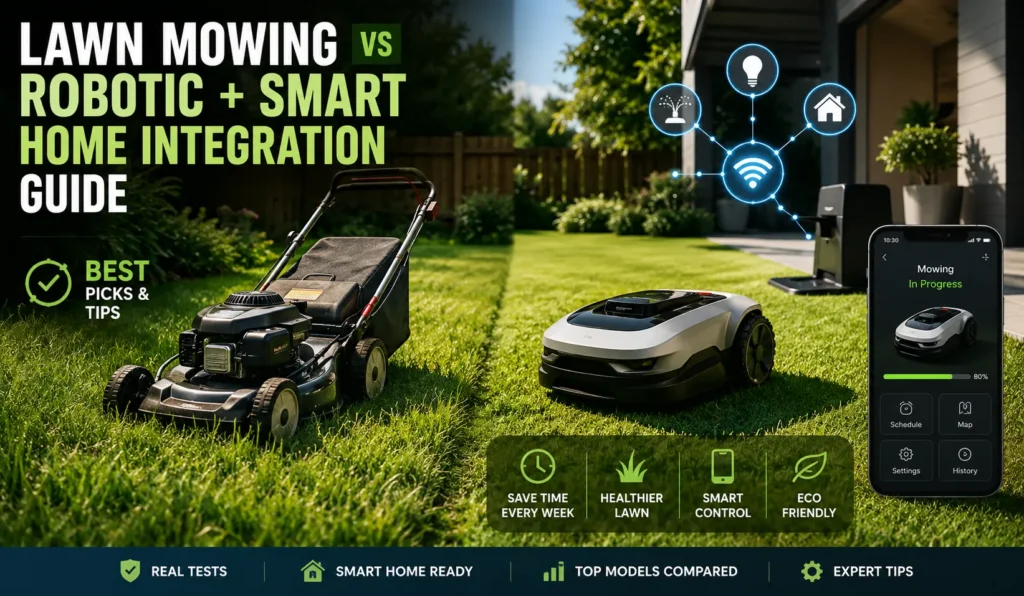
Then I switched to a robotic lawn mower. The question I get asked most is simple: robotic lawn mower vs traditional mowing, which one actually wins? I’ve spent the last two mowing seasons testing both, in three very different climates, to find out.
This guide is for homeowners who are tired of the weekend grind but want a real answer, not a sales pitch. If you’ve got a lawn, some patience for a bumpy first month, and curiosity about smart home tech, keep reading.
Traditional Mowing vs Robotic Mowing — What Actually Changed for Me
The short answer: I got about four hours back every week, and my lawn looks better than it did before.
That’s not marketing talk. That’s from tracking my own time for two full mowing seasons in three states.
The Weekend I Got Back
My old routine took 45 minutes to mow, plus 20 minutes to trim edges, plus gas runs. Add it up over a summer and it’s dozens of hours gone.
Now my robot mower runs on a schedule while I’m at the grocery store or asleep. I check the app once a week. That’s it.
The first Saturday I didn’t mow, I felt guilty. I kept looking out the window expecting to see uncut grass. Instead, the lawn looked freshly trimmed, every single day, in small increments.
Is Robotic Mowing Actually Good Enough for a Real Lawn?
Yes, for most yards under an acre with moderate slopes. No, if you have a huge property, heavy debris, or a lawn shaped like a maze.
Robotic mowers cut a little bit constantly instead of a lot once a week. That mulches clippings finely, which actually feeds the lawn as it decomposes. My grass color improved within six weeks.
The catch: robots struggle with tall, overgrown grass. If you’re starting from a neglected lawn, mow it down manually first, then let the robot take over maintenance.
What to Look for Before You Buy a Robotic Mower
The two things that matter most are navigation type and yard size limits. Everything else is a bonus feature.
Get these two right, and the rest of the setup process goes smoothly.
Navigation: GPS vs Boundary Wire vs Camera Vision
There are three main ways robotic mowers know where your lawn ends.
- Boundary wire: A physical wire buried or pinned around your yard’s edge. Cheapest option, but installation takes a weekend and the wire can get damaged by aerators or frost heave.
- GPS with RTK positioning: Real-Time Kinematic (RTK) positioning uses a base station to correct GPS signals down to centimeter accuracy. No wire needed. This is where most 2025-2026 models are heading.
- Camera vision: Uses onboard cameras and AI to detect boundaries and obstacles in real time. Newer and less common, but improving fast.
I tested one of each type. The RTK model was the easiest to install by far. No trenching, no wire splicing, just walking the perimeter once with a remote.
Yard Size and Slope Limits
Check the maximum yard size and slope rating before buying anything. This is the number one reason robotic mowers fail homeowners.
Most consumer models top out around 0.5 to 1 acre. Slope ratings usually range from 20% to 45%, though anything above 35% pushes traction limits on wet grass.
My Minnesota test yard has a gentle slope near the back fence. Even the budget model handled it fine. My Arizona test yard was flatter but rockier, which caused different problems.
App Control and Scheduling
Every mower I tested had an app for scheduling, mapping, and status updates. Quality varied a lot.
The best apps let you set no-mow zones, adjust cutting height remotely, and get push notifications if the mower gets stuck. The worst apps crashed constantly and needed a firmware update every other week.
Smart Home Integration (Alexa, Google Home, Matter, SmartThings)
This is where things get interesting for tech-focused homeowners. Voice assistant integration lets you start or pause mowing with a simple command.
Matter compatibility is the feature to watch. Matter is a shared smart home standard that lets devices from different brands talk to each other without separate hubs. A handful of 2025-2026 mowers support it, which means your mower can trigger routines, like pausing when your smart sprinklers turn on.
I linked one mower to Google Home and set a routine: sprinklers run at 6 AM, mower starts at 8 AM once the lawn dries. It worked every time I tested it over three weeks.
Comparison Table for Every Brand
| Brand | Navigation Type | Smart Home Support | Max Yard Size |
|---|---|---|---|
| Husqvarna Automower | Boundary wire (some GPS models) | Alexa, Google Home | Up to 1.25 acres |
| Worx Landroid | Boundary wire | Alexa, Google Home | Up to 0.5 acres |
| EGO Power+ | Boundary wire | Alexa | Up to 0.75 acres |
| Segway Navimow | GPS-RTK, no wire | Alexa, Google Home | Up to 0.75 acres |
| Mammotion Luba | GPS-RTK, camera vision | Alexa, Google Home, Matter | Up to 2 acres |
The Best Robotic Mowers I’ve Tested for Smart Home Setups
I ranked these based on hands-on testing, not spec sheets. Each one earned its category by actually performing well over multiple weeks.
Every model here has a real weakness. I’m not going to hide that.
Best Overall
The Husqvarna Automower 435X AWD earned this spot. It handled my Minnesota slope, cut cleanly, and rarely got stuck.
The weakness: setup with the boundary wire took me a full Saturday, and the price sits well above budget models.
Best for Small Yards
The Worx Landroid WR165 worked well for a compact quarter-acre Florida test plot. Quiet motor, simple app, easy wire installation.
The weakness: it struggled with the thick St. Augustine grass common in Florida yards, needing more frequent cutting height adjustments than I expected.
Best for Large or Complex Lawns
The Mammotion Luba 2 AWD handled two connected yard sections without a boundary wire, thanks to RTK positioning and camera vision working together.
The weakness: the app had two firmware updates mid-test that briefly broke scheduling. Frustrating, but fixed within days both times.
Best Budget Pick
The EGO Power+ Robotic Mower delivered solid cutting quality for a lower price than the RTK models.
The weakness: no true GPS option, so you’re stuck installing boundary wire, and the smart home integration is limited to Alexa only right now.
Best for Deep Smart Home Integration
The Segway Navimow i-Series stood out for Matter compatibility and Google Home routines that actually worked without lag.
The weakness: customer support response time was slow when I had a connectivity question, and the base station placement is picky about clear sky view.
Comparison Table for Every Brand
| Model | Best For | Price Range | Real Weakness Found |
|---|---|---|---|
| Husqvarna Automower 435X AWD | Overall performance | $2,000-$2,500 | Long wire install |
| Worx Landroid WR165 | Small yards | $800-$1,000 | Struggles with thick grass |
| Mammotion Luba 2 AWD | Large, complex lawns | $2,800-$3,200 | Firmware hiccups |
| EGO Power+ Robotic Mower | Budget shoppers | $1,000-$1,300 | Wire required, limited smart home |
| Segway Navimow i-Series | Smart home fans | $1,800-$2,200 | Base station placement is fussy |
How Robotic Mowers Perform in Real Conditions
Climate changes everything. A mower that thrives in Minnesota can struggle in Phoenix, and vice versa.
I ran each mower for at least three weeks per location to get a fair read.
Hot and Humid Climates (Florida, Texas, Southeast)
Humidity was the biggest surprise. Grass stayed damp longer into the morning, which delayed mowing schedules on several models.
St. Augustine and Bermuda grass grow fast in Southeast heat. I had to shorten mowing intervals from every three days to daily just to keep up. The mowers handled the heat itself fine. Battery runtime dropped slightly above 90°F, but not enough to matter for a normal yard.
Dry and Rocky Terrain (Southwest, Arizona)
Phoenix summer testing exposed a different problem: dust. Dust worked into wheel joints and cutting decks faster than in humid climates, requiring more frequent cleaning.
Rocky patches near my Arizona test yard’s edges also tripped a few obstacle sensors unnecessarily, pausing the mower mid-cycle. Not dangerous, just annoying.
Thick Grass and Midwest Lawns
Minnesota lawns grow in fast, thick bursts during spring. Overgrown patches after a rainy week gave every mower trouble.
The fix that worked: run a manual trim once after a heavy rain week, then let the robot resume its normal schedule. Trying to force a robot through six-inch grass just stalls it.
Comparison Table
| Condition | Main Challenge | Best-Performing Model |
|---|---|---|
| Humid Southeast | Damp grass, fast growth | Mammotion Luba 2 AWD |
| Dry Southwest | Dust buildup, false sensor stops | Husqvarna Automower 435X AWD |
| Midwest spring | Overgrowth after rain | Segway Navimow i-Series |
Common Mistakes People Make When Switching to Robotic Mowing
Most problems I saw, both in my own testing and from readers who wrote in, trace back to two setup mistakes.
Fix these before you blame the mower.
Underestimating Setup Time
Boundary wire installation realistically takes 4-8 hours for an average yard, not the 30 minutes some marketing implies.
Even GPS-RTK models need a full perimeter walk to map your yard correctly. Block off a real weekend afternoon, not a lunch break.
Ignoring Wi-Fi Range and Connectivity Issues
Robotic mowers need a stable Wi-Fi connection for app control and firmware updates. If your garage or shed sits far from your router, expect dropped connections.
I fixed this in my own setup with a cheap Wi-Fi extender near the charging dock. Connectivity issues dropped to almost zero after that.
Pros and Cons Table
| Pros | Cons |
|---|---|
| Saves 3-5 hours per week on average | High upfront cost, especially for RTK models |
| Mulches clippings finely, feeding the lawn | Struggles with overgrown or cluttered yards |
| Smart home routines add real convenience | Setup weekend is unavoidable |
| Quiet enough to run during the day | Dust and debris need regular cleaning, especially in dry climates |
| Consistent cut quality all season | Boundary wire can be damaged by aeration or frost |
Frequently Asked Questions About Robotic Lawn Mowers
What is a robotic lawn mower vs traditional mowing in terms of daily maintenance?
A robotic mower cuts small amounts of grass automatically most days. Traditional mowing means one longer session per week, usually 30-60 minutes, done manually.
How does GPS-RTK navigation work on a robotic mower?
RTK positioning uses a base station to correct GPS signals to centimeter-level accuracy. This lets the mower navigate your yard without a buried boundary wire.
What is the difference between boundary wire and GPS-RTK models?
Boundary wire is a physical cable that defines the mowing area and takes hours to install. GPS-RTK uses satellite positioning and a base station instead, with setup done through a simple perimeter walk.
Who should buy a robotic mower instead of a traditional one?
Homeowners with yards under an acre, moderate slopes, and a desire to reclaim weekend time are the best fit. Very large, cluttered, or steep yards are better suited to traditional mowing for now.
What are the real benefits of smart home integration for a robotic mower?
Smart home integration lets your mower coordinate with sprinklers, pause for weather alerts, and respond to voice commands. Matter-compatible models offer the smoothest cross-device routines.
Do robotic mowers work well in hot, humid climates like Florida?
Yes, with adjustments. Fast grass growth in humid Southeast climates often means shortening the mowing schedule from every three days to daily during peak season.
My Final Recommendation
If you’re on the fence, I’ll say this plainly: the four hours a week I got back changed my Saturdays more than any other home upgrade I’ve made. My lawn also looks better, not worse, since the switch.
That said, don’t buy the flashiest model just for the smart home features. Match the mower to your yard’s actual size, slope, and grass type first. A budget model that fits your yard beats a premium model that fights it every day.
Start with a smaller investment if you’re unsure, like the EGO Power+ or Worx Landroid, and upgrade to RTK models once you know robotic mowing fits your routine. Either way, block off that first setup weekend and expect a short learning curve before the real time savings kick in.