
Quick Overview
- Most mower problems – won’t start, cuts ragged, dies mid-run – come down to five or six common parts.
- A blade, spark plug, and air filter replacement costs under $30 in parts and takes 30 minutes; a shop charges $80-$150 for the same job.
- Always look up your model number and serial number before ordering any part – wrong part numbers are the #1 DIY mistake.
- OEM (original equipment manufacturer) parts are guaranteed to fit; aftermarket parts cost 30-50% less and work fine for most repairs.
- This guide covers gas push mowers, self-propelled mowers, and riding mowers, with real US brands and retailers throughout.
It was the Saturday before the Fourth of July. My neighbor knocked on my door at 8 a.m., looking exhausted. His Husqvarna push mower had cranked twice, coughed once, and quit. His grass was knee-high. He had a cookout in two days.
I walked over, pulled the air filter, and found it so choked with debris it was basically a felt brick. Replaced it with a $6 filter from my parts drawer. The mower started on the first pull.
He’d been about to load it in his truck and drive it to a shop. That would have cost him $85 just to walk in the door, plus parts and labor.
That’s the whole point of knowing your lawn mower parts. You don’t need to be a mechanic. You need to know what breaks, what it looks like when it breaks, and where to get the right replacement. This guide is for homeowners who want to handle basic repairs themselves and stop paying shop rates for problems that take ten minutes to fix.
Why Knowing Your Lawn Mower Parts Saves You Real Money
Most small engine repair shops charge $70-$100 per hour in labor, on top of parts (RepairClinic, 2024). A spark plug costs $4. Installing one takes five minutes. Yet shops bill for a full diagnostic visit just to pop one in.
Understanding your mower’s parts shifts that math in your favor fast.
What a Basic Tune-Up Actually Costs You at a Shop
A standard tune-up – spark plug, air filter, oil change, blade sharpen – runs $120-$200 at most shops (Angi, 2024). Parts for that same job cost $20-$35 if you buy them yourself.
In Georgia, where I worked out of a small engine shop for eight years, summer backlog meant a two-week wait just to get your mower looked at. That’s two weeks of uncut grass in July heat. Learning to handle tune-ups yourself eliminates that problem entirely.
What You Can Realistically Fix Yourself
Most homeowners can handle these repairs without prior experience:
- Replacing a spark plug, air filter, or fuel filter.
- Sharpening or replacing a mower blade.
- Swapping a drive belt on a self-propelled mower.
- Cleaning or replacing a carburetor on a push mower.
- Replacing a battery or starter on an electric or battery-powered model.
Carburetor rebuilds on riding mowers, electrical diagnostics, and deck spindle replacements get harder. Those are worth handing off if you’re not comfortable.
The Essential Lawn Mower Parts You Should Know
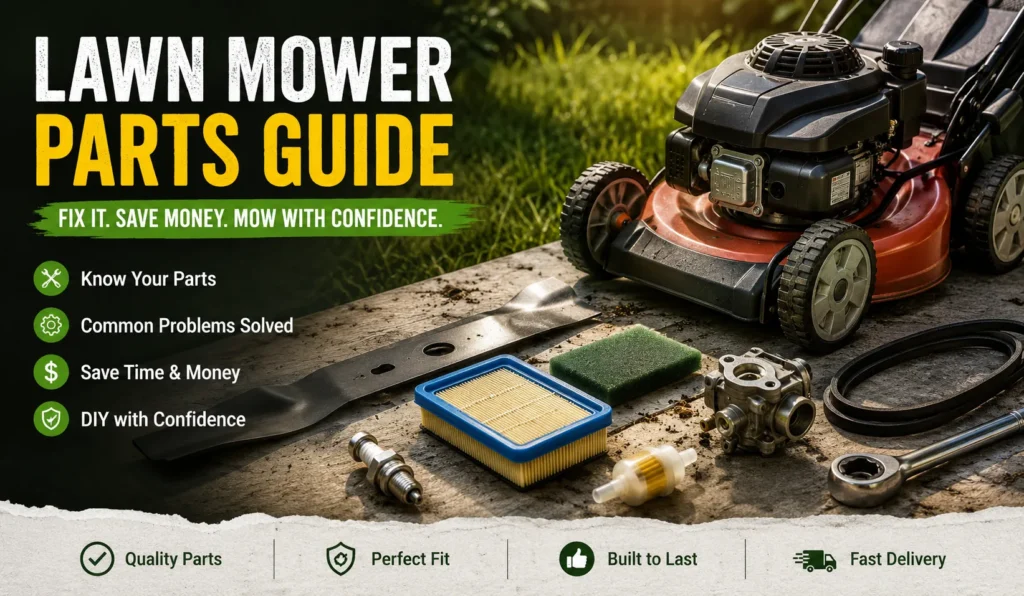
The six parts below cover the vast majority of mower repairs. Learn these, and you can diagnose most problems in your driveway.
The Blade – The Most Replaced Part on Any Mower
The blade is the hardest-working part on your mower. It spins at 2,800-3,200 RPM and hits rocks, roots, and wire without warning. A dull or bent blade leaves ragged, brown-tipped grass. A cracked blade is a safety risk.
Replace the blade if you see visible cracks, deep nicks, or if the tip is bent. A good visual check: the blade should have an even edge with no curling or waviness along the cutting surface. On my Toro Personal Pace, I replace the blade every season regardless – about $18 for an OEM replacement.
The Air Filter – Small Part, Big Impact
The air filter keeps dirt and debris out of the engine. A clogged filter starves the engine of air, which causes hard starting, rough running, and sometimes a complete no-start.
Paper filters should be replaced, not cleaned. Foam pre-filters can be washed with mild soap, dried, and lightly oiled before reuse. Briggs & Stratton recommends replacing the paper air filter every 25 hours of operation or once per season, whichever comes first (Briggs & Stratton, 2023).
A Briggs & Stratton OEM filter runs $5-$12 depending on engine size.
The Spark Plug – When to Replace It
The spark plug fires the air-fuel mix in the engine cylinder. A fouled or worn plug causes misfires, hard starts, and poor fuel economy.
Pull the plug and look at it. Black, sooty buildup means the engine is running rich (too much fuel). A white or gray tip is normal. A cracked ceramic insulator means replace it immediately.
The spark plug gap – the distance between the center and ground electrode – must match your engine specs. On most Briggs & Stratton and Honda GCV engines, the gap is 0.030 inches. Use a feeler gauge to check. Wrong gap = no start or misfires.
Replace the spark plug annually or every 100 hours. A Champion or NGK plug runs $3-$8.
The Carburetor – Why Mowers Won’t Start After Sitting
The carburetor mixes air and fuel in the right ratio before sending it to the cylinder. Ethanol in modern gasoline degrades fast and leaves a varnish-like residue inside the carb. That residue blocks the tiny fuel jets and causes a no-start condition.
If your mower sat all winter with gas in it, a gummed carb is the most likely culprit. Try a carburetor cleaner spray first – sometimes a good soak clears the jets. If it doesn’t, a replacement carb for most push mowers runs $15-$35 on Amazon or PartSelect. That’s often cheaper than a shop cleaning.
Replacing a carb on a push mower is about a 45-minute job. The hardest part is not losing the small screws.
The Drive Belt – For Self-Propelled and Riding Mowers
The drive belt transfers power from the engine to the wheels on self-propelled mowers, or to the deck and transmission on riding mowers. A worn belt slips, squeals, or snaps entirely.
On my old Craftsman self-propelled, I smelled burning rubber before the belt snapped. That’s your warning. If the mower stops moving while the engine keeps running, or if you hear slipping under load, check the belt.
Belt replacement is doable on most models but requires removing the deck or cover panels. Allow 60-90 minutes your first time. Belt cost: $12-$40 depending on mower type.
Parts, Function, Replacement Frequency, and Average Cost
| Part | Function | Replace Every | Average Part Cost |
|---|---|---|---|
| Blade | Cuts grass | 1-2 seasons or when damaged | $15-$40 |
| Air Filter | Keeps engine clean | 1 season / 25 hours | $5-$15 |
| Spark Plug | Ignites fuel | 1 season / 100 hours | $3-$8 |
| Carburetor | Mixes air and fuel | As needed (old gas damage) | $15-$60 |
| Drive Belt | Powers wheels or deck | 3-5 seasons or when slipping | $12-$40 |
| Fuel Filter | Filters debris from fuel | Every 1-2 seasons | $5-$12 |
Lawn Mower Parts by Mower Type
Different mower types share some parts and differ on others. Knowing which parts your mower uses saves you time when ordering.
Push Mower Parts (Gas and Battery)
Gas push mowers – think Honda HRX217 or Toro Recycler – use the smallest engines and the fewest parts. Their most common repairs are blade, spark plug, air filter, and carburetor.
Battery push mowers like those from EGO or Greenworks skip the engine parts entirely. Their common failures are the battery pack, blade, and motor brushes. A replacement EGO 56V battery runs $200-$300 – by far the most expensive “part” on any battery mower.
Self-Propelled Mower Parts
Self-propelled mowers add a drive system to the standard push mower setup. That means an additional drive belt, drive cables, and sometimes a transmission or gear box.
The drive cable is one of the most common failures on Honda and Toro self-propelled models. It frays or breaks at the handle end. A replacement cable runs $8-$20 and takes about 20 minutes to swap out.
Riding Mower and Zero-Turn Parts
Riding mowers and zero-turns – Husqvarna, John Deere, Craftsman – have the most parts and the most potential failure points. Beyond the engine parts, you’re also dealing with deck spindles, deck belts, steering linkage, idler pulleys, and PTO (Power Take-Off) switches.
Deck spindles hold the blades in place and spin them. A bad spindle wobbles, vibrates, or makes a grinding noise. Replacement spindles run $30-$80 each. Most riding mowers have two or three under the deck.
Zero-turns add hydrostatic drive systems – hydraulic pumps and wheel motors – to the mix. Those repairs can get expensive fast and are generally better left to a shop.
Mower Type vs. Most Common Parts Needed
| Mower Type | Top Repair Parts | Avg Annual Parts Cost |
|---|---|---|
| Gas Push Mower | Blade, spark plug, air filter, carb | $20-$60 |
| Battery Push Mower | Battery pack, blade | $20-$300 |
| Self-Propelled Gas | Blade, drive belt, drive cable, spark plug | $30-$80 |
| Riding Mower | Deck belt, blade, spindle, battery, spark plugs | $50-$200 |
| Zero-Turn | Deck belt, blades, spindles, idler pulleys | $80-$300 |
How to Know When a Part Needs Replacing
Mowers tell you when something is wrong – you just have to know what to listen and look for.
Visual Signs Your Blade Is Worn Out
Look at the blade’s cutting edge from the side. A sharp blade has a clean 30-40 degree bevel. A worn blade looks rounded, not angled. Deep U-shaped nicks mean a rock hit – sharpen or replace immediately.
Also check blade balance. A blade that’s heavier on one side shakes the entire deck and stresses the crankshaft bearing. Hang the blade on a nail through the center hole. It should sit level. If it tips to one side, file the heavy end until it balances.
Engine Symptoms That Point to Specific Parts
Different symptoms point to different parts. Hard starting after winter almost always means a carburetor issue or a fouled spark plug. Black smoke from the exhaust means too much fuel – a choked air filter or a stuck choke. White or blue smoke means oil is burning – that’s a more serious engine problem.
A mower that starts but dies after 30 seconds often has a vapor lock or a dirty fuel cap vent. Try loosening the fuel cap slightly and restarting. If that fixes it, replace the cap or clean the vent.
How Many Hours or Seasons a Part Typically Lasts
Most homeowners run their mowers 40-60 hours per season (OPEI, 2023). Here’s what that means for parts life in real terms:
- Spark plug: Replace every 100 hours – about two seasons for average use.
- Air filter: Replace every 25 hours – once per season minimum.
- Blade: Replace or sharpen every 20-25 hours. At least once per season.
- Drive belt: Lasts 150-200 hours on average, or 3-5 seasons.
- Carburetor: No set interval – fuel quality and storage habits determine this.
Symptom, Likely Cause, Part to Replace
| Symptom | Likely Cause | Part to Replace |
|---|---|---|
| Won’t start after winter | Gummed carb or dead fuel | Carburetor or fuel filter |
| Starts but runs rough | Fouled spark plug or dirty air filter | Spark plug, air filter |
| Uneven or ragged cut | Dull or unbalanced blade | Blade |
| Self-propel stops working | Worn drive belt or broken cable | Drive belt or drive cable |
| Black smoke from exhaust | Blocked air filter, engine running rich | Air filter |
| Excessive vibration | Bent blade or bad spindle | Blade or deck spindle |
| Dies after a few minutes | Clogged fuel cap vent or fuel issue | Fuel cap or fuel filter |
Where to Buy Lawn Mower Parts in the US
You have four real options: online parts retailers, big box stores, small engine dealers, and direct from the manufacturer. Each has trade-offs.
OEM Parts vs. Aftermarket – What’s the Real Difference?
OEM parts (original equipment manufacturer) are made by or for the mower brand. A Briggs & Stratton OEM air filter for your Craftsman mower is designed to that engine’s exact spec. Fit is guaranteed.
Aftermarket parts are made by third-party companies – brands like Stens, Oregon, MaxPower, and Arnold. They’re engineered to fit multiple models and cost 30-50% less than OEM. For blades, belts, filters, and spark plugs, aftermarket parts work fine for most homeowners.
Where I stay with OEM: carburetors and spindle assemblies. Cheap aftermarket carbs can have poor fuel jet sizing. A $14 carb that runs rough is not a deal.
Best Online Retailers for Lawn Mower Parts
Three sites stand above the rest for part availability and model-number lookup tools:
- PartSelect – has a model number lookup tool and a good diagram library. Strong for Husqvarna, Craftsman, and Toro parts.
- Jack’s Small Engines – one of the biggest online small engine parts retailers in the US. Wide OEM and aftermarket stock.
- Amazon – fast shipping, but quality varies by seller. Stick to brands like Oregon, Stens, or Prime Line for aftermarket parts. Read reviews carefully on carbs and spindles.
RepairClinic is also solid for engine-specific parts and comes with how-to video guides for most repairs.
Local Hardware Stores and Dealer Networks
Home Depot and Lowe’s carry a limited but useful selection – blades, belts, filters, and spark plugs for common brands. Their in-store stock covers most tune-up parts.
For riding mower parts and anything brand-specific, go to an authorized dealer. John Deere dealers, Husqvarna dealers, and Honda Power Equipment dealers carry OEM stock and can pull parts by serial number. Worth the slightly higher price for complex parts where fit matters.
In rural areas, local feed stores and farm supply shops like Rural King or Tractor Supply often stock a surprising range of small engine parts – especially for Briggs & Stratton and Kohler engines.
Part Source Comparison
-$
| Source | Part Availability | Price Range | Best For |
|---|---|---|---|
| PartSelect | Wide – OEM and aftermarket | $$ | Model-specific lookups |
| Jack’s Small Engines | Very wide | −- $ | OEM and Stens/Oregon parts |
| Amazon | Wide but variable quality | −- $$ | Fast shipping, tune-up parts |
| Home Depot / Lowe’s | Limited – common parts only | $$ | Same-day pickup, basic tune-ups |
| Brand Dealers | OEM only | Riding mower, model-specific parts | |
| RepairClinic | Wide with repair guides | $$ | Complex repairs with guidance |
Common Mistakes People Make When Replacing Lawn Mower Parts
Getting the wrong part is the #1 frustration in DIY mower repair. These two mistakes cause most of the problems.
Buying the Wrong Part Number for Your Model
Mower manufacturers use dozens of engine variations across their model lines. A Toro Recycler from 2018 and a Toro Recycler from 2022 may look identical but use different carburetors, different blade lengths, or different air filter dimensions.
Searching for “Toro push mower carburetor” on Amazon returns 30 results. Half of them won’t fit your specific engine. Buying by part number – not by mower brand alone – is the only way to guarantee a match.
Every reputable parts site has a model number lookup. Use it every time.
Skipping the Model and Serial Number Lookup
Your mower’s model number and serial number are on a sticker, usually on the underside of the deck, on the engine housing, or on the back of the frame. Write them down before you search for any part.
On Briggs & Stratton engines, the model, type, and code numbers are stamped directly on the engine block. You need all three to find the exact correct part. On Honda GCV engines, the serial number is on a sticker on the engine side.
I had a customer in Ohio once who ordered three different carburetors for his Craftsman before calling me. He’d been searching by mower name only. The right carb took 30 seconds to find once he read the engine model number off the block.
My Final Recommendation
If you own a push mower or self-propelled gas mower, keep a small parts kit on hand. A spare blade, a spare air filter, two spark plugs, and a bottle of carburetor cleaner cover about 80% of what goes wrong in a season. Total cost: around $40-$60. That kit has saved me from shop waits more times than I can count.
For riding mowers, I recommend at least one spare deck belt per season. Belts snap at the worst times – mid-mow in August heat in Texas, usually. A spare on the shelf means you’re back mowing in 30 minutes instead of waiting two weeks for a shop slot.
Know your limits, too. If the engine burns oil, knocks, or loses compression, that’s internal engine work. Most homeowners should hand that off. The repair cost may exceed what the mower is worth – and knowing that before you pay a diagnostic fee is valuable information.
DIY Parts Replacement – Pros and Cons for the Average Homeowner
| Factor | Pros | Cons |
|---|---|---|
| Cost | Parts only – no labor markup. Save $60-$150 per repair. | Wrong part purchases cost money and time. |
| Speed | Fix it same-day if parts are in stock. | First-time repairs take longer than you expect. |
| Learning curve | Skills carry over season to season. | Some repairs (carbs, spindles) require patience. |
| Part sourcing | Wide selection online, better pricing. | Model-number mistakes lead to returns. |
| Quality control | You control part brand and quality. | Cheap aftermarket parts can fail faster. |
| Scope limits | Handles most tune-ups and common failures. | Internal engine work, electrical faults need a shop. |
Frequently Asked Questions About Lawn Mower Parts
What are the most common lawn mower parts that need replacing?
The five most commonly replaced parts are the blade, spark plug, air filter, drive belt, and carburetor. These cover the majority of push mower, self-propelled mower, and riding mower repairs for most homeowners.
How do I find the right replacement part for my mower?
Locate your mower’s model number and serial number – usually on a sticker on the deck underside or engine housing. Enter these on a parts site like PartSelect or Jack’s Small Engines to find exact-fit parts. Never order by mower brand name alone.
What is the difference between OEM and aftermarket lawn mower parts?
OEM parts are made by or for the original mower brand and are guaranteed to fit. Aftermarket parts are made by third-party manufacturers and cost 30-50% less. Aftermarket parts work well for blades, belts, and filters. For carburetors and spindles, OEM parts are worth the extra cost.
How often should I replace the spark plug on my lawn mower?
Replace the spark plug every 100 hours of operation or once a year, whichever comes first. For most homeowners running a mower 40-60 hours per season, that means every one to two years. A new plug costs $3-$8 and is one of the easiest parts to replace yourself.
Where is the cheapest place to buy lawn mower parts in the US?
Online retailers like Jack’s Small Engines and Amazon typically offer the lowest prices on aftermarket parts from brands like Oregon and Stens. Home Depot and Lowe’s are priced similarly for common parts but offer same-day pickup. Authorized brand dealers charge more but carry guaranteed OEM stock.
How do I know if my mower blade needs replacing or just sharpening?
Sharpen a blade if the cutting edge is dull but the metal is straight and crack-free. Replace the blade if you see cracks, deep U-shaped nicks, a bent tip, or any damage near the center hole. Also replace it if the blade no longer balances evenly after sharpening.
Can I use a used or universal blade on my lawn mower?
Universal blades exist but must match your deck width, center hole size, and blade length exactly. When in doubt, buy a blade made for your specific mower model. A mismatched blade that comes loose during operation is a serious safety hazard.