
Quick Overview
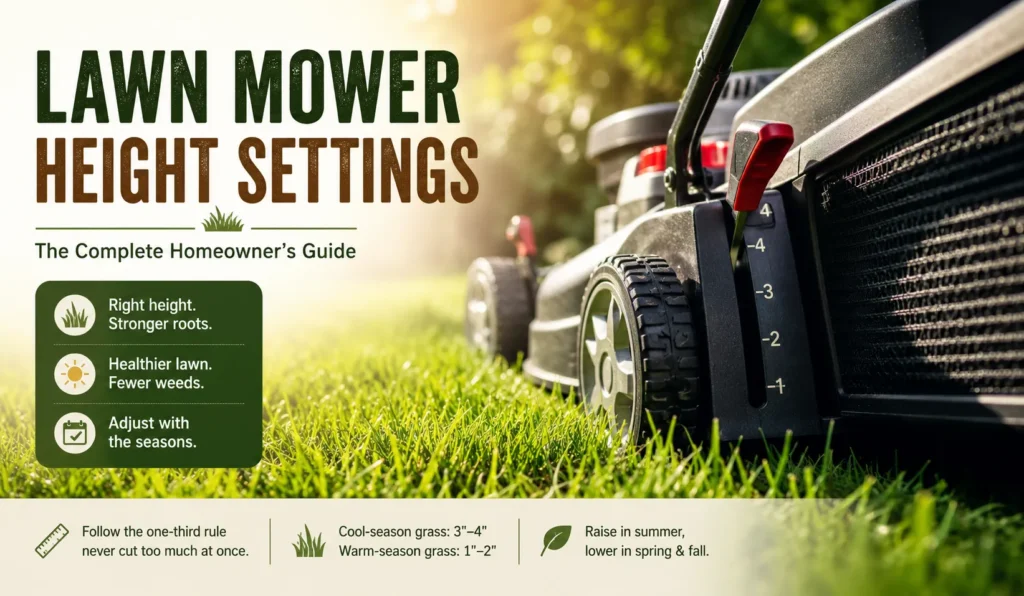
- Lawn mower height settings control how tall your grass stays after each cut – and the wrong setting can kill your lawn in a single session.
- The one-third rule is the most important mowing guideline: never cut more than one-third of the blade length at once.
- Cool-season grasses (Kentucky Bluegrass, Fescue) thrive at 3-4 inches; warm-season grasses (Bermuda, Zoysia) do best at 1-2 inches.
- Single-lever height systems adjust all four wheels at once; individual wheel systems require adjusting each corner separately.
- Raise your mowing height in summer heat and shade, lower it slightly in early spring and before the final fall cut.
My neighbor Rick has the best-looking lawn on our street. Every Saturday morning I’d watch him mow, and his grass always looked like a golf course fairway by noon. Mine, meanwhile, looked like I’d attacked it with a lawnmower and lost. Brown patches in July. Thin, scraggly growth in the shade. A crunching sound under the blade that made me wince.
It took me two full seasons to figure out what Rick was doing differently. He wasn’t using better fertilizer. He wasn’t watering more. He was adjusting his lawn mower height settings – and he was doing it right.
This guide is for homeowners who’ve never touched their height adjustment lever, or who’ve turned it once and hoped for the best. Whether you’ve got a postage-stamp yard in Atlanta or a half-acre in Minnesota, the principles here are the same.
Why Cutting Height Matters More Than You Think
Height is the most underestimated setting on your mower. Most people set it once when they first buy the machine, then forget it exists. That single decision – often made in a parking lot while reading the mower box – quietly shapes how healthy your lawn is for years.
The One Mistake That Kills Healthy Grass
Scalping. That’s what happens when you cut too low. You expose the crown of the grass plant – the growing point right at soil level – to direct sun, heat, and stress. Once the crown burns in July heat, that patch doesn’t just turn brown. It dies.
I scalped a 10-foot section of my Georgia backyard one August because I dropped the deck to “make the lawn look neater.” Six weeks later, weeds had moved in. The grass never recovered that season. My lawn care store sold me a bag of patch seed and told me this story happens every summer, all over the South.
Scalping also removes most of the leaf blade at once. Grass uses its leaves to photosynthesize. Cut too much, and the plant diverts all its energy from root growth to emergency leaf regeneration. You see thin, stressed turf within a week.
How Height Affects Root Depth and Lawn Health
Taller grass grows deeper roots. This isn’t a theory – it’s consistent across every grass type. The leaf blade and the root system are in balance. When you mow higher, you get a deeper, more drought-resistant root system.
Studies on Kentucky Bluegrass at Rutgers University show that grass maintained at 3.5 inches develops roots twice as deep as grass cut at 1.5 inches. Deeper roots reach moisture further down in the soil. That’s why Rick’s lawn stays green longer in a dry July.
Taller grass also shades the soil surface. That shade keeps soil cooler, slows moisture evaporation, and blocks sunlight from weed seeds waiting to germinate. Higher cut equals fewer weeds. That’s not a coincidence.
How Lawn Mower Height Settings Actually Work
Most homeowners have no idea what the numbers on their mower actually mean. Some think it’s a speed setting. Others assume it controls suction. Here’s how the system actually works.
Single-Lever vs. Individual Wheel Adjustments
Modern rotary mowers use one of two height adjustment systems.
Single-lever systems move all four wheels simultaneously with one handle. You squeeze a release, slide the lever along a notched track, and every wheel rises or falls together. These are faster, more consistent, and standard on most mid-range and premium mowers. The downside is that if your yard is sloped, you can’t compensate per-wheel.
Individual wheel adjustment systems have a lever at each wheel. You adjust four separate points. This takes longer – maybe two extra minutes per mowing session – but it lets you fine-tune deck angle on uneven ground. You’ll find this system on older mowers and some entry-level models. If your yard has a noticeable slope, this actually becomes an advantage.
What the Numbers on Your Mower Actually Mean
The numbers – or notches, on some models – represent the cutting deck height in inches. Position 1 is the lowest. Position 6 or 7 is typically the highest. Most mowers offer a range from about 1 inch to 4 inches, sometimes up to 4.5 inches.
The catch is that these positions are rarely labeled in inches. You’ll see “1, 2, 3” or small dots between notches. To know the actual height, measure. Park the mower on a flat concrete surface. Drop a ruler next to the blade. Measure from the ground to the lowest point of the blade. Do this at each position you use, and write the actual heights on a small piece of tape on your mower handle. Takes five minutes. Saves a season of guessing.
How Many Height Settings Do You Really Need?
Three positions cover almost every scenario for a typical homeowner.
A low position around 2 inches for your first spring cut and your final fall cut. A medium position at 3 to 3.5 inches for most of the season. A high position at 4 inches for summer heat stress, shady areas, and drought conditions.
That’s it. You don’t need to dial in a different height every single mow. But you do need to move that lever intentionally when seasons and conditions change.
Cutting Height Comparison Across Common Mower Types
| Mower Type | Typical Height Range | Adjustment System | Best For |
|---|---|---|---|
| Rotary push mower | 1 to 4 inches | Single-lever or per-wheel | Most home lawns |
| Self-propelled rotary | 1 to 4.5 inches | Single-lever | Larger flat yards |
| Rear-engine riding mower | 1 to 5 inches | Deck lift lever | Half-acre+ properties |
| Zero-turn riding mower | 1 to 5 inches | Deck lift lever | Large properties |
| Reel mower (manual) | 0.5 to 2.5 inches | Roller adjustment | Fine-blade warm-season grasses |
| Robotic mower | 0.8 to 3.5 inches | Digital dial | Flat, low-maintenance lawns |
The Right Cutting Height for Every Grass Type
Grass type is the single biggest factor in determining your ideal cutting height. There is no universal setting that works for every lawn. The numbers below are research-backed recommendations from university extension programs across the US.
Warm-Season Grasses (Bermuda, St. Augustine, Zoysia)
These grasses grow aggressively in heat and go dormant in cold. They have a low, dense growth habit and generally prefer shorter cuts.
Bermuda grass performs best at 1 to 1.5 inches. Bermuda spreads through stolons – horizontal stems at soil level – and a short cut keeps those stolons productive. Cut it too high and it gets puffy and spongy, a condition called thatch buildup. Common throughout Georgia, Texas, and the Carolinas.
St. Augustine grass needs more leaf surface and should stay between 2.5 and 4 inches. It doesn’t take stress well and burns faster than Bermuda when scalped. If you’re in Florida or coastal areas, this is probably your grass – wide blades, coarse texture.
Zoysia grass sits in the middle at 1 to 2.5 inches depending on the variety. Fine-blade Zoysia varieties can go lower. Coarse varieties need the extra height. Zoysia is common in the mid-South and transition zone states.
Cool-Season Grasses (Kentucky Bluegrass, Fescue, Ryegrass)
These grasses thrive in spring and fall, slow down in summer, and prefer higher cuts. They’re common in the Midwest, Northeast, and Pacific Northwest.
Kentucky Bluegrass does best at 2.5 to 3.5 inches. It spreads through underground stems called rhizomes and is shade-tolerant when maintained at the higher end of that range. Drop it below 2 inches regularly and you’ll see thin patches by mid-summer.
Tall Fescue is the workhorse of the transition zone. It handles heat, shade, and drought better than most cool-season options. Recommended height is 3 to 4 inches. Its deep root system – up to 3 feet in good soil conditions – is what makes it drought-tough. It’s the right choice if you’re in Missouri, Tennessee, or the middle tier of the country.
Perennial Ryegrass is often mixed with Bluegrass in Northern lawns. Mow it at 2 to 3 inches. It germinates fast and recovers quickly from foot traffic, which is why it’s popular in high-use lawns and sports fields.
Transitional Zone Grasses – The Tricky Middle Ground
The transition zone runs from Northern California to Virginia, cutting through Kansas, Missouri, Kentucky, and the Carolinas. Neither purely warm-season nor cool-season grasses thrive here year-round without some management.
Most homeowners in this zone use Tall Fescue for its resilience. Some use Zoysia because it tolerates the heat but handles mild cold. The real challenge is that whatever you plant will face heat stress in July and cold stress in January. The answer is maintaining height at the upper end of the range for your grass type. That extra leaf surface is a buffer.
Recommended Heights by Grass Type
| Grass Type | Optimal Height Range | Season | Notes |
|---|---|---|---|
| Bermuda | 1 to 1.5 in | Spring to fall | Reel mower ideal for low cuts |
| St. Augustine | 2.5 to 4 in | Spring to fall | Avoid going below 2.5 in summer |
| Zoysia | 1 to 2.5 in | Spring to fall | Variety-dependent |
| Kentucky Bluegrass | 2.5 to 3.5 in | Spring and fall | Raise in summer |
| Tall Fescue | 3 to 4 in | Year-round | Best transition zone choice |
| Perennial Ryegrass | 2 to 3 in | Spring and fall | Often mixed with Bluegrass |
| Fine Fescue | 2.5 to 3.5 in | Year-round | Best for shade |
How Seasons Change the Height You Should Use
Height isn’t a set-and-forget number. The same lawn needs different heights in March than it does in August. Most homeowners miss this.
Spring – Starting Low or High? (Most People Get This Wrong)
The common instinct in spring is to leave the mower high because the grass looks fragile. Actually, a slightly lower first cut in early spring is beneficial for most grass types.
For cool-season grasses, drop to the lower third of your normal range for the first one or two cuts of the season. This removes dead leaf tips from winter, lets light reach the soil to warm it up, and encourages lateral growth rather than vertical shoot growth. Think of it as a reset after dormancy.
For warm-season grasses like Bermuda and Zoysia, a lower scalp cut in early spring (as low as 0.5 to 1 inch for Bermuda) is a standard practice in the Southeast. It removes the dead brown material and speeds up green-up. Do this only once, in late March or early April before active growth starts. Never scalp after the lawn is fully green and growing.
After that first cut, bring the height back up to your normal growing-season range.
Summer Heat and the One-Third Rule
The one-third rule is the most practical guideline in lawn care. Never remove more than one-third of the blade length in a single cut. If you normally mow at 3 inches, don’t let the grass grow past 4.5 inches before you cut.
In summer heat, this rule becomes even more important. The leaf blade is what keeps the soil cool and the roots protected. A Phoenix August lawn at 3 inches holds its soil temperature notably lower than one scalped to 1.5 inches in the same conditions, according to University of Arizona Cooperative Extension recommendations (2022).
In summer, raise your mowing height by half an inch to a full inch above your normal setting. Cut more frequently to stay within the one-third rule. Less removed per cut means less stress on a grass plant already fighting heat.
I keep my Atlanta Bermuda at 2 inches from May through September instead of the 1.5 inches I use in spring. That half-inch difference in summer keeps me from seeing those burned, white-tipped blades I used to get every August.
Fall Prep and the Final Cut Before Winter
In fall, cool-season grasses enter their best growing season. They thicken up, spread laterally, and recover from summer stress. This is the time to let them grow at the higher end of their range and apply fall fertilizer.
For warm-season grasses, bring the height down slightly – about half an inch – two to three weeks before your first expected frost. This removes some material before it goes dormant and prevents snow mold from developing on long blades.
The final mow of the season for cool-season grasses should be at your normal or slightly lower setting – around 2 to 2.5 inches for most varieties. This reduces the chance of matting and disease over winter. Don’t go too low. The crown still needs protection from hard freezes.
Seasonal Height Guide by US Region
| Region | Grass Type | Spring | Summer | Fall | Winter |
|---|---|---|---|---|---|
| Southeast (GA, FL, SC) | Bermuda / St. Augustine | 1 to 1.5 in | 1.5 to 2 in | 1 to 1.5 in | Dormant |
| Southwest (AZ, CA) | Bermuda | 1 to 1.5 in | 2 in | 1.5 in | Dormant or overseeded |
| Midwest (MN, OH, IN) | Kentucky Bluegrass | 2.5 to 3 in | 3.5 to 4 in | 3 to 3.5 in | Dormant |
| Northeast (PA, NY, NJ) | Tall Fescue / Bluegrass | 3 in | 3.5 to 4 in | 3 to 3.5 in | Dormant |
| Transition Zone (MO, TN, KY) | Tall Fescue | 3 to 3.5 in | 4 in | 3 to 3.5 in | Dormant |
| Pacific Northwest (OR, WA) | Fine Fescue / Ryegrass | 2.5 to 3 in | 3 to 3.5 in | 2.5 to 3 in | Minimal mowing |
Height Settings for Different Yard Conditions
Grass type and season are the biggest factors. But the specific conditions in your yard also change the equation.
Shady Lawns vs. Full Sun
Shaded grass needs to be taller. This is one of the most consistent recommendations from extension programs at Penn State, Clemson, and North Carolina State.
Here’s why: shade reduces photosynthesis. Each square inch of leaf blade is producing less energy than it would in full sun. To compensate, the grass needs more leaf surface area. Raising your mowing height by half an inch to a full inch in shaded areas gives the plant the surface area it needs to stay healthy.
If you’re mowing a lawn that has both sunny and shady sections, you have two options. Raise the deck for the whole yard to accommodate the shade areas. Or walk slower through the shade sections so the blade lifts and cuts less aggressively. The first option is simpler.
In deep shade – less than four hours of direct sun per day – even the most shade-tolerant grasses struggle. Raising height helps, but you may need to accept that grass won’t thrive there. Ground cover or mulch may serve those spots better than any mowing strategy.
Sloped or Uneven Terrain
Slopes dry out faster than flat ground. The sun hits at a steeper angle, water runs off before it soaks in, and the soil temperature is higher. For these reasons, raise your cutting height by half an inch on slopes compared to your flat-lawn setting.
Mowing direction also matters on slopes. Mow across the slope, not up and down. On steep grades, a riding mower or self-propelled mower going up and down can tip. More practically, going across the slope gives you better control and reduces striping from wheel ruts.
Uneven terrain – lawns with high and low spots – creates scalping risk at the high spots even when your deck is set correctly. If you notice certain areas getting scalped consistently, you may need to topdress those spots with soil or simply mow those sections separately with a raised deck.
Drought-Stressed or Recovering Grass
When grass is drought-stressed, the crown is already under pressure. This is the worst time to cut low. Raise the deck to the high end of your normal range and keep it there until you see consistent new growth.
If the lawn has gone completely dormant from drought – tan and crunchy when you walk on it – don’t mow it at all. Dormant grass looks dead but is alive. Mowing it removes the protective tip of each blade and exposes what’s left to more stress. Wait for rain or irrigation to break dormancy, then resume mowing once you see green growth returning.
For recovering grass after disease, traffic damage, or lawn renovation, the same rule applies: mow high, mow less often, and let the plant recover before you stress it again.
Yard Condition vs. Recommended Height Adjustment
| Condition | Height Adjustment | Reason |
|---|---|---|
| Full sun, good soil | Normal range | Standard conditions |
| Partial shade (2-4 hr sun) | +0.5 in | More leaf surface for photosynthesis |
| Deep shade (<2 hr sun) | +1 in | Maximum leaf area; consider alternatives |
| South-facing slope | +0.5 in | Dries faster, higher heat |
| Drought stress or dormancy | High end of range or skip | Protect the crown |
| Lawn recovering from damage | High end of range | Allow plant to regenerate |
| Heavy foot traffic area | High end of range | Grass needs extra resilience |
Common Mistakes People Make With Cutting Height
Cutting Too Short Too Often (Scalping)
The most common mistake, and the most damaging. Scalping happens when the deck is set too low for the grass type, or when you wait too long between cuts and then try to cut back to your normal height in one pass.
The result is visible and immediate. Yellow or white patches where the crown was exposed. In warm climates, those patches can die within a week. In cool climates, they become entry points for disease.
The fix is simple but requires patience. Set the deck one notch higher than you think you need. Wait a full week. Look at how the lawn responds. Most lawns that struggle from scalping recover noticeably just from raising the deck by one position.
One detail most people skip: check the actual blade height after adjusting, not just the lever position. Worn deck wheels, uneven concrete driveways used for measuring, or misaligned adjustment mechanisms can all mean your “3-inch” setting is actually cutting at 2.2 inches.
Never Changing the Height Between Seasons
The second major mistake is treating height as a permanent setting. I see this constantly. Someone buys a new mower, sets it in the middle position, and touches the adjustment lever once in the next five years.
The problem: the same height that works in a cool Minnesota May is too low for a hot Minnesota August. The same height that’s right for your lawn in October is wrong for it in July.
Seasonal adjustment takes about 30 seconds. Slide the lever two positions up before your first hot-summer cut. Slide it back down in October. That two-second habit change is worth more than most fertilizer applications.
A useful trigger: change your mowing height when you change your clocks. Spring forward, raise the deck. Fall back, lower it slightly for the final cuts. It’s not a perfect match to grass growth cycles, but it’s a useful memory hook.
My Final Recommendation
If I had to give one piece of advice to a new homeowner standing in their backyard with a mower they’ve never adjusted: look up your grass type first, then set your deck to the middle of the recommended range for that grass. Don’t guess. That single lookup – takes two minutes on any university extension website – will do more for your lawn than any fertilizer or watering schedule.
From there, the only habit you need to build is this: check your height lever twice a year. Once in late spring before summer heat arrives. Raise it. Once in early fall before you start the end-of-season cuts. Lower it slightly. Those two adjustments per year account for 90 percent of what seasonal height management requires.
The last thing I’d say is this: if your lawn looks stressed, raise the deck before you reach for any product. Stressed lawns almost always respond to being cut less aggressively. More leaf means more photosynthesis, more root growth, and more recovery. I’ve talked homeowners out of $80 lawn treatments by having them raise their deck one notch for three weeks. It works more often than it should.
Cutting Low vs. Cutting High – Trade-Offs Compared
| Factor | Cutting Low | Cutting High |
|---|---|---|
| Appearance | Neat, manicured look immediately after cut | Fuller, more natural look |
| Root depth | Shallower roots | Deeper roots, more drought-resistant |
| Weed pressure | More weed germination (less soil shade) | Fewer weeds (shaded soil) |
| Moisture retention | Lower – soil exposed to sun | Higher – soil stays cooler and moist |
| Scalping risk | High, especially on uneven terrain | Low |
| Mowing frequency needed | More often (grows back faster when stressed) | Less often in most conditions |
| Summer performance | Struggles in heat – browns faster | Handles summer stress better |
| Best use case | Bermuda grass, reel-mowed fine turf | Most home lawns, cool-season grasses |
Frequently Asked Questions About Lawn Mower Height Settings
What height should I set my lawn mower?
The right height depends on your grass type. Cool-season grasses like Kentucky Bluegrass and Tall Fescue should be cut at 3 to 4 inches. Warm-season grasses like Bermuda should stay at 1 to 1.5 inches, while St. Augustine needs 2.5 to 4 inches. If you don’t know your grass type, take a photo to your local garden center – they can identify it in under a minute.
What is the one-third rule for mowing?
The one-third rule says you should never remove more than one-third of the grass blade in a single mow. If your target height is 3 inches, let the grass grow no taller than 4.5 inches before cutting. Breaking this rule forces the plant into emergency recovery mode, diverting energy from roots to replace lost leaf tissue.
Should I raise my mower height in summer?
Yes. Most homeowners should raise their mowing height by half an inch to a full inch during the hottest months. Taller grass shades the soil, keeps roots cooler, and retains more moisture. This applies to both cool-season and warm-season grasses, though the exact target height differs by type.
How do I know what number on my mower equals what height in inches?
The easiest method: park the mower on flat concrete, set a position, then measure from the ground to the lowest point of the blade with a ruler. Write those measurements down and tape them to your mower handle. Manufacturer numbering systems vary – there’s no universal standard.
What happens if I mow my lawn too short?
Cutting too short exposes the crown of the grass plant – its growing point – to direct sun and heat. This causes scalping: yellow or brown patches that can take weeks to recover and may die in summer heat. It also results in a shallower root system, making the lawn less drought-resistant and more vulnerable to weed invasion.
Can I mow my lawn at the same height all year?
You can, but your lawn will perform better if you adjust seasonally. The two key changes: raise the height by half an inch to an inch before summer heat peaks, and lower it slightly for the final one or two cuts before winter dormancy. These two adjustments per year make a real difference in how your lawn holds up through stress.
How often should I change my lawn mower height setting?
Most lawns need two to four height adjustments per year. Key moments: early spring (a slightly lower cut to clear winter debris), early summer (raise for heat), late summer or early fall (lower slightly for final recovery), and the last cut before dormancy. You don’t need to adjust every time you mow.