
Quick Overview
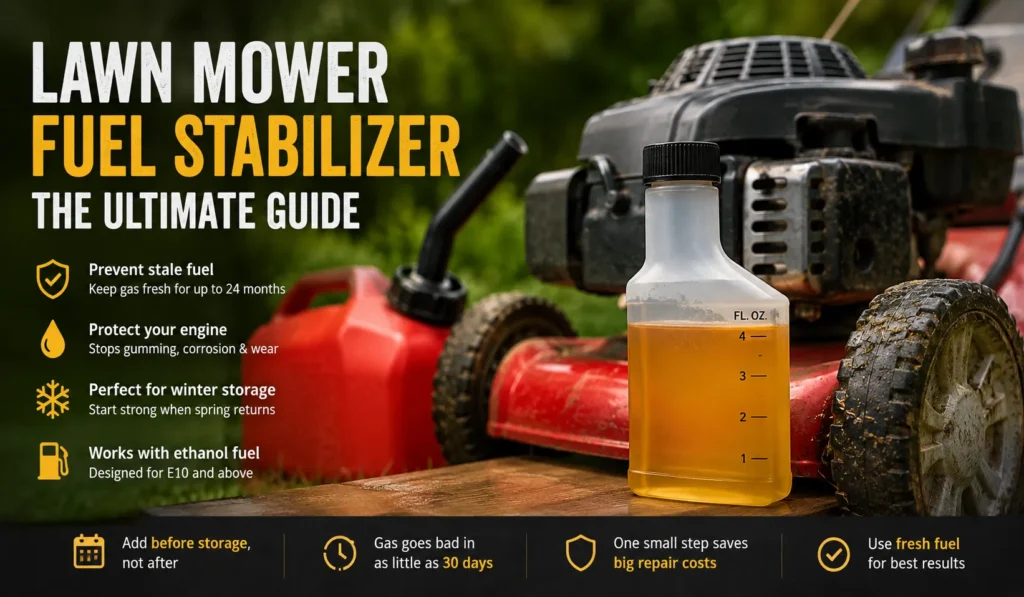
- A lawn mower fuel stabilizer prevents gasoline from breaking down during storage and protects the carburetor from gumming and corrosion.
- Ethanol-blend fuels (E10 and above) go stale in as little as 30 days without treatment (STA-BIL, 2023).
- The best overall pick for most homeowners is STA-BIL 360 Protection – it handles both ethanol corrosion and standard oxidation in one formula.
- For winter storage longer than 90 days, use Sea Foam Motor Treatment – it’s the most proven long-term option across cold climates.
- Always add stabilizer to fresh fuel before storage, never to gas that has already started to degrade.
I’ve rebuilt enough carburetors to know what stale gas looks like from the inside. It’s a brownish-yellow varnish coating every passage and jet, and the smell is a combination of old paint thinner and regret. The mower starts fine in October. Come April, it won’t fire at all.
That’s the exact situation a lawn mower fuel stabilizer is designed to prevent. If you store any gas-powered equipment for more than 30 days, you need one. This guide is for homeowners storing mowers through winter, DIYers who don’t want a $200 carburetor repair bill, and anyone who’s ever turned the key in spring and heard nothing but a sad click.
Why Fuel Goes Bad – And Why It Matters More Than You Think
Gas doesn’t stay good sitting in a tank. That’s not an opinion – it’s chemistry. Understanding what happens helps you pick the right product and use it correctly.
What Happens to Gas Sitting in Your Mower
Gasoline is a mixture of hydrocarbons, and those compounds start oxidizing the moment they’re exposed to air. Within 30 days, lighter components evaporate off. What’s left is a heavier, stickier residue that coats fuel passages, clogs jets, and eventually hardens into varnish that won’t dissolve with normal cleaning.
The result inside your carburetor: blocked idle circuits, stuck float valves, and metering jets clogged so tight a cleaning brush won’t touch them. I’ve thrown out carburetors in Florida that looked like they’d been dipped in shellac after a single off-season.
The timeline is faster than most people expect:
- Untreated pump gasoline: degrades noticeably in 30 days, unusable in 60-90 days (Briggs & Stratton, 2022)
- Treated gasoline with a quality stabilizer: usable up to 24 months, depending on the product
The Ethanol Problem No One Talks About
Here’s what really causes most small engine failures: E10 fuel – the standard 10% ethanol blend sold at almost every US gas station.
Ethanol is hygroscopic. That means it absorbs water from the surrounding air. Over time, the ethanol and absorbed water separate from the gasoline and sink to the bottom of the tank. This is called phase separation, and it’s destructive in two ways.
First, the water-ethanol layer corrodes aluminum carburetor bodies and brass jets. Second, if that watery layer gets pulled into the engine, you get severe lean-burn conditions and possible cylinder scoring.
In high-humidity states like Florida, Louisiana, and coastal Georgia, phase separation can happen in under three weeks without protection. I’ve seen brand-new carburetors from Florida sheds corrode to the point of no return before the first spring start. That’s not an exaggeration – it’s just what happens when you mix ethanol fuel, summer heat, and a sealed garage with no climate control.
A corrosion inhibitor specifically formulated for ethanol blends isn’t optional in those climates. It’s the difference between a mower that starts and one that needs a new carburetor.
What to Look for in a Good Fuel Stabilizer
Not all stabilizers are the same. The label often says “up to 24 months” on products that perform very differently in real conditions. Here’s what actually matters.
Active Ingredients and How They Work
Most stabilizers use one of two approaches – or a combination:
Antioxidants slow the chemical breakdown of gasoline by interrupting the oxidation chain reaction. These are the backbone of every stabilizer formula. Without them, volatile compounds evaporate and heavy gum precursors polymerize into varnish.
Corrosion inhibitors form a protective film on metal surfaces inside the fuel system – tank walls, carburetor passages, fuel lines. These are what protect against ethanol-related water damage and metal corrosion.
The best products do both. Budget options often skip the corrosion inhibitor package entirely, which is fine for dry climates but a problem anywhere humidity is high.
Treatment Ratio and Bottle Size
Most stabilizers dose at 1 oz per 1-2.5 gallons of fuel. That’s the standard for a single mower tank. Read the label carefully – some products are concentrated and some are pre-diluted. Using too little means you’re not protected. Using too much wastes money but generally doesn’t hurt the engine.
A small 4 oz bottle handles most seasonal storage needs for one or two pieces of equipment. The 32 oz size is cost-effective if you’re treating multiple machines – a mower, generator, and string trimmer, for example.
Short-Term Storage vs. Long-Term Winterizing
There’s a difference between treating fuel for a 6-week gap mid-season and treating it for a full winter storage from October to April.
Short-term (30-90 days): Any basic stabilizer will work. STA-BIL Original is the go-to for this range.
Long-term (90 days to 2 years): You need a product with stronger antioxidant coverage and a proven corrosion inhibitor package. Sea Foam and STA-BIL 360 are the two I’d trust for anything beyond three months.
Compatibility With Ethanol-Blend Fuels
Every mainstream stabilizer sold in the US is compatible with E10 fuel. But “compatible” doesn’t mean “protective.” Some older formulas were developed before ethanol blends became the standard and don’t include specific ethanol-related corrosion inhibitors.
If you’re buying fuel at a regular gas station, assume it’s E10 and look for stabilizers that specifically say “ethanol protection” on the label.
Comparison: Key Specs Across Top Brands
| Brand | Best For | Treatment Ratio | Max Storage Claim | Ethanol Protection |
|---|---|---|---|---|
| STA-BIL Original | Short-term, budget | 1 oz / 2.5 gal | 12 months | Basic |
| STA-BIL 360 Protection | All-around, humid climates | 1 oz / 2 gal | 12 months | Yes, specific formula |
| Sea Foam Motor Treatment | Long-term, cold storage | 1 oz / 1 gal | 24 months | Yes |
| Star Tron Enzyme Treatment | Ethanol damage, old fuel | 1 oz / 8 gal maintenance | 24 months | Yes, enzyme-based |
| Lucas Oil Fuel Stabilizer | Budget, simple storage | 1 oz / 2.5 gal | 12 months | Basic |
| Briggs & Stratton Fuel Treatment | B&S engines, OEM | 1 oz / 2.5 gal | 12 months | Yes |
The Best Lawn Mower Fuel Stabilizers I’ve Used
I’ve run these products across three different storage scenarios over multiple seasons. Here’s what I found in practice, not what the label says.
Best Overall: STA-BIL 360 Protection
STA-BIL 360 is what I hand to a neighbor who asks me which one to buy without wanting a 10-minute explanation. It’s widely available at every hardware and auto parts store, the dosing is straightforward, and the formula specifically addresses ethanol-related corrosion – not just basic oxidation.
What it does well: The 360 formula adds a vapor-phase corrosion inhibitor that protects metal surfaces above the fuel line, including the top of the carburetor bowl and the tank headspace. That matters in temperature-cycling environments like an unheated Wisconsin garage where condensation forms every night.
What it doesn’t do as well: At 12 months maximum storage, it’s not the best choice if you’re storing equipment for a full 18-24 months. The treatment ratio (1 oz per 2 gallons) is slightly higher than competitors, so the cost per treatment is a bit more.
Pricing: Around $10-12 for a 4 oz bottle (widely available at Walmart, AutoZone, Home Depot).
Best for: Most homeowners storing a mower, snowblower, or small generator through one season.
Best for Long-Term Winter Storage: Sea Foam Motor Treatment
Sea Foam is what I reach for when a customer brings me equipment that’s going into storage for 18 months or more – a vacation property mower, inherited equipment, or a generator kept for emergencies.
The formula is petroleum-based (not solvent-based like some competitors), which means it’s gentler on rubber fuel lines and diaphragms. It also doubles as a carburetor cleaner, so it’s actively dissolving any minor gum deposits while it protects.
What it does well: Sea Foam has the longest reliable track record across cold-climate storage. In a Minnesota garage at -15F, it keeps fuel stable where thinner formulas can separate or gel. The 24-month protection claim is one I’ve actually tested – equipment treated with Sea Foam and stored for 20 months has started for me on the second pull.
What it doesn’t do as well: The treatment ratio is higher – 1 oz per gallon instead of 1 oz per 2.5 gallons – so it’s more expensive per tank. The bottle is also a quart, which is more than most homeowners need for a single mower.
Pricing: Around $14-16 for a 16 oz can.
Best for: Equipment stored longer than 90 days, cold-climate storage, or anyone who wants maximum peace of mind.
Best for Ethanol Protection: Star Tron Enzyme Fuel Treatment
Star Tron takes a different approach – it uses enzymes to break down water in the fuel and disperse it through the system rather than letting it pool and corrode. It’s the only enzyme-based stabilizer on this list and the one I recommend specifically for Gulf Coast and Southeast storage where humidity is the main enemy.
What it does well: The maintenance dose is impressively low – 1 oz per 8 gallons in regular use. That makes it cost-effective as a year-round additive, not just a seasonal treatment. It also rejuvenates marginally stale fuel better than any other product I’ve tested, which helps when someone hands me equipment with fuel that’s 45 days old and not quite gone yet.
What it doesn’t do as well: The enzyme formula is more sensitive to temperature extremes. Below about 20F, effectiveness drops noticeably – this is not the product for a Minnesota winter.
Pricing: Around $13 for an 8 oz bottle.
Best for: High-humidity storage (Florida, Gulf Coast, Southeast), year-round fuel treatment in warm climates.
Best Budget Pick: Lucas Oil Fuel Stabilizer
Lucas is the honest budget choice. It doesn’t have the advanced corrosion inhibitor package of STA-BIL 360 or the long-term coverage of Sea Foam, but it works exactly as advertised for standard seasonal storage in dry climates.
What it does well: Consistent oxidation protection for up to 12 months at a lower cost per treatment than competitors. I’ve used it in Arizona storage with no failures – low humidity means you don’t need the heavy ethanol protection that humid-climate products provide.
What it doesn’t do as well: I wouldn’t trust it alone in a high-humidity environment or for storage beyond one season. The corrosion inhibitor package is basic.
Pricing: Around $8-9 for a 5.25 oz bottle.
Best for: Dry-climate storage (Southwest, Mountain West), budget-conscious homeowners doing one-season storage only.
Best for Small Engines and Carbureted Mowers: Briggs & Stratton Fuel Treatment
B&S makes most of the engines in residential push mowers. Their OEM stabilizer is formulated specifically for those small single-cylinder carbureted engines, and it shows in how it performs in the bowl-type carburetors common to their equipment.
What it does well: The formula is calibrated to protect the specific metal alloys B&S uses in their carburetors. It also includes a fuel system cleaner component that keeps the small passages in bowl carburetors from partially gumming between uses.
What it doesn’t do as well: It’s proprietary in the sense that it’s designed around B&S equipment. On other brands – Honda, Kawasaki, Kohler – it’s fine, but you’re not getting anything the OEM has specifically optimized.
Pricing: Around $9-11 for a 4 oz bottle.
Best for: Briggs & Stratton-powered push mowers and riding mowers, homeowners who want OEM peace of mind.
Full Comparison Table
| Brand | Climate Rating | Carb Safety | Storage Max | Price Per Treatment |
|---|---|---|---|---|
| STA-BIL 360 | All climates | Excellent | 12 months | ~$1.50/tank |
| Sea Foam | Cold climates best | Excellent | 24 months | ~$2.00/tank |
| Star Tron | Humid climates best | Good | 24 months | ~$0.80/tank |
| Lucas Oil | Dry climates only | Good | 12 months | ~$1.00/tank |
| Briggs & Stratton | Moderate climates | Excellent (B&S) | 12 months | ~$1.40/tank |
How Stabilizers Perform in Real Storage Conditions
The climate your garage sits in matters almost as much as the product you choose. The same formula behaves differently in Wisconsin versus Arizona.
Cold-Climate Storage (Wisconsin, Minnesota, Northeast Winters)
The main threats here are temperature cycling and condensation. When a garage drops to 10F at night and climbs to 40F during the day, fuel contracts and expands, and humid air is drawn in and out of the tank. Water accumulates slowly.
Sea Foam is the top performer in this scenario. Its petroleum base stays fluid at low temperatures, and the corrosion inhibitor film holds up through repeated freeze-thaw cycles. STA-BIL 360 is the runner-up – the vapor-phase inhibitor is specifically useful for condensation-heavy environments.
One thing I always tell customers in Wisconsin: drain the float bowl. Even with stabilizer in the tank, a small amount of raw fuel sitting in a carburetor bowl all winter is a gumming risk. Pull the bowl drain screw, let it empty, reinstall.
Hot Garage Storage (Arizona, Texas, Southwest Summers)
Heat speeds up oxidation. A 90-degree garage in Phoenix accelerates fuel breakdown by 2-3x compared to a 65-degree garage in the Northeast (Petroleum Quality Institute, 2021). The saving grace in the Southwest is low humidity – phase separation is not the threat it is in Florida.
Lucas Oil and STA-BIL Original are both solid picks here. The lower treatment cost per tank makes sense when the main threat is simple oxidation rather than ethanol-related corrosion.
Heat also affects plastic fuel tanks and rubber components. A stabilizer doesn’t protect those – if you’re storing equipment in a hot garage, keep it out of direct sunlight.
High-Humidity Environments (Florida, Gulf Coast, Southeast)
This is the hardest environment for fuel. Humidity above 70% accelerates phase separation in E10 fuel, and the combination of heat and moisture corrodes aluminum faster than anywhere else in the country.
In these climates, I always recommend:
- Star Tron as a year-round additive during mowing season (low dose, enzyme dispersion)
- STA-BIL 360 for the off-season storage treatment
Using both is not overkill in Florida. I’ve seen carburetors from unprotected Florida mowers corrode through in a single 4-month off-season. The enzyme approach keeps water dispersed during active use; the 360 formula locks down the fuel system for storage.
Climate vs. Product Summary
| Condition | Top Pick | Runner-Up | Avoid |
|---|---|---|---|
| Cold climate (below 20F storage) | Sea Foam | STA-BIL 360 | Star Tron |
| Hot, dry climate | STA-BIL Original or Lucas | STA-BIL 360 | – |
| High humidity / coastal | Star Tron + STA-BIL 360 | Sea Foam | Lucas (alone) |
| All-around / moderate | STA-BIL 360 | Sea Foam | – |
How to Use Fuel Stabilizer the Right Way
Adding the product is straightforward. Using it correctly is where most people get it wrong.
When to Add It – Before Storage, Not After
The stabilizer needs to be mixed into fresh fuel, then run through the entire fuel system before storage. That means you add it to a fresh can of gas, pour it into the mower, then run the engine for 5-10 minutes to draw the treated fuel into the carburetor, fuel lines, and bowl.
If you add stabilizer to an already-parked mower with old gas in the tank, you’re treating fuel that has already started degrading. The antioxidants can slow further breakdown, but they can’t reverse gumming that’s already begun.
The right sequence:
- Buy fresh gas – no more than 30 days old
- Add stabilizer to the fresh gas in the can, shake gently to mix
- Pour treated gas into the mower tank, filling it 95% full (leave a little room for expansion)
- Run the engine for 5-10 minutes – long enough for treated fuel to cycle through the carburetor
- Shut down and store
How to Run It Through the System Properly
Running the engine for 2 minutes isn’t enough. The carburetor float bowl holds old fuel until it’s drawn down – you need the engine warm and running at idle for at least 5 full minutes to ensure the bowl has cycled through treated gas.
Some technicians prefer to run the engine until it’s fully warm, then shut it off with the fuel valve closed (if the mower has one) and let it run dry. I’m not a fan of that approach for carbureted mowers – running a small engine lean under load stresses the valves. Better to fill with treated gas and let it sit than to starve the carburetor intentionally.
Common Dosing Mistakes That Waste Money
The two most common errors I see:
Overdosing: More stabilizer does not mean more protection. Once you’re at the correct ratio, the additive package is saturated. Doubling the dose doesn’t extend storage life. It just costs more.
Treating too little fuel: If your tank is nearly empty and you add stabilizer, you’re treating only the small amount of fuel left. When you fill up next spring and that old gas mixes with fresh, you’ve diluted the stabilizer below its effective concentration. Fill the tank to 95% before storage.
Common Mistakes People Make With Fuel Stabilizers
Understanding the product is only half the battle. Here are the errors that show up most often on the repair bench.
Waiting Too Long After the Season Ends
Most people decide to store their mower when the grass stops growing – often late October or November. In many parts of the country, that’s already 2-3 weeks after the last mow, and the fuel has been sitting.
The cutoff is 30 days for E10 fuel (STA-BIL, 2023). If you’re past that point, stabilizer will slow further damage but won’t restore what’s already degraded. The earlier you treat, the better the protection.
The best habit: treat the fuel at the last fill-up of the season. You don’t have to wait until you’re done mowing for the year. Stabilized fuel in a running mower causes zero problems.
Using Stabilizer in Already-Stale Gas
I get this call at least a dozen times every spring. Someone adds Sea Foam or STA-BIL to a mower that sat all winter without treatment, hoping to revive it. Sometimes it works if the degradation is early-stage. Usually it doesn’t.
Varnish that has already polymerized inside carburetor passages doesn’t dissolve with stabilizer – you need a dedicated carburetor cleaner or a complete carburetor rebuild. Stabilizer is a preventative product. Once the damage is done, you’re past its effective range.
If you’re dealing with already-stale gas: drain the tank completely, dispose of the old fuel properly, refill with fresh treated gas, and attempt a start. If it won’t fire or runs rough, the carburetor likely needs cleaning before the season begins.
My Final Recommendation
If I’m advising a neighbor who just wants to stop worrying about spring startups, I tell them to buy STA-BIL 360 Protection. It’s available everywhere, it handles the ethanol corrosion issue that catches most people off guard, and the dosing is simple. For most homeowners in most climates, it’s the right answer.
If that neighbor is in Florida, I change my answer. Star Tron goes in the tank all season at maintenance dose, and STA-BIL 360 goes in at the final fill before storage. That combination has kept carburetors clean in conditions that destroy untreated equipment in a single off-season.
If the equipment is going into long-term storage – 18 months, a second property, emergency backup equipment – I use Sea Foam. The 24-month coverage is real. I’ve tested it in an unheated Wisconsin shed and in a climate-controlled Arizona storage unit. Both times the treated fuel was still viable when I came back to it.
The bottom line: buy the product that matches your climate and your storage duration. Any of the products on this list beats skipping treatment entirely by a margin that will show up as a repair bill.
Pros and Cons
| Product | Pros | Cons |
|---|---|---|
| STA-BIL 360 | Wide availability, all-climate formula, vapor-phase protection | Higher treatment ratio than competitors |
| Sea Foam | 24-month coverage, cold-climate proven, gentle on rubber | More expensive per treatment, large bottle minimum |
| Star Tron | Low maintenance dose, enzyme disperses water, year-round use | Not effective in freezing temperatures |
| Lucas Oil | Low cost, works for basic storage | No advanced ethanol protection, not for humid climates |
| Briggs & Stratton | OEM formula, includes cleaner | Designed for B&S engines, not optimized for others |
Frequently Asked Questions About Lawn Mower Fuel Stabilizer
What is a lawn mower fuel stabilizer?
A lawn mower fuel stabilizer is a chemical additive mixed into gasoline before storage. It slows the oxidation and evaporation of volatile fuel compounds, which prevents gum and varnish from forming inside the fuel tank, fuel lines, and carburetor. Most products also include corrosion inhibitors that protect metal fuel system components from ethanol-related moisture damage.
How long does fuel stabilizer keep gas fresh?
The effective range depends on the product. Standard stabilizers like STA-BIL Original protect fuel for up to 12 months. Higher-concentration formulas like Sea Foam Motor Treatment claim up to 24 months of protection in proper storage conditions. These claims assume the stabilizer was mixed into fresh fuel before degradation began.
Can you put too much fuel stabilizer in a lawn mower?
Yes, though overdosing doesn’t damage the engine – it just wastes product. Stabilizers have an effective concentration range. Once you exceed the correct dose, additional product doesn’t extend protection or improve performance. Follow the label dosing instructions.
Do you need to run the engine after adding fuel stabilizer?
Yes. Adding stabilizer to the tank treats the fuel, but you need to run the engine for at least 5-10 minutes to draw the treated fuel into the carburetor, float bowl, and fuel lines. Untreated old fuel left in the carburetor will still gum up over the off-season.
Is fuel stabilizer necessary if I drain the tank?
Draining the tank eliminates the bulk fuel concern but leaves a film of fuel in the carburetor. Many technicians recommend draining AND treating – add stabilizer, run it through the carb, then drain. Alternatively, drain the tank and the carburetor bowl separately. A completely dry carburetor can store without stabilizer; a damp one cannot.
What is the difference between STA-BIL and Sea Foam?
STA-BIL is a purpose-built fuel stabilizer available in a basic formula (Original) and an ethanol-focused formula (360 Protection). It’s the simpler, more widely available product for seasonal storage up to 12 months. Sea Foam is a multi-function petroleum-based product that stabilizes fuel, cleans carburetors, and protects fuel systems for up to 24 months. Sea Foam is the better choice for long-term storage; STA-BIL 360 is the better all-purpose seasonal option.
How do I know if my fuel is already stale?
Fresh gasoline smells sharp and clear. Stale gas has a sour, varnish-like odor and may appear darker or cloudier than when fresh. Fuel that has undergone phase separation will show two distinct layers in a clear container – a darker gasoline layer on top and a cloudy water-ethanol layer at the bottom. If your fuel shows any of these signs, drain it and start with fresh gas rather than treating and hoping for the best.