

Quick Overview
- Lawn mower blade timing is the exact rotational position two blades must hold relative to each other on a dual-blade deck so they don’t collide during operation.
- When timing is off, you’ll notice uneven cuts, streaky lawn lines, heavy vibration, and loud blade clatter.
- The most common cause is a blade strike – hitting a rock, root, or buried debris at full RPM.
- Most residential DIYers can reset blade timing at home with basic hand tools in under an hour.
- If the spindle assembly is cracked or the deck housing is bent, stop and take it to a shop.
I pulled a Husqvarna zero-turn into my Georgia shop a few summers ago. The homeowner said it “just didn’t cut right anymore.” The lawn looked like someone had mowed it with a blindfold on – thick stripes of uncut grass between clean passes. I put it up on the lift, grabbed the blades by hand, and felt it immediately. One blade was sitting about 30 degrees off from where it should be. Classic blade timing problem.
This guide is for homeowners, DIYers, and small engine hobbyists who want to understand lawn mower blade timing and fix it without paying shop rates. I’ll walk you through what it is, how to spot it, and how to fix it yourself – safely, step by step.
What Is Lawn Mower Blade Timing and Why Does It Matter?
Lawn mower blade timing is the fixed rotational relationship between two blades on a dual-blade mower deck. Each blade must be offset from the other at a specific angle – usually 90 degrees on most residential decks – so they spin past each other without touching.
Get that angle wrong, and you have two heavy steel blades spinning at 3,000 RPM on a collision course.
How Dual Blades Are Supposed to Work Together
On a standard 42-inch to 54-inch dual-blade deck, each blade spins on its own spindle. The spindles are driven by a belt from the engine crankshaft. That belt keeps both blades turning at the same RPM and – when everything is set correctly – at the same timed offset.
Think of it like two clock hands set exactly 90 degrees apart. They spin at the same speed, so they never meet. The blade overlap zone – the area in the middle of the deck where both blades sweep – stays safe because the blades pass through it at different moments.
This timing is what lets you run a 42-inch deck with two 21-inch blades that slightly overlap in the center. Without it, you’d need a gap in coverage, and you’d get a strip of uncut grass right down the middle.
What Happens When Timing Goes Wrong
When blade timing slips, the two blades no longer pass through the overlap zone at the right time. At best, they barely miss each other and the vibration is severe. At worst, they strike.
A blade strike at full RPM is violent. I’ve seen it crack deck housings, shatter blade bolts, strip spindle keyways, and bend blade tips. Even a near-miss – where timing is off but the blades don’t quite touch – destroys cut quality and puts enormous stress on both spindles.
Signs Your Blade Timing Is Off
Most people notice something is wrong before they know what to call it. The mower just feels different. It sounds different. The lawn looks worse than it should.
Here are the specific symptoms to look for, broken down by what you’ll see and feel.
Uneven Cutting and Streaky Lawn Lines
The most obvious sign is a lawn that looks like it was cut in alternating passes – some strips clean, some ragged or missed entirely. This happens because the blade overlap zone isn’t being cleared properly. One blade enters the zone at the wrong time, leaving a strip of grass untouched.
This symptom shows up clearly on Bermuda and Zoysia lawns in the South – tight, dense grass that really exposes any cut inconsistency.
Vibration, Noise, and Blade Clatter
Off-timing causes blades to create competing air pressure waves under the deck. The result is a deep, rhythmic vibration you feel through the handles or seat. On a zero-turn, it can go numb in your hands after 10 minutes.
You may also hear a metallic flutter or clatter from under the deck. That sound is the blades disrupting each other’s airflow turbulence – not yet a strike, but they’re too close.
Scalping, Missed Patches, and Poor Mulching
When timing is slightly off, the blades don’t move material the same way. Grass clippings don’t circulate properly inside the deck. You get clumping, poor mulch, and sometimes actual scalping in the overlap zone where the blade tips dip unpredictably.
I saw this exact issue on a Toro TimeCutter in Wisconsin. The owner thought his deck height was off. It wasn’t. The timing was out by about 20 degrees – just enough to wreck the airflow pattern without causing a strike.
Symptom vs. Likely Cause
| Symptom | Likely Cause |
|---|---|
| Stripe of uncut grass down the center | Blade overlap zone not clearing – timing off |
| Heavy vibration through handles or seat | Blades disrupting each other’s air pressure |
| Metallic clatter from under deck | Blades near-missing in overlap zone |
| Poor mulching, clumping clippings | Disrupted airflow under deck |
| Scalping in a consistent line | Blade tip dipping in overlap zone |
| Loud bang followed by all symptoms | Blade strike – full timing failure |
What Causes Blade Timing to Go Off
Blade timing doesn’t slip on its own. Something causes it. Knowing the cause helps you fix the right thing – because if you reset timing without fixing the underlying problem, it’ll go off again.
Hitting a Rock, Root, or Hidden Debris
This is the most common cause, by a wide margin. A blade hits something solid at full RPM. The blade stops – or jerks violently – but the spindle and belt keep trying to turn. The key that locks the blade to the spindle shears or slips. The blade position shifts.
It takes almost no time. One rock, one second. The timing is off.
I’ve pulled dozens of decks where the homeowner said “I didn’t hit anything.” Then I find a piece of concrete edging, a buried sprinkler head, or a root they drove over in the same spot for years. Oregon soil is soft but full of rocks just below the surface – I saw this constantly at the repair bench in Portland.
Worn or Damaged Spindle Assembly
The spindle is the shaft the blade mounts on. Inside the spindle housing are bearings that keep it spinning true. When those bearings wear out, the spindle wobbles. That wobble changes the effective rotational position of the blade.
Worn spindle bearings also cause vibration that gets mistaken for timing problems. The fix here is different – you need to replace the spindle assembly, not just reset the blade position.
Improper Blade Installation After a Sharpen or Replace
When someone sharpens or replaces a blade and reinstalls it without checking timing, they can reattach it at the wrong angle. This is especially common when only one blade is replaced – the new blade goes back on without checking its position relative to the other blade.
I’ve seen this from backyard DIYers and from shops that rushed the job. Always check timing after any blade removal.
Cause vs. Mower Type Most Affected
| Cause | Mower Type Most Affected |
|---|---|
| Blade strike from debris | All types – zero-turn most vulnerable at speed |
| Worn spindle bearings | Older residential mowers, commercial units with high hours |
| Improper reinstallation | All types – any mower that’s had recent blade work |
| Belt stretch or slipping | Belt-driven decks on push mowers and older riders |
How to Check Blade Timing Yourself
Checking blade timing takes about 15 minutes. You don’t need special tools. What you need is patience and a commitment to working safely around mower blades.
Always start here before attempting any fix.
Tools You’ll Need Before You Start
- Socket set (typically 5/8″ or 9/16″ for blade bolts)
- Torque wrench
- Work gloves – heavy leather, not fabric
- Marker or chalk
- Flat, level surface to work on
Safety First – Always Disconnect the Spark Plug
Before you put your hands anywhere near the blade, pull the spark plug wire. Don’t just turn the mower off. Pull the wire and tuck it away from the plug terminal.
On battery-powered mowers like EGO or Ryobi, remove the battery pack entirely.
A mower blade can spin if the engine kicks. It doesn’t need a full start – a compression kick from bumping the blade is enough. I’ve seen bad hand injuries from skipping this step. Don’t skip it.
How to Find the Correct Blade Orientation
Most dual-blade decks use one of two timing positions:
- 90-degree offset – The blades form a cross shape when viewed from below. This is the most common configuration on residential zero-turns.
- Parallel offset – Both blades point the same direction, but one leads the other by a fixed degree. Less common, found on some older John Deere and Cub Cadet models.
Your owner’s manual specifies which. If you don’t have the manual, the manufacturer’s website carries deck diagrams for every model. Search “[your mower model] blade timing diagram.”
Step-by-Step Timing Check and Reset
- Put the mower on a flat, level surface. Engage the parking brake.
- Pull the spark plug wire (or remove the battery).
- Tip the mower so you can see the underside of the deck – or use a mower lift if you have one.
- Use your marker to draw a line down the length of each blade, on the top face.
- Rotate one blade so it points straight forward and backward (12 o’clock and 6 o’clock).
- Check where the second blade sits. On a 90-degree deck, it should point to 3 o’clock and 9 o’clock.
- If the second blade is off, loosen its blade bolt, rotate the blade to the correct position, and retighten.
- Retighten to the torque spec in your manual. Do not guess.
Timing Position by Common Mower Brand
| Brand | Typical Deck Config | Timing Offset | Notes |
|---|---|---|---|
| Husqvarna | Dual-blade zero-turn | 90 degrees | Verify per deck size |
| John Deere | Dual-blade rider | 90 degrees | Some older models differ |
| Toro | Dual-blade TimeCutter | 90 degrees | Check manual for 48″ vs 54″ |
| Cub Cadet | Dual-blade rider | 90 degrees | XT2 series uses keyed spindles |
| Ryobi (battery) | Dual-blade 40V/80V | 90 degrees | Remove battery before any work |
How to Fix Blade Timing on Different Mower Types
The process varies slightly depending on your mower’s drive system and deck design. Here’s how to approach each type.
Fixing Timing on a Residential Zero-Turn
Zero-turn mowers are the most common machines I work on for blade timing issues. The decks are wide, the spindles are belt-driven, and the blades spin fast – blade tip speed often exceeds 18,000 feet per minute.
On most residential zero-turns (Husqvarna, Toro, Cub Cadet), the blades are held by a single center bolt. After disconnecting power, remove both blades. Inspect the spindle keyways – the small slot where a metal key locks the blade’s hub to the spindle shaft. If the key is sheared or missing, replace it before reinstalling the blade. Setting timing without a key in place is pointless – it’ll slip again immediately.
Reinstall both blades at the correct offset, then torque the bolts per spec. Most residential zero-turns call for 70–90 ft-lbs on the blade bolt. Check your manual.
Fixing Timing on a Standard Push or Self-Propelled Mower
Single-blade push mowers don’t have a timing relationship between two blades – there’s only one blade. But they can still have blade position problems.
If the blade is upside down (installed with the cutting edge facing the wrong direction), the mower will cut poorly and throw clippings at the operator. This isn’t a timing issue – it’s an installation error. It’s also the most common call-back I see after a blade sharpening job.
For self-propelled mowers with two blades (some Toro and Honda wide-cut models have them), the process mirrors the zero-turn steps above.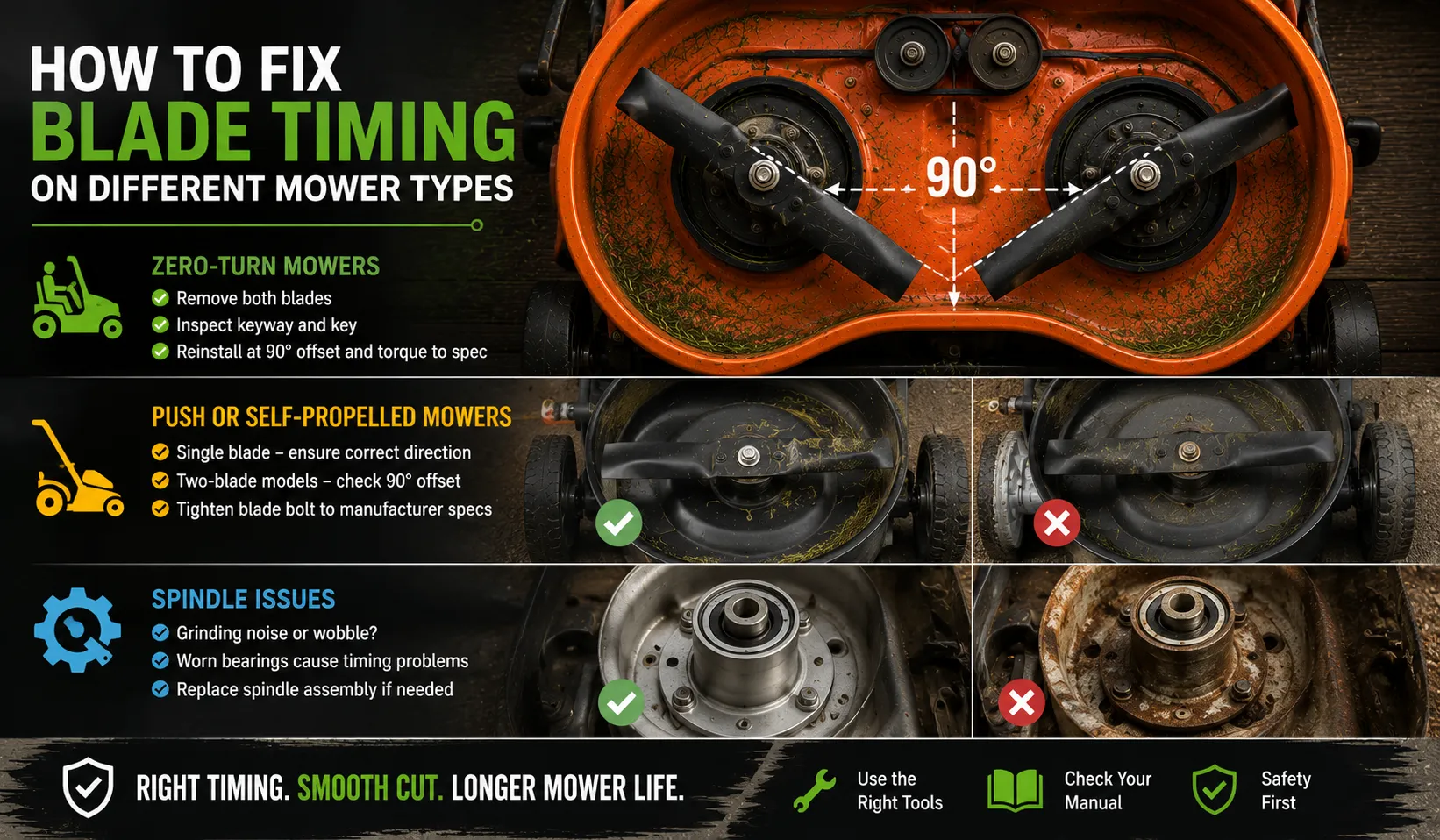
When the Problem Is the Spindle, Not the Blade
If you reset the blade timing and the symptoms come right back – or if you hear a grinding sound from the spindle housing – the spindle bearings are shot.
A bad spindle bearing doesn’t just sound rough. It lets the spindle shaft wobble, which means the blade position shifts slightly with every rotation. You cannot fix timing issues caused by spindle wear without replacing the spindle assembly.
Spindle replacement is a step up in difficulty. It’s doable at home with the right tools, but if you’re not comfortable with it, this is where I’d say take it to a shop. Getting it wrong can lead to a blade separating from the deck at speed – and that’s genuinely dangerous.
Fix Difficulty by Mower Type
| Mower Type | DIY Difficulty | Most Common Fix Needed |
|---|---|---|
| Residential zero-turn | Moderate | Blade repositioning + torque check |
| Push / self-propelled | Easy | Blade reinstallation check |
| Commercial zero-turn | Moderate to hard | Spindle inspection always required |
| Older belt-drive riders | Moderate | Belt check + blade positioning |
Common Mistakes People Make When Fixing Blade Timing
Most DIY blade timing fixes go wrong in one of two places. Both are easy to avoid if you know what to watch for.
Reinstalling Blades Upside Down
Every mower blade has a correct orientation. The cutting edge faces the direction of rotation. The lift wings – the angled tips that create airflow – curve upward toward the deck.
Flip a blade upside down and it still spins. It just doesn’t cut, doesn’t lift clippings, and throws debris sideways. A lot of homeowners have done this after their first blade sharpening. The fix is simple: reinstall the blade right-side up.
Look at the blade before you take it off. Take a photo. Put it back the same way.
Skipping the Torque Spec on the Blade Bolt
The blade bolt does two jobs: it holds the blade on and it holds the blade at the right position on the spindle. Under-torque it and the blade can shift or wobble. Over-torque it and you can strip the spindle threads or crack the blade hub.
I cannot count how many times I’ve pulled a blade that someone “tightened really good” with a standard wrench and found it either loose or cross-threaded. Use a torque wrench. Most residential blade bolts spec between 40 and 90 ft-lbs depending on the model. That range matters. Look it up.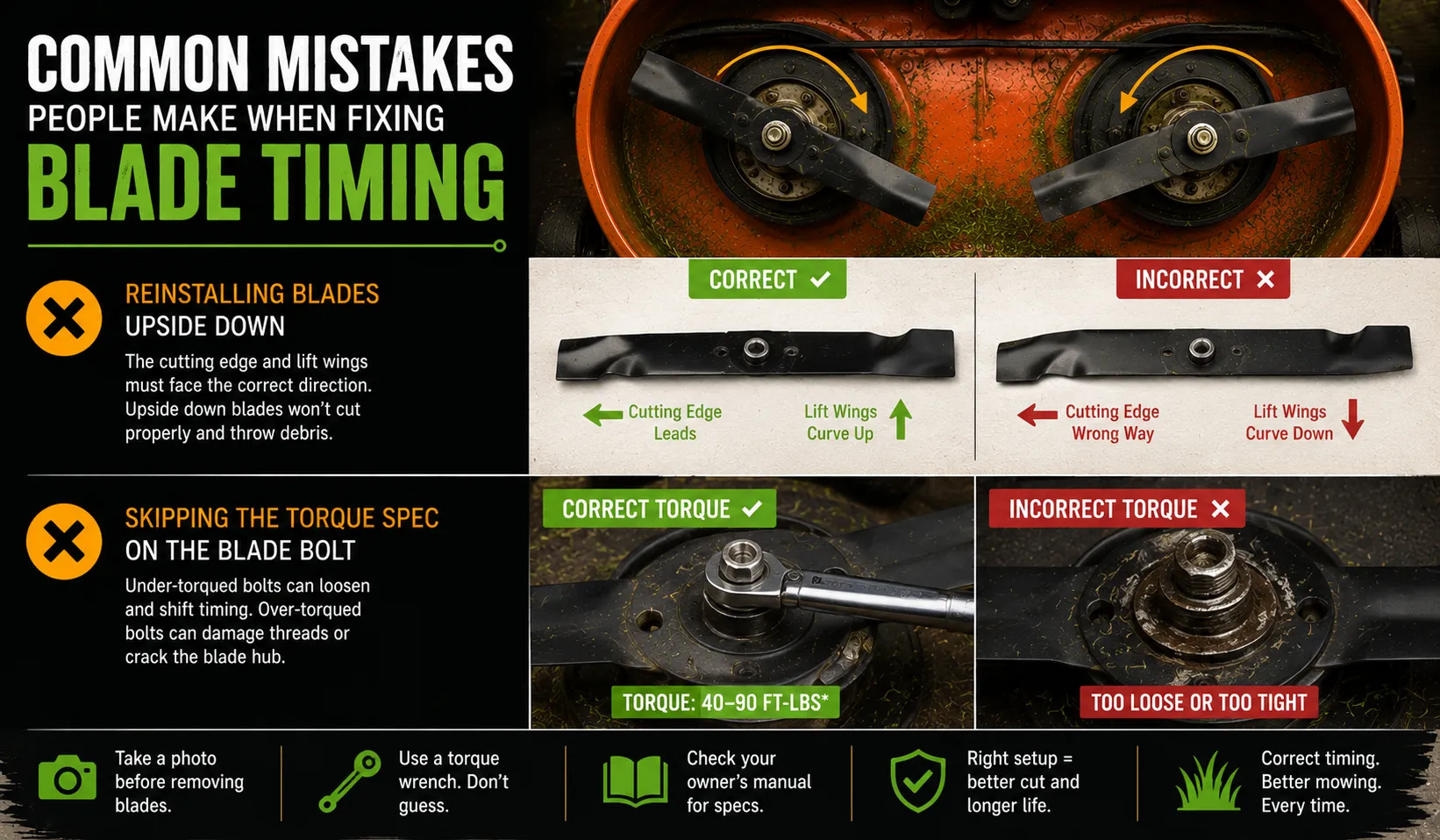
My Final Recommendation
Most homeowners can handle blade timing themselves if the problem is just a repositioned blade after a debris strike. The process is straightforward, the tools are basic, and the result – when you get it right – is immediately obvious. The vibration disappears. The cut gets clean again. There’s a real satisfaction in fixing something that was making your lawn look bad.
Where I tell people to stop and call a pro is when they find spindle damage. Cracked spindle housing, missing keyways, bearings that grind when you spin the shaft by hand – those are shop jobs. Not because they’re impossible at home, but because getting them wrong has real consequences. A blade that comes loose on a zero-turn at full speed can travel a long distance and cause serious harm.
If your mower is more than 8 years old and has been cutting regularly, I’d also recommend having a shop do a full spindle inspection while they’re fixing the timing. Worn bearings often don’t show up as obvious symptoms until they fail completely – and they tend to fail at the worst possible time, mid-season, in the middle of a job.
DIY Blade Timing Fix vs. Professional Shop Service
| Factor | DIY Fix | Professional Shop |
|---|---|---|
| Cost | $0–$20 (tools only) | $60–$150 labor + parts |
| Time | 30–60 minutes | 1–3 days shop turnaround |
| Tools needed | Socket set, torque wrench | Full shop equipment |
| Best for | Blade repositioning after strike | Spindle damage, deck housing damage |
| Risk level | Low if spark plug is disconnected | Low – trained technician |
| Warranty impact | None on most DIY repairs | Shop work usually warranted |
| Confidence required | Basic mechanical comfort | No experience needed |
Frequently Asked Questions About Lawn Mower Blade Timing
What is lawn mower blade timing?
Lawn mower blade timing is the fixed rotational offset between two blades on a dual-blade mower deck. On most residential mowers, the blades are set 90 degrees apart so they pass through the overlap zone without striking each other during operation.
How do I know if my blade timing is off?
The clearest signs are streaky or uneven cuts with a consistent missed strip, heavy vibration through the handles or seat, and metallic clatter from under the deck. Any of these symptoms after hitting debris almost certainly points to a blade timing problem.
Can I fix blade timing myself without special tools?
Yes. You need a socket set that fits your blade bolt, a torque wrench, and work gloves. The process takes 30–60 minutes on a residential mower. The most important step is disconnecting the spark plug before touching the blades.
Is blade timing the same on all mower brands?
Most residential dual-blade mowers use a 90-degree offset between blades. Some older John Deere and Cub Cadet models use a different offset. Always check your owner’s manual or the manufacturer’s deck diagram for your specific model before resetting timing.
When should I take my mower to a shop instead of fixing it myself?
Take it to a shop if you hear grinding from the spindle housing, if the blade bolt threads are damaged, if the deck housing is bent or cracked, or if the spindle keyway is stripped. These problems require more than blade repositioning and can make the mower unsafe if not fixed correctly.
What torque spec should I use on the blade bolt?
Torque specs vary by mower model – typically between 40 and 90 ft-lbs for residential machines. Never estimate this. Look up the spec in your owner’s manual or on the manufacturer’s website using your model number. Under-torqued blade bolts can allow the blade to shift position again quickly.