
Quick Overview
- New homeowners should start with a self-propelled mower for yards between 1,500 and 10,000 sq ft – it covers most suburban lots without physical strain.
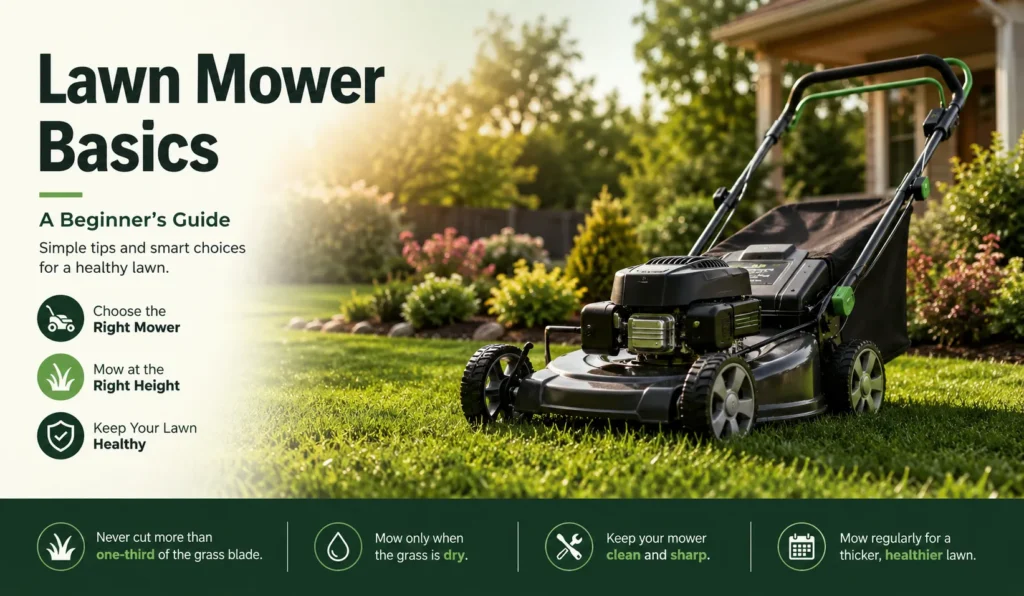
- Never cut more than one-third of the grass blade in a single mow; doing so stresses the lawn and can kill it in summer heat.
- Gas mowers cost less upfront but need oil changes, air filter swaps, and fresh fuel every season; battery mowers cost more but need almost no upkeep.
- Blade sharpening once per season (roughly every 25 hours of use) is the single most overlooked maintenance task by first-time mowers (This Old House, 2024).
- Mowing wet grass clogs the deck, tears the blades unevenly, and can spread lawn disease – always wait until the grass is dry.
I still remember standing in the mower aisle at Home Depot the week after getting the keys to my first house in suburban Columbus, Ohio. I had a quarter-acre lot, a lawn that looked fine from the street, and zero idea what I was holding in my hands when I grabbed the first mower I saw. The box said “self-propelled.” I had no idea what that meant.
That’s what this guide is about – lawn mower basics for new homeowners who feel exactly like I did that day. Not a product manual. Not a turf science lecture. Just what I’ve learned over 15 years of mowing three different yards, making every mistake in the book, and finally figuring out what actually matters.
If you’ve never mowed your own lawn before, or you’re doing it for the first time on a yard you actually own, this is for you.
Why Mowing Feels Overwhelming at First (And Why It Doesn’t Have to Be)
Mowing looks simple from the outside. You push a machine. Grass gets cut. Done. But when it’s your lawn, your equipment, and your first time – it stops feeling simple fast.
The Moment I Realized I Had No Idea What I Was Doing
My neighbor in Columbus watched me mow for about 10 minutes before he walked over and turned off my mower.
He pointed to the grass behind me. I had cut it down to almost nothing. The lawn looked like it had mange. I’d set the cutting height wrong, ran the mower too fast, and scalped a patch of Kentucky Bluegrass that took six weeks to recover.
Nobody had told me about cutting height. Nobody had told me about the one-third rule. I just assumed you mowed until the grass looked short.
That embarrassing afternoon taught me more about lawn care than any article I’ve read since.
What Mowing Actually Does for Your Lawn
Mowing isn’t just cosmetic. It controls weed growth, encourages the grass to grow thicker, and keeps pests from taking hold.
When you cut grass at the right height, it grows back denser at the base. That density crowds out weeds naturally. But when you cut too low, you expose the soil to sunlight – and weeds love that.
Regular mowing also triggers the grass to spread sideways, which fills in thin or bare patches over time. It’s one of the cheapest things you can do to improve lawn health.
Types of Lawn Mowers – Which One Is Right for You?
There are four main types of mowers you’ll find at Lowe’s or Home Depot. Each one works differently and fits a different kind of yard. Here’s a plain-language breakdown before we get into the specifics.
Push Mowers (Manual and Powered)
A push mower is exactly what it sounds like – you walk behind it and push it forward. The mower doesn’t move itself.
Manual reel mowers (the old-fashioned kind with spinning blades and no engine) are quiet, cheap, and good for small, flat yards under 1,500 sq ft. They work well in mild climates like the Pacific Northwest but struggle with thick Southern grasses like Zoysia or Bermuda.
Powered push mowers have a gas or electric engine that drives the blade but not the wheels. You still do all the pushing. They’re best for flat yards under 3,000 sq ft. If your lawn has even a gentle slope, pushing a powered mower uphill gets old fast.
Self-Propelled Mowers
A self-propelled mower has a drive system that moves the wheels forward. You guide it – you don’t muscle it.
This is the type I’d recommend to almost every first-time homeowner with a standard suburban lot. You control the speed, usually with a lever on the handle. Your arms get a rest. Hills become manageable.
Self-propelled mowers cost $100 to $200 more than equivalent push mowers, but on anything over 3,000 sq ft, that difference is worth every dollar (Consumer Reports, 2024).
Riding Mowers – Do You Really Need One?
Riding mowers make sense at roughly half an acre or more. That’s about 21,780 sq ft.
If your yard is smaller than that, a riding mower is mostly an expensive toy. They’re harder to maneuver around trees and beds, they can’t get into tight corners, and they cost $1,500 to $5,000 to buy.
If you’re on a large rural lot in Texas or the Midwest – a true half-acre or more of open turf – a riding mower earns its price in time saved.
Robot Mowers – Are They Worth It Yet?
Robot mowers are real, they work, and they’re improving fast. But in 2026, they’re still a niche buy for most new homeowners.
The entry price for a capable robot mower starts around $800 and can hit $3,000 for larger yards. Most require you to install a perimeter wire or use GPS boundary mapping. Setup takes a few hours.
They’re best for flat, simple yards without a lot of obstacles. If your lawn has trees, raised beds, and a weird shape – a robot mower will struggle.
Give it a few more years before making this your first mower.
Mower Type Comparison
| Type | Best For | Avg Price | Physical Effort | Notes |
|---|---|---|---|---|
| Push (manual reel) | Flat yards under 1,500 sq ft | $100-$200 | High | Quiet, no fuel costs |
| Powered push | Flat yards under 3,000 sq ft | $250-$450 | Medium-high | Budget-friendly starting point |
| Self-propelled | Most suburban yards, 1,500-10,000 sq ft | $350-$700 | Low-medium | Best all-around for new homeowners |
| Riding | Half-acre or more | $1,500-$5,000 | Low | Overkill for typical suburban lots |
| Robot | Flat, simple yards | $800-$3,000 | None | High setup cost; still maturing tech |
How to Choose the Right Mower for Your Yard
The mower aisle can feel like a wall of confusing options. But the decision actually comes down to four things: yard size, terrain, power source, and deck size.
Yard Size – The Number One Factor
Measure your yard before you buy anything. Use Google Earth or your county assessor’s website to get the sq ft of your lawn area.
Here’s a simple starting point:
- Under 1,500 sq ft: manual reel mower or small powered push mower
- 1,500 to 10,000 sq ft: self-propelled mower
- 10,000 sq ft to half-acre: larger self-propelled or small riding mower
- Half-acre or more: riding mower
Most new homeowners in suburban neighborhoods have yards between 2,000 and 8,000 sq ft. A mid-range self-propelled mower covers that range comfortably.
Flat vs. Hilly Terrain
Slopes change everything. A flat yard is easy to mow with almost any machine. A hilly yard is a completely different challenge.
On slopes steeper than 15 degrees, a self-propelled mower is not just convenient – it’s close to necessary. Pushing a heavy powered mower uphill on a hot July afternoon in Georgia is miserable, and it’s a safety issue if you lose grip.
For very steep slopes, a wheeled string trimmer or a four-wheel self-propelled mower (designed for hills) is safer than a standard mower.
Gas vs. Battery vs. Electric – The Honest Trade-offs
Gas mowers start hard in cold weather, need annual oil changes and air filter swaps, and require fresh fuel (or fuel stabilizer in storage). They’re louder and heavier. But they’re powerful, they don’t run out of charge mid-lawn, and replacement parts are easy to find anywhere in the country.
Battery mowers are quiet, start every time, and have zero seasonal maintenance. The downside: run time. Most 40V or 60V battery mowers give you 30 to 60 minutes on a charge. That’s fine for yards under 5,000 sq ft. Larger yards may need a second battery, which adds $80 to $150 to the cost.
Corded electric mowers are the cheapest to run but the most annoying to use. Dragging an extension cord around your yard is a genuine pain. I’d skip corded unless your yard is tiny and completely flat.
What Deck Size Actually Means
The deck is the housing that covers the blade. Deck size tells you how wide a strip you cut with each pass.
A 21-inch deck is standard for suburban yards. A 28-inch or wider deck cuts more grass per pass – useful for larger yards where you want to finish faster.
Don’t buy a wide-deck mower for a small yard with lots of turns. The larger deck makes tight maneuvering harder and isn’t worth the trade-off.
Match Your Yard to the Right Mower
| Yard Profile | Recommended Type | Deck Size | Power Source |
|---|---|---|---|
| Under 2,000 sq ft, flat | Push or self-propelled | 18-21 inch | Battery or gas |
| 2,000-6,000 sq ft, flat | Self-propelled | 21 inch | Battery or gas |
| 2,000-6,000 sq ft, hilly | Self-propelled | 21 inch | Gas (more power on hills) |
| 6,000-20,000 sq ft, flat | Self-propelled or small riding | 21-30 inch | Gas or battery |
| Half-acre or more | Riding mower | 30-54 inch | Gas |
Lawn Mower Parts Every New Homeowner Should Know
You don’t need a mechanic’s knowledge to mow well. But you do need to know a handful of parts – because they affect how you use the machine and what you do when something goes wrong.
The Deck, the Blade, and the Bag
The deck is the flat housing on the bottom of the mower that covers the spinning blade. It protects you from flying debris and directs the cut grass to the bag or the side chute.
The blade spins at roughly 3,000 RPM and cuts the grass. A sharp blade cuts cleanly. A dull blade tears the grass tips, leaving them ragged and brown – which stresses the lawn and opens it up to disease.
The bag (also called a grass catcher) collects clippings after they’re cut. Most mowers also let you mulch instead – which means the blade chops the clippings into fine pieces and drops them back onto the lawn as fertilizer. Mulching is good for lawn health and saves you from hauling bags to the curb.
Cutting Height Adjustment – Use It More Than You Think
Cutting height is how high off the ground the blade cuts. Almost every mower has a lever or knob on each wheel to raise or lower the deck.
Most grass types should be cut between 2.5 and 4 inches tall. The right height depends on your grass type:
- Kentucky Bluegrass (common in the Midwest and Northeast): 2.5 to 3.5 inches
- Bermuda (common in the South): 1 to 2 inches
- Zoysia (Southeast and transition zone): 1 to 2.5 inches
- Tall Fescue (widely used across the US): 3 to 4 inches
Raise the cutting height in summer. Taller grass shades the soil, holds moisture better, and handles heat stress. I learned this the hard way during a Texas summer when I kept cutting my Bermuda low and ended up with brown patches by August.
The Safety Features That Actually Matter
Every mower has a dead man’s switch – a bar on the handle that stops the blade the second you let go. Don’t try to disable it or prop it open. It’s there because a spinning mower blade will cut through anything in its path.
Check for a blade brake on better models. It stops the blade within three seconds of releasing the handle but keeps the engine running, so you don’t have to restart every time you stop to move a branch.
Always disconnect the spark plug (on gas mowers) or remove the battery before reaching under the deck for any reason. This sounds obvious. People still get hurt skipping this step.
How to Mow Your Lawn the Right Way
Good mowing technique isn’t complicated, but it does take a few passes to get the feel of it. The rules below will save you from the mistakes that trip up almost every first-timer.
The One-Third Rule (And Why It Protects Your Grass)
Never cut more than one-third of the grass blade in a single mow. This is the most important mowing rule there is.
If your grass is 4.5 inches tall and you want it at 3 inches, that’s fine – you’re removing exactly one-third. But if you let it grow to 6 inches and then try to cut it to 2 inches, you’ve removed two-thirds of the blade. That shocks the plant, strips away the green part (where photosynthesis happens), and leaves behind dry, yellow stems.
If your lawn gets away from you and grows too tall, cut it in two passes. Take it down by one-third, wait two or three days, then take it down again.
Mowing Patterns – Stripes, Rows, and Why They Matter
Mowing in the same direction every time causes the grass to lean permanently in that direction. It also creates ruts in the soil from the wheels following the same path.
Change your mowing direction every time you mow. If you go north-south this week, go east-west next week. Diagonal the time after that. This encourages the grass to stand more upright and grow more evenly.
The classic striped lawn look you see on baseball fields comes from mowing in alternating parallel rows and bending the grass blades in opposite directions with each pass. A simple lawn roller attachment creates the same effect.
How Often Should You Actually Mow?
Mowing frequency depends on grass type and season, not a fixed schedule.
In peak growing season – spring and early summer – cool-season grasses like Kentucky Bluegrass and Fescue may need mowing every 5 to 7 days. Warm-season grasses like Bermuda in a hot Southern summer might need it every 4 to 5 days.
In late summer and fall, growth slows. You might mow every 10 to 14 days. In winter, most lawns in the US stop growing entirely.
The real rule: mow when the grass needs it, not when the calendar says to.
Mowing Schedule by Grass Type and Season
| Grass Type | Spring | Summer | Fall | Winter |
|---|---|---|---|---|
| Kentucky Bluegrass | Every 5-7 days | Every 7-10 days | Every 7-10 days | Dormant |
| Tall Fescue | Every 5-7 days | Every 7-14 days | Every 7-10 days | Minimal |
| Bermuda | Every 7-10 days | Every 5-7 days | Every 10-14 days | Dormant |
| Zoysia | Every 7-10 days | Every 7-10 days | Every 14 days | Dormant |
| St. Augustine | Every 7-10 days | Every 7-10 days | Every 10-14 days | Dormant |
Lawn Mower Maintenance Basics (Don’t Skip This)
Maintenance is where most new homeowners fall short. A neglected mower runs rough, cuts poorly, and dies young. The good news: basic upkeep takes less than 30 minutes a season.
Cleaning After Every Use
After each mow, knock the grass clippings off the underside of the deck. Wet clippings stick and dry into a dense mat that restricts airflow, causes corrosion, and dulls the blade faster.
Use a putty knife or plastic scraper – not a metal one, which scratches the deck coating. Spray the underside with water, scrape it clean, and let it dry before storing.
This takes five minutes. It adds years to the deck life.
Blade Sharpening – When and How
Sharpen the blade once per season or every 25 hours of use, whichever comes first (This Old House, 2024).
A sharp blade cuts grass cleanly. A dull blade shreds it. You can tell a blade needs sharpening when the tips of your grass look white or frayed after mowing – that’s torn tissue, not a clean cut.
To sharpen it yourself: disconnect the spark plug or battery, tip the mower on its side (carburetor side up on gas mowers to avoid oil flooding), remove the blade bolt, and take the blade to a hardware store for sharpening. It usually costs $5 to $10. You can also buy a blade sharpening kit for about $15 and do it with a hand file or drill attachment.
Replace the blade entirely if it has cracks, deep nicks, or a significant bend. A cracked blade is a safety issue.
Oil Changes and Air Filters (Gas Mowers)
Change the oil in your gas mower once per season – typically in spring before first use, or in fall before storage. Most small engines take SAE 30 or 10W-30 oil. Check your manual.
Replace or clean the air filter once per season. A clogged air filter makes the engine run rich (too much fuel, not enough air), reducing power and increasing fuel consumption.
Both jobs take about 15 minutes and cost under $15 in parts. Skipping oil changes is the most common reason small mower engines seize up and need replacement.
Battery Care (For Battery-Powered Mowers)
Don’t leave a lithium-ion battery fully discharged for weeks. If you’re done mowing for the season, charge it to about 50 percent before storing.
Store batteries indoors in a dry place, away from temperature extremes. Garage storage in a Minnesota winter or Arizona summer shortens battery life significantly.
Most 40V or 60V lithium-ion batteries last 300 to 500 charge cycles (EGO Power+, 2024). At once-a-week mowing, that’s five to ten years of use.
Common Mistakes New Homeowners Make
Almost everyone who’s new to mowing makes the same errors in the first season. Here’s what to watch for so you don’t learn these the hard way.
Mowing Too Short (Scalping)
Scalping means cutting grass so low you expose bare soil or the brown stems at the base of the plant. It’s the most common beginner mistake.
It happens for two reasons: cutting height is set too low, or the yard has uneven ground where the mower dips into a depression and cuts deeper than intended.
To fix uneven ground scalping, raise your cutting height by one notch and fill low spots with topsoil before the next growing season. For general scalping, just raise the deck. Your lawn will recover, but it takes time.
Mowing Wet Grass
Wet grass bends away from the blade instead of standing up to be cut cleanly. The result is an uneven cut with clumps of wet clippings that smother the lawn beneath them.
Wet clippings also clog the discharge chute and the bag, forcing you to stop and clean them out every few minutes. And on disease-prone grasses like Fescue, mowing wet spreads fungal spores across the entire lawn.
Wait until the grass is dry. If you mow in the morning, give it until at least 10 a.m. for dew to burn off.
Forgetting to Check for Obstacles
Before every single mow, walk your yard and look for: rocks, dog toys, garden stakes, sprinkler heads, hoses, pinecones, and anything else that can go under the deck.
A mower blade hitting a rock sends that rock flying at speeds that can break glass, dent cars, and seriously injure people. Every mowing season in the US sees thousands of such injuries (American Academy of Orthopaedic Surgeons, 2023).
Also check for holes – armadillo, mole, or groundhog burrows. A wheel dropping into a hole can tip the mower and injure you.
My Final Advice for New Homeowners
If I could go back to that Home Depot aisle in Columbus and tell myself one thing, it would be this: buy a self-propelled mower, set the deck higher than you think you need to, and mow more often in smaller amounts rather than letting it go too long.
The lawn won’t punish you for learning. It’s forgiving in ways that surprise most beginners. Grass grows back. Mistakes fade. The brown patch I scalped in my first month was gone by fall, and by the following spring you’d never have known.
The nervous feeling you have before the first mow is normal. Most of it goes away the moment you start the engine and make your first pass. After a few mows, you’ll notice what your lawn actually needs. You’ll see when it’s getting too long. You’ll know what it looks like after a good cut versus a rushed one.
Go slow on your first pass. You’ll be fine.
Mower Types: Honest Pros and Cons for New Homeowners
| Type | Pros | Cons |
|---|---|---|
| Push (manual reel) | No fuel, quiet, cheap, low maintenance | Hard work on anything over 1,500 sq ft; can’t handle thick grass |
| Powered push | Affordable, easy to find parts, works on most grass types | You do all the pushing; tiring on large or hilly yards |
| Self-propelled | Reduces physical effort; handles hills; works for most suburban yards | Costs more upfront; slightly heavier than push |
| Riding | Fast on large yards; comfortable; easy on the body | Expensive; can’t handle tight spaces; overkill for most new homeowners |
| Robot | Mows without you; consistent cutting schedule | High setup cost; struggles with complex yards; still developing |
Frequently Asked Questions About Lawn Mower Basics
What lawn mower is best for a first-time homeowner?
A self-propelled mower with a 21-inch deck is the best starting point for most new homeowners. It handles the majority of suburban yard sizes, reduces physical strain compared to push mowers, and works with both gas and battery power. Mid-range models from brands like Honda, EGO, and Toro are widely available at Home Depot and Lowe’s for $350 to $600.
How often should a new homeowner mow their lawn?
Mow based on grass growth, not a fixed calendar. During spring and summer, most lawns need mowing every 5 to 10 days. In fall, growth slows and every 10 to 14 days is typical. The guide is the one-third rule: never cut more than one-third of the blade height in one session.
What cutting height should I use as a beginner?
Start at 3 to 3.5 inches for most cool-season grasses and 1.5 to 2 inches for warm-season grasses like Bermuda or Zoysia. When in doubt, cut higher rather than lower. Cutting too short is one of the most common mistakes new homeowners make and can take weeks to recover from.
Do I really need to sharpen mower blades?
Yes. Dull blades tear the grass instead of cutting it, which leaves ragged white tips and stresses the plant. Sharpen the blade once per season or every 25 hours of use. Most hardware stores sharpen blades for $5 to $10, or you can do it yourself with a file and 15 minutes.
Should I bag my grass clippings or mulch them?
Mulch when the grass isn’t too long and the clippings are fine. Grass clippings return nitrogen to the soil and reduce the amount of fertilizer you need to apply – roughly 25 percent less per season (University of Minnesota Extension, 2023). Bag when the grass is very long or wet, so clippings don’t smother the lawn beneath them.
Is gas or battery better for a new homeowner?
Battery mowers are easier to maintain and better for most new homeowners on standard suburban lots. They start every time, produce no fumes, and need almost no seasonal maintenance. Gas mowers are better for very large yards where run time is a concern, or for areas where access to replacement batteries is limited.
How do I know when my lawn needs mowing?
The simple answer: when it looks like it needs it. Practically, that means when the grass is about 50 percent taller than your target cutting height. If you cut at 3 inches, mow again when it reaches 4.5 inches. Waiting longer than that pushes you into one-third-rule violations and makes each mow harder on both the lawn and the machine.