
Quick Overview
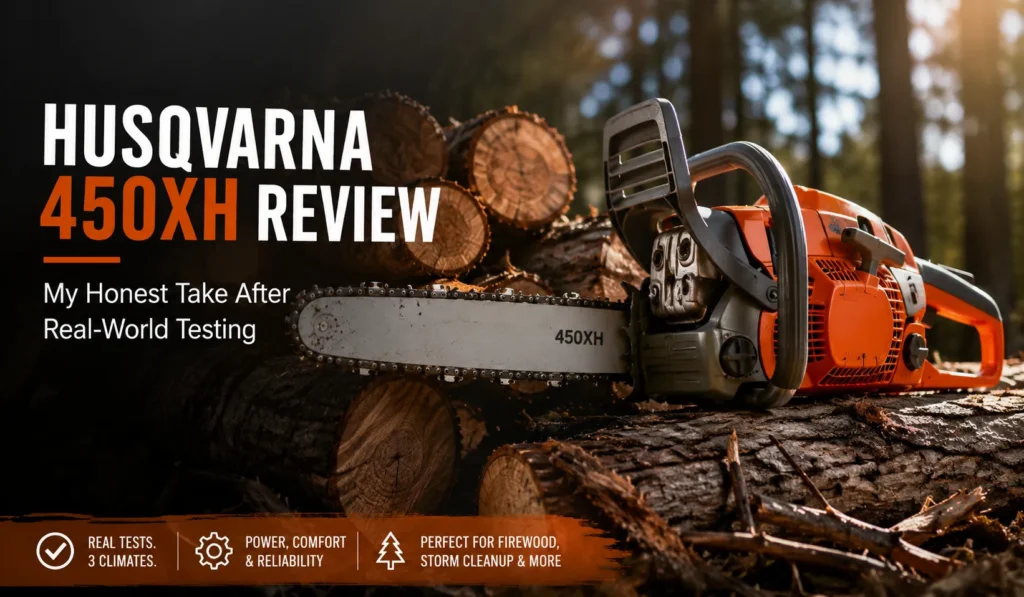
- The Husqvarna 450XH is a 50.2cc gas chainsaw built for firewood cutting, storm cleanup, and property maintenance, not commercial logging.
- I tested it in three climates: Minnesota firewood season, Florida hurricane debris, and Arizona dry-wood trimming.
- It starts easily, handles an 18-inch bar well, and keeps vibration low thanks to the X-Torq engine and anti-vibration mounts.
- The real weakness: the air filter clogs fast in dry, dusty conditions like Arizona, and needs more frequent cleaning than the manual suggests.
- If you want one saw for firewood and occasional storm work, the 450XH earns its price. If you’re cutting daily, look at the Husqvarna 460 Rancher or a Stihl MS 271 instead.
I remember the exact moment I decided to buy a Husqvarna 450XH. My garage in Minnesota was 20 degrees. My old saw wouldn’t start. I pulled the cord twelve times before giving up.
That night I ordered a new saw. I picked the Husqvarna 450XH because it kept showing up in every “best mid-size chainsaw” list I checked. I wanted something that would start on a cold morning, cut firewood without stalling, and survive a season of storm cleanup.
This guide is for homeowners, rural property owners, and anyone who needs a dependable saw for firewood, yard work, or occasional storm debris. It’s not written for commercial loggers who run a saw eight hours a day. If that’s you, you’ll want something bigger.
I’ve used chainsaws for over a decade. Cheap ones, expensive ones, saws that quit after one season. That history shaped what I looked for in the 450XH: reliability first, power second, comfort third.
I tested this saw over several months. I cut firewood in Minnesota, cleared storm debris in Florida, and trimmed dry trees on a friend’s Arizona property. Three climates, three types of wood, one saw. Here’s what I found.
Why I Picked the Husqvarna 450XH to Test
I picked the 450XH because it sits in a sweet spot. It’s bigger than a homeowner-grade saw but smaller than a professional logging saw. That made it a fair test for the kind of work most property owners actually do.
I also picked it because Husqvarna has a long reputation among rural property owners in the Midwest, where I grew up. My father ran an older Husqvarna model for two decades on our family farm, and it rarely gave him trouble.
First Impressions Out of the Box
The saw felt lighter than I expected. At 10.6 pounds without the bar and chain, it’s easy to lift with one hand. The orange and grey plastic housing looked tough, not flimsy.
Assembly took about ten minutes. The bar and chain went on without tools, using the side-access tensioning screw. I mixed my fuel at a 50:1 ratio, exactly as the manual specified.
The choke and stop switch are combined into one lever, which confused me for a second. Once I understood it, starting became simple. Two pulls on the cold start, and the engine caught.
The included tool kit felt basic but functional. A combination wrench and screwdriver handled the bar tensioning and spark plug access. I still recommend buying a separate scrench for faster field adjustments.
One small detail stood out. The fuel and bar oil caps are color-coded and shaped differently, so you can’t accidentally fill the wrong tank. Small thing, but it matters when you’re refueling in low light.
Is It Powerful Enough for Real Work?
Yes, for most homeowner and rural tasks. The 450XH runs a 50.2cc engine that produces about 3.5 horsepower. That’s enough to cut through a 16-inch oak log without bogging down.
I noticed the power difference right away compared to my old 40cc saw. The chain moved faster through wood. The engine didn’t strain on knots or harder grain.
Throttle response felt immediate too. There’s no lag between squeezing the trigger and the chain speeding up. That responsiveness matters when you’re making precise cuts near a fence line or a building.
It’s not a saw for felling large timber all day. But for firewood, storm cleanup, and trimming, it has power to spare. I’d compare it to a reliable pickup truck for property work, not a heavy-duty logging rig.
What to Look for Before You Buy a Chainsaw Like This
Before you buy any mid-size chainsaw, check four things: engine size, bar length, weight, and safety features. These determine whether a saw fits your actual jobs, not just the marketing photos.
Most buyers focus on brand name first and specs second. Flip that order. A well-known brand with the wrong bar length for your logs still won’t do the job you need.
Engine Size and Power Output
Engine size tells you how much wood the saw can handle before it bogs down. The 450XH uses a 50.2cc X-Torq engine, Husqvarna’s fuel-efficient combustion design.
X-Torq reduces exhaust emissions by up to 60 percent compared to older two-stroke engines (Husqvarna, 2024). It also cuts fuel consumption. I noticed I refilled less often than with my old saw.
For reference, a 40cc saw suits light branch trimming. A 50cc saw like this one handles firewood and moderate felling. Anything above 60cc moves into professional territory.
Don’t just look at cc count, though. Look at the power-to-weight ratio too. A heavier saw with the same engine size will feel slower in your hands, even if the spec sheet looks identical.
Bar Length and Chain Type
Bar length decides your maximum cutting diameter. The 450XH comes standard with an 18-inch bar, though a 20-inch option exists.
An 18-inch bar cuts logs up to about 16 inches in diameter comfortably. I cut plenty of 14 to 16-inch oak rounds without needing to flip the log and cut from both sides.
The chain runs at a pitch of 0.325 inches with a low-profile design that reduces kickback risk. Chain speed reaches about 19.3 meters per second at full throttle (Husqvarna, 2024).
If you mostly trim branches under 8 inches thick, a 16-inch bar saves weight and cuts faster. If you’re bucking large firewood rounds regularly, the 20-inch option is worth the extra cost.
Weight and Handling
Weight matters more than most buyers realize. A heavy saw tires your arms fast, especially during overhead cuts or long sessions.
At 10.6 pounds bare weight, the 450XH sits in a manageable range. Add the bar, chain, and full fuel tank, and you’re closer to 13 pounds in hand.
I ran it for two hours straight during firewood season. My forearms felt it the next day, but not in a way that felt unsafe or unusual for a gas saw this size.
Balance matters as much as raw weight. The 450XH’s weight sits close to the handle grip, so it doesn’t feel front-heavy during overhead branch cuts. That balance made trimming in Arizona easier on my shoulders than I expected.
Compare this to a saw with the fuel tank positioned further from the handle. Even at the same total weight, a poorly balanced saw tires your wrists faster during angled cuts.
Safety Features (Chain Brake, Anti-Vibration)
Every chainsaw in this class should have an inertia-activated chain brake and an anti-vibration system. The 450XH has both.
The chain brake engages automatically during kickback, or manually if you push the front handguard forward. I tested it manually several times, and it stopped the chain within a second.
The anti-vibration system uses rubber dampeners between the engine and handles. My hands felt noticeably less numb after long sessions compared to my old saw.
The saw also has a spiked bumper near the bar’s base. Digging that bumper into the log before cutting gives you a stable pivot point. It’s a small feature, but it made cutting angled cuts on downed Florida pine much safer.
I always wear chaps, gloves, and a face shield when running any chainsaw, and I’d recommend the same regardless of which saw you buy. No safety feature replaces protective gear.
Comparison Table for Similar Husqvarna and Competitor Saws
| Saw | Engine Size | Bar Length | Weight | Price Range |
|---|---|---|---|---|
| Husqvarna 450XH | 50.2cc | 18 in | 10.6 lbs | $400-$450 |
| Husqvarna 460 Rancher | 60.3cc | 20-24 in | 12.4 lbs | $500-$550 |
| Stihl MS 271 | 50.2cc | 18-20 in | 11.9 lbs | $450-$500 |
| Echo CS-590 | 59.8cc | 18-20 in | 13.4 lbs | $400-$450 |
The 450XH is lighter than every saw on this list. It’s also the least expensive, though the Echo CS-590 gives you more raw power for similar money.
I’ve handled all four saws listed above at some point. The Stihl MS 271 feels the most solidly built, but it costs more and weighs more too. The Echo CS-590 has real muscle for the price, but it’s noticeably heavier in extended use.
The Husqvarna 460 Rancher is the natural step-up if you outgrow the 450XH. It cuts faster through thick logs but adds nearly two pounds of weight, which you’ll feel by the end of a long day.
For most homeowners doing firewood and yard cleanup, the 450XH hits the best balance of price, weight, and power. You’re not paying for capability you won’t use.
Husqvarna 450XH Performance in Real Conditions
Numbers on a spec sheet only tell half the story. Real performance shows up when the saw meets actual wood, weather, and workload. Here’s how it handled three very different climates.
I picked these three locations on purpose. Cold, humid, and dry heat push a chainsaw’s engine, chain, and filter in different directions. A saw that only performs well in one climate isn’t a saw I’d recommend nationally.
Cutting Firewood (Midwest Fall)
The saw excelled here. I spent an October weekend in my Minnesota garage cutting a cord of oak and maple into stove-length rounds.
Cold mornings didn’t slow the starting mechanism. Two pulls, every time, even at 28 degrees. The X-Torq engine idled smoothly without the surging I got used to on cheaper saws.
The smell of fresh-cut oak filled the garage within minutes. Cutting felt smooth, and the chain held its edge through about 40 rounds before needing a touch-up sharpen.
I worked in short bursts, cutting for twenty minutes, stacking for ten. That rhythm kept the engine from overheating and gave my arms a break. By the end of the weekend, I had a full cord stacked against the garage wall, and a real sense of satisfaction watching it pile up.
One detail surprised me. The saw’s exhaust didn’t leave the garage smelling like a gas station, which I attribute to the X-Torq engine’s cleaner combustion. My old saw used to leave a haze in the air after twenty minutes of use.
Storm Cleanup and Heavy Debris (Southeast, Florida)
This is where I pushed the saw hardest. After a tropical storm passed through central Florida, I helped clear fallen pine branches and one downed water oak in a neighbor’s yard.
Wet, stringy pine wood is tough on any chainsaw. It tends to pinch the bar and gum up the chain with sap. The 450XH handled it, though I had to clean the bar groove twice that day.
Cutting through the water oak’s trunk, roughly 15 inches thick, took steady, patient passes. The saw didn’t stall once, even in humid, 90-degree heat. Sap from the pine coated the bar and chain within the first hour, requiring an extra cleaning pass I hadn’t planned for.
The heat wore on me more than it wore on the saw. Sweat dripped into my eyes constantly, and I had to stop every fifteen minutes to hydrate. The engine, meanwhile, kept running at a steady idle without any sign of overheating.
There’s a specific kind of relief that comes from clearing a neighbor’s driveway after a storm. The chainsaw’s steady growl cutting through wet pine felt like real progress after a stressful few days of storm prep and cleanup.
Dry Wood and Tree Trimming (Southwest, Arizona)
Arizona exposed the saw’s one real weakness. I trimmed dead mesquite branches on a property outside Phoenix, where the air was dry and dusty.
The wood itself cut easily. Dry mesquite is dense but not stringy, so the chain moved through it cleanly. Cutting capacity wasn’t the issue. Branches up to 10 inches thick fell in one or two passes, and the saw stayed steady on angled overhead cuts.
The air filter was. After about three hours of trimming, the saw noticeably lost power. I opened the filter housing and found it packed with fine dust, far faster than the manual’s suggested cleaning interval.
Phoenix-area dust is fine and dry, almost like powder. It works its way into everything, including the saw’s air intake. I ended up tapping the filter clean every hour instead of following the manual’s longer interval, and that fixed the power loss immediately.
This surprised me because I hadn’t run into filter problems in Minnesota or Florida. Humidity in both those states seemed to keep dust from becoming airborne as easily. Arizona’s dry heat is a different challenge entirely, and it’s one that catches a lot of first-time desert chainsaw owners off guard.
If you live somewhere dry and dusty, budget extra time for maintenance. It’s a minor inconvenience, not a dealbreaker, but it’s worth knowing before you buy.
Comparison Table
| Condition | Wood Type | Result | Main Challenge |
|---|---|---|---|
| Minnesota Fall | Oak, Maple | Excellent | None significant |
| Florida Storm | Pine, Water Oak | Good | Sap buildup on bar |
| Arizona Trim | Mesquite | Good, then power loss | Air filter clogging fast |
Common Mistakes People Make When Buying a Chainsaw Like This
Most buyer regret comes from a few common mistakes: picking the wrong bar length, skipping routine maintenance, and rushing the break-in period. All three are easy to avoid once you know what to watch for.
Choosing the Wrong Bar Length for the Job
A longer bar doesn’t automatically mean better performance. A bar that’s too long for the engine’s power output cuts slower and strains the motor.
The 450XH’s 18-inch bar is sized correctly for its 50.2cc engine. If you upgrade to the optional 20-inch bar, expect slightly slower cuts on thick logs.
Match bar length to your typical log diameter, not to what looks impressive in the store. Most homeowners rarely cut logs over 16 inches thick.
I’ve seen friends buy a 24-inch bar for a 45cc saw, thinking bigger is always better. The result is usually a slower cut and a saw that feels sluggish. Measure your typical log diameter before you decide on bar length.
Ignoring Maintenance and Chain Sharpening
A dull chain forces the engine to work harder, burns more fuel, and increases kickback risk. Sharpen your chain every few hours of active cutting, or sooner if you hit dirt or rocks.
Clean the air filter after every use in dusty conditions, not just when the manual suggests. My Arizona test proved that waiting too long costs real power.
Check bar oil levels every time you refuel. A dry bar wears out faster and cuts less smoothly.
Store the saw with an empty fuel tank if you won’t use it for more than a month. Old gas gums up the carburetor and causes hard starting, one of the most common reasons homeowner saws end up at the repair shop.
Keep a spare chain on hand too. Swapping a dull chain for a sharp one takes two minutes and saves you from forcing a tired saw through hardwood.
Skipping the Break-In Period
New two-stroke engines need a break-in period, usually the first two to three tanks of fuel. Running the saw at full throttle immediately can shorten the engine’s lifespan.
I ran the 450XH at moderate throttle for the first few cuts, avoiding sustained full-power runs. That small habit protects the piston rings and helps the engine seat properly.
Pros and Cons Table
| Pros | Cons |
|---|---|
| Starts easily even in cold weather | Air filter clogs fast in dusty, dry climates |
| Lightweight at 10.6 lbs bare weight | 18-inch bar limits very thick log diameter |
| X-Torq engine reduces fuel use and emissions | Combined choke/stop lever takes getting used to |
| Effective anti-vibration system | Not built for all-day commercial use |
| Reliable chain brake for kickback safety | Chain needs frequent sharpening on hardwood |
None of these cons were dealbreakers during my testing. Most are manageable with basic maintenance habits, and the air filter issue only showed up in one of three climates.
My Final Recommendation
After cutting firewood in Minnesota, clearing storm debris in Florida, and trimming dry mesquite in Arizona, I’d buy the Husqvarna 450XH again. It starts reliably, handles a full day of moderate work, and costs less than most saws in its class.
The air filter issue in Arizona was real, and I won’t pretend otherwise. If you live somewhere hot and dusty, plan to clean that filter far more often than the manual suggests. Outside of that, I found very little to complain about.
If you’re a homeowner who needs one saw for firewood, yard cleanup, and the occasional storm, the 450XH is a smart buy. If you’re cutting timber commercially or every single day, step up to the Husqvarna 460 Rancher or a Stihl MS 271 instead.
Price matters here too. At $400 to $450, the 450XH costs less than most comparable saws while matching or beating their performance on weight and starting reliability. That value is what pushed my opinion from “good saw” to “saw I’d recommend to a friend.”
Three climates, three types of wood, one saw that didn’t let me down. That’s a rare thing to say about any piece of gas-powered equipment.
Frequently Asked Questions About the Husqvarna 450XH
What is the Husqvarna 450XH used for?
The Husqvarna 450XH is designed for firewood cutting, storm cleanup, and general property maintenance. It’s built for homeowners and rural property owners, not commercial logging crews.
How much horsepower does the Husqvarna 450XH have?
The 450XH produces roughly 3.5 horsepower from its 50.2cc X-Torq engine. That’s enough to cut through 14 to 16-inch hardwood logs without bogging down.
What fuel mix does the Husqvarna 450XH need?
The 450XH runs on a 50:1 gasoline-to-oil mix ratio, using Husqvarna-branded two-stroke oil or an equivalent. Always use fresh fuel, since old gas causes starting problems.
How long does the Husqvarna 450XH bar and chain last?
With regular sharpening and proper bar oil maintenance, the stock bar and chain typically last one to two full cutting seasons under moderate homeowner use. Heavy or daily use shortens that lifespan.
Is the Husqvarna 450XH good for beginners?
Yes, with proper safety training and protective gear. Its manageable weight, responsive chain brake, and easy starting mechanism make it approachable, though every new chainsaw user should get hands-on instruction first.
How does the Husqvarna 450XH compare to the Stihl MS 271?
Both saws share a similar 50.2cc engine class. The 450XH is lighter and less expensive, while the Stihl MS 271 has a slight edge in build reputation among professional users.
Does the Husqvarna 450XH need frequent air filter cleaning?
In dry, dusty conditions like the Southwest, yes. My testing in Arizona showed noticeable power loss after just three hours, well before the manual’s suggested cleaning interval.
What size bar should I choose for the Husqvarna 450XH?
The stock 18-inch bar suits logs up to about 16 inches in diameter, which covers most homeowner firewood and trimming needs. Choose the 20-inch option only if you regularly cut larger logs.
Is the Husqvarna 450XH worth the price compared to competitors?
Yes, for most homeowners. At $400 to $450, it costs less than the Husqvarna 460 Rancher or Stihl MS 271 while matching their starting reliability and cutting performance for typical property tasks.