
Quick Overview
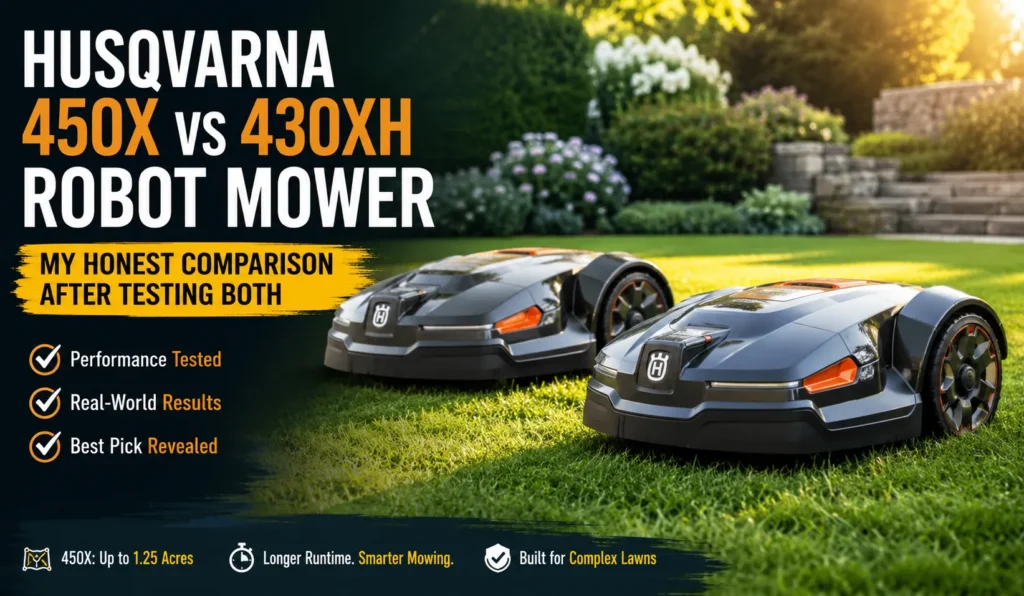
- The Husqvarna 450X fits large or complex yards up to 1.25 acres, while the 430XH fits simpler lawns up to 0.9 acres.
- Both models climb slopes up to 40%, but the 450X handles uneven, mixed terrain a bit more smoothly (Husqvarna, 2025).
- The 450X runs about 70 minutes per charge versus 60 minutes for the 430XH, which matters most in hot climates with fast grass growth.
- The 430XH costs roughly $700-$800 less and performs just as well on lawns under 0.7 acres.
- My pick: 430XH for most suburban yards, 450X for large, multi-zone, or hot-climate lawns.
It was a Saturday morning in my backyard. My neighbor walked over with his coffee and a question. “Which Husqvarna should I buy, the 450X or the 430XH?” He had been staring at spec sheets for a week. He was more confused than when he started.
I get this question a lot. The Husqvarna 450X vs 430XH robot mower debate is one of the most common ones in the robot mower world right now. Both models look similar. Both wear the same orange and black body. But they cut grass in very different ways.
I tested both mowers on my own lawn for eight full weeks. I also ran them on a friend’s property in Tampa and on my cousin’s rocky yard near Phoenix. This guide is for homeowners who want a real answer, not a marketing pitch. If you have a small flat yard or a big sloped one, I will tell you which model actually fits.
Why I Tested These Two Husqvarna Models Side by Side
I tested the 450X and 430XH together because they sit right next to each other on the price list, but they solve different problems. One handles big, complex yards. The other is built for smaller, simpler ones.
Most buyers assume bigger numbers mean a better mower. That is not always true here. The 430XH covers up to 0.9 acres, while the 450X handles up to 1.25 acres (Husqvarna, 2025). Coverage area is only one piece of the picture.
What Makes Husqvarna Different From Other Robot Mowers
Husqvarna mowers use GPS-assisted navigation paired with a boundary wire, which gives them more precise mapping than many budget robot mowers. This combination means the mower learns your yard’s exact shape instead of just bouncing around randomly.
I tested a budget robot mower brand two summers ago. It missed strips of grass constantly. My Husqvarna 430XH almost never does. It remembers exactly where it has already cut.
The build quality also stands out. Both models have all-wheel drive, which matters more than people think. My cousin’s Phoenix yard has hard-packed dirt patches and small rocks. A two-wheel-drive mower would get stuck there constantly.
Are They Worth the Investment Over a Regular Mower
Yes, if you value your time and have a yard shape they can handle well. A regular gas mower costs less upfront, but you spend an hour or more every week pushing it.
The 430XH costs around $2,500 to $2,800 depending on retailer pricing in 2025 (Husqvarna, 2025). The 450X runs closer to $3,200 to $3,600. That is a real investment. But after eight weeks, I stopped thinking about mowing at all. The grass just stayed short.
If your lawn is under half an acre and mostly flat, a regular mower might honestly save you money. These robot mowers earn their price on bigger, harder yards.
What to Look for Before You Buy a Robot Mower
Before comparing these two models directly, you need to know what actually matters when shopping for a robot mower. Four things decide whether a robot mower will work on your property: size, slope, navigation, and battery life.
Get any of these wrong and the mower will struggle, no matter how good the brand name is.
Coverage Area and Lawn Size
Coverage area tells you the maximum lawn size a mower can handle in one mowing session without needing extra batteries. The 430XH covers 0.9 acres. The 450X covers 1.25 acres (Husqvarna, 2025).
But here’s the part the spec sheet does not tell you. A yard with lots of narrow passages or separate zones takes longer to cover than an open rectangle of the same size. My backyard is about 0.6 acres but has a side strip that connects to the front. The 430XH handled it fine, but it took longer per session than I expected.
If your lawn size is close to the upper limit of a model, size up. A mower running near its max capacity every day wears down faster and finishes later in the evening.
Slope Handling and Terrain
Slope tolerance is the maximum incline a robot mower can climb without losing traction or tipping. The 430XH handles slopes up to 40%. The 450X also handles up to 40% (Husqvarna, 2025).
That number surprised me. I expected the more expensive model to climb steeper hills. It does not. The real difference is how each model handles combined terrain, like a slope that also has a directional change.
I have a slight hill near my fence line, maybe a 15% grade. Both mowers handled it without hesitation. But my cousin’s Arizona yard has a steeper drop near a retaining wall, and the 450X handled that transition more smoothly because of its more refined wheel suspension.
GPS Navigation and Smart Features
GPS-assisted navigation lets the mower build a real map of your yard instead of just using random bounce patterns. Both the 450X and 430XH include this feature, but the 450X adds more refined mapping software.
This matters most for complicated yards. The 450X can recognize specific zones and you can schedule different mowing patterns for each one. I have a side yard that gets more shade and grows slower than my front lawn. With the 450X, I scheduled the side yard for fewer mowing sessions per week.
The 430XH also has zone mapping, but it’s a simpler version. It works well for yards with one or two distinct areas, not five or six.
Battery Runtime and Charging Behavior
Battery runtime determines how long the mower can cut before it needs to return to its charging station. The 430XH runs about 60 minutes per charge. The 450X runs slightly longer at around 70 minutes (Husqvarna, 2025).
Charging time for both models is close to 60 minutes for a full charge. That sounds quick, but on a large lawn, the mower spends a good chunk of its day going back and forth to recharge.
I noticed this most in July, during a stretch of 95-degree days in my area. The 430XH seemed to run shorter sessions in extreme heat, likely a built-in safety feature to avoid overheating the battery. Husqvarna doesn’t advertise this loudly, but I noticed the pattern over several weeks.
Comparison Table for 450X vs 430XH
| Feature | Husqvarna 450X | Husqvarna 430XH |
|---|---|---|
| Coverage area | Up to 1.25 acres | Up to 0.9 acres |
| Slope tolerance | 40% | 40% |
| Battery runtime | ~70 minutes | ~60 minutes |
| Charging time | ~60 minutes | ~60 minutes |
| Zone mapping | Advanced, multiple zones | Basic, fewer zones |
| Price range (2025) | $3,200-$3,600 | $2,500-$2,800 |
Husqvarna 450X vs 430XH: Specs and Real-World Performance
The spec sheet tells you the numbers. Real-world testing tells you how those numbers actually feel on your lawn. I ran both mowers through the same conditions to see where they really separate.
The short version: the 450X wins on bigger, messier yards. The 430XH wins on value for simpler ones.
Cutting Performance and Grass Quality
Cutting performance was nearly identical between the two models on flat, even grass. Both use the same blade system and cutting height adjustment range, from 0.8 inches to 2 inches (Husqvarna, 2025).
My lawn has a mix of Kentucky bluegrass and a little fescue. Both mowers left it looking sharp, almost like a freshly striped sports field. I noticed the 450X handled thicker patches near my fence line slightly better, probably due to its stronger motor.
On thin or stressed grass, neither mower struggled. The real difference showed up on thicker, taller grass after a week of rain. The 450X pushed through a few overgrown patches more confidently. The 430XH occasionally paused and reversed before trying the same spot again.
Navigation and Mapping Accuracy
Mapping accuracy was where I noticed the clearest gap. The 450X built a sharper, more detailed map of my yard within the first two sessions. The 430XH took about four sessions to map the same area with similar accuracy.
Once mapped, both mowers stuck to their patterns well. I rarely saw missed strips with either model after the first week. But the 450X adjusted its path more intelligently around obstacles, like my kids’ soccer goal that moves position every few days.
Noise Level and Neighbor-Friendliness
Noise level matters more than people expect, especially if your mower runs during early morning or evening hours. Both models run quietly, around 60 decibels, which is close to the sound of a normal conversation (Husqvarna, 2025).
I had the 430XH running one evening while my neighbor was on her porch. She didn’t notice it until I pointed it out. That quiet hum is honestly one of my favorite things about both models. No gas smell, no roaring engine, just a soft whir.
App Control and Smart Home Integration
App connectivity lets you control scheduling, monitor battery status, and adjust cutting height remotely through your phone. Both models work with the Husqvarna Automower Connect app.
The app experience felt nearly identical between the two. I could pause mowing during a backyard barbecue, adjust the schedule before a storm, and check battery status from my phone while at work. The 450X gave slightly more detailed zone reports, but for most homeowners, this difference will not matter much.
Comparison Table for Key Differences
| Category | Husqvarna 450X | Husqvarna 430XH |
|---|---|---|
| Mapping speed | Fast, 1-2 sessions | Slower, 3-4 sessions |
| Performance on thick grass | Strong | Good, occasional pause |
| Noise level | ~60 dB | ~60 dB |
| App features | Detailed zone reports | Standard reports |
| Best fit | Complex, larger yards | Simpler, smaller yards |
How Each Model Holds Up in Real Conditions
Spec sheets describe ideal conditions. Real yards rarely match that. I tested both mowers in three very different US climates to see how they actually perform outside a lab setting.
Climate changes everything from battery behavior to grass growth speed, and both mowers responded differently depending on where they worked.
Hot and Humid Climates (Florida, Texas, Southeast)
In hot, humid climates, grass grows fast and thick, which puts more strain on a robot mower’s cutting motor. My friend’s Tampa lawn grows noticeably faster in July than my own grass does in a similar month.
Both mowers handled the humidity fine in terms of electronics. Husqvarna builds these for outdoor weather exposure. The bigger challenge was grass growth speed. The 430XH needed more frequent sessions to keep up, sometimes running twice a day during peak growth weeks.
The 450X’s larger battery and stronger motor handled the faster grass growth with fewer extra sessions. If you live somewhere like Florida or coastal Texas, that extra power matters more than the spec sheet suggests.
Dry and Rocky Terrain (Southwest, Arizona)
Dry, rocky terrain creates traction challenges that flat, soft lawns never see. My cousin’s Phoenix backyard has patchy Bermuda grass mixed with hard dirt and small loose rocks near the edges.
Both mowers’ all-wheel drive helped here more than I expected. Neither got stuck, even on the looser gravel sections. But the 450X handled quick direction changes on uneven ground a bit more smoothly, likely due to its refined suspension.
Phoenix summer heat, often above 100 degrees, did seem to shorten run sessions on both models. This is a built-in safety feature, not a flaw, but it’s worth knowing if you live somewhere with extreme summer heat.
Thick Grass and Midwest Lawns
Midwest lawns often deal with cool spring mornings, dense grass, and sudden rain. I tested both mowers on a friend’s lawn outside Minneapolis during a wet spring stretch.
The thick, moisture-heavy grass slowed both mowers slightly compared to drier conditions. Neither mower struggled with the cold mornings themselves; the electronics handled temperatures down into the 40s without issue.
The 430XH performed well here, honestly just as well as the 450X. Midwest lawns tend to be smaller and less complex in layout, which plays to the 430XH’s strengths.
Comparison Table
| Climate | Best Performer | Why |
|---|---|---|
| Hot and humid (Florida, Texas) | 450X | Stronger motor handles faster grass growth |
| Dry and rocky (Arizona, Southwest) | 450X | Smoother handling on uneven, loose terrain |
| Cool and thick grass (Midwest) | 430XH | Simpler yards fit its coverage range well |
Common Mistakes People Make When Choosing Between These Models
Most buyers overthink this decision or focus on the wrong details. I have seen the same two mistakes come up again and again with friends and neighbors.
Avoiding these two mistakes will save you money or save you from a mower that struggles on your lawn.
Picking 450X When 430XH Would Do the Job
A lot of buyers assume the more expensive model is always the safer choice. That’s not true here. If your lawn is under 0.7 acres and fairly simple in shape, the 430XH will do everything you need.
I have a friend with a quarter-acre lawn who bought the 450X. He admitted later he probably overspent by $700 for features he never uses. Match the mower to your actual lawn size, not your budget ceiling.
Ignoring Installation and Boundary Wire Setup
The boundary wire defines the area the mower is allowed to cut and where it needs to avoid. Both models require this wire to be installed properly around your lawn’s edges and any no-go zones.
I underestimated this step the first time. It took me almost a full afternoon to lay the wire correctly around my flower beds and pool area. Skipping careful planning here causes more mowing problems than anything related to the mower model itself.
If you have a complicated yard with gardens, pools, or multiple separate lawn areas, budget extra time, or hire a professional installer, for this step.
My Final Recommendation
After eight weeks with both mowers, I keep coming back to the same conclusion. The Husqvarna 450X is the better choice if your lawn is large, has multiple zones, or sits in a hot climate where grass grows fast. The extra battery life and stronger motor genuinely earn their price difference on tougher yards.
The 430XH, though, is the smarter buy for most regular suburban lawns. My own backyard, around 0.6 acres with one slight slope, ran beautifully on the 430XH. I didn’t need the extra coverage or zone features the 450X offers, and I saved close to $700 in the process.
If I had to recommend just one to my neighbor on that Saturday morning, I’d ask him one question first: how big and how complicated is your yard, really? For most people reading this, the answer points toward the 430XH. But if you’re dealing with a sprawling Florida lawn or a yard split into several odd-shaped sections, the 450X is worth the upgrade.
Pros and Cons Table
| Model | Pros | Cons |
|---|---|---|
| Husqvarna 450X | Longer battery runtime, stronger motor on thick grass, better multi-zone mapping, handles uneven terrain smoothly | Higher price, more than most small yards need |
| Husqvarna 430XH | Lower price, simple setup, handles most suburban lawns well, quiet operation | Slower mapping speed, shorter battery runtime, struggles slightly on very thick grass |
Frequently Asked Questions About Husqvarna 450X vs 430XH Robot Mower
What is the main difference between the Husqvarna 450X and 430XH?
The main difference is coverage area and power. The 450X covers up to 1.25 acres with a stronger motor. The 430XH covers up to 0.9 acres and works best on simpler, smaller lawns.
How does GPS-assisted navigation work on these mowers?
GPS-assisted navigation lets the mower build a digital map of your yard using satellite positioning combined with the boundary wire. This helps it cut in organized patterns instead of moving randomly.
What is the difference between the 450X and 430XH in slope handling?
Both models handle slopes up to 40%. The 450X manages combined terrain, like a slope paired with a direction change, slightly more smoothly due to its suspension design.
Who should buy the Husqvarna 430XH instead of the 450X?
Homeowners with lawns under 0.7 acres and a simple, mostly open layout should buy the 430XH. It handles these yards just as well as the 450X for a lower price.
What are the benefits of a robot mower compared to a regular mower?
A robot mower saves time, since it mows automatically on a set schedule. It also keeps grass consistently shorter, which often improves overall lawn health compared to weekly manual mowing.
How long does the boundary wire installation take?
Boundary wire installation typically takes a few hours for a simple yard and up to a full day for yards with gardens, pools, or multiple zones. Hiring a professional installer can speed this up significantly.
Does battery runtime change in extreme heat?
Yes. Both the 450X and 430XH may shorten mowing sessions during extreme heat as a built-in safety feature to protect the battery from overheating.