
Quick Overview
- Old gas left in the tank all winter is the most common reason mowers won’t start in spring.
- For gas mowers, drain the tank or add a fuel stabilizer, then change the oil before storage.
- For battery mowers, charge the battery to about 40-60% and store it indoors, away from the mower itself.
- Clean the deck, blade, and underside before storage. This stops rust before it starts.
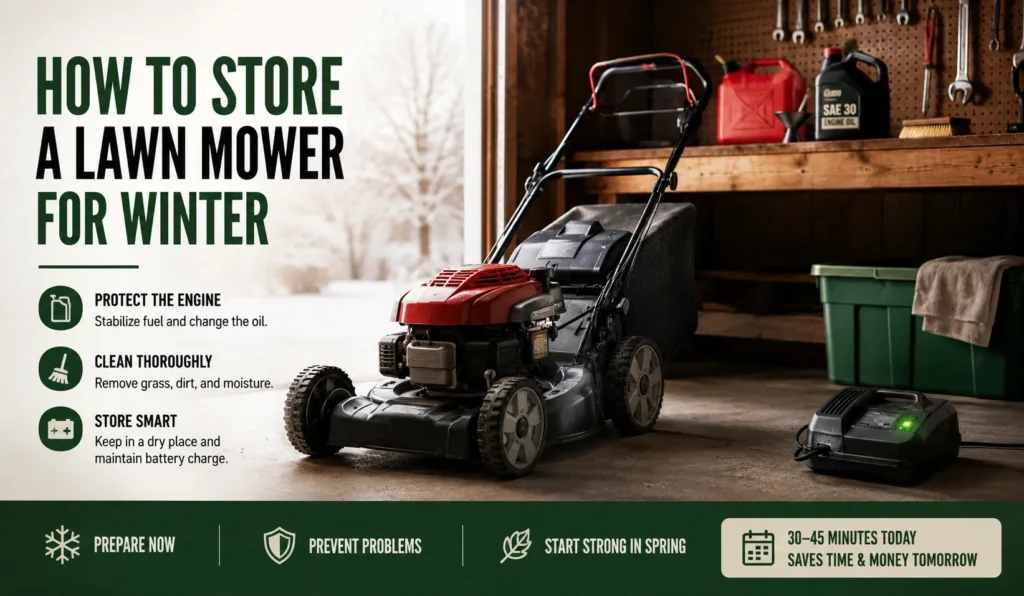
- This step-by-step method to store a lawn mower for winter takes about 30 to 45 minutes for gas mowers, and less for battery mowers.
Last November, frost covered the grass in my backyard outside Minneapolis. I walked into the garage and saw it: a gas can, half full, sitting right next to my mower. That gas had been there since August.
I almost poured it straight into the tank. That would have been a mistake. By spring, that old gas could have turned my carburetor into a gummy mess.
That’s the year I learned how to store a lawn mower for winter the right way. Not the rushed way. The way that actually works come spring.
Since then, I’ve winterized mowers all over the place. A cold garage in Minnesota. A damp shed near Portland, Oregon. Even a Texas carport, where winter barely shows up at all.
This guide is for anyone with a gas mower or a battery mower. Maybe your mower struggled to start last spring. Maybe this is your first fall as a homeowner. Either way, here’s exactly what I do, step by step, every single year.
Why Winter Storage Matters More Than You Think
Skipping winter prep doesn’t just risk a slow start in spring. It can cost real money in repairs. Here’s what’s actually on the line.
What Happens If You Skip It
Skip these steps, and your mower may not start in spring. Or it starts, but runs rough and stalls. The causes are almost always the same: old gas, old oil, rust, or a dead battery.
Old gas turns thick and sticky. It clogs the small passages inside the carburetor.
Old oil holds moisture and grime. Left all winter, it can lead to rust inside the engine.
Grass clippings stuck to the deck trap moisture too. That’s a recipe for rust spots by spring.
My first year as a homeowner, I skipped all of this. Come April, my mower wouldn’t start. Not on the third pull. Not on the tenth. I took it to a small engine shop in town. The bill was $85, just to clean the carburetor. One skipped step, one expensive lesson.
Gas Mowers vs. Battery Mowers: Different Risks
Gas mowers and battery mowers face different risks over winter. Gas mowers deal with fuel and oil. Battery mowers deal with charge level and cold.
A gas mower, like a Honda or a Toro, can develop stale fuel, thick oil, and a gummed-up carburetor. Rust can also form on the deck and blade if they’re left dirty and wet.
A battery mower, like an EGO or a Ryobi, skips the fuel and oil problems entirely. But the battery itself is sensitive. Store it the wrong way, and it loses power fast, sometimes for good.
Cold can also cause corrosion on battery contacts, especially in a damp shed or garage. That’s true for both types of mower, anywhere a metal battery terminal sits exposed to moist air.
Both types need a clean deck and dry storage. That part never changes, no matter what powers the mower.
What You Need Before You Start
You don’t need much to store a lawn mower for winter. Most of it is probably already sitting in your garage.
Tools and Supplies Checklist
I lay everything out on the workbench before I start. That way I’m not hunting for a rag halfway through with greasy hands.
- A bottle of fuel stabilizer, for gas mowers
- Fresh engine oil and a funnel, usually SAE 30
- A garden hose or a bucket of soapy water
- A stiff brush or a putty scraper for the deck
- A rag and a can of light oil, like WD-40, for the blade and metal parts
- A battery charger, for battery mowers
- Work gloves and safety glasses
How Much Time to Set Aside
Plan for 30 to 45 minutes for a gas mower. A battery mower takes less, closer to 15 to 20 minutes.
I do mine on a Saturday afternoon, right after the last mow of the season. No rush. A cup of coffee, the garage door half open, maybe a podcast playing in the background.
If you’re also storing a battery trimmer or a leaf blower, batch the cleaning steps together. Wipe down all the tools at once. It saves time, and you’re less likely to forget a step on the second or third tool.
Step-by-Step: Storing a Gas-Powered Mower for Winter
Storing a gas mower for winter comes down to four steps. Deal with the fuel. Change the oil. Clean the deck. Handle the battery, if it has one.
Step 1: Drain or Stabilize the Fuel
You have two choices here. Run the tank dry before storage. Or add a fuel stabilizer and run the engine for a few minutes. Either way, don’t let old gas sit in the tank all winter.
A fuel stabilizer is a liquid additive. It slows down how fast gas breaks down over time. Mix it into your gas can, following the directions on the bottle. Then run the mower for five to ten minutes, so the treated fuel moves through the whole system.
One popular brand, STA-BIL, says treated gas can stay usable for up to 24 months in the right storage conditions (Gold Eagle, 2024). That’s more than enough to cover one winter, even a long Minnesota one.
One year in my Minneapolis garage, I skipped this step. No stabilizer, no draining, nothing. By spring, the gas in the tank smelled sour, almost like varnish. The carburetor was gummed up inside, and the mower wouldn’t run for more than a few seconds. I had to take it in for a cleaning. Now I add stabilizer every single fall, without exception.
Step 2: Change the Oil
Change your oil in the fall, not the spring. Old oil holds moisture and grime. Left all winter, it can cause rust inside the engine.
Here’s how I do it. First, run the mower for a few minutes to warm up the oil. Warm oil drains faster and more completely than cold oil.
Then tip the mower with the spark plug side up, and drain the old oil into a pan. Most push mowers take SAE 30 oil, but check your manual to be sure, since some smaller engines call for something different.
Take the old oil to an auto parts store for recycling. Most will take it for free. Then refill the engine with fresh oil to the line on the dipstick.
That’s it. Come spring, your mower is ready to go. No extra oil change standing between you and the first mow.
Step 3: Clean the Deck, Blade, and Underside
Grass clippings stuck to the deck hold moisture. Left there all winter, they cause rust. Clean the deck before you store the mower.
Tip the mower onto its side with the spark plug facing up. This keeps oil from leaking into the air filter while you work underneath.
Scrape off caked grass with a putty knife or a stiff brush. Then spray the underside with a hose and let it dry completely. A wet deck stored in a cold garage is asking for rust by January.
While you’re under there, check the blade. Look for nicks, dents, or a dull edge. Fall is a good time to sharpen it, so it’s ready for the first mow of spring instead of sitting in line at the shop.
Once everything is dry, wipe the blade and the underside of the deck with a rag and a little light oil. This adds a thin layer of rust prevention that lasts all winter, even on that cold concrete floor.
Step 4: Disconnect or Remove the Battery
If your gas mower has an electric start, it has a small battery too. Disconnect it before you store the mower for winter.
A connected battery can slowly drain over the winter months, even with the mower turned off. It can also corrode, especially in a damp shed.
Look for the battery near the engine or under the seat area, depending on the mower. Disconnect the cable, then store the battery somewhere dry and above freezing. A basement shelf or a closet works well.
If your mower is pull-start only, like a lot of basic Honda or Toro models, skip this step entirely. There’s no battery to worry about, which is one less thing on your list.
Step-by-Step: Storing a Battery-Powered Mower for Winter
Battery mowers skip the fuel and oil steps entirely. But the battery itself needs the right care, or it won’t last as long as it should.
Step 1: Clean the Mower Body and Blade
Start the same way you would with a gas mower. Clean the deck, the blade, and the underside. Grass buildup causes rust no matter what powers the mower.
Brush off any caked grass from the deck. Then hose it down and let it dry fully before storage.
Check the blade for nicks or a dull edge. This is a good time to sharpen it, just like with a gas mower.
Wipe down the mower body with a damp cloth, then dry it well. A battery mower with a damp housing sitting in a cold shed all winter is how corrosion gets started.
Step 2: Charge the Battery to the Right Level
Don’t store the battery fully charged. Don’t store it fully dead, either. Aim for about 40% to 60% charge.
Charge level just means how much power is left in the battery. Think of it like a fuel gauge, but for electricity instead of gas.
Most batteries show this with a row of small lights. Charge or run down the battery until two out of four lights are lit. That’s roughly the 40% to 60% range most makers recommend.
Here’s why it matters. A battery stored at full charge can lose up to 20% of its capacity in a single year, just from sitting on a shelf. At 40% to 60%, that drops to under 5% (MakeUseOf, 2026).
I still remember the click of my EGO battery seating into the charger that first fall. I charged it to 100% and figured that was the safe choice. It wasn’t, and the next section explains why.
Step 3: Store the Battery Indoors, Away From the Mower
Keep the battery indoors, somewhere that doesn’t freeze. The mower body can stay in the garage or shed. The battery should not.
Cold temperatures slow down the chemical reactions inside a lithium-ion battery. In extreme cold, this can cause permanent capacity loss, not just a temporary dip.
A closet, a mudroom, or a heated basement all work well. In an Ohio basement, for example, the temperature usually stays well above freezing all winter, even on nights when the garage drops below zero.
Check the battery once or twice over the winter. If the charge has dropped too low, top it back up to that 40% to 60% range, then disconnect it from the charger again.
Comparison Table: Gas vs. Battery Storage Steps
Here’s how the two storage routines stack up, side by side, once everything above is done.
| Task | Gas Mower | Battery Mower |
|---|---|---|
| Fuel or power source | Drain the tank or add fuel stabilizer | No fuel to manage |
| Oil | Change to fresh oil before storage | Not needed |
| Battery | Disconnect if it has electric start | Charge to 40-60%, store indoors |
| Cleaning | Clean deck, blade, and underside | Clean deck, blade, and underside |
| Storage spot | Garage, shed, or basement | Mower in garage or shed, battery indoors |
Where and How to Store Your Mower
Where you store your mower depends on your climate. But the goal is always the same: keep it dry, and keep it out of deep cold if it has a battery.
Best Storage Spots by Climate (Garage, Shed, Basement)
A heated or insulated garage is the best spot, in any climate. But an unheated garage, a dry shed, or a basement corner all work too, with a few small adjustments.
In a Minnesota garage, an unheated space still works fine for the mower body itself. Just keep any battery indoors, somewhere warmer, like we covered above.
In a damp shed near Portland, Oregon, the bigger issue usually isn’t the cold. It’s moisture in the air, day after day. Rust can creep in even when temperatures stay mild all winter.
In a Texas shed or carport, winter barely registers most years. But humidity is still a factor, especially closer to the Gulf Coast. The cleaning and rust-prevention steps still matter, even if the rest of this guide feels like overkill in December.
A basement works in any climate, as long as the mower stays away from anything that drips or floods. Just don’t run a gas mower’s engine indoors, even briefly, because of exhaust fumes.
Protecting It From Moisture, Rust, and Pests
Moisture causes rust. Mice cause chewed wires and nesting material packed into the deck. Both are easy to prevent with a few extra steps.
Set the mower up on a wood pallet or a couple of boards. A cold concrete floor pulls in moisture, and that moisture ends up on the underside of your mower.
Toss a moisture-absorbing packet or two near the mower, especially in a shed. These pull excess humidity out of the air around it, the same way they work in a closet or a gun safe.
For pests, stuff a little steel wool into the exhaust opening and any other small gaps. Mice love a quiet mower deck for a winter nest. I learned that one the hard way, after finding a nest of grass and insulation packed into my mower’s air filter housing one spring.
Skip the plastic tarp if you can. It traps moisture underneath and can make rust worse, not better. A breathable cover, or no cover at all in a dry space, works better for most mowers.
Common Mistakes People Make When Storing Mowers
I’ve made both of these mistakes myself, more than once. Here’s why they cause problems down the road, and how to avoid repeating them.
Leaving Old Gas in the Tank All Winter
This is the single most common mistake, and the most expensive one. Gas left in the tank all winter breaks down. It turns sticky and gums up the carburetor.
Ethanol-blended gas, the kind most of us pump at the station, absorbs moisture from the air over time. Sitting in a cold tank all winter speeds this process up.
The fix is simple. Either run the tank dry before storage, or treat the gas with a stabilizer and run the engine so it circulates through the system. Both take less than ten minutes. A carburetor cleaning at a repair shop takes a lot longer, and costs a lot more than a bottle of stabilizer ever will.
Storing a Battery Fully Charged or Fully Dead
Both extremes shorten battery life. A battery left at 100% all winter loses capacity faster than it should. A battery left at 0% can sometimes fail to hold a charge again at all.
After my first winter with an EGO mower, I noticed something the next spring. The battery didn’t last as long per charge as it used to. I’d left it on the charger at full power for months, and it showed.
The fix going forward was simple. Run the battery down to around 50% before storing it, then check it once a month over the winter. A few minutes of attention saves you from buying a replacement battery, which often costs more than people expect when they first look at the price tag.
My Final Recommendation
If you only have ten minutes, do two things. For a gas mower, add fuel stabilizer and run the engine for a few minutes. For a battery mower, get the charge down to around 50%. These two steps alone prevent the most common, most expensive problems I’ve run into over the years.
If you have a full afternoon, work through everything in this guide. The oil change, the deck cleaning, the blade check. None of it is hard. It’s mostly just time, a rag, and a little elbow grease.
I’ve stored mowers in a frozen Minnesota garage, a damp Pacific Northwest shed, and a mild Texas carport. The climate changes the details. A Minnesota mower needs more attention to freezing temperatures. A Pacific Northwest mower needs more attention to moisture. But the core steps stay the same everywhere you go.
My old Honda mower is still running, mostly because I started doing this every fall instead of skipping it. My EGO mower’s battery still holds a solid charge, because I stopped leaving it on the charger all winter. A new mower can run $300 to $600. A new battery alone can run $150 or more. Thirty minutes in the fall is cheap by comparison.
It took me a few bad springs to learn all of this. Hopefully this guide saves you a few of your own.
Winter Storage Checklist Table
Print this out, or save it to your phone. Check off each box as you go through your mower this fall.
| Step | Gas Mower | Battery Mower |
|---|---|---|
| Clean deck, blade, and underside | ☐ | ☐ |
| Drain or stabilize fuel | ☐ | N/A |
| Change oil | ☐ | N/A |
| Disconnect battery (if electric start) | ☐ | N/A |
| Charge battery to 40-60% | N/A | ☐ |
| Store battery indoors, above freezing | ☐ (if electric start) | ☐ |
| Sharpen or inspect blade | ☐ | ☐ |
| Raise mower off the floor | ☐ | ☐ |
| Add moisture absorber to storage area | ☐ | ☐ |
| Block pest entry points (steel wool) | ☐ | ☐ |
Frequently Asked Questions
How long can I leave gas in my lawn mower over winter?
Without a stabilizer, don’t leave gas in the tank longer than about 30 days. With a stabilizer added, gas can stay usable for the whole winter, sometimes up to two years in the right conditions (Gold Eagle, 2024). Either way, run the engine for a few minutes after adding stabilizer, so it reaches the carburetor.
Should I store my lawn mower battery fully charged?
No. A fully charged battery loses capacity faster over time, especially when it sits unused for months. Aim for about 40% to 60% charge before storing it, and check it once a month over the winter.
Can I store my lawn mower outside in an unheated shed?
Yes, in most cases. An unheated shed is fine for the mower body itself, as long as it stays dry and is raised off the floor. Just keep any removable batteries indoors, somewhere warmer, like a closet or a basement.
Do I need to start my mower during the winter months?
No, not if you’ve prepped it properly in the fall. Running the engine briefly after adding fuel stabilizer is part of the prep step itself, not a separate winter task. After that, the mower can sit untouched until spring.
How do I keep mice out of my mower over winter?
Stuff steel wool into the exhaust opening and any other small gaps before storage. Raise the mower off the floor on a pallet or a couple of boards. Mice are far less likely to nest in a mower that’s elevated, sealed up, and free of leftover grass clippings.