
Quick Overview
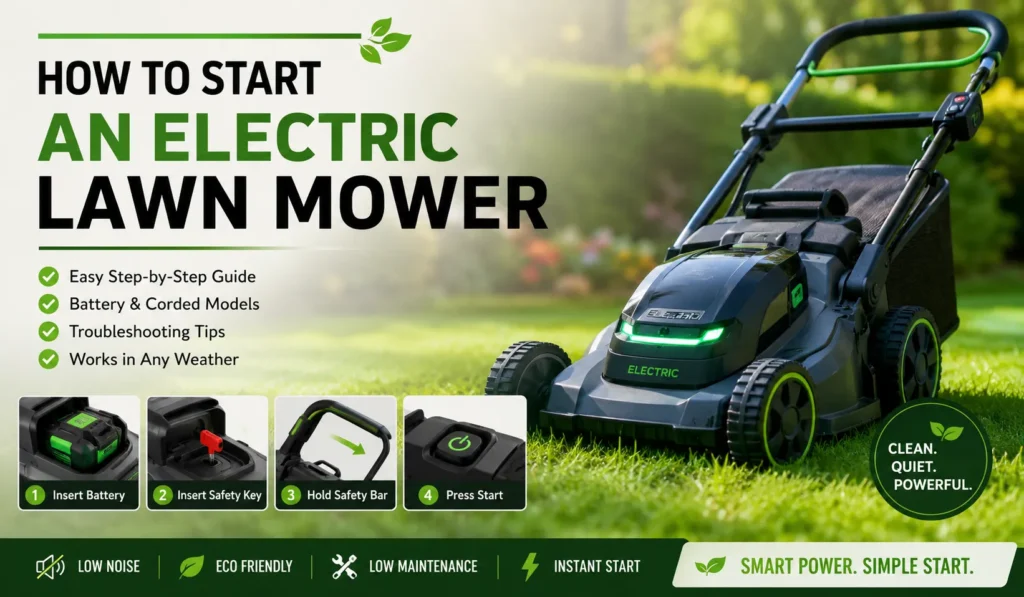
- To start a battery-powered mower, insert a charged battery, check the safety key, then press the safety bar and power button at the same time.
- To start a corded mower, plug into an outdoor-rated extension cord, hook the cord into the retention clip, then press the safety button and lever together.
- Most electric mowers won’t start because of a missing safety key, dead battery, or a tripped GFCI outlet – not a mechanical failure.
- EGO, Ryobi, Greenworks, and HART all use slightly different start sequences; check your model’s specific lock-out switch location before troubleshooting.
- Electric mowers start faster than gas mowers in every climate – no warm-up, no priming, no pull cord.
It was a Saturday morning in late April. My neighbor called me over, clearly frustrated. He’d just bought a Greenworks 40V mower and couldn’t figure out how to start an electric lawn mower. He was pressing the power button, nothing was happening, and he was already convinced the thing was broken.
It wasn’t broken. He’d forgotten to insert the safety key.
I’ve tested battery-powered and corded electric mowers across a few different US climates – humid Florida summers, dry Arizona heat, and cool Midwest spring mornings in Minnesota. Each climate throws its own wrinkle at the starting process. This guide is for new electric mower owners, people switching from gas, and anyone standing in their yard right now wondering why the thing won’t turn on.
Why Starting an Electric Mower Is Different from Gas
Electric mowers start differently from gas mowers. There’s no pull cord to yank, no choke to set, and no fuel to prime. The process is faster – but it trips people up because the safety features are less obvious.
No Pull Cord, No Choke, No Hassle
With a gas mower, you’d set the choke, prime the carburetor, then pull the cord two or three times (sometimes ten). Electric mowers skip all of that.
You press a button. The motor spins. That’s it.
The catch is that electric mowers have two or three safety steps built in before that button does anything. Miss one, and nothing happens. The mower just sits there, silent.
What You Need Before You Even Try to Start It
Before you touch the power button, make sure you have:
- A fully charged battery (for cordless models) or a working outdoor extension cord (for corded models)
- The safety key inserted into its port – this is usually a red or yellow plastic tab
- A clear deck with no obstructions under the blade
That’s it. No oil to check, no gas to add. But all three of those things need to be in place.
How to Start a Battery-Powered (Cordless) Lawn Mower
Battery mowers are now the most popular type for US residential yards under half an acre (Statista, 2024). Starting one takes about 10 seconds once you know the sequence.
Step 1 – Charge and Insert the Battery
Charge the battery fully before your first use. Most 40V and 56V batteries take 30 to 90 minutes depending on the charger included with your kit.
When the battery is ready, slide it into the deck housing until it clicks. On most EGO and Greenworks models, the battery sits under the rear handle. On some Ryobi ONE+ mowers, it mounts to the side of the deck.
Don’t force it. If the battery isn’t clicking in smoothly, check that the release latch is fully open before sliding.
Step 2 – Check the Safety Key or Lock-Out Switch
This is the step most people miss.
The safety key is a small plastic piece – usually red, sometimes yellow – that plugs into a port on the handle or deck. On EGO mowers like the LM2135SP, it sits at the top of the handle near the power button. On Greenworks models, it’s often on the lower deck near the battery slot.
Without the safety key in place, pressing the power button does nothing. No error light, no sound. Just silence. I’ve seen people return mowers to Home Depot thinking they’re defective when the key was just sitting in the box.
Some newer models – like the Ryobi RY401180 – use a digital lock-out button instead of a physical key. You hold a small button for two seconds to unlock the system before starting.
Step 3 – Engage the Safety Bar and Power Button
With the battery in and the key inserted, you’re one step away.
Grip the safety bar – the metal or plastic bar across the top of the handle. Hold it down toward the handle with your hands. On most US models, you also press the power button at the same time or right after.
You’ll hear a click, then the brushless motor spins up with a clean, steady hum. The whole sequence from grip to running blade takes about two seconds.
On some models, the safety bar alone starts the mower. On others (like HART’s 40V series), you press a separate power button first, then hold the bar. Check your manual for the exact order.
Step 4 – What to Do If It Still Won’t Start
If you’ve done all three steps and nothing happens, work through this in order:
- Check the battery charge level. Most batteries have LED indicators on the side. If all lights are off or only one is lit, charge first.
- Confirm the safety key is fully seated. Pull it out and reinsert it firmly.
- Look for a reset button on the deck. Some EGO and Greenworks models have a small thermal reset button near the motor housing. Press it once.
- Check that the blade isn’t jammed. If grass or debris is packed against the blade, the motor’s overload protection may have cut power.
Comparison Table for Brand Start Methods
| Brand | Safety Key Location | Start Sequence | Lock-Out Type |
|---|---|---|---|
| EGO (LM2135SP) | Top of handle | Insert key → hold bar + press button | Physical key |
| Ryobi (RY401180) | Handle panel | Hold unlock button 2 sec → hold bar | Digital lock-out |
| Greenworks (2500402) | Deck near battery | Insert key → hold bar | Physical key |
| HART (HLPM041) | Handle base | Press power → hold bar | Physical key |
How to Start a Corded Electric Lawn Mower
Corded electric mowers are simpler in one way – you never worry about battery charge. But the extension cord setup is where most people make mistakes.
Step 1 – Set Up the Extension Cord Safely
Use an outdoor-rated, 3-prong extension cord. For most 12-amp to 15-amp corded mowers, the right cord is:
- 14-gauge for runs up to 50 feet
- 12-gauge for runs between 50 and 100 feet
Using an undersized cord causes voltage drop. The mower starts sluggishly, runs weak, or won’t run at all. I learned this the hard way with a Black+Decker MM2000 on a long lot in Florida – kept tripping the thermal cutout until I swapped to a heavier gauge cord.
Don’t run the cord through water. Check for any damage – cuts, exposed wire, melted spots – before plugging in.
Step 2 – Use the Cord Retention Hook
Every corded mower has a cord retention hook near where the cord plugs into the handle. Thread the cord through or around this hook before you plug into the outlet.
The hook keeps the cord from pulling loose if you back up over it. Without it, one wrong step and the cord yanks free, cutting power mid-row.
Loop the cord. Hook it. Then plug in.
Step 3 – Press the Safety Button and Lever Together
Corded mowers use the same safety logic as battery mowers. There’s a safety button – usually on the handle with your thumb – and a lever you squeeze with your fingers.
Press and hold both at the same time. The motor starts immediately. Release either one and the motor stops.
That dual-press design prevents accidental starts. It’s the main thing that confuses people coming from gas, where you just pull a cord and the engine runs on its own.
Common Reasons Corded Mowers Trip or Won’t Start
- GFCI outlet tripped: If you’re plugging into an outdoor outlet, it may be a GFCI type. Check for the reset button on the outlet itself and press it.
- Extension cord gauge too light: Swap to 12-gauge if you’re running more than 50 feet.
- Motor thermal cutout: If you ran the mower in thick, wet grass, the motor may have overheated. Let it sit for 10 minutes, then try again.
- Damaged plug or cord: Inspect the full length before blaming the mower.
Troubleshooting When Your Electric Mower Won’t Start
Most starting failures come down to a handful of issues. Work through these in order before assuming the mower is defective.
Battery or Power Issues
A battery below 20% charge may not have enough voltage to trigger the start sequence. Most brushless motors need a minimum voltage to spin up safely.
Check the battery indicator lights first. If the battery is below one light, charge it fully before trying again. Don’t try to “nurse” a nearly dead battery through a mow.
For corded mowers, test the outlet. Plug in a phone charger or lamp to confirm the outlet has power. If the outlet is GFCI-protected, press the reset button on the face of the outlet.
Safety Mechanism Problems
Safety mechanisms are the most common cause of a mower that “just won’t start.”
Go through each one:
- Is the safety key fully inserted? Pull it out and push it in firmly until it seats.
- Are you holding the safety bar down before pressing power? Some models require the bar to be held first.
- Is the battery door or cover fully closed? Many mowers cut power if the battery housing is even slightly open.
Weather and Storage Issues
Cold batteries lose capacity. If you stored your mower in a garage in Minnesota over winter, the battery may read “charged” but perform poorly in temperatures below 40°F.
Bring the battery inside and let it warm to room temperature – about 65°F to 70°F – before mowing on cold spring mornings.
In Arizona and other dry climates, dust buildup in the battery contacts is a real problem. Wipe the contacts with a dry cloth before inserting the battery.
In Florida and other humid areas, moisture in the safety key port can cause intermittent starts. Dry the port with compressed air if the mower sat outside overnight.
Comparison Table for Common Fixes
| Symptom | Likely Cause | Fix |
|---|---|---|
| No response at all | Missing or loose safety key | Reinsert key firmly |
| Starts then stops | Safety bar released too early | Keep holding bar while mowing |
| Weak or slow start | Low battery or light extension cord | Charge battery / use 12-gauge cord |
| Won’t start in cold | Cold battery | Warm battery indoors for 30 min |
| Tripped GFCI | Moisture or overload | Reset GFCI outlet button |
| Motor won’t spin up | Thermal cutout triggered | Let motor cool 10 minutes |
Starting Tips for Different Conditions
Climate affects how electric mowers start and run. Here’s what I’ve noticed from using these machines in different parts of the US.
Cold Mornings (Midwest Spring)
Minnesota spring mornings can drop into the 30s in April. Lithium-ion batteries hate the cold.
A battery that’s fully charged but cold will show all charge lights – then die after two minutes of mowing. The fix is simple: store your battery indoors overnight. Bring it out right before you mow.
EGO’s 56V ARC Lithium batteries handle cold better than most. I’ve started an EGO mower at 38°F with no issues when the battery came from inside the house.
Hot, Humid Climates (Florida, Texas, Southeast)
In Florida and Texas summers, the bigger issue is heat and moisture, not cold.
After 30 to 40 minutes of mowing thick St. Augustine grass in 90°F+ heat, the motor thermal protection can kick in. The mower just stops. This isn’t a failure – it’s the system protecting itself.
Let it sit in the shade for 10 to 15 minutes with the battery removed. Then restart. It will work.
Keep the underside of the deck clean. Wet grass clippings pack under the deck fast in humid climates, forcing the motor to work harder than it should.
Dusty, Dry Terrain (Southwest, Arizona)
Phoenix summers mean fine dust everywhere. That dust gets into battery contacts, button ports, and the cooling vents on the motor housing.
Before starting, blow out the battery contacts and key port with a can of compressed air. Check the air vents on the motor housing too. Blocked vents cause overheating faster than any other issue I’ve seen in dry climates.
Greenworks 60V models have a sealed motor design that holds up better in dusty conditions than some open-vent designs I’ve tested.
Common Mistakes People Make When Starting Electric Mowers
Most of the starting problems I’ve seen in person – or heard about from neighbors and forum posts – come from a few repeated mistakes. These are worth knowing before you end up standing in your yard confused.
Forgetting the Safety Key or Lock-Out
This is the number one mistake. The safety key looks easy to lose because it’s small. A lot of people take the mower out of the box, set the key aside, and then spend 15 minutes pressing the power button wondering why nothing happens.
Keep the key attached to your battery bag or stored in the mower’s handle. Some people zip-tie a small hook to the handle and hang the key there between uses.
If you lose the key entirely, contact the brand. Most manufacturers sell replacement keys. EGO and Greenworks both sell them through their websites and Amazon for under $10.
Letting the Battery Sit Uncharged Too Long
Lithium-ion batteries degrade when stored fully discharged for months. If you put your mower away in October with a dead battery and pull it out in May, the battery may no longer hold a charge.
Store batteries at 40% to 60% charge over winter. Most battery chargers have a “storage mode” or will simply stop charging when the battery hits a safe storage level.
If your battery won’t charge after winter storage, try leaving it on the charger for a full 24 hours. If that doesn’t work, the battery likely needs replacement. Most 40V and 56V replacement batteries cost $80 to $150.
My Final Recommendation
After testing these machines in Florida backyards, Arizona driveways, and Minnesota front lawns, my honest take is this: electric mowers start easier than any gas mower I’ve ever used. The safety steps feel like a lot at first, but after two or three mows, you do them without thinking.
The one thing I’d tell any new electric mower owner is this – read the starting sequence in your manual once, before you go outside. Just once. The specific order of steps varies by brand, and knowing whether you press the button before or after holding the bar saves you 20 minutes of frustration on your first Saturday morning.
If I had to pick one brand for the easiest starting experience right now, I’d lean toward EGO. The safety key sits in an obvious spot, the bar-and-button sequence is straightforward, and their chargers are fast. Greenworks is a close second, especially for the value. Ryobi’s digital lock-out is clever, but the two-second hold feels slightly awkward until you get used to it.
Battery vs. Corded Starting Process
| Factor | Battery-Powered | Corded Electric |
|---|---|---|
| Setup time | 2-5 min (charge battery) | 3-5 min (run cord) |
| Starting steps | 3 (battery, key, bar+button) | 2 (cord setup, button+lever) |
| Starting in rain | Not recommended | Not recommended |
| Cold weather start | Reduced battery performance | No change |
| Risk of stopping mid-mow | Battery runs out | Cord pulls free |
| Mobility | Full – no cord | Limited by cord length |
| Safety mechanism | Safety key + bar | Dual-button press |
Frequently Asked Questions About Starting Electric Lawn Mowers
What is the first step to starting an electric lawn mower?
For battery mowers, the first step is inserting a charged battery and confirming the safety key is in place. For corded mowers, the first step is running a properly rated outdoor extension cord and looping it through the cord retention hook before plugging in.
Why won’t my electric lawn mower start when I press the button?
The most common reason is a missing or loose safety key. The second most common reason is a battery that’s too low to start the motor. Check the safety key first, then check the battery charge level. If both are fine, look for a thermal reset button on the deck housing.
Do electric lawn mowers need a safety key to start?
Most battery-powered electric mowers do require a safety key or lock-out mechanism. Some newer models – like certain Ryobi ONE+ units – use a digital lock-out button instead of a physical key. Corded electric mowers typically use a dual-button press (thumb button + trigger lever) instead of a key.
How long does it take to charge an electric lawn mower battery before first use?
Charging time depends on battery voltage and charger speed. Most 40V batteries take 60 to 90 minutes with a standard charger. EGO’s 56V 5.0Ah battery charges in about 50 minutes with the rapid charger. Always charge fully before the first use.
Can I start an electric mower in wet or rainy conditions?
No. Electric mowers – both battery and corded – should not be used in rain or on wet grass where standing water is present. Moisture in the battery contacts, safety key port, or motor housing can cause safety issues or damage the motor. Wait until the grass and the mower are both dry.
How is starting an electric mower different from starting a gas mower?
Gas mowers require priming, choke adjustment, and a pull cord start – often several pulls. Electric mowers have no pull cord, no choke, and no warm-up period. The trade-off is that electric mowers have multiple safety steps (battery, key, bar) that must all be completed in order before the motor will start.
What voltage battery do I need for a reliable start in all weather?
40V batteries handle most residential lawns well in moderate climates. For reliable cold-weather starts and thick grass in hot, humid climates like Florida or Texas, 56V or 60V batteries perform better. EGO’s 56V system and Greenworks’ 60V system both start more reliably in temperature extremes than lower-voltage alternatives.