
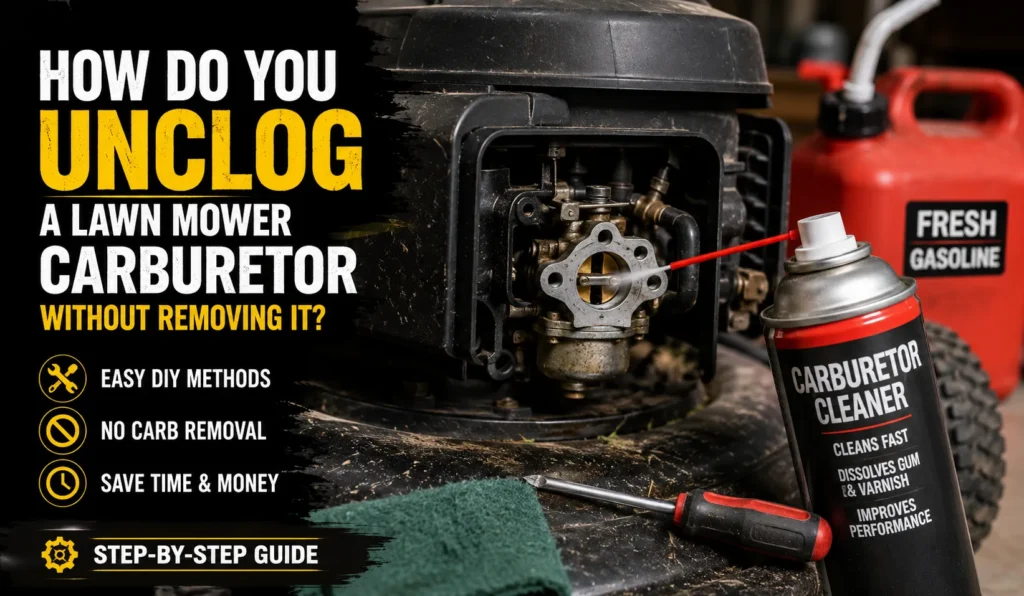
Quick Overview
- You can often unclog a lawn mower carburetor without removing it by spraying cleaner through the air intake and running fresh gas through the system.
- Most clogs come from stale ethanol gas that breaks down and leaves gum behind (Briggs & Stratton, 2025).
- Start with the easiest fix first: fresh gas and a clean fuel filter solve more problems than people expect.
- If the engine still won’t idle after these methods, the clog is likely inside the carb bowl and you’ll need to remove it.
- Budget one Saturday morning, a can of carb cleaner, and some patience before you decide it’s a lost cause.
My mower sat in the garage all winter with gas still in the tank. I know better. I just didn’t drain it before the snow came.
So when I pulled the cord on the first warm Saturday in March, it sputtered twice and died. That smell hit me right away, stale gas, sharp and a little sour, mixed with old grease on my hands from the last oil change.
I wanted to unclog a lawn mower carburetor without removing it because I didn’t have all morning to pull the whole thing apart. Turns out, that’s possible more often than people think.
My hands were already grimy from checking the oil, and the garage was warming up fast under the March sun. I had a lawn that hadn’t been touched in three weeks and a mower that clearly had other plans. That’s usually when people either give up or start searching for a fix.
This guide is for anyone with a small gas mower, push or self-propelled, who’s dealing with a rough start, a stall, or an engine that just won’t catch. If you’ve got a riding mower with a bigger carb, most of this still applies, though the tank size and fuel line length will differ a bit.
Why Carburetors Get Clogged in the First Place
Carburetors clog because fuel residue dries out and blocks the tiny passages that mix gas and air. Most of the time, it’s not dirt from outside. It’s the gas itself breaking down inside the carb.
Old or Stale Gas
Gasoline starts losing its lighter compounds within about 30 days, especially ethanol blends common at US pumps (Briggs & Stratton, 2025). What’s left behind is a sticky gum that hardens in the carb’s tiny jets.
That gum is thick enough to block a passage smaller than a pencil lead. Once that happens, fuel can’t flow the way the engine needs it to.
Sitting Too Long Without Use
A mower that sits for a season, especially over winter, is the most common clog case I see. The fuel doesn’t move, so it has nowhere to go but stale.
I learned this one the hard way. My neighbor Tom always drains his tank before storing his Toro for the winter. I didn’t, and I paid for it with a Saturday morning of cleaning instead of mowing.
Climate plays a bigger role in this than most people realize. In Minnesota and other cold-winter states, mowers often sit for five or six months straight, which gives stale gas plenty of time to break down before spring. In Florida and other parts of the Southeast, high humidity adds a second problem: moisture can mix into the fuel and speed up corrosion inside the carb even during shorter storage gaps. Out in Arizona and the Southwest, the issue flips again. Intense heat causes gasoline to evaporate faster, leaving behind a more concentrated, gummier residue in less time than you’d expect. Wherever you live, the fix is the same: don’t let gas sit untouched for a full season.
Signs Your Carburetor Is Clogged (Not Something Else)
A clogged carburetor usually shows up as a mower that won’t start, runs rough at idle, or surges up and down on its own. These symptoms point to fuel delivery, not the spark plug or blade.
Won’t Start or Starts Then Dies
If the engine catches for a second and then dies, fuel is reaching the cylinder but not consistently. That’s a classic clog symptom, not a dead battery or bad spark plug issue.
Pull the cord a few times and listen. A clean cough followed by silence usually means fuel starvation, not ignition failure.
Rough Idle or Surging
An engine that idles unevenly, revving up and down without you touching the throttle, is fighting a partial blockage. Fuel is getting through, just not steadily.
This one is frustrating because the mower runs, so it feels like it should just work. It doesn’t. The surging will usually get worse before it gets better.
Black Smoke or Fuel Smell
Black smoke from the exhaust or a strong gas smell around the engine points to a rich fuel mixture, often caused by a stuck float or clogged jet. Too much fuel is getting through relative to air.
If you smell raw gas standing near the mower after a failed start, don’t keep cranking it. Let it sit a few minutes so the extra fuel can clear before you try again.
I’ve made this mistake myself, cranking the cord over and over while the garage filled with fumes. All that does is flood the engine further and make the eventual fix take longer. Step back, let it breathe, and come back in five minutes.
What You Need Before You Start
You need a can of carburetor cleaner, fresh gas, basic hand tools, and a well-ventilated space before attempting any of these methods. None of this requires removing the carb from the engine.
Tools and Supplies
- A can of carburetor and choke cleaner with a small red straw nozzle for precise spraying
- Fresh gasoline, ideally ethanol-free or no older than 30 days
- A basic screwdriver set for accessing the air filter housing
- Clean rags for wiping up spilled fuel and cleaner residue
- Safety glasses to keep spray and fumes away from your eyes
- A small container or turkey baster if you plan to drain old gas
None of this needs to be expensive. A basic can of carb cleaner runs a few dollars, and most homeowners already have the screwdrivers on hand. You don’t need a full mechanic’s toolbox for any of these methods.
Safety Precautions
Work outdoors or in a garage with the door open, since carb cleaner fumes build up fast in an enclosed space. Keep the mower away from any open flame or pilot light.
Let the engine cool completely before you start spraying anything into it. A hot muffler near carb cleaner is a real fire risk, not just a theoretical one.
How to Unclog It Without Removing It
You can unclog a lawn mower carburetor without removing it using four main methods: spraying cleaner through the intake, clearing the fuel line and filter, running fresh gas through the system, and using the choke to loosen debris. Start with the simplest and work up.
Method 1 – Carb Cleaner Spray Through the Air Intake
Remove the air filter, then spray carb cleaner directly into the intake opening while pulling the starter cord a few times. This pulls cleaner through the carb’s internal passages without any disassembly.
I’ve done this on my own Honda push mower twice now. The first time, it took about six short bursts before the engine caught and ran smooth. The smell of solvent mixing with old gas fumes is not pleasant, but it works.
The second time was worse. I’d let the mower sit even longer, and it took closer to ten bursts spread over two rounds, with a five-minute break in between so the cleaner had time to soak in. I remember standing there listening for that first real cough of the engine, half expecting it to just die again like it had the last three times.
The limitation here is real: this method cleans passages the spray can actually reach. A clog deep in the main jet or inside the float bowl usually won’t clear this way.
Method 2 – Cleaning the Fuel Line and Filter First
Disconnect the fuel line at the carb, check the inline filter for gunk, and clean or replace it before touching the carb itself. A clogged filter can mimic carb problems and waste your time.
I skipped this step once and spent 20 minutes spraying cleaner into a carb that was fine. The real problem was a filter so dark with sediment I couldn’t see through it.
This is a five-minute check that saves you from misdiagnosing the issue. Always rule out the filter before assuming the carb itself is clogged.
Most inline fuel filters are cheap, usually a few dollars at any hardware store or auto parts counter. If yours looks cloudy, dark, or has visible sediment sitting at the bottom, just replace it. There’s no reason to clean a filter that costs less than a cup of coffee.
Method 3 – Draining and Refilling with Fresh Gas
Drain any stale gas from the tank and carb bowl, then refill with fresh fuel to flush out residue and restore proper combustion. This alone fixes a surprising number of no-start cases.
Use a turkey baster or a siphon pump to pull old gas from the tank. Don’t just add fresh gas on top of stale gas. That dilutes the problem instead of solving it.
A buddy of mine in Georgia tried skipping the drain step during a humid August weekend. He just topped off the tank with fresh gas over the old stuff, figured it would even out. It didn’t. The mower ran rough for another two weeks until he finally drained it properly and started over.
That kind of shortcut is tempting because it feels faster in the moment. It almost never is. Draining the tank properly the first time takes maybe ten extra minutes and saves you from repeating the whole process later.
The downside is that this method works best on light clogs. If gum has already hardened into a solid deposit, fresh gas alone won’t dissolve it fast enough to help.
Method 4 – Using the Choke and Throttle to Loosen Debris
Run the engine at full choke and high throttle for a minute or two once it starts, since the extra fuel flow can help dislodge loose debris from partially blocked passages. This works as a follow-up, not a first step.
I’ve had a mower go from rough surging to a steady idle after two minutes at full choke. It’s not guaranteed, but it costs nothing to try once the engine is running at all.
This method won’t do much if the engine isn’t starting yet. It’s best used right after Method 1 or Method 3, once you’ve got some kind of ignition happening.
I like this step because it costs nothing and takes almost no effort. Once the engine is running even roughly, let it sit at full choke for a minute, then ease off gradually. Sometimes you’ll hear the idle smooth out right in front of you, which is a satisfying sound after a frustrating morning.
Compression Table for Every Method
| Method | Effort | Best For | Limitation |
|---|---|---|---|
| Carb cleaner spray | Low | Light surface clogs | Can’t reach the float bowl |
| Fuel line and filter check | Low | Filter-caused symptoms | Doesn’t fix true carb clogs |
| Fresh gas flush | Medium | Stale gas cases | Won’t dissolve hardened gum |
| Choke and throttle run | Low | Loosening minor debris | Only works once engine starts |
What to Do If These Methods Don’t Work
If the mower still won’t idle or start after trying all four methods, the clog is likely inside the carburetor bowl or jets, and removal is the next step. There’s no shame in that. Some clogs just need direct access.
When You Actually Need to Remove the Carburetor
Pull the carburetor when spray cleaner and fresh gas haven’t restored a steady idle after two or three attempts. At that point, the blockage is probably solid material sitting in a spot the spray can’t reach.
I hit this wall once with a Craftsman mower that had sat for two full seasons. No amount of spraying helped. Pulling the bowl off showed a chunk of hardened gum the size of a pencil eraser sitting right in the jet.
Removing the carb on most small engines isn’t as intimidating as it sounds. It usually means disconnecting the fuel line, throttle linkage, and two or three bolts. Keep a phone camera handy to photograph each step, so reassembly isn’t a guessing game later.
Signs the Clog Is Too Severe for a Quick Fix
A mower that cranks fine, smells like fresh fuel, but still won’t catch after multiple tries usually has a blockage too solid for spray cleaner to dissolve. You’ll feel it in how consistently nothing happens.
If you’ve replaced the fuel filter, flushed the tank, and sprayed cleaner with zero change, stop repeating the same steps. Removing the carb bowl at that point is faster than trying again.
I know it’s tempting to just spray one more round of cleaner and hope. I’ve done that too, twice in a row on the same stubborn mower, before finally admitting the clog needed direct access. Trust the pattern. If nothing changed the first two times, it won’t change the third.
Common Mistakes People Make
Using the Wrong Cleaner
Some people reach for brake cleaner or general degreaser instead of actual carb cleaner, and it can damage rubber seals and gaskets inside the carburetor. Stick to a product labeled specifically for carbs and chokes.
I made this mistake early on with a generic degreaser. It worked once, but I noticed a small fuel leak from a seal a few weeks later. Not worth the few dollars saved.
Read the can before you buy it. Products labeled specifically for carburetors and chokes are formulated to be gentle on rubber and plastic. General-purpose degreasers are not, even if the bottle looks similar sitting on the shelf.
Skipping the Fuel Filter Check
Jumping straight to carb cleaner without checking the fuel filter wastes time when the real blockage is upstream. Always check the cheap, easy part first before the harder one.
This mistake cost me a wasted Saturday early on. Check the filter first. It takes five minutes and rules out half the common causes.
Overtightening Fuel Line Connections
Cranking the hose clamp down too hard when reattaching the fuel line can crack the plastic fitting on the carb, especially on older Briggs & Stratton engines. Snug is enough. You don’t need to force it.
I cracked a fitting this way once, which turned a 20-minute cleaning job into a parts-store run. Now I stop tightening the moment I feel resistance, not after.
Hand-tight plus a quarter turn with the screwdriver is usually plenty for a small engine fuel line clamp. If it needs more force than that, something else is probably misaligned, not the clamp itself.
Pros and Cons Table (No Removal vs. Full Removal Cleaning)
| No Removal Methods | Full Removal Cleaning | |
|---|---|---|
| Time needed | 20-40 minutes | 1-2 hours |
| Tools required | Minimal | Full tool set, possible gasket kit |
| Success rate on light clogs | High | High |
| Success rate on hardened clogs | Low | High |
| Risk of damaging parts | Low | Moderate if rushed |
| Good for beginners | Yes | Needs some mechanical comfort |
My Final Recommendation
If your mower won’t start after sitting all winter, try the no-removal methods first. Fresh gas, a clean filter, and a few bursts of carb cleaner through the intake fix more problems than people expect, and you can be done before lunch.
I’ve used this exact sequence on three different mowers now, a Honda, a Craftsman, and my brother-in-law’s old Toro. Two of them started right back up. The Craftsman needed a full teardown, and that’s fine. It happens.
Give the quick methods a real shot before you assume the worst. But if you’ve sprayed, flushed, and choked your way through an afternoon with nothing to show for it, stop fighting it. Pull the carb, clean the bowl, and you’ll likely be back to mowing by the weekend.
There’s a kind of satisfaction in fixing something small engine related yourself, even when it takes longer than you planned. That first clean start after a morning of frustration, the mower catching and settling into a steady idle, makes the grease-stained hands worth it. Just don’t let it become a yearly ritual. A little fuel stabilizer and an empty tank before winter storage will save you the whole ordeal next spring.
Frequently Asked Questions About Unclogging a Lawn Mower Carburetor
Can I unclog a lawn mower carburetor without removing it?
Yes, in many cases. Spraying carb cleaner through the air intake, flushing stale gas, and checking the fuel filter clear light to moderate clogs without any disassembly.
How do I know if my mower’s carburetor is clogged?
Common signs include the engine starting then dying, a rough or surging idle, and black smoke or a strong fuel smell. These point to a fuel delivery problem rather than an ignition issue.
What’s the best carb cleaner for a lawn mower?
Any product labeled specifically as carburetor and choke cleaner works well. Avoid brake cleaner or general degreasers, since they can damage rubber seals inside the carb.
How long should I let carb cleaner sit before starting the mower?
A quick spray-and-crank approach works for light clogs. For heavier buildup, let the cleaner sit for a few minutes before pulling the starter cord again.
Will fresh gas alone fix a clogged carburetor?
Sometimes, especially if the clog is just stale gas residue rather than hardened gum. Drain the old fuel completely before adding fresh gas for the best results.
How often should I drain my mower’s gas tank for storage?
Drain the tank or run the engine dry before storing the mower for more than 30 days, especially over winter. This is the single biggest thing you can do to prevent clogs.
Is it safe to spray carb cleaner into the air intake?
Yes, as long as the engine is cool and you’re working in a ventilated space away from open flame. Avoid spraying directly onto hot engine parts.
How do I know when it’s time to remove the carburetor entirely?
If you’ve tried spray cleaner, a fresh gas flush, and a fuel filter check without any improvement after two or three attempts, the clog is likely solid material that needs direct removal to clear.
Can ethanol gas cause carburetor clogs?
Yes. Ethanol blends break down faster than pure gasoline and leave behind a gummy residue that clogs small carb passages (Briggs & Stratton, 2025). Ethanol-free fuel or a fuel stabilizer helps prevent this.
Does climate affect how often my carburetor clogs?
Yes. Hot, dry climates like Arizona speed up gas evaporation, while humid regions like Florida add moisture that can corrode carb parts faster. Cold-winter states see more clogs simply because mowers sit unused for longer stretches.
Can I use a fuel stabilizer to prevent future clogs?
Yes. Adding a fuel stabilizer before storage keeps gas from breaking down as quickly, which is especially useful if you know your mower will sit for more than a month.
Do riding mowers clog the same way as push mowers?
The same basic causes apply, but riding mowers often have larger fuel systems and additional filters, so it can take a bit more fuel and cleaner to fully flush the system.