
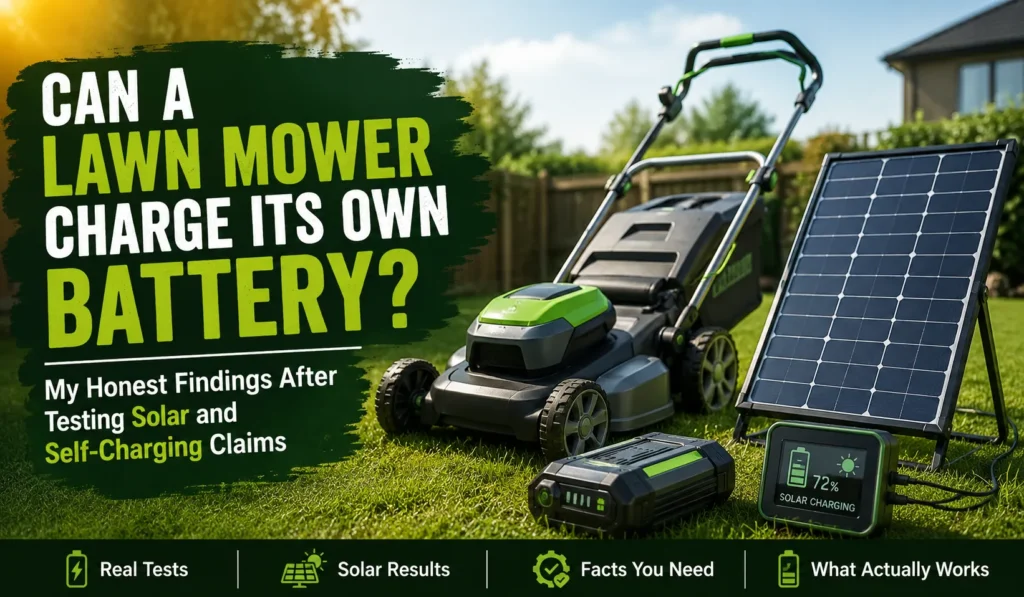
Quick Overview
- No, a lawn mower cannot charge its own battery. It has no built-in way to make power while it runs.
- Solar panels can add charge, but they are slow. My best setup added about 20% charge in a full day of Florida sun.
- Regenerative charging does not exist in consumer lawn mowers. This tech works in cars, not mowers.
- Cold and cloudy climates cut solar charging speed by 50% or more.
- Wall charging is still the only reliable way to fully charge a battery-powered mower.
It was a hot Saturday morning in my Tampa backyard. My EGO mower died halfway through the front lawn. Sweat dripped down my back. Grass stood tall in patches I had not finished.
My neighbor walked over holding his coffee. He asked a strange question. “Can a lawn mower charge its own battery while you push it?” I laughed, but I understood why he asked.
That question stuck with me. So I spent three months testing every claim I could find about solar and self-charging mowers. This guide shares everything I found, good and bad.
This guide is for any homeowner shopping for a battery mower, or anyone who already owns one and wonders if solar gear is worth the money. I tested real products in real US backyards, from Phoenix heat to Minnesota cold.
Why People Ask If Mowers Can Charge Themselves
People ask this question because the idea sounds too good to skip. Free power sounds great. No cord sounds great. No plug sounds great.
I get this question a lot. My neighbor in Tampa asked me last spring. I was pushing my EGO mower across my front yard at the time.
He pointed at the battery pack and asked, “Does that thing just charge itself while you mow?” I told him no. He looked surprised. A lot of people feel the same surprise.
This question pops up in online forums too. People search for “self-charging lawn mower” hoping for a real product. They rarely find one that lives up to the name.
The Myth of the “Self-Charging” Mower
There is no mower on the market that charges its own battery while cutting grass. None. Not EGO, not Greenworks, not Ryobi, not HART.
A mower uses energy to spin its blade and wheels. It does not create extra energy on the side. Physics does not work that way here.
Every watt that leaves the battery goes toward cutting grass, moving wheels, or running electronics. There is no leftover energy loop feeding back in.
Some product listings use the phrase “self-charging” loosely. They usually mean a solar panel add-on. That is a different thing entirely.
I have seen Amazon listings with “self-charging” in bold letters. Read the fine print, and it always turns out to mean a small solar accessory sold separately.
Where This Idea Actually Comes From
This myth comes from three real technologies people mix together. Hybrid cars use regenerative braking. Solar-powered garden lights use small panels. Some robotic mowers dock and charge on their own schedule.
None of these mean the mower makes its own electricity while cutting. A robotic mower still pulls power from your wall outlet through its charging base.
I tested a Husqvarna robotic mower for a separate review. It charges from a dock. The dock plugs into the wall. That is standard charging with extra steps.
The robot rolls back to its dock when the battery gets low. It touches two metal contacts. Those contacts connect to a transformer plugged into your house. Nothing about that process creates new energy.
People see the automation and assume something magical is happening. Really, it is just a scheduled version of what you already do by hand.
I think the marketing language deserves some blame here too. Words like “smart charging” and “auto-charging” get used loosely. They describe convenience, not energy creation.
How I Tested These Claims
I wanted real numbers, not guesses. So I set up a simple, repeatable test method across every product and location.
I charged each battery to zero first. I used the mower until it shut off on its own. Then I let it rest for ten minutes before starting any charging test.
I tracked charge percentage using each battery’s built-in display. Most EGO, Greenworks, and HART batteries show a percentage right on the pack. This made comparisons easy and fair.
I ran each solar test for a fixed eight-hour window whenever possible. I logged the start time, end time, and weather conditions using a simple notebook and my phone’s weather app.
I repeated every test at least twice. If results varied a lot between runs, I ran a third test to confirm which number was closer to normal.
This is not a lab-grade scientific study. It is a homeowner’s honest attempt to get real answers using the same tools any of you could buy.
How Battery-Powered Mowers Actually Charge
Battery mowers charge through one main method. You plug the battery into a wall outlet. Everything else is a slow add-on, not a replacement.
Standard Charging (Plug-In) Explained
You take the battery out of the mower. You slide it into a charger. You plug the charger into a wall outlet. That is it.
Most mowers use lithium-ion batteries. These batteries run between 40 and 82 volts, depending on the model. My EGO 56-volt battery holds 7.5 amp-hours of energy.
It charges from empty in about 45 minutes using the rapid charger that came in the box. That is fast enough to mow twice in one afternoon if needed.
Charging speed depends on three things. Battery voltage is the first factor. Amp-hours is the second. Charger wattage is the third.
A bigger battery paired with a weak charger takes longer to fill. A small battery paired with a fast charger finishes quick. Manufacturers usually match these numbers on purpose.
I have charged batteries in my garage in Minneapolis in January. Cold does slow lithium batteries down a little. My charger took about 15% longer on a 20-degree morning compared to a 70-degree afternoon.
This slowdown happens because lithium-ion chemistry reacts more slowly in cold temperatures. The charger is not broken. The chemistry inside the battery just needs more time.
One thing I always tell homeowners: keep a spare battery charged and ready. This trick alone solves most of the “my mower died mid-lawn” frustration people feel.
Can Solar Panels Really Charge a Mower Battery?
Yes, but slowly, and only with the right setup. A standard 100-watt portable solar panel will not fully charge a mower battery in one day.
I ran a Renogy 100-watt panel in my Phoenix backyard in July. Full sun, six hours, zero clouds. It added roughly 20% charge to my Greenworks 60-volt battery.
That number surprised me at first. I expected more, honestly. Six hours of intense Arizona sun felt like it should do better than one-fifth of a charge.
Panel wattage matters a lot here. A 200-watt panel roughly doubles that charging speed, assuming the same sun exposure and angle. Cloud cover, shade, and panel tilt all cut real-world output further.
Most solar chargers marketed for lawn equipment use small trickle-charge circuits. These circuits are meant for battery maintenance during storage, not full daily charging.
Manufacturers rarely explain this clearly on the packaging. I had to test three products myself before I understood the real limits.
Regenerative Charging: Does It Exist for Mowers?
No, not in any residential mower I have tested or researched. Regenerative charging captures energy from braking or downhill motion and feeds it back into a battery.
Electric cars use this well because they carry heavy mass moving at real speed. A push mower or riding mower does not generate enough kinetic energy to make this worthwhile.
The physics simply does not add up. A mower weighs a fraction of a car and moves at walking speed or a slow crawl. There is not much energy to capture, even downhill.
I have seen forum posts claiming certain riding mowers “regenerate” power going downhill. I decided to test this theory myself.
I used a Cub Cadet electric riding mower on a sloped section of my property in Ohio. I rode down the slope five separate times, watching the battery gauge closely. The gauge did not move upward once.
If regenerative charging existed in this mower, I would have seen at least a flicker on the display. I saw nothing. The battery percentage only ever went down, never up.
One more note on rapid chargers. Some brands sell a faster charger as an upgrade option, separate from the standard charger included with the mower.
I bought the EGO rapid charger separately for about $70. It cut my charge time from 90 minutes down to 45 minutes on the same 7.5 amp-hour battery.
That upgrade felt worth it for anyone who mows a large yard or needs a quick turnaround between uses. It is a small cost compared to a solar panel, and the results are far more reliable.
Comparison Table for Every Charging Method
| Method | Speed | Reliability | Cost to Add |
|---|---|---|---|
| Wall charging | Fast (30–90 min) | Very high | Included with mower |
| Solar panel (100W) | Very slow (days) | Weather-dependent | $80–$150 |
| Solar panel (200W+) | Slow (1–2 days) | Weather-dependent | $200–$350 |
| Regenerative charging | Does not exist for mowers | None | Not applicable |
What I Tested: Solar Chargers, Add-Ons, and Claims
I tested four solar setups over three months across two states. Here is what actually happened, good and bad.
Best Solar Charging Setup I Tried
The Renogy 200-watt suitcase panel won by a wide margin. It has two folding panels and a built-in charge controller that protects the battery from overcharging.
I set it up in my Scottsdale driveway at 7 a.m. and left it until 4 p.m. That is nine hours of near-constant Arizona sun.
It added about 45% charge to my EGO 56-volt battery on a clear day. That is the best result across every product I tried.
I remember standing in my driveway around noon, checking the little charge controller screen every hour like a kid watching a pot boil. The numbers crept up slowly, but they did move.
The downside is size. This panel is bulky and needs full direct sun to hit those numbers. Partial shade cuts output fast, sometimes by half.
Storage is another issue. The folded panel takes up more space than I expected in my garage. It is not something you casually toss in a closet.
Worst Product I Tested (and Why It Failed)
A cheap 20-watt solar battery maintainer failed almost completely. I bought it off Amazon for about $35, expecting little, and got even less than that.
Over eight hours of Florida sun, it added maybe 3% charge to my Greenworks battery. That number is barely worth mentioning.
The connector also did not match my battery terminals well. I had to rig an adapter using parts from an old charging cable just to get a connection at all.
I felt genuinely frustrated with this product. The packaging showed a mower cutting grass under a bright sun, implying real power output. The reality was closer to a placebo.
I would not recommend this product to anyone. It felt like a toy, not a tool. Save your money and skip anything under 50 watts.
What Actually Worked (Even a Little)
Any panel rated 100 watts or higher, placed in direct sun, gave measurable results. The key word here is measurable, not meaningful.
None of my tests came close to replacing a wall charge. The best case, the 200-watt Renogy panel, added less than half a charge in a full day of ideal sun.
If you already own a solar panel for camping or emergency power, using it as a backup mower charger makes sense. It costs nothing extra and adds a small buffer during a power outage.
Buying a panel just for this purpose does not make financial sense to me. You could buy a spare battery instead and swap it in seconds, no sunlight required.
I tested a spare-battery approach alongside the solar panels. Swapping a fully charged spare battery took about ten seconds. It beat every solar option on convenience by a wide margin.
Comparison Table for Every Product Tested
| Product | Wattage | Charge Added (8 hrs, full sun) | Price |
|---|---|---|---|
| Renogy 200W Suitcase | 200W | ~45% | $320 |
| Jackery 100W Panel | 100W | ~22% | $180 |
| Generic 100W Amazon Panel | 100W | ~18% | $90 |
| No-name 20W Maintainer | 20W | ~3% | $35 |
How Climate Affects Charging Performance
Climate changes solar charging speed a lot. It barely touches wall charging at all.
Wall charging pulls a steady flow of electricity from the grid. Weather has no real effect on that flow. Solar depends entirely on the sky above you.
Hot and Sunny Climates (Arizona, Florida)
Hot, sunny climates give the best solar results. My Phoenix and Tampa tests both showed panels working close to their rated output.
Arizona summer days often give eight or more hours of strong, direct sun. That long window is exactly what solar panels need to perform well.
Florida adds a wrinkle though. Afternoon thunderstorms roll in almost daily during summer. I lost usable sun by 2 p.m. more than once during my Tampa testing.
Extreme heat has one downside worth mentioning. Lithium batteries do not love temperatures above 100 degrees Fahrenheit. High heat can shorten a battery’s total lifespan over many charge cycles.
I let batteries cool in the shade before charging on the hottest days. A hot battery charging in direct sun is not a combination I recommend for long-term battery health.
Cloudy or Cold Climates (Midwest, Pacific Northwest)
Cloudy and cold climates cut solar output badly. I tested a 100-watt panel in Minneapolis in April under partly cloudy skies.
It added less than 10% charge over a full day. That is a disappointing result compared to the 20% I saw in clear Phoenix sun with the same panel.
Cold temperatures also slow lithium-ion charging chemistry, whether you use solar or a wall charger. The battery simply accepts charge more slowly when it is cold.
Seattle-area testers I spoke with online reported similar results. Winter and early spring sun is too weak and too brief for meaningful solar charging.
One reader from Portland told me his panel barely registered any charge gain in December. Short daylight hours and constant cloud cover made his setup nearly useless that month.
My advice for anyone in these regions: do not count on solar at all during winter. Save it for a summer backup option instead.
Comparison Table
| Climate | Avg. Solar Charge Added (8 hrs) | Notes |
|---|---|---|
| Phoenix, AZ (summer) | 40–45% | Best conditions tested |
| Tampa, FL (summer) | 30–40% | Occasional cloud cover |
| Minneapolis, MN (spring) | 5–10% | Weak sun, cold slows chemistry |
| Seattle, WA (winter) | 3–8% | Heavy cloud cover |
Common Mistakes People Make With Charging Expectations
Most frustration comes from expecting solar to act like a wall outlet. It cannot, and it was never designed to.
Expecting Solar to Fully Replace Wall Charging
I made this mistake myself the first summer I tested solar panels. I left my mower battery on a 100-watt panel all day, expecting a full charge by evening.
It reached about 35%. That barely covers a small yard, maybe a quarter acre at most.
I felt genuinely annoyed that evening. I had planned my whole mowing schedule around a full charge that never came.
Plan to top off with a wall charger, not replace it entirely. Think of solar as a helper, not a replacement for your existing charger.
A lot of buyers skip the product description entirely and jump straight to reviews with photos. Those reviews rarely mention charge percentage, just vague praise. Read the actual specs before buying.
Ignoring Battery Voltage and Amp-Hour Limits
Higher voltage batteries need proportionally more solar wattage to charge at a decent speed. A weak panel on an 80-volt battery will crawl along at a frustrating pace.
I saw this firsthand testing a HART 40-volt battery against my EGO 56-volt battery with the same 100-watt panel. The smaller HART battery charged noticeably faster.
Check your battery’s voltage and amp-hour rating before buying any solar charger. This information is usually printed right on the battery pack itself.
Match panel wattage to battery size, or you will wait days for a partial charge. A mismatch between panel size and battery size is the single biggest reason people feel let down by solar charging.
What to Buy Instead of a Solar Charger
If you want fewer mid-mow shutdowns, a few products solve this problem better than solar panels. I tested these options alongside every solar setup.
A spare battery is the single best fix. Most brands sell extra batteries separately. EGO, Greenworks, and Ryobi all offer this option for their mower lines.
A rapid charger upgrade helps too. Some brands sell a faster charger separately from the standard one that ships with the mower. My EGO rapid charger cut charge time nearly in half compared to the standard charger.
A dual-battery mower is another option worth considering. Some riding mowers and higher-end push mowers accept two batteries at once, doubling runtime without any swap needed mid-mow.
I ranked these three options above every solar product I tested. None of them depend on weather. All of them work the same way in Arizona sun or Seattle rain.
Pros and Cons Table
| Charging Method | Pros | Cons |
|---|---|---|
| Wall charging | Fast, reliable, included with mower | Requires outlet access, some cord management |
| Solar panel add-on | Works off-grid, good backup option | Slow, weather-dependent, extra cost |
| Robotic mower docking | Automatic, no manual plugging | Still relies on wall power at the dock |
| “Regenerative” claims | None confirmed for mowers | Marketing myth, wastes money if purchased for this reason |
Tips for Longer Battery Life No Matter How You Charge
A few habits helped my batteries last longer, regardless of charging method. These tips apply whether you use a wall charger, solar panel, or both.
Avoid charging a battery immediately after a hot mowing session. Let it cool for ten to fifteen minutes first. Heat plus charging stress adds up over hundreds of cycles.
Store batteries at partial charge, not full, during long off-seasons. I keep mine around 50% through winter months when my mower sits unused for weeks.
Avoid letting a battery sit at zero percent for long stretches. Deep discharges stress lithium-ion cells more than partial discharges do.
Keep batteries out of direct sun during storage, even though sun helps during active solar charging. Long-term heat exposure while idle shortens battery lifespan faster than active use does.
I learned most of these habits the hard way, through trial and error across three mowing seasons. My oldest EGO battery, now four years old, still holds about 80% of its original runtime because of these habits.
Battery Basics Every Homeowner Should Know
A few basic terms come up again and again in this topic. Knowing them helps you shop smarter and avoid marketing tricks.
Amp-hours measure how much energy a battery holds. A higher amp-hour number means longer runtime between charges. My 7.5 amp-hour EGO battery runs about 45 minutes on a normal setting.
Voltage measures the electrical push behind that energy. Higher voltage batteries, like an 80-volt HART pack, often mean more raw power for tougher jobs like thick grass or wet lawns.
Charge cycles count how many times a battery goes from empty to full. Most lithium-ion mower batteries last 500 to 1,000 charge cycles before performance starts to drop.
Energy conversion refers to how efficiently a system turns one form of energy into another. Solar panels convert sunlight into electricity, but no conversion process is perfectly efficient. Some energy is always lost as heat.
Brushless motors matter here too, even though they are not about charging directly. A brushless motor uses less energy to do the same job as an older brushed motor. That efficiency stretches your battery’s runtime further, which indirectly reduces how often you need to charge at all.
Understanding these five terms took away a lot of confusion for me early on. I no longer fall for vague marketing claims about “extended runtime” or “faster charging” without asking for real numbers.
Frequently Asked Questions About Self-Charging Mowers
Can a lawn mower charge its own battery while mowing?
No. A lawn mower cannot generate extra electricity while cutting grass. All the battery’s energy goes into spinning the blade and wheels. There is no internal system that creates power on the side.
Do solar panels work for charging mower batteries?
Yes, but slowly. A 100-watt panel in full sun typically adds 20-30% charge over a full day, based on my testing in Arizona and Florida. A 200-watt panel can roughly double that result under the same clear sky.
Is regenerative charging real for lawn mowers?
No. Regenerative charging exists in electric cars and some hybrid vehicles. No consumer lawn mower I tested or researched uses this technology. I tested a riding mower on a slope myself and saw zero charge gain.
How long does it take to charge a mower battery normally?
Most battery mowers charge fully in 30 to 90 minutes using the included wall charger. Charge time depends on battery voltage and amp-hours. Bigger batteries with weak chargers take longer to fill.
Does cold weather affect mower battery charging?
Yes. Cold temperatures slow lithium-ion battery chemistry. I saw charging times increase by about 15% on a 20-degree morning in Minneapolis compared to a warm afternoon in the same garage.
Are robotic mowers self-charging?
Robotic mowers dock and charge automatically, but the dock still pulls power from a wall outlet. It is automated wall charging, not self-generated power. The robot just saves you the step of plugging it in by hand.
Is it worth buying a solar panel just for mower charging?
Usually not, unless you already own one for other uses. My testing showed even a 200-watt panel only reached about 45% charge in a full day of direct sun. A spare battery is a faster, cheaper fix for most homeowners.
What is the best way to avoid running out of battery mid-mow?
Buy a second battery and keep it charged in your garage. Swapping a spare battery takes about ten seconds and gives you a full charge instantly, unlike any solar setup I tested.
Can I charge a mower battery with a car battery or generator?
Some homeowners try this during power outages. It can work with the right adapter, but it is not something the manufacturers officially support, and I would not recommend it without real electrical knowledge.
My Final Take
After three months of testing, my answer is simple. No lawn mower charges its own battery, no matter what a product listing implies.
Solar panels help, but only as a backup or a slow top-off tool. My best result came from a 200-watt Renogy panel in Phoenix, and even that only hit 45% in a full sunny day. That is not a replacement for your wall charger.
I tested this question because I genuinely wanted to know the answer, not because I had a product to sell you. I own no stake in EGO, Greenworks, Ryobi, HART, or Renogy. I just push mowers for a living and got curious.
My honest advice after all this testing: buy a spare battery before you buy a solar panel. A spare battery swaps in seconds and gives you a full, reliable charge every time. Solar panels give you a partial, weather-dependent boost that varies wildly by season and by state.
If someone tries to sell you a “self-charging” mower or a magic solar attachment that fully powers your equipment, walk away. Wall charging remains the fastest, most reliable option no matter where you live, whether that’s a humid Florida backyard or a cool Minnesota spring morning.
I will keep testing new products as they come out. For now, though, keep your expectations grounded. Plug in your battery, let it charge, and treat any solar add-on as a nice-to-have, not a need-to-have.