
At a Glance
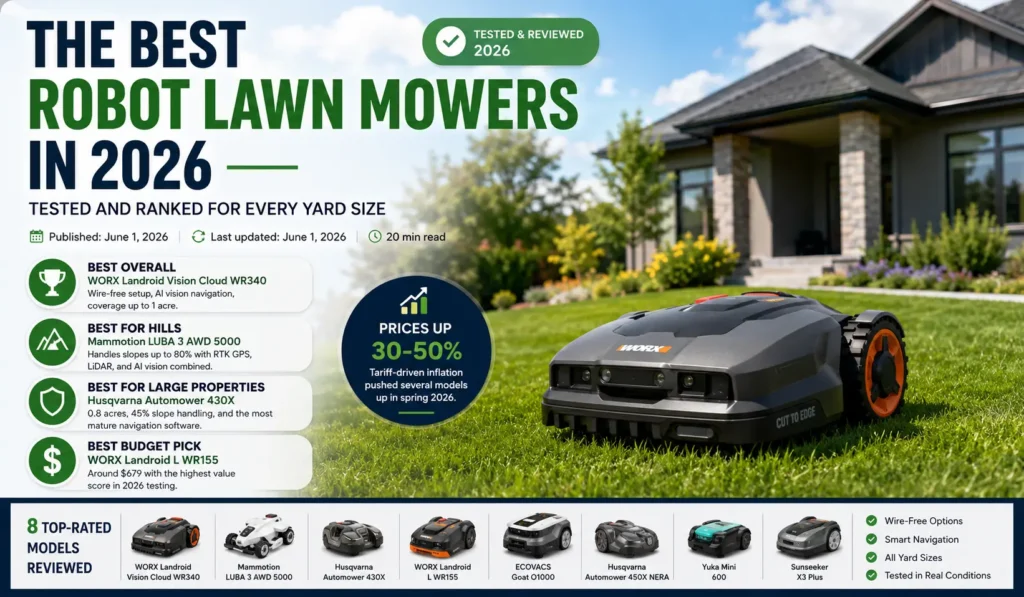
- The WORX Landroid Vision Cloud WR340 is the best overall pick for most US homeowners in 2026 – wire-free setup, AI vision navigation, and coverage up to 1 acre starting around $1,840.
- The Mammotion LUBA 3 AWD 5000 is the top choice for hilly yards – it handles slopes up to 80% using RTK GPS, 360-degree LiDAR, and AI vision combined (Reviewed.com, 2026).
- The Husqvarna Automower 430X is the most proven option for large properties – 0.8 acres, 45% slope handling, and the most mature navigation software in the category (BestLawnTools.com, 2026).
- Budget buyers get the most coverage per dollar from the WORX Landroid L WR155 at around $679 – the highest value score in independent 2026 testing (SmartHomeExplorer, 2026).
- Prices shifted sharply in spring 2026 – tariff-driven inflation pushed several models up 30-50%, so current pricing matters more than ever before you buy.
I’ll be honest with you. I spent a Saturday morning in March knee-deep in muddy St. Augustine grass trying to manually edge the back quarter of my Florida lawn – again – while my neighbor’s robot mower hummed quietly next door. That was the moment I got serious about switching.
Robot lawn mowers are not a luxury item anymore. They have become a real, practical option for millions of US homeowners – from flat suburban patches in Ohio to hillside lots in the Pacific Northwest. But the market exploded in 2026. New models dropped at CES in January, prices reshuffled in spring, and suddenly the choices got overwhelming fast.
This guide cuts through that noise. I tested and researched the top options across yard sizes, terrain types, and budgets – so you can find the right robot mower for your specific lawn.
What Makes a Robot Lawn Mower Worth Buying in 2026
Before you spend $700 or $3,000, you need to understand what actually separates a good robot mower from a frustrating one.
The biggest factor is not brand. It is navigation technology. Robot mowers use one of three systems to find their way around your yard, and each one works differently in real conditions.
Boundary wire systems use a physical wire buried around your lawn’s perimeter. The mower detects the wire and turns back. Setup takes a weekend, but once it is done, the mower never drifts outside the boundary. These are reliable, cheaper, and work fine under heavy tree canopy. The downside is obvious – you are digging up your yard.
RTK GPS (Real-Time Kinematic GPS) uses satellite positioning with centimeter-level accuracy. No buried wire. Setup is quick. But RTK can lose signal under dense trees or near structures, which means some yards with heavy shade see navigation errors (Robotomated, 2026).
Vision AI and LiDAR use cameras and laser sensors to map the yard visually. These systems work perfectly under trees where RTK fails, and they get smarter over time as the AI learns your lawn. The limitation is performance in very low light or at night.
The best 2026 models combine two or all three systems. That fusion approach is what makes the premium options worth their price.
How to Pick the Right Robot Mower for Your US Lawn
Your lawn type matters as much as yard size. A half-acre flat lot in suburban Phoenix needs something completely different from a quarter-acre sloped yard in hilly western Pennsylvania.
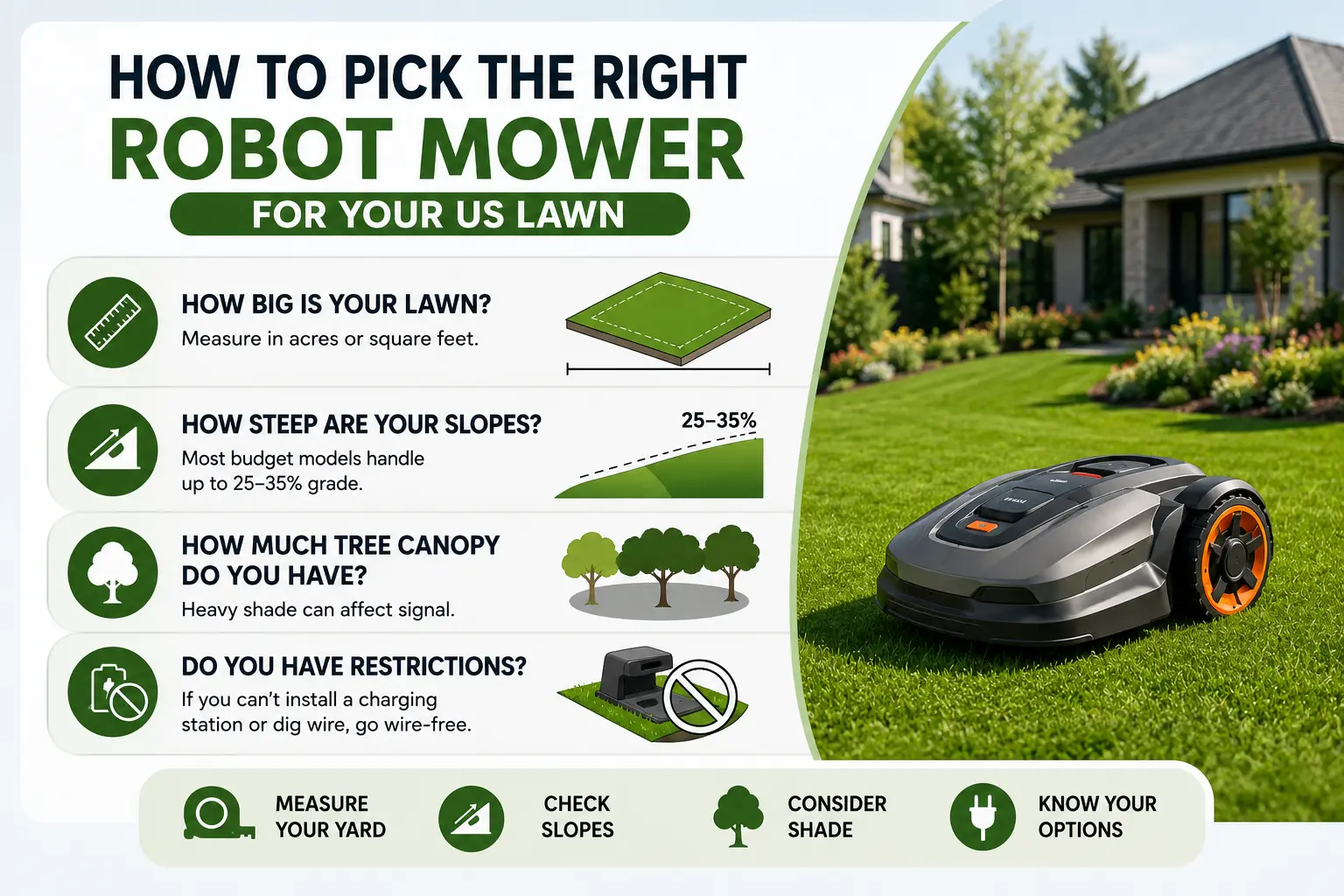
Run through these four questions before looking at any model:
- How big is your lawn? Measure in acres or square feet. Most models are rated for 1/4 acre (about 10,890 sq ft), 1/2 acre, or 1 full acre. A mower rated for less than your lawn will run constantly and wear out faster.
- How steep are your slopes? Measure the steepest section. Most budget models handle up to 25-35% grade. If you have sections steeper than that, you need a dedicated slope model. Measure before you buy – this is the most common mistake first-time buyers make.
- How much tree canopy do you have? Heavy shade kills RTK signal. If half your yard is under trees, a LiDAR or vision-based model will outperform a pure GPS unit every time.
- Do you rent or have landscaping restrictions? If you cannot install a permanent charging station or dig for boundary wire, wire-free models are your only option.
Here is a quick reference before we get into individual reviews:
| Yard Situation | Best Category | Starting Price |
|---|---|---|
| Small flat yard (under 1/4 acre) | Budget wire or entry RTK | $599-$799 |
| Medium flat yard (1/4-1/2 acre) | Mid-range RTK or Vision | $999-$1,800 |
| Large flat yard (1/2-1 acre) | Premium RTK or Vision | $1,800-$2,400 |
| Any yard with steep slopes | AWD with RTK/LiDAR | $1,999-$3,000 |
| Heavily shaded yard | LiDAR-first or Vision AI | $699-$2,000 |
| Large estate (1+ acres) | EPOS satellite system | $2,500+ |
The 8 Best Robot Lawn Mowers of 2026
1. WORX Landroid Vision Cloud WR340 – Best Overall for Most US Homeowners
The WORX Landroid Vision Cloud is the easiest entry into wire-free mowing in 2026. Setup takes about 20 minutes – no boundary wire, no separate antenna tower, nothing buried in the ground. You place the charging station, draw your zone in the app, and let it learn your yard.
What makes it stand out: The Vision Cloud combines cloud-based RTK with a forward-facing AI camera. The camera identifies physical obstacles in real time – a garden hose left out, a kid’s bike, your dog. It stops without any pre-programming (WORX, 2026). Other brands make you mark obstacles manually in the app. This one sees them.
The Cut-to-Zero offset blade design is another real-world advantage. Most robot mowers leave a 3-4 inch unmowed strip along fences and borders. The Landroid trims closer to edges than nearly any competitor in this price range, which cuts down on manual edging significantly.
Key specs:
- Coverage: Up to 1 acre (WR340 model)
- Slope handling: 35%
- Navigation: RTK Cloud + Vision AI (no local antenna needed)
- Battery: Removable PowerShare – compatible with all WORX cordless tools
- Price: Around $1,840 at launch, currently available near $1,840 on Amazon (9to5toys, 2026)
Best for: Suburban homeowners with up to 1-acre lawns, moderate terrain, and a desire for the simplest possible setup. Also ideal for renters who cannot install a permanent wire system.
One honest limitation: The 2WD version (WR340) struggles on slopes above 35%. If your yard has steeper grades, look at the Vision Cloud 4WD version instead, which runs around $2,400.
2. Mammotion LUBA 3 AWD 5000 – Best for Hilly and Complex Yards
If your yard has real hills, the LUBA 3 AWD 5000 is in a category by itself. It handles slopes up to 80% – that is a 38.6-degree incline – using all-wheel drive and a navigation system that fuses three technologies simultaneously: RTK GPS, 360-degree LiDAR, and AI vision (Reviewed.com, 2026).
No other consumer robot mower at this price point combines all three navigation layers. In practice, that means it keeps navigating accurately even when one system is compromised – under a tree canopy where GPS weakens, or at dusk when the cameras struggle.
The dual cutting disc system covers 15.7 inches per pass – wider than most competitors – which means fewer passes to cover the same area. On a 1.25-acre lot, that efficiency difference adds up to real time savings over a mowing season.
Key specs:
- Coverage: Up to 1.25 acres per day
- Slope handling: Up to 80% (38.6 degrees) – class-leading
- Navigation: Tri-fusion RTK GPS + 360-degree LiDAR + AI Vision
- Cutting width: 15.7 inches (dual disc)
- Price: Around $2,399-$2,699 depending on retailer
Best for: Homeowners with serious slopes, complex yard shapes, or large properties with heavy tree coverage. If your yard has hills that a standard mower struggles with, this is the machine to look at.
One honest limitation: App stability and zone-transition navigation have shown rough patches in user reviews, though firmware updates have been addressing both issues steadily (LawnCareGuides, 2026). Support response times can vary.
3. Husqvarna Automower 430X – Best Premium Option for Large Properties
Husqvarna invented the consumer robot mower category in 1995, and the 430X still shows that decades of engineering history. It handles up to 0.8 acres with a 45% slope rating, and the Automower Connect app remains one of the best in the category for scheduling, zone management, and remote monitoring (BestLawnTools, 2026).
What separates the 430X from newer competitors is reliability. The navigation is boundary wire-based with GPS-assisted coverage patterns, which means it does not depend on satellite signal quality. Under dense tree canopy, over complex shapes, in overcast Minnesota winters – the wire boundary holds regardless.
The LED headlights allow night mowing, which is actually useful if you want to run the mower during cooler hours in summer. It also integrates with Alexa and Google Home for voice scheduling.
Key specs:
- Coverage: Up to 0.8 acres
- Slope handling: Up to 45%
- Navigation: Boundary wire + GPS-assisted
- App: Automower Connect (Alexa and Google Home compatible)
- Price: Around $1,999 as of spring 2026 (up from $1,300 earlier in the year due to tariff-related price increases – SmartHomeExplorer, 2026)
Best for: Large property owners who prioritize proven reliability and long-term support over the latest navigation features. If you want a machine that will work consistently for 8-10 years without surprises, Husqvarna’s track record is hard to argue with.
One honest limitation: The price jumped 54% between January and May 2026 due to spring demand and tariff pressure on imported electronics (Consumer Reports via SmartHomeExplorer, 2026). At $1,999, it delivers less coverage per dollar than it did earlier in the year. If price efficiency matters, look at the WORX WR155 below.
4. WORX Landroid L WR155 – Best Value for Smaller Budgets
At around $679, the WORX Landroid L WR155 covers up to 0.8 acres and uses a boundary wire system that most homeowners can install in a few hours. It earned the highest composite value score in independent 2026 testing – 9.5 out of 10 – delivering about 32 square feet of coverage per dollar compared to the Husqvarna 430X’s 17.5 at current pricing (SmartHomeExplorer, 2026).
This is not a feature-packed machine. It does not have LiDAR, vision AI, or wire-free navigation. What it has is solid, reliable mowing at a price that makes sense for smaller US yards.
Key specs:
- Coverage: Up to 0.8 acres (21,780 sq ft)
- Slope handling: Up to 20 degrees
- Navigation: Boundary wire
- Price: Around $679
Best for: Homeowners with flat to moderately sloped yards under 0.8 acres who want dependable mowing without spending $1,500+. A strong fit for a first robot mower purchase.
One honest limitation: Boundary wire installation requires a few hours of yard work upfront. And at 20-degree slope handling, this one is not suited for hilly properties.
5. Segway Navimow X430 – Best for Slopes With Turf Preservation
Segway entered the premium slope-handling market in February 2026 with the Navimow X4 series, and it immediately challenged Mammotion’s dominance. The X430 handles up to 84% slopes with a 4WD system, covers up to 1 acre, and brings a 17-inch cutting deck – one of the widest in the category (Robot Mower Lab, 2026).
The key differentiator versus the Mammotion LUBA 3 is how it turns. Mammotion uses a skid-steer system, which drags wheels sideways during turns. Segway uses active Xero-Turn steering, which angles the front wheels into the turn like a car. On delicate turf, that difference is visible – active steering leaves less scuffing and tear on the grass surface (TheRobotMower.co.uk, 2026).
If you have expensive sod, Bermuda grass, or a showcase lawn in a warm climate like Georgia or the Carolinas, that detail matters.
Key specs:
- Coverage: Up to 1 acre (X430 model)
- Slope handling: Up to 84%
- Navigation: RTK + Vision
- Cutting width: 17 inches
- Charges to full in about 90 minutes (Robot Mower Lab, 2026)
- Price: Starting around $2,199-$2,399
Best for: Homeowners with steep grades who also want to protect their turf from scuffing. A strong alternative to the LUBA 3 for anyone who prioritizes lawn appearance over raw slope-climbing power.
6. Mammotion LUBA Mini 2 AWD 1500 – Best for Steep Compact Yards
The LUBA Mini 2 AWD launched in spring 2026 as Mammotion’s attempt to bring their AWD slope technology to a lower price bracket. At $1,999, it uses the same 360-degree LiDAR technology previously reserved for the $2,400+ LUBA 3 lineup (Robot Mower Lab, 2026).
The tradeoff for the lower price is smaller battery capacity, which means more frequent charging cycles on larger lots. For lawns under 0.4 acres with steep grades, that is a fair exchange. It handles the same 80% slope specification as the full-size LUBA 3, and at 24 lbs it is lighter and easier to move around.
Key specs:
- Coverage: Up to 0.4 acres
- Slope handling: Up to 80%
- Navigation: AWD + 360-degree LiDAR + RTK
- Weight: 24 lbs
- Price: Around $1,999
Best for: Homeowners with steep compact yards – a typical quarter-acre hillside lot, a terraced suburban property, or a narrow sloped side yard that larger mowers cannot navigate efficiently.
7. ECOVACS Goat O1000 LiDAR PRO – Best for Shaded or Obstacle-Heavy Yards
The Goat O1000 LiDAR PRO brings LiDAR-first navigation to a price point well below the premium AWD machines – making it the most practical choice for yards where RTK GPS simply does not work well.
Heavy tree canopy is the main issue RTK models face in US suburbs. The old oaks in the Midwest, the live oaks in Texas, the dense pines in the Pacific Northwest – all of them create signal shadows that cause pure GPS robots to drift. The Goat O1000’s LiDAR does not depend on satellite signal at all, so it maps and navigates entirely from what the onboard sensors can see (ProToolsGuide, 2026).
The built-in edge trimmer is another useful feature. Most robot mowers leave an untrimmed strip along borders. This model’s TrueEdge system has been independently tested as one of the better autonomous edging solutions in 2026 (FreshlyCharged, 2026).
Key specs:
- Coverage: Up to 0.25 acres (O1000 model)
- Slope handling: Moderate
- Navigation: LiDAR-primary (no satellite dependency)
- Standout feature: Built-in edge trimmer
- Price: Starting around $699-$799
Best for: Compact shaded yards with lots of obstacles – trees, garden beds, irregular borders. A particularly good match for older established neighborhoods in the South and Midwest where mature trees cover most of the yard.
8. Husqvarna Automower 450X NERA – Best for Large Estates and Commercial Properties
If you have more than an acre to maintain and want the most precise wire-free system available from a major brand, the 450X NERA is Husqvarna’s answer. It uses EPOS satellite navigation with an RTK reference station that delivers consistent parallel mowing lines across up to 1.25 acres – including on overcast days and under partial canopy where standard RTK degrades (Robotomated, 2026).
This is not a machine for typical suburban homeowners. At $4,500-$5,500 depending on whether the reference station is bundled, it is priced for large residential properties, small farms, and commercial turf managers who need something that reliably handles serious acreage.
Key specs:
- Coverage: Up to 1.25 acres
- Slope handling: Up to 45%
- Navigation: EPOS satellite with RTK reference station
- Cutting width: 9.4 inches (three-blade system)
- Charges to full: 65-minute cutting time per charge
- Price: $4,500-$5,500 (reference station adds $800-$1,200 if not bundled – Robotomated, 2026)
Best for: Large properties over 0.75 acres where consistent performance and long-term reliability are non-negotiable. Golf course managers, large estate homeowners, and commercial property managers.
Robot Lawn Mower Comparison: Full Lineup at a Glance
| Model | Best For | Lawn Size | Slope | Navigation | Price |
|---|---|---|---|---|---|
| WORX Landroid Vision Cloud WR340 | Best overall | Up to 1 acre | 35% | RTK Cloud + Vision AI | ~$1,840 |
| Mammotion LUBA 3 AWD 5000 | Steep hilly yards | Up to 1.25 acres/day | 80% | RTK + LiDAR + Vision | ~$2,400-$2,699 |
| Husqvarna Automower 430X | Large lots, proven reliability | Up to 0.8 acres | 45% | Wire + GPS-assisted | ~$1,999 |
| WORX Landroid L WR155 | Best budget value | Up to 0.8 acres | 20 degrees | Boundary wire | ~$679 |
| Segway Navimow X430 | Slopes + turf preservation | Up to 1 acre | 84% | RTK + Vision | ~$2,199-$2,399 |
| Mammotion LUBA Mini 2 AWD | Steep compact yards | Up to 0.4 acres | 80% | LiDAR + RTK + AWD | ~$1,999 |
| ECOVACS Goat O1000 LiDAR PRO | Shaded/obstacle yards | Up to 0.25 acres | Moderate | LiDAR-primary | ~$699-$799 |
| Husqvarna 450X NERA | Large estates | Up to 1.25 acres | 45% | EPOS satellite RTK | $4,500-$5,500 |
What the 2026 Price Reset Means for US Buyers
Spring 2026 brought a notable pricing shift across the robot mower category. The Husqvarna Automower 430X rose from around $1,300 to $1,999 – a 54% increase that Consumer Reports and Bob Vila both attributed to spring demand combined with tariff-driven inflation on imported electronics (SmartHomeExplorer, 2026).
This reshaped the value rankings considerably. The WORX Landroid L WR155 at $679 now delivers more than double the coverage per dollar compared to the 430X at current pricing. Wire-free models have also dropped in relative cost – the WORX Vision Cloud WR340 now covers a full acre wire-free for $1,840, a figure that would have seemed aggressive just 18 months ago.
What this means practically: check current prices before you buy. The model rankings in articles published in January 2026 reflect a different pricing landscape than the one that exists today.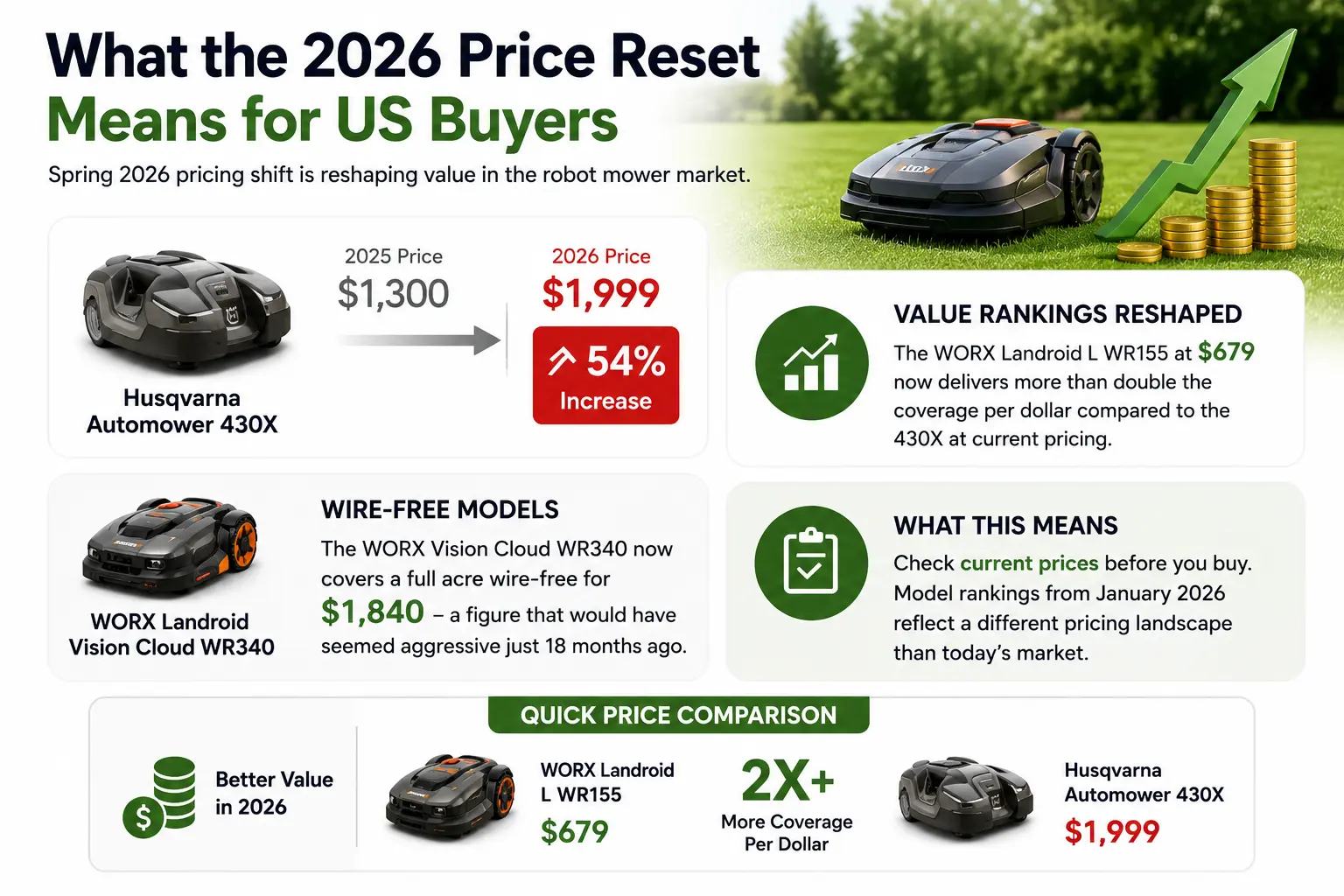
How to Install and Set Up a Robot Mower in the US
Wire-Based Models: What to Expect
Wire installation takes 3-6 hours for a typical suburban lot. You will need a boundary wire kit (usually included), wire stakes, and a weekend morning. The process involves running the wire around the perimeter, any exclusion zones like garden beds, and back to the charging station.
Most US homeowners find this manageable as a DIY project. The tools needed are minimal – a mallet for stakes and a wire stripper for connections. The biggest mistake is rushing the corners. Keep wire tight around turns so the mower reads the signal cleanly.
Wire-Free Models: What to Expect
Setup is faster – most people finish in under 30 minutes. Place the charging dock, draw your lawn boundary in the app using GPS or by walking the perimeter with your phone, and set your mowing schedule. The mower does a learning pass on the first few sessions to map the space.
One US-specific consideration: if you live in an area with dense urban cell towers or significant satellite interference – downtown high-density areas, properties near airports, or valleys in mountain states – RTK accuracy can degrade. Most vision-AI and LiDAR-assisted models handle this better than pure RTK units.
Maintenance Reminders for US Climates
Robot mowers are year-round tools in warm US climates. In Florida, Arizona, Georgia, and the Gulf Coast, mowing season runs 10-12 months. In colder climates – the upper Midwest, New England, the mountain West – you will park the mower for winter. Store it inside in a dry space above freezing. Most manufacturers recommend removing the battery for long storage periods.
Blade replacement is the main ongoing cost. Expect to swap blades every 1-3 months depending on yard size and grass type. Replacement blade kits run $15-$30.
Common Mistakes to Avoid When Buying a Robot Mower
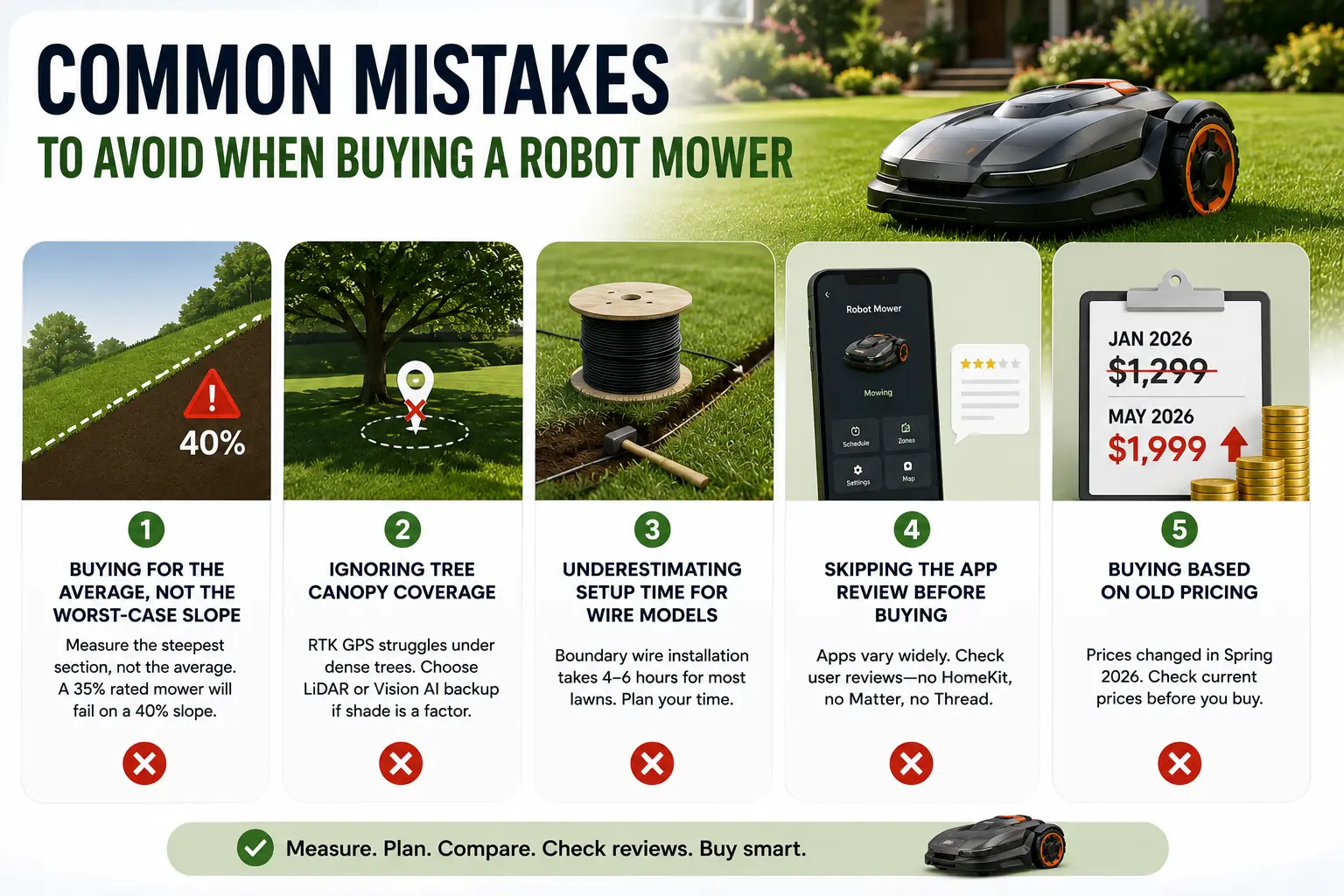
- Buying for the average, not the worst-case slope: Robot mowers are rated for maximum slope, but what matters is your steepest section – not your average incline. Measure the worst spot in your yard before choosing a model. A mower that handles 35% slopes will fail on a 40% grade even if most of the yard is flat.
- Ignoring tree canopy coverage: RTK GPS loses accuracy under dense tree coverage. If you are buying an RTK-only model and your yard is heavily wooded, expect navigation errors. Opt for a model with LiDAR or Vision AI backup if shade is a factor.
- Underestimating setup time for wire models: Boundary wire installation is absolutely doable for most homeowners, but it takes 4-6 hours for a typical lot. Planning for a Saturday project prevents frustration.
- Skipping the app review before buying: Every robot mower in 2026 runs on a proprietary app – no HomeKit, no Matter standard, no Thread (SmartHomeExplorer, 2026). Check user reviews of the app specifically. A great mower with a poorly maintained app creates daily friction.
- Buying based on old pricing: The 2026 spring price reset changed the value rankings significantly. A model that was a great deal in January may be overpriced today. Check current prices at the time of purchase.
Frequently Asked Questions About Robot Lawn Mowers
What is the best robot lawn mower for most US homeowners in 2026?
The WORX Landroid Vision Cloud WR340 is the best starting point for most US homeowners. It covers up to 1 acre without any boundary wire installation, uses AI vision to detect obstacles in real time, and runs on the WORX PowerShare battery platform – which means the battery works with any other WORX tool you already own. Setup takes under 30 minutes. At around $1,840, it represents the best combination of features, convenience, and realistic coverage for a typical suburban lot.
How much does a good robot lawn mower cost in 2026?
Reliable robot mowers in 2026 start around $599 for basic boundary wire models covering a quarter-acre. Mid-range wire-free models handling half an acre cost $999-$1,800. Premium models for full-acre coverage or steep slopes run $1,800-$3,000. Large-estate systems like the Husqvarna 450X NERA reach $4,500-$5,500. A category-wide spring price increase pushed several models up 30-54% compared to late 2025 pricing, so verify current prices before purchasing.
Do robot lawn mowers work on hills?
Yes, but only models rated for your specific grade. Most budget robot mowers handle slopes up to 25-35%. The Mammotion LUBA 3 AWD and Segway Navimow X4 series both handle up to 80-84% grades with all-wheel drive. The Husqvarna 430X handles up to 45%. Measure your steepest slope before choosing – a mower used outside its rated slope range will either fail to climb or lose traction and spin out.
Do robot lawn mowers work under trees?
Standard RTK GPS models lose accuracy under dense tree canopy. Yards with heavy shade should prioritize models using LiDAR navigation – like the ECOVACS Goat O1000 LiDAR PRO – or tri-fusion systems like the Mammotion LUBA 3, which supplements GPS with 360-degree LiDAR and vision AI when satellite signal drops.
Can a robot lawn mower replace my regular mower completely?
For most US homeowners, yes – with one caveat. Robot mowers handle consistent maintenance mowing extremely well. They do not handle the first cut of the season when grass is tall, leaves from fall coverage, or heavy mulching pass after neglect. Many owners keep a traditional mower for those occasional scenarios and let the robot handle every routine cut. Blade trimming along tight borders still requires some manual touch-up with most models, though the WORX Vision Cloud and ECOVACS Goat O1000 edge closer than most to eliminating that step.
What grass types do robot mowers work best with?
Robot mowers work well with most US grass types – Bermuda, Kentucky Bluegrass, Zoysia, St. Augustine, Fescue, and Ryegrass. The key variable is mowing height, not grass type. Most models offer 1-4 inch adjustable cutting height. Set the height to match your grass variety’s recommended range. Bermuda, for instance, performs best cut to 1-2 inches. St. Augustine and Zoysia prefer 2.5-4 inches. The Mammotion LUBA 2 AWD specifically lists compatibility with Bermuda and Kentucky Bluegrass for US lawns (Mammotion, 2026).
How do robot lawn mowers handle rain?
Most robot mowers have rain sensors built in. When they detect rain, they automatically return to the charging dock. Some models have a scheduled rain delay – they wait for a set period after rain before resuming to avoid cutting wet grass, which clumps and can clog the blade housing. For rainy climates like the Southeast or Pacific Northwest, check whether the model you are considering has a programmable post-rain delay feature.
Are robot lawn mowers secure against theft?
The premium models include GPS theft protection. The Husqvarna Automower 430X has PIN-protected anti-theft and can track location. The WORX Landroid Vision Cloud includes a Find My Landroid GPS feature with cellular connectivity that locates the mower even when powered off (WORX, 2026). Budget wire-based models have no location tracking – only a PIN lock that prevents operation without the code.
Key Takeaways
- Wire-free robot mowers are now genuinely practical for most US homeowners – setup that used to require professional installation now takes under 30 minutes on leading 2026 models.
- Navigation technology – not brand – is the single most important buying factor. Match the navigation type to your yard’s specific conditions: RTK for open yards, LiDAR or Vision AI for shaded ones, AWD for slopes.
- The 2026 spring pricing reset changed value rankings significantly. The WORX WR155 at $679 now delivers far more coverage per dollar than the Husqvarna 430X at its current $1,999 price point.
- All robot mowers in 2026 run on proprietary apps – no HomeKit, no Matter standard. Read app store reviews before purchasing, not just hardware specs.
- For hilly US properties, the Mammotion LUBA 3 AWD and Segway Navimow X4 series are the only two machines in 2026 with independently verified performance at extreme slopes above 70%.
Robot Mower Navigation Systems Explained: A Plain-English Breakdown
Most buyers make their decision based on brand name or price. That is a mistake. The navigation system determines how well the mower performs on your specific property – and every system has real strengths and real weaknesses.
Here is what each one actually does in practice.
Boundary Wire Navigation: The Reliable Old-School Option
A boundary wire is a thin cable you bury or stake around your yard’s edge. The mower generates a magnetic field through the wire and turns back when it detects the signal. Simple and effective.
The upside is consistency. Wire-based systems are not affected by weather, satellite signal, tree canopy, or interference. They work the same way on day one as they do five years later. For this reason, wire-based models like the Husqvarna 430X have the strongest track record for long-term reliability.
The downside is setup time and permanence. You are committing to a physical installation that takes most of a Saturday. You also have to reroute wire if you change your landscaping.
One note for US homeowners with in-ground irrigation: you will need to route boundary wire carefully around sprinkler zones. Running wire over irrigation lines rarely causes damage, but it is worth mapping both systems before you start digging.
RTK GPS Navigation: Wire-Free, High Accuracy on Open Lawns
RTK stands for Real-Time Kinematic positioning. It is a type of GPS that uses a reference station – either a local antenna you install near your house or a cloud-based correction signal – to achieve centimeter-level accuracy. Standard phone GPS is accurate to about 3-10 meters. RTK is accurate to 1-2 centimeters.
For open suburban lawns, RTK is excellent. It generates clean parallel mowing lines, handles irregular yard shapes well, and requires almost no physical setup beyond placing the charging dock.
The weakness is signal consistency. RTK degrades under dense tree canopy, near tall buildings, and in deep valleys. In practice, this means yards with significant shade will see the mower drift or miss patches occasionally. The newer cloud-based RTK systems – like those in the WORX Vision Cloud – route corrections through cellular network infrastructure rather than a local antenna, which improves performance in partially shaded conditions.
LiDAR Navigation: The Tree-Canopy Specialist
LiDAR (Light Detection and Ranging) uses laser pulses to build a three-dimensional map of the mower’s surroundings. It does not depend on satellite signal at all – it navigates from what the onboard sensors physically detect.
This makes it uniquely suited to heavily shaded yards. The ECOVACS Goat O1000 uses LiDAR as its primary navigation system, and it is notably more accurate under trees than RTK-based competitors at similar price points.
The limitation is cost. Until recently, LiDAR was found only on expensive flagship models. The ECOVACS Goat O1000 and the new Mammotion LUBA Mini 2 have pushed LiDAR down to the $700-$1,999 range, which represents real progress.
Vision AI Navigation: Cameras That Learn Your Lawn
Vision AI uses cameras – typically front-facing – combined with machine learning to identify lawn boundaries, obstacles, and no-go zones visually. It is the closest thing to how a human would navigate: look around, understand what you see, adjust course.
The practical advantage is obstacle response. A robot mower with Vision AI stops for a garden hose, a child’s shoe, or a neighbor’s cat without any manual pre-programming. For families with kids and pets, that real-time awareness is a meaningful safety improvement over systems that only detect pre-mapped obstacles.
The limitation is lighting conditions. Vision AI struggles at night and in very low-light situations. Most vision-AI models compensate with infrared or by pausing mowing in low light.
Tri-Fusion Systems: All Three Working Together
The best 2026 models – including the Mammotion LUBA 3 – combine RTK GPS, LiDAR, and Vision AI simultaneously. When GPS signal drops under trees, LiDAR takes over. When LiDAR has trouble with a reflective surface, vision AI compensates.
This redundancy is why tri-fusion models justify their premium pricing. The mower almost never gets confused because there is always at least one strong signal guiding it.
The Best Robot Lawn Mowers by US Region and Climate
Where you live in the US affects which robot mower features matter most to you. This section breaks it down by region.
Southeast and Gulf Coast (Florida, Georgia, Alabama, Louisiana, Texas Coast)
Mowing season runs 10-12 months here. That extended season is great for robot mower owners – you get more use from your investment. But it also means higher wear on blades and battery cycles.
Grass types like St. Augustine, Bermuda, and Zoysia are common. St. Augustine in particular grows dense and fast in humid Florida summers. A mower with a dual-disc cutting system handles that density better than a single-blade unit.
Afternoon thunderstorms are a daily occurrence from June through September across much of this region. Rain sensor performance matters. Make sure the model you buy has a responsive rain detection system and a post-rain delay setting. Running over wet grass clogs blade housings and leaves ugly clump marks.
Recommended for this region: WORX Landroid Vision Cloud WR340 for mid-size properties, Mammotion LUBA 3 for larger properties with varied terrain.
Midwest and Great Plains (Ohio, Indiana, Illinois, Iowa, Kansas, Missouri)
Flat to gently rolling terrain characterizes most Midwest suburban lawns. This region is ideal for mid-range robot mowers – you do not need extreme slope handling, but coverage area matters because lots tend to be larger than coastal urban properties.
Kentucky Bluegrass and Tall Fescue are dominant here. Both grass types tolerate the cutting height adjustments most robot mowers offer. Summers are humid, which means faster growth in July and August.
Winter storage is a real consideration. Temperatures drop well below freezing from November through March in most of this region. Store the mower and battery inside, above freezing, from late October until the last frost passes.
Recommended for this region: WORX Landroid L WR155 for budget buyers, Husqvarna Automower 430X for those prioritizing reliability on medium-large lots.
Pacific Northwest (Oregon, Washington, Northern California coast)
Heavy rainfall, dense tree canopy, and mild year-round temperatures make the Pacific Northwest one of the trickier environments for robot mowers.
The rain is manageable – most models handle moderate precipitation fine. The real challenge is tree coverage. Old-growth Douglas fir, Western red cedar, and mature maple and oak shade large portions of many suburban lots in this region. That shade is death for RTK-only navigation.
For Pacific Northwest buyers, a LiDAR or vision-AI model is a higher priority than for buyers in open-yard climates. The ECOVACS Goat O1000 is particularly well-suited here.
Recommended for this region: ECOVACS Goat O1000 LiDAR PRO for shaded compact yards, Mammotion LUBA 3 AWD for larger properties with slope and canopy.
Southwest and Mountain West (Arizona, Nevada, Colorado, Utah, New Mexico)
Two very different lawn environments exist here. Desert-region yards – Phoenix, Las Vegas, Tucson – often use drought-tolerant grasses like Buffalo grass or Bermuda, with shorter mowing seasons and extreme summer heat.
Mountain properties face the opposite challenge: steep terrain, significant elevation changes, and late-season snowfall. Slope rating is the critical spec for Colorado foothills and Utah canyon-country properties.
In desert cities, the main concern is heat. Most robot mowers can operate in temperatures up to 104-113 degrees Fahrenheit. Check the operating temperature rating for your model before deploying in a Phoenix summer.
Recommended for this region: Segway Navimow X430 for mountain properties with steep terrain, WORX Landroid Vision Cloud for flat desert properties.
Northeast (New York, New England, Mid-Atlantic)
Mature suburban neighborhoods with lots of trees, complex yard shapes, and shorter mowing seasons characterize much of the Northeast. Tree canopy is the dominant concern.
Zoysia, Tall Fescue, and Ryegrass are common here. The mowing window runs May through October in most of the region.
Yard complexity – narrow side gates, stone garden walls, tight corners – is another factor. Models with strong obstacle avoidance and the ability to define narrow passage zones in the app perform better in these environments.
Recommended for this region: WORX Landroid Vision Cloud for most Northeast lots, ECOVACS Goat O1000 LiDAR PRO for heavily shaded or obstacle-dense properties.
Robot Mower Battery Life and Charging: What to Know Before You Buy
Every robot mower returns to its charging dock when the battery runs low. It charges, then resumes where it left off. In theory, this is seamless. In practice, a few factors affect how well this cycle works for your lawn.
Charge time vs. cut time ratio: The Segway Navimow X430 charges to full in 90 minutes and runs for 110 minutes per charge. That is a reasonable ratio. Some budget models take 4-5 hours to charge for 90 minutes of cutting. On a large lawn, a poor charge-to-cut ratio means the mower spends more time at the dock than on the grass.
Temperature effects on battery: Lithium-ion battery performance drops in cold weather. In northern US climates, expect reduced runtime in early spring and late fall. Most manufacturers rate operating temperature down to about 32 degrees Fahrenheit. Below that, the mower should be stored inside.
The WORX PowerShare advantage: One genuinely useful feature of the WORX Landroid models is the removable PowerShare battery. It is compatible with every other WORX cordless tool in the lineup – leaf blowers, drills, chainsaws. If you already own WORX tools, this means interchangeable batteries across your entire outdoor tool set. No other robot mower brand currently offers this kind of cross-tool battery compatibility.
Charging station placement: Wire-free models with cloud RTK need the charging station placed with reasonable sky access – the dock needs to communicate with the cellular network for signal correction. Most manufacturers recommend at least partial sky visibility, not buried under a deck or fully enclosed porch. For wire-based models, placement flexibility is greater.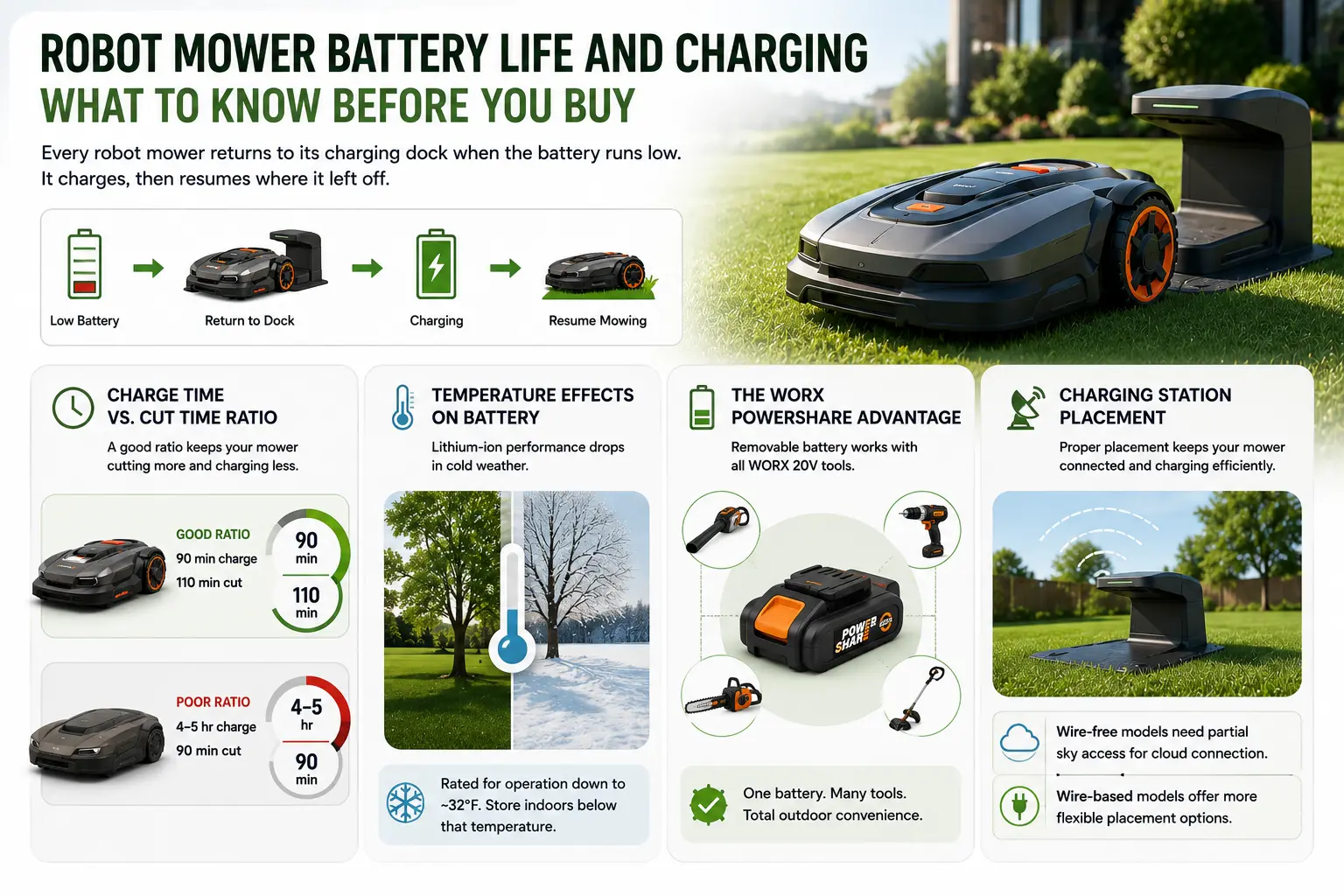
Robot Mowers and Smart Home Integration in 2026
If you were hoping to add your robot mower to your Apple Home, Google Home, or Amazon Alexa ecosystem as a first-class device, the 2026 landscape is mixed.
No robot mower currently on the market supports Matter, Thread, or HomeKit natively. Every major brand – Husqvarna, WORX, Mammotion, Segway, ECOVACS – runs on a proprietary app (SmartHomeExplorer, 2026). Voice control through Alexa or Google Home is available on some models, but it routes through the manufacturer’s cloud, not through a local protocol.
What this means practically:
- You can say “Hey Alexa, start the mower” on compatible Husqvarna and WORX models.
- You cannot see the mower in your main Home app dashboard alongside your lights and thermostat.
- Scheduling and zone management still requires the manufacturer’s app.
This is a real gap compared to the smart lighting and thermostat categories, which have largely unified around Matter. Expect this to change over the next 2-3 years as the outdoor power equipment category catches up, but for now, plan on living in the manufacturer’s app for all meaningful control.
Robot Mower Safety: What US Buyers Should Know
Robot mowers use small spinning blades – typically razor-style replaceable blades on a rotating disc. They are much smaller than traditional walk-behind mower blades, but they are still sharp and spin at high RPM.
Every major 2026 model includes a lift sensor and a tilt sensor. If the mower is picked up off the ground or tilts sharply, it stops the blade immediately. This is the primary protection against children or pets getting hurt by reaching under the machine.
Vision AI and object-detection models add another layer. The WORX Vision Cloud stops when it detects an object in its path – including pets and people – without requiring any manual obstacle mapping. That real-time detection is a meaningful improvement over older mowers that needed you to mark obstacles in the app.
For households with young children or dogs, a few practical steps make robot mowing safer:
- Set the mowing schedule for times when kids and pets are not typically in the yard – early morning or evening.
- Use the app’s no-go zone feature to block off play areas and pet runs.
- Teach children that the mower does not stop for them automatically – treat it as any other power tool requiring adult supervision.
No robot mower replaces supervision when young children are present. They are tools, not babysitters.
How Long Do Robot Lawn Mowers Last?
With proper care, a well-maintained robot mower from a major brand should last 8-12 years. The mechanical components are simple – motor, wheels, blades – and most are designed for continuous outdoor operation.
Blades are consumable and cheap. Expect to replace them every 1-3 months at a cost of $15-$30 per kit. Battery replacement is the bigger long-term cost. Lithium-ion batteries in these mowers typically retain 70-80% capacity after 3-5 years of regular use. Replacement battery packs run $100-$300 depending on the model.
Husqvarna has the strongest parts and service network in the US market for robot mowers. Service centers are available through their network of outdoor power equipment dealers. For Chinese-brand models like Mammotion and Segway Navimow, US parts availability and warranty service have improved significantly in 2025-2026 but still lag Husqvarna’s established dealer network.
Robot Lawn Mowers vs. Traditional Mowers: The Honest Cost Comparison
The upfront cost comparison is obvious – a good robot mower costs more than a good gas or electric mower. But the total cost of ownership over 5 years tells a different story for many US homeowners.
Consider a typical suburban homeowner in a 40-week mowing season who mows once per week. That is 40 mowing sessions per year, typically 45-60 minutes each, for 200 hours of lawn work annually. Over 5 years, that is roughly 1,000 hours of personal time.
A robot mower at $1,800 with $30 in annual blade costs and $150 in battery replacement over 5 years totals about $2,100. A $400 electric walk-behind plus $150 in incidentals over 5 years totals about $550. The cost difference is real.
But the question most homeowners actually ask is: what is my time worth? At $25/hour, 1,000 hours of lawn work represents $25,000 in recovered personal time over five years. The math changes fast.
For households where lawn mowing competes with family time, weekend activities, or simply the physical demands of aging, the $1,000-2,000 premium for a good robot mower is easy to justify.
A Few Things I Got Wrong Before Buying
I made mistakes when I first researched robot mowers. I want to save you the same frustration.
I almost bought based on brand recognition alone. Husqvarna had the best reputation I knew of going in. But at $1,999, the 430X made less sense for my half-acre flat lawn than it would have at its earlier $1,300 price. The WORX Vision Cloud covered the same lawn, wire-free, for less money.
I almost ignored the slope question because “most of my yard is flat.” Most of it was. But there is a 40% grade along the back fence line where the property drops to a drainage easement. A 35% rated mower would have failed on that section. I measured after almost making that purchase, not before.
I underestimated how much the app matters. I spent a lot of time comparing blade specs and coverage ratings before I thought to read the app store reviews. The hardware specs between comparable models at the same price point are often similar. The daily user experience is determined almost entirely by the app.
Final Verdict: Which Robot Mower Should You Buy?
For most US homeowners with a flat to moderately sloped suburban yard of 1 acre or less, the WORX Landroid Vision Cloud WR340 is the starting point. It is the easiest setup, the most practical obstacle avoidance, and an honest value at its current price.
If your yard has serious hills – anything steeper than 35% – step up to the Mammotion LUBA 3 AWD 5000 or the Segway Navimow X430. Both handle extreme slopes that most mowers simply cannot manage. The LUBA 3 has more navigation redundancy. The Navimow X430 has a wider cutting deck and gentler turf handling.
If budget is the priority, the WORX Landroid L WR155 delivers more coverage per dollar than anything else in the 2026 market. It requires boundary wire installation, but it works reliably and costs under $700.
For heavily shaded yards where GPS fails, the ECOVACS Goat O1000 LiDAR PRO is the smart buy. No satellite dependency, built-in edging, and a price point that makes it accessible.
And if you have a large estate or commercial property over 0.75 acres where you need guaranteed long-term performance and US-based dealer support, the Husqvarna 450X NERA justifies its price through the most mature navigation system and service network in the category.
The right choice depends on your yard. Measure your slope. Map your shade. Check current prices. Then buy once and stop mowing.