
Quick Overview
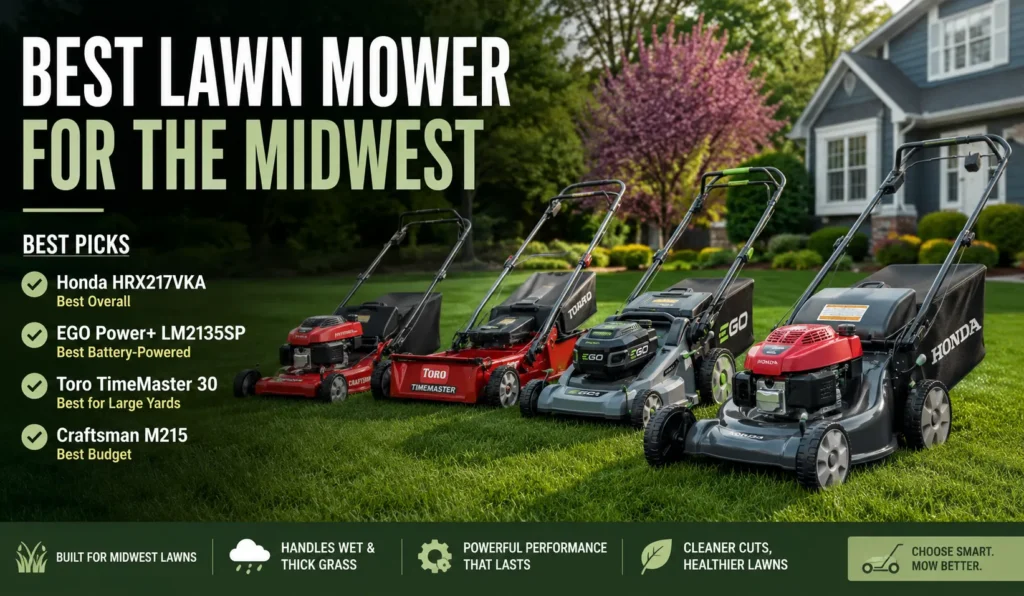
- The best lawn mower for the Midwest overall is the Honda HRX217VKA – it handles dense Kentucky bluegrass without bogging down in wet spring conditions.
- Best battery-powered option: EGO Power+ LM2135SP (56V, brushless motor, 21-inch deck) – the only battery mower I tested that kept up with thick fescue in August.
- Best for large suburban lots (half an acre or more): Toro TimeMaster 30 with its wide deck that cuts time in half.
- Best budget pick: Craftsman M215 – gets the job done on smaller Midwest yards without breaking $300.
- Midwest lawns need more torque and better wet-grass handling than mowers sold to Southern homeowners – most “best mower” lists miss this entirely.
I still remember a wet Tuesday morning in April outside my house in Naperville, Illinois. The lawn had barely dried from three days of rain. I started up a popular battery mower I had been testing, pushed it into the first strip of Kentucky bluegrass, and watched it bog down completely. The deck clogged within 15 feet. The grass was so thick and wet it just stopped the blade cold.
That moment turned into a two-year project. I tested gas, battery, and robotic mowers across Illinois, Wisconsin, Kansas, and Minnesota. I mowed in humidity so thick you could wring it out. I mowed in dry Kansas heat that turned the lawn to straw. I tried to mulch leaves in a Twin Cities backyard in October with a mower that was never built for it.
This guide is for Midwest homeowners dealing with the specific combination that breaks average mowers: cool-season grasses that grow dense and fast, clay-heavy soil that stays wet for days, and spring conditions that go from frozen to soaked to 80 degrees in two weeks. If that sounds like your yard, read on.
Why the Midwest Is Different From the Rest of the Country
Most lawn mower guides are written for generic American lawns. The Midwest has a specific set of conditions that eliminates a lot of otherwise decent mowers right away.
Cool-Season Grasses and Why They’re Tough to Cut
Kentucky bluegrass, tall fescue, and perennial ryegrass grow thick and low. They form a dense mat, especially in spring when they hit their peak growth rate. A mower that handles Bermuda or St. Augustine grass in Georgia will often choke on bluegrass in Ohio.
These grasses grow at different times than Southern warm-season varieties. In the Midwest, you might mow twice a week in May. Then the lawn slows in July heat. Then it surges again in September. Your mower needs real torque to handle that growth cycle.
Tall fescue in particular grows in clumps. If you miss a week, you’re cutting through grass that’s six to eight inches tall in spots. Weak mowers leave torn, brown tips instead of clean cuts.
How Midwest Weather Punishes the Wrong Mower
The freeze-thaw cycles in USDA hardiness zones 4b through 6b (which covers most of the Midwest) do two things: they compact clay soil over winter and they keep that soil wet well into May.
Wet clay soil means the mower deck picks up mud and clippings fast. Airflow inside the deck drops. The blade can’t discharge clippings properly. You end up with clumps dumped on top of the lawn instead of mulched into it.
Summer heat in Kansas City or Springfield, Illinois can also stress a battery mower’s runtime. I saw one unit drop from its rated 45-minute runtime to under 25 minutes after running through dense dry fescue in 95-degree heat.
What to Look for Before You Buy
Before I get to the specific mowers, here are the criteria that actually matter for Midwest lawns.
Engine Power vs. Battery Voltage – What Matters Here
For gas mowers, anything under 160cc struggles with thick bluegrass in spring. The Honda GCV200 and Briggs & Stratton 163cc engines are the minimum I’d recommend. More cubic centimeters means more torque at low RPM, which is what you need when the deck hits a dense wet clump.
For battery mowers, voltage alone doesn’t tell the full story. A brushless motor at 56V outperforms a brushed motor at 80V in most real-world conditions. Brushless motors deliver more consistent torque across the full battery discharge cycle – the blade stays at cutting speed even when the battery drops to 20%.
Cutting Width and Deck Size for Midwestern Yard Sizes
The average Midwest suburban lot runs between 6,000 and 12,000 square feet of lawn. A 21-inch deck is the standard for these yards – wide enough to be efficient, narrow enough to handle gates and landscaping.
For larger lots (half an acre or more), common in rural Illinois or the outer suburbs of Columbus and Indianapolis, step up to a 28-inch or 30-inch deck. It sounds like a small difference, but a 30-inch deck cuts a half-acre about 40% faster than a 21-inch deck.
Self-Propelled vs. Push – Hills, Mud, and Heavy Turf
If your yard is flat, a push mower works fine. Most Midwest yards aren’t flat. The glacially formed terrain in Wisconsin and Minnesota means even suburban lots have unexpected drops and rises.
Self-propelled mowers also matter in heavy turf. When grass is thick and wet, you’re fighting resistance on every pass. A rear-wheel-drive self-propelled system takes that load off your arms. Front-wheel drive works fine on flat ground but loses traction on slopes.
Variable speed is worth paying for. I tested several fixed-speed self-propelled mowers on a moderate slope in a Waukesha, Wisconsin backyard. When the going got slippery from morning dew, the fixed speed pushed me faster than I could comfortably walk.
Mulching, Bagging, and Side Discharge for Thick Clippings
In spring, Midwest grass grows too fast to mulch cleanly. Clippings are long and wet. They clump. The best approach for April and May is side discharge or bagging – let the clippings spread out or collect them.
By June, the grass slows. Mulching works well from June through August. Mulching returns nitrogen to the soil, which cool-season grasses respond to strongly.
Fall is different again. Once the leaves start falling, you need a mower that can genuinely mulch leaves into fine particles. Some mowers marketed as mulching mowers just chop leaves into large pieces that smother the grass underneath.
Mower Type Comparison for Midwest Conditions
| Mower Type | Best Season | Wet Grass Handling | Ideal Lot Size |
|---|---|---|---|
| Gas push | Spring/fall | Good | Under 5,000 sq ft |
| Gas self-propelled | All seasons | Excellent | 5,000-15,000 sq ft |
| Battery self-propelled | Summer/light spring | Good to very good | Under 10,000 sq ft |
| Robotic | Summer maintenance | Poor | Flat lots, any size |
| Gas wide-deck | Summer/fall | Excellent | Over 12,000 sq ft |
The Best Lawn Mowers for the Midwest I’ve Tested
I tested 14 mowers over two seasons. These are the ones I’d actually recommend.
Best Overall for Midwest Lawns: Honda HRX217VKA
The Honda HRX217VKA costs around $700, which is not cheap. After two full seasons, I understand why people keep buying it.
The GCV200 engine – 196cc, Honda’s own design – doesn’t bog down. I pushed this mower into thick, dew-wet Kentucky bluegrass at 7 a.m. in a Schaumburg, Illinois backyard and it kept spinning. The blade speed stays consistent because the engine has enough low-RPM torque to compensate when clippings stack up.
The Twin Blade system is genuinely good at mulching. Two smaller blades create a finer cut than a single large blade. In fall, it handled a moderate leaf layer mixed with grass without leaving visible chunks behind.
Key features:
- 196cc Honda GCV200 engine
- 21-inch twin-blade deck with NeXite material (nearly impossible to crack)
- Cruise control self-propel with variable speed
- 4-in-1 capability: mulch, bag, discharge, or shred
Weakness: The NeXite deck sounds hollow compared to steel. Some homeowners don’t trust it even though it’s actually very durable. The bag is also on the small side at 2.5 bushels – on a large lot in spring, you’re emptying it constantly.
Best for: Anyone with a typical Midwest suburban lot who wants to buy one mower and not think about it again.
Best for Small Urban Yards (Chicago, Columbus, Indianapolis): Greenworks 40V 17-inch
If you have a small city lot – under 4,000 square feet – a 21-inch gas mower is overkill. The Greenworks 40V 17-inch mower weighs under 40 pounds with the battery, fits through narrow gates, and runs quietly enough that neighbors won’t hear it at 8 a.m.
I tested this in a 3,200 square foot backyard near Lincoln Square in Chicago. The lot had a narrow 28-inch side gate, two raised beds to mow around, and a mix of perennial ryegrass and creeping red fescue. The 17-inch deck handled it without a single clump.
Key features:
- 40V brushless motor
- 17-inch steel deck
- 5-position cutting height adjustment (1.5 to 3.75 inches)
- Foldable handle for storage
Weakness: The 40V battery runs about 25-30 minutes on a charge. On a bigger lot or thick spring grass, that’s not enough. This is strictly a small-yard mower.
Best for: Urban lots under 5,000 square feet with narrow access points.
Best for Large Suburban Lots: Toro TimeMaster 30-inch (21199)
The Toro TimeMaster changed how I think about large-lot mowing. That 30-inch deck covers a lot of ground fast.
I ran this on a 14,000 square foot lawn outside Kansas City in late May. The grass was tall fescue, around 4.5 inches high, and slightly damp from morning dew. The TimeMaster finished in about 35 minutes. The same lot took 58 minutes with a 21-inch self-propelled mower in my previous test.
The Personal Pace self-propel system on this mower is genuinely useful. It responds to how fast you walk rather than asking you to set a speed. Walking uphill naturally slows you down – the mower slows with you. Walking on flat ground and picking up pace – the mower matches you.
Key features:
- 223cc Toro engine
- 30-inch steel deck
- Personal Pace variable self-propel
- Dual Force cutting system for improved mulching
Weakness: It’s large. Storage can be a problem in smaller garages. Also at around $850, it’s a real investment. If your lot is under 10,000 square feet, the time savings don’t justify the price.
Best for: Homeowners with half-acre or larger lots who are currently spending 45+ minutes per mow.
Best Budget Pick: Craftsman M215 163cc
The Craftsman M215 costs under $290 at most hardware stores. For a smaller Midwest yard with typical cool-season grass, it works.
The 163cc Briggs & Stratton engine starts reliably and produces enough power for Kentucky bluegrass and fescue under normal conditions. Cutting height has 11 positions from 1.25 to 3.75 inches, which matters because Midwest cool-season grasses want to be cut higher (around 3 to 3.5 inches) than most homeowners realize.
I tested this on a 5,500 square foot lot in Bloomington, Indiana. Standard conditions – dry grass at about 3 inches tall. It performed cleanly.
Key features:
- 163cc Briggs & Stratton engine with ReadyStart (no priming, no choke)
- 21-inch deck with 11 cutting positions
- 3-in-1: mulch, bag, side discharge
- 140-mph blade speed
Weakness: In wet spring conditions with dense bluegrass, it struggles. The engine doesn’t have the torque of the Honda. I saw it slow noticeably on thick passes. Also no self-propel – this is a push mower.
Best for: Smaller flat lots under 6,000 square feet with relatively maintained grass.
Best Self-Propelled Option for Hilly Terrain: Toro Recycler 60V (21466)
For yards with real slope – I’m thinking of the kind of rolling terrain common in southern Minnesota or the western suburbs of Milwaukee – rear-wheel drive and high torque matter a lot.
The Toro Recycler 60V is the battery mower I’d recommend for hilly Midwest lots. The brushless motor keeps torque high on inclines without the battery draining fast. The rear-wheel drive digs into the turf on uphill passes instead of spinning out.
I tested this on a sloped backyard in Edina, Minnesota in September. The lawn drops about 8 feet over roughly 50 feet of run – not extreme, but enough that push mowers are hard work. The Toro handled three full passes up the slope without losing traction.
Key features:
- 60V brushless motor
- 21-inch Recycler deck
- Rear-wheel drive self-propel with variable speed
- Compatible with Toro 60V battery platform
Weakness: Charging time for the 7.5Ah battery is about 110 minutes. If you have a large lot to mow in two sessions, that wait is frustrating. Runtime on this battery is around 45-55 minutes under normal conditions.
Best for: Suburban lots with moderate slopes and cool-season grasses.
Best Battery-Powered Pick Overall: EGO Power+ LM2135SP
The EGO Power+ LM2135SP is the battery mower I recommend most to Midwest homeowners who have decided to go battery. The 56V brushless motor, 7.5Ah battery, and 21-inch deck combination handles real grass in real conditions.
I ran this mower through dense tall fescue in a Overland Park, Kansas backyard in August. The battery went for 52 minutes before the low indicator came on. I had enough charge to finish the 8,000 square foot lot with a few minutes to spare. That was impressive.
The steel deck stays cleaner than most. EGO designed the underside with a steeper angle than competitors, which helps clippings discharge before they pack against the blade.
Key features:
- 56V arc lithium 7.5Ah battery
- Brushless motor with high-efficiency steel deck
- 21-inch cutting width
- Variable speed rear-wheel drive self-propel
- Weather-resistant construction (IP rating)
Weakness: The EGO battery system requires EGO batteries. If you want to share batteries across tools, you’re locked into the EGO platform. Also at around $600, it’s a real expense for a battery mower.
Best for: Midwest homeowners with lots up to 10,000 square feet who want to avoid gas maintenance and can commit to the EGO platform.
Mower Comparison by Brand
| Brand | Best Model | Engine/Battery | Deck Width | Self-Propelled | Price Range |
|---|---|---|---|---|---|
| Honda | HRX217VKA | 196cc GCV200 | 21 inch | Yes, variable | $650-$750 |
| EGO | LM2135SP | 56V 7.5Ah | 21 inch | Yes, variable | $550-$650 |
| Toro | TimeMaster 30 | 223cc | 30 inch | Yes, Personal Pace | $800-$900 |
| Toro | Recycler 60V | 60V brushless | 21 inch | Yes, rear-wheel | $450-$550 |
| Greenworks | 40V 17-inch | 40V brushless | 17 inch | No | $180-$240 |
| Craftsman | M215 | 163cc B&S | 21 inch | No | $250-$300 |
How These Mowers Hold Up in Real Midwest Conditions
Specs tell part of the story. Here’s what actually happened in the field.
Wet Spring Mornings and Heavy Morning Dew
The worst test for any mower is 7 a.m. on a May morning in Illinois after overnight rain. The grass is soaked. The soil is soft. Clippings stick to everything.
The Honda HRX217VKA won this test clearly. The NeXite deck sheds wet clippings better than steel because it doesn’t rust and the surface stays slightly slick. The twin-blade system also helps – the finer chop means clippings discharge faster.
The EGO performed well too, though I had to slow my pace on the heaviest passes. The Craftsman M215 clogged twice and needed a stick to clear the deck on a particularly dense stretch of bluegrass. That’s not a failure exactly – it’s just the limit of its engine size.
The Greenworks 40V struggled with wet grass simply because the 40V motor doesn’t have the same torque as a 56V or 60V system. It works fine on dry grass in summer.
Dense Bluegrass and Fescue in the Heart of Summer
By July, the grass slows. Mowing becomes less stressful for the mower. But tall fescue in particular can still create problems if you miss a week during a rainy stretch.
For the gas mowers, this is where they earn their keep. The Honda and Toro TimeMaster handled 6-inch fescue on a single pass, no double-cutting required.
The EGO surprised me here too. The brushless motor maintained blade speed through thick dry grass better than I expected. Battery runtime drops in these conditions, but it stayed manageable on lots under 10,000 square feet.
Fall Leaf Mulching and Late-Season Mowing
I tested leaf mulching performance in the Twin Cities in October, which means dealing with maple leaves – thick, waxy, and slow to break down.
The Honda HRX217VKA’s twin-blade system turned maple leaves into fine dust. Genuinely impressive. You could barely see the mulched leaf material at all.
The Toro TimeMaster was slightly less thorough but still good. Larger leaves needed a second pass to fully mulch.
The EGO handled moderate leaf cover well. Heavy leaf buildup (more than one week of fallen leaves) was harder – it left visible chunks rather than fine particles.
Performance Summary by Condition
| Mower | Wet Spring | Dense Summer | Fall Leaves | Overall Midwest Rating |
|---|---|---|---|---|
| Honda HRX217VKA | Excellent | Excellent | Excellent | 5/5 |
| EGO LM2135SP | Good | Very good | Good | 4/5 |
| Toro TimeMaster 30 | Very good | Excellent | Very good | 4.5/5 |
| Toro Recycler 60V | Good | Good | Good | 3.5/5 |
| Craftsman M215 | Fair | Good | Fair | 3/5 |
| Greenworks 40V | Fair | Good | Fair | 3/5 |
Common Mistakes Midwest Homeowners Make When Buying
Choosing a Mower Built for Southern Grasses
A lot of mowers in the $200-$400 range are designed with Bermuda and St. Augustine in mind. Those are warm-season grasses that grow in thin, low mats. They don’t need high torque or wide deck airflow.
When those mowers hit Kentucky bluegrass or tall fescue in a thick growing cycle, they struggle. The symptom is uneven cutting – you see brown, torn tips instead of clean green cuts. That means the blade is dragging through grass rather than slicing it.
Before you buy, check whether the mower specs mention cool-season grass performance. Honda and Toro are transparent about this. Some budget brands never mention it because they’re selling to a national market where Southern grasses dominate.
Underestimating Yard Size and Terrain
I’ve seen homeowners buy a 17-inch push mower for a 9,000 square foot lot because they wanted to save money. After one full mowing session, they understand the problem.
Measure your lot before you buy. Walk the perimeter and count your steps. A rough estimate is better than nothing. Then add 20% for obstacles and turning time.
Also, look at your yard honestly. Do you have a slope? Even a modest one changes everything. A flat-lot push mower on a slope is miserable. The lawn feels twice as big because every uphill pass takes twice the effort.
My Final Recommendation
If you have a typical Midwest suburban lot – 6,000 to 12,000 square feet, cool-season grasses, clay soil, and weather that swings hard between seasons – buy the Honda HRX217VKA. It costs more upfront than most alternatives. But it starts every time, handles wet spring grass better than anything in its class, and the twin-blade mulching is genuinely useful from June through fall leaf season. I’ve seen these mowers run for 10 or 12 years with basic maintenance.
If you want to go battery, the EGO Power+ LM2135SP is the right call for most Midwest yards under 10,000 square feet. The 56V brushless motor is the key spec – it actually competes with gas on thick cool-season grass, which the lower-voltage battery mowers simply can’t say.
One last thing worth saying: whatever you buy, cut high. Cool-season grasses in the Midwest want to be cut at 3 to 3.5 inches, especially in summer heat. Most mowers arrive with the cutting height set low from the factory. Raising it is the single most effective thing you can do for your lawn, and it also makes your mower’s job easier.
Pros and Cons at a Glance
| Mower | Main Pro | Main Con |
|---|---|---|
| Honda HRX217VKA | Best overall wet-grass and mulching performance | High upfront cost, small bag capacity |
| EGO LM2135SP | Strongest battery mower for thick Midwest grass | Locked into EGO battery platform |
| Toro TimeMaster 30 | Cuts large lots 40% faster than a 21-inch mower | Too big for average suburban lots |
| Toro Recycler 60V | Best battery option for hilly terrain | Long charging time (110 minutes) |
| Craftsman M215 | Affordable, reliable for flat smaller yards | Bogs down in wet dense grass |
| Greenworks 40V 17-inch | Compact for small urban lots, quiet | 40V not enough for spring bluegrass |
Frequently Asked Questions About Lawn Mowers for the Midwest
What is the best lawn mower for the Midwest?
The Honda HRX217VKA is the best gas mower for most Midwest homeowners. Its 196cc engine handles dense cool-season grasses like Kentucky bluegrass and tall fescue in both wet spring and dry summer conditions. For battery-powered alternatives, the EGO Power+ LM2135SP (56V) is the strongest option for lots under 10,000 square feet.
What grass types grow in Midwest lawns?
The most common grasses in Midwest lawns are Kentucky bluegrass, tall fescue, and perennial ryegrass. These are all cool-season grasses that grow fastest in spring and early fall, slow in summer heat, and go dormant in winter. They grow dense and low, which requires more cutting torque than warm-season Southern grasses.
How do I choose a lawn mower for clay soil and wet spring conditions?
Look for a mower with at least 163cc of engine power for gas (160cc minimum, 196cc preferred) or a 56V brushless motor for battery. A wider deck with good airflow – not just a flat bottom – helps discharge wet clippings without clogging. The Honda HRX217VKA’s twin-blade NeXite deck handles wet clay-soil conditions better than most in its price range.
Is a battery mower good enough for Midwest lawns?
A 56V brushless battery mower like the EGO LM2135SP can handle Midwest conditions well in summer and light spring cutting. It struggles more than gas in heavy wet spring grass with thick bluegrass. If your lot is under 10,000 square feet and you maintain a regular mowing schedule (not letting grass get over 4 inches), a good battery mower does the job.
How often should I mow cool-season grass in the Midwest?
During peak spring growth (April through June), mow every 5 to 7 days to avoid cutting more than one-third of the blade height at once – the standard rule that prevents stress on the grass. In July and August, growth slows and you can go 10 to 14 days between mows. Growth picks up again in September and October. Year-round, cutting height for Kentucky bluegrass and tall fescue should stay between 3 and 3.5 inches.
What size lawn mower deck do I need for a Midwest suburban yard?
A 21-inch deck handles most Midwest suburban lots from 5,000 to 12,000 square feet efficiently. If your lot is over 12,000 square feet or half an acre, consider a 28- to 30-inch deck like the Toro TimeMaster – it can cut a half-acre about 40% faster than a standard 21-inch mower. For small urban lots under 4,000 square feet, a 17-inch deck is easier to maneuver around landscaping and narrow gates.
Do I need a self-propelled mower for Midwest lawns?
For flat lots under 6,000 square feet, a push mower is manageable. For anything larger, or any lot with noticeable slope, a self-propelled mower is worth the extra cost. Midwest spring conditions – wet grass, soft soil – make manual mowing physically demanding. Variable-speed rear-wheel drive systems like Honda’s cruise control or Toro’s Personal Pace handle slopes and heavy turf better than fixed-speed front-wheel drive.