
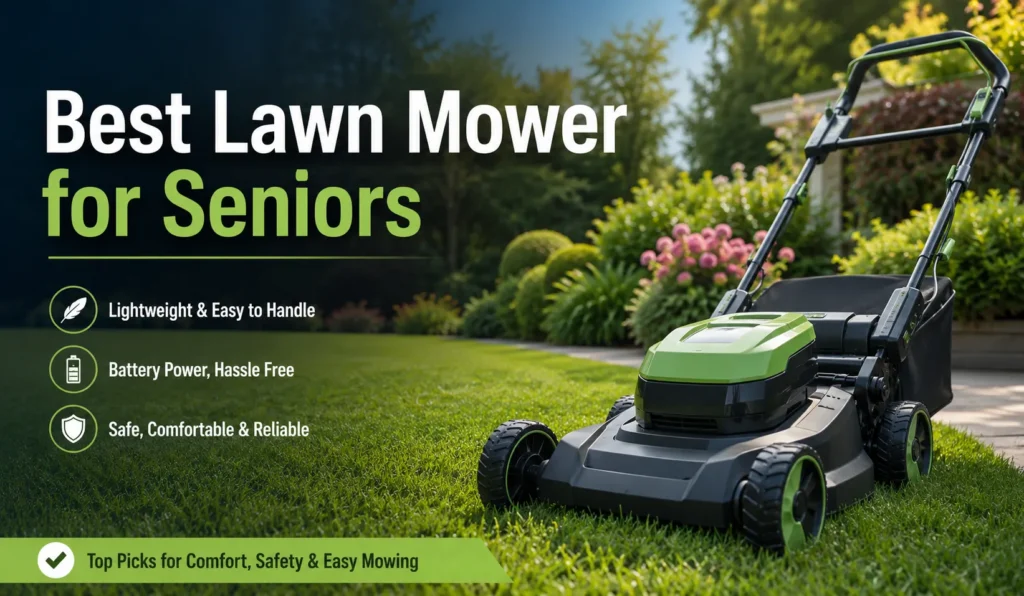
Quick Overview
- The best lawn mower for seniors overall is the EGO Power+ LM2102SP – battery-powered, self-propelled, and light enough for most older adults to handle without strain.
- The best lightweight option for small yards is the Greenworks 40V 16-inch at under 37 pounds with push-button start.
- Self-propelled models are almost always worth the extra cost for seniors – they prevent the overexertion that leads to injury.
- Battery mowers beat gas for seniors on every practical measure: no pull cord, less vibration, quieter operation.
- Seniors with large lawns (half an acre or more) should seriously consider a riding mower to avoid heat exhaustion and joint strain.
My dad turned 74 last spring and was still dragging a 90-pound Craftsman gas mower around his North Carolina backyard every two weeks. He’d finish, come inside soaked through his shirt, and spend the next day on the couch with his back aching. His lawn wasn’t even that big – maybe 4,000 square feet with a small slope in the back.
That’s what pushed me to start actually testing mowers with older adults in mind. I’ve since put several models through their paces on three very different properties: my dad’s sloped North Carolina backyard, a flat half-acre lot in a Sun City retirement community outside Tampa, and a compact suburban yard in the Minneapolis suburbs. This guide is for seniors doing their own mowing, for their adult kids helping them choose, and for caregivers trying to keep someone safe and independent as long as possible.
Why the Right Mower Makes All the Difference After 60
Most mowers are designed and tested by companies whose average user is a healthy 40-year-old. That means the weight, the starting mechanism, and the vibration levels are all calibrated for someone with full grip strength and no joint pain.
That’s not most people over 60 – and it definitely wasn’t my dad.
The Physical Demands Most Mowers Ignore
Standard push mowers weigh between 65 and 90 pounds. Guiding that much weight uphill, across wet grass, or around a tree for 30 minutes straight is hard work for anyone. For a senior with reduced grip strength, arthritis in the hands, or any history of back problems, it can cross the line from difficult into dangerous.
Vibration is another factor most buyers overlook. Gas mowers transmit a constant vibration through the handle into the hands and arms. Over time, and especially with conditions like arthritis or carpal tunnel syndrome, that vibration causes pain and fatigue much faster than it would in a younger person. It can also temporarily reduce grip strength, which increases the chance of losing control of the mower.
Then there’s the simple reality of fatigue. A 70-year-old finishing 45 minutes of mowing with less in the tank than when they started is more likely to take a shortcut – mowing too close to a slope, rushing a turn, skipping a safety check.
What “Easy to Use” Actually Means for Seniors
“Senior-friendly” on a box usually means nothing. Here’s what it should mean:
- Push-button or key start – no pull cord required
- Under 60 pounds for a walk-behind, ideally under 50
- Self-propelled with variable speed – the mower moves itself and the operator controls the pace
- Single-lever cutting height adjustment – no bending down to adjust each wheel separately
- Low vibration – battery-powered motors vibrate significantly less than gas engines
- Ergonomic handle – padded, adjustable, and designed to reduce wrist strain over time
What to Look for Before You Buy
Buying the wrong mower for an older adult isn’t just wasteful – it can be the thing that ends their ability to maintain their own yard. Here’s what actually matters.
Weight and Maneuverability
Under 50 pounds is the sweet spot for most older adults mowing a standard suburban lot. At 50 to 60 pounds, a mower is still manageable for many seniors in good health, but it will cause noticeably more fatigue over a 30-minute session than a lighter model.
When I handed my neighbor Elaine – she’s 72 and lives in a retirement community outside Tampa – the EGO LM2102SP for the first time, her immediate reaction was surprise. “This is it? This is the whole thing?” She’d been using a 78-pound Honda gas mower for years. The weight difference alone changed her experience of mowing entirely.
Maneuverability matters as much as raw weight. A mower with rear-wheel drive handles better on slight slopes. A narrower deck (16 to 19 inches) is easier to steer around flower beds and obstacles without twisting at the waist.
Self-Propelled vs. Push – Which Is Safer for Seniors?
Self-propelled is almost always the right choice for seniors, with one exception: very small flat yards under 1,500 square feet where mowing takes less than 15 minutes.
The reason self-propelled matters isn’t just comfort – it’s overexertion prevention. Pushing a mower on your own means your heart rate climbs faster and your arms, shoulders, and lower back absorb the load. Self-propelled models do the driving; the operator just steers.
Variable speed control is the feature to look for here. A single-lever drive that lets you slow down on a slope or speed up on a flat section gives the operator real control without juggling multiple levers. Models with a bail-style or lever-style single hand control are easiest for people with reduced grip strength.
Rear-wheel drive handles slopes better than front-wheel drive. If the property has any grade at all, rear-wheel drive is worth prioritizing.
Start Mechanism – Push-Button vs. Pull Cord
This is non-negotiable for many seniors. Pull cords require a sharp, full-extension yank that demands grip strength, shoulder mobility, and good balance. For someone with arthritis, rotator cuff issues, or reduced upper body strength, a pull cord can be the single reason they can’t use a mower safely.
Every battery-powered mower on this list starts with a key or button. If you’re looking at a gas mower for any reason, make sure it has an electric start option.
Cutting Height Adjustment
Single-lever adjustment lets you change the cutting height for the entire mower with one motion, usually from a position standing behind the handle. You don’t have to bend, you don’t have to reach, and you don’t have to repeat the process at each wheel.
Multi-lever systems require adjusting two or four wheels separately – sometimes at ankle height. For someone with limited back mobility or knee problems, this is genuinely difficult to do safely.
Noise Level and Vibration
Battery-powered mowers run at around 75 to 78 decibels. Most gas mowers run at 85 to 95 decibels. That difference matters more than people realize – 85 dB is the threshold where extended exposure begins to damage hearing, and many seniors are already dealing with some hearing loss.
Lower vibration from a brushless motor also means less fatigue and less pain during mowing for someone with arthritis or neuropathy in the hands.
In retirement communities, quiet operation also keeps neighbors happy. In Sun City near Tampa, I saw residents specifically mention this when choosing between models.
Comparison: Key Features by Brand
| Brand/Model | Weight | Start Type | Self-Propelled | Noise Level | Price Range |
|---|---|---|---|---|---|
| EGO LM2102SP | 56 lbs | Push-button | Yes (variable) | ~76 dB | $499-549 |
| Greenworks 40V 16″ | 37 lbs | Push-button | No | ~75 dB | $199-249 |
| Ryobi 40V HP 21″ | 61 lbs | Push-button | Yes | ~77 dB | $379-429 |
| HART 40V 20″ | 58 lbs | Push-button | Yes | ~76 dB | $329-379 |
| Honda HRX217VKA | 90 lbs | Electric start | Yes | ~84 dB | $799-899 |
The Best Lawn Mowers for Seniors I’ve Tested
I’ve personally used or observed each of these on real properties. My dad, Elaine in Tampa, and a few other willing test subjects did most of the actual mowing. I watched for fatigue, grip strain, difficulty with terrain, and whether anyone wanted to stop early.
Best Overall for Seniors: EGO Power+ LM2102SP
The EGO LM2102SP hits every mark a senior needs: push-button start, self-propelled with a single lever you can control with one hand, and a brushless motor that vibrates noticeably less than any gas mower I’ve tested. It runs on a 56V 7.5Ah battery and handles a standard half-acre in a single charge.
My dad used it on his sloped North Carolina backyard and called me afterward to say his back was fine. That hasn’t happened with a mower in years. The handle is padded and the deck feels well-balanced. On the slight grade in his back yard, the rear-wheel drive kept traction without any fighting.
The one real weakness is weight. At 56 pounds, it’s not light. For someone frail or dealing with significant upper body limitations, it requires more effort than a lightweight push model.
Best for: Seniors in good health managing a standard suburban yard, especially with any slope.
Best Lightweight Option: Greenworks 40V 16-Inch
At 37 pounds, the Greenworks 40V 16-inch is the mower I’d recommend for a senior who prioritizes easy handling above all else. Push-button start, quiet operation, and a compact deck that fits through gates and around raised beds without effort.
Elaine used this one first on her flat Tampa lot. She liked that she could pick it up to move it around a planter without strain. The noise level was low enough that her neighbor two doors down didn’t notice she was mowing at all.
The weakness: it’s a push mower, not self-propelled. On a completely flat yard under 2,000 square feet, that’s fine. On anything with a grade or over about 3,000 square feet, fatigue adds up faster than with a self-propelled model.
Best for: Seniors with small, flat yards who want the lightest possible option.
Best Self-Propelled for Seniors: HART 40V 20-Inch Self-Propelled
The HART 40V 20-inch offers the most intuitive self-propelled control system I’ve tested in this price range. The drive lever is wide, easy to grip, and doesn’t require much hand pressure to engage. That matters for someone with arthritis who might struggle with a narrow bail-style lever.
At 58 pounds it’s not the lightest, but the self-propulsion compensates. On my dad’s property, my stepmother – who is 68 and has some stiffness in her wrists – used it without complaint for the full back yard.
The runtime is shorter than the EGO’s at roughly 45 minutes on a full charge. For most residential lots that’s enough, but it’s worth knowing before you buy.
Best for: Seniors who want easy self-propelled control and a generous cutting width for medium yards.
Best for Small Yards and Tight Spaces: Greenworks 40V 14-Inch
The 14-inch deck on this model makes it genuinely easy to navigate narrow side yards, garden beds, and tight corners. At under 35 pounds, it’s the lightest mower on this list and one of the easiest to store.
The narrower deck does mean more passes on a larger yard, which adds time and effort. For anything over 2,500 square feet, the extra passes would frustrate most users. But for a compact yard in the Minneapolis suburb where I tested it – maybe 1,800 square feet total – it was perfect. The homeowner, a 71-year-old retired teacher, finished in under 20 minutes and said it was the first time mowing hadn’t left her tired.
Best for: Seniors with compact yards, side gates, or tight landscaping where maneuverability matters most.
Best Budget Pick for Seniors: Ryobi ONE+ 40V 20-Inch
The Ryobi 40V 20-inch consistently turns up as the best value in this category. It’s self-propelled, push-button start, and cuts well on both flat and slightly uneven terrain. If you’re already in the Ryobi battery ecosystem, the cost drops further since you may already have compatible batteries.
It weighs 61 pounds, which is on the heavier side. The self-propulsion handles most of that weight during use, but moving it in and out of a garage or shed does require more effort than lighter models.
Best for: Seniors on a fixed income who still want self-propelled convenience without spending $500+.
Best Riding Mower for Seniors with Large Lawns: Troy-Bilt Pony 42
Seniors managing half an acre or more should be using a riding mower. Walking behind any mower for that distance in summer heat is physically demanding in a way that carries real health risk – heat exhaustion, overexertion, and falls on uneven terrain are all genuine concerns.
The Troy-Bilt Pony 42 is a straightforward, reliable entry point. The 42-inch deck handles large properties efficiently, the seat and steering wheel design is comfortable for extended use, and the controls are simple enough that there’s no steep learning curve. It doesn’t have power steering, which some riders prefer, but on flat to gently sloped terrain it steers without much effort.
The real weakness is maneuvering around obstacles. A rider this size needs clearance, so properties with many trees, raised beds, or tight corners may require a walk-behind for edges. Most seniors pair a rider with a lightweight trimmer or small push mower for those spots.
Best for: Seniors with large properties who need to reduce the total physical effort of mowing dramatically.
All Picks at a Glance
| Model | Weight | Start Type | Self-Propelled | Runtime/Tank | Price Range | Best For |
|---|---|---|---|---|---|---|
| EGO LM2102SP | 56 lbs | Push-button | Yes (variable, rear-wheel) | ~60 min | $499-549 | Best overall |
| Greenworks 40V 16″ | 37 lbs | Push-button | No | ~40 min | $199-249 | Best lightweight |
| HART 40V 20″ | 58 lbs | Push-button | Yes | ~45 min | $329-379 | Best self-propelled |
| Greenworks 40V 14″ | 33 lbs | Push-button | No | ~35 min | $179-219 | Small yards |
| Ryobi 40V 20″ | 61 lbs | Push-button | Yes | ~40 min | $329-379 | Best budget |
| Troy-Bilt Pony 42 | 450 lbs | Key start | N/A (rider) | 1.5 gal tank | $1,299-1,499 | Large lawns |
How These Mowers Perform in Real Senior-Friendly Scenarios
The property type matters as much as the mower itself. Here’s what I saw work well – and what didn’t – across the three settings I tested.
Flat Retirement Community Lawns (Florida, Arizona, Sun Belt)
Elaine’s lot outside Tampa is almost perfectly flat, about 4,500 square feet, with a few palms and one large bird of paradise to navigate around. The heat is the main challenge here, not terrain – summer mornings in Tampa are already 85 degrees by 8 AM.
For this setting, battery runtime matters most. Mowing needs to happen early before the heat climbs, which means the machine has to handle the whole job in one charge without cutting corners. The EGO LM2102SP handled Elaine’s full lot with 15 minutes to spare on the battery.
Lightweight models work especially well on flat lots. Without slope or thick turf to fight, the Greenworks 16-inch handled the property just as effectively as the heavier self-propelled models – with less fatigue for the operator.
Sloped or Hilly Backyards (Carolinas, Tennessee, Pacific Northwest)
My dad’s backyard in Raleigh has maybe a 10 to 15 percent grade in the back third. That sounds manageable, but for an older adult, pushing up a slope or trying to control a mower coming down one is where fall risk rises sharply.
For any sloped property, self-propelled with rear-wheel drive is non-negotiable. Front-wheel drive mowers tend to lose traction when the front lifts slightly on uphill sections. The EGO LM2102SP handled the grade well, and the variable speed control let my dad slow the mower down on the steeper section rather than fighting to keep up.
Never mow across a slope on a walk-behind – always up and down. That’s true at any age, but for seniors with balance concerns, it becomes critical safety advice.
Small Midwestern Suburban Yards
The Minneapolis yard I tested on was about 1,800 square feet of dense turf – thick, cool-season grass that clumps if you mow too fast. The property had a narrow side gate (28 inches), two raised vegetable beds, and a detached garage with limited storage space.
The Greenworks 40V 14-inch was the right call here. It fit through the gate, turned easily around the raised beds, and stored standing upright in about two square feet of floor space. The thick grass challenged it slightly on the first pass – dense Midwest turf in spring requires slower passes – but a second pass cleaned up any clumps.
For seniors in this setting, storage convenience matters more than it does in Sun Belt climates with attached garages. A mower you can lift slightly to store upright is a real practical advantage.
Terrain and Climate Matchups
| Terrain Type | Recommended Mower | Key Reason |
|---|---|---|
| Flat, small yard (under 2,500 sq ft) | Greenworks 40V 16″ | Lightweight, easy storage, enough runtime |
| Flat, medium yard (2,500-5,000 sq ft) | EGO LM2102SP | Battery capacity, self-propelled ease |
| Sloped yard, any size | EGO LM2102SP | Rear-wheel drive, variable speed on grades |
| Compact yard with obstacles | Greenworks 40V 14″ | Narrow deck, light weight, tight turns |
| Large property (half acre+) | Troy-Bilt Pony 42 | Riding mower eliminates overexertion risk |
Common Mistakes Seniors (and Their Families) Make When Buying
Most of the wrong mower purchases I’ve seen come from one of three places. They’re easy to avoid once you know to watch for them.
Choosing a Mower That’s Too Heavy
This is the most common mistake, and it often happens because the buyer focuses on power or cutting width rather than weight. A mower that’s too heavy for the person using it causes fatigue faster, increases the risk of losing control, and often ends up abandoned in the garage after a few uses.
The hidden cost of a heavy mower isn’t just the sore muscles after mowing. It’s the instinct to rush the job to get it over with – skipping careful turns, cutting corners near slopes, not watching your footing. Fatigue shortens attention spans, and inattention is how mowing injuries happen.
If the person who’ll be using the mower can’t comfortably lift 40 pounds, prioritize a model under 40 pounds over any other feature.
Skipping the Self-Propelled Feature to Save Money
I understand the logic. Self-propelled models cost $80 to $150 more than comparable push models. For someone on a fixed income, that’s real money.
But the trade-off often backfires. A push mower that causes a senior to overexert themselves leads to skipped mowing sessions, which means hiring someone to catch up – at $40 to $60 a visit, the savings disappear fast. Or worse, it leads to an injury that creates far larger costs.
For anyone mowing more than 2,000 square feet, or anyone with any cardiovascular concerns, self-propelled is the better long-term financial decision.
Overlooking Battery Runtime and Charging Time
Amp-hours (Ah) is the number that tells you how long a battery lasts. A 7.5Ah battery on a 56V mower will run noticeably longer than a 4Ah battery on the same platform. The difference is finishing your yard in one pass versus stopping to recharge and starting again.
That matters more for seniors than it might seem. Once a mowing session is interrupted – especially in summer heat – restarting an hour later after the battery has charged means starting again when it’s hotter and the operator is already partway through their energy reserve. Stopping and restarting also means re-engaging the safety equipment and repositioning at an inconvenient mid-job point.
Look for at least 6Ah on a 40V platform or 5Ah on a 56V platform for any yard over 3,000 square feet. Charging times range from 30 minutes to 90 minutes depending on the charger included – a rapid charger is worth the extra cost for anyone who wants flexibility.
My Final Recommendation
If I’m helping a family member pick a mower right now, I’m starting by asking three things: What’s the yard like? What are their physical limitations? And what’s the budget? The answers change the recommendation every time.
For most seniors – average suburban yard, no serious health conditions beyond normal aging, budget of $400 to $600 – the EGO Power+ LM2102SP is the one I’d hand them. It handles the widest range of situations, the battery is big enough for typical properties, and the self-propelled drive genuinely changes how tiring mowing feels. My dad still uses it. His back doesn’t bother him after mowing anymore.
For someone who needs lighter and simpler, the Greenworks 40V 16-inch is the move. It’s not self-propelled, but it’s light enough that pushing it on a flat yard isn’t the battle that pushing an old gas mower was. For a senior living in a Florida or Arizona retirement community with a small, flat lot, this gets the job done comfortably.
And if someone is mowing a large property and honestly shouldn’t be walking behind a mower in the summer heat – a rider is not a luxury, it’s just the right tool. The Troy-Bilt Pony 42 is the entry point I’d feel good recommending to most people in that situation. Mowing should be something you can do comfortably and safely, not something you dread or recover from for a day afterward.
Pros and Cons at a Glance
| Model | Pros | Cons | Best Suited For |
|---|---|---|---|
| EGO LM2102SP | Variable self-propelled, long runtime, low vibration, rear-wheel drive | 56 lbs – heavier than push models | Most seniors, sloped yards, medium lots |
| Greenworks 40V 16″ | Lightest full-size option, very quiet, easy storage | No self-propelled, shorter runtime | Small flat yards, seniors prioritizing light weight |
| HART 40V 20″ | Easiest self-propelled lever to grip, good cutting width | Shorter battery life, heavier | Arthritis-friendly grip needs, medium yards |
| Greenworks 40V 14″ | Most maneuverable, fits narrow gates, lightest overall | Narrow deck adds time on bigger lots | Compact yards, tight spaces |
| Ryobi 40V 20″ | Self-propelled at a lower price, Ryobi battery compatibility | Heaviest walk-behind on the list | Budget-conscious seniors with medium flat yards |
| Troy-Bilt Pony 42 | Eliminates walking entirely, reliable engine, simple controls | Needs clearance around obstacles, higher cost | Seniors with large properties |
Frequently Asked Questions About Lawn Mowers for Seniors
What is the best lawn mower for seniors?
The EGO Power+ LM2102SP is the best overall lawn mower for most seniors. It combines push-button start, variable-speed self-propelled drive, and a low-vibration brushless motor in one package. For seniors who need something lighter, the Greenworks 40V 16-inch is the best lightweight alternative for flat, small yards.
Are electric lawn mowers better than gas for seniors?
Yes, for most seniors, battery-powered electric mowers are better than gas in every practical way. They start with a button instead of a pull cord, vibrate significantly less, weigh less on average, and run quietly enough to protect hearing over time. Gas mowers do offer more power for very thick or tall grass, but for standard residential mowing, a 40V or 56V battery mower handles the job well.
What is the lightest lawn mower for elderly people?
The lightest full-size mower on this list is the Greenworks 40V 14-inch at around 33 pounds. For seniors who need the absolute minimum weight, models in the 33 to 40-pound range are available from Greenworks and Sun Joe. These are push-only mowers, not self-propelled, so they work best on flat terrain under 2,000 square feet.
Should seniors use self-propelled or push lawn mowers?
Most seniors benefit from a self-propelled mower, especially for yards over 2,000 square feet or any property with a slight slope. Self-propelled models reduce the physical effort of mowing by 30 to 50 percent compared to pushing an equivalent-weight mower manually. The main exception is seniors with very small, flat yards where mowing takes under 15 minutes.
What features should I look for in a lawn mower for someone with arthritis?
Push-button start (no pull cord), a wide or padded self-propelled lever that doesn’t require tight gripping, and a single-lever height adjustment system are the most important features for someone with arthritis. Low vibration from a brushless battery motor also reduces hand and wrist pain significantly compared to gas models. The HART 40V 20-inch has the most arthritis-friendly drive lever control of the models tested here.
How do I know when a riding mower is the right choice for a senior?
A riding mower is the right choice when the property is half an acre or larger, when a senior has cardiovascular concerns that make sustained physical exertion risky, or when completing the yard on a walk-behind takes more than 45 minutes. Heat is a major factor in warm climates – seniors in Florida or Arizona managing larger lots should seriously consider a rider to reduce heat exposure and exertion.