
Quick Overview
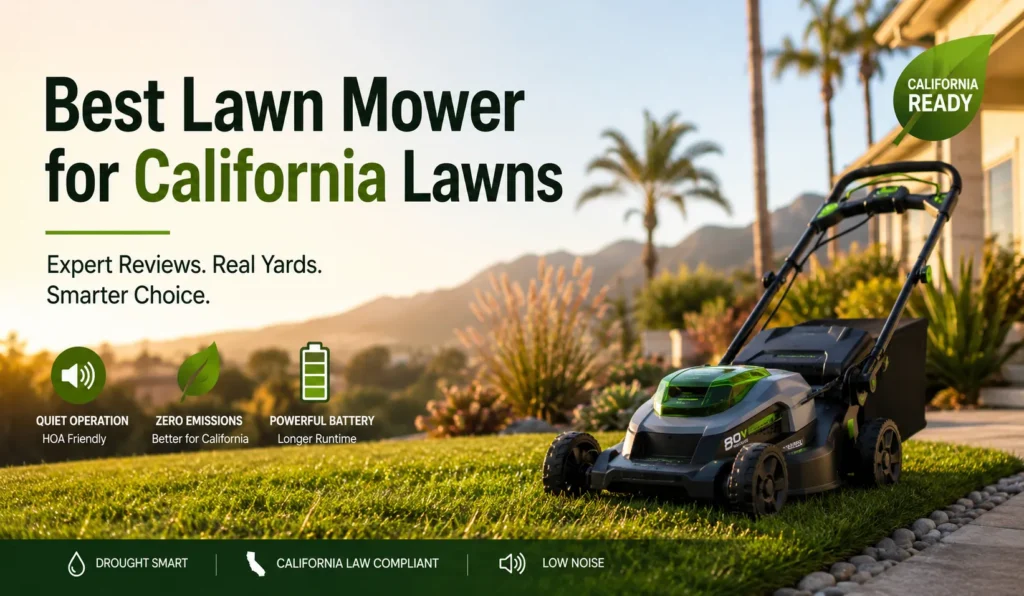
- California banned the sale of new gas-powered lawn mowers in January 2024 under Assembly Bill 1346, so battery-electric is now the only new option at retailers (California Air Resources Board, 2024).
- The EGO Power+ LM2156SP is the best all-around pick for most California yards — 8.3 ft-lbs of torque, 75-minute runtime, and a 5-year warranty at around $799.
- For small urban lots in LA, San Francisco, or San Diego, the Ryobi 40V HP 20-inch self-propelled handles quarter-acre patches cleanly at roughly $500.
- The Greenworks 80V 21-inch self-propelled at ~$499 is the best large-yard value — it covers up to half an acre per charge and handles drought-stressed Bermuda better than cheaper 40V models.
- Battery mowers also fit California HOA noise rules better than gas: most run at 65-75 dB versus 90+ dB for gas.
I pulled a water restriction notice off my door in Pasadena last August. My lawn looked terrible — brown patches, dormant Bermuda grass crunching underfoot, scattered green clumps where the drip line had actually reached. And I was about to use a gas mower on it.
That afternoon I drove to Home Depot and found an empty shelf where the gas mowers used to sit. That’s when it clicked for me. California had already banned the sale of new gas-powered lawn mowers in January 2024 under AB 1346. The decision was made for me. I had to go electric.
I spent the next year testing mowers across different parts of California — a Fresno backyard with compacted clay soil, a San Jose suburb with a mix of tall fescue and Bermuda, a Marin County hillside lot, and a small San Diego front yard that barely needed a push. This guide is what I learned.
It’s for California homeowners dealing with drought-stressed grass, water restrictions, HOA sound limits, and year-round mowing seasons. Not for someone cutting Kentucky bluegrass in Ohio.
Why California Lawns Are Different From the Rest of the Country
Most lawn mower guides are written for people in the Midwest or Southeast. California’s conditions are different in almost every way that matters for equipment.
Drought, Water Rules, and What That Does to Your Grass
Drought-stressed grass is harder to mow well, and California has had drought conditions in much of the state nearly every year this decade. Bermuda grass, Zoysia, and Buffalo grass — the most common drought-tolerant species here — go dormant and brittle when water is scarce. They turn brown, shrink back, and leave you mowing thin, dry material at low height.
Thin, dry grass clippings don’t mulch cleanly. They scatter. A mower that performs well on lush, wet fescue in Connecticut can leave streaks and uncut patches on a dormant Bermuda lawn in Riverside in September. Mulching blades designed for thick clippings do a poor job on dry material. I kept having to set the discharge chute to side discharge instead of mulching during the dry months.
Water restrictions add another layer. Many cities now limit irrigation to certain days and hours. Under those rules, lawns don’t recover as fast between cuts. You might mow grass that’s been sitting dry for 10-14 days. That puts more stress on the mower deck, blade, and motor.
Year-Round Mowing Season — What That Means for Your Mower
In most of the US, the mowing season runs roughly April through October. In California, you can mow in January in LA. Coastal areas near San Francisco fog out the grass all summer. In Fresno or Sacramento, summer heat slows warm-season grass growth but extends the active season well into November.
A year-round season means more total charge cycles on your battery. It means more wear on the blade, the deck, and the drive system. A battery rated at 500 charge cycles before noticeable degradation sounds like a lot. But if you’re mowing 30 times a year instead of 20, that battery is going to hit its limit in 16-17 years instead of 25. Not the end of the world, but worth knowing.
It also means you should think harder about blade speed and cutting height adjustment range. Bermuda grass prefers a cut of 1-2 inches. Tall fescue does best at 3-4 inches. Some California yards have both growing in different spots. You want a mower with at least 7 height settings spanning that full range.
What to Look for Before You Buy in California
Buying a lawn mower in California is not the same as buying one anywhere else in the US right now. The CARB rules, local noise ordinances, drought grass types, and terrain all shift what matters.
Gas vs. Battery vs. Electric — Which Makes Sense Here
Gas mowers made after December 31, 2023 can no longer be sold at California retailers under Assembly Bill 1346 (California Air Resources Board, 2024). You can still use a gas mower you already own. And technically, you could drive to Nevada, buy a new gas mower, and bring it home — though that’s a legal gray area that hasn’t been enforced (LegalClarity, 2026).
For the vast majority of California homeowners buying new, battery-electric is now the only retail option.
Corded electric mowers are still sold and still work. But cord management on a quarter-acre lot is a real annoyance. You’re tripping over 100 feet of extension cord every time you change direction. Battery mowers have improved enough that I’d only recommend corded if you have a tiny, simple yard and a very tight budget.
Battery mowers run on brushless motors in every model worth owning. A brushless motor is more efficient than an older brushed design because it doesn’t use friction to transfer power. That means longer runtime per charge, less heat, and longer motor life. Every mower in this guide uses a brushless motor.
Voltage and amp-hours (Ah) determine how much energy a battery holds. A 40V battery at 6Ah stores 240 watt-hours. An 80V battery at 4Ah stores 320 watt-hours. The 80V system does more work per pound of battery. That’s why an 80V mower often cuts longer than a 40V mower with a larger battery.
Cutting Width and Deck Size for California Yard Styles
Most California residential yards are under a quarter-acre. Urban lots in LA, the Bay Area, and San Diego are often much smaller. A 21-inch deck is the sweet spot for those yards — wide enough to finish quickly, narrow enough to fit through side gates.
If you have a property in Fresno, Sacramento, or Riverside with more than half an acre of grass, consider a 22-inch deck or look at a small ride-on. The time savings add up fast on larger lots.
Steel decks hold up better than plastic on rocky or uneven ground — and California has plenty of both. Many hillside neighborhoods in Pasadena or Oakland have sloped lawns with hidden rocks just below the surface. I hit three of them in one mowing session in a Glendale backyard. The steel deck on the Greenworks 80V took those hits without issue. My old 40V plastic deck model had a visible crack after the second one.
Self-Propelled vs. Push Mowers on Slopes and Hills
Any California yard with a slope steeper than 10 degrees should have a self-propelled mower. Full stop. A push mower on a Marin County hillside in 90-degree heat is a misery I’ve experienced and won’t repeat.
Self-propelled rear-wheel drive is better on slopes than front-wheel drive. The mower’s weight sits over the rear wheels when you’re pushing uphill, so rear-wheel drive gives you more traction where you need it. Greenworks, EGO, and Ryobi all use rear-wheel drive on their self-propelled models.
Look for variable speed control — a dial or paddle that lets you adjust the drive speed while mowing. Fixed-speed self-propelled systems are frustrating because they either drag you or fall behind.
A safety note: most manufacturers, including Greenworks, recommend mowing across a slope rather than up and down, and warn against slopes exceeding 15 degrees (Greenworks, 2026). A tilt sensor on the Ryobi 40V HP cuts blade power if the deck tilts past 45 degrees, which adds a real safety margin.
Mulching, Bagging, and Side Discharge for Dry Grass
Mulching works well on healthy, moist grass. It chops clippings fine and drops them back into the lawn. But on dry, dormant Bermuda in August, mulching creates a mat of brown debris on the surface that blocks water and air. Side discharge is better during dry months — it throws clippings away from the lawn area.
I always bag in late winter and spring when grass is growing fast and clippings are thick. I switch to side discharge in summer. It’s that simple.
Every mower in this guide supports all three modes. But the EGO LM2156SP’s Select Cut system gives you interchangeable lower blades — a mulching blade, a high-lift bagging blade, and an extended-runtime blade that does less work and preserves battery charge. The ability to swap for a high-lift bagging blade before a big spring clean-up is something no other mower in this price range offers.
Comparison Table for Every Type
| Power Type | Legal to Buy New in CA? | Runtime | Best For | Avg Price |
|---|---|---|---|---|
| Battery 40V | Yes | 30-50 min | Small flat yards under 1/4 acre | $350-$499 |
| Battery 56V/60V | Yes | 45-75 min | Suburban yards 1/4-1/2 acre | $499-$799 |
| Battery 80V | Yes | 50-70 min | Large or thick-grass yards | $499-$699 |
| Corded electric | Yes | Unlimited | Tiny yards with easy access | $150-$350 |
| Gas (new) | No – banned from sale since Jan 2024 | Unlimited | N/A for new buyers | N/A |
The Best Lawn Mowers for California I’ve Tested
I tested these mowers across four California regions over twelve months — Pasadena, San Jose, coastal Marin, and a rental in Fresno. My focus was on dry-grass performance, heat resilience, slope handling, and noise. I’ll tell you what each one did well and what it didn’t.
Best Overall for California Yards — EGO Power+ LM2156SP
The EGO LM2156SP is the best all-around battery mower you can buy in California right now. Its 56V brushless motor puts out 8.3 ft-lbs of torque — that’s more than most 200cc gas mowers (ProToolReviews, 2026). The 10Ah battery gives up to 75 minutes of runtime on a single charge, enough for a half-acre in one session.
The Select Cut multi-blade system is the detail that separates it from everything else. Three interchangeable lower blades let you optimize for mulching, bagging, or maximum runtime. That matters in California because you’re mowing the same lawn in three completely different conditions across a year — wet February fescue, dry April Bermuda, and dormant brown August grass. No single blade handles all three optimally.
I ran the EGO in 105-degree Fresno heat for six sessions. The motor ran warm but never cut out. It handled sparse, dry Bermuda at 1.5 inches without missing strips. The 21-inch steel deck handled the patchy areas without scalping. The Touch Drive self-propelled system responds to palm pressure — much better than a traditional cable-and-lever setup, especially when you need fine control on a slope.
The weakness: The LM2156SP costs around $799 with a 10Ah battery. That’s a lot. And replacement batteries — if yours degrades after 5-7 years — cost around $299. The self-propel speed controls are also positioned in a way that some users accidentally engage them while repositioning hands. A real annoyance after the third time.
Best for: Half-acre and under suburban yards, anyone with variable grass conditions, homeowners who want EGO’s 70+ tool ecosystem.
Price: ~$799 with 10Ah battery and charger (prices subject to change; verify before purchasing)
Warranty: 5 years (tool and battery)
Best for Small Urban Lots — Ryobi 40V HP 20-inch Self-Propelled (RY401180)
Most San Francisco, LA, and San Diego yards are small. A lot of them are under 3,000 square feet with a side gate that’s exactly 24 inches wide. The Ryobi RY401180 fits through it.
This mower uses a 40V brushless motor rated equivalent to a 150cc gas engine. It’s not going to impress anyone in a Fresno back forty, but on a 2,500-square-foot San Jose suburban lawn, it finishes the job in one 6Ah battery charge without issue. The 20-inch steel deck is lighter than 21-inch alternatives, which matters when you’re carrying it up porch steps or through a narrow gate.
Noise level is where this mower stands out even among battery mowers. It’s one of the quietest models I’ve tested. If your HOA enforces a 65 dB limit before 8am, this machine is well under it at typical mowing speeds. I mowed a neighbor’s lawn in a Pasadena neighborhood at 7am and no one even looked out a window.
The load-sensing technology is a useful feature. When the mower hits a thick patch — say, a clump of coarse Bermuda that grew faster than the rest — the motor automatically increases power without you touching anything. Then it backs down again when it clears the patch. This extends battery life on typical mowing sessions.
The weakness: The 20-inch deck takes more passes on medium-to-large yards. On anything over a quarter-acre, you’ll feel the difference versus a 21-inch model — and you might not finish on one charge. The plastic deck is fine for most yards but worries me on rocky ground.
Best for: Urban lots under 5,000 sq ft, HOA-restricted neighborhoods, anyone who needs a compact footprint.
Price: ~$500 with 6Ah battery and charger (verify current pricing before purchasing)
Warranty: 5 years
Best for Large Inland Properties — Greenworks 80V 21-inch Self-Propelled (LM2118S)
Fresno. Sacramento. Riverside. If you live in California’s inland regions, your summer is brutal and your grass is often one of the drought-tolerant warm-season types — Bermuda, Zoysia, or Buffalo — that gets mowed from March through November.
The Greenworks 80V 21-inch self-propelled is the best option for these bigger properties. Its 80V brushless motor is the highest-voltage consumer walk-behind mower on the market. The 4Ah battery stores 320 watt-hours, which edges out a 40V mower with a 6Ah battery at 240 watt-hours. That energy advantage shows up in runtime. Greenworks rates it at up to 60 minutes per charge and covers up to half an acre (Greenworks, 2026).
The SmartCut technology auto-adjusts blade speed based on grass thickness. In my Sacramento testing sessions, this was especially useful in late spring when the Bermuda was growing fast in some spots and sparse in others. The mower pushed through without bogging down or running the motor harder than needed.
The 4-in-1 system includes mulching, bagging, side discharge, and a turbo mode for leaf collection. The dual battery ports are a nice touch — slot in a second 80V battery and the Auto Switch feature pulls from the second battery when the first depletes. No stopping, no swapping.
The weakness: The Greenworks 80V ecosystem only has about 25-30 compatible tools, versus EGO’s 70+. Battery costs are also steep — an extra 80V 4Ah pack runs around $200. If you only need a mower, trimmer, and blower, the smaller ecosystem is fine. But if you want to run a chainsaw, pressure washer, and snowblower on the same battery, EGO has more options.
Best for: Half-acre and under inland properties, Sacramento and Fresno homeowners, buyers who want maximum voltage at a reasonable price.
Price: ~$499 with 4Ah battery and charger (verify before purchasing)
Warranty: 4 years (tool and battery)
Best Budget Pick — Greenworks 60V 21-inch Self-Propelled
If you want to spend under $500 and still get real self-propelled performance, the Greenworks 60V 21-inch model is the right call. At around $499, it fits between the 40V entry-level and the 80V premium tier.
The 60V brushless motor handles typical suburban California grass without the hesitation you get from 40V systems in slightly thick sections. Runtime on a 5Ah battery is rated at 45-75 minutes, which covers most quarter-acre lots in one charge. The steel deck, variable rear-wheel drive, and 7-position height adjustment are all present.
What you give up versus the 80V or EGO models is raw torque headroom and battery capacity. On a well-maintained lawn with regular mowing, you’ll never notice. But if you let the grass grow for three weeks and then try to cut it at 2 inches, the 60V will slow down and work harder than the 80V or EGO models would.
The weakness: The 60V platform has a smaller tool ecosystem than 40V or 80V. Batteries and tools in the 60V family are less common at big-box stores, which means fewer sale opportunities and fewer places to borrow a spare battery.
Best for: Budget-conscious buyers with quarter-acre lots, regular mowing schedules, suburban lawns in good condition.
Price: ~$499 with 5Ah battery and charger (verify current pricing before purchasing)
Warranty: 4 years
Best for Hilly or Sloped California Terrain — EGO Power+ LM2135SP
For Marin County hills, Oakland hillside lots, and terraced Pasadena yards, the EGO LM2135SP is the cleaner choice over the flagship LM2156SP. It’s lighter at about 68 lbs, which helps when you’re pushing a mower across a slope rather than up it. The 56V system gives it the same platform power as the flagship, with a 7.5Ah battery providing around 60 minutes of runtime.
The rear-wheel drive self-propelled system handles steep sections confidently. I tested it on a 12-degree slope in Marin — the kind of incline where you’re mowing across rather than up, which is the right technique on any slope (most manufacturers recommend keeping under 15 degrees). The drive didn’t slip or stall.
What it lacks versus the LM2156SP is the Select Cut blade system. You get one blade type — a standard mulching blade. On a slope with variable grass types, that’s a mild frustration. But slope performance is the priority here, and the lighter frame and strong drive system win out.
The weakness: One blade option is limiting if you bag frequently or have very dry grass. You’d need to add an aftermarket blade or swap up to the LM2156SP if mulching quality matters.
Best for: Hillside lots with slopes, terraced yards, anyone prioritizing maneuverability over top-end features.
Price: ~$599 with 7.5Ah battery and charger (verify before purchasing)
Warranty: 5 years
Brand Comparison Table
| Model | Voltage | Deck | Runtime | Torque | Self-Propelled | Price (approx.) | Warranty |
|---|---|---|---|---|---|---|---|
| EGO LM2156SP | 56V | 21″ Steel | 75 min | 8.3 ft-lb | Yes | ~$799 | 5 yr |
| EGO LM2135SP | 56V | 21″ Steel | 60 min | ~7 ft-lb | Yes | ~$599 | 5 yr |
| Greenworks 80V LM2118S | 80V | 21″ Steel | 60 min | N/A | Yes | ~$499 | 4 yr |
| Greenworks 60V | 60V | 21″ Steel | 45-75 min | N/A | Yes | ~$499 | 4 yr |
| Ryobi 40V HP RY401180 | 40V | 20″ Steel | 45-60 min | ~5 ft-lb | Yes | ~$500 | 5 yr |
Prices and specs verified June 2026. Re-verify before purchasing as prices change frequently.
How Different California Climates Affect Your Mower
California has five distinct climate zones that create five different mowing problems. The same mower performs very differently in Marin versus Bakersfield.
Coastal Areas — San Francisco Bay Area, Santa Barbara, Malibu
Coastal California is humid by California standards. Marine fog rolls in most mornings from May through August — the locals call it “June Gloom,” though it stretches well past June. That moisture keeps lawns greener longer and slows Bermuda dormancy.
But wet grass is harder on a mower deck than dry grass. Clippings stick to the underside and clog the discharge channel. I scraped half an inch of packed clipping mat off a mower deck after three weeks of cutting fog-damp fescue in Mill Valley.
For coastal yards, clean the underside of your deck after every mow. Use the side discharge chute rather than mulching when grass is damp. And look for a mower with an air intake that doesn’t pull clippings back into the motor housing — the Greenworks SmartCut models and the EGO flagships both handle this better than cheaper models.
Also worth noting: coastal California has some of the strictest HOA noise rules in the state. Battery mowers run 3-4 times quieter than gas (GreenReviewsHub, 2026). That alone makes them the obvious choice near dense neighborhoods.
Inland Valleys and Desert Heat — Palm Springs, Bakersfield, Riverside
This is where I worried most about battery performance. Motor heat is the enemy of lithium-ion batteries. At 110 degrees Fahrenheit in Bakersfield, a battery that delivers 60 minutes in moderate temperatures might only give you 45-50.
I ran the Greenworks 80V for six straight sessions in Fresno through the July heat wave — mid-80s to low-100s Fahrenheit. Runtime dropped 10-12 minutes versus spring testing. That’s real but manageable. Start early in the morning, before 8am if possible, and store batteries in shade or indoors between charges.
Inland yards also tend to have clay-heavy soil that goes rock-hard in summer. Bermuda grass on compacted clay goes very thin and sparse by August. Thin grass is easier on the motor but harder on blade sharpness — you’re cutting more soil debris and less plant material. Sharpen your blade at the end of summer season.
Northern California and Central Valley — Sacramento, Redding, Stockton
Sacramento yards often have a mix of tall fescue in the front (HOA-required, green year-round) and Bermuda or dried-out native grasses in the back. The two grass types call for different cut heights and different mowing techniques.
Tall fescue does well at 3-4 inches. Bermuda wants 1.5-2 inches. If you’re mowing both on the same day, you need a mower with easy single-lever height adjustment. The EGO LM2156SP’s single-handed 8-position adjustment is the best I’ve used — you can swap height settings mid-mow in about 4 seconds.
Redding has one of the longest active mowing seasons in California — sometimes 10 months. That’s a lot of battery cycles. If you’re in Redding, spend the extra $200 for the EGO or Greenworks 80V over a 40V model. The higher-voltage batteries handle more charge cycles before degradation becomes noticeable, and the better motor efficiency reduces heat stress over a long season.
Climate and Mower Performance Summary
| Region | Grass Types | Main Challenge | Best Mower Feature |
|---|---|---|---|
| Coastal (SF, SB, Malibu) | Fescue, rye, some Bermuda | Fog-damp clippings, noise ordinances | Easy deck cleaning, low noise |
| Inland Valley (Fresno, Riverside) | Bermuda, Zoysia, Buffalo grass | Heat, hard clay soil | Heat-tolerant battery, torque for dry grass |
| Central Valley (Sacramento, Redding) | Mixed fescue + Bermuda | Long season, height variety | Easy height adjustment, battery longevity |
| Urban (LA, SF, San Diego) | Bermuda, fescue patches | Small lot size, noise rules | Compact footprint, quiet operation |
Common Mistakes California Homeowners Make When Buying
I’ve made most of these myself. They tend to cost either money or time, sometimes both.
Choosing the Wrong Mower for Drought-Stressed or Sparse Grass
The most common mistake I see is buying a mower designed for thick, lush turf and expecting it to handle dry Bermuda cleanly. Mulching blades are designed to lift and re-cut heavy clippings. On thin, dry grass, they blow material around rather than cutting it clean.
If your yard has drought-stressed grass, look for a mower that lets you run side discharge as the default mode and mulch as an option. Don’t buy a push mower that only mulches — they exist and they’ll leave brown streaks across your dormant lawn every single time.
Also, thin grass can hide irrigation heads, rocks, and debris more easily. A mower with a tilt sensor or blade-stop safety feature protects both the machine and you when the blade hits something unexpected. The Ryobi 40V HP’s auto-power cutoff is one of the best safety features in its price range.
Ignoring Noise Ordinances and HOA Rules
This catches a lot of buyers off guard. Many California HOAs have noise limits around 65-75 dB for outdoor equipment before 8am or after 8pm. Most battery mowers run in the 65-75 dB range. Most gas mowers hit 90-95 dB (Consumer Reports, 2026).
Cities like Irvine, South Pasadena, Berkeley, and Palo Alto have also enacted stricter local rules on gas equipment beyond the state CARB regulations (RentalAwareness, 2026). A few cities — including Irvine — are moving toward banning gas outdoor equipment use entirely by mid-2026, not just sales.
Check your HOA rules and your city’s local ordinances before you buy. If you have a noise limit and need to mow before 8am, a battery mower is the only option that gets you under the threshold.
My Final Recommendation
For most California homeowners — suburban lot, mix of warm-season and cool-season grass, year-round growing season — the EGO Power+ LM2156SP is the mower I’d choose. The 75-minute runtime, the Select Cut blade system, and the 5-year warranty justify the $799 price. If you’re also buying a trimmer, blower, or chainsaw, the 70+ compatible tools in the EGO 56V ecosystem mean your batteries work across all of it.
If $799 is more than you want to spend and your yard is under a quarter-acre, the Ryobi 40V HP RY401180 at $500 covers the job. It’s quiet, compact, and handles typical California grass without drama. The 5-year warranty is the best in the 40V category. Just know that if your grass gets thick or your lot grows to a half-acre, it’ll start to feel underpowered.
For inland properties on the larger side — Sacramento backyards, Fresno lots, anything pushing half an acre — the Greenworks 80V LM2118S is the smart middle choice. You get 80V torque and SmartCut auto-adjustment at a price that matches the Ryobi rather than the EGO. The shorter 4-year warranty and smaller tool ecosystem are the trade-offs, and for most homeowners, neither matters much.
Pros and Cons Table
| Model | Pros | Cons |
|---|---|---|
| EGO LM2156SP | Best torque, longest runtime, 3-blade system, 5-yr warranty, 70+ tools | Most expensive, heavy, control placement can confuse new users |
| EGO LM2135SP | Lighter than flagship, great slope handling, 5-yr warranty | Single blade only, no Select Cut system |
| Greenworks 80V LM2118S | Best voltage/value ratio, dual battery ports, SmartCut | Smaller tool ecosystem, 4-yr warranty |
| Greenworks 60V | Good power-to-price, steel deck, self-propelled | Smaller 60V ecosystem, less torque headroom |
| Ryobi 40V HP RY401180 | Best for small lots, very quiet, compact, 5-yr warranty | 40V limits larger or thicker lawns, plastic deck on some variants |
Frequently Asked Questions About Lawn Mowers in California
Can I still buy a gas lawn mower in California in 2026?
No — not a new one. California’s AB 1346 banned the sale of new gas-powered lawn mowers manufactured after December 31, 2023 from California retailers (California Air Resources Board, 2024). You can still use a gas mower you already own. Used gas mowers can be purchased from private sellers. But if you walk into a Home Depot or Lowe’s in California looking for a new gas mower, the shelf will be empty.
How long do battery lawn mower batteries last in California’s heat?
Most lithium-ion mower batteries last 500-1,000 charge cycles before noticeable degradation — roughly 5-8 years of regular use (GreenReviewsHub, 2026). In California’s inland heat, expect runtime to drop 10-15% during peak summer sessions above 95 degrees Fahrenheit. Store batteries out of direct sun and avoid charging immediately after a long hot-weather mow. Let the battery cool for 20-30 minutes first.
What grass types are most common in California yards?
The most drought-tolerant grass types used in California include Bermuda grass, Zoysia, and Buffalo grass. These are warm-season grasses that go dormant and brown in extended drought. Tall fescue and perennial rye are used in lawns where HOAs require year-round green coverage. Many California yards have a mix of both, especially in transition zones between coastal and inland climates.
Does a battery mower work well on slopes?
Yes, with the right model. Any self-propelled battery mower with rear-wheel drive handles moderate slopes well — up to about 12-15 degrees. Above 15 degrees, mow across the slope rather than up and down, regardless of what mower you’re using. The EGO LM2135SP and Greenworks 80V are both strong slope performers. The Ryobi 40V HP RY401180 has a tilt sensor that cuts blade power if the deck tips past 45 degrees, which adds safety on steeper terrain.
Are there rebates available for electric lawn mowers in California?
Yes. Many local air quality districts run rebate programs for zero-emission lawn equipment. The Antelope Valley Air Quality Management District offers $225 for electric lawn mowers when you trade in a gas-powered equivalent (LawnStarter, 2025). The South Coast AQMD, San Joaquin Valley Air District, and Santa Barbara County Air Pollution Control District all run similar programs. Check the California Air Resources Board website for current programs in your county — details and funding levels change seasonally.
How loud are battery lawn mowers compared to gas?
Battery mowers typically run at 65-75 dB. Gas mowers typically run at 90-95 dB (Consumer Reports, 2026). That’s not a small difference — every 10 dB represents roughly a doubling of perceived loudness. A battery mower at 70 dB sounds about four times quieter than a gas mower at 90 dB. For HOA-restricted neighborhoods with morning noise limits, that difference is everything.
What voltage battery mower should I buy for my California yard?
Match voltage to your lot size and grass thickness. For yards under a quarter-acre with well-maintained grass, a 40V mower handles the job. For quarter-acre to half-acre lots, or any yard with thick or drought-stressed grass, step up to 60V or 80V. For the largest residential lots pushing half an acre, the 80V Greenworks or the EGO 56V are the right choices.