
Quick Overview
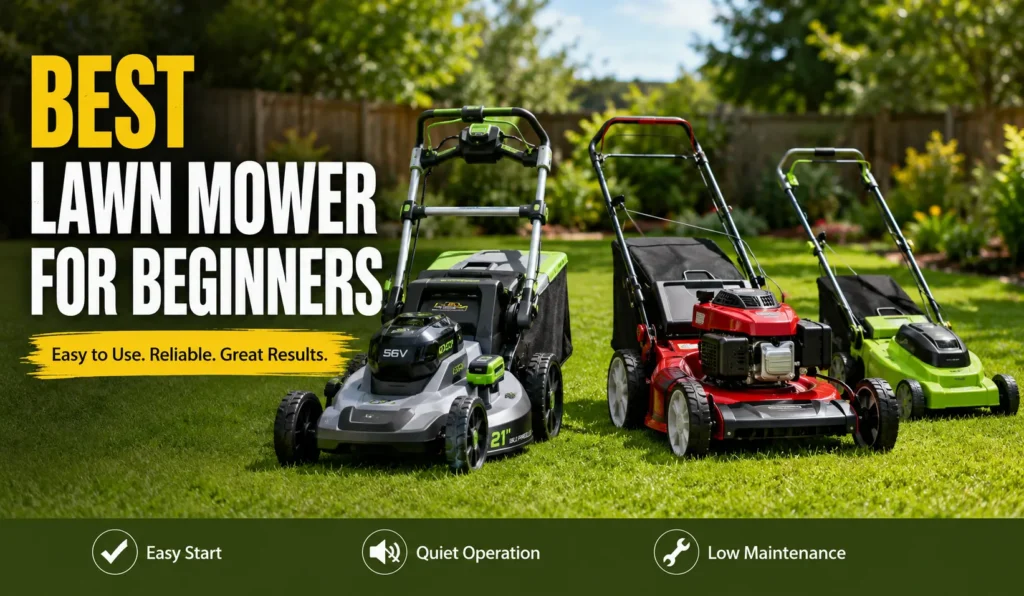
- The best lawn mower for beginners overall is the EGO Power+ LM2102SP – it starts with a button, runs quiet, and needs almost no maintenance.
- For small yards under 1/4 acre, a battery push mower handles nearly every beginner scenario.
- Gas mowers cost less upfront but add maintenance steps most beginners don’t expect.
- Self-propelled models are worth the extra $50-$100 if your yard has any slope at all.
- Never buy a riding mower unless your yard is over half an acre – it’s overkill and harder to store.
I remember standing in a big box store parking lot, staring at a flatbed cart loaded with a mower still in the box, wondering if I’d just made a $400 mistake. My first house. A backyard that hadn’t been cut in three weeks. And a mower I had no idea how to use.
If that sounds familiar, this guide is for you. Whether you just closed on your first home, you’re renting a place with a yard for the first time, or you’ve just never bought a mower before – I’ve spent years helping people in that exact spot figure out what they actually need. Not what the store wants to sell them. Not what the neighbor with a shed full of equipment swears by. What works for a normal person with a normal yard who just wants to get the grass cut without a headache.
The best lawn mower for beginners is not the cheapest one you find. And it’s probably not the most powerful either. It’s the one you’ll actually use – and use correctly – without frustration.
Let’s sort this out.
Why Choosing Your First Mower Feels Overwhelming (And How to Simplify It)
Walk into any hardware store and you’ll find 30 mowers lined up in a row. They all look slightly different. Most don’t have prices on them. A salesperson will start talking about torque and deck size and you’ll nod and smile and have no idea what any of it means.
Here’s the good news: most beginners need one of maybe three or four mowers. The rest of that lineup is for professionals, large property owners, or people with very specific needs. Once you understand what actually matters, the decision gets simple fast.
Too Many Options, Too Much Jargon
Mower packaging is full of numbers that don’t help first-time buyers make a decision. “190cc engine.” “21-inch steel deck.” “3-in-1 capability.” These specs matter – but only after you understand the basics. A 190cc engine means nothing if you don’t know whether you even need a gas mower in the first place.
The jargon problem is real. Self-propelled. Rear-wheel drive. Brushless motor. Mulching bagging side discharge. These are all real features with real differences. I’ll define each one as we go, so you don’t need to Google anything.
What Actually Matters When You’re Just Starting Out
Four things. That’s it.
Yard size. Under 1/4 acre, a push mower handles it fine. Over 1/2 acre, you start looking at self-propelled. Over an acre, riding mowers come into the conversation.
Terrain. Flat yard with no hills? Almost anything works. A slope, even a gentle one, changes the game completely.
Power source. Gas, battery, or corded electric. Each has real trade-offs I’ll break down shortly.
Your storage situation. Some mowers fold down to nearly nothing. Others need a dedicated corner of your garage. Know your space before you buy.
Everything else – blade speed, cutting width, deck material – is secondary. Get the four things above right and you’ll be fine.
The Different Types of Lawn Mowers – Explained Simply
There are five main types of mowers you’ll encounter. Most beginners need the first two. The rest are either for large properties or for people who want to spend more money to do less work.
Push Mowers (Manual and Powered)
A push mower is exactly what it sounds like. You push it. The engine or motor spins the blade. You supply the forward motion.
There are two kinds. A reel mower (also called a manual push mower) has no engine at all – the blade spins as you push. These work fine on small, flat, well-maintained yards. They’re quiet, cheap, and easy to store. But they struggle with thick grass, tall grass, or anything over about 2,500 square feet.
The more common option is a powered push mower – gas, battery, or corded electric. The engine or motor drives the blade while you walk behind it. For most first-time buyers with yards under 5,000 square feet, a powered push mower is exactly what you need.
Self-Propelled Mowers
A self-propelled mower drives itself forward. You guide it; you don’t push it. A set of wheels connected to the drivetrain pulls the mower along while you walk behind it.
These cost more – typically $100-$200 over a comparable push model. For flat yards, they’re nice but not necessary. For sloped yards, they’re the difference between finishing the job and giving up halfway through. If you’ve ever pushed a heavy mower uphill in 85-degree heat, you’ll understand immediately why people spend the extra money.
Self-propelled mowers come in front-wheel drive and rear-wheel drive. For beginners, rear-wheel drive is the better choice – it provides more traction on slopes and doesn’t lose grip as easily when you lift the front to turn.
Riding Mowers – When Do Beginners Actually Need One?
Rarely. A riding mower is a significant purchase – often $1,500 to $4,000 – and it requires storage space, more maintenance, and a learning curve most people underestimate.
The honest answer: if your yard is under half an acre and roughly flat, you don’t need one. If your yard is between half an acre and an acre, a self-propelled walk-behind will still do the job in reasonable time. Once you cross an acre, or if your terrain is too rough for a walk-behind, riding mowers start making sense.
For first-time buyers? Probably not. Get comfortable with a walk-behind first.
Robotic Mowers – Are They Worth It for Beginners?
Robotic mowers are fascinating in concept and frustrating in practice for most beginners. Brands like Husqvarna and Worx make models that mow your yard on a schedule while you’re at work. They keep grass short by mowing frequently in small increments rather than cutting a full inch at once.
The downsides: they’re expensive (typically $800 to $2,500+), require a perimeter wire installation, struggle with irregular yard shapes and obstacles, and don’t handle overgrown grass at all. If your lawn gets away from you for two weeks, a robot won’t rescue it.
For a first-time buyer who wants a set-and-forget option and has a simple yard shape, a robotic mower can work. For everyone else, the cost and setup complexity don’t pay off yet.
Mower Type Comparison
| Type | Best Yard Size | Best For | Price Range | Maintenance Level |
|---|---|---|---|---|
| Manual push (reel) | Under 2,500 sq ft | Flat, maintained yards | $90-$200 | Very low |
| Powered push | Up to 1/4 acre | Most beginners | $200-$450 | Low-Medium |
| Self-propelled | 1/4 to 1/2 acre | Slopes, larger yards | $350-$700 | Low-Medium |
| Riding mower | 1/2 acre+ | Large, open properties | $1,500-$4,000+ | Higher |
| Robotic mower | Simple yards, any size | Hands-off owners | $800-$2,500+ | Low (setup is harder) |
What to Look for Before You Buy
Before you land on a specific model, five specs will narrow your choices fast. Understanding these saves you from returns, buyer’s remorse, and the shame of buying a mower that’s genuinely wrong for your yard.
Yard Size and Terrain
The single most important factor. Measure your mowable area before shopping – not the total lot size, but the grass you actually need to cut. A 6,000 square foot lot with a house, driveway, flower beds, and deck might have 2,500 square feet of actual grass.
Under 2,500 sq ft: Any powered push mower handles this. Battery power is ideal.
2,500 to 5,000 sq ft: Standard 21-inch push mower. Self-propelled is nice on slopes.
5,000 to 10,000 sq ft (roughly 1/4 acre): Self-propelled recommended. Battery mowers with large packs can cover this on a charge.
Over 10,000 sq ft (1/4 to 1/2 acre): Self-propelled walk-behind or riding mower depending on terrain.
Terrain matters just as much as size. A flat 8,000 square foot yard is manageable with a push mower. A sloped 4,000 square foot yard is genuinely hard work without a self-propelled model.
Power Source – Gas vs. Battery vs. Electric Corded
This is where most beginners get confused. Here’s the plain-language breakdown.
Gas mowers run on gasoline and start with either a pull cord or electric start. They’re powerful, can run as long as you have fuel, and work on any yard size. The downside: they need oil changes, air filter replacements, spark plug checks, and carburetor maintenance. They’re loud. They require winterization if you live somewhere cold. And that pull cord – which requires a hard yank to start – is the source of more beginner frustration than anything else in lawn care.
Battery mowers run on a rechargeable lithium-ion battery. They start with a button push, run nearly silent, require almost no maintenance, and are dramatically improving in power and battery runtime every year. The best 56V and 60V models from EGO, Greenworks, and Ryobi handle most residential yards comfortably. The downside: large yards may need a second battery or a mid-mow recharge. Batteries also degrade over time.
Corded electric mowers plug into a standard outlet via extension cord. They’re cheap, start instantly, never run out of power mid-job. The downside: you’re dragging a cord around your yard, which gets frustrating fast, especially in larger spaces or around obstacles. Most beginners find the cord more annoying than they expected.
For most beginners, battery is the right call in 2026. The technology has caught up for yards under 1/3 acre, and the near-zero maintenance makes it far more approachable.
Cutting Width and Deck Size
The deck is the housing that covers the blade. Cutting width is how wide a strip the mower cuts in a single pass.
Most residential mowers are 20 to 22 inches. A wider deck means fewer passes to cover your yard – which saves time. But wider decks are heavier and harder to maneuver around trees, garden beds, and tight corners.
For a typical suburban yard with some obstacles: 21 inches is the sweet spot. It covers ground efficiently without being awkward to turn.
For small yards or yards with a lot of obstacles: 20 inches or a compact model makes maneuvering easier.
Ease of Use – Starting, Stopping, and Adjusting
Beginners underestimate how much starting method matters until they’ve fought a gas mower’s pull cord for ten minutes in the summer heat.
Look for:
- Push-button or key start (battery and electric start gas models)
- A single lever for cutting height adjustment (rather than adjusting each wheel individually)
- A blade control that doesn’t require constant hand pressure to hold (some have a deadman lever that stops the blade when you release it – this is actually a safety feature worth getting used to)
- Handles that fold down for storage
For cutting height adjustment: a single-point adjustment lever that changes all four wheels at once saves real time. Many budget mowers require you to adjust each wheel by hand, which gets old quickly.
Storage and Maintenance Requirements
Be honest about where you’ll store it. A standard push mower with folding handles fits in about 3 feet by 2 feet of floor space. A riding mower needs a full parking spot or a dedicated shed.
On maintenance: battery mowers need almost nothing beyond blade sharpening once a season. Gas mowers need an oil change annually, air filter checks, spark plug replacements every few years, and fuel stabilizer if you’re storing the mower over winter. If the idea of doing any of that sounds annoying, get a battery mower.
Spec Comparison for Beginner-Friendly Options
| Spec | What to Look For | What to Avoid |
|---|---|---|
| Cutting width | 20-21 inches for most yards | Over 22 inches for small yards |
| Start method | Push button (battery/elec start) | Pull cord only |
| Height adjustment | Single-lever (all wheels) | Individual wheel adjust only |
| Power (battery) | 40V minimum, 56V-60V preferred | Under 36V for anything over 2,000 sq ft |
| Storage | Foldable handles | Fixed upright handles (wastes space) |
| Warranty | 3 years minimum on battery models | Less than 2 years total coverage |
The Best Lawn Mowers for Beginners I’ve Tested
I’ve mowed a lot of grass with a lot of mowers. Below are the six picks I’d recommend to any first-timer based on real use – not spec sheets. Each includes at least one honest weakness because no mower is perfect.
Best Overall for Beginners: EGO Power+ LM2102SP
If I had to send every first-time buyer to one mower, this is it. The EGO LM2102SP is a 21-inch self-propelled battery mower powered by a 56V battery with a brushless motor (brushless motors last longer and run more efficiently than brushed ones – you’ll see that term on a lot of premium battery tools).
It starts with a button. The self-propulsion speed is adjustable. The cutting height changes with a single lever. It handles grass that’s been neglected for two weeks without bogging down. Runtime is around 45 minutes on a charge with the 5.0Ah battery – enough for most yards under 1/3 acre.
It’s also quiet enough that you can mow at 7am without hating your neighbors.
Weakness: The price. At $549 with battery and charger, it’s not cheap. And the battery, while excellent, takes about 45 minutes to charge – plan around that if your yard is larger.
Best for: Beginners with yards up to 1/3 acre who want a near-zero-maintenance experience and don’t mind spending for quality.
Best Battery-Powered Pick for New Owners: Greenworks 40V 21-Inch Push Mower
If the EGO is too expensive, the Greenworks 40V is the runner-up. At around $299 with a 4Ah battery, it covers smaller yards well and still offers the push-button start and low-maintenance experience that makes battery mowers so beginner-friendly.
The 40V system isn’t as powerful as EGO’s 56V, but for flat yards under 5,000 square feet it does the job. The build quality is solid for the price point.
Weakness: It’s a push model, so slopes will wear you out. And the 40V system has shorter battery runtime – expect around 30-35 minutes on a full charge. Thick or wet grass will drain it faster.
Best for: Beginners with flat yards under 5,000 square feet who want a budget-friendly battery option.
Best for Small Yards and Tight Spaces: Ryobi 40V 20-Inch Push Mower (RY401110)
The Ryobi 40V 20-inch is shorter and lighter than most 21-inch models, which makes a real difference in compact yards with lots of garden beds, trees, or fence lines to work around. It handles tight turns well and stores in minimal space.
The 20-inch deck cuts a slightly narrower path, which means more passes on a larger yard. But for a townhouse backyard or a starter home with under 3,000 square feet of grass, the extra maneuverability more than makes up for it.
Ryobi’s 40V battery system is widely available and compatible across their tool line, which is a genuine advantage if you already own Ryobi tools.
Weakness: The 20-inch deck means more passes on anything over 4,000 square feet – it just takes longer. Also, the handle height isn’t adjustable on some versions, which is uncomfortable for taller users.
Best for: Beginners with small, obstacle-heavy yards who value easy storage and maneuverability.
Best Budget Option Under $300: HART 20V Push Mower
HART is a Walmart-exclusive brand that doesn’t get enough credit for what it delivers at budget prices. Their 20V push mower is typically $199-$229, making it one of the cheapest battery mowers that actually works reliably.
It’s no-frills. The battery runtime is the shortest on this list – around 20-25 minutes, which realistically covers yards up to about 2,000 square feet per charge. The cut quality is decent. It starts every time.
For a first-time buyer on a tight budget who has a small yard and just needs to get the job done without spending $400+, this is worth considering.
Weakness: Limited runtime is the real constraint. If your yard is much over 2,000 square feet, you’ll be stopping to recharge mid-job. The build quality is also lighter than the EGO or Greenworks – don’t expect it to last a decade.
Best for: Beginners with very small yards (under 2,000 sq ft) who want the lowest price of entry.
Best Self-Propelled for Beginners Who Hate Pushing: Toro Recycler 60V Max
Toro has been in the mower business for a long time and the 60V Max Recycler is their strongest entry for residential buyers. This self-propelled model is quiet for its power level, handles well on slopes, and has one genuinely clever feature: Personal Pace, which matches the mower’s speed to how fast you naturally walk. You don’t set a speed dial – the mower just keeps up with you.
For beginners who find the idea of mowing an exhausting ordeal, that feature alone changes the experience. It feels more like walking your yard than working it.
Weakness: At $449-$499 with battery, it’s mid-range pricing for a push-button experience that some buyers might find worth a higher tier. The battery runtime is about 40 minutes, which can fall short on larger yards.
Best for: Beginners with slopes or yards over 5,000 square feet who want self-propulsion with minimal learning curve.
Best Gas Mower If You Prefer Traditional Power: Honda HRN216VKA
If you want gas, get a Honda. The HRN216VKA is a 21-inch self-propelled mower with Honda’s GCV170 engine – one of the most reliable small engines in the industry. It starts reliably, runs smoothly, and will genuinely last 10-15 years with proper maintenance.
The pull cord is much easier to start than many gas competitors. The single-speed self-propulsion is straightforward. The cut quality is excellent across all grass types, including thick Southern grasses like St. Augustine and Zoysia that challenge some battery mowers.
Weakness: Gas. You’ll need to maintain it – oil changes, spark plugs, fuel stabilizer before winter storage. And at $450-$499, you’re paying Honda prices. Budget buyers can find cheaper gas mowers, but reliability suffers.
Best for: Beginners with large yards or thick grass who prefer gas power and are willing to learn basic maintenance.
Mower Comparison Table
| Model | Type | Power | Cutting Width | Best For | Price (approx) |
|---|---|---|---|---|---|
| EGO LM2102SP | Self-propelled | 56V battery | 21″ | Best overall | ~$549 |
| Greenworks 40V | Push | 40V battery | 21″ | Budget battery | ~$299 |
| Ryobi RY401110 | Push | 40V battery | 20″ | Small/tight yards | ~$329 |
| HART 20V | Push | 20V battery | 20″ | Tight budget | ~$199-$229 |
| Toro 60V Recycler | Self-propelled | 60V battery | 21″ | Easy self-propelled | ~$449 |
| Honda HRN216VKA | Self-propelled | Gas | 21″ | Gas preference | ~$479 |
How Different Yard Conditions Affect Your Choice
Not all yards are the same, even within the same neighborhood. The condition and shape of your specific yard changes which mower makes sense.
Flat, Small Yards (Townhouses, Starter Homes)
This is the easiest scenario. A flat yard under 5,000 square feet is where battery push mowers shine. You don’t need self-propulsion. You don’t need a wide deck. You just need something that starts easily, cuts cleanly, and stores in a small space.
The Greenworks 40V or Ryobi 40V are ideal here. If budget is the main concern, the HART gets the job done.
Sloped or Uneven Terrain
Slopes change everything. Even a gentle grade – one you barely notice walking across – adds significant effort when you’re pushing a 60-pound mower. On steeper slopes, push mowers become genuinely dangerous because the mower can slide.
For any slope you’d describe as “noticeable,” step up to a self-propelled model. Rear-wheel drive is better for slopes than front-wheel drive because the weight distribution keeps traction where the work is happening.
Also consider this: going across a slope (mowing horizontally rather than up and down) is safer and less tiring than going straight up and down. Any mower you use on a slope should be comfortable to maneuver sideways.
Thick or Overgrown Grass (Neglected Lawns)
Moved into a rental that hasn’t been mowed in two months? Bought a house where the previous owners stopped caring in August? Overgrown grass is a real beginner scenario and it’s harder on mowers than anyone tells you.
For thick or tall grass:
- Use the highest cutting height setting first and take off the top third.
- Go back over it a second time at your normal cutting height.
- Never try to cut more than one-third of the grass blade in a single pass – the mower will bog down and the lawn will look worse.
Gas mowers and 56V-60V battery mowers handle overgrown grass better than lower-voltage battery models. If you’re regularly dealing with neglected grass, factor that into your choice.
Yard Type to Mower Type
| Yard Type | Recommended Mower Type | Power Source |
|---|---|---|
| Flat, under 5,000 sq ft | Push mower | Battery (40V+) |
| Flat, 5,000-10,000 sq ft | Push or self-propelled | Battery (56V+) or gas |
| Sloped, any size | Self-propelled (rear-wheel drive) | Battery or gas |
| Overgrown / thick grass | Self-propelled | 56V+ battery or gas |
| Over 10,000 sq ft | Self-propelled or riding | Gas recommended |
Common Beginner Mistakes to Avoid
Most first-timer mistakes fall into one of three categories. All of them are fixable before you buy.
Buying a Mower That’s Too Big (or Too Small) for Your Yard
Bigger is not better with mowers. A wide-deck self-propelled mower is frustrating in a small yard with trees and garden beds – you’ll spend half the time wrestling it around corners. And a tiny push mower with a 20V battery will leave you recharging twice to finish a half-acre yard.
Measure first. Decide after.
Skipping the Maintenance Plan Entirely
Battery mower buyers sometimes assume “low maintenance” means “no maintenance.” It doesn’t. The blade still needs sharpening at the start of each season. A dull blade tears grass instead of cutting it cleanly – which stresses the lawn and leaves it looking ragged.
A blade-sharpening kit runs about $15 at any hardware store. Sharpening takes ten minutes once you know how. Or pay a local shop $10-$20 to do it in the fall. Either way, don’t skip it.
Choosing Price Over Ease of Use
The cheapest gas mower in the store is often a pull-cord-start, single-speed push model with individual wheel height adjustment and no safety key. Nothing about that setup is beginner-friendly. Saving $80 upfront often means buying a mower you stop using because it’s more hassle than it’s worth.
The better calculation: what’s the easiest mower I can use reliably for my specific yard, at the highest price I can reasonably afford? Buy that one.
My Final Recommendation
If you’ve read this far and you’re still unsure which mower to buy, here’s the honest version: for most beginners, with most yards, the right answer is a 56V battery push or self-propelled mower from EGO or Toro, in the $350-$550 range. That category gives you push-button start, near-silent operation, almost zero maintenance, and enough power for any standard residential yard. The EGO LM2102SP is my first pick. The Toro 60V Personal Pace is my second.
If $350 is genuinely not in reach, the Greenworks 40V at $299 will handle a flat yard up to 5,000 square feet without complaint. It’s a real mower, not a toy. And if you have a very small yard and want to spend less than $250, the HART 20V does the job without pretending to be something it’s not.
The one thing I’d push back on: don’t buy a cheap gas mower to save money if you’ve never maintained a small engine before. The maintenance isn’t hard, but it’s real – and the pull-cord start on a flooded engine at the beginning of the season has ended more than a few people’s lawn care ambitions before summer even starts. Get a battery mower, get comfortable mowing your yard, and graduate to gas later if you find you actually need it.
Your first cut won’t be perfect. That’s fine. The smell of fresh-cut grass is pretty good regardless.
Pros and Cons at a Glance
| Pros | Cons | |
|---|---|---|
| EGO LM2102SP | Best power, quiet, push-button, self-propelled | Expensive, 45-min charge time |
| Greenworks 40V | Good value, reliable, low maintenance | Shorter runtime, push only |
| Ryobi 40V 20″ | Compact, great for tight yards, Ryobi compatible | Narrow deck = more passes, limited height adjust |
| HART 20V | Cheapest battery option, works reliably | Short runtime, lighter build quality |
| Toro 60V Personal Pace | Self-propelled, intuitive, quiet | Mid-range price, battery size limits large yards |
| Honda HRN216VKA | Durable, powerful, great for thick grass | Requires gas maintenance, pull cord start |
Frequently Asked Questions About Lawn Mowers for Beginners
What is the best lawn mower for a beginner?
The EGO Power+ LM2102SP is the best overall pick for most beginners. It’s a 21-inch self-propelled battery mower that starts with a button push, runs quietly, and needs almost no maintenance. For beginners with smaller budgets or smaller yards, the Greenworks 40V push mower is a strong second option at $299.
Is gas or battery better for a first-time buyer?
Battery is the better choice for most first-time buyers in 2026. Modern 56V and 60V battery mowers match gas performance for typical residential yards. They start instantly with a button push, require no oil changes or fuel management, and run quietly. Gas remains the right choice for large properties, thick Southern grasses, or buyers who genuinely prefer traditional equipment.
How do I know what size mower to buy?
Measure your mowable grass area before shopping – not your total lot size. Under 5,000 square feet, a 20 to 21-inch push mower is plenty. Between 5,000 and 10,000 square feet, consider self-propelled for easier coverage. Over 10,000 square feet, a self-propelled model or riding mower becomes worth the investment depending on terrain.
What does self-propelled mean on a lawn mower?
Self-propelled means the mower drives itself forward using a drivetrain connected to the wheels. You guide it and steer – but you don’t push. Self-propelled mowers are especially useful on slopes and larger yards where pushing a heavy mower would be tiring. They typically cost $100-$200 more than comparable push models.
How often do I need to maintain a battery lawn mower?
Very little. The main task is blade sharpening once per season – ideally at the start of spring. Clean the underside of the deck after each use to prevent grass buildup. Check the battery terminals occasionally for corrosion. That’s the full maintenance list for most battery mowers. No oil, no spark plugs, no fuel stabilizer.
Can a battery mower handle thick or tall grass?
Yes, but with limits. A 56V or 60V battery mower with a brushless motor handles moderately overgrown grass well if you use the highest cutting height setting on the first pass. Budget 20V and 40V models can bog down in thick or wet grass. For regularly heavy grass – St. Augustine, Zoysia, or any frequently overgrown lawn – choose a higher-voltage battery mower or a gas model.
What is a brushless motor in a lawn mower?
A brushless motor is an electric motor without the carbon brushes that older motors use for power transfer. Brushless motors are more efficient, generate less heat, last significantly longer, and deliver more consistent power than brushed motors. Most premium battery mowers from EGO, Toro, and Greenworks use brushless motors. If you see “brushless” on the box, it’s a quality signal worth noting.