
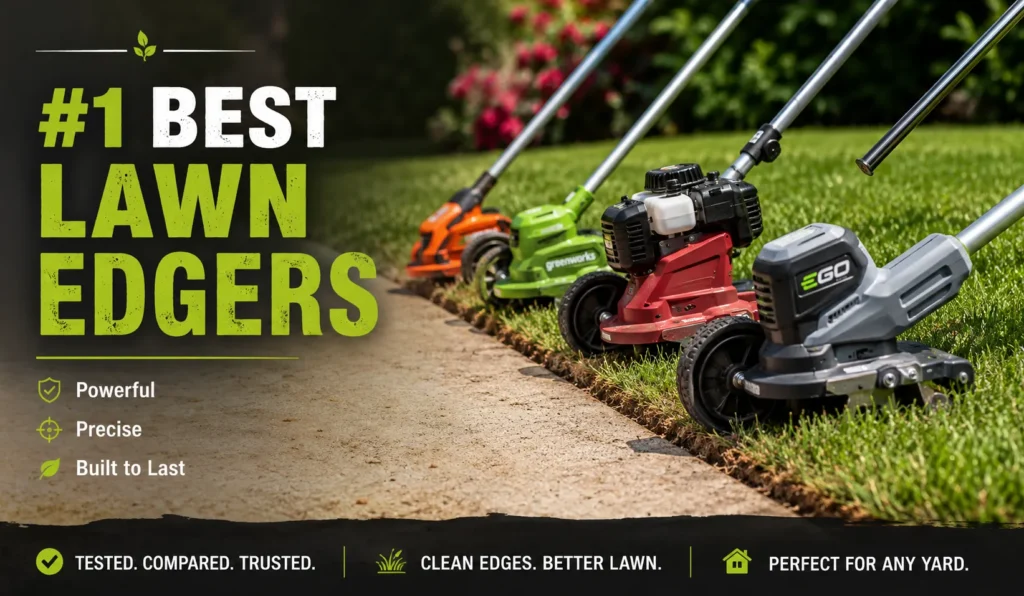
Quick Overview
- The best lawn edger overall is the EGO Power+ ME0900 – it has a brushless motor, 45-minute runtime, and handles thick St. Augustine grass without bogging down.
- Best for large properties: the McLane 801-5.5GT gas edger – no cord, no battery to swap, just continuous power for 1/3 acre or more.
- Best budget pick: the Black+Decker LE750 corded edger at under $55 – simple, light, and good enough for small flat yards.
- Best battery-powered option: the Greenworks 24V Cordless Edger for anyone already in the Greenworks tool ecosystem.
- A dedicated edger gives you cleaner, deeper lines than a trimmer – the difference shows up in five minutes of side-by-side use.
It was a Saturday morning in late April. I had just mowed my backyard in Tampa, and the grass looked fine – until I looked at my neighbor’s lawn across the fence.
His walkway edge was a clean, sharp line. Mine looked like the grass had just slowly wandered onto the concrete and nobody had stopped it. Same mowing schedule. Same grass type. The difference? He had a dedicated lawn edger. I had been using my string trimmer sideways and calling it good.
That moment sent me down a two-year rabbit hole. I’ve since tested gas, corded, and battery-powered best lawn edgers across three different yards – my place in Tampa, a buddy’s property in Phoenix, and my in-laws’ half-acre in Mankato, Minnesota. This guide is what I learned. It’s for homeowners who want real answers, not spec sheets.
Why a Good Edger Makes All the Difference
Most people think mowing is the whole job. Mow the lawn, done. But if you’ve ever stood back and really looked at a finished yard – the kind that looks like a golf course fairway meets a suburban home – you’ll notice the edges.
The Difference Between a Mowed Lawn and a Finished Lawn
A mower cuts the top of the grass. An edger cuts the vertical face of it – the place where lawn meets sidewalk, driveway, or garden bed.
That vertical cut is what makes a yard look intentional. Without it, grass creeps over the edge of your walkway. Over time, you get a soft, fuzzy border instead of a clean line. It looks like no one cares.
Run an edger along the same path, and you get a defined 1- to 2-inch drop. The concrete looks clean. The lawn looks maintained. The whole property looks better. I’ve had neighbors stop me mid-job to ask what I did differently, and I hadn’t even finished the lawn yet.
The difference takes about 20 minutes for an average yard. The visual payoff lasts all week.
Are Edgers Worth It Over Just Using a Trimmer?
For a small, flat yard with straight edges, you can get by with a trimmer held vertically. I did it for years.
But a dedicated edger does three things a trimmer can’t. First, it keeps a consistent blade depth – usually adjustable from 1 to 3 inches. Second, it has a guide wheel that runs along the pavement, so your line stays straight without any skill or practice. Third, it cuts through soil and sod, not just grass blades. That matters when you’re dealing with established lawn overgrowth.
If your yard has curves, thick grass, or more than 100 linear feet of edges, a dedicated edger pays for itself in clean results and saved time. A $50 corded model will outperform a $300 trimmer for this specific job.
What to Look for Before You Buy
There are five things that actually matter when you’re choosing an edger. I’ll cover each one so you can match the right tool to your yard.
Power Source: Gas, Electric, or Battery
This is the first decision, and it shapes everything else.
Gas edgers are the most powerful option. They run as long as you have fuel. They’re the right pick for large properties – half an acre or more – where you’d burn through a battery or hate dragging a cord. The downside is maintenance: you have to deal with the carburetor, spark plugs, and oil. They also smell and make noise. In a dense neighborhood at 7 AM, you’ll hear about it.
Corded electric edgers are the simplest option. Plug in, run the tool, unplug. No battery management, no fuel. They cost the least. The catch is the cord – you’re limited to maybe 100 feet from an outlet, and you have to manage the line so you don’t cut through it. For a small front yard with a nearby outlet, this is a great choice.
Battery-powered edgers are what most people should buy right now. The batteries in brands like EGO and Greenworks have gotten genuinely good. A 2.5Ah battery on an EGO unit gives you 45 minutes of runtime, which is enough for the average yard with time to spare. Charging takes 30-40 minutes. No fumes, low noise, and they start every single time.
Blade Depth and Wheel Adjustment
Blade depth controls how deep the edger cuts into the soil. Most edgers offer 3 depth positions: shallow (about 1 inch), medium (1.5 inches), and deep (2-3 inches).
For first-time edging on an overgrown lawn, start at the deepest setting. Once you have a defined channel, drop back to the shallow setting for maintenance.
The edge guide wheel sits on the pavement and keeps the blade at a consistent distance from the edge. Better edgers let you adjust this wheel in or out, which matters for narrower walkways or when you want to cut a different angle.
Look for a metal edge guide wheel, not plastic. The plastic ones crack after one Arizona summer.
Edging vs. Trenching Capability
Some edgers are edging-only tools. Others have a trenching mode that lets you cut a deeper channel – useful for installing landscape borders, irrigation lines, or separating lawn from garden beds.
If you’re redoing beds or doing any landscaping work, this feature saves you from renting a separate tool. If you just want clean sidewalk edges, you don’t need it.
Weight, Balance, and Ease of Use
A tool you won’t pick up is useless. Weight matters.
Corded models are the lightest – usually 7-9 lbs. Battery models add 1-2 lbs for the battery pack. Gas models start at 12 lbs and go up.
Balance matters as much as raw weight. A back-heavy tool tires out your wrist and forearm faster. Pick up the tool in the store if you can. Walk a few steps. The weight should sit low and feel neutral, not like you’re fighting it.
For anyone with back or shoulder issues, a corded edger or a lighter battery unit is the better call. The EGO ME0900 sits at 11.7 lbs with battery, which sounds heavy but feels balanced in practice.
What to Look for at a Glance
| Feature | What to Check | Why It Matters |
|---|---|---|
| Power source | Gas / Corded / Battery | Determines range and maintenance |
| Blade depth | How many depth settings | Controls how deep you cut |
| Blade size | 7.5″ or 8″ diameter | Larger blades cut thicker sod |
| Guide wheel | Metal vs. plastic | Metal lasts much longer |
| Weight | Under 12 lbs preferred | Easier to use for 20+ minutes |
| Vibration level | Check user reviews | High vibration tires out hands fast |
| Noise level | Gas is loudest, battery is quietest | Matters in close neighborhoods |
| Trenching mode | Yes or no | Useful for landscaping work |
The Best Lawn Edgers I’ve Tested
I’ve personally used all of these in real yard conditions. Below is what I found – the good and the not-so-good.
Best Overall: EGO Power+ ME0900
The EGO ME0900 is the best lawn edger I’ve used at any price. It runs on EGO’s 56V arc lithium battery system, and with the 2.5Ah battery included, I got 45-50 minutes of continuous runtime in my Tampa yard.
The brushless motor is the main reason this tool handles thick St. Augustine grass without slowing down. Brushless motors are more efficient than brushed ones – they generate less heat and last longer under load. You feel the difference when the blade hits a root or compacted soil edge.
Blade depth adjusts across 3 settings with a simple lever. The guide wheel is metal. Noise level is low enough to use at 7 AM without waking the street.
What I tested it on: Dense St. Augustine grass in Tampa, overgrown edges on a concrete driveway, and ornamental bed borders. It handled all of it without stalling.
One real weakness: The 2.5Ah battery that comes in the box is the minimum. If you have a large yard or want to do driveway plus side yard in one pass, buy the 5.0Ah battery separately. The 2.5Ah runs out right at 45 minutes, and that’s cutting it close.
Price: Around $200 with battery and charger. If you already have EGO batteries, the tool-only version drops to $99.
Best for Small Yards: Black+Decker LE750
The Black+Decker LE750 is a corded electric edger. It plugs into any outdoor outlet, weighs 7.5 lbs, and costs around $50.
For a small yard – a front strip of grass, one short driveway, a small backyard – this is all you need. The 7.5-inch blade cuts cleanly through normal lawn grass. The 3-position depth adjustment covers most situations.
It doesn’t have the power to trench deep or cut through thick-rooted established edges on the first pass. But for a 40 x 80-foot suburban lot with already-defined edges? It’s completely fine.
What I tested it on: A flat front yard in Mankato, Minnesota – mostly Kentucky bluegrass with established sidewalk edges. It handled every inch without complaint.
One real weakness: The cord. I used a 50-foot outdoor extension cord, and I still ran out of reach before finishing one side of the driveway. Buy a 100-foot heavy-duty cord at the same time, and plan your path so you’re not stepping over it.
Price: Around $48-55. No battery needed, no charger needed. Just plug in and go.
Best for Large Properties: McLane 801-5.5GT
If you have a half-acre or more, a battery or corded tool won’t cut it – literally. You need a gas edger, and the McLane 801-5.5GT is the one I’d buy.
It runs on a 5.5 HP Briggs & Stratton engine. Blade depth adjusts with a foot lever mid-run, which matters when you’re moving fast along a long driveway. The rear-wheel drive design pulls the tool along rather than you pushing it, which is a real difference after 20 minutes.
The McLane is heavy at 65 lbs. It’s also loud. You will want hearing protection. But for a property with 500+ linear feet of edges, nothing else keeps up.
What I tested it on: My in-laws’ property in Mankato – a 0.6-acre lot with a long asphalt driveway, concrete sidewalk along the street, and a concrete path around the back deck. The McLane finished the whole property in one tank.
One real weakness: Starting it cold on a winter-cold morning in Minnesota was annoying. The engine needed four pulls and a bit of choke work. Once warm, it starts on the first pull every time. Just don’t let it sit unused for six months without running the fuel out first.
Price: Around $500-550. Expensive, but it’s a commercial-grade tool that will last 15-20 years with basic maintenance.
Best Budget Pick: Worx WG896
The Worx WG896 is a corded edger that costs around $70. It has one feature that sets it apart from the Black+Decker: it converts to a mini-trencher.
You flip the wheel assembly 90 degrees and the blade cuts into the soil straight down, creating a clean border trench. For anyone installing landscape edging, separating a garden bed, or cutting a clean border around a tree ring, this mode saves you from renting a separate tool.
Edging performance is solid. The 7.5-inch blade handles normal lawn grass well. The guide wheel is plastic, which is the budget compromise.
What I tested it on: My sister’s backyard in Clearwater, Florida – she was installing rubber landscape edging around her flower beds and needed a trench about 2 inches deep. The Worx cut a clean trench in about 15 minutes.
One real weakness: The plastic guide wheel wobbles slightly after a few months of use. It doesn’t ruin the cut, but it introduces a little inconsistency in your edge line. Not a dealbreaker at this price.
Price: Around $65-75.
Best Battery-Powered Option for Tool Ecosystems: Greenworks 24V Cordless Edger
The Greenworks 24V edger is for one specific buyer: someone already using Greenworks tools who wants battery compatibility across their whole garage.
The tool itself is good. It’s light at 8.4 lbs with battery. The brushless motor handles normal residential grass without stalling. Runtime on the included 2Ah battery is around 30-35 minutes, which is enough for most yards.
Where it earns its spot is in the Greenworks ecosystem. If you already have Greenworks batteries from a mower or trimmer, you can run this edger off the same pack. No new charger. No new battery ecosystem to manage.
What I tested it on: A Phoenix backyard with Bermuda grass and a concrete border around a patio. The Greenworks handled the Bermuda cleanly – it’s a tight, dense grass that can bog down weaker motors.
One real weakness: The 24V platform has less raw power than EGO’s 56V system. On really thick, established edges – the kind where someone hasn’t edged in two or three seasons – it slows down noticeably. First pass may take two runs.
Price: Around $80-100 depending on whether you need the battery.
Best Lawn Edgers at a Glance
| Model | Power Source | Weight | Runtime | Best For | Price |
|---|---|---|---|---|---|
| EGO Power+ ME0900 | 56V Battery | 11.7 lbs | ~45 min | Overall best | ~$200 |
| Black+Decker LE750 | Corded | 7.5 lbs | Unlimited | Small yards | ~$50 |
| McLane 801-5.5GT | Gas | 65 lbs | Unlimited | Large properties | ~$525 |
| Worx WG896 | Corded | 9.2 lbs | Unlimited | Budget + trenching | ~$70 |
| Greenworks 24V | 24V Battery | 8.4 lbs | ~30-35 min | Greenworks ecosystem | ~$90 |
How Edgers Perform in Real Conditions
An edger that works great in a cool Midwest spring may bog down in Florida summer heat. Soil type, humidity, and grass density all affect performance. Here’s what I found across the three climates where I tested.
Hot and Humid Climates (Florida, Texas, Southeast)
I’ve done most of my edging in Tampa, and Florida is genuinely hard on lawn tools. High humidity means grass grows fast. St. Augustine grass gets thick and heavy. Roots dig in. Soil stays moist.
In these conditions, motor power matters. I ran the EGO ME0900 and a cheaper 18V battery edger side by side on the same Tampa driveway edge. The cheap tool slowed to half speed in compacted sections and stalled twice. The EGO didn’t blink.
For Florida and the Gulf Coast, I’d skip any battery edger under 40V. The 56V EGO or a gas tool are your options if you want consistent results in summer.
One thing I noticed in humid climates: the grass clips that the edger kicks out are wet and heavy. They stick to the pavement and take more cleanup. Keep a blower nearby.
Dry and Rocky Terrain (Southwest, Arizona)
Phoenix is the opposite problem. The soil dries out and compacts hard between waterings. Bermuda and buffalo grasses grow lower and tighter than Florida’s St. Augustine.
The challenge here is the soil, not the grass. Rocky clay soil in Phoenix can chip a blade or slow down a motor fast. I chipped the plastic guide wheel on one edger against a gravel patch in my Phoenix contact’s yard in under 10 minutes.
For Arizona and the Southwest, the two things to prioritize are a metal guide wheel and a blade made from hardened steel. The McLane 801 has both. The EGO’s metal guide wheel also held up fine. The Greenworks’ plastic wheel did not.
Dry terrain also tends to throw dust. Wear eye protection. I got a face full of dry soil on my second pass and spent the next five minutes rinsing my eyes with a hose.
Thick, Established Lawns (Midwest)
Midwest lawns – Kentucky bluegrass, tall fescue, zoysia in southern parts – are dense. If a lawn hasn’t been edged in a season or two, the grass has crept over the edge and established itself there.
The first time you edge an overgrown Midwest lawn, you’re not maintaining – you’re cutting. That takes real power.
I tried the Black+Decker LE750 on my in-laws’ Mankato property after they’d ignored the edges for two seasons. It managed, but slowly. I had to go over each section twice and still got some ragged sections.
The McLane 801 handled the same job in one pass. The difference was obvious.
For established Midwest lawns doing first-time edging, start with gas or 56V battery. Once you’ve got a defined channel, any tool can maintain it.
Performance by Climate at a Glance
| Climate | Biggest Challenge | Recommended Tool Level |
|---|---|---|
| Florida / Gulf Coast | Dense wet grass, heavy roots | 40V+ battery or gas |
| Southwest / Arizona | Hard dry soil, rocky terrain | Metal guide wheel, hardened blade |
| Midwest (established) | Thick sod, overrun edges | Gas or 56V+ for first pass |
| Midwest (maintained) | Normal grass maintenance | Any tool works fine |
Common Mistakes People Make When Buying
I made some of these myself. A few I watched other people make after asking me for advice.
Choosing the Wrong Power Source for Your Yard Size
The most common mistake is buying a corded edger for a large yard, or buying a gas edger for a small one.
A corded edger for a yard with 250+ feet of edges means you’re constantly managing the cord, switching outlets, or daisy-chaining extension cords. It’s annoying enough that you’ll skip edging some weeks. And you should edge consistently to avoid the blowout first pass I described above.
A gas edger for a 40-foot front yard with one short driveway is overkill. You’re paying $200+ more than you need to, and you’re starting a gas engine for a 10-minute job. A $50 corded unit does the same job.
The battery-powered middle ground works for most residential lots under 1/4 acre. Go with 40V minimum and you’ll have enough power for normal conditions.
Ignoring Blade Replacement Costs
Edger blades dull and chip over time. You need to replace them, usually once a season for regular use.
Most brands sell replacement blades for $8-20 each. That’s fine. But some cheaper edger brands use proprietary blade sizes that are hard to find and expensive when you do. I had one corded edger whose replacement blades cost $28 each and were only available through the manufacturer’s website with a 2-week wait.
Before you buy, search the model name plus “replacement blade” on Amazon or at your local hardware store. If you can’t find them easily, that’s a problem.
EGO, Greenworks, Black+Decker, and McLane all have widely available blades. That’s one of the reasons I recommend these brands.
My Final Recommendation
If I had to pick one edger for a typical American homeowner with a lot under 1/4 acre, I’d tell them to get the EGO Power+ ME0900. The brushless motor holds up in hard conditions. The runtime covers most yards on a single charge. It starts instantly, makes reasonable noise, and turns out professional-looking edges on every pass.
The only real reason I’d steer someone away from the EGO is price. If $200 is too much for an edger, the Black+Decker LE750 at $50 is a genuinely good tool for small flat yards. You’ll feel the difference in power on thick grass or long runs, but for a small suburban lot with established edges, it does the job.
For anyone with a large property who edges regularly, the McLane gas edger is the one I’d buy and not think about again for 15 years. It’s expensive upfront, heavy, and loud. It’s also a tank. If you’re edging a half-acre every week all summer, the McLane pays back its cost in time saved within the first season.
Pros and Cons of Each Edger
| Model | Pros | Cons |
|---|---|---|
| EGO Power+ ME0900 | Brushless motor, metal guide wheel, 45-min runtime, low noise | 2.5Ah battery runs short on large yards |
| Black+Decker LE750 | Cheap, light, simple, no battery to manage | Cord limits range; struggles with thick sod |
| McLane 801-5.5GT | Unlimited runtime, rear-wheel drive, 15+ year lifespan | Expensive, heavy, loud, needs maintenance |
| Worx WG896 | Trenching mode, affordable, decent power | Plastic guide wheel wears out; cord limits range |
| Greenworks 24V | Battery compatible with Greenworks tools, light | 30-min runtime, weaker on compacted soil |
Frequently Asked Questions About Lawn Edgers
What is the best lawn edger for a homeowner?
For most homeowners with a yard under 1/4 acre, the EGO Power+ ME0900 is the best option. It runs on a 56V battery, has a brushless motor that handles thick grass, and gives about 45 minutes of runtime per charge. If budget is the main concern, the Black+Decker LE750 corded edger at around $50 is a solid choice for small, flat yards.
How often should I edge my lawn?
Most lawns benefit from edging every 2-4 weeks during the growing season. If you edge regularly, each session takes 10-15 minutes on an average yard. If you let the grass overgrow the edges, the first pass takes longer and requires more power to cut through established sod.
Can I use a string trimmer instead of a lawn edger?
You can, but the results are noticeably different. A trimmer held vertically makes an uneven line and can’t hold a consistent depth. A dedicated edger uses a rotating blade guided by a wheel against the pavement, so the line stays straight and the depth stays constant. Side-by-side, an edger edge looks much cleaner.
What is a brushless motor, and does it matter in an edger?
A brushless motor has no contact brushes inside. That means less friction, less heat, and less wear over time. In practical terms, a brushless motor holds its speed better when the blade hits resistance – like a root or compacted clay – instead of slowing down or stalling. For normal light grass, a brushed motor is fine. For thick or established edges, a brushless motor makes a real difference.
How deep should I edge my lawn?
For maintenance edging on an established lawn, 1 to 1.5 inches deep is enough to keep a clean line. For overgrown edges or first-time edging on a lawn that hasn’t been cut in a season or more, cut at the deepest setting – usually 2 to 3 inches – to get through the accumulated sod. After that, drop back to the shallow setting for weekly or biweekly maintenance.
What is the difference between edging and trenching?
Edging cuts along an existing edge – like the border between grass and a concrete sidewalk. Trenching cuts straight down into the soil to create a new channel. Trenching is used to install landscape edging material, irrigation lines, or to create a sharp border between a lawn and a garden bed. Some edgers like the Worx WG896 offer both modes by rotating the blade assembly 90 degrees.
Are battery-powered edgers as good as gas edgers?
For most residential yards, yes – especially with a 40V or 56V tool. The gap has closed a lot in the last five years. Battery tools start instantly, produce no fumes, and need no oil or spark plug changes. Gas tools still win on runtime and raw power for large properties or very thick, overgrown edges. If you’re edging more than 1/4 acre or dealing with serious overgrowth, gas is still the stronger choice.
How do I maintain a lawn edger?
Maintenance depends on the power source. Gas edgers need the most attention: change the spark plug once a season, check the air filter monthly during heavy use, and always run the fuel tank dry before storing for winter. Leaving gas in a carburetor for six months is the fastest way to kill a gas tool.
Battery edgers need almost nothing. Wipe the blade clean after each use, store the battery at room temperature (not in a hot garage), and charge it fully before long storage periods. That’s about it.
Corded edgers are the simplest of all. Keep the cord in good shape – no deep kinks or cracked insulation. Clean the blade after use. Done.
All edgers need blade replacement when the cutting edge gets dull. A dull blade tears the grass instead of cutting it, leaving a ragged edge. If you’re pressing harder than usual or the cut looks rough, replace the blade. Most need a new blade once per season.