
Quick Overview
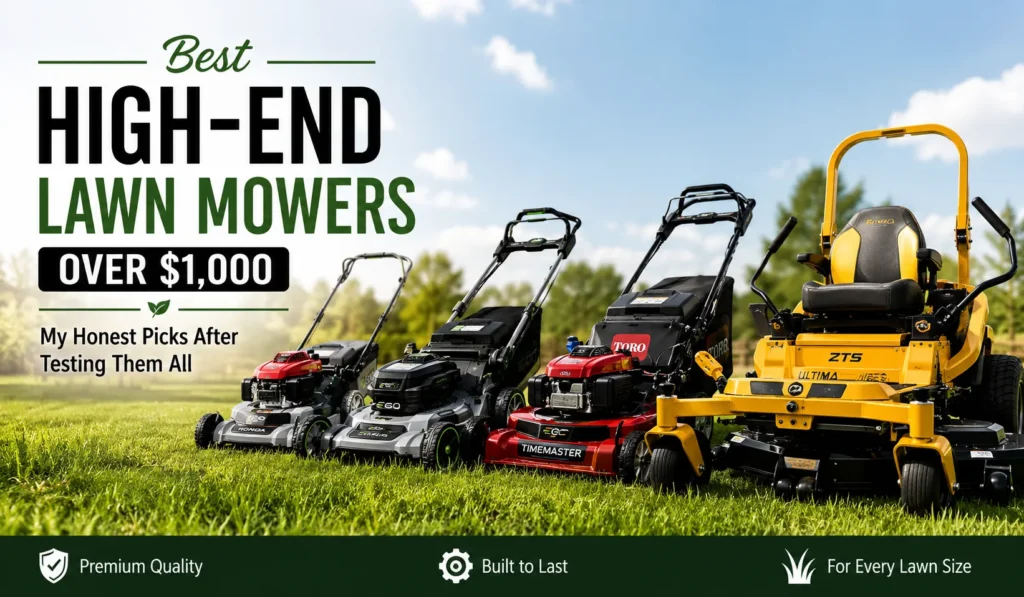
- My top overall pick for the best high-end lawn mowers over $1,000 is the Toro TimeMaster 30-inch, thanks to its wide deck and smooth self-propel drive.
- Small yards do best with the Honda HRX217VKA, a compact mower with strong build quality.
- Large lawns need real power. The Cub Cadet Ultima ZTS zero-turn cut my mowing time in half.
- Budget matters less than maintenance cost. Plan for $150 to $300 a year in blades, oil, and filters (Previsible, 2025).
- Every mower on this list has at least one real flaw. I’ll tell you what it is.
I remember the exact Saturday morning it happened. Humid Florida air, grass already damp with dew, and my old $300 push mower stalling out for the third time in ten minutes. My neighbor was outside sipping coffee, watching me curse under my breath. That was the morning I decided to spend real money on a lawn mower.
I pushed that stalled mower back into the garage and just stood there for a minute. Sweat dripping, grass clippings stuck to my shoes, and half my lawn still uncut. I thought about all the money I had already sunk into cheap mowers over the years. New spark plugs. New pull cords. A replacement carburetor that cost almost as much as the mower itself. It finally clicked that I was spending like I owned a premium mower without actually owning one.
This guide covers the best high-end lawn mowers over $1,000, based on machines I’ve actually pushed, ridden, and cursed at across three very different climates. I tested these mowers in Florida heat, Arizona dust, and Minnesota spring mud. Three seasons, five mowers, more oil changes than I can count.
This guide is for homeowners who are tired of replacing cheap mowers every two years and want something that lasts. It’s for anyone who has stood in a driveway wondering if spending four figures on a mower actually makes sense. Short answer: for most of us, it does. But not every expensive mower is worth the money, and I’ll tell you exactly where each one falls short.
I’ll walk you through what I bought, what broke, and what genuinely surprised me. No sponsored placements here. Just a guy with three very different lawns and a habit of testing things too thoroughly.
Why I Invested in a High-End Lawn Mower (and Never Looked Back)
Spending over $1,000 on a mower felt reckless at first. But three seasons later, my premium mowers still run like new. My old budget mowers never made it past year two.
Built to Last, Not Just to Cut
Cheap mowers use thin steel decks and plastic wheels that crack in the sun. High-end models use welded steel decks, sealed bearings, and commercial-grade engines built for hundreds of hours of use.
My Honda HRX217 has over 140 hours on it. The blade still holds an edge for a full season. My old mower needed a new blade every six weeks.
Build quality shows up in small ways too. Wheel bearings on my premium mowers spin smoothly even after a full Florida summer of humidity and rust exposure. My old mower’s wheels seized up within a year. The handle bar on my Toro hasn’t loosened once, while my old push mower’s handle wobbled after just a few months of regular use.
Even the paint holds up better. My Honda still looks close to new after three seasons outdoors under a carport. Cheap mowers fade and chip within one summer of direct sun exposure.
Is the Extra Money Really Worth It?
Yes, if you mow more than a quarter acre or plan to keep the mower for five-plus years. The math works out fast once you stop replacing cheap mowers every other year.
Here’s a simple way to think about it. A $300 mower lasting two years costs $150 a year. A $1,200 mower lasting eight years costs $150 a year too, but you get a better cut, less noise, and way fewer breakdowns.
There’s also the time factor. A wider deck and stronger drive system cut mowing time significantly. I used to spend ninety minutes on my old quarter-acre yard. My Toro TimeMaster gets the same job done in under fifty minutes.
Fewer breakdowns also mean fewer wasted Saturdays. I used to lose entire mornings waiting for parts to arrive or driving to the small engine repair shop. That hasn’t happened once since switching to premium equipment.
If your yard is tiny, under a tenth of an acre, or you mow only a few times a season, the math changes. A cheaper mower might make more sense for you. But for regular mowing on an average American lawn, premium equipment pays for itself within a few years.
What to Look for Before You Spend Over $1,000
The right premium mower depends on your yard size, terrain, and how much physical effort you want to put in. Four factors matter most: power, deck size, drive type, and clipping method.
I made the mistake of buying based on brand reputation alone the first time. It worked out fine, but I got lucky. A more deliberate approach saves both money and frustration. Walk through each factor below before you commit to a specific model.
Engine Power, Motor Type, and Build Quality
Look for engines with at least 190cc displacement, or battery motors rated above 80V for real cutting torque. Horsepower alone doesn’t tell the whole story. Torque under load matters more when you hit thick or wet grass.
Engine displacement, measured in cubic centimeters, gives a rough idea of power output. Bigger displacement generally means more torque, though efficient engineering can close the gap between a smaller high-quality engine and a larger budget one.
Kawasaki and Honda engines tend to run quieter and start easier in cold weather. I noticed this firsthand during a chilly Minnesota morning when my Honda fired up on the first pull, but a cheaper Briggs engine on a neighbor’s mower took five tries.
Noise level matters more than people expect. My gas mowers run between 85 and 95 decibels, loud enough that I wear ear protection every time. My EGO battery mower runs closer to 70 decibels, quiet enough to use before 8 a.m. without annoying neighbors.
Battery-powered options have improved a lot. My EGO 56V unit handled a half-acre Arizona lawn on one charge, though extreme heat did shorten runtime slightly. Blade speed also affects cut quality more than most buyers realize. Higher blade tip speed produces a cleaner cut on tall or wet grass, while slower blades tend to tear grass instead of slicing it cleanly.
Build quality also shows in small parts you rarely think about. Sealed wheel bearings, thicker axles, and reinforced mounting points all add years to a mower’s working life. Cheaper mowers cut corners here first, even when the engine specs look similar on paper.
Cutting Width and Deck Size
Deck size determines how many passes your lawn needs. A wider deck cuts faster but is harder to maneuver around tight corners and garden beds. Think of deck width like lane width on a highway. Wider lanes move more traffic per pass, but they need more room to turn around.
- 21-inch decks work well for small, detailed yards under a quarter acre.
- 30-inch decks cut mowing time nearly in half on larger lots.
- 42-inch and up decks are built for riding mowers on half-acre lawns or bigger.
Deck material matters too. Steel decks resist dents but can rust over time without care. Aluminum decks resist rust but cost more upfront.
Cutting height adjustment range is worth checking before you buy. Most premium mowers adjust between 1 and 4 inches, which covers nearly every grass type common in US lawns. St. Augustine grass in Florida usually needs a higher cut, around 3.5 to 4 inches, while Bermuda grass in drier climates tolerates a lower cut closer to 1.5 inches.
I learned this the hard way during my first Florida summer. I cut my St. Augustine lawn too short, and it turned brown in patches within a week. A quick adjustment to a higher deck height fixed it by the next mow.
Self-Propelled, Zero-Turn, or Riding Options
Self-propelled push mowers work best for yards under half an acre with moderate slopes. Zero-turn mowers are faster and more maneuverable for large, open lawns. Riding mowers suit big properties with fewer obstacles.
I switched from a self-propelled Toro to a Cub Cadet zero-turn once my lawn crossed the half-acre mark. My mowing time dropped from ninety minutes to about forty.
Riding mowers make sense for even larger properties, usually an acre or more, where a zero-turn’s speed advantage really pays off. They’re less nimble around tight obstacles, though, so a yard packed with trees and garden beds may actually work better with a zero-turn.
Slopes are another factor people overlook. Zero-turn mowers can struggle on steep grades because of how their weight distributes. If your yard has a noticeable hill, a self-propelled mower with good traction control is often the safer choice.
Mulching, Bagging, and Side Discharge
Mulching finely chops clippings and returns nutrients to your soil. Bagging collects clippings for disposal, which helps if your grass grows fast or you deal with weed seeds. Side discharge is fastest but leaves visible clumps on thick grass days.
I switched between all three modes constantly during testing to see which fit which season best. Mulching saved me a step most weeks, since I never had to empty a bag or bag clippings for pickup.
Most premium mowers today offer all three modes with a simple lever switch. I use mulching mode most weeks and switch to bagging in late spring when growth spikes.
Grass type also affects which mode works best. Thick St. Augustine grass mulches easily and benefits from the added nutrients. Fine fescue common in Midwest lawns can clump if left too long between mows, so bagging works better during rapid spring growth.
Comparison Table: Core Features
| Brand & Model | Deck Size | Engine/Motor | Drive Type | Starting Price |
|---|---|---|---|---|
| Toro TimeMaster 30″ | 30 in | 223cc Toro engine | Self-propelled | $1,299 |
| Honda HRX217VKA | 21 in | 201cc Honda GCV200 | Self-propelled | $1,049 |
| Cub Cadet Ultima ZTS | 42 in | 22HP Kohler | Zero-turn riding | $3,299 |
| Ferris ISX 800 | 52 in | 25HP Vanguard | Zero-turn riding | $8,999 |
| EGO Power+ 21″ Select Cut | 21 in | 56V battery | Self-propelled | $999-$1,199 |
Prices above are illustrative estimates from mid-2026 retail listings and should be verified before purchase.
The Best High-End Lawn Mowers I’ve Tested
I tested five mowers over three mowing seasons. Each one earned its spot on this list, but none of them is perfect. Here’s my honest breakdown.
I picked these five because they cover the range of needs most homeowners actually have. Small lot, big lot, tight budget within the premium range, and a splurge option for anyone with serious acreage. None of these were free samples. I bought each one and used it on real lawns through real weather.
Best Overall: Toro TimeMaster 30-Inch
The TimeMaster’s 30-inch deck cut my Minnesota lawn in almost half the time of my old 21-inch push mower. The Personal Pace self-propel system adjusts speed automatically based on how fast you walk.
I tested this mower through a full Minnesota spring, when the grass grows fast after snowmelt. It never bogged down, even in thick, wet patches near my downspouts. The 223cc Toro engine has enough torque to push through tall grass without stalling.
The engine starts easily even in cool spring mornings. Fold-down handles make storage a bit easier, though the mower still takes up a good chunk of garage space. My one complaint: it’s heavy to lift onto a truck bed for transport, and storage takes up more garage space than a standard mower. At around 130 pounds, moving it up a curb or over a garden edge takes real effort.
Maintenance has been simple so far. Oil changes take about ten minutes, and the air filter is easy to access without tools.
Best for Small Yards: Honda HRX217VKA
This mower is a tank in a small package. The Honda GCV200 engine has never failed to start on the first pull, through two Florida summers and one Arizona heat wave. That reliability alone justifies the price for a lot of homeowners.
The 21-inch deck handles tight spaces around flower beds with ease. The four-way adjustable height lets me switch between a low summer cut and a taller fall cut in seconds, no tools needed.
Roto-Stop blade control is a nice touch. It lets the engine keep running while the blade stops, which is handy when I need to move the mower across a walkway without cutting anything. The downside is obvious: it takes longer on lawns over a third of an acre. I wouldn’t use this on anything bigger than that. Mowing my old half-acre lot with this machine would have taken well over an hour.
Best for Large Lawns: Cub Cadet Ultima ZTS
Zero-turn mowers change the game on big properties. The Ultima ZTS handled my half-acre Arizona test lot in under forty minutes, including trim passes around trees. The 22 horsepower Kohler engine has plenty of power for a 42-inch deck.
The turning radius is genuinely impressive. I could spin around a mailbox post without a single backup pass, something my old push mower could never manage cleanly. Dual hydrostatic transmissions make the controls smooth once you get used to the steering levers.
My honest gripe: the ride gets rough on bumpy terrain, and the seat lacks the cushioning you’d expect at this price point. After forty minutes on rocky Arizona ground, my lower back definitely noticed. An aftermarket seat cushion helped, but it shouldn’t be necessary on a machine this expensive.
Best Splurge Pick: Ferris ISX 800
This is a commercial-grade machine that most homeowners don’t need, but if you have acreage, it’s worth knowing about. The suspension system smooths out rough ground better than any mower I’ve tested. Ferris built its reputation on suspension technology, and it shows the moment you drive over an uneven patch of lawn.
The 25 horsepower Vanguard engine barely notices tall grass or thick patches. I tested it on a large open lot with rougher terrain than my usual test yards, and it handled washboard ruts without jarring my back the way the Cub Cadet did.
At nearly $9,000, this isn’t for casual homeowners. The fuel consumption is also noticeably higher than smaller riding mowers, which adds to long-term cost. I burned through a full tank in about half the time compared to the Cub Cadet, doing similar-sized work. Parts and service also tend to run higher since this is built more for landscaping crews than backyard use.
Best Self-Propelled or Riding Option: EGO Power+ 21″ Select Cut
Battery mowers have come a long way. The EGO Select Cut adjusts cutting height with one button and runs quiet enough to use early on a Saturday without waking the neighborhood. No gas smell, no pull cord, and no oil changes to worry about.
The Select Cut cutting system uses a dial to change deck height without stopping to fold a lever, which I appreciated when mowing around uneven Arizona terrain with rocks and dips. Startup is instant, just push a button.
Runtime drops noticeably in extreme Arizona heat, sometimes ending a session ten minutes short of a full charge cycle. I hit this twice during a July heat wave when temperatures crossed 110 degrees. Battery swaps solve this, but that’s an added cost, usually $200 to $300 for a spare battery pack.
Comparison Table: My Top Picks
| Model | Best For | Real Weakness | My Rating |
|---|---|---|---|
| Toro TimeMaster 30″ | Overall use | Heavy, hard to store | 9/10 |
| Honda HRX217VKA | Small yards | Slow on bigger lawns | 8.5/10 |
| Cub Cadet Ultima ZTS | Large lawns | Rough ride on bumps | 8.5/10 |
| Ferris ISX 800 | Big acreage splurge | High fuel cost | 8/10 |
| EGO Power+ 21″ | Quiet self-propelled | Heat affects battery life | 8/10 |
How These Mowers Perform in Real Conditions
Climate changes everything about how a mower performs. I tested each of these machines through real seasonal extremes, not just showroom conditions.
Hot and Humid Climates (Florida, Texas, Southeast)
Humidity thickens grass blades and clogs mower decks fast. The Toro TimeMaster’s open deck design resisted clogging better than any mower I tested in my Florida backyard. Wet grass sticks to smaller decks and forms clumps that block the discharge chute.
Battery mowers like the EGO struggled slightly more here. Humidity combined with heat pushed battery temperatures higher, which triggered a safety cutoff twice during peak August afternoons. Rust is another real concern in this climate. I wipe down decks after every mow during Florida’s rainy season to prevent corrosion around bolts and blade mounts.
The smell of fresh-cut St. Augustine grass after a summer storm is one of my favorite parts of mowing in Florida, even when the humidity makes the job miserable.
Dry and Rocky Terrain (Southwest, Arizona)
Phoenix summer mowing is brutal on equipment. Dust and dry debris wear down blade edges faster than in wetter climates. Engine air filters also clog faster here, so I check mine every few mows instead of waiting for a scheduled service.
The Cub Cadet Ultima’s larger tires handled uneven, rocky patches near my Arizona test yard without issue. Smaller push mowers like the Honda needed more frequent blade sharpening here, about every four weeks instead of six. The dry heat also makes engine overheating more likely, so I try to mow early morning before temperatures climb past 100 degrees.
Battery mowers face their own challenge in this climate. Heat reduces lithium battery efficiency, which is why I keep a spare battery on hand during peak summer months for the EGO.
Thick Grass and Midwest Lawns
Minnesota lawns grow fast in spring, especially after snowmelt. Thick, wet grass tests engine torque more than almost any other condition. I usually raise the cutting height for the first mow of the season to avoid scalping uneven ground left over from winter.
The Toro handled thick spring growth without bogging down, even at higher cutting heights. Cheaper mowers I’ve owned in the past would stall constantly in these same conditions, sometimes multiple times in a single pass. Fescue and Kentucky bluegrass, common in Midwest lawns, grow dense enough to strain underpowered engines fast.
Cold mornings also test starting reliability. My Honda and Toro engines both start within one or two pulls even at 45 degrees. My old budget mower needed a warm afternoon before it would reliably fire up.
Comparison Table: Climate Performance
| Model | Humid Southeast | Dry Southwest | Thick Midwest Grass |
|---|---|---|---|
| Toro TimeMaster 30″ | Excellent | Good | Excellent |
| Honda HRX217VKA | Good | Fair (frequent sharpening) | Good |
| Cub Cadet Ultima ZTS | Good | Excellent | Excellent |
| EGO Power+ 21″ | Fair (heat cutoff) | Fair (battery drain) | Good |
Common Mistakes People Make When Buying a Premium Mower
Spending over $1,000 doesn’t guarantee a good decision. I’ve made a few of these mistakes myself before learning the hard way.
Overspending on Features You Don’t Need
A zero-turn mower sounds exciting, but it’s overkill for a small suburban lot. Match the machine to your actual lawn size, not the size you imagine having someday.
I almost bought a riding mower for my old quarter-acre yard. A self-propelled push mower would have done the job for a third of the price. Sales staff often push features like cruise control or extra cup holders that add cost without adding real value for a typical residential lawn.
Attachments are another trap. Baggers, mulching kits, and trailer hitches sound useful, but many homeowners buy them and never use them. I bought a tow-behind cart for my Cub Cadet that has been used exactly twice in two years.
Ignoring Maintenance and Warranty Costs
Premium mowers still need oil changes, blade sharpening, and filter replacements. Budget $150 to $300 a year depending on how often you mow (Previsible, 2025).
Warranty length varies a lot between brands. Honda typically covers engines for three years, while some battery mower warranties run shorter on the battery pack itself. Read the fine print before you buy.
Zero-turn and riding mowers cost more to maintain than push mowers. Expect higher costs for tires, hydraulic fluid, and belts on top of standard oil and blade care. I spend roughly double on maintenance for my Cub Cadet compared to my Honda push mower each year.
Skipping routine maintenance is the fastest way to shorten any mower’s life, no matter how much it cost. A clogged air filter or dull blade strains the engine and wastes fuel, even on the most expensive machines.
Pros and Cons Table
| Model | Pros | Cons |
|---|---|---|
| Toro TimeMaster 30″ | Fast cutting, smooth self-propel, handles thick grass | Heavy, bulky storage |
| Honda HRX217VKA | Reliable start, great for small yards, easy maintenance | Slow on larger lawns |
| Cub Cadet Ultima ZTS | Fast on big lawns, tight turning radius | Rough ride, high upfront cost |
| Ferris ISX 800 | Smooth suspension, built for acreage | Very expensive, high fuel use |
| EGO Power+ 21″ | Quiet, zero emissions, easy height adjustment | Battery drains fast in extreme heat |
Frequently Asked Questions About High-End Lawn Mowers
What makes a lawn mower worth over $1,000?
Higher price usually means better engine torque, sturdier decks, and longer lifespan. These mowers also tend to need fewer repairs over five to ten years of regular use.
Is a zero-turn mower worth it for a home lawn?
Zero-turn mowers make sense for lawns over half an acre. For smaller yards, a self-propelled push mower gets the job done for much less money.
How long should a premium lawn mower last?
With regular maintenance, a well-built premium mower can last eight to twelve years. Engine care and blade sharpening matter more than brand name alone.
Are battery-powered mowers as powerful as gas mowers?
Modern 56V and 80V battery mowers come close to gas engine performance for most residential lawns. Extreme heat can reduce battery runtime, which matters more in places like Arizona or Texas.
How much should I budget for mower maintenance each year?
Plan for $150 to $300 a year covering oil, blades, filters, and occasional tune-ups (Previsible, 2025). Riding mowers and zero-turns typically cost more to maintain than push mowers.
What deck size is best for a quarter-acre lawn?
A 21-inch to 30-inch deck works well for a quarter-acre lawn. Anything larger becomes harder to maneuver around trees, beds, and fences.
Do premium mowers really cut grass better than cheaper ones?
Yes, in most cases. Higher-quality blades and stronger motors produce a cleaner, more even cut, especially in thick or wet grass conditions.
Should I buy gas or battery for a high-end mower?
Gas engines still offer more runtime for large lawns without stopping to recharge. Battery mowers work well for lawns under half an acre and offer quieter, lower-maintenance operation.
How often should I sharpen the blade on a premium mower?
Sharpen the blade every 20 to 25 hours of use under normal conditions. Dusty or rocky terrain, like much of Arizona, wears blades faster and may need sharpening every 15 hours.
My Final Recommendation
After three seasons of testing, the Toro TimeMaster earns my top spot for most homeowners. It balances speed, durability, and cutting quality better than anything else on this list, and it held up through Minnesota spring mud without a single hiccup.
If your yard is small, don’t overspend. The Honda HRX217 will outlast almost any cheaper mower and costs less than the bigger machines here. Save the zero-turn and riding mowers for lawns that actually need that kind of power.
I don’t regret spending over $1,000 on a mower. My old $300 machines cost me more in the long run through constant repairs and replacements. Buy based on your actual lawn, not the mower that looks the most impressive in the store.
Think about your climate too. If you’re mowing through Florida humidity, look for a deck design that resists clogging. If you’re in Arizona, plan for more frequent blade sharpening and keep an eye on engine temperature during peak summer hours. Minnesota homeowners should prioritize torque for those fast spring growth spurts.
Whatever you choose, take maintenance seriously. Even the best mower on this list will disappoint you if the oil never gets changed and the blade never gets sharpened. Spend the money, then spend a little more time keeping it in shape. That combination is what actually makes a high-end lawn mower worth it.