
Quick Overview
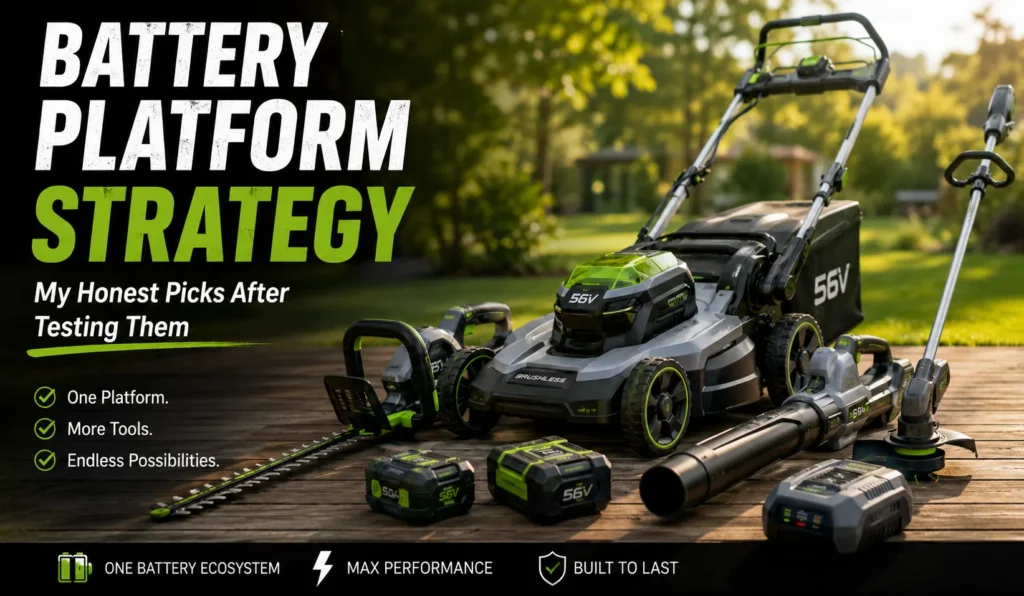
- A battery platform strategy means picking one voltage family and sticking with it, instead of buying tools brand-by-brand.
- EGO 56V is the best overall pick for most suburban yards because it covers nearly every outdoor tool on one voltage (EGO Power+, 2026).
- Ryobi 18V ONE+ wins for small yards thanks to a 300-plus tool ecosystem that shares batteries across yard and household tools (The Honest Reviewers, 2026).
- Greenworks 80V Pro is the only battery platform with a real gas-competing zero-turn and ride-on mower for large properties (GreenReviewsHub, 2026).
- Check tool availability and battery interchangeability before you buy – most platform regret comes from skipping this step, not from picking the “wrong” brand.
My garage used to look like a battery graveyard. Three chargers. Four battery shapes. One dead pack on the exact Saturday I needed to mow before a cookout. That mess is what pushed me into a real battery platform strategy instead of buying whatever mower looked good at Home Depot that week.
I’ve spent the last few seasons testing cordless yard tools across three very different climates. Humid Florida summers. Dry Phoenix heat. Cool Minnesota spring mornings. I’ve run EGO, Ryobi, Greenworks, DeWalt, and Milwaukee packs through real yards, not just a driveway demo.
I also tracked runtime, charge time, and how each battery held up as the season wore on, not just how a tool performed fresh out of the box. A mower that impresses on day one but loses noticeable capacity by August isn’t a fair trade for the convenience it promises. Every recommendation in this guide reflects months of actual use, not a single afternoon test.
This guide is for homeowners who are tired of guessing. Maybe you already own one battery-powered tool and want to know if you should stay in that lane. Maybe you’re starting from zero and don’t want to end up with my old drawer of orphaned batteries. Either way, I’ll walk you through what actually matters and which platform earns your money.
This isn’t a ranked list of individual mowers. Plenty of guides already cover that ground. This is about the battery family behind the mower, the one decision that quietly shapes every yard tool purchase you’ll make for years afterward. Get the platform right, and every future tool purchase gets simpler. Get it wrong, and you’re back in my old garage, staring at three chargers and none of them charging the tool you actually need right now.
Why I Committed to One Battery Platform (and Never Looked Back)
I didn’t plan this. It happened by accident, then on purpose. Once I saw how much simpler one battery family made my weekends, I stopped buying tools by brand loyalty and started buying by battery fit.
One Battery, Every Tool, No Headache
My EGO 56V pack runs my mower, my trimmer, and my blower. I pull one battery off the charger and use it three different ways before lunch. No hunting for the right charger. No dead tool because I grabbed the wrong pack by mistake.
That sounds small until you live it. Before I committed, I owned a Ryobi trimmer, a Black+Decker blower, and a gas mower. Three fuel sources. Three failure points. Now I own one battery family and a shelf with two spare packs.
I remember the exact Saturday that pushed me over the edge. I had a full afternoon planned: mow, trim, blow the clippings off the driveway, and be done before a cookout that evening. The trimmer battery died halfway through the edging. My spare battery, it turned out, belonged to the blower, not the trimmer. I spent twenty minutes driving to a hardware store for a replacement instead of finishing the yard. That’s the kind of afternoon a single battery platform eliminates entirely.
A neighbor asked me last spring why I had three different brands of yard tools sitting in my open garage. I didn’t have a good answer at the time, other than “they were on sale when I needed them.” That’s not a strategy. That’s just accumulation. Once I explained my new one-platform approach, he ended up doing the same thing with his own tools within the month.
Swapping is fast, too. I pull a spent battery off the mower, drop in a charged one, and I’m back to work in under ten seconds. No more waiting around for a slow charge cycle mid-yard.
There’s a mental cost to fragmented batteries that nobody talks about. Before I switched, I had to remember which charger matched which tool, which battery was actually full, and which one had been sitting dead in a drawer since last fall. That’s decision fatigue for a task that should take zero thought. Now I grab any pack off my charging shelf and know it fits whatever I’m about to use.
The financial side matters too. Every extra battery family means an extra charger, and chargers aren’t cheap. A single EGO Rapid Charger runs close to $150 on its own. Multiply that across three or four brands and you’ve spent hundreds of dollars just keeping batteries topped off, on top of the batteries themselves.
Is One Platform Powerful Enough for a Real Yard?
Yes, if you pick the right voltage tier. This is where most people get nervous, and I get it. A battery mower sounds like a toy compared to a gas engine you can hear from three houses down.
I was skeptical too. Then I ran my EGO 21-inch self-propelled mower through thick St. Augustine grass in July and it didn’t stall once. The brushless motor ramps up torque exactly when it hits resistance, the same way a good gas engine downshifts under load.
The catch is voltage and amp-hours. An 18V push mower struggles past a small, flat yard. A 40V, 56V, or 80V mower with a real amp-hour battery handles a half-acre without blinking. Platform alone doesn’t determine power. Platform plus the right battery size does.
For reference, my half-acre Florida yard takes about 35 minutes to cut with a 56V 6.0Ah battery. That beats my old gas mower on convenience, and it ties it on raw cutting power in anything short of waist-high overgrowth.
I want to be fair here, because I know battery skeptics well. I used to be one. My worry wasn’t whether a cordless mower could cut grass. Any mower can cut grass on a calm, dry Tuesday. My worry was whether it could keep up on the days that matter – after three days of rain, or at the end of a hot week when the grass grows an inch overnight.
I still remember comparing torque numbers between my old gas mower and the EGO before I bought it, trying to translate cubic centimeters into something meaningful. It turns out that comparison is less useful than manufacturers make it sound. What matters in practice is how a mower’s motor responds under load, not a static horsepower-equivalent number printed on a box. A gas engine loses RPM under resistance and takes a moment to recover. A good brushless electric motor senses that resistance almost instantly and ramps up torque to compensate, often faster than a gas engine can respond.
Those are the days that separate a real platform from a toy. A cheap 20V push mower with a tiny 2.0Ah battery will choke on wet, overgrown grass. A 56V or 80V mower with a proper 5.0Ah-plus battery pushes through the same conditions without much drama. The platform matters less than most people think. The voltage-and-capacity combination is what actually does the work.
One more thing I didn’t expect: noise. My gas mower woke up the whole street at 8 a.m. on a Saturday. My battery mower is quiet enough that I can mow before 8 without a neighbor complaint. That’s not a performance stat on any spec sheet, but it changed how often I actually mow, because I stopped putting it off until a “reasonable” hour.
What to Look for Before You Commit to a Platform
Before you buy a single tool, understand these four things. Skip this step and you’ll end up like I did – with three chargers and a garage full of regret.
I’d also encourage you to think about your household, not just yourself. If a spouse, a teenager, or a neighbor occasionally helps with yard work, a platform with lighter, simpler tools might matter more than one with the absolute highest torque numbers. I’ve watched people buy the “best” mower on paper, only to have it sit unused because it’s too heavy or complicated for whoever actually mows on a given week. Match the platform to the people using it, not just the yard it’s cutting.
One more factor worth naming up front: brand support and parts availability. A mower is a long-term purchase, often five to ten years of use if you maintain it well. Brands with a large US retail footprint, like EGO, Ryobi, DeWalt, and Milwaukee, make it easy to find replacement blades, batteries, and accessories at a local Home Depot or Lowe’s. Smaller or newer brands sometimes require ordering parts online and waiting a week, which matters more than people expect when a blade cracks mid-season.
Voltage Consistency Across Tools
Voltage tells you how much raw power a tool can pull from the battery. Higher voltage generally means more torque, which matters for mowers, chainsaws, and anything cutting through resistance.
Think of voltage like water pressure in a garden hose. A higher-voltage battery pushes more electrical “pressure” through the motor, similar to how a higher-pressure hose moves more water in less time. Amp-hours, which I’ll get to shortly, work more like the size of the tank behind that hose – how long the pressure keeps flowing before you run dry. You genuinely need both numbers to understand how a tool will perform, not just one.
Here’s the part that trips people up: brands don’t always run one clean voltage number. Ryobi splits its outdoor lineup into 18V ONE+ and a separate 40V system. DeWalt’s higher-end mower draws power from two 20V MAX batteries wired together, which the brand markets as 40V-equivalent. Milwaukee does something similar – its M18 mower pulls from two 18V batteries in series for 36V of combined output.
Greenworks takes a different approach entirely, running four separate voltage families: 24V, 40V, 60V, and 80V. None of these voltage tiers share batteries with each other. A 40V Greenworks battery will never power an 80V Greenworks tool.
The lesson: don’t just ask “what voltage is this tool?” Ask “does this voltage share batteries with the rest of the tools I want to own?”
I learned this the hard way with a Ryobi purchase a few years back. I bought an 18V ONE+ leaf blower thinking it would eventually pair with a mower on the same battery. It didn’t. Ryobi’s mowers that actually handle a real yard live on the separate 40V platform. My 18V batteries were useless for that purchase, and I ended up buying a second battery family I hadn’t planned for.
Voltage numbers also get inflated by marketing in ways that confuse buyers. A “40V-equivalent” mower running two 20V batteries in series isn’t the same engineering as a native 40V single-cell platform, even though the number on the box looks identical. Both approaches work fine in practice, but don’t assume two brands advertising “40V” are drawing from the same kind of battery architecture.
Tool Ecosystem Size and Compatibility
This is the number that matters most for long-term value. A battery platform with three tools locks you in fast. A platform with 300 tools lets you grow for a decade without switching brands.
Ryobi’s 18V ONE+ system leads by a wide margin, covering more than 300 products from drills to leaf blowers to shop fans (The Honest Reviewers, 2026). Its 40V outdoor-only platform is smaller, at roughly 85 to 90 tools, but every one of them is built for yard work specifically (Yahoo Tech, 2025).
Milwaukee’s M18 line spans about 250 tools and crosses from the garage into the yard, so the same batteries that run your mower also run a drill, a saw, or a shop vacuum (GreenReviewsHub, 2026). EGO’s 56V platform sticks to outdoor equipment only, but it covers nearly every category in that space: mowers, blowers, trimmers, chainsaws, pressure washers, snow blowers, and even a zero-turn riding mower.
DeWalt’s 20V MAX platform is the largest in raw tool count once you include its full construction lineup, though its dedicated lawn and garden selection is smaller than EGO’s or Ryobi’s.
Greenworks sits in an interesting middle spot. Across its four voltage tiers combined, the brand offers more than 150 tools, but that number is misleading because it’s split four ways. The 40V tier alone covers roughly 50 tools, mostly entry-level mowers and trimmers. The 60V tier adds another 30-plus tools aimed at homeowners who want steel decks and brushless motors without commercial pricing. The 80V Pro tier is the smallest in tool count but the only one that includes a real zero-turn riding mower.
Think about ecosystem size in terms of your next five years, not just your next purchase. A platform with 300 tools means you’ll almost never hit a wall. A platform with 30 tools might cover everything you need today. But it can leave you stuck if your needs grow. Maybe you buy a bigger property. Maybe you start doing yard work for a neighbor and need a chainsaw you didn’t expect to own.
Shared vs. Dedicated Batteries
Some platforms want you to buy into one battery family for everything. Others deliberately separate light-duty tools from heavy-duty yard equipment.
Ryobi and Greenworks both use this split model. Light tools like drills or small blowers sit on a lower voltage tier, while mowers, chainsaws, and pressure washers sit on a higher one. This keeps light tools from getting bulky, but it means two separate battery investments if you want both categories.
Milwaukee and DeWalt lean toward shared batteries across most of their catalog, so your drill batteries and your mower batteries are frequently the same pack, or at least draw from the same core voltage family.
Neither approach is wrong. A split system saves weight on small tools. A shared system saves money on batteries. Decide which trade-off fits your garage before you commit.
Here’s a practical way to decide: count how many tools you’ll own in each category. If you’re mostly buying yard equipment and rarely touch a drill, a split system like Ryobi’s or Greenworks’ won’t cost you much, since you’re staying in one tier anyway. If you split your purchases evenly between garage tools and yard tools, a shared system like Milwaukee’s or DeWalt’s saves real money over time, because every battery pulls double duty.
I made the mistake of ignoring this early on. I bought into a split system assuming I’d “eventually” get the higher tier, then never did, because the entry-level tier handled everything I actually needed. I ended up with unused headroom I paid extra for. Know your actual usage pattern before you pick a structure, not your aspirational one.
Runtime, Charging, and Battery Swapping
Amp-hours, not voltage, control how long a battery lasts on a single charge. A 56V 5.0Ah battery will outlast a 56V 2.5Ah battery by roughly double, even though the voltage is identical.
Real numbers from my testing: an EGO 56V 6.0Ah battery gives a self-propelled mower around 45 to 70 minutes of runtime, depending on grass thickness (EGO Power+, 2026). A Ryobi 40V 8.0Ah battery in their self-propelled mower runs closer to 55 minutes on a half-acre lot (SlashGear, 2026). Milwaukee’s M18 mower, running dual 12.0Ah batteries, lands around 40 to 60 minutes (Milwaukee Tool, 2026).
Charging speed varies just as much. EGO’s standard charger tops off a 5.0Ah battery in about 100 minutes (EGO Power+, 2026). Ryobi’s 40V rapid charger can refill a 4.0Ah pack in around 105 minutes (Pro Tool Reviews, 2026). If you mow a large property in one sitting, keep a second charged battery on hand rather than waiting mid-yard.
Battery swapping is where platform choice really pays off. On a large property, I keep three batteries in rotation: one on the mower, one on the charger, and one fully charged and waiting. That means I never actually stop working to wait for a charge. This only works, though, if every tool in your rotation accepts the same battery. If your trimmer needs a different pack than your mower, you can’t rotate freely, and you’re back to planning your day around charge cycles.
Fuel gauges matter more than most buyers realize too. EGO, Ryobi, and Milwaukee batteries all include LED indicator lights showing remaining charge in rough percentage bands. That sounds minor until you’re thirty minutes into mowing and need to know if you’ll finish the job or need a swap. A battery with no gauge means guessing, and guessing wrong mid-yard is annoying at best and dangerous at worst if you’re operating a chainsaw and it cuts out unexpectedly.
Battery lifespan is the last piece of this puzzle, and it’s easy to ignore until years three or four. Most lithium-ion yard tool batteries are rated for somewhere around 800 to 2,000 full charge cycles before capacity noticeably declines, depending on the brand and how well you store them. A homeowner mowing weekly during a six-month growing season uses roughly 25 to 30 charge cycles a year, which means a well-maintained battery should easily outlast a decade of typical residential use. Commercial users mowing daily burn through that cycle count much faster, which is worth factoring in if you’re doing paid yard work rather than just maintaining your own property.
Comparison Table: Battery Platforms at a Glance
| Brand | Core Voltage(s) | Ecosystem Size | Shared or Split? | Flagship Mower Runtime |
|---|---|---|---|---|
| EGO | 56V | 30+ outdoor tools | Shared (outdoor only) | 45-70 min (6.0Ah) |
| Ryobi | 18V + 40V | 300+ (18V) / 90+ (40V) | Split by voltage | 55 min (8.0Ah, 40V) |
| Greenworks | 24V, 40V, 60V, 80V | 150+ across all tiers | Split by voltage | 45-75 min (5.0Ah, 60V) |
| DeWalt | 20V MAX / 60V FLEXVOLT | 300+ (mostly construction) | Mostly shared | 70-100 min (dual 20V/60V) |
| Milwaukee | M18 (dual for mowers) | 250+ | Mostly shared | 40-60 min (dual 12.0Ah) |
The Best Battery Platforms I’ve Tested
I ranked these based on real mowing, trimming, and blowing across three climates, not spec sheets. Every platform here has at least one genuine weakness. I’ll tell you what it is.
Before I get into individual picks, a quick note on how I tested. Each mower ran on its manufacturer-recommended battery size, not the cheapest option in the lineup, since undersizing a battery skews runtime numbers unfairly low. I mowed the same general grass conditions across each test window: freshly grown grass at roughly three to four inches, cut down to a standard two-and-a-half-inch height. I also ran each trimmer and blower for a minimum of twenty minutes of continuous light-duty use to get a real sense of comfort, noise, and control, not just a five-minute demo run.
I also want to be upfront that “best” here means best for a specific situation, not universally best. A platform that wins for a large rural property might be a poor fit for a small urban lot, and vice versa. Read the category that matches your actual yard, not the one with the flashiest specs.
Best Overall: EGO Power+ 56V
EGO earns the top spot because it never asks you to think about voltage tiers. Every tool, from the 15-inch trimmer to the 30-inch commercial mower, runs on the same 56V ARC Lithium battery family. That simplicity, paired with genuinely strong cutting performance, is hard to beat.
My honest weakness: EGO stays outdoor-only. If you also want a cordless drill or impact driver on the same battery, EGO doesn’t offer one. You’ll need a second platform for anything indoors.
Beyond the mower, the rest of EGO’s lineup impressed me more than I expected. The string trimmer uses a Rapid Reload head that feeds new line at the press of a button, which sounds small until you’ve spent ten minutes fighting a tangled trimmer head in ninety-degree heat. The blower moves real air – enough to clear wet leaves off a driveway in one pass instead of three. And the attachment system, where a single powerhead accepts a trimmer, blower, edger, or pole saw head, means you can start with one motor and add capability over time without buying a whole new tool each time.
Price is EGO’s other honest trade-off. A self-propelled mower with a 6.0Ah battery runs close to $580, and that’s before you add a trimmer or blower. You’re paying for consistency and performance, not for the lowest sticker price on the shelf. If budget is your top priority, EGO probably isn’t your first stop. If you want one battery system that just works across nearly every yard task, it’s hard to beat.
Best for Small Yards: Ryobi 18V ONE+
For a yard under a quarter-acre, Ryobi’s 18V ONE+ system is the smartest buy I’ve tested. The same battery that runs your drill also runs a lightweight trimmer, blower, and even a small push mower. You get an enormous tool ecosystem without paying for power you’ll never use.
My honest weakness: I tried an 18V push mower on my own property once it grew past a quarter-acre, and it struggled. Two 18V batteries in tandem still can’t match a dedicated 40V or 56V mower in thicker grass. Past a small, flat lawn, step up to Ryobi’s 40V line instead.
What sold me on 18V ONE+ for a small yard is everything around the mower. The same battery that powers my trimmer also runs a shop vacuum, a work light, a caulk gun, and a small inflator I keep in the trunk for flat bike tires. With more than 300 tools on this one platform, I keep finding new uses for batteries I already own, which is the opposite of what happened with my old mismatched tool drawer.
Ryobi also introduced HP-designated batteries in recent years, which pair with HP-badged tools to unlock noticeably more power and speed than standard batteries deliver. If you’re buying into 18V ONE+ today, start with HP batteries specifically. Standard packs still work, but they leave real performance on the table in demanding tools like blowers and reciprocating saws.
Best for Large Properties: Greenworks 80V Pro
Greenworks is the only battery brand I’ve tested with a real zero-turn riding mower and a true ride-on that go head-to-head with gas equipment. The 80V Pro platform is built for acreage, with steel decks and battery capacity that holds up across long mowing sessions.
My honest weakness: the 80V Pro platform doesn’t talk to Greenworks’ own 40V or 60V tools. If you already own Greenworks 40V equipment, none of those batteries carry over to the 80V lineup. You’re starting a second battery collection from scratch.
The scale of what’s possible on 80V surprised me. Greenworks sells a CrossoverT ride-on mower and an 80V zero-turn that go head-to-head with gas-powered John Deere and Husqvarna models, not just other battery brands. That’s a category almost nobody else competes in yet. If you’re covering an acre or more and don’t want a gas engine, this is close to the only serious battery option on the market right now.
For California residents specifically, Greenworks has an added advantage. Every Greenworks mower is zero-emission by design, which sidesteps California’s small off-road engine regulations entirely since there’s no gas engine to register or restrict in the first place. If you’re in a state with tightening gas equipment rules, that’s one less thing to think about down the road.
Best Budget Pick: HART 40V (Walmart)
HART is Walmart’s outdoor power brand, and its 40V platform is a genuinely close match to Ryobi’s 40V hardware underneath a different shell. I tested the HART 40V 20-inch self-propelled mower and got real performance for a lower price than most name-brand competitors.
My honest weakness: HART’s tool selection is thinner than Ryobi’s, Greenworks’, or EGO’s. You get a mower, a trimmer, a blower, and a handful of other essentials, but nowhere near the breadth to build out a full yard toolkit on this platform alone.
The self-propelled 40V model, in particular, punches above its price point. It handles up to half an acre on a single charge, folds down quickly for storage, and uses a brushless motor that holds up under sustained use without overheating. For a first-time cordless buyer who just wants a reliable mower without a big investment, HART is a legitimate option, not just a cheap knockoff.
The trade-off is availability. HART products sell through Walmart almost exclusively, both online and in stores. If you prefer shopping at Home Depot or Lowe’s, or you like being able to walk into a specialty tool store for support, HART won’t be as convenient to service or expand as the bigger national brands.
Best for Expandable Tool Lineups: Milwaukee M18
If you already do any home repair work, Milwaukee M18 doubles as your yard platform and your workshop platform. The same batteries that power a drill or a reciprocating saw also drive their self-propelled mower, string trimmer, and blower.
My honest weakness: Milwaukee’s mower needs two 12.0Ah batteries running in series to hit full power, and those batteries are expensive to replace. A single spare set can cost more than an entire budget mower from another brand.
I tested the M18 FUEL self-propelled mower against thick fescue and St. Augustine and came away impressed with the build quality specifically. The steel deck feels like it can take real abuse, and the POWERSTATE motor keeps blade speed consistent even when the mower detects resistance, rather than bogging down and stalling out. That’s the kind of engineering discipline Milwaukee is known for in its professional power tool line, applied to a lawn mower.
The real argument for Milwaukee isn’t the mower on its own merits. It’s what happens to your overall spending once you own the batteries. If you’re already running M18 drills, saws, and shop tools, adding the mower means zero new batteries and zero new chargers. That math doesn’t work the same way if you’re starting from nothing, since Milwaukee’s per-battery pricing runs higher than most homeowner-focused competitors.
Comparison Table: Top Picks by Category
| Category Winner | Platform | Standout Strength | Real Weakness |
|---|---|---|---|
| Best Overall | EGO 56V | Full outdoor lineup, one voltage | No indoor power tools |
| Best Small Yard | Ryobi 18V ONE+ | Massive shared ecosystem | Underpowered past 1/4 acre |
| Best Large Property | Greenworks 80V Pro | Real ride-on and zero-turn options | No crossover with 40V/60V tools |
| Best Budget | HART 40V | Ryobi-level performance, lower cost | Thin tool selection |
| Best Expandable | Milwaukee M18 | Shares batteries with shop tools | Expensive replacement batteries |
How Platform Performance Holds Up in Real Conditions
Spec sheets don’t tell you how a battery behaves at 95 degrees with 80 percent humidity, or how it handles a 40-degree spring morning. I tested across three regions to find out.
Lithium-ion batteries, the type used across every platform in this guide, perform best in a fairly narrow temperature window, generally somewhere between 50 and 90 degrees Fahrenheit. Push outside that range in either direction, and you lose some combination of runtime, charging speed, or raw power output. None of the brands I tested are immune to basic battery chemistry. The difference between a good platform and a mediocre one in extreme weather usually comes down to how well the tool’s electronics manage that chemistry, not the marketing claims on the box.
That’s an important distinction for anyone shopping by spec sheet alone. A manufacturer’s stated runtime is almost always measured under ideal lab conditions: moderate temperature, dry grass, flat ground. Real yards rarely match that description. Expect actual performance to run 10 to 25 percent below the advertised number once you factor in your specific climate, terrain, and grass type.
Hot and Humid Climates (Florida, Texas, Southeast)
Thick St. Augustine and Bermuda grass punish underpowered tools fast. In my Florida testing, the EGO 56V and Milwaukee M18 handled dense, humid-season grass the best, thanks to brushless motors that ramp up torque under load instead of bogging down.
Heat also affects the battery itself, not just the motor. EGO’s ARC Lithium design actively pushes heat away from battery cells, which kept my pack from throttling down during back-to-back mowing sessions on 95-degree afternoons. Cheaper battery packs without active thermal management can lose power output as they heat up.
Humidity brings its own separate problem: clumping. Wet, dense grass in the Southeast tends to mat down and clog under a mower deck no matter how strong the motor is. I found that switching to side discharge instead of mulching made a bigger difference than any spec sheet number during Florida’s rainy season. Bagging works too, but you’ll empty the bag twice as often in thick, damp grass.
Runtime also takes a real hit in extreme humidity, even when temperature alone wouldn’t explain it. I consistently got about 10 to 15 percent less mowing time per charge during Florida’s July and August stretch compared to drier spring conditions, across every brand I tested. Budget a little extra battery capacity if you’re mowing through a genuinely humid summer.
Dry and Rocky Terrain (Southwest, Arizona)
Phoenix summers bring a different challenge: dust, dry soil, and rock-hard ground that’s brutal on plastic mower decks. I cracked the edge of a plastic-deck mower after a single hidden-rock strike. Steel and aluminum decks shrugged off the same impact without issue.
Battery heat is still a factor here too, even in dry conditions. Charging in a hot garage slows the process down on every platform I tested, so I started charging batteries indoors overnight instead of leaving them in a sun-baked shed.
Dust is the other Arizona-specific issue nobody mentions in marketing materials. Fine desert dust works its way into vents and moving parts faster than it does in a humid climate, where moisture keeps particles heavier and more settled. I noticed motor housings needed more frequent cleaning during a dry Phoenix summer than during an entire wet Florida season. A quick wipe-down after each use kept intake vents clear and prevented any noticeable drop in cooling performance.
Rocky, hard-packed soil also punishes lightweight mowers in a way flat, grassy terrain doesn’t. Beyond the deck material issue, I noticed lighter mowers, especially compact 18V and 24V models, bounce and skip more on uneven, rocky ground, which makes for an inconsistent cut. A heavier mower with a wider wheelbase tracks straighter across that kind of terrain, even if it’s a little more work to push around corners.
Heavy-Use Midwest Properties
Minnesota spring mornings bring cold batteries and fast-growing wet grass. Cold lithium-ion cells lose some capacity temporarily, so a battery that runs 60 minutes in July might only manage 45 in a 40-degree April morning. Let batteries warm to room temperature before a big mowing session in cold weather.
Wet spring grass is the toughest test I ran all year. Clippings clump and clog under the deck on nearly every mower regardless of brand. Milwaukee’s dual-battery M18 mower and EGO’s 56V both kept blade speed more consistent than lower-voltage competitors, but every platform benefits from switching to side discharge instead of mulching when grass is soaked.
Midwest properties also tend to run larger than coastal suburban lots, and larger lots mean longer mowing sessions in a shorter growing window. Spring grass in Minnesota can grow two inches in a single warm week, and homeowners often end up cramming multiple mowing sessions into a narrow stretch of good weather. That’s exactly the scenario where battery swapping and a second charged pack earn their keep. I never once ran out of runtime mid-yard once I started keeping a spare battery charged and ready during peak spring growth.
Cold storage matters too, and it’s easy to overlook. Leaving batteries in an unheated garage all winter shortens their long-term lifespan, even if they still work fine when you pull them out in spring. I keep my spare packs somewhere closer to room temperature over the winter months, and I’ve had zero capacity loss issues across multiple seasons of use.
Comparison Table: Climate Fit
| Climate | Top Performer | Why |
|---|---|---|
| Hot, humid (FL, TX) | EGO 56V | Active thermal management, strong torque in thick grass |
| Dry, rocky (AZ, Southwest) | Greenworks 80V Pro (steel deck) | Durable deck material resists rock strikes |
| Cold, wet Midwest spring | Milwaukee M18 | Consistent blade speed in wet, clumping grass |
Common Mistakes People Make When Choosing a Platform
I made both of these mistakes myself before I understood how these platforms actually work. Learn from my garage full of chargers.
Both of these mistakes share a root cause: buying the tool in front of you instead of researching the platform behind it. A mower on sale at the end of an aisle is designed to catch your eye, not to fit your long-term plan. Slow down for fifteen minutes before any purchase and you’ll avoid most of the regret I hear about from other homeowners.
Committing to a Platform Without Checking Tool Availability
I bought into a battery family once because the mower was on sale, then discovered the brand didn’t make a matching hedge trimmer. I ended up buying a hedge trimmer from a different brand entirely, which meant a third charger back on the shelf.
Before you buy anything, list every tool you expect to own in the next three years. Check that the platform actually makes all of them. A missing tool later costs you more than a slightly higher price today.
This mistake shows up most often with specialty tools. Pole saws, pressure washers, and snow blowers aren’t universal across every platform, even big ones. DeWalt’s outdoor lineup is thinner here than its massive construction catalog would suggest, since most of DeWalt’s 300-plus tool count comes from drills, saws, and job-site gear rather than yard equipment. If you specifically want a battery-powered pressure washer or snow blower down the line, confirm the brand actually sells one before you buy the mower that locks you into that battery family.
I’d also recommend checking a brand’s release pattern, not just its current lineup. EGO and Ryobi both add several new tools to their platforms every year, which means the ecosystem you buy into today keeps growing. Smaller or newer platforms sometimes stall out, adding only one or two products annually. A quick search for “[brand] new tools 2026” before you commit tells you whether a platform is actively expanding or coasting on its existing catalog.
Ignoring Battery and Charger Interchangeability
Not every battery in a brand’s lineup works with every tool, even inside the same company. Greenworks’ 40V, 60V, and 80V batteries are all physically incompatible with each other. Ryobi’s 18V ONE+ and 40V systems don’t share batteries either, despite both wearing the Ryobi name.
Read the fine print before assuming “same brand” means “same battery.” I’ve seen homeowners buy a second tool expecting it to run on batteries they already own, only to find out it needs an entirely separate charger.
DeWalt causes the most confusion here, in my experience. Its 60V FLEXVOLT batteries are backward-compatible with 20V MAX tools, but the reverse isn’t always true, and not every 20V tool is rated to accept the larger FLEXVOLT packs safely. The mower lineup specifically supports both, since certain 20V mowers can pair with FLEXVOLT batteries for extended runtime, but plenty of DeWalt’s smaller hand tools cannot. Always check the specific tool’s battery compatibility list rather than assuming an entire voltage family behaves the same way.
The safest habit I’ve developed: before buying any new tool, look up its exact model number alongside the word “compatible batteries” rather than trusting the voltage number on the box alone. It takes two extra minutes and has saved me from at least three mismatched purchases over the past two years.
My Final Recommendation
If I were starting from zero again, knowing what I know now, I’d go with EGO 56V for most suburban yards. It covers nearly every outdoor tool category on one battery voltage, the performance holds up in real conditions across three different climates I tested, and the resale value on used EGO equipment stays strong because so many homeowners are already invested in it.
That said, EGO isn’t the right call for everyone. If you already own Milwaukee or DeWalt power tools for home projects, staying on that same platform for your yard equipment saves real money on batteries you’d otherwise duplicate. And if your yard is small and your budget is tight, Ryobi’s 18V ONE+ system or HART’s 40V lineup will do the job without the premium price tag.
The real mistake isn’t picking the “wrong” brand. It’s picking a different brand every time you need a new tool. Decide on a platform, check that it covers your future tool list, and stick with it. Your garage, your wallet, and your Saturday mornings will thank you.
If you’re reading this because you already own a mismatched drawer of tools like I used to, don’t panic and sell everything at once. Pick the platform you’ll commit to going forward, and let your old tools retire naturally as they wear out. I still have one old gas trimmer I haven’t replaced yet, and that’s fine. A battery platform strategy is a direction, not a deadline.
And if you’re still torn between two platforms after reading all of this, default to whichever one you can test in person. Walk into a Home Depot, Lowe’s, or Ace Hardware and actually pick up the mower. Feel the weight, listen to the motor, check how the handle folds. Every platform on this list performs well on paper. The one that fits your hands and your yard is the one you’ll actually enjoy using every week, and that matters more than any spec sheet number I can give you here.
Frequently Asked Questions About Battery Platform Strategy
What is a battery platform strategy?
A battery platform strategy means choosing one voltage family from one brand and buying every future tool within that same family. It replaces random, tool-by-tool purchasing with a plan that keeps every battery and charger cross-compatible.
Which battery platform is best for a homeowner starting from scratch?
EGO 56V is the best starting point for most suburban yards, since it covers nearly every outdoor tool category on one battery voltage. If you already own a different brand’s power tools, staying on that existing platform for yard equipment usually saves more money than switching to EGO.
Can I mix batteries from different brands?
No. Every brand covered in this guide, including EGO, Ryobi, Greenworks, DeWalt, and Milwaukee, uses a proprietary battery interface. A battery from one brand will not physically fit or electrically power a tool from a different brand.
Do higher voltage batteries always mean more power?
Not on their own. Voltage sets the electrical pressure available to a motor, but amp-hours determine how long that power lasts. A 40V tool with a large amp-hour battery can outperform an 80V tool with a small one in real-world runtime, even though the voltage number looks lower.
How long do cordless yard tool batteries last?
Most lithium-ion batteries used in yard tools are rated for roughly 800 to 2,000 full charge cycles before capacity noticeably declines. A homeowner mowing weekly during a typical growing season should expect a well-maintained battery to last close to a decade.
Is it worth paying more for a premium platform like EGO or Milwaukee over a budget option like HART?
It depends on how many tools you plan to own. If you’re buying just a mower, a budget platform like HART can match premium performance at a lower price. If you plan to build out a full toolkit over several years, a larger ecosystem like EGO’s or Milwaukee’s pays off through wider tool selection and stronger resale value.
Pros and Cons Table
| Platform | Pros | Cons |
|---|---|---|
| EGO 56V | Single voltage across full outdoor lineup; strong performance in heat and thick grass; wide resale demand | No indoor power tools; premium pricing on batteries |
| Ryobi 18V ONE+ / 40V | Massive combined ecosystem; budget-friendly entry point; batteries widely available | 18V underpowered for larger yards; split voltage means two battery families |
| Greenworks (24V/40V/60V/80V) | Only brand with real ride-on and zero-turn options; wide price range across tiers | Four voltage families that don’t cross-compatible; confusing for new buyers |
| DeWalt 20V MAX / 60V FLEXVOLT | Enormous total tool count; batteries often shared with construction tools | Smaller dedicated lawn and garden lineup than EGO or Ryobi; heavier mowers |
| Milwaukee M18 | Shares batteries with shop and construction tools; pro-grade build quality | Expensive replacement batteries; mower needs two batteries for full power |
| HART 40V | Lowest price for real self-propelled performance; solid for budget buyers | Thin tool catalog; limited availability outside Walmart |