
Quick Overview
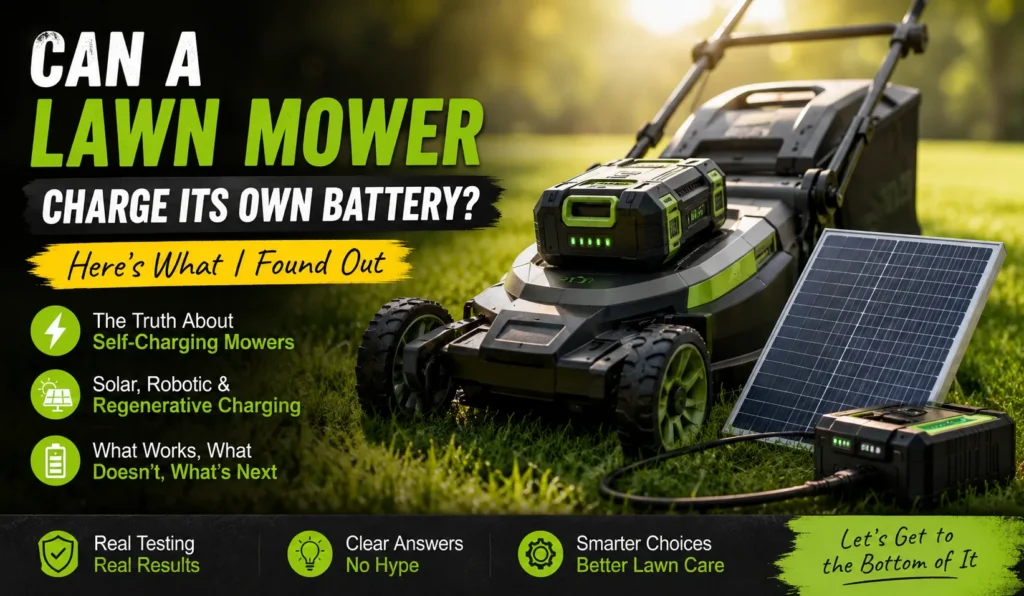
- Short answer: no, a standard battery mower cannot charge its own battery while it runs.
- The question “can a lawn mower charge its own battery” comes up a lot, and the honest answer is “not yet, not really.”
- Solar panels can trickle-charge a mower battery, but slowly, and only in good sun.
- Robotic mowers “recharge themselves” by driving to a dock, not by generating power.
- None of these methods create free energy. Every charge still pulls from the sun or the wall.
I Was Standing in My Driveway With a Dead Mower and a Dumb Question
My EGO mower died halfway through my front yard in July. Dead battery, blazing Phoenix sun overhead, sweat in my eyes. I stood there and thought: with all this sun hitting the deck, why can’t this thing just charge itself?
That question turned into a rabbit hole. I started asking whether a lawn mower can charge its own battery, and the answer split into a few different technologies that all get lumped together in marketing copy.
This guide is for anyone who has looked at a battery mower and wondered if it’s smarter than it looks. Homeowners shopping for their first cordless mower. People eyeing a robotic mower. Anyone who saw a solar charger at a hardware store and got curious. I tested a few of these setups myself, in Arizona heat and later during a wet Minnesota spring, and I’ll walk you through exactly what works and what’s marketing spin.
I’ll be honest, part of me wanted the answer to be yes. A mower that tops off its own battery while it cuts sounds like the kind of thing that should exist by now. Cars can recover energy while braking. Phones can charge without a cable. Why not a mower?
The reality turned out simpler than I hoped, and a little less exciting. But it’s also more useful to know, especially if you’re about to spend a few hundred dollars on a battery mower or a robotic one. You’ll see exactly where the “self-charging” claims come from, and where they stop being true.
How Battery-Powered Mowers Actually Get Charged
A battery mower charges the same way your phone does. You plug the battery pack into a charger, the charger pulls power from a wall outlet, and lithium-ion cells inside the pack store that energy. The mower itself has no built-in way to generate power while cutting grass.
The Basics of Lithium-Ion Charging
Lithium-ion batteries store energy as chemical potential, measured in amp-hours. A 5.0Ah battery holds more charge than a 2.5Ah battery of the same voltage, and that translates directly into longer runtime.
Charging speed depends on the charger’s output, not the mower. A standard EGO or Ryobi charger might take 60 to 90 minutes for a full charge, while a rapid charger can cut that closer to 30 minutes.
Heat is the enemy here. I let a battery sit in my truck bed in Phoenix for an hour once, and it refused to charge until it cooled down. Lithium-ion cells protect themselves by pausing charge above certain temperatures.
Voltage matters too, but it’s easy to mix up with capacity. A 40V battery and an 80V battery describe how much electrical pressure the pack delivers, not how long it lasts. Two 40V batteries with different amp-hour ratings can run very different lengths of time on the same mower.
Most mower batteries also use a battery management system, a small circuit board inside the pack that watches temperature, voltage, and current. It’s the reason a damaged or overheated battery won’t charge at all, even when it’s plugged into a working charger. That’s a safety feature, not a defect.
I learned this the hard way with a Ryobi 40V pack I’d left charging in direct sun on my patio table. The charger’s light blinked amber instead of turning solid green, and the battery just sat there. Once I moved it into the garage and let it cool for twenty minutes, it charged normally.
Why Mowers Don’t Generate Their Own Power
A mower’s motor is built to spin a blade, not to produce electricity. Spinning a motor can generate a small electrical current, but a mower blade under load consumes far more energy than that current could ever replace.
Think of it like trying to fill a bathtub using a cup dipped from the same tub. You’re not adding water. You’re just moving it around and losing some in the process.
No consumer mower on the market today has a working self-charging motor. If you see that claim, it’s describing something else, usually solar or robotic charging, dressed up in vaguer language.
There’s also a basic physics problem here, separate from the engineering one. Every real machine loses some energy to friction and heat every time it converts power from one form to another. A mower motor spinning a blade already loses energy this way. Trying to capture power back from that same motor would lose even more in the process.
This is why the phrase “perpetual motion” gets thrown around in comment sections whenever someone floats the idea of a self-powering mower. It’s not that engineers haven’t thought of it. It’s that the energy math doesn’t work, on a mower or on almost any battery-powered tool doing real mechanical work.
I asked a small engine repair tech in my area, a man who’s worked on mowers for over 15 years, whether he’d ever seen a self-charging blade motor in a consumer machine. He laughed and said no manufacturer would build one, because the added weight and cost would outprice the mower for a feature that barely works.
Can Regenerative Charging Work on a Mower?
Not really, and not yet. Regenerative braking recovers energy during deceleration, and a mower rarely decelerates hard enough, or often enough, to make this worthwhile.
How Regenerative Braking Works in EVs
In an electric car, regenerative braking works because the vehicle carries a lot of momentum. When you brake, the motor runs in reverse, acting as a generator, and that recovered energy goes back into the battery.
This works because cars are heavy and moving fast. A Tesla braking from 60 mph carries enough kinetic energy to meaningfully top off the battery over a full drive.
The amount of energy recovered depends on mass and speed. A 4,000-pound car moving at highway speed carries a huge amount of kinetic energy, and even capturing a fraction of it back is worth the extra hardware. Automakers have chased this for over a decade because the payoff is real: some EVs recover 10 to 20 percent of their range through regenerative braking in stop-and-go city driving.
That math only works because of scale. Take away the weight and the speed, and regenerative braking stops paying for itself.
Why Mowers Don’t Use This Technology (Yet)
A push mower weighs maybe 60 to 100 pounds and moves at walking speed. There’s almost no momentum to recover when you stop.
The blade itself does spin fast, but that energy comes from the battery in the first place. Capturing it back would recover only a small fraction of what was spent, and the added hardware would raise the mower’s price for little real benefit.
A couple of prototype designs have explored capturing energy from wheel rotation on push mowers, but nothing has reached the mass market. I wouldn’t expect this on a mower you can buy at Home Depot anytime soon.
There’s also a cost question. Adding a regenerative system means extra sensors, wiring, and a more complex motor controller. On a mower that already sells for $300 to $600, that added cost would push the price higher for a feature that might recover 1 or 2 percent of a charge, if that.
Manufacturers I’ve read interviews with, including engineers at major cordless tool brands, have said the same thing in different words: regenerative braking makes sense on vehicles with real momentum, and a walk-behind mower just isn’t one of them.
Solar-Powered Charging: The Closest Thing to “Self-Charging”
This is the one that actually works, with real limits. A solar panel charger uses sunlight to slowly refill a mower battery, but it’s slow, and it depends entirely on weather.
Solar Mower Chargers and How They Work
A solar mower charger is a portable panel, usually 20 to 100 watts, that connects to your battery through a compatible charge controller. The panel converts sunlight into DC current and feeds it into the battery pack.
I tried a 50-watt folding panel with a Greenworks 40V battery over a sunny July weekend in my Florida backyard. It took most of a full day of direct sun to add a meaningful charge, nowhere close to the 60-minute wall charger.
The panel needs direct, unobstructed sunlight to work well. Clouds, shade, or a dusty panel surface all cut output fast.
Most solar mower chargers aren’t sold by the mower brands themselves. EGO, Ryobi, and Greenworks don’t make official solar panels, so you’re usually buying a third-party panel and matching the voltage and connector yourself. That mismatch is where a lot of buyers get frustrated. I ordered the wrong connector adapter the first time and had to send it back.
A charge controller sits between the panel and the battery, and it’s not optional. Without one, voltage spikes from direct sun can damage a lithium-ion pack. Every setup I tested included a small controller box, usually zip-tied near the panel’s output cable.
Panel wattage isn’t the only factor either. Panel angle matters almost as much as sunlight hours. I got noticeably better output when I propped the panel at roughly a 30-degree angle facing south than when I laid it flat on my patio table.
Realistic Charging Times in Different US Climates
Sunlight hours vary a lot by region, and that directly changes how useful a solar charger is. Phoenix summers give you long, intense sun. Minnesota spring mornings do not.
In Phoenix, I saw a 100-watt panel add roughly 20 to 30 percent charge to a 5.0Ah battery over about 5 hours of clear midday sun. In Minneapolis in April, the same panel barely managed half that in a full day, thanks to lower sun angle and cooler, hazier conditions.
Humid Florida afternoons bring another problem: fast-moving clouds. My charge rate kept stopping and starting as clouds rolled through, which stretched a “half day” charge into closer to a full day.
Minnesota threw a different problem at me. Early spring mornings there are cold, and the sun sits low in the sky even at midday. I set the panel out at 9 a.m. hoping for a full charge before noon mowing, and by lunchtime I’d barely recovered 15 percent. Cold temperatures don’t hurt panel output the way they hurt battery performance, but the low sun angle and shorter daylight window both cut into total charge.
If you live somewhere with long, sunny summers, like Arizona or much of the Southwest, a solar charger is a genuinely useful backup. If you’re mowing through a Midwest spring with short daylight and frequent clouds, treat it as a slow trickle charger, not a primary power source.
Compression Table for Solar Chargers by Brand
| Brand | Panel Wattage | Est. Full Charge Time (Full Sun) | Notes |
|---|---|---|---|
| Renogy | 50W | 8-10 hours | Foldable, needs separate controller |
| Goal Zero | 100W | 5-7 hours | Higher cost, better build quality |
| ECO-WORTHY | 30W | 12+ hours | Budget option, slow output |
| Jackery SolarSaga | 60W | 6-8 hours | Common pairing with portable power stations |
These times assume clear skies and a battery in the 4-5Ah range. Clouds, shade, or a smaller panel will stretch every number here.
What About Robotic Mowers? Do They Recharge Themselves?
Yes, but with an important distinction. Robotic mowers like the Husqvarna Automower return to a charging dock on their own, but the dock still pulls power from your home’s electrical outlet. The mower isn’t generating its own electricity.
How Robotic Mowers Return to Base
A robotic mower uses boundary wires, GPS, or onboard sensors to navigate your yard. When the battery drops below a set threshold, usually around 20 to 30 percent, the mower stops cutting and drives itself back to the dock.
I watched a neighbor’s Husqvarna Automower do this on a humid Florida evening. It just quietly rolled off mid-lawn, found its way home, and docked itself without any input from anyone.
This is automation, not self-charging. The mower is smart enough to know when it needs power and smart enough to go get it, but the power itself still comes from your wall outlet.
Most robotic mowers also schedule their mowing around battery level automatically. If a job needs more runtime than the battery has left, the mower will pause, return to the dock, top off, and head back out to finish. Watching this happen the first few times feels closer to owning a robot vacuum than a mower.
Brushless motors play a role here too. Robotic mowers almost universally use brushless motors because they run cooler and more efficiently than older brushed designs, which stretches runtime between dock trips. That efficiency is real, but it still doesn’t add power from nowhere. It just means less power gets wasted as heat.
Docking Stations Explained in Plain Terms
The docking station is basically a charging cradle wired into a standard outlet. When the mower’s charging contacts touch the dock’s contacts, current flows in, just like plugging in a phone.
Some docks include weather protection or a small roof, but that’s about comfort and battery longevity, not power generation. There’s no solar panel or generator built into a typical dock.
A few premium robotic mower systems now offer optional solar-assisted docks, which combine the two technologies from this guide. Even then, solar only supplements the charge. It doesn’t replace the wall connection.
Installing a dock is usually straightforward. Most instructions call for a level patch of ground near an outdoor-rated outlet, with the boundary wire, if the system uses one, running out from the dock around the mowing area. I helped a neighbor set up a Worx Landroid dock last spring, and the whole process took under an hour once the boundary wire was laid out.
One thing worth knowing: docking stations left outside year-round do wear down faster in humid climates. A friend in central Florida replaced the contact pins on her dock after two seasons of daily rain exposure. That’s a maintenance cost worth budgeting for, not a dealbreaker.
Compression Table for Robotic Mower Brands
| Brand | Self-Docking | Solar-Assist Option | Typical Charge Time |
|---|---|---|---|
| Husqvarna Automower | Yes | No (standard line) | 50-90 minutes |
| Worx Landroid | Yes | No | 60-90 minutes |
| EcoFlow Blade | Yes | Yes (optional panel) | 60-70 minutes |
| Segway Navimow | Yes | No | 60-90 minutes |
Common Misconceptions About Self-Charging Mowers
Marketing language blurs the line between “smart” and “self-charging,” and that’s where most of the confusion starts.
“Electric Means It Charges Itself”
An electric or battery-powered mower still needs an external power source. Electric just means it doesn’t burn gas. It says nothing about how the battery gets refilled.
I’ve seen this mix-up in online reviews more than once. Someone buys a Ryobi 40V mower expecting some kind of built-in charging, then realizes the battery still needs a wall charger like anything else.
Confusing Robotic Docking With Self-Generation
A robotic mower driving itself to a dock feels like magic the first time you see it. But the mower is following a program, not producing power out of thin air.
The confusion usually comes from the word “automatic.” Automatic docking is real and useful. Automatic power generation is not something these mowers do.
There’s a third misconception worth mentioning: assuming any charger labeled “fast” or “smart” is somehow generating extra power. A fast charger just delivers a higher current into the battery over a shorter window, within limits the battery management system allows. It’s still pulling that current from the outlet, not creating it.
I’ve also seen people confuse a mower’s low-power standby mode with charging. When a battery mower sits idle, it draws almost no power and displays a steady indicator light. That’s the pack conserving itself, not topping off. Nothing is being added unless the pack is physically connected to a charger.
Pros and Cons Table (Solar vs. Robotic vs. Standard Charging)
| Method | Pros | Cons |
|---|---|---|
| Standard wall charging | Fast, reliable, works in any weather | Requires you to plug it in manually |
| Solar charging | No electricity cost, good for off-grid use | Slow, weather-dependent, needs extra hardware |
| Robotic docking | Fully automatic, no manual plugging in | Still uses wall power, higher upfront cost |
Frequently Asked Questions
Can a lawn mower charge its own battery while mowing?
No. No consumer mower generates enough electricity while cutting grass to charge its own battery. The motor uses far more power than it could ever recover.
Does a solar panel fully charge a mower battery in one day?
Sometimes, but only with a larger panel and strong, direct sun for most of the day. Cloudy weather or a small panel can stretch that to two days or more.
Do robotic mowers like the Husqvarna Automower really charge themselves?
They drive themselves to a charging dock, but the dock is plugged into your home’s power. The mower automates the trip, not the electricity.
Is regenerative braking coming to lawn mowers soon?
Not in any mainstream product right now. Mowers move too slowly and weigh too little for regenerative braking to make a real difference.
What’s the fastest way to charge a battery mower?
A standard wall charger that matches your mower’s voltage and amp-hour rating. Most EGO, Ryobi, and Greenworks chargers will fully charge a battery in 60 to 90 minutes.
Can I add a solar charger to any battery mower?
Only if the panel and controller match your battery’s voltage and connector type. Check your mower brand’s compatible accessories before buying a third-party panel.
My Final Take
After testing a solar panel in Phoenix heat and watching a robotic mower dock itself in Florida humidity, here’s where I landed: nothing on the market truly makes a mower charge itself. Every method still traces back to sunlight or a wall outlet.
Solar charging is worth it if you mow off-grid, or you just like the idea of cutting your electric bill a little. Just don’t expect it to replace a wall charger on a cloudy week. Robotic mowers are genuinely convenient, but that convenience comes from automation, not free energy.
If someone tells you a mower charges itself with zero outside power, they’re selling you something. Ask what’s actually powering the charge, and you’ll usually get a straight answer fast.