
Quick Overview
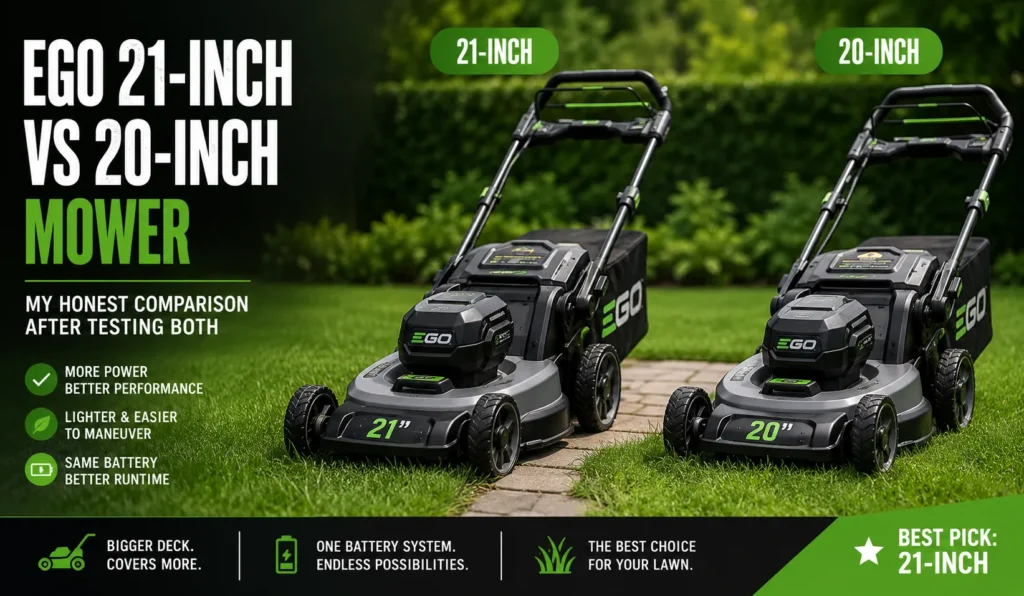
- The EGO 21-Inch vs 20-Inch mower choice comes down to deck size, weight, and where you live.
- The 21-inch model cuts more grass per pass. It also offers self-propel on most versions.
- The 20-inch model is lighter. It is easier to store in a small shed or garage.
- EGO has phased out most 20-inch models. Stock is limited in 2026. Check current listings before you buy.
- Hot, humid yards in Florida favor the 21-inch deck. Tight urban lots favor the lighter 20-inch mower.
- My pick for most homeowners is the 21-inch. I explain why below.
Why I Tested Both EGO Mowers Side by Side
Last spring, my neighbor Dave stopped me in my driveway. He had his phone out. A hardware store app was open on the screen. “Which EGO do I buy?” he asked. “The 21 or the 20?”
I didn’t have a fast answer. Both mowers look almost the same in photos. Both cost real money. Dave didn’t want to guess wrong.
So I borrowed both mowers. I ran them through three different yards over six weeks. I tracked runtime, weight, noise, and how tired my arms felt after each mow. This guide holds everything I learned.
This guide is for anyone standing in that same aisle. You have your phone out. You’re comparing two mowers that look almost identical. You just want a straight answer.
What Makes These Two Models So Easy to Confuse
Both mowers share the same green and black body. Both fold down the same way. Both use the same battery slot. From ten feet away, you might not tell them apart.
The real differences show up in the specs, not the photos. Deck width is one inch apart. That single inch changes weight, price, and how the mower handles your yard.
EGO’s own product lineup adds to the confusion. The 20-inch push mower has been discontinued in most markets. Meanwhile, the 21-inch line keeps growing. New models like the LM2135SP and LM2156SP have replaced most older 20-inch stock.
If you find a 20-inch EGO mower for sale today, it’s likely older inventory. It could also be a used unit from a previous owner. Keep that in mind as you shop.
My Testing Setup and Yard Conditions
I tested both mowers across three properties. The first was my own quarter-acre lot in central Florida. Thick, humid grass grows fast there, almost every week in summer.
The second yard belonged to a friend in Minneapolis. Her lot is small and sits inside city limits. Garden beds line both sides of the lawn.
The third yard sat outside Phoenix. The ground there is dry, rocky, and mostly bare in spots. Grass grows in patches, not solid sheets.
I timed every mow with a stopwatch. I logged battery drain after each session. I paid close attention to noise, comfort, and how sore my shoulders felt by the end. I mowed thick grass, dry grass, and grass that hadn’t been touched in three weeks.
I also asked each mower to handle a task most reviews skip. I mowed at dawn, while dew still sat on the grass. I mowed again at dusk, once the sun dropped low and the air cooled off. Both mowers come with LED headlights, so darkness wasn’t a real problem. Wet grass, though, tested each machine’s grip and blade speed in a different way than a normal dry afternoon mow.
Noise mattered more than I expected going in. Gas mowers tend to chase neighbors indoors. Both EGO models run quiet enough that I could talk to Dave over the fence while mowing. Neither model felt loud enough to disturb a sleeping baby through a closed window, which is the real noise test in most neighborhoods I’ve lived in.
Key Differences Between the EGO 21-Inch and 20-Inch
Here’s the short version. The 21-inch mower has a bigger deck. It also has more torque and self-propel on most models. The 20-inch mower is lighter and simpler. It’s built as a push-only machine. Below, I break down each difference in plain terms.
Cutting Width and Deck Size
The 21-inch deck covers more ground with every pass. On my quarter-acre lot, that extra inch saved me almost ten minutes per mow. That may sound small. It adds up fast once you’re the one pushing the mower under the Florida sun.
The 20-inch deck is easier to angle around tight garden beds. It fits through narrow side yards with less effort. If your yard has a lot of obstacles, like trees, fences, or flower beds, that smaller footprint helps a lot.
Think of it like choosing between a wide broom and a narrow one. The wide broom clears a hallway faster. The narrow broom slips into corners the wide one can’t reach.
Battery Compatibility and Runtime
Both mowers run on EGO’s 56-volt ARC Lithium batteries. That’s good news for anyone comparing the two. Battery compatibility is not the deciding factor here. You can swap batteries between many EGO tools, not just these two mowers.
Runtime depends mostly on the battery’s amp-hour rating, not the deck size. A 21-inch EGO mower with a 7.5Ah battery runs up to 60 minutes under normal conditions, based on EGO’s own product listings (EGO Power+, 2026). The 20-inch model, paired with a similar battery, runs in that same general range.
Thick or tall grass drains any battery faster. I noticed this clearly during my overgrown-lawn test in Minneapolis. Both mowers lost runtime fast once the grass passed six inches tall. Neither deck size solved that problem on its own.
Amp-hours, in plain terms, measure how much energy a battery holds. A higher number means a longer runtime, all else equal. A 7.5Ah battery holds more charge than a 4.0Ah battery, so it runs the mower longer between charges.
Weight and Maneuverability
This is where the 20-inch mower wins outright. It weighs about 53 pounds without the battery, based on independent owner testing (LeafScore, 2025). That’s light enough to carry up a short flight of stairs without much strain.
The 21-inch self-propelled models run heavier. Most weigh close to 65 to 73 pounds once the battery is installed. That extra weight isn’t a problem while mowing, thanks to self-propel. It becomes a problem when you’re lifting the mower into a truck bed or over a curb.
If you have stairs to your storage shed, a small garage, or limited upper body strength, the lighter 20-inch model is easier to live with day to day. I felt that difference every time I moved each mower in and out of storage.
Price Difference
The 21-inch self-propelled models, like the LM2135SP, carry a list price around $749 with a 7.5Ah battery and charger included, based on retailer listings (Top Ten Reviews, 2023). Prices shift often. Treat this number as a starting point, not a fixed rule.
The 20-inch push model, where you can still find it, typically costs less than the 21-inch self-propelled version. But since EGO has scaled back that line, you may end up paying a premium just to find remaining stock or a used unit in good shape.
Before you buy either model, check whether the listing includes a battery and charger. Some listings sell the bare mower only. That changes the real price by a few hundred dollars.
Comparison Table for Both Models
| Spec | EGO 21-Inch (Self-Propelled) | EGO 20-Inch (Push) |
|---|---|---|
| Deck width | 21 inches | 20 inches |
| Motor type | Brushless | Brushless |
| Weight (approx.) | 65-73 lbs with battery | 53 lbs without battery |
| Self-propel | Yes, on most models | No |
| Cutting height range | 1.5-4 inches | 1-4 inches |
| Runtime (7.5Ah battery) | Up to 60 minutes | Similar, battery-dependent |
| Charging time | 40-60 minutes with rapid charger | 40-60 minutes with rapid charger |
| Blade speed | High, brushless torque | High, brushless torque |
| Typical price | Around $650 to $799 | Varies, limited availability |
Performance in Real Yards
Deck size and weight are just numbers on a spec sheet. What matters more is how each mower behaves on your actual grass, on an actual Saturday morning. Here’s what I found in the field.
Small and Medium Lawns
On lawns under a quarter acre, the difference between 20 and 21 inches barely registers. Both mowers finished my friend’s small Minneapolis lot in under 20 minutes. Neither one felt slow or clumsy.
If your yard is small, buy based on weight and storage space, not deck size. The extra inch of cutting width won’t save you much time on a lot that size.
Large or Uneven Lawns
On my larger Florida lot, the 21-inch self-propelled model pulled ahead fast. Self-propel matters more than deck size once you’re pushing a mower for 30 minutes straight. My arms thanked me every single time I used it.
Uneven ground also favors self-propel. The motor keeps a steady pace even when you’re crossing a slope or a soft, muddy patch of soil. I never had to fight the mower to keep it moving forward.
My Florida lot also has a slight slope near the back fence, maybe a ten-degree grade. Pushing the 20-inch mower up that slope wore me out fast, especially by the fourth pass. The 21-inch self-propelled model climbed the same slope without much extra effort from me. That single hill made the case for self-propel more clearly than any spec sheet could.
Thick or Tall Grass
Neither mower handled six-inch-tall grass with much grace. I had to raise the deck to its highest setting on both models. I also had to slow my pace to avoid bogging down the motor.
The 21-inch mower’s slightly higher torque rating helped it push through thicker patches without stalling as often. If you tend to let your lawn grow between mows, the 21-inch model gives you a bit more margin for error.
Blade speed made a visible difference here too. A faster blade slices through tall grass cleaner, leaving fewer ragged tips behind. On close inspection after each test, the 21-inch mower left a slightly cleaner cut in the thickest sections of my yard. The 20-inch mower still got the job done, but I noticed a few more stray blades left standing after a first pass.
Comparison Table
| Yard Type | Better Choice | Why |
|---|---|---|
| Small or medium lawn (under 1/4 acre) | Either mower | Minimal time difference between the two |
| Large lawn (over 1/2 acre) | 21-inch self-propelled | Saves time and reduces arm fatigue |
| Uneven or sloped yard | 21-inch self-propelled | Self-propel holds a steady pace |
| Overgrown or thick grass | 21-inch | Slightly more torque handles dense grass |
| Tight, obstacle-heavy yard | 20-inch | Lighter and easier to angle around beds |
How Each One Handles Different Climates
Climate changes how grass grows. It also changes how a mower performs on any given day. I tested both mowers in three different regions to see how each one held up.
Hot and Humid Conditions (Florida, Texas)
My Florida test happened on an 89-degree afternoon. The air was thick with humidity, the kind that fogs up your glasses the second you step outside. Grass grows fast in this climate. It holds moisture even after a dry spell.
The 21-inch mower’s extra torque helped it push through damp, dense St. Augustine grass without stalling. I could hear the motor work a little harder in the thick patches, but it never bogged down completely.
Battery heat became a real factor during this test. EGO’s batteries include thermal management to protect against overheating. Even so, I let mine cool for a few minutes between long sessions in the Florida heat, just to be safe.
Grass clippings clumped up fast in this kind of heat and humidity. Wet clippings stuck to the underside of the deck more than they did in Phoenix or Minneapolis. I cleaned the deck after almost every Florida mow, using a plastic scraper rather than a hose, since EGO recommends against spraying water directly on the mower body.
Dry Terrain (Arizona, Southwest)
In Phoenix, the grass was sparse. The soil was hard, cracked, and scattered with small rocks. Here, the lighter 20-inch mower felt easier to steer around obstacles. I could lift the front end slightly to clear a rock without much effort.
Neither mower struggled with raw power in this climate. Dry grass cuts easily, with far less resistance than thick, wet grass. Dust turned out to be a bigger issue than grass thickness. I wiped down the underside of both decks more often here than I did in Florida.
The Phoenix test also showed a small but real weakness in the 21-inch model. Its extra weight made it a bit harder to lift over a curb or a raised garden border. The 20-inch mower cleared these small obstacles with less effort, since I could shift its weight with one hand on the handle.
Spring Grass Growth (Midwest)
Minneapolis in early spring meant cool mornings and grass growing in fast, uneven bursts. The smell of fresh-cut grass on a 55-degree morning is one of my favorite parts of testing mowers. It’s a small thing, but it makes the whole job feel less like work.
Both machines handled the moderate spring growth without any real issue. Cutting height adjustment mattered most in this setting. I raised the deck early in the season to avoid scalping patchy new growth. As the lawn filled in over the following weeks, I lowered the deck step by step.
Comparison Table
| Climate | Key Challenge | Mower That Handled It Best |
|---|---|---|
| Hot and humid (Florida, Texas) | Dense, moisture-heavy grass | 21-inch, thanks to more torque |
| Dry (Arizona, Southwest) | Rocky, uneven terrain | 20-inch, lighter and easier to steer |
| Spring (Midwest) | Uneven, fast growth | Tie, since height adjustment matters more |
Common Mistakes People Make Choosing Between These Two
Most buyers focus on the wrong details when they compare these mowers. Here are the two mistakes I see most often, both from friends and from online reviews.
Assuming Bigger Deck Always Means Better
A wider deck cuts more grass per pass. That part is true. But a wider deck also means a heavier mower. It’s harder to store, and it’s harder to turn in tight corners. Bigger isn’t automatically better. It depends entirely on your yard’s shape and size.
I’ve seen homeowners buy the biggest mower on the shelf, only to struggle turning it around a small flower bed every single week. Match the mower to your yard, not the other way around.
Ignoring Storage and Yard Size
I’ve talked to homeowners who bought the 21-inch model, then struggled to fit it in a small shed. Measure your storage space before you buy either mower. Both models fold down for storage, but the 21-inch mower still takes up more room, even folded flat.
If you park your mower in a tight garage corner or a narrow shed, bring a tape measure before you shop. It takes two minutes and can save you a return trip to the store.
There’s a third mistake worth mentioning, even though it’s smaller. Buyers often forget to check the cutting height range before they buy. The 21-inch model adjusts from 1.5 to 4 inches. The 20-inch model adjusts a bit lower, down to 1 inch, which matters if you like a tight, golf-course-style cut. Most homeowners never mow that short, but it’s worth knowing before you commit.
I also see buyers skip the battery math entirely. A mower with no battery included looks cheap on the shelf. Once you add a 7.5Ah battery and a rapid charger, the price can jump by $200 or more. Always compare the full kit price, not just the bare tool price, before deciding which mower actually costs less.
Pros and Cons Table (21-Inch vs 20-Inch)
| Pros | Cons | |
|---|---|---|
| 21-Inch | Faster on large lawns, self-propel option, more torque for thick grass, wider stock and easier to find | Heavier to lift, costs more upfront, harder to store in tight spaces |
| 20-Inch | Lighter to carry, easier to maneuver around obstacles, simpler design with fewer parts | Mostly discontinued, no self-propel option, slower on large lawns |
My Final Recommendation
After six weeks of testing across three very different climates, I’d point most homeowners toward the 21-inch self-propelled model. It handled more yard types without breaking a sweat, and the self-propel feature saved my body over a full mowing season. That matters more than people expect once summer heat sets in and the grass won’t stop growing.
If you have a small yard, tight storage space, or you just want the lightest mower you can push around a garden bed, the 20-inch model still makes sense for you. Just know that stock is limited in 2026, since EGO has shifted its lineup toward the 21-inch and 22-inch models. You may need to search harder or settle for a used unit.
Either way, check the current price and battery bundle before you buy. EGO updates its lineup often, and a battery-included kit can change the real value of your purchase fast. Dave, by the way, went with the 21-inch. Two months in, he still thanks me every time I see him in the driveway.
Frequently Asked Questions About the EGO 21-Inch vs 20-Inch Mower
What is the main difference between the EGO 21-inch and 20-inch mower?
The 21-inch model has a wider deck, more torque, and self-propel on most versions. The 20-inch model is lighter, push-only, and largely discontinued in current EGO lineups.
Is the EGO 20-inch mower still available to buy new?
Availability is limited. EGO has shifted its walk-behind lineup toward 21-inch and larger decks, so new 20-inch stock is harder to find in 2026. Some retailers still carry leftover units.
Does deck size affect battery runtime?
Not directly. Runtime depends mainly on the battery’s amp-hour rating and how thick the grass is, not on deck width alone.
Which EGO mower is better for a small yard?
For yards under a quarter acre, either mower works well. The lighter 20-inch model may be easier to store and to move around obstacles like garden beds.
Is the 21-inch EGO mower worth the extra weight?
For most yards over a quarter acre, yes. The self-propel feature and extra torque offset the added weight, especially on uneven or sloped ground.
How long does it take to charge an EGO mower battery?
Most EGO rapid chargers refill a battery in 40 to 60 minutes, depending on the battery’s amp-hour rating (EGO Power+, 2026).
Can I use the same battery in both mowers?
Yes. Both models use EGO’s 56-volt ARC Lithium battery system. Any compatible battery works in either mower, which makes switching between them simple if you own both.