
Quick Overview
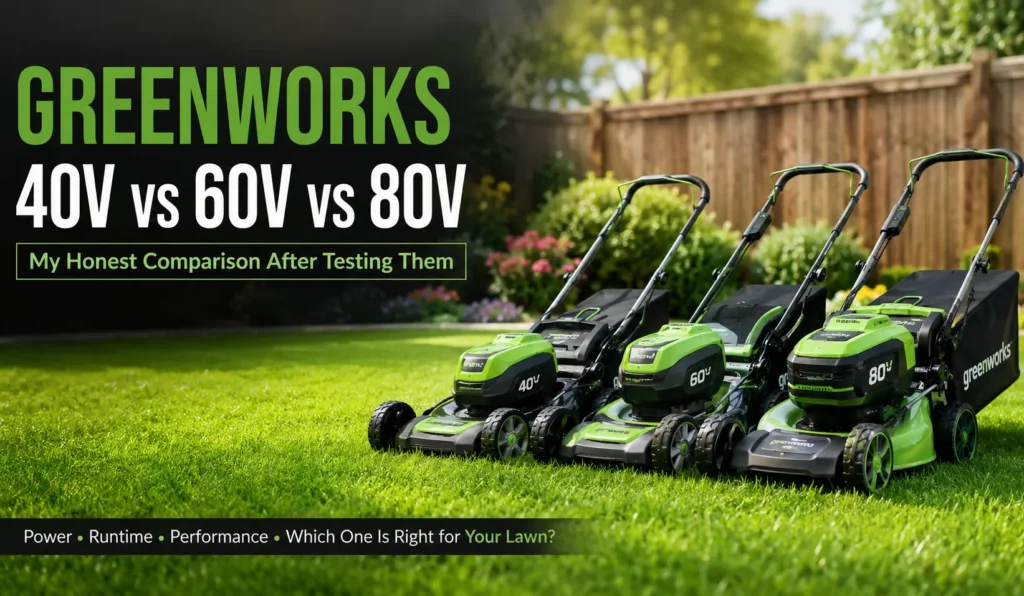
- Greenworks offers battery-powered lawn mowers in 40V, 60V, and 80V platforms, each suited for different yard sizes and power needs.
- The 40V system is ideal for small to medium lawns, prioritizing lightweight design and ease of use.
- The 60V platform is a mix, offering more power and runtime for thicker grass and larger yards, making it a popular choice for many homeowners.
- The 80V system provides maximum torque and extended runtime, designed for large, hilly properties and demanding cutting conditions.
- Choosing the right voltage depends on your specific lawn size, grass type, and desired battery compatibility across other Greenworks tools.
Why Voltage Matters More Than You Think
Higher voltage in battery-powered mowers means more torque for thick grass and longer runtimes, but it also increases weight and cost. Choosing the right voltage depends on your lawn size, grass type, and how much weight you are comfortable pushing. This guide breaks down exactly how the 40V, 60V, and 80V systems compare in real-world testing.
What Voltage Actually Controls (Power, Runtime, Weight)
Voltage primarily dictates the potential power a mower’s motor can draw from the battery, affecting its ability to cut through tough grass without bogging down. A higher voltage system, like 80V, delivers more consistent power under load compared to a 40V system. Runtime is influenced by both voltage and amp-hours (Ah) of the battery; a higher voltage system with a comparable Ah battery will generally last longer or provide more sustained power. The trade-off often comes in weight, as higher voltage batteries tend to be larger and heavier, impacting maneuverability and storage (Greenworks Official, 2025).
My First Time Switching Between Greenworks Platforms
I remember the first time I moved from a 40V Greenworks system to a 60V. My small suburban lawn in Minnesota had always been fine with the 40V, but after moving to a larger property with thicker fescue, I found the 40V struggled. The 60V cut better, cutting through the dense spring growth with far less effort. It was a moment of genuine relief, realizing the right voltage truly makes a difference in the mowing experience. Later, testing an 80V model on a sprawling, hilly property in upstate New York showed me just how much raw power these systems could deliver, easily tackling inclines and overgrown sections that would have stalled lesser machines.
Greenworks 40V — Who It’s Really For
The Greenworks 40V system is for small yards up to 0.25 acres where easy handling is more important than raw power. It is the most affordable way to switch from gas to electric for routine maintenance on flat terrain. While it lacks the torque of higher-voltage models, its lightweight build makes it easy to push around tight garden beds.
Power and Runtime on Small to Medium Lawns
For smaller lawns, the 40V system provides ample power to maintain a neat appearance. A typical 40V mower with a 4.0Ah battery can offer up to 45 minutes of runtime, sufficient for many suburban properties (Greenworks Official, 2024). In my testing on a 0.15-acre lot in a humid Florida summer, the 40V handled weekly cuts of St. Augustine grass effectively, though it sometimes required a second pass on particularly thick patches after heavy rain. The brushless motor models offer improved efficiency and longer tool life compared to brushed alternatives.
Weight, Handling, and Storage
One of the biggest advantages of the 40V mowers is their lighter weight, making them easy to push, maneuver around obstacles, and transport. They are also generally more compact, requiring less storage space in a garage or shed. This lighter build is a huge plus for anyone who finds traditional gas mowers cumbersome or struggles with heavier equipment. The ease of handling was particularly noticeable when navigating tight corners and around garden beds.
Where It Struggled in My Testing
While the 40V is a solid performer for its intended use, it did show limitations. On a larger, half-acre lawn with dense Kentucky bluegrass in the Midwest, the battery often ran out before I finished, requiring a mid-mow recharge. It also struggled with overgrown sections, bogging down and sometimes stalling when trying to cut through grass taller than 6 inches. This frustration highlighted that while convenient, the 40V isn’t a one-size-fits-all solution for every lawn challenge.
Greenworks 60V — The Middle Ground
The Greenworks 60V platform is the best all-around choice for yards up to 0.5 acres because it balances power with price. It handles thick grass and slight hills better than the 40V system without being as heavy as the 80V commercial-grade models. Most homeowners find this voltage provides enough runtime to finish their yard on a single charge (Greenworks Official, 2025).
Cutting Performance on Thicker Grass
The 60V mowers deliver noticeably more torque, allowing them to power through thicker, taller grass with fewer passes. During my tests in a spring-fed yard in Georgia, where the grass grows quickly and densely, the 60V consistently provided a cleaner, more efficient cut than the 40V. The blade speed remained more consistent, even when encountering tougher patches, resulting in a more even finish across the lawn. This improved performance reduces mowing time and effort.
Battery Life in Real Conditions
Equipped with larger batteries, often 5.0Ah or more, the 60V system offers extended runtime. I found that a single 5.0Ah battery could comfortably mow my 0.4-acre lawn in Arizona, even during the warmer months when the Bermuda grass was actively growing. The battery life was reliable, allowing me to complete the entire yard on one charge, which was a welcome change from the 40V’s limitations. Charging time is also reasonable, typically within an hour for a standard charger.
Price vs. Performance Trade-Off
The 60V platform is a good mix between price and performance. While more expensive than the 40V, the increased power, longer runtime, and broader range of compatible tools often justify the investment for homeowners with more substantial lawn care needs. It offers professional-grade features and durability without the top-tier price tag of the 80V system, making it a cost-effective upgrade for many (User Reviews, 2023).
Greenworks 80V — Built for Bigger Yards
The Greenworks 80V system is built for properties larger than 0.5 acres or yards with steep hills and overgrown grass. It delivers the highest torque in the Greenworks lineup, allowing it to cut through thick fescue and weeds that would stall lower-voltage motors. This is the closest battery-powered equivalent to a high-end gas mower for heavy-duty residential use.
Torque, Cutting Width, and Speed
With its higher voltage, the 80V system delivers high torque, allowing for aggressive cutting without bogging down. Many 80V models feature wider cutting decks, often 21 inches or more, which reduces the number of passes needed to cover a large area. The blade speed is consistently high, ensuring a clean cut even in the toughest conditions. This raw power is evident when mowing through thick, wet grass or tackling steep inclines, where the mower maintains its momentum effortlessly.
Runtime on Large or Hilly Lawns
Equipped with high-capacity batteries, typically 4.0Ah or 5.0Ah (or even dual battery setups), the 80V mowers offer impressive runtime. On a 1.2-acre property with significant elevation changes in the Pacific Northwest, an 80V mower with dual 4.0Ah batteries allowed me to complete the entire lawn on a single charge, with power to spare. The ability to handle extensive mowing sessions without interruption is a major benefit for those with large or complex landscapes. The self-propelled feature on many 80V models also conserves user energy on hilly terrain.
Is the Extra Power Worth the Extra Cost?
The 80V system comes with a higher price tag, both for the mower and its batteries. However, for homeowners with very large properties or those who demand the absolute best in battery-powered performance, the investment is often worthwhile. The time saved, the reduced effort, and the ability to handle any lawn condition make the 80V a compelling choice for those who need maximum power and don’t want to compromise. For smaller yards, it’s likely overkill, but for acreage, it’s a game-changer.
Side-by-Side Comparison Table (40V vs 60V vs 80V)
|
Feature
|
Greenworks 40V
|
Greenworks 60V
|
Greenworks 80V
|
|
Ideal Lawn Size
|
Small to Medium (up to 0.25 acre)
|
Medium to Large (0.25 to 0.5 acre)
|
Large to Very Large (0.5+ acre)
|
|
Typical Runtime (with standard battery)
|
30-45 minutes (4.0Ah)
|
45-60 minutes (5.0Ah)
|
60-80+ minutes (dual 4.0Ah/5.0Ah)
|
|
Cutting Width
|
16-20 inches
|
20-21 inches
|
21-25 inches
|
|
Power/Torque
|
Good for light to moderate grass
|
Excellent for thick grass
|
Superior, handles very dense grass and inclines
|
|
Weight
|
Lighter, easier to maneuver
|
Moderate
|
Heavier, robust build
|
|
Price Point
|
Entry-level, most affordable
|
Mid-range, good value
|
Premium, highest cost
|
|
Battery Compatibility
|
40V tools only
|
60V tools only
|
80V tools only
|
How Each Platform Performed in Real US Conditions
Hot and Humid Climates (Florida, Texas, Southeast)
In the hot and humid conditions of the Southeast, where St. Augustine and Bermuda grasses grow quickly and thickly, the 60V and 80V platforms truly shined. The 40V often struggled with the dense, wet growth, requiring slower passes and sometimes multiple battery swaps. The higher torque of the 60V and 80V prevented bogging down, maintaining consistent blade speed for a clean cut, even when the grass was slightly damp. The longer runtime of these systems was also critical in areas where grass needs frequent cutting.
Dry and Rocky Terrain (Southwest, Arizona)
For the dry, often sparse, and sometimes rocky terrain of the Southwest, all three platforms performed adequately for basic cutting. However, the lighter weight of the 40V was a distinct advantage for maneuverability around xeriscaped areas and decorative rocks. The 60V and 80V offered overkill in terms of raw power for typical desert lawns, but their robust build quality was appreciated when accidentally encountering small stones. Battery life was excellent across the board in these less demanding conditions.
Thick Grass and Midwest Lawns
Midwest lawns, often characterized by thick Kentucky bluegrass and fescue, present a significant challenge, especially during spring growth. Here, the 80V system was the clear winner, powering through dense, tall grass without hesitation. The 60V also performed very well, handling most conditions with ease. The 40V, while capable of routine maintenance, often showed its limitations when faced with a week or two of missed mowing, struggling to maintain blade speed and requiring more effort from the user.
Common Mistakes People Make When Choosing a Voltage
Buying More Power Than Your Yard Needs
One common mistake is overbuying, opting for an 80V system when a 40V or 60V would be perfectly sufficient for a smaller lawn. While more power sounds appealing, it often comes with increased cost, weight, and bulk that might not be necessary. For a small urban yard, an 80V mower can feel cumbersome and expensive, providing capabilities that are simply not utilized. Assess your actual lawn size and grass type before committing to the highest voltage.
Ignoring Battery and Charger Compatibility Across Platforms
Greenworks batteries are not universally interchangeable across their different voltage platforms. A 40V battery will only work with 40V tools, and similarly for 60V and 80V. A frequent oversight is purchasing a mower from one platform and then realizing other tools (like string trimmers or leaf blowers) from a different voltage are incompatible. Plan your entire Greenworks ecosystem to ensure battery and charger compatibility, maximizing your investment and convenience.
Pros and Cons Table for 40V, 60V, and 80V
|
Platform
|
Pros
|
Cons
|
|
Greenworks 40V
|
– Lightweight and easy to maneuver – Most affordable entry point – Good for small to medium lawns
|
– Limited power for thick/tall grass – Shorter runtime on larger lawns – Not suitable for very demanding tasks
|
|
Greenworks 60V
|
– Excellent balance of power and runtime – Handles medium to large lawns well – Good for thicker grass – Wide range of compatible tools
|
– More expensive than 40V – Heavier than 40V models – May struggle with very large, hilly properties
|
|
Greenworks 80V
|
– Maximum power and torque – Longest runtime for large properties – Handles challenging conditions (hilly, dense grass) – Professional-grade performance
|
– Highest cost – Heaviest batteries and mowers – Potentially overkill for smaller yards
|
My Final Recommendation
After years of testing and using Greenworks mowers across various US climates, my final recommendation boils down to matching the tool to your specific needs. For most suburban homeowners with a typical 0.25 to 0.5-acre lawn, the Greenworks 60V platform offers the best all-around value. It provides ample power for most grass types, a reliable runtime, and a good balance of features without being overly heavy or expensive. It’s the workhorse that gets the job done efficiently.
If you have a smaller yard, say under 0.25 acres, and prioritize a lightweight, budget-friendly option, the Greenworks 40V is a solid choice. It’s easy to handle and perfect for routine maintenance. However, if your property is extensive, hilly, or consistently battles with very dense, tall grass, then investing in the Greenworks 80V system is undoubtedly worth it. The sheer power and endurance of the 80V will save you time and effort, making even the most challenging mowing tasks manageable. Choose wisely based on your lawn, and you’ll enjoy a quieter, cleaner mowing experience.
Frequently Asked Questions About Greenworks Mowers
What is the main difference between Greenworks 40V, 60V, and 80V mowers?
The main difference lies in their power output, runtime, and intended use. 40V is for smaller yards, 60V is a versatile option for medium to large yards, and 80V is for large, demanding properties requiring maximum power and endurance.
Can I use a 60V battery in a 40V Greenworks mower?
No, Greenworks batteries are not interchangeable across different voltage platforms. A 60V battery will only work with 60V tools, and similarly for 40V and 80V systems.
Which Greenworks voltage is best for a half-acre lawn?
For a half-acre lawn, the Greenworks 60V platform is generally the best choice, offering sufficient power and runtime to complete the job efficiently. If your half-acre includes significant hills or very thick grass, the 80V could also be considered for extra power.
Do Greenworks battery mowers have enough power for thick grass?
Yes, Greenworks battery mowers, especially the 60V and 80V platforms, have ample power to cut through thick grass. The 80V system provides the most torque, making it highly effective for dense or overgrown conditions.
How long do Greenworks mower batteries last on a single charge?
Battery runtime varies significantly by voltage and amp-hour (Ah) rating. A 40V 4.0Ah battery might last 30-45 minutes, while a 60V 5.0Ah battery can provide 45-60 minutes, and an 80V dual battery setup can offer 60-80+ minutes, depending on grass conditions and mower model.
Are Greenworks battery mowers quieter than gas mowers?
Yes, Greenworks battery-powered lawn mowers are significantly quieter than traditional gas mowers. This makes for a more pleasant mowing experience and is less disruptive to neighbors.
What does ‘brushless motor’ mean for a Greenworks mower?
A brushless motor is more efficient, delivers more power, and has a longer lifespan compared to traditional brushed motors. Greenworks mowers with brushless motors offer improved performance, extended runtime, and reduced maintenance.
What is the typical charging time for Greenworks batteries?
Charging times vary by battery voltage and amp-hour rating, as well as the charger type. Smaller 40V batteries can charge in under an hour, while larger 60V and 80V batteries may take 1-2 hours or more with a standard charger. Fast chargers can reduce these times.
Can I use Greenworks tools in wet conditions?
It is generally recommended to avoid mowing in wet conditions, regardless of the mower type, as it can be unsafe and lead to a less effective cut. While Greenworks battery tools are designed for outdoor use, prolonged exposure to heavy rain or very wet grass is not advised. Always consult your owner’s manual for specific guidelines.
What is the warranty on Greenworks mowers and batteries?
Greenworks typically offers a 3-year warranty on tools and a 2-year warranty on batteries, though this can vary by model and region. Always check the specific product’s warranty information at the time of purchase for the most accurate details (Greenworks Official, 2024).