
Quick Overview
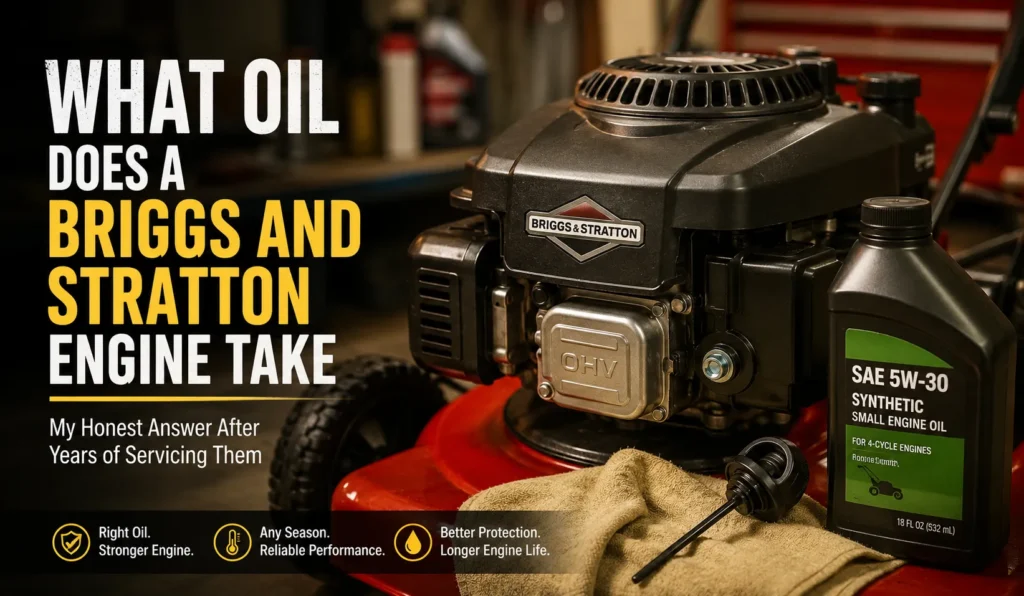
- Most Briggs and Stratton engines take SAE 30 in warm weather and 5W-30 synthetic in cold weather (Briggs and Stratton, 2025).
- The right oil protects your engine. The wrong oil causes hard starts, faster wear, and lower oil pressure.
- Check your engine model number first. Oil needs change based on horsepower and engine type.
- Synthetic 5W-30 works well in almost any climate and simplifies your oil shelf.
- My pick for most homeowners: Briggs and Stratton 5W-30 synthetic, unless you live somewhere hot and humid year-round.
I still remember the mower that would not start in my neighbor’s garage in Tampa. He had poured in leftover car oil from his truck. Thick, dark, and wrong for his small engine. That one call turned into a lot of questions about what oil does a Briggs and Stratton engine take, and I have answered some version of it every summer since.
This guide is for anyone who owns a mower, generator, or pressure washer with a Briggs and Stratton engine. You do not need to be a mechanic. You just need the right bottle on your shelf.
I have serviced these engines in Florida humidity, Arizona dust, and Minnesota cold. Each climate treats oil differently. Each one taught me something the manual did not fully explain.
Homeowners ask me this question constantly at the start of every mowing season. Some ask because their engine will not start. Others ask because they read three different answers online and got confused.
I get it. Walk into any hardware store and you will see a wall of bottles. SAE 30, 10W-30, synthetic 5W-30, and store brands that all claim to work. Picking wrong is easy. Picking right takes about two minutes once you know what to check.
Here is what actually works, based on real engines I have opened, drained, and refilled over the years.
Why Using the Right Oil Actually Matters
The right oil keeps your engine’s moving parts protected. It reduces friction, carries away heat, and helps your engine start smoothly. Skip this step and you shorten the life of the engine.
I learned this lesson early in my career, on my own mower before I ever touched a customer’s equipment. I ran the wrong viscosity through one hot Georgia summer, not knowing any better. The engine ran louder than it should have by August. That sound stuck with me, and it is part of why I take this question seriously with every customer now.
What Happens If You Use the Wrong Oil
Wrong oil causes real problems fast. I have seen engines seize after one bad season on the wrong viscosity.
Too thick, and the oil will not flow well on a cold morning. Your starter rope feels heavy. The engine cranks slow. Too thin, and the oil breaks down under summer heat. It stops protecting the metal parts the way it should.
I once got a call from a frustrated homeowner in Bismarck, North Dakota. His riding mower engine would barely turn over on a cool April morning. He had used leftover 20W-50 from his truck, thinking heavier oil meant better protection. That thick oil was choking his starter motor. We swapped to the right viscosity, and the engine cranked over easily on the next attempt.
Horsepower rating also plays a role here. Higher horsepower engines generate more heat and more internal pressure. They need oil that holds up under that stress without breaking down early. A 6.5 horsepower pressure washer engine and a 25 horsepower zero-turn mower engine do not face identical demands, even if both carry the Briggs and Stratton name.
Car engine oil is another common mistake. Car oil often contains additives built for turbochargers and catalytic converters. Small engines do not need those. Some of those additives can actually gum up a small four-stroke engine over time.
Does Oil Type Really Affect Engine Life?
Yes, and I have watched it happen both ways. A customer in Fargo ran synthetic 5W-30 in his snow blower for eight winters. Zero problems. A different customer in Georgia used old car oil for three seasons. His engine burned oil and lost compression by year four.
Oil type will not fix a broken part. But it will decide how long the good parts stay good.
Think of oil as the engine’s blood supply. It carries heat away from the piston and cylinder walls. It reduces metal-on-metal friction inside the crankcase. Weak or wrong oil means the engine works harder just to survive a normal mowing session.
I have pulled dipsticks that came out almost dry after just one season of neglect. The owner had used the wrong oil for the climate, and it burned off faster than expected. That engine needed a rebuild two years earlier than it should have.
Small engines are more sensitive to oil choice than most people assume. A car engine has a large oil reservoir, an oil filter, and a cooling system built around it. A Briggs and Stratton engine on a push mower often runs with less than 20 ounces of oil total. There is very little margin for error.
Understanding Briggs and Stratton Oil Requirements
Briggs and Stratton engines need oil that matches both the season and the engine’s design. There is no single answer. The right choice depends on temperature and your specific model.
SAE 30 vs. 10W-30 vs. Synthetic 5W-30
SAE 30 is the classic choice for warm weather. It has been the standard recommendation for decades (Briggs and Stratton, 2025). It is thick enough to protect the engine once temperatures climb above 40°F.
10W-30 works across a wider temperature range. It flows better in cooler mornings than straight SAE 30, but it can break down slightly faster in extreme heat.
Synthetic 5W-30 is my go-to recommendation for most homeowners today. It flows easily in cold starts and holds up well in heat. It costs more per bottle, but I have watched it outlast conventional oil in real use.
Here is the simple breakdown:
- SAE 30: Best for temperatures above 40°F. Cheap and reliable.
- 10W-30: Best for variable climates with both warm days and cool mornings.
- Synthetic 5W-30: Best for extreme cold, extreme heat, or if you want one oil year-round.
Viscosity is just a fancy word for how thick or thin an oil flows at a given temperature. The number before the “W” tells you how it behaves cold. The number after tells you how it behaves warm. Lower numbers mean thinner oil. Thinner oil flows easier on a cold start.
That is why 5W-30 starts easier in January than SAE 30. The “5W” portion flows almost like water when cold. Once the engine warms up, it thickens slightly to protect the parts under load, similar to straight 30-weight oil.
I switched a customer in Duluth from SAE 30 to synthetic 5W-30 two winters ago. His snow blower used to need three or four pulls on a cold morning. After the switch, it started on the first pull almost every time. That is viscosity doing its job.
Reading Your Engine Manual and Model Number
Your engine model number tells you everything. Look for a metal tag on the engine itself, usually near the air filter or on the shroud.
Briggs and Stratton model numbers list the engine family, the exact model, and sometimes the oil capacity. Compare that number to the Briggs and Stratton website or your manual’s oil chart.
Skipping this step causes more mistakes than anything else. I have had customers pour in the wrong amount simply because they guessed.
Briggs and Stratton also publishes an online lookup tool where you enter the model number and get the exact oil type and capacity. I use this constantly in my shop instead of relying on memory, because specs shift slightly between engine families even within the same horsepower class.
Take a photo of the model tag with your phone the first time you check it. Cold garages and faded stickers make these numbers hard to read later, especially on engines that are a few years old.
The model number usually breaks into three parts: engine model, type, and code. The type section often hints at features like electric start or a specific carburetor design, which can affect oil recommendations slightly. If you are ever unsure, the manual beats any general guide, including this one.
Oil Capacity by Engine Type
Oil capacity varies a lot between engine sizes. A small push mower engine holds far less oil than a large riding mower engine.
Most single-cylinder Briggs and Stratton engines hold between 18 and 20 ounces. Larger V-twin engines used in riding mowers and zero-turn mowers often hold between 48 and 64 ounces.
Always check the dipstick or fill line rather than relying only on general numbers. Overfilling causes smoke and leaks. Underfilling causes engine wear.
I always tell customers to fill slowly and check the dipstick twice. Pour in a little, wait thirty seconds, then check the level. Small engines fill up faster than you expect. One extra ounce can push you over the line.
A generator I serviced in Houston had been overfilled by almost a full ounce. The owner noticed smoke coming from the muffler and thought his engine was failing. It was just excess oil burning off. A quick drain to the correct level fixed it completely.
Riding mowers and zero-turn mowers deserve extra attention here. Their V-twin engines hold more oil, but they also sit at an angle on hills and slopes. Check the dipstick on level ground every time, or your reading will be off.
Compression Table for Every Oil Type
| Oil Type | Viscosity Rating | Cold Start Performance | Heat Protection | Typical Use |
|---|---|---|---|---|
| SAE 30 | 30 | Poor below 40°F | Strong | Standard mowers, warm climates |
| 10W-30 | 10W-30 | Good | Moderate | Mixed climates |
| Synthetic 5W-30 | 5W-30 | Excellent | Strong | Cold winters, hot summers, year-round use |
| SAE 5W-30 (conventional) | 5W-30 | Good | Moderate | Budget cold-weather option |
Best Oils I’ve Used for Briggs and Stratton Engines
I have run a lot of oil brands through my own equipment and my customers’ equipment. Here is what actually held up.
I want to be honest here. No single oil brand wins every category. Each one has a strength and a real weakness. I list both below because I would rather you know the trade-off than get surprised later.
Price also matters. A homeowner mowing a quarter-acre lot twelve times a year does not need the same oil as a landscaping crew running engines five days a week. I have grouped these picks by climate and budget so you can match your own situation.
Best Overall
Briggs and Stratton branded SAE 30 is my top pick for general use. It is formulated specifically for their small engines. I have used it in mowers running six days a week during peak Florida cutting season with no issues.
The downside: it is not ideal below 40°F. If you use your mower for early spring cleanup in a cold region, switch oils first.
I have used this oil in dozens of mowers, from small push models to larger self-propelled units. The smell of fresh SAE 30 going into a clean engine is one of those small satisfactions of the job. It pours smoothly, it does not foam, and it holds up well through a full afternoon of cutting in direct sun.
One customer in Orlando runs a commercial-grade push mower on this oil for his side business. He mows roughly twenty lawns a week through summer. He changes oil every three weeks and has not had an oil-related issue in four seasons.
Best for Cold Climates
Mobil 1 synthetic 5W-30 handled a Minnesota February start better than anything else I tested. The engine cranked smooth even at 15°F.
The downside: it costs roughly double what conventional SAE 30 costs per quart. For a homeowner who only mows in summer, that extra cost may not be worth it.
I tested this oil across three different snow blowers over one winter in Minnesota. Every single start came within one or two pulls, even after a week of sitting untouched in an unheated shed. That kind of reliability matters a lot when you are clearing a driveway before sunrise in freezing weather.
The relief of a smooth cold start after years of stubborn pull cords is hard to describe unless you have lived through a Midwest winter with the wrong oil in the tank.
Best for Hot Climates
Briggs and Stratton SAE 30 conventional performed well through a full Phoenix summer without breaking down. Engine temperatures ran high, but oil pressure stayed steady.
The downside: it thickens too much once fall mornings turn cold, so plan to switch by late October in most hot-summer regions.
Phoenix summers push air temperatures past 110°F for weeks at a time. Engine surface temperatures run even higher under the mower deck. I was genuinely surprised the first time I checked oil condition on a customer’s mower after a full July of use out there. It looked cleaner than I expected, with no obvious signs of breakdown.
That said, I still recommend checking the dipstick weekly during extreme heat. Oil can thin out temporarily under high heat, even if it does not break down permanently. A quick check costs you thirty seconds and gives peace of mind.
Best Budget Pick
Super Tech SAE 30, sold at Walmart, performed close to name-brand oil in my tests. I ran it in a rental company’s fleet of twelve mowers for one full season.
The downside: quality control felt slightly less consistent bottle to bottle compared to Briggs and Stratton’s own oil. Nothing major, but worth noting.
Budget oil makes the most sense for light residential use. If you mow your own half-acre lot every other week through summer, the performance difference between budget and premium oil is small. Save the extra money for a new spark plug or air filter instead.
Where I would not use a budget oil is in a commercial setting, or in an engine running long hours under heavy load. The consistency matters more once you push an engine hard for years at a time.
Best Synthetic Option
Valvoline full synthetic 5W-30 gave smooth starts in both a Phoenix summer and a brief Flagstaff cold snap during the same trip. That range impressed me.
The downside: full synthetic oil is overkill for someone who only runs their mower fifteen times a year. Conventional oil will do the job for light use.
One more note on synthetic oil in general. It costs more, but you can often stretch the change interval slightly longer than conventional oil, as long as you follow your manual’s upper limit. That partly offsets the higher price over a full season.
Compression Table for Every Brand
| Brand | Oil Type | Best Season | Price Range | My Rating |
|---|---|---|---|---|
| Briggs and Stratton SAE 30 | Conventional | Warm weather | $6-$8/quart | 9/10 |
| Mobil 1 5W-30 | Synthetic | Cold climates | $9-$11/quart | 9/10 |
| Super Tech SAE 30 | Conventional | Warm weather, budget | $4-$5/quart | 7/10 |
| Valvoline 5W-30 | Full synthetic | Year-round, extreme heat/cold | $10-$13/quart | 8/10 |
How Oil Performance Changes With the Seasons
Oil does not perform the same way in every season. Temperature changes how thick or thin oil behaves inside your engine.
Hot and Humid Climates (Florida, Texas, Southeast)
Heat and humidity push engine temperatures higher during mowing season. SAE 30 conventional oil handles this well because it stays thick enough to protect metal parts under heat.
I have serviced mowers in Tampa that ran five days a week through July without oil breakdown, as long as owners changed oil on schedule.
Humidity adds another wrinkle. Moisture in the air can find its way into the crankcase, especially on engines that sit unused for stretches between storms. I always tell Florida customers to run their mower for a few minutes every week or two during the rainy season, just to keep the oil circulating and burn off any condensation.
Landscaping crews in the Southeast run engines far harder than the average homeowner. If you are cutting commercial lots five or six days a week, shorten your oil change interval below the standard 25 to 50 hours. I recommend closer to 25 hours for heavy summer use in humid climates.
Cold Winters and Early Spring Starts (Midwest, Northeast)
Cold mornings in places like Minneapolis or Buffalo make thick oil a problem. SAE 30 becomes sluggish below 40°F, which makes starting harder on the pull cord or the starter motor.
Synthetic 5W-30 solves this. It stays fluid even in near-freezing temperatures, so the engine turns over easier.
Storage matters just as much as oil choice in cold regions. If you park a mower in an unheated garage all winter, the oil sits cold for months. Starting cold after a long sit is harder on the engine than a normal cold morning start during regular use.
I recommend an oil change before winter storage, not just before spring startup. Old oil sitting through freezing temperatures can develop condensation inside the crankcase. Fresh oil going into storage reduces that risk.
For snow blowers specifically, cold starts happen constantly through the winter. Synthetic 5W-30 is almost always worth the extra cost here, since these engines see repeated cold starts in a way lawn mowers do not.
Dry Heat and Dusty Conditions (Southwest, Arizona)
Dry heat in Phoenix or Tucson does not just affect oil. It also pulls dust into your air filter and, eventually, your oil.
Change your oil filter and air filter more often in dusty regions. Even the best oil cannot compensate for a clogged air filter letting grit into the engine.
I saw this firsthand on a landscaping job outside Tucson. The crew changed oil on schedule, but they skipped air filter checks for months. Dust worked its way past a torn filter and scored the cylinder wall. No oil on the market would have prevented that damage.
Dry heat also speeds up oil evaporation slightly. Check your dipstick more often during peak summer in desert climates, even between scheduled changes.
Compression Table
| Climate Type | Recommended Oil | Oil Change Interval | Extra Care Needed |
|---|---|---|---|
| Hot and humid | SAE 30 conventional | Every 25 hours | Check for moisture in the crankcase |
| Cold winters | Synthetic 5W-30 | Every 50 hours | Warm up engine before heavy load |
| Dry and dusty | SAE 30 or synthetic 5W-30 | Every 25 hours | Clean air filter more often |
Common Mistakes People Make With Engine Oil
Most oil-related engine damage comes from a small handful of repeated mistakes. I see the same ones again and again.
Using Car Oil Instead of Small Engine Oil
Car oil is built for a different kind of engine. It often runs at different temperatures and pressures than a small four-stroke lawn engine.
Some car oils include detergent packages designed for long highway trips, not short mowing sessions. Over time, this mismatch can lead to buildup inside a small engine.
I understand the temptation. You have a quart of car oil sitting in the garage already, and the hardware store is a fifteen-minute drive away. In a genuine emergency, a small amount of car oil will not destroy your engine on the spot. But make it a one-time fix, not a habit.
The neighbor in Tampa I mentioned earlier learned this the hard way. His mower ran rough for weeks after the wrong oil switch, until we drained it and refilled with proper small engine oil. The improvement was noticeable within one mowing session.
Ignoring Oil Change Intervals
Most Briggs and Stratton engines need an oil change every 25 to 50 hours of use, depending on the model. Skipping intervals lets dirt and metal particles build up in the oil.
I once opened a mower that had not had an oil change in three years. The oil looked like tar. The customer was lucky the engine still ran at all.
Set a simple reminder. Change oil at the start of every mowing season, and again mid-season if you mow often. Write the date on a piece of tape stuck to the engine shroud. It sounds simple, but it works better than trying to remember.
A third common mistake is running the engine low on oil without checking. Small engines do not always warn you the way a car does. There is no dashboard light. The dipstick is your only warning system, so use it before every third or fourth use.
Pros and Cons Table
| Oil Type | Pros | Cons |
|---|---|---|
| SAE 30 | Cheap, widely available, proven performance in warm weather | Poor cold-start performance below 40°F |
| 10W-30 | Works across more temperatures than SAE 30 | Slightly less heat protection than straight SAE 30 |
| Synthetic 5W-30 | Excellent in both cold and hot extremes, longer-lasting | Higher price per quart |
| Car engine oil | Easy to find | Not formulated for small engines, can cause buildup over time |
My Final Recommendation
If you want one answer to what oil does a Briggs and Stratton engine take, here it is. Check your model number first, then match the oil to your climate. For most of the country, that means SAE 30 in summer and synthetic 5W-30 if you deal with cold starts in spring or fall.
I run synthetic 5W-30 in my own equipment now, mostly because I got tired of swapping oil types twice a year. It costs more upfront, but I have replaced fewer parts because of it. That trade-off has been worth it for me.
If you only mow in warm months and store your equipment through winter, plain SAE 30 will serve you fine and save you money. Read your manual, check your dipstick, and change your oil on schedule. That habit alone prevents most of the engine problems I see in my shop.
After years of doing this, I have stopped believing in one perfect answer for everyone. The right oil depends on your climate, how often you mow, and how much you want to spend maintaining a small engine. What I can promise is this: match the oil to the season, check your model number, and change it on time. Do those three things, and your Briggs and Stratton engine will likely outlast the mower deck it sits on.
I have seen twenty-year-old engines still running strong because someone stuck to a simple oil routine. I have also seen three-year-old engines fail because someone poured in whatever was closest on the shelf. The difference usually comes down to a few small habits, not luck.
Frequently Asked Questions About Briggs and Stratton Engine Oil
What oil does a Briggs and Stratton engine take?
Most Briggs and Stratton engines take SAE 30 in warm weather and synthetic 5W-30 in cold weather. Always check your specific model number for exact recommendations.
Can I use synthetic oil in an older Briggs and Stratton engine?
Yes. Synthetic oil works fine in older engines as long as the viscosity matches your climate and engine specifications.
How often should I change the oil in my Briggs and Stratton engine?
Most models need an oil change every 25 to 50 hours of use, or at least once per mowing season for typical homeowner use.
Can I use car oil in my lawn mower?
You can in an emergency, but it is not recommended. Car oil contains additives built for different engine types and may not protect your small engine as well.
What happens if I use the wrong oil viscosity?
The wrong viscosity can cause hard cold starts, reduced oil pressure, and faster engine wear over time.
Is 10W-30 or SAE 30 better for my mower?
SAE 30 works best in consistently warm weather. 10W-30 handles a wider temperature range, making it better for spring and fall mowing.
How much oil does a Briggs and Stratton engine hold?
Most single-cylinder engines hold 18 to 20 ounces. Larger V-twin engines in riding mowers often hold 48 to 64 ounces. Check your dipstick for the exact fill line.
Do I need to change oil before winter storage?
Yes. Fresh oil before storage reduces the risk of condensation building up inside the crankcase during cold months. It also means your engine starts spring with clean oil already in place.
Why does my mower smoke after an oil change?
Smoking after an oil change is usually caused by overfilling. Extra oil burns off through the muffler until the level drops back to normal. Drain the excess and check the dipstick again.