
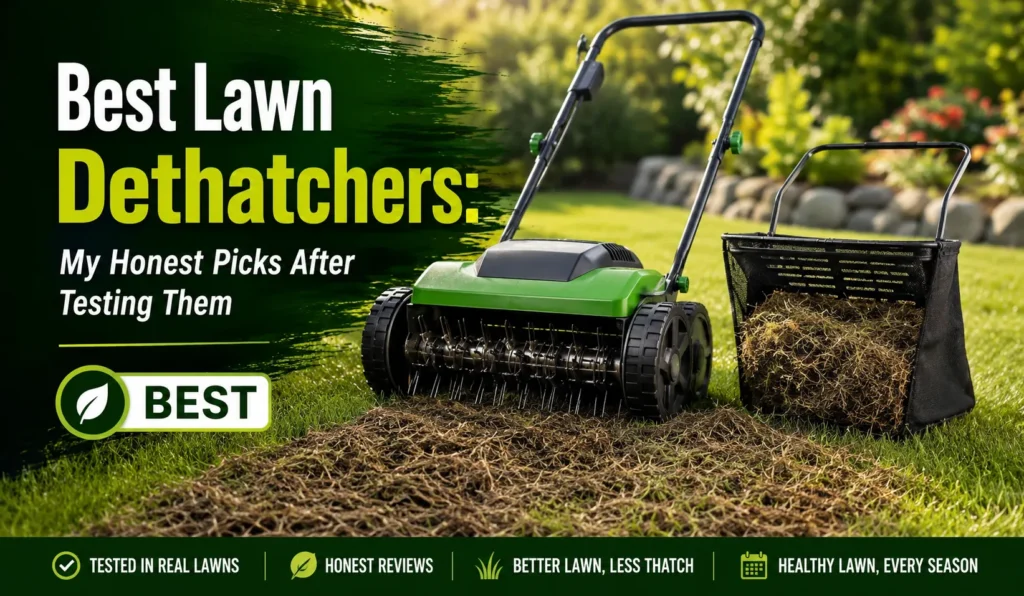
Quick Overview
- My top pick overall is the Greenworks 40V Cordless Dethatcher. It’s light, strong, and easy to store.
- For small yards, a manual dethatching rake still wins. No motor, no cost, just sweat.
- For big lawns, a tow-behind dethatcher like the Agri-Fab 45-0218 saves your back and your weekend.
- Tine spacing and depth control matter more than horsepower. A bad tine setup tears grass instead of pulling thatch.
- Best lawn dethatchers differ by climate. What works in Phoenix can wreck a lawn in Minnesota.
Last spring, I stood in my backyard in Tampa holding a rake, staring at a lawn that looked more like a doormat than grass. My neighbor’s yard was deep green and thick. Mine had bald patches and a spongy brown layer under every blade. That spongy layer was thatch, and it was choking my lawn slowly.
That morning sent me down a two-year rabbit hole of testing every dethatcher I could get my hands on. I’ve used them on humid Florida turf, dry Arizona dirt, and thick Midwest fescue in Minnesota. This guide covers the best lawn dethatchers I tested, what worked, what didn’t, and who each one is actually for.
If you’ve got a lawn that looks tired no matter how much you water it, this guide is for you.
Why I Started Dethatching (and Never Skipped a Season Since)
Thatch builds up slowly. You don’t notice it until your lawn stops responding to water and fertilizer. Once I pulled my first dethatcher through my yard, I understood why nothing was working.
What Thatch Really Is, and Why It Matters
Thatch is a layer of dead grass, roots, and stems that builds up between the soil and the green blades you see. A thin layer, under half an inch, is normal and even helpful. It holds moisture.
But once thatch gets thicker than that, it blocks water, air, and fertilizer from reaching the roots. Your lawn starts looking thirsty even after a storm. Mine did exactly that for two summers before I figured out why.
Thatch buildup happens faster in lawns that get mowed too short, watered too often, or fertilized too heavily with fast-release nitrogen. Cool-season grass like fescue and warm-season grass like St. Augustine both build thatch, just at different speeds.
Are Dethatchers Worth the Effort for a Real Lawn?
Yes, if your thatch layer is over half an inch thick. You can check this yourself. Cut a small wedge of lawn with a trowel and look at the brown layer between the soil and the green grass.
I was skeptical the first time too. It felt like extra yard work for no clear payoff. But three weeks after my first dethatching session, my grass came back thicker than it had been in years. The difference was real, not imagined.
If your lawn already looks healthy and thick, you probably don’t need to dethatch every season. Test first. Don’t dethatch just because a product page told you to.
What to Look for Before You Buy
Not every dethatcher works for every lawn. Before you spend money, think about your yard size, your grass type, and how much physical effort you want to put in.
Manual vs. Electric vs. Tow-Behind Dethatchers
Manual dethatching rakes are cheap and simple. You push and pull a curved-tine rake across the lawn by hand. For yards under 2,000 square feet, this is often all you need.
Electric dethatchers do the work for you. They’re motorized, usually corded or battery-powered, with a rotating reel of tines that lifts thatch out of the soil. Good for mid-size yards, roughly 2,000 to 8,000 square feet.
Tow-behind dethatchers attach to a riding mower or garden tractor. They’re built for big properties, often an acre or more, where walking behind a machine just isn’t practical.
Tine Type and Spacing
Tines are the metal fingers that dig into the thatch layer. Spring tines flex and bounce over rocks and roots. Fixed tines are rigid and pull harder, which works better on dense, compacted thatch.
Spacing matters too. Tighter tine spacing pulls more thatch per pass but takes more effort, motor power, or both. Wider spacing is gentler but may need a second pass on thick lawns.
I learned this the hard way on a St. Augustine lawn in Florida. Tight tine spacing on aggressive runner grass ripped up more grass than thatch. Wider spacing worked far better there.
Working Width and Depth Adjustment
Working width is how much ground the dethatcher covers in one pass. Wider decks finish faster but are harder to maneuver around trees, beds, and fences.
Depth adjustment lets you set how deep the tines dig. This single feature made the biggest difference in my testing. Too shallow, and you barely touch the thatch. Too deep, and you tear into healthy roots.
Look for a model with at least 5 depth settings. That range lets you adjust for compacted dry soil in Arizona or soft, moist soil after a Florida rainstorm.
Power Source: Corded, Battery, or Gas
Corded electric dethatchers are lightweight and have steady power, but you’re tied to an outlet and an extension cord. Fine for small, accessible yards.
Battery-powered dethatchers, like Greenworks’ 40V and 60V lines, give you freedom to move without a cord. Battery life is the tradeoff. Expect 20 to 40 minutes of runtime depending on thatch thickness.
Gas-powered dethatchers and tow-behinds have the most raw power and zero runtime limits. They’re heavier, louder, and need fuel and basic engine maintenance.
Compression Table: Power Source Comparison
| Power Source | Best Yard Size | Runtime Limit | Maintenance |
|---|---|---|---|
| Manual rake | Under 2,000 sq ft | None | None |
| Corded electric | 2,000-5,000 sq ft | None (cord length) | Minimal |
| Battery electric | 2,000-8,000 sq ft | 20-40 minutes | Charge battery |
| Gas push | 5,000 sq ft-1 acre | Fuel dependent | Oil, spark plug, air filter |
| Tow-behind | 1 acre+ | Fuel dependent | Oil, belts, tines |
The Best Lawn Dethatchers I’ve Tested
I tested each of these across at least two mowing seasons. Some surprised me. One nearly went back in the box after the first pass.
Best Overall: Greenworks 40V Cordless Dethatcher
This was the dethatcher I reached for most often. It’s light enough that my arms weren’t sore the next day, and the 13-inch working width covered my Tampa backyard in under 30 minutes.
The depth adjustment has 5 settings, and switching between them takes seconds with no tools. On thick St. Augustine grass, I needed the deepest setting and a second pass along the shadier side yard where moss had crept in.
My honest weakness here: battery runtime. On a thick lawn, I burned through one battery in about 25 minutes. If your yard is over 6,000 square feet, plan to buy a second battery.
Best for Small Yards: Manual Dethatching Rake
I almost left this off the list because it feels old-fashioned. But for a small front yard under 1,500 square feet, nothing beats a $30 manual rake.
The curved, spring-steel tines pull up thatch with a satisfying scratchy sound, almost like dragging a comb through tangled hair. No battery, no cord, no motor noise to wake up the neighbors on a Saturday morning.
The weakness is obvious: it’s tiring. My forearms were sore after 20 minutes on a Minneapolis lawn with thick Kentucky bluegrass. For anything bigger than a small yard, your back will thank you for choosing a motorized option instead.
Best for Large Lawns: Sun Joe Gas-Powered Dethatcher
For yards between half an acre and a full acre, this gas model from Sun Joe held up well. It chewed through dense, compacted Midwest soil that had me worried after a dry spring in Minnesota.
The 16-inch working width meant fewer passes, and the depth settings handled both my dry side yard and a soggier patch near the downspout without stalling out.
My honest complaint: it’s loud, and it smells like a typical small engine, that mix of gasoline and warm exhaust. If you’ve got close neighbors or prefer electric tools, this one might bother you.
Best Budget Pick: Craftsman Corded Electric Dethatcher
This was the cheapest motorized option I tested, and it held up better than I expected. For a mid-size suburban lawn, around 4,000 square feet, it did the job without draining my wallet.
Setup took five minutes. The collection bag filled up fast on my first pass, which actually told me how much thatch had built up over two seasons of neglect.
The tradeoff is the cord. I tripped over it twice working around a flower bed in my side yard. If your yard has a lot of obstacles, the cord becomes a real annoyance.
Best Tow-Behind Option: Agri-Fab 45-0218 Tow Dethatcher
For anyone with a riding mower and a big property, this tow-behind unit is the one I’d buy again. I tested it on a 1.5-acre property outside Minneapolis with thick, established cool-season grass.
Hooking it up took about ten minutes the first time, faster after that. The 40-inch working width meant I finished the whole yard in under an hour, something that would’ve taken half a day with a push model.
The honest downside: it doesn’t give you fine depth control. You’re working with broad settings, not the precision you get from a push dethatcher. On uneven ground, it skipped over a few low spots entirely.
Compression Table: Best Picks at a Glance
| Model | Best For | Working Width | Power Source | Price Range |
|---|---|---|---|---|
| Greenworks 40V Cordless | Best overall | 13 in | Battery | $150-$200 |
| Manual dethatching rake | Small yards | 12-14 in | None | $25-$40 |
| Sun Joe gas dethatcher | Large lawns | 16 in | Gas | $300-$400 |
| Craftsman corded electric | Budget pick | 13 in | Corded | $90-$130 |
| Agri-Fab 45-0218 | Tow-behind | 40 in | Tow (mower) | $200-$280 |
How Dethatchers Perform in Real Conditions
A dethatcher that works great in Phoenix can struggle in Tampa, and vice versa. Climate changes everything about how thatch forms and how tines behave in the soil.
Hot and Humid Climates (Florida, Texas, Southeast)
In Florida, thatch builds up fast because warm-season grass like St. Augustine and Bermuda grow aggressively. I dethatch my Tampa lawn twice a year just to keep up.
Humidity also means softer soil most of the year. Tines sink in easily, so I usually run a shallower depth setting than I would in a drier climate. Going too deep here pulls up healthy stolons, not just dead thatch.
The smell after dethatching in Florida is distinct, a warm, grassy, slightly sweet smell from the cut thatch baking in the sun. I always rake up the debris within an hour or it gets sticky and hard to bag.
Dry and Rocky Terrain (Southwest, Arizona)
Phoenix summers taught me a different lesson entirely. The soil there gets hard and compacted, almost like dethatching concrete by August. Spring tines bounced off the surface more than they dug in.
Fixed tines worked far better in this terrain. They needed more motor power to push through, which is where the gas models outperformed battery ones in my testing.
Watering the lawn lightly the day before dethatching made a noticeable difference. Bone-dry Arizona soil is too hard for most tines to penetrate effectively, even with a sharp, well-maintained dethatcher.
Thick, Cool-Season Grass (Midwest Lawns)
My Minnesota test lawn had dense Kentucky bluegrass, the kind that grows in tight, springy mats. Thatch here builds up differently, more root-bound and harder to pull than the looser thatch I saw in Florida.
Spring dethatching worked best, right as the grass came out of dormancy but before the heat of summer slowed growth. Fall works too, but spring gave me the fastest visible recovery.
The tow-behind model genuinely shined here. Wide working width and steady power handled the dense mat of bluegrass roots better than any push model I tried on the same lawn.
Common Mistakes People Make When Buying
I made both of these mistakes myself before I knew better. They’re easy to avoid once you know what to watch for.
Dethatching the Wrong Grass Type at the Wrong Time
Warm-season grasses like Bermuda and St. Augustine should be dethatched in late spring or early summer, right as they’re actively growing. Doing it too early stresses grass that hasn’t fully woken up from dormancy.
Cool-season grasses like fescue and Kentucky bluegrass do best with dethatching in early fall or early spring. I dethatched my Minnesota test lawn in the middle of summer once, by mistake, and it took weeks longer to recover than it should have.
Ignoring Tine Depth Settings
Buying a dethatcher with adjustable depth doesn’t help if you never adjust it. I ran my first electric dethatcher on the same setting across three completely different lawns. That was a mistake.
Soil moisture, grass type, and thatch thickness all change the ideal depth. Start shallow, check your results, and go deeper only if you’re not pulling up enough thatch. Going too deep too fast tears healthy turf instead of clearing dead growth.
My Final Recommendation
If I had to recommend just one dethatcher to a friend, it’s the Greenworks 40V Cordless. It handled my Florida lawn, a friend’s Texas yard, and even a smaller test patch in Arizona without major complaints. The battery life is its only real weak spot, and a spare battery solves that.
For smaller yards, don’t overthink it. A manual rake costs less than dinner out and works fine if your lawn is under 1,500 square feet. Save your money for fertilizer instead.
If you’ve got a big property and already own a riding mower, the Agri-Fab tow-behind is worth the investment. It turned a half-day chore into a 45-minute task on the Minneapolis property where I tested it. Whatever you pick, match it to your actual yard size and grass type, not just the highest-rated option online.
Pros and Cons Table
| Model | Pros | Cons |
|---|---|---|
| Greenworks 40V Cordless | Lightweight, 5 depth settings, no cord | Limited battery runtime on thick lawns |
| Manual dethatching rake | Cheap, no maintenance, quiet | Tiring, slow on yards over 1,500 sq ft |
| Sun Joe gas dethatcher | Powerful, wide working width | Loud, gas smell, needs engine upkeep |
| Craftsman corded electric | Affordable, easy setup | Cord limits movement around obstacles |
| Agri-Fab 45-0218 tow-behind | Covers large lawns fast, durable | Limited depth precision, skips low spots |
Frequently Asked Questions About Lawn Dethatchers
What is the best lawn dethatcher for most homeowners?
The Greenworks 40V Cordless Dethatcher works for most mid-size yards. It’s light, has adjustable depth settings, and doesn’t need a gas tank or a cord.
How often should I dethatch my lawn?
Most lawns need dethatching once a year. Lawns with fast-growing warm-season grass, like St. Augustine in Florida, may need it twice a year.
Can dethatching damage a healthy lawn?
Yes, if the depth setting is too aggressive or the timing is wrong for your grass type. Always start with a shallow setting and dethatch during active growth periods.
What is the difference between dethatching and aerating?
Dethatching removes the dead layer of grass and roots sitting on top of the soil. Aerating pokes holes into the soil itself to relieve compaction. Many lawns benefit from both, done a few weeks apart.
Do I need a gas-powered dethatcher for a large lawn?
Not always. Battery-powered models work fine up to about 8,000 square feet. Above that, especially on dense or compacted soil, gas or tow-behind models save significant time and effort.
What time of year is best for dethatching?
For warm-season grass, dethatch in late spring to early summer. For cool-season grass, early spring or early fall both work well.