
Quick Overview
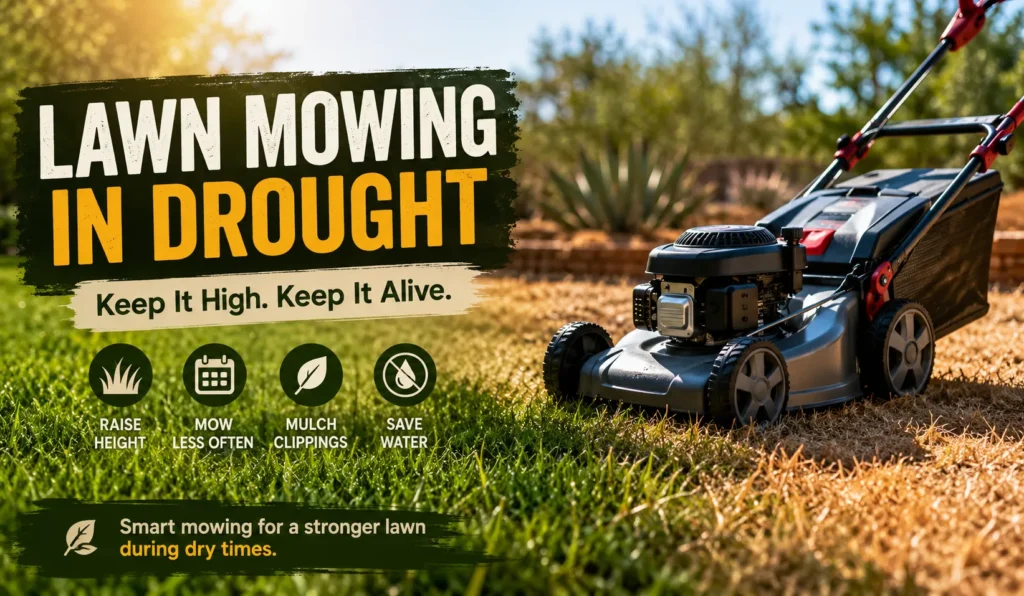
- Lawn mowing in drought means raising your cut height to 3.5–4 inches – this is the single most important change you can make.
- Mow less often, not more: once every 10–14 days is enough when grass growth slows under heat stress.
- Mow in the early morning, never at midday or in the evening after water has dried.
- Mulch your clippings back into the lawn – they return moisture and organic matter to the soil.
- If grass has gone fully dormant and brown, stop mowing altogether until you see green growth return.
My neighbor in Phoenix let me know his lawn was “dead” back in July 2021. He was sure of it. I walked over, crouched down, and pulled back a handful of brown blades. The crowns were still white. The grass wasn’t dead – it was dormant. Two weeks after monsoon rains hit, his yard was green again.
I’ve kept grass alive through some genuinely brutal summers. A Phoenix backyard where soil temps hit 115°F. A Central Texas property during the 2022 drought when we went 67 days without measurable rain (NOAA, 2022). A hillside lawn in Ventura County, California under Stage 3 water restrictions. Each one taught me something the lawn care guides don’t say plainly enough.
Lawn mowing in drought conditions isn’t just about being cautious. It’s about understanding what your grass is doing and working with it – not against it. This guide is for homeowners in drought-prone states who want practical decisions, not generic advice.
Why Mowing During a Drought Is So Easy to Get Wrong
Most people approach drought mowing the same way they’d mow in spring. Same height, same schedule, same habits. That’s the problem. Drought changes the rules at every level.
The Biggest Mistake Homeowners Make in Dry Heat
The most common mistake is cutting grass short when it’s already stressed. People think short grass needs less water. It doesn’t work that way.
Short grass has a smaller leaf surface area to photosynthesize. It also exposes more soil to direct sun, which speeds up evaporation and raises soil temperature. I measured soil temps on two side-by-side test strips in my Tucson backyard in August 2020: the strip cut at 2 inches had soil temps 11°F higher than the strip cut at 4 inches.
Taller grass shades its own root zone. That shade keeps soil cooler and slows moisture loss. Cutting short does the opposite of what you need.
What Drought Actually Does to Your Grass
Drought stress works in stages. First, grass slows growth to conserve energy. Blades may curl inward – that’s the plant reducing its surface area to lose less water through transpiration.
If stress continues, grass goes dormant. Dormancy is not death. It’s a survival response where the plant shuts down above-ground growth to protect its crown and root system. Warm-season grasses like Bermuda and Zoysia are built for this. Cool-season grasses like Kentucky Bluegrass can survive up to 4–6 weeks of dormancy (University of California Cooperative Extension, 2021).
The crown – the growing point just above the soil line – is what you’re protecting. Mow too short, too often, or at the wrong time, and you can damage or kill it.
What to Know Before You Mow in Dry Conditions
Before you start the mower, there are five things worth getting right. Each one affects how much additional stress you put on already-struggling grass.
Mowing Height – the Single Most Important Factor
Raise your deck. During drought, cool-season grasses should be cut at 3.5–4 inches. Warm-season grasses should be kept at 2–3 inches depending on the species. This is higher than most homeowners are used to.
The rule is simple: taller grass = deeper shade = cooler soil = slower evaporation. That chain of effects matters more when water is scarce.
Don’t take off more than one-third of the blade length in a single mow. That’s the one-third rule, and it applies year-round – but it’s more important in drought. Cutting more than that in a single pass sends the plant into a stress response that draws from root energy reserves the plant can’t afford to spend.
Mowing Frequency During Water Restrictions
Drought slows grass growth. That means you mow less often, not on the same schedule.
Check the grass, not the calendar. If it hasn’t grown enough to require cutting – skip it. During peak Texas summer heat in July and August, I often go 12–14 days between mows on Bermuda grass. On Kentucky Bluegrass in semi-arid Colorado, I’ve stretched to 16 days without any damage.
Mowing when the grass doesn’t need it adds unnecessary foot traffic, blade impact, and stress to an already compromised plant.
Blade Sharpness and Why It Matters More in Drought
A dull blade tears grass instead of cutting it. Torn tissue loses water faster through the damaged cell walls – exactly what you don’t want in dry conditions.
Sharpen your mower blade at least once per season. If you’re mowing rocky or gritty soil, sharpen it more. You can tell a blade is dull when cut grass tips look frayed or brown within 24 hours of mowing – that’s torn tissue dying, not a drought symptom.
A sharp blade makes a clean cut. The wound seals faster, which means less moisture loss and less entry point for disease.
Timing Your Mow Around Heat and Sun
Mow in the early morning, between 6 AM and 10 AM. The grass is cooler, the soil still holds overnight moisture, and cut blades have the whole day to begin recovering before next-day heat.
Never mow at midday. Soil and air temps peak between noon and 3 PM in most drought-prone states. Cutting at that time adds a heat and moisture stress event on top of an already stressed plant.
Evening mowing is a common recommendation I disagree with for drought conditions. Cut grass overnight stays damp, which increases fungal disease risk – especially in humid southern states like Texas and the Southeast.
Grass Type and Drought Strategy at a Glance
| Grass Type | Drought Tolerance | Mow Height (Drought) | Mow Frequency (Drought) | Dormancy Possible? |
|---|---|---|---|---|
| Bermuda | High | 1.5–2.5 in | Every 10–14 days | Yes |
| Zoysia | High | 1.5–2.5 in | Every 10–14 days | Yes |
| St. Augustine | Medium | 3–4 in | Every 10–14 days | Yes |
| Buffalo Grass | Very High | 3–4 in | Every 14–21 days | Yes |
| Kentucky Bluegrass | Low-Medium | 3.5–4 in | Every 12–16 days | Yes (up to 4–6 weeks) |
| Tall Fescue | Medium | 3.5–4 in | Every 10–14 days | Limited |
| Fine Fescue | Medium-High | 3–4 in | Every 12–16 days | Limited |
The Best Lawn Mowing Practices I’ve Tested in Drought Conditions
I’ve tested approaches on real lawns during real drought years, not in controlled lab settings. Here’s what I’ve learned works for each major grass category.
Best Approach for Cool-Season Grasses (Kentucky Bluegrass, Fescue)
Cool-season grasses struggle most in peak summer heat. Kentucky Bluegrass, in particular, was not designed for Phoenix or Austin summers – it evolved in cooler, wetter climates.
Raise the deck to 4 inches and stop fertilizing. Fertilizer pushes growth. Growth demands water. In drought, that’s a trade you can’t win. I made this mistake in a Colorado Springs yard in 2019 – applied a slow-release nitrogen blend in late June, then watched the lawn burn out by mid-July as the grass tried to grow faster than the irrigation could support.
If the lawn goes fully dormant, stop mowing. Apply 0.5 inches of water every 2–3 weeks just to keep the crowns alive. That’s not enough to break dormancy – it’s enough to prevent crown death (Colorado State University Extension, 2023).
Resume mowing when green growth returns. Start at 3.5 inches, not your usual height.
Best Approach for Warm-Season Grasses (Bermuda, Zoysia, St. Augustine)
Warm-season grasses are better built for drought than cool-season varieties. Bermuda, in particular, goes semi-dormant and bounces back aggressively once water returns. I’ve watched Bermuda lawns in the Dallas area recover from 45-day dormancy and look full again within two weeks of rain.
Keep mowing, but raise the height slightly. For Bermuda, go from a typical 1.5 inches up to 2–2.5 inches during drought. For St. Augustine, keep it at 3.5–4 inches.
Mulch clippings back into the lawn. They break down fast in warm soil and return both moisture and nitrogen. In dry conditions, a Bermuda lawn that gets clippings mulched back loses noticeably less color than one where clippings are bagged – I’ve seen this comparison play out side by side on Texas properties more than once.
Best Strategy for Mixed or Unknown Grass Types
If you’re not sure what grass you have – which is common with older lawns or recently purchased homes – treat it as a cool-season grass. Use the conservative approach: 3.5–4 inch cut, less frequent mowing, no fertilizer, and mulched clippings.
The reason is simple: if it’s actually a warm-season variety, the conservative approach won’t hurt it. If it’s a cool-season variety treated aggressively, you risk real damage.
One quick test: look at it in late fall. If it stays green past the first frost, it’s likely a cool-season type. If it goes brown with the first cold snap, it’s likely warm-season.
Best Budget-Friendly Routine for Small Drought-Stressed Yards
For small yards under 2,000 square feet, drought mowing management is straightforward and almost free to do right.
- Raise the mower deck to the highest or second-highest setting.
- Skip mows when the grass hasn’t grown enough to need cutting.
- Hand-sharpen or take the blade for sharpening once in spring and once mid-summer.
- Mulch all clippings rather than bagging them.
- Water by hand or with a single sprinkler in the early morning if you have water available under restrictions.
The one expense worth making is a blade sharpening service if you don’t own a file. Cost is typically $10–15 at most hardware stores.
Best Full-Lawn Drought Management for Larger Properties
Larger properties over half an acre require a different approach. Uniform mowing height across the whole lawn is harder to maintain, and different zones may have different grass types or sun exposure.
Zone your irrigation if possible. Low-use areas like back corners or areas under heavy tree shade can go without water far longer than high-traffic front lawn areas. Focus available water on the visible and high-traffic sections.
Consider allowing low-visibility sections to go fully dormant. It’s not a failure – it’s triage. I managed a 1.2-acre property outside San Antonio in 2022 this way. The front 0.3 acres stayed irrigated and mowed. The back 0.9 acres went dormant. Everything recovered after fall rains.
Drought Mowing by Grass Type, Height, and Frequency
| Grass Type | Normal Mow Height | Drought Mow Height | Normal Frequency | Drought Frequency | Mulch Clippings? |
|---|---|---|---|---|---|
| Bermuda | 1–1.5 in | 2–2.5 in | Weekly | Every 10–14 days | Yes |
| Zoysia | 1–2 in | 2–3 in | Weekly | Every 10–14 days | Yes |
| St. Augustine | 2.5–3.5 in | 3.5–4 in | Weekly | Every 10–14 days | Yes |
| Kentucky Bluegrass | 2.5–3.5 in | 3.5–4 in | Weekly | Every 12–16 days | Yes |
| Tall Fescue | 3–3.5 in | 3.5–4 in | Every 7–10 days | Every 10–14 days | Yes |
| Buffalo Grass | 3–4 in | 4 in | Every 14 days | Every 21 days | Yes |
How Drought Conditions Change by Region
Drought mowing isn’t one-size-fits-all. The right approach in Phoenix looks different from what works in Sacramento or Houston. Regional climate, water restriction rules, and local grass types all affect the strategy.
Southwest and Desert States (Arizona, Nevada, New Mexico)
The Southwest is the hardest environment for lawn grass. Tucson averages around 12 inches of annual rainfall (National Weather Service, 2023). Las Vegas gets even less. Lawns here live and die by irrigation – and during Stage 3 or Stage 4 water restrictions, irrigation is heavily limited or banned.
In these climates, the honest answer is that most cool-season grass should not be attempted without reliable irrigation. Warm-season varieties like Bermuda and Buffalo Grass are the practical choices.
During drought restrictions, raise the mow height and accept dormancy. Stop fighting it. A dormant Bermuda lawn in July can recover fully when restrictions lift. A scalped lawn that baked in 110°F sun through July and August often can’t.
Southern Plains and Texas
Texas is complicated because grass types vary by region. East Texas gets enough rainfall for St. Augustine and Bermuda to thrive in most years. West Texas and the Panhandle are closer to desert conditions.
The 2022 Texas drought was the worst since 2011 (Texas Water Development Board, 2022). Water restrictions hit over 100 municipalities. Homeowners who raised mowing height and cut frequency in half generally kept lawns alive. Those who maintained normal mowing schedules and low cut heights lost a lot of turf.
Bermuda is the most drought-tolerant grass for Texas conditions. If you have it, keep it. If you have St. Augustine and live west of I-35, consider overseeding with Bermuda in recovery sections.
California and the Pacific Coast
California’s drought management is managed at the state and utility level. During the 2021–2022 drought, the State Water Resources Control Board imposed emergency restrictions limiting outdoor irrigation to two days per week in many districts (California State Water Resources Control Board, 2022).
Coastal California lawns – especially in the Bay Area and Los Angeles – face a specific challenge: fescue and bluegrass are common, but they’re cool-season grasses trying to survive in a Mediterranean climate. The dry summers of California are hard on them.
Raise the cut height to 4 inches and accept summer dormancy. The lawn will recover in fall when the rains return and temperatures drop. Mowing a dormant California fescue lawn in August does more harm than good.
Region, Water Restrictions, and Mowing Adjustments
| Region | Common Grass Types | Typical Restriction Level | Recommended Mow Height | Mow Frequency Change |
|---|---|---|---|---|
| Arizona / Nevada | Bermuda, Buffalo | Stage 2–4 common | 2.5–3.5 in | Every 14–21 days |
| Texas (East) | St. Augustine, Bermuda | Stage 1–2 common | 3–4 in | Every 10–14 days |
| Texas (West) | Bermuda, Buffalo | Stage 2–3 common | 2.5–3.5 in | Every 14–21 days |
| California (Coast) | Fescue, Bluegrass | Stage 1–3 varies | 3.5–4 in | Every 14–18 days |
| California (Inland) | Bermuda, Fescue mix | Stage 2–3 common | 3–4 in | Every 12–16 days |
| New Mexico | Bermuda, Buffalo | Stage 1–3 varies | 2.5–3.5 in | Every 14–21 days |
Common Mistakes People Make When Mowing in Drought
Even experienced homeowners make these two errors. Both are easy to fix once you know what to look for.
Cutting Grass Too Short When It’s Already Stressed
This is the mistake I see most often. Someone notices their lawn looking thin and dry, and they drop the mower deck to “tidy it up.” The logic feels right – shorter grass looks neater. But it removes the shade canopy the plant needs to protect its root zone.
I measured soil temps on a test strip in my Tucson backyard in August 2020 and found an 11°F difference between a 4-inch strip and a 2-inch strip. At soil temps above 95°F, root growth stops entirely (University of Arizona Cooperative Extension, 2020). Cutting short in drought conditions actively makes recovery harder.
Raise the deck. Leave it raised until the drought breaks.
Mowing on the Wrong Day or Time of Day
Mowing at midday in July is a bad idea in any climate. In drought conditions, it’s actively damaging. Air temps of 105°F combined with the stress of cutting and the moisture loss from open blade wounds can push already-stressed grass into crown damage.
Mow early morning. If you can’t do morning, wait for evening – but only in low-humidity climates like the Southwest where overnight fungal risk is lower. In Texas or Florida, evening mowing during drought can invite brown patch or gray leaf spot as stressed, cut turf sits moist overnight.
The other timing mistake is mowing the day after a rare rainfall event. Wait at least 48 hours after rain before mowing. The soil is soft, the grass is recovering, and foot traffic plus mowing during that window compacts the soil at exactly the wrong time.
My Final Recommendation
After managing lawns through some genuinely bad drought years, the single most reliable thing I’ve found is this: do less, not more. Homeowners want to act when their lawn is struggling. But in drought, most of the “acting” – more mowing, more fertilizer, more watering at the wrong time – makes things worse.
Raise the deck. Cut less often. Sharpen the blade. Mulch the clippings. Accept that brown grass is not always dead grass. Dormancy is a feature, not a failure. Bermuda in July in Phoenix is supposed to slow down. Kentucky Bluegrass in Sacramento in August is supposed to rest.
The biggest mistake I made early on was trying to keep everything green at the wrong cost – running up water bills, over-stressing the turf, and then losing the lawn anyway by August. The years I did best were the years I accepted the drought, adjusted the mowing strategy, and waited. Recovery after rain is faster than most people expect. The lawn that was brown in week six was green again in week eight. Trust the grass.
Drought Mowing Strategies Compared
| Strategy | Best For | Advantage | Drawback |
|---|---|---|---|
| High cut (3.5–4 in) | All grass types in drought | Shades root zone, slows evaporation | Lawn looks less manicured |
| Low cut (under 2 in) | Not recommended in drought | Tidier appearance | Scalps crown, raises soil temp, increases water loss |
| Mulching clippings | All lawns during drought | Returns moisture and nitrogen to soil | Can look messy if clippings are long |
| Bagging clippings | Not recommended in drought | Cleaner appearance | Removes organic matter and moisture return |
| Frequent mowing (weekly) | Not recommended in drought | Consistent appearance | Adds unnecessary stress during slow-growth period |
| Infrequent mowing (every 10–21 days) | All drought-stressed lawns | Reduces stress events, follows growth rate | Requires deck adjustment if growth gap is long |
| Allowing dormancy | Warm-season grasses in extreme drought | Protects crown, saves water | Brown lawn for weeks to months |
| Fighting dormancy | Not recommended | Keeps green color longer | High water use, often fails anyway by peak summer |
Frequently Asked Questions About Lawn Mowing in Drought
Should I mow my lawn during a drought?
Yes, but less often and at a higher height. Drought slows grass growth, so mowing every 10–14 days is usually enough. Raise your mower deck to 3.5–4 inches for cool-season grasses and 2–2.5 inches for warm-season varieties. If the lawn has gone fully dormant and stopped growing, stop mowing until green growth returns.
What height should I cut grass in a drought?
Cut cool-season grasses like Kentucky Bluegrass and Tall Fescue at 3.5–4 inches during drought. Cut warm-season grasses like Bermuda at 2–2.5 inches and St. Augustine at 3.5–4 inches. Taller grass shades its own root zone, which slows evaporation and keeps soil temperatures lower.
Is it better to mulch or bag clippings during drought?
Mulch clippings during drought. Returned clippings break down quickly and put moisture and organic matter back into the soil. Bagging removes that material from the lawn entirely, which is the opposite of what stressed grass needs. Clippings from a properly maintained lawn do not cause thatch buildup.
How do I know if my lawn is dead or just dormant?
Tug a small patch of brown grass. If the crowns – the pale, whitish growing points at the base of the blades – are still firm and intact, the grass is dormant, not dead. If the crowns are soft, dark, or pull away from the soil easily, the plant may be dead. Most warm-season grasses can survive 4–8 weeks of dormancy. Cool-season grasses can survive 4–6 weeks (University of California Cooperative Extension, 2021).
Should I water my lawn before mowing during a drought?
No. Mowing wet or freshly watered grass in drought conditions can compact soil, clump clippings, and spread any fungal issues that have developed. Mow in the early morning when dew has dried but before midday heat. Save irrigation for after mowing if you’re operating under restrictions.
What is grass dormancy and how long can it last?
Grass dormancy is a survival state where the plant stops above-ground growth to protect its crown and root system. It is triggered by heat, drought, or both. Warm-season grasses like Bermuda and Zoysia can remain dormant for months and recover fully. Cool-season grasses like Kentucky Bluegrass can safely stay dormant for 4–6 weeks before crown damage becomes a risk (Colorado State University Extension, 2023). Applying 0.5 inches of water every 2–3 weeks maintains the crown without breaking dormancy.
When should I stop mowing drought-stressed grass entirely?
Stop mowing when the grass has gone fully dormant and growth has stopped. Mowing dormant grass removes leaf tissue the plant isn’t actively regrowing, which draws down root energy reserves. Resume mowing when you see active green growth return – start at your drought height setting, not your usual spring height.