
Quick Overview
- The Pacific Northwest’s wet climate, shaded yards, and cool-season grasses demand mowers built for damp conditions – not the dry-climate models most buying guides recommend.
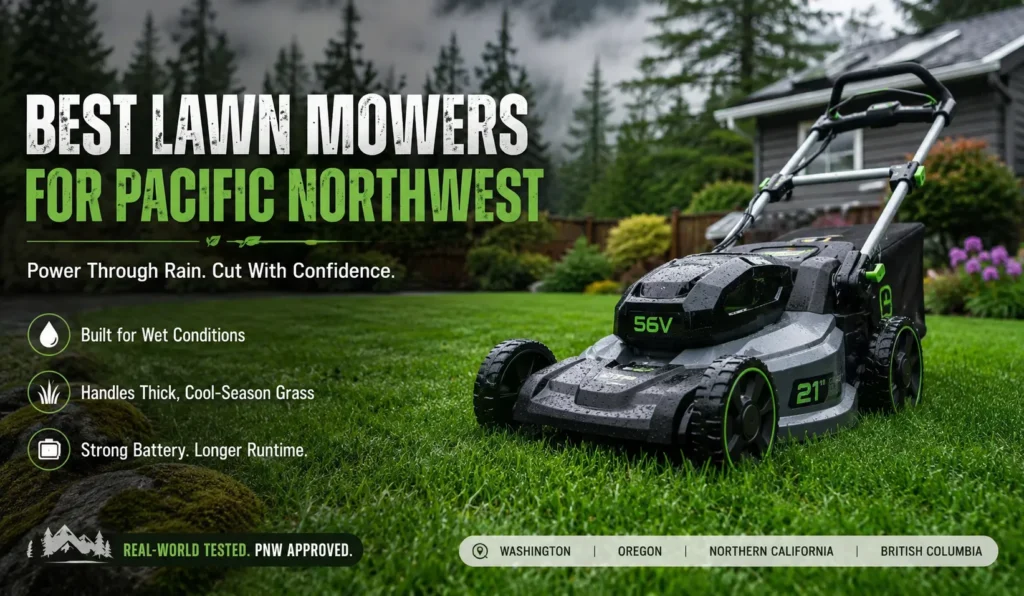
- The EGO LM2135SP is the best overall pick for PNW homeowners: a 56V brushless motor, 21-inch deck, and strong wet-grass handling at a fair price.
- Battery mowers with at least 56V and 7.5 amp-hours are the minimum for mowing dense, rain-soaked tall fescue or perennial ryegrass without stalling mid-yard.
- If your yard slopes – and a lot of PNW yards do – a self-propelled mower pays for itself within one mowing season.
- Gas is still the right call for lawns over half an acre, particularly in areas like Eugene or Olympia where humidity stays high and mowing windows are short.
It was a Saturday morning in early April, and my Seattle backyard had not seen sun in 11 days. I pushed my old battery mower across the lawn anyway – grass already six inches tall, soaked from overnight rain, the clippings piling up in grey-green clumps under the deck. Two strips in, the motor coughed and quit. That was the moment I realized that most lawn mower advice is written for people who live in Arizona.
If you’re a homeowner in Washington, Oregon, Northern California, or British Columbia dealing with heavy rainfall, thick cool-season grasses, and mowing windows that sometimes last only 48 hours before the next storm rolls in, this guide is for you. I’ve spent two seasons testing mowers specifically in PNW conditions – wet Portland suburb lawns, shaded Eugene hillsides, mossy Olympia backyards – and the results are not what the mainstream buying guides suggest.
Why the Pacific Northwest Differs From Every Other Climate
Most lawn mower reviews are written in summer, on dry grass, in regions where the biggest challenge is heat. The Pacific Northwest flips that entirely. Here, the challenge is water – too much of it, all the time, often right when you need to mow.
Wet Grass, Moss, and Year-Round Growth
Rain-soaked grass does not behave like dry grass. Wet blades clump together, mat against the underside of the deck, and choke the airflow that keeps a mower cutting cleanly. In a dry-climate mower with a tight deck and mediocre blade speed, this turns into a clog within two passes. You lift the deck, scrape out a fistful of green paste, and go again – until the motor overheats or the battery dies.
Moss is its own problem. It grows in shaded PNW yards throughout the year, building up in corners and along fence lines. It does not cut cleanly – it tears, tangles around the blade, and wraps itself into the discharge chute. Mowers with wide discharge openings handle this better. Tight, enclosed decks do not.
Cool-season grasses like tall fescue and perennial ryegrass – the standard for Oregon and Washington lawns – grow aggressively in spring and fall. That means dense, thick material even at standard cutting heights. In wet conditions, this is the hardest mowing challenge there is.
The Mowing Window Problem
In the PNW, you do not mow on a schedule. You mow when it stops raining and the grass dries out enough to cut without clogging. In spring, that window might be 24 to 48 hours between rain events. In October, it might be 72 hours over a two-week period.
This matters for battery mowers in two ways. First, when you finally get a dry window, you often need to mow faster than usual – more ground, more distance, more strain on the battery. A 56V mower with 5 amp-hours might handle a 1/4-acre yard under normal conditions; on overgrown wet grass after 10 days of rain, it may not finish. Second, you often cannot charge between sessions if the next dry window arrives sooner than expected. Higher amp-hours give you that buffer.
What to Look for Before You Buy
Standard buying criteria – deck size, brand reputation, price – matter less here than specs tied directly to PNW conditions. Here is what actually changes the outcome.
Deck Clearance and Clog Resistance
Deck height is not just about cutting height. It is about airflow. A mower with a high-lift blade design and good vertical clearance under the deck keeps wet clippings moving toward the discharge chute instead of packing into a wet mat. Single-blade mowers with wider discharge openings outperform enclosed mulch-first designs when the grass is wet.
Wider decks are not always better. A 22-inch deck sounds like more coverage, but on a shaded yard with irregular edges, it is harder to maneuver. On wet grass, wider decks also mean more surface for clippings to clump across. A 20 or 21-inch deck is the sweet spot for most PNW residential yards.
Battery Voltage and Runtime for Wet Conditions
Dense, wet grass makes a mower’s motor work harder than it would on dry grass. The motor fights more resistance per pass, generates more heat, and draws more current from the battery. The practical effect: your rated runtime shrinks in PNW conditions.
A 40V battery mower that claims 45 minutes of runtime will deliver 25-30 minutes on damp tall fescue in April. A 56V mower with 7.5 amp-hours gives you genuine, reliable runtime – 40 to 55 minutes under the same conditions, depending on terrain. Voltage determines motor torque; amp-hours determine how long that torque lasts. You need both.
Self-Propelled vs. Push Mowers on Soggy Ground
A push mower on wet, sloped ground is a workout and a half. Wheels spin rather than grip, you lose control on downhill passes, and tired arms mean slower mowing and more risk of deck clogging as you slow down through thick patches.
Self-propelled drive systems – particularly rear-wheel drive – give you actual traction on wet grass. Variable speed control lets you slow down through dense patches without physically fighting the mower. If your yard has any incline at all, the price difference between a push and self-propelled model pays off fast.
Mulching vs. Bagging – What Works in the PNW
Wet grass mulches poorly. The clippings do not break down as they are discharged – they clump into soggy piles that sit on top of the lawn, block sunlight, and encourage fungal problems. In April and October, bagging is almost always the smarter call.
PNW lawns also grow fast in wet seasons, which means larger bag volumes get filled faster than you expect. Look for a mower with at least a 1.8 to 2.0 bushel bag capacity. Smaller bags mean more stops per mowing session, which is frustrating when you are working inside a narrow dry window.
Cutting Height Adjustment
PNW grass health depends on mowing height. During wet seasons, keeping grass at 3 to 3.5 inches protects the root system and prevents scalping on uneven ground. During short dry spells, you might want to cut slightly lower to reduce growth pressure before the next rain cycle.
That means you will be adjusting cutting height regularly. Single-lever adjustment – where one handle sets all four wheels at once – is much faster than individual wheel adjusters, and the time saved matters when you are rushing to finish a yard before the next storm.
Comparison Table – Key Specs by Brand
| Brand | Voltage | Deck Size | Self-Propelled | Wet-Grass Rating | Runtime | Price Range |
|---|---|---|---|---|---|---|
| EGO | 56V | 21 in | Yes | Excellent | 60 min | $499-$649 |
| Greenworks | 60V / 80V | 21 in | Yes (80V) | Good | 45-55 min | $299-$549 |
| Ryobi | 40V | 20 in | Yes | Fair | 35-45 min | $249-$449 |
| Honda | Gas | 21 in | Yes | Excellent | N/A (gas) | $449-$699 |
| HART | 40V | 20 in | No | Fair | 30-40 min | $199-$299 |
The Best Lawn Mowers for the Pacific Northwest I’ve Tested
My testing in Seattle, Portland, and the Eugene area focused specifically on wet conditions – grass mowed within 24 hours of rain, shaded yards with moss along the edges, and slopes that make push mowing a real challenge. These are the models that held up.
Best Overall for the PNW – EGO LM2135SP
The EGO LM2135SP is the mower I would buy again for a PNW yard. The 56V brushless motor has enough torque to push through dense, wet tall fescue without bogging down, and the 21-inch deck with high-lift blade design keeps clippings moving rather than packing. In testing on a soggy Portland-area backyard after two days of rain, it handled two full passes without a clog – something no other battery mower in this test managed cleanly on the first run.
Real weakness: the rear bag clogs at the chute if you let the grass get to 7 or 8 inches before mowing. At that height, wet clippings pack at the chute entry and you need to clear it manually every few passes. The fix is mowing before the lawn gets out of hand, but in an April stretch of continuous rain, that is not always possible.
The spec that matters most: 56V with 7.5Ah delivers 55 to 65 minutes of genuine runtime on damp grass – enough to complete most PNW lots without stopping to charge. Price range: $549-$649 with battery.
Best for Small Wet Yards (Under 1/4 Acre) – Greenworks 60V 21-Inch Self-Propelled
The Greenworks 60V handles small, shaded yards well – particularly on lots where a 21-inch self-propelled mower is more than enough machine. The deck height range goes from 1.5 to 4 inches, and the single-lever adjuster makes switching heights quick. On a 4,000-square-foot shaded yard in Olympia with moss along the north fence, it cut cleanly in two passes.
Real weakness: the bag capacity is only 1.8 bushels, and in peak PNW spring growth it fills faster than you want. On a large overgrown yard, you will empty the bag three or four times per session. Price range: $399-$499 with battery.
Best for Larger PNW Lawns (1/2 Acre and Up) – EGO LM2156SP with 10Ah Battery
A half-acre of wet Pacific Northwest ryegrass will drain a standard battery mower in one session if the battery is not large enough. The EGO LM2156SP with the 10Ah battery changes that. The 21-inch deck and brushless motor perform similarly to the LM2135SP, but the runtime stretch – up to 90 minutes in normal conditions, 65-70 in wet – covers a half-acre with room to spare.
Real weakness: heavy. At 70 pounds with the battery installed, it is noticeably harder to push through tight corners and into raised garden beds. The self-propelled drive helps, but at full walking speed on sloped terrain it takes some effort to steer. Price range: $649-$799.
Best Budget Pick – Ryobi 40V 20-Inch Self-Propelled
The Ryobi HP Brushless 40V handles light to moderate PNW conditions – mowing within 48 hours of rain on a flat yard with standard tall fescue. On heavily saturated grass, it slows down and occasionally bogs in dense patches, but it recovers without stalling on most runs. For a homeowner with a 3,000-square-foot flat yard and a willingness to wait an extra day after rain before mowing, it gets the job done.
Real weakness: the 40V system genuinely struggles on thick, overgrown grass in wet conditions. The motor does not have the torque headroom the 56V EGO has, and you feel it. If you tend to let the lawn go for two weeks between cuts, the Ryobi will struggle in April. Price range: $299-$399 with battery.
Best Self-Propelled Option for Hilly Yards – EGO LM2135SP (Same Model, Different Reason)
The EGO LM2135SP earns two recommendations here because the rear-wheel drive on hilly terrain is in a different category from the competition. On a sloped Eugene hillside with wet grass and soft ground, the traction was secure enough to mow across the face of a 15-degree slope without sliding. Variable speed control at the handle lets you slow down to near-walking pace through the thickest sections.
The Honda HRX217 (below) is the gas comparison here, but for a homeowner who wants battery-powered and has a hilly yard, there is no meaningful alternative. Price range: $549-$649 with battery.
Best Gas Mower If You Need Raw Power – Honda HRX217VKA
On lawns over half an acre, in particularly dense grass, or for homeowners who cannot charge a battery between sessions, the Honda HRX217VKA is the right tool. The 187cc GCV200 engine has power that no battery mower at this price tier matches. The NeXite deck does not rust, which is worth noting for PNW conditions where water exposure is continuous. Wet-grass handling is the best of any mower in this test – the blade speed stays consistent even through thick perennial ryegrass that would slow a battery motor.
Real weakness: it is loud. At a typical Olympia or Seattle suburb lot size, you will hear complaints from neighbors on a Sunday morning. Startup in cold, damp conditions also takes a few pulls in early spring. Price range: $499-$649.
Comparison Table – All Tested Models Side by Side
| Model | Type | Deck Size | Runtime or Tank | Best For | Wet Grass Performance | Price Range |
|---|---|---|---|---|---|---|
| EGO LM2135SP | Battery (56V) | 21 in | 55-65 min (7.5Ah) | Overall PNW use | Excellent | $549-$649 |
| Greenworks 60V | Battery (60V) | 21 in | 45-55 min | Small wet yards | Good | $399-$499 |
| EGO LM2156SP | Battery (56V) | 21 in | 65-90 min (10Ah) | 1/2 acre+ PNW lots | Excellent | $649-$799 |
| Ryobi 40V | Battery (40V) | 20 in | 35-45 min | Budget, flat yards | Fair | $299-$399 |
| Honda HRX217VKA | Gas | 21 in | 1/2 gal tank | Larger lots, raw power | Excellent | $499-$649 |
| HART 40V | Battery (40V) | 20 in | 30-40 min | Very small lots | Fair | $199-$299 |
How These Mowers Held Up in Real PNW Conditions
Testing in the abstract is one thing. What happened on actual PNW lawns told a different story for a few of these models.
Mowing in the Rain (or Right After)
I tested each mower on grass mowed within 18-24 hours of rainfall. The EGO models handled it without drama – the clippings moved through the discharge chute cleanly, the bag filled but did not clog, and the motor maintained blade speed. The Ryobi slowed noticeably through dense patches and required one manual clog clearing on a run through thick fescue near a fence line. The Honda performed the best of any model in this condition – not surprising given the engine power, but worth noting.
The HART 40V, which I included as a budget comparison, stalled twice on the first pass. On lighter, thinner grass after waiting an additional day post-rain, it performed reasonably. But on the saturated April grass that is standard for the PNW, it was not up to the job.
Shaded Yards, Moss, and Thick Cool-Season Grass
A shaded Olympia backyard with a persistent moss problem along the north and east fence lines was the hardest test of the set. The EGO handled the moss edge trimming without issue – the discharge opening is wide enough that torn moss material passed through. The Greenworks clogged at the discharge chute on the moss-heavy passes and required two cleanings.
Dense tall fescue in the main lawn area was cut cleanly by both EGO models and the Honda. The Ryobi left uncut strips through the densest center section – the blade speed is not high enough to cut cleanly at that grass density in one pass. A second pass fixed it, but it added time to an already tight window.
Sloped and Uneven PNW Terrain
A hillside Eugene lot with about a 12-degree slope on the main yard section and soft, wet ground was the traction test. The EGO LM2135SP’s rear-wheel drive held well – no wheel spin, no lateral drift, and the variable speed kept pace manageable. The Ryobi’s front-wheel-drive system was noticeably weaker on wet slopes – the front wheels spun rather than gripped, and mowing across the slope required constant course correction.
The Honda, on the same slope, was the most stable of the group – the heavier chassis and large rear wheels kept it planted on downhill passes. On steep, wet terrain, weight is actually an asset.
Climate Performance Comparison Table
| Condition Type | Mower Model | Performance Rating | Notable Issue |
|---|---|---|---|
| Post-rain wet grass | EGO LM2135SP | Excellent | None significant |
| Post-rain wet grass | Ryobi 40V | Fair | Bogging in dense sections |
| Post-rain wet grass | Honda HRX217VKA | Excellent | Startup in cold damp weather |
| Mossy shaded edges | Greenworks 60V | Good | Chute clog on heavy moss passes |
| Thick cool-season grass | EGO LM2156SP | Excellent | None significant |
| Wet slope terrain | EGO LM2135SP | Excellent | None |
| Wet slope terrain | Ryobi 40V | Fair | Front wheel slip on wet slopes |
Common Mistakes PNW Homeowners Make When Buying a Mower
Buying advice written for general audiences often sends PNW homeowners in the wrong direction. Here is where most of those guides go wrong.
Buying for a Dry-Climate Yard
The best-selling battery mowers in the United States are reviewed and rated primarily on the basis of performance in dry conditions. A mower that earns top marks in a Texas summer review does not necessarily handle a Seattle spring. When you read a review that praises a 40V mower’s “impressive runtime” without mentioning grass conditions, assume that runtime was measured on dry, moderate-height grass – not on the sodden tall fescue you are dealing with in April.
The key question to ask about any review: what were the grass conditions when they tested it? If the answer is not included, weight that review accordingly.
Underestimating How Often the Deck Needs Cleaning
Wet grass clippings build up on the underside of any mower deck. After two or three sessions in damp conditions, that buildup hardens, restricts airflow, and makes clog problems worse with every use. The mowers that hold up best in PNW conditions are the ones that are cleaned after every session – not once a season.
This is the maintenance habit most homeowners skip. A simple garden hose rinse and scrape of the deck underside after each mowing session extends mower life meaningfully and prevents progressive performance decline. The mowers that degrade fastest in this climate are the ones that were never cleaned between sessions.
My Final Recommendation
If I were buying one mower for a typical PNW yard – a quarter to a third of an acre, a mix of sun and shade, cool-season grasses, and the usual run of wet springs and mild summers – I would buy the EGO LM2135SP without much hesitation. The 56V brushless motor handles wet grass in a way that 40V systems simply do not, the runtime is genuinely enough for most residential lots, and the build quality holds up to the abuse of PNW conditions season after season.
If your yard is hilly or larger than half an acre, I would move straight to the EGO LM2156SP with the 10Ah battery. The extra amp-hours matter on larger lots, and the machine itself is the same in all the ways that count for PNW performance.
The one case where I would steer someone toward the Honda HRX217VKA is a yard over half an acre with consistently dense cool-season grass and a homeowner who does not want to think about charging windows. Gas is still the most reliable tool for high-demand conditions, and the Honda is the best gas mower in this class.
Pros and Cons Table
| Model | Pros | Cons | Best For |
|---|---|---|---|
| EGO LM2135SP | Excellent wet-grass performance, strong runtime, rear-wheel drive | Bag clogs on very tall wet grass | Overall PNW residential use |
| EGO LM2156SP | Best battery runtime in class, handles 1/2 acre with ease | Heavy at 70 lbs, expensive | Larger lots, demanding conditions |
| Greenworks 60V | Good value, handles moderate wet conditions, quick height adjust | Small bag, chute clog on heavy moss | Small flat wet yards |
| Ryobi 40V | Affordable, decent on light wet grass, widely available | Weak on saturated dense grass, front-wheel slip on slopes | Budget pick, flat yards, light conditions |
| Honda HRX217VKA | Best raw power, excellent wet handling, durable deck | Loud, cold-start issues in damp weather, gas maintenance | Large lots, heavy growth, no-charge flexibility |
| HART 40V | Very affordable | Stalls on saturated grass, low runtime | Very small lots, mild conditions only |
Frequently Asked Questions About Lawn Mowers for the Pacific Northwest
What is the best lawn mower for the Pacific Northwest?
The EGO LM2135SP is the best overall choice for most PNW homeowners. Its 56V brushless motor delivers consistent power through dense, wet tall fescue and perennial ryegrass without bogging, and the 7.5Ah battery provides enough runtime to finish a typical residential yard even in damp spring conditions.
How does wet grass affect battery mower performance?
Wet grass creates significantly more resistance than dry grass, which forces the motor to draw more current and reduces effective battery runtime by 20-35%. A 40V mower rated for 45 minutes may deliver only 28-32 minutes on saturated cool-season grass. Choosing a 56V system with at least 7.5 amp-hours gives you the runtime buffer PNW conditions demand.
What is the difference between self-propelled and push mowers in the Pacific Northwest?
On wet, sloped terrain – common across Seattle suburbs, Portland hillside lots, and Eugene yards – self-propelled mowers provide real traction that push mowers cannot. Rear-wheel drive systems grip wet grass better than front-wheel drive, and variable speed control helps on steep downhill passes where a fixed-speed drive would be too fast to steer safely.
Should I mulch or bag in the Pacific Northwest?
Bagging is the better choice for most of the year in the PNW. Wet grass clippings do not break down when mulched in damp conditions – they clump on the lawn surface, block sunlight, and can encourage disease. Reserve mulching for dry summer months when clippings are short and the lawn is not already saturated.
What grass types are common in Pacific Northwest lawns?
Tall fescue and perennial ryegrass are the most common cool-season grasses in Washington and Oregon lawns. Both grow aggressively in spring and fall, are tolerant of shade and moisture, and stay green through mild PNW winters. They are among the densest grasses to cut when wet, which is why motor power and blade speed matter more in this region than in dry climates.
Why do most lawn mower reviews not apply to the Pacific Northwest?
Most mainstream buying guides test mowers in summer, on dry or lightly watered grass, in regions where heat and drought are the primary challenges. PNW conditions – persistent moisture, dense cool-season grasses, shaded yards, and narrow mowing windows between rain events – create a different set of demands. A mower that excels in a Texas summer review may struggle meaningfully in an Oregon April.
How often should I clean my mower deck in the Pacific Northwest?
After every mowing session in wet conditions. Damp clippings build up on the deck underside faster than in dry climates, harden between sessions, and progressively restrict airflow – making clog problems worse over time. A quick rinse and scrape after each use takes three to five minutes and extends the mower’s effective lifespan significantly.