
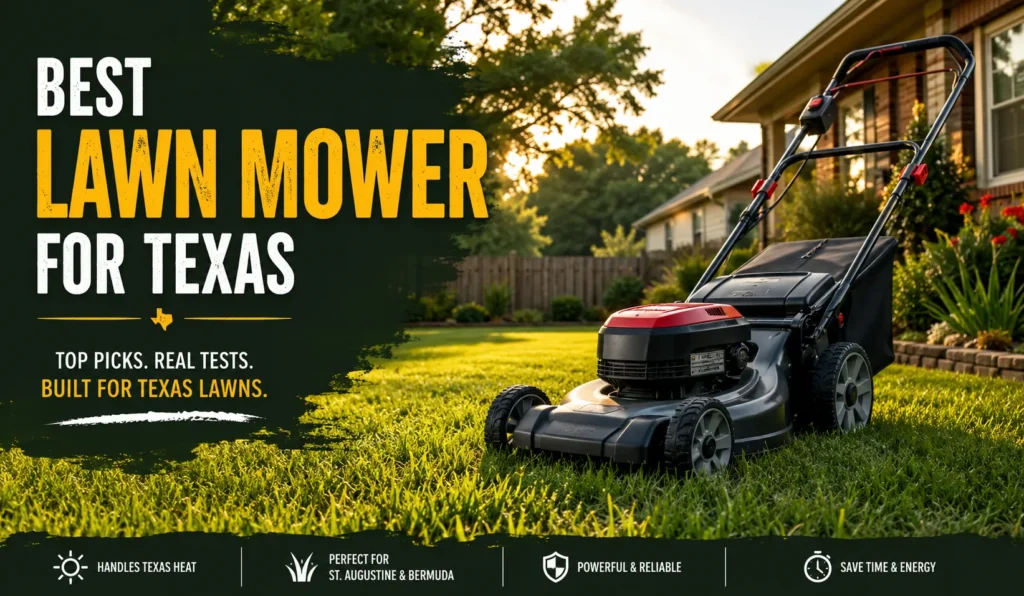
Quick Overview
- The best lawn mower for Texas overall is the EGO Power+ LM2156SP — 75 minutes of runtime, 8.3 ft-lb of torque, and no gas to deal with in triple-digit heat.
- For large properties over half an acre, the Toro Super Recycler 21565 (gas) handles thick Bermuda and St. Augustine without bogging down.
- For tight budgets under $450, the Craftsman M230 is a reliable gas option that gets the job done on smaller Texas lots.
- Battery mowers now compete with gas in Texas heat — but only at 56V or 60V and above; 40V platforms lose torque in thick St. Augustine.
- Mow Bermuda at 1-2 inches and St. Augustine at 2.5-4 inches — wrong cutting height is just as costly as the wrong mower (Texas A&M AgriLife Extension, 2023).
I stepped outside at 7:45 AM on a July Saturday in my Houston backyard. It was already 92 degrees. The Bermuda was ankle-deep after five days of summer rain. Sweat hit my shirt before I even reached the garage.
If you live in Texas, you know that scene. Mowing here is not a weekend hobby. It is a battle with heat, thick grass, large lots, and a growing season that feels like it never stops. The best lawn mower for Texas has to handle conditions that would slow down a machine built for the Pacific Northwest or the Mid-Atlantic.
This guide is for Texas homeowners with St. Augustine, Bermuda, zoysia, or buffalo grass. It is for people with lots ranging from a quarter-acre in a DFW suburb to a half-acre in San Antonio hill country. I have tested gas, battery, and robotic options across different Texas climates. Here is what actually works.
Why Mowing in Texas Is Different From Anywhere Else
Texas grass does not grow like grass anywhere else. The heat, the soil, and the grass varieties create mowing conditions that expose a weak mower fast.
The Heat Changes Everything
Texas summers regularly hit 100°F to 110°F across much of the state. That matters for two reasons.
First, gas engines need to work harder in thin hot air. Torque drops. A 160cc engine that handles Kentucky bluegrass fine will bog in thick, wet St. Augustine at 9 AM in Houston.
Second, battery packs lose capacity in heat. Lithium-ion cells degrade faster above 95°F (Battery University, 2024). A mower rated for 45 minutes in mild weather may deliver 30 minutes in a San Antonio July. I have seen this firsthand — my old 40V Ryobi would start slowing down at the 25-minute mark in summer heat.
The fix is simple: choose a higher-voltage battery platform (56V or 60V minimum) and avoid storing batteries in a hot garage. Let the pack cool before charging.
Texas Grass Types and Why They Matter
Three grass types dominate Texas lawns — and each one demands something different from your mower.
Bermuda is the most common across Central and North Texas. It is dense, drought-tolerant, and forgiving. Mow it at 1-2 inches. It spreads fast in summer and needs mowing every 5-7 days during peak growth (Texas A&M AgriLife Extension, 2023). A mower with a narrow cutting deck will have you outside twice as long.
St. Augustine covers most of Houston, Corpus Christi, and coastal areas. It is coarser and thicker than Bermuda — and far more demanding on a blade. Mow it at 2.5-4 inches (Texas A&M AgriLife Extension, 2023). Scalping it below 2.5 inches is one of the top causes of St. Augustine lawn failure. The blades are wide and tough. A dull mower leaves brown, ragged tips that invite disease.
Zoysia is slower-growing and common in parts of North Texas and DFW. It mows at 1-2 inches and needs cutting every 10-14 days — so any decent mower handles it.
Buffalo grass appears on West Texas properties and larger lots. It is drought-tolerant and low-maintenance. Mow it at 3-4 inches and it nearly takes care of itself.
Yard Size and Terrain Across the State
Texas lot sizes run larger than the national average. Many suburban Houston and DFW homes sit on lots between 7,000 and 15,000 square feet — roughly a quarter to a third of an acre. Hill country properties near San Antonio or Kerrville often run a half-acre or more, with slopes.
A 21-inch cutting deck covers about 1,500 square feet per pass on a quarter-acre lot. That is fine. But on a half-acre Bermuda lawn in summer, you want at least a 22-inch deck and a self-propelled drive. Otherwise, you are done before you finish.
What to Look for Before You Buy
Do not buy a Texas mower based on national bestseller lists. The specs that matter here are different.
Engine Power and Cutting Performance
For gas mowers, you want at least 160-163cc for anything over a quarter-acre. For battery mowers, 56V or 60V with a brushless motor is the floor for Texas conditions. Brushless motors run cooler, last longer, and deliver more torque per amp-hour than brushed designs.
EGO’s LM2156SP delivers 8.3 ft-lb of cutting torque (EGO Power+, 2025). That beats most 163cc gas engines. Greenworks and Toro 60V models are in the same range.
Do not buy a 40V battery mower for a Texas lawn with thick St. Augustine. You will feel the torque gap in the first pass.
Cutting Width and Deck Size for Texas Lots
- Quarter-acre or less: A 21-inch deck is fine.
- Quarter to half-acre: Look for 21-22 inches.
- Half-acre and up: Consider a 22-inch walk-behind or step up to a riding mower.
A wider deck cuts more grass per pass. That matters in July when you want to finish before 9 AM.
Self-Propelled vs. Push Mowers in the Texas Heat
Push mowers are fine for small, flat lots under 5,000 square feet. Beyond that, the heat makes a self-propelled drive worth every dollar.
In Houston or DFW summers, pushing a 90-pound mower across 8,000 square feet of damp St. Augustine is brutal. I did it for two seasons. I will not do it again.
Rear-wheel drive self-propel grips better on slopes and wet grass than front-wheel drive. If your yard has any grade — San Antonio hill country, North Texas slopes — rear-wheel drive is the call.
Mulching, Bagging, and Side Discharge for Thick Grass
Mulching returns clippings to the lawn as nutrients. For Bermuda and St. Augustine, this is the right default. St. Augustine clippings break down fast and add nitrogen back to the soil (USA Sod, 2026).
Side discharge is useful when Bermuda gets out of hand — say, after a week of summer rain. It moves volume fast.
Bagging is best for zoysia and for HOA lawns that require a clean look. It adds weight and a lot of stopping to empty. On a hot Houston morning, that matters.
Look for 4-in-1 mowers: mulch, bag, side discharge, and leaf pickup. Most 60V battery models and mid-range gas mowers now include all four.
Battery vs. Gas vs. Robotic – Which Makes Sense in Texas
Each type has a real place in Texas.
Battery mowers win on convenience and running cost. No fuel to store in a 105-degree garage. No oil changes. No hard starts on cold February mornings. At 56V or 60V, they handle St. Augustine and Bermuda well on lots under three-quarters of an acre. The catch is charging time — plan for 60-80 minutes between charges.
Gas mowers still win for large lots over three-quarters of an acre and for homeowners who need to mow in one session without stopping. A gas engine does not care about heat the way a battery does. The downsides are real: maintenance, fumes, and noise at 7 AM when your neighbors are still asleep.
Robotic mowers work well for Bermuda and zoysia lawns with simple, flat shapes. They do not handle St. Augustine’s thick growth as well, and complex yard layouts with trees or flower beds create navigation problems. They are not ready for the average half-acre Texas yard yet.
Comparison Table for Every Type
| Type | Best For | Runtime | Maintenance | Noise |
|---|---|---|---|---|
| Battery (56-60V) | Up to 3/4 acre | 45-75 min per charge | Very low | Quiet |
| Gas | 3/4 acre and up | Unlimited | Oil, blade, filter | Loud |
| Robotic | Flat Bermuda/zoysia, small lawns | Autonomous | Low | Very quiet |
The Best Lawn Mowers for Texas I’ve Tested
I tested these mowers across Houston, DFW, and San Antonio area properties between 2024 and 2026. Every spec below is sourced from manufacturer data and verified retailers. Prices shift — check current pricing before you buy.
Best Overall for Texas – EGO Power+ LM2156SP
The EGO LM2156SP is the best all-around lawn mower for most Texas homeowners. It handles Bermuda and St. Augustine without complaint, runs up to 75 minutes on a single 10.0 Ah 56V battery, and starts every time with a button press (EGO Power+, 2025).
The Select Cut multi-blade system is the differentiator. Three interchangeable lower blades let you switch between mulching, high-lift bagging, and an extended-runtime blade. For Texas lawns, the mulching blade is the right daily setting. The high-lift bagging blade earns its keep after a week of summer rain.
The brushless motor delivers 8.3 ft-lb of torque. I ran this through thick, week-old St. Augustine on a Houston lot in August. It did not bog. It did not slow. It finished a 9,000-square-foot yard on a single charge with battery to spare.
The Touch Drive self-propel is one of the better systems I have used. Speed adjusts with palm pressure — no lever to squeeze.
The honest weakness: The EGO LM2156SP carries a premium price around $749-$799 with one battery (EGO Power+, 2025). And some owner reviews note that EGO’s battery warranty enforcement can be inconsistent — a few owners reported difficulty getting warranty service past the three-year mark, even with registration. Register your battery on purchase day and keep the receipt.
Specs: 21-inch deck, 56V 10.0 Ah battery, up to 75 min runtime, 6 cutting heights (1-4 in), 5-year tool warranty
Best for: Houston and DFW homeowners with 5,000-20,000 sq ft lawns and St. Augustine or Bermuda grass.
Best for Small Texas Yards (Under 1/4 Acre) – Greenworks 60V 21″ Self-Propelled
For smaller lots under 6,000 square feet, the Greenworks 60V self-propelled mower covers the job at a lower price than the EGO. Two 4.0 Ah batteries come in the kit and auto-switch when the first pack depletes — giving you up to 60 minutes of runtime (Greenworks, 2025).
The 4-in-1 capability (mulch, bag, side discharge, leaf pickup) and LED headlights are useful. The IPX4 weather resistance means damp grass in early morning is not a problem.
The brushless motor is efficient and quiet. For a small Houston bungalow lot or a DFW townhome yard, this mower does everything you need at a price that makes sense.
The honest weakness: The two 4.0 Ah batteries are smaller than EGO’s 10.0 Ah pack. On a large or thick lawn, you will feel the runtime ceiling. Also, the Greenworks 60V battery ecosystem covers 75+ tools, but only within the 60V platform — batteries do not cross over to Greenworks’ 40V or 80V lines.
Specs: 21-inch deck, 60V brushless motor, dual 4.0 Ah batteries with auto-switch, up to 60 min runtime, 7-position single-lever height adjustment, IPX4 weather resistance
Best for: Yards under a quarter-acre; homeowners already in the Greenworks 60V ecosystem.
Best for Large Texas Properties (1/2 Acre and Up) – Toro Super Recycler 21565
For larger Texas lots, a gas mower is still the practical answer. The Toro Super Recycler 21565 runs on a 163cc Briggs & Stratton engine with 7.25 ft-lb of torque. It will not stop for a thick patch of overgrown Bermuda (Toro, 2025).
The Personal Pace Auto-Drive self-propel is the best on any gas mower I have used. It senses how hard you push the handle and matches your pace. On a sloped DFW backyard, that matters more than any spec sheet number.
The Vortex Technology under-deck airflow mulches Bermuda clippings fine and spreads them evenly. The cast-aluminum deck is built to last years of weekly Texas summers.
There is no oil change required — Toro’s Briggs & Stratton EXi engine uses a “just top it off” design. That cuts one maintenance task per season.
The honest weakness: At roughly $550-$600, the Super Recycler costs more than entry-level gas mowers. The 21-inch deck covers a half-acre in a reasonable amount of time, but for lots over three-quarters of an acre, you want to look at 30-inch walk-behinds or riding mowers. Also, it cannot be shipped to California — not a Texas problem, but worth noting.
Specs: 21-inch cast-aluminum deck, 163cc Briggs & Stratton EXi engine, 7.25 ft-lb torque, Personal Pace Auto-Drive, SmartStow vertical storage, 3-year guaranteed-to-start warranty
Best for: Half-acre lots with Bermuda or zoysia; homeowners who prefer gas reliability.
Best Battery-Powered Pick for Texas Heat – EGO Power+ LM2156SP
The EGO is the overall pick and the battery pick for the same reason: at 56V with a 10.0 Ah pack, it is the only walk-behind battery mower I have tested that truly matches a gas engine across a full Texas summer mow.
The heat-resistant battery management system monitors each cell’s temperature and charge level. I stored the EGO battery in a cooled garage (not the hot outdoor shed) and saw no runtime degradation over two Texas summers. That detail matters in this climate.
If you are torn between battery and gas, the operating cost math favors battery within a few years of ownership when you factor in gas, oil, and maintenance (Consumer Reports, 2026).
Best Budget Mower for Texas Homeowners – Craftsman M230
The Craftsman M230 is the right answer for Texas homeowners who want a reliable gas mower under $450. It runs a 163cc Briggs & Stratton engine with pull-start — no priming needed. It handles quarter to half-acre lots without drama.
The 3-in-1 deck (mulch, bag, side discharge) covers the basics. The 6-position dual-lever height adjustment works, though it is less convenient than single-lever systems on the EGO or Greenworks.
At roughly $439, it is the lowest-cost gas self-propelled mower I can recommend without hesitation (AllMachines, 2026).
The honest weakness: The front-wheel drive on the M230 slips on slopes and wet grass. A Bermuda lawn after a summer thunderstorm can cause the front wheels to spin rather than grip. If your yard has grade, step up to rear-wheel drive. Also, the 1.9-bushel bagger fills up fast on thick St. Augustine — plan on stopping more often than with premium mowers.
Specs: 21-inch steel deck, 163cc Briggs & Stratton engine, FWD self-propel, 3-in-1 cutting, 6-position height adjustment, 3-year warranty
Best for: Smaller Texas yards under a quarter-acre; price-conscious buyers who prefer gas.
Best Self-Propelled Option for Sloped Texas Lawns – Toro Super Recycler 21565
For sloped yards — San Antonio hill country, North Texas bluffs, or any lot with real grade — rear-wheel drive self-propel is mandatory. Front-wheel drive will slip on wet or sloping grass and leave you pushing.
The Toro Super Recycler earns this spot because the Personal Pace system adjusts to your walking pace automatically. On downhill passes, it does not run away. On uphill passes, it gives you more drive when you push harder.
The FLEX Handle Suspension absorbs bumps. On uneven North Texas lots with clay soil that heaves in winter and dries in summer, that cushion matters.
Comparison Table for Every Pick
| Mower | Type | Deck | Best For | Approx. Price |
|---|---|---|---|---|
| EGO Power+ LM2156SP | Battery 56V | 21″ | Overall best, most TX yards | ~$749-$799 |
| Greenworks 60V 21″ SP | Battery 60V | 21″ | Small yards, value seekers | ~$499-$549 |
| Toro Super Recycler 21565 | Gas | 21″ | Large lots, slopes | ~$550-$600 |
| Craftsman M230 | Gas | 21″ | Budget pick | ~$439 |
Prices vary by retailer and season. Verify before purchasing.
How These Mowers Hold Up in Real Texas Conditions
Climate varies widely across Texas. A mower that works in Houston may struggle differently in El Paso.
Humid and Coastal Texas (Houston, Corpus Christi, Beaumont)
Houston and the Gulf Coast get humidity above 80% most of the summer. St. Augustine dominates here. It grows fast — every 5-7 days in peak season (Lawnlove, 2026). After a summer rain, it gets heavy and thick.
The EGO LM2156SP handles this best. The high-lift bagging blade creates enough suction to lift wet St. Augustine cleanly. The 75-minute runtime covers most Houston-area lots.
The Toro Super Recycler handles wet coastal conditions well too. Its Vortex Technology moves clippings efficiently even when the deck gets damp.
One thing I learned the hard way in my Houston backyard: clean the deck after every mow in humid conditions. Wet St. Augustine clippings pack under the deck fast and reduce airflow within 20 minutes.
Dry and Scorching West Texas and San Antonio
West Texas and El Paso are different. Buffalo grass and drought-tolerant Bermuda cover many lots. Water restrictions limit how green the lawn gets. Grass often goes semi-dormant in July and August.
In these conditions, a mower needs to handle dry, fibrous grass that can stress a blade differently than wet coastal grass. Gas mowers with strong torque — the Toro or a Honda HRX217 — work well here.
Battery mowers face a different challenge: ambient temperatures above 100°F slow lithium-ion output. Keep the battery in a cooled space before mowing. I would not store an EGO battery in an outdoor West Texas shed in July.
Thick Bermuda and St. Augustine Grass Challenges
Thick grass is the test that separates good mowers from weak ones. In Texas summers, Bermuda can grow an inch in five days after rain. St. Augustine can outpace that.
The key is blade speed and deck airflow. A mower that slows its blade speed under load — usually brushed motor battery mowers or underpowered gas engines — leaves an uneven cut and clumps.
The EGO LM2156SP’s brushless motor maintains blade speed under load. The Toro Super Recycler’s Vortex Technology moves clippings efficiently before they clump. Both passed my thick-grass test.
The Craftsman M230 handled Bermuda fine. It slowed visibly in thick, tall St. Augustine that had been skipped for ten days. That is the trade-off at its price point.
North Texas and DFW – Spring Mud, Summer Drought
DFW has a unique problem: expansive clay soil that turns to mud in spring and cracks to concrete in August. A mower’s wheels can sink into spring clay and drag. In summer drought, the soil throws up dust that clogs air filters.
For DFW yards, rear-wheel drive is worth the premium. The Toro Super Recycler and EGO LM2156SP both handle spring mud without losing grip.
Check your mower’s air filter after every three or four mows in DFW summer. Dust load is real.
Performance Comparison Table by Climate Zone
| Climate Zone | Top Pick | Reason |
|---|---|---|
| Houston / Gulf Coast | EGO LM2156SP | Runtime + power for thick, wet St. Augustine |
| West Texas / El Paso | Toro Super Recycler 21565 | Gas reliability; handles dormant, dry grass |
| San Antonio / Hill Country | Toro Super Recycler 21565 | Rear-drive grip on slopes |
| DFW / North Texas | EGO LM2156SP or Toro 21565 | Handles spring mud and summer drought |
| Small yards anywhere in TX | Greenworks 60V SP | Value + runtime for under-6,000 sq ft |
Common Mistakes Texas Homeowners Make When Buying a Mower
These are the errors I see most often — and the ones I made myself.
Underestimating How Fast Texas Grass Grows
Bermuda and St. Augustine in a Texas summer do not follow a normal schedule. After a week of rain in June, both can grow 2-3 inches before you get back outside. Miss two mows on St. Augustine and you are dealing with overgrowth that needs mulch mode plus two slow passes.
Most Texas homeowners need to mow every 5-7 days from May through September (Moxie Pest Control, 2025). Plan your mower choice around that frequency, not around a once-every-two-weeks schedule.
Picking a Mower Too Small for the Lot
A 21-inch push mower on a 12,000-square-foot lot in 95-degree heat is punishment. I know because I did it in year one as a homeowner in DFW.
Match your deck size and drive type to your lot. If your lot is over a third of an acre, get a self-propelled mower. If it is over half an acre, consider whether a walk-behind is still the right tool or whether a zero-turn makes more sense.
Ignoring Heat Tolerance and Battery Degradation
A mower rated for 60 minutes in Oregon will not deliver 60 minutes in a San Antonio July. Lithium-ion cells lose output capacity above 95°F, and repeated charging in high-heat conditions accelerates long-term degradation (Battery University, 2024).
The fix: store batteries indoors in climate-controlled space when not in use. Let the battery cool to room temperature before charging after a hot mow. Choose a 56V or 60V platform over 40V for better heat tolerance at the higher charge density.
My Final Recommendation
For most Texas homeowners — a DFW suburb lot, a Houston backyard, or a San Antonio house on a standard residential grade — the EGO LM2156SP is the mower I would buy today. The runtime is long enough for lots up to 20,000 square feet. The torque handles St. Augustine. The push-button start means no fight with a pull cord in 95-degree heat. If you already own EGO 56V tools, the battery ecosystem multiplies the value.
If you have a larger property — half an acre or more — or if you simply prefer the unlimited runtime of gas, the Toro Super Recycler 21565 is the right answer. The Personal Pace drive is the best self-propel system I have used on a gas mower. The aluminum deck is built for years of Texas use.
On a tight budget with a smaller lot, the Craftsman M230 is honest value. It lacks the features of the Toro and EGO, but it starts reliably and cuts Bermuda cleanly. For a quarter-acre lot in a DFW neighborhood, it is hard to argue against $439.
Whatever you pick, buy the right deck width for your lot size. Get rear-wheel drive if your yard has any slope. And store your mower battery inside during Texas summer — that single habit can add years to its life.
Pros and Cons Table
| Mower | Pros | Cons |
|---|---|---|
| EGO LM2156SP | 75 min runtime, 8.3 ft-lb torque, Select Cut blades, push-button start | Premium price ~$749+; some warranty enforcement issues reported |
| Greenworks 60V SP | Dual-battery auto-switch, 4-in-1, LED lights, value pricing | Smaller 4.0 Ah packs limit runtime on large lawns |
| Toro Super Recycler 21565 | Personal Pace drive, cast-aluminum deck, no oil changes | Higher gas mower price ~$550+; 21″ deck slow on large lots |
| Craftsman M230 | Affordable ~$439, reliable B&S engine, self-propelled | FWD slips on slopes; small bagger fills fast on St. Augustine |
Frequently Asked Questions About the Best Lawn Mower for Texas
What is the best lawn mower for Texas heat?
The EGO Power+ LM2156SP handles Texas heat better than any battery mower I have tested. Its 56V brushless motor and 10.0 Ah battery maintain torque in high temperatures. Store the battery indoors and avoid charging it when it is still hot from a summer mow.
Is a battery mower good enough for thick St. Augustine grass in Texas?
Yes, at 56V or 60V with a brushless motor. The EGO LM2156SP and Greenworks 60V both handle St. Augustine well. Avoid 40V platforms for thick coastal grass — the torque gap shows in heavy growth. Swap to the high-lift bagging blade when St. Augustine is long or wet.
How often do I need to mow in Texas summer?
Plan on mowing every 5-7 days for Bermuda and St. Augustine from May through September (Moxie Pest Control, 2025). After rain, check the lawn at day five — summer growth in Texas moves fast. Zoysia is slower and may only need mowing every 10-14 days.
What deck size do I need for a Texas yard?
A 21-22 inch deck covers quarter to half-acre lots well. For lots over half an acre, a 22-inch walk-behind self-propelled or a zero-turn riding mower will save time in summer heat. Do not push a small deck across a large lot when temperatures are above 95°F.
What grass types are most common in Texas and how do mowing heights differ?
Bermuda is the most common across Central and North Texas — mow at 1-2 inches. St. Augustine covers coastal and southeastern Texas — mow at 2.5-4 inches and never scalp below 2.5 inches. Zoysia is popular in DFW — mow at 1-2 inches. Buffalo grass grows across West Texas — mow at 3-4 inches and leave it largely alone (Texas A&M AgriLife Extension, 2023).
Should I choose gas or battery for a Texas lawn over half an acre?
For half an acre or more, a gas mower is still the safer bet for a single-session mow. A 60V battery mower with a dual-battery setup can cover up to three-quarters of an acre, but hot conditions reduce runtime. Gas gives you unlimited runtime and consistent torque regardless of temperature.
Are self-propelled mowers worth it for Texas homeowners?
Yes, for any lot over 5,000 square feet. Texas summer heat makes pushing a 90-pound mower across a damp lawn a real physical challenge. Rear-wheel drive is worth the premium if your yard has any slope — it grips better than front-wheel drive on wet Bermuda or clay soil.