
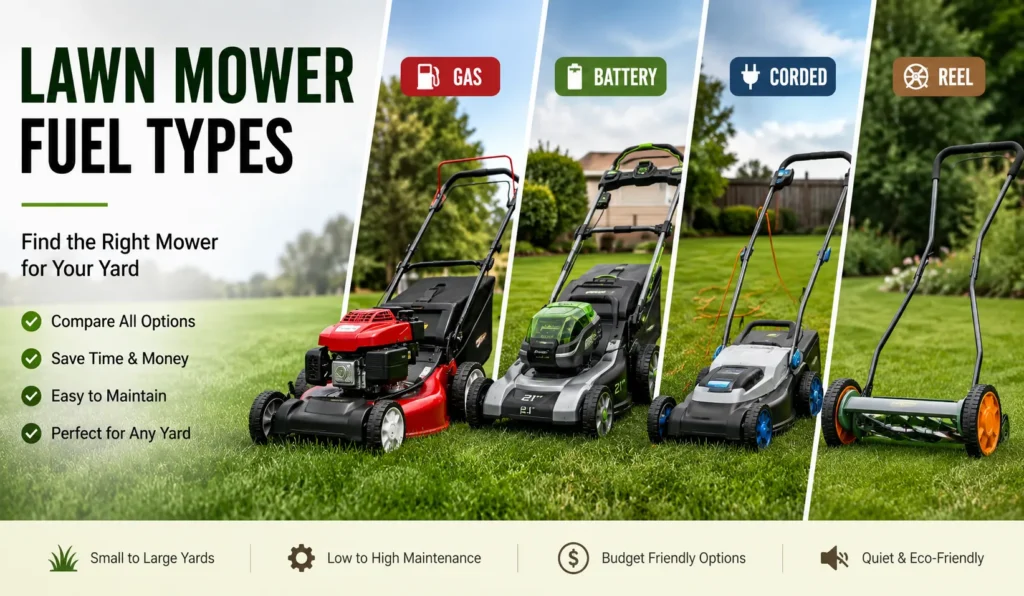
Quick Overview
- Gas mowers have the most power and the longest runtime, but they cost more to maintain and smell like a garage
- Battery-powered mowers are the best fit for most yards under 1/3 acre in 2026
- Corded electric mowers are cheap and quiet, but the cord is a real problem on any yard over 2,000 sq ft
- Manual reel mowers cost almost nothing to run and work well for small, flat lawns that get cut often
- The right lawn mower fuel type depends on your yard size, terrain, and how much time you want to spend on upkeep
I walked into Home Depot on a Saturday morning in May, caffeine in hand, fully planning to buy “just a mower.” Forty-five minutes later, I was standing in the aisle reading the back of a box, more confused than when I walked in.
Gas? Battery? Corded? There were six different lawn mower fuel types on the shelf and zero helpful signage explaining which one was right for my quarter-acre Florida backyard.
I ended up buying the wrong one. Twice.
Since then, I’ve owned and used gas-powered, battery-powered, corded electric, and manual reel mowers across three different states and three very different yards. This guide is the article I wish I had found that Saturday morning.
If you’re trying to figure out which fuel type is right for your yard – without reading ten different product pages that all say “best in class” – you’re in the right place.
Why Lawn Mower Fuel Type Matters More Than You Think
Most people pick a mower based on price or brand name. Fuel type is usually an afterthought. That’s a mistake, and I say that from experience.
Your fuel type changes how your mower performs, how much you spend every year, and honestly, how much you enjoy mowing. Get it wrong and you’ll feel it every weekend from April through October.
It Affects Power, Noise, and Maintenance
Gas mowers run on small combustion engines. Most residential gas mowers use 140cc to 190cc engines (roughly 4 to 6 horsepower). They’re loud – typically 85 to 95 decibels at the operator’s ear (Outdoor Power Equipment Institute, 2023). That’s about as loud as a motorcycle.
Battery mowers run on lithium-ion packs, usually 40V to 60V with 4.0 to 7.5 amp-hours (Ah). A brushless motor inside converts that electricity to rotational force quietly, at around 75 decibels. No fumes, no pull cord, no carburetor to clean.
Corded mowers plug into a wall outlet. They’re the quietest and simplest option. Manual reel mowers have no motor at all – you push, and the spinning blades cut. Maintenance on those is close to zero.
It Also Affects Your Wallet Long-Term
Here’s where people get surprised.
A gas mower might cost $280 at the start. But over five years, add up oil changes, air filter replacements, spark plug swaps, carburetor cleanings, and fuel costs. Per the American Lawn Care Association (2024), the average homeowner spends $150 to $200 per year just on gas mower upkeep and fuel.
Battery mowers cost more upfront – $350 to $600 for a good one – but the electricity to charge a 56V battery costs about $0.10 to $0.15 per charge in most US states (U.S. Energy Information Administration, 2024). No oil. No spark plugs. No gas cans.
Corded electric and manual reel mowers have the lowest total cost of ownership by far. If budget is a real concern, that matters a lot.
The Main Lawn Mower Fuel Types Explained
There are four fuel types you’ll find in US stores. Each one fits a different kind of yard and a different kind of homeowner.
Gas-Powered Mowers
Gas mowers are the standard in American yards. They’ve been around since the 1950s, and for most of that time, they were the only real option.
You fill the tank with regular unleaded gasoline (or a 50:1 gas-oil mix for 2-stroke engines, though most residential mowers today are 4-stroke). Pull the cord, the engine fires, and you get serious cutting power.
I had a Honda HRX217 for three years at my Minnesota property. That mower chewed through 10-inch-tall spring grass without slowing down. On a half-acre yard with thick, damp Kentucky bluegrass, nothing I’ve tried comes close on raw power.
The real weakness is maintenance. Before every spring season, I was doing a fresh oil change, cleaning the air filter, and checking the spark plug. One year the carburetor clogged because I left old gas in the tank over winter. That repair cost me $90 at the small engine shop. The smell of gasoline also got old fast.
Who gas works for: Anyone with a yard over 1/2 acre, thick grass types like St. Augustine or tall fescue, or hilly terrain that needs consistent torque.
Battery-Powered (Cordless Electric) Mowers
Battery mowers changed my opinion of electric tools. I picked up an EGO Power+ 56V mower in 2022 and used it on my 8,500 sq ft Tampa yard for two full seasons.
The first time I used it, I was stunned by the quiet. My neighbor actually came over to ask if something was wrong with it. That was a good sign.
Battery mowers use a brushless motor, which means no carbon brushes to wear down, less heat, and longer motor life. The EGO’s 7.5Ah battery gave me about 45 to 50 minutes of runtime per charge – enough for my yard with a few minutes to spare.
The honest weakness: when the battery runs out, you’re done. You either wait 45 to 60 minutes for a recharge, or you buy a second battery (around $150 to $200 extra). For yards over 1/3 acre, a single battery sometimes isn’t enough. I learned that lesson when I ran out of juice 200 feet from the finish line on a hot July day.
Who battery works for: Yards under 1/3 acre, homeowners who want no maintenance headaches, and anyone who lives in an area with noise restrictions or HOA rules.
Corded Electric Mowers
Corded mowers plug directly into your home’s outlet via a heavy-duty extension cord. Brands like Greenworks and Sun Joe have solid options in the $150 to $250 range.
The power is consistent because you’re drawing from the grid – no battery to drain, no gas to run out. Corded mowers run at around 10 to 15 amps, which delivers enough power for thin to medium grass types.
I borrowed one from my brother-in-law for a summer when my battery mower was being repaired. On his 1,800 sq ft Phoenix backyard, it worked perfectly. Flat ground, short Bermuda grass, compact space.
The weakness is real: the cord. You’ll spend mental energy managing it every single pass. I tripped over it twice. I accidentally mowed over it once (thank goodness for the safety shut-off). On any yard larger than 5,000 sq ft, the cord becomes genuinely frustrating.
Who corded works for: Very small, flat yards under 3,000 sq ft where the outlet is nearby.
Manual Reel Mowers
Manual reel mowers have no engine, no battery, no cord. You push them forward and a spinning cylinder of blades cuts grass through a scissor action against a fixed bottom blade.
They’re silent. They leave a clean, golf-course-style cut. A good one from Fiskars or American Lawn Mower Company costs $80 to $150 and can last 20 years with basic blade sharpening.
I used one on a small apartment-style townhome yard in Austin – about 900 sq ft of flat Bermuda grass. It took 12 minutes to mow and required zero prep time.
The weakness is fitness and frequency. Reel mowers work only if your grass is short – ideally under 4 inches. Let it go 10 days without mowing in the Southeast summer and a reel mower won’t touch it. You also need to push with some effort. It’s not effortless.
Who manual reel works for: Very small flat yards mowed frequently, eco-conscious homeowners, and people who want zero operating costs.
Comparison Table: All Four Fuel Types at a Glance
| Feature | Gas | Battery | Corded Electric | Manual Reel |
|---|---|---|---|---|
| Avg. Upfront Cost | $280-$450 | $350-$600 | $150-$250 | $80-$150 |
| Annual Running Cost | $150-$200 | $5-$15 | $3-$10 | $0-$5 |
| Noise Level | 85-95 dB | 70-78 dB | 65-75 dB | 55-60 dB |
| Runtime per Session | Unlimited (tank) | 40-60 min | Unlimited (cord) | Unlimited |
| Maintenance | High | Low | Very low | Very low |
| Emissions | Yes | None | None | None |
| Best Yard Size | 1/3+ acre | Up to 1/3 acre | Up to 3,000 sq ft | Under 2,000 sq ft |
Which Fuel Type Fits Which Yard
Yard size and shape make a bigger difference than most people realize. A mower that’s perfect for a flat suburban lot can be a nightmare on a sloped, wooded lot three streets over.
Here’s how to match fuel type to what you’re actually working with.
Small Yards and Townhomes
For yards under 5,000 sq ft – think townhomes, urban lots, or small suburban backyards – you don’t need a gas mower. A battery-powered or corded electric mower handles these spaces easily and saves you money every year.
I’d go battery over corded even for small yards. The freedom to move without cord management is worth the extra $100 upfront. EGO, Ryobi, and Greenworks all have solid 40V to 56V options in this range.
Manual reel mowers are a real option here if your yard is flat, the grass type is fine-bladed (Bermuda, fine fescue, zoysia), and you’re willing to mow every 5 to 7 days.
Large Open Lawns
Large yards – anything over 1/2 acre – are still gas territory for most homeowners.
Battery technology is catching up. EGO’s dual-port charger and multi-battery system let you run two batteries back-to-back for up to 90 minutes of runtime. But for a true half-acre with thick grass, I still think gas is more practical for most people in 2026.
Toro, Honda, and Craftsman all make reliable self-propelled gas mowers in the $350 to $500 range that will handle big lawns without breaks.
If you go gas on a large lot, buy a self-propelled model. Pushing a gas mower across 22,000 sq ft of lawn is exhausting. The self-propel drive makes a huge difference.
Hilly or Uneven Terrain
Hills change everything. On slopes steeper than 15 degrees, you need torque and control.
Gas mowers win here. The engine delivers steady power even when the mower is tilted. A good 190cc Honda engine won’t bog down on a steep Georgia hillside the way a battery mower can when the motor load spikes.
Battery mowers have improved, but heavy inclines still drain the battery faster than flat ground. On my Minnesota property, I noticed battery runtime dropped by about 20% on the sloped back section.
Avoid corded electric on hills. Managing a cord on uneven terrain adds real risk of tripping.
Comparison Table: Fuel Type by Yard Type
| Yard Type | Best Pick | Acceptable | Avoid |
|---|---|---|---|
| Small flat yard (<5,000 sq ft) | Battery | Corded, Manual Reel | N/A |
| Medium yard (5,000-15,000 sq ft) | Battery or Gas | Gas | Corded, Manual Reel |
| Large yard (1/2+ acre) | Gas | Battery (dual pack) | Corded, Manual Reel |
| Hilly or sloped | Gas | Battery | Corded |
| Tiny flat lot (<2,000 sq ft) | Manual Reel | Battery | Gas |
Performance in Real Conditions
US climate zones put real stress on lawn mowers. A mower that thrives in a dry Phoenix yard can struggle in a muggy Florida backyard. Here’s what I’ve seen personally and heard from other homeowners across different regions.
Hot and Humid Climates (Florida, Texas, Southeast)
I mowed in Tampa for two summers. St. Augustine grass in Florida grows fast – sometimes 2 inches a week in June. It’s thick, tough, and stays damp from afternoon rain almost every day.
Gas mowers handle this well. The engine power chews through wet, dense grass without slowing down.
Battery mowers also work well here if your yard is under 1/3 acre. The heat does affect battery performance a little – I noticed my EGO running about 5 to 8 minutes shorter on 95-degree days. Still enough for most suburban lots.
Corded and manual reel mowers struggle with thick St. Augustine. A reel mower won’t cut through grass that’s wet or over 4 inches tall.
Dry Heat and Dusty Terrain (Southwest, Arizona)
Dry heat is actually kinder to mowers than humidity. Dust is the bigger problem.
In Arizona and the Southwest, dust gets into air filters and carburetors fast. With gas mowers, you need to clean the air filter more often – every 20 to 25 hours of use instead of the standard 50 hours recommended in cooler climates.
Battery mowers have no air filter and no carburetor. Dust is far less of a problem. A Ryobi or Greenworks 40V mower in a Phoenix yard is genuinely low-maintenance.
Bermuda grass is common in the Southwest. It’s a fine-bladed grass that doesn’t need much power to cut. Battery and even corded mowers handle it well.
Thick, Fast-Growing Grass (Midwest Lawns)
Spring in the Midwest is brutal on mowers. After a long cold winter, lawns come back fast and tall. Kentucky bluegrass and tall fescue can go from dormant to 8 inches tall in two weeks.
My Honda HRX217 was at its best here. I’d drop the deck to 3 inches, engage the rear-wheel drive, and it chewed through thick spring grass without complaint.
Battery mowers can struggle with very tall or wet Midwest spring grass. The motor load spikes, which drains the battery faster and can trigger the thermal protection shut-off on some models. Ryobi’s 40V line in particular has had complaints about this on tall grass (Home Depot customer reviews, 2024).
If you’re in Illinois, Ohio, or Wisconsin and your yard is over 10,000 sq ft, a gas mower is still the more reliable tool for spring cleanups.
Comparison Table: Performance by Climate
| Climate | Gas | Battery | Corded | Manual Reel |
|---|---|---|---|---|
| Hot and humid (FL, TX, SE) | Excellent | Good | Poor | Poor |
| Dry heat (AZ, NV, SW) | Good (clean filter often) | Excellent | Good | Good |
| Thick spring grass (Midwest) | Excellent | Fair | Poor | Poor |
| Mild year-round (CA, PNW) | Good | Excellent | Good | Good |
Common Mistakes People Make When Choosing a Fuel Type
Most buying mistakes happen before anyone checks a spec sheet. They happen in the parking lot or at the kitchen table, based on habit or assumptions.
Choosing Gas Out of Habit
A lot of homeowners buy gas mowers because that’s what their parents had. It’s familiar.
If you have a yard under 10,000 sq ft, flat terrain, and a normal grass type, you may be spending $150+ per year on maintenance you don’t need. I made this mistake my first year in Tampa. I bought a Toro gas mower out of habit, used it on a yard that a $400 battery mower would have handled better, and paid for it in oil changes and carburetor headaches.
Ask yourself honestly: do you need unlimited runtime and raw power? If not, battery is probably the smarter buy.
Underestimating Battery Runtime Needs
The opposite mistake is buying a battery mower with too small a battery pack for your yard.
A 2.5Ah battery on a 40V mower gives you maybe 20 to 25 minutes of runtime. That’s not enough for a 10,000 sq ft yard. Many first-time buyers grab the cheapest battery mower on the shelf, don’t check the amp-hours, and then wonder why they’re stopping mid-mow to recharge.
The minimum I’d recommend: a 56V mower with at least a 5.0Ah battery for any yard over 5,000 sq ft. EGO’s 56V 7.5Ah combo runs about $499 and gives you 50+ minutes of real-world runtime (EGO Product Specifications, 2025).
If you’re between sizes, buy the bigger battery. The price difference is $50 to $80. The frustration of running out of power is much worse.
My Final Recommendation
After using all four types across multiple yards and states, I’d put most homeowners in a battery mower today. If your yard is under 1/3 acre and mostly flat, a 56V battery mower from EGO or Greenworks is the most practical choice. Less mess, less maintenance, and the technology has caught up to the point where runtime is no longer a real issue for average-sized suburban lots.
If your yard is over 1/2 acre or you’ve got thick, demanding grass – St. Augustine in Florida, tall fescue in the Midwest – I’d still buy a gas mower. Not because gas is better in some abstract way, but because unlimited runtime and raw torque still matter when your yard is big and the grass is unforgiving. A Honda HRX217 or Toro TimeMaster will serve you better than any battery mower at that scale right now.
Manual reel mowers deserve more credit than they get. For a small, flat lot with fine grass mowed frequently, they’re ideal. Zero fuel cost, zero oil changes, and a genuinely satisfying cut. I still use mine for a small patch in my front yard. It takes six minutes and I don’t have to think about batteries or gas cans.
The honest truth is that no single fuel type wins across every situation. The right answer depends on your yard, your climate, and how much time you want to spend on upkeep. Match the tool to the actual job.
Full Pros and Cons by Fuel Type
| Fuel Type | Pros | Cons |
|---|---|---|
| Gas | Unlimited runtime, highest power, works on any terrain | Loud, smells, high maintenance, produces emissions |
| Battery | Quiet, no fumes, low maintenance, easy start | Limited runtime, higher upfront cost, battery degrades over time |
| Corded Electric | Cheap, consistent power, no battery to charge | Cord limits range, dangerous on slopes, small yard only |
| Manual Reel | Zero running cost, silent, eco-friendly, lasts decades | Requires fit operator, only works on short flat grass, no large yards |
Frequently Asked Questions About Lawn Mower Fuel Types
What are the main lawn mower fuel types?
The four main lawn mower fuel types are gas (petrol), battery (cordless electric), corded electric, and manual (no motor). Gas and battery are the two most common for residential yards in the US. Corded and manual reel mowers are better fits for very small, flat spaces.
Are battery lawn mowers as powerful as gas mowers?
For most residential yards, yes. A 56V battery mower with a brushless motor delivers enough torque to handle grass up to 4 to 5 inches tall on flat to moderate terrain. For very thick grass, steep hills, or yards over 1/2 acre, gas mowers still have more consistent power and no runtime limits.
How long does a battery lawn mower last on one charge?
Runtime depends on the battery’s voltage and amp-hours. A 56V, 5.0Ah battery on an EGO or Greenworks mower gives roughly 35 to 45 minutes of runtime. A 7.5Ah pack extends that to 50 to 60 minutes. Hot weather and tall grass reduce runtime by 10 to 20%.
What is the cheapest lawn mower fuel type to run long-term?
Manual reel mowers cost almost nothing to run – just occasional blade sharpening every two to three years. Corded electric is next, costing $3 to $10 per season in electricity. Battery mowers cost $5 to $15 per season in electricity. Gas is the most expensive, averaging $150 to $200 per year in fuel and maintenance (American Lawn Care Association, 2024).
Which lawn mower fuel type is best for a small yard?
A battery-powered mower is the best pick for most small yards (under 5,000 sq ft). It handles the space easily on a single charge, requires almost no maintenance, and is quiet enough for early Saturday mornings without annoying the neighbors. A manual reel mower is worth considering if the yard is under 2,000 sq ft and the grass is fine-bladed.
Do gas mowers require more maintenance than electric mowers?
Yes, by a significant margin. Gas mowers need oil changes every 50 hours or once per season, air filter cleaning or replacement, spark plug checks, and carburetor attention if left with old fuel over winter. Battery and corded electric mowers need almost no scheduled maintenance beyond blade cleaning and sharpening.
Is a corded electric mower worth buying?
For a very small flat yard – under 3,000 sq ft – yes. Corded electric mowers are cheap, quiet, and consistent. The cord is the main drawback. On a larger yard or any yard with obstacles, the cord becomes frustrating and potentially dangerous. For anything beyond a small, simple layout, a battery mower is more practical.