
Quick Overview
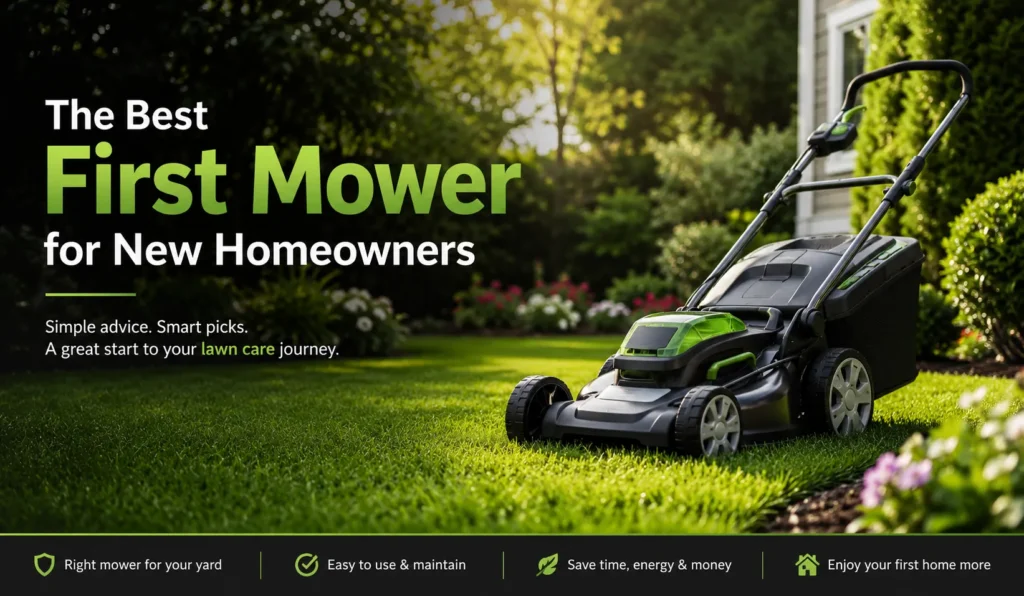
- The best first mower for most new homeowners is the EGO Power+ LM2102SP – it starts instantly, runs quietly, and handles yards up to half an acre without gas or oil changes.
- Match mower size to yard size first: yards under 5,000 sq ft need a 20-21″ push; over 10,000 sq ft, look at self-propelled models.
- Battery-powered mowers now match gas in power for most suburban yards and win on convenience for first-timers.
- Self-propelled is worth the extra $80-100 if you have any slope – your arms will thank you after the third cut.
- Budget $300-500 for a reliable first mower; below $200, quality drops fast.
I remember the first Saturday I spent in the backyard of my first house in Columbus, Ohio. The grass was already six inches tall – the previous owners had clearly stopped caring in May. My neighbor walked over, looked at my blank expression, and said, “You just need to get a Honda.” Then he walked away. Thanks, Dave.
That’s the problem every new homeowner faces. Everyone has an opinion, nobody explains anything, and one trip to Home Depot leaves you staring at a wall of machines priced from $179 to $899 with no real clue what the difference is.
This guide is for people buying their very first mower, not landscapers upgrading their fleet. I’ll walk you through exactly what matters, what doesn’t, and which models I’d actually recommend to a friend.
Why Choosing Your First Mower Feels So Overwhelming
Most people underestimate how confusing the mower aisle really is. It’s not that the products are complicated – it’s that nobody teaches you the vocabulary before you walk in.
Too Many Options, Not Enough Clear Answers
Walk into any big-box store and you’ll find push mowers, self-propelled mowers, rear-wheel drive, front-wheel drive, gas, battery, corded electric, single-stage, variable speed. The tags throw numbers at you – 160cc, 21″, 56V, 7.5Ah – without context for what any of it means for a quarter-acre lot in a new subdivision.
Online reviews make it worse. Most review sites test 20 mowers and crown a winner based on lab measurements. Your backyard isn’t a lab. You have a specific yard, a specific budget, and maybe you’ve never pulled a recoil starter in your life.
Why Most Online Guides Get It Wrong for Beginners
The typical “best mower” listicle assumes you already know whether you want gas or battery, self-propelled or push, 21″ or 22″ deck. It jumps straight to model comparisons without explaining the decision framework that makes those comparisons make sense.
What first-timers actually need is a way to eliminate most mowers before they start shopping. Once you know your yard size, terrain, and honest budget, the field narrows from 30 options to 4 or 5. That’s a decision you can actually make.
The First Questions You Need to Answer Before You Buy
Get these four things straight before you look at a single product page. They’ll cut the options in half.
How Big Is Your Yard, Really?
Most people guess wrong. A “small backyard” that feels manageable to walk across is often 3,000-5,000 square feet, which is actually fine for a basic push mower. A “medium yard” in a new build outside Charlotte, NC might be 8,000-12,000 sq ft once you include the front and sides – at that size, a self-propelled mower stops being a luxury.
A quick way to estimate: pace off the length and width in steps, multiply, and divide by 9 to get square footage. Or pull up your address on Google Maps, switch to satellite, and measure with the ruler tool. Knowing the number matters more than the vibe.
Do You Have Hills, Obstacles, or Tight Spaces?
One gentle slope changes everything. Pushing a 70-lb gas mower up a hill in July in Atlanta is exhausting in a way you can’t appreciate until you’ve done it. If your yard has any incline steeper than a gentle pitch, prioritize self-propelled.
Obstacles matter too. Lots of garden beds, a swing set, a narrow side yard between your fence and the house – those tight spaces are easier to navigate with a 19-21″ cutting deck than a 22″ or wider one. A smaller deck means more passes on open ground, but it’s far less frustrating in tight spots.
What’s Your Budget – Honestly?
Set a real number before you start shopping. Here’s what the price ranges actually get you:
- Under $200: Entry-level corded electric or bare-bones push gas. Gets the job done, but build quality is lower and you’ll likely replace it in 3-4 years.
- $250-$400: The sweet spot for most first-timers. Solid battery or gas push mowers with good warranty coverage.
- $400-$600: Self-propelled electric or quality gas. Worth it for yards over 8,000 sq ft or sloped terrain.
- $600+: Premium battery systems, commercial-grade gas. Usually overkill for a first home.
Don’t let a salesperson push you above your range. A $350 mower used correctly and maintained annually will outlast a $600 mower that gets stored wet and never gets an oil change.
Gas, Battery, or Electric – Which Is Right for You?
This is the decision that trips up most first-time buyers. Each power type has a real use case.
Gas is still the default for large yards (over 15,000 sq ft), areas with no nearby outlet, and people who mow infrequently and want a machine that can sit for three weeks and still start. The downside: you need oil changes, fresh fuel, spark plug replacements, and a recoil start that can be stubborn on cold mornings.
Battery has closed the gap dramatically. Modern 56V and 60V battery mowers from EGO and Greenworks match gas in cutting power for yards under half an acre. They start with a button, cost nothing to maintain beyond charging, and run quietly enough that you can mow at 7am without irritating the neighbors. Runtime on a single charge typically covers 45-60 minutes, enough for most suburban lots (EGO, 2024).
Corded electric is inexpensive and always has full power, but the cord limits you to roughly 100 feet from your outlet and adds real mental overhead – you’re constantly managing the cable. Best for tiny lots under 3,000 sq ft where the convenience math works.
Comparison Table: Gas vs. Battery vs. Corded Electric for First-Time Buyers
| Factor | Gas | Battery | Corded Electric |
|---|---|---|---|
| Startup ease | Pull cord (can be stubborn) | Button start | Button start |
| Maintenance | Oil, filter, spark plug, fuel | Minimal – charge only | Minimal – charge only |
| Runtime | Unlimited (with fuel) | 45-60 min per charge | Unlimited (cord permitting) |
| Best for | Large yards 15,000+ sq ft | Yards under half an acre | Tiny lots under 3,000 sq ft |
| Noise | Loud | Quiet to moderate | Quiet |
| Upfront cost | $250-$450 | $300-$600 | $150-$250 |
| Starting price for good quality | ~$300 | ~$320 | ~$160 |
What to Look for as a First-Time Buyer
Once you know your yard type, these are the spec differences that actually matter.
Engine or Motor Power – What the Numbers Actually Mean
For gas mowers, engine displacement is measured in cubic centimeters (cc). A 140cc engine is adequate for a flat yard with thin grass; 160cc handles thicker grass and slightly uneven terrain. Anything above 190cc is generally overkill for a suburban lot.
For battery mowers, volts and amp-hours (Ah) together determine performance. Voltage (V) is the power level – 40V is light-duty, 56V and above handles real grass. Amp-hours measure the battery’s capacity, like a fuel tank. A 56V 5.0Ah battery will run longer and recover better under load than a 56V 2.5Ah battery.
Don’t get caught up chasing the highest number. For a 6,000 sq ft yard with standard turf, a 160cc gas or 56V battery mower is plenty.
Cutting Width and Why It Changes Everything
The cutting width (also called deck size) is how wide a strip the blade clears in one pass. A 21″ deck means each pass covers 21 inches.
For small yards under 5,000 sq ft, a 19-20″ deck is fine. For medium yards of 8,000-12,000 sq ft, a 21-22″ deck cuts mowing time noticeably. The wider the deck, the fewer passes you make – on a 10,000 sq ft yard, moving from 19″ to 21″ saves about 10% of your time per session.
The trade-off: wider decks are heavier and harder to maneuver around obstacles.
Self-Propelled vs. Push – Don’t Make This Mistake
A push mower relies entirely on you to move it forward. A self-propelled mower has a drive system (front-wheel, rear-wheel, or all-wheel) that pulls itself across the yard – you guide it, it moves.
The mistake first-timers make is buying a push mower for a yard that has any real slope or size. A 70-lb gas mower being pushed up a modest incline feels brutal by the end of a hot afternoon. A self-propelled mower removes almost all of that effort.
Rear-wheel drive is better for hills and bagging. Front-wheel drive turns more easily. For most first-time buyers with a flat suburban lot, front-wheel drive self-propelled is the right call.
Easy Start Features and Adjustable Cutting Height
For first-timers, these two features matter more than most specs:
Easy start means you don’t need to yank a cord 12 times while swearing quietly into your garage. Battery mowers have true push-button starts. Some gas mowers now offer electric start – worth paying for if you go gas.
Adjustable cutting height lets you raise or lower the blade. For Kentucky bluegrass in the Midwest, you want to cut at 3-3.5 inches. For Bermuda grass in the South, 1.5-2 inches is standard. A mower with 6-8 height positions gives you flexibility as you learn what your grass needs.
Look for single-lever height adjustment where one handle changes all four wheels at once. Four individual levers (one per wheel) are slower and more annoying than they sound.
Storage, Folding, and Garage-Friendly Design
New homeowners often underestimate how tight garage space gets fast. Most push and self-propelled mowers can fold the handle down for storage. Battery mowers are generally lighter and easier to store vertically.
If your garage is small, measure the spot where you plan to store the mower before you buy. A standard push mower stored upright (handles folded) takes roughly 24″ wide x 20″ deep x 40″ tall.
Comparison Table: Key Features Every Beginner Should Prioritize
| Feature | Why It Matters | What to Look For |
|---|---|---|
| Cutting width | Fewer passes = less time | 20-21″ for most yards |
| Self-propelled | Essential for slopes or large yards | Rear-wheel drive for hills |
| Easy start | Huge quality-of-life difference | Push-button or electric start |
| Height adjustment | Match grass type to region | Single-lever with 6+ positions |
| Battery capacity | Determines runtime | 56V / 5.0Ah or higher |
| Weight | Affects maneuverability | Under 70 lbs for push, 80 lbs self-propelled |
The Best First Lawn Mowers I’d Recommend to Any New Homeowner
These are the models I’d actually suggest to someone who just bought their first house. Not a ranked list of 20 – just the six types worth considering, with the specific model I’d point to in each category.
Best Overall First Mower
EGO Power+ LM2102SP (21″, 56V Self-Propelled)
For most first-time buyers with a yard between 4,000 and 12,000 sq ft, this is the one I’d start with. It starts with a button, runs quietly enough for early morning cuts, and handles typical suburban grass without breaking a sweat.
The self-propelled drive is variable speed – squeeze the bail more to go faster, ease off to slow down. It’s intuitive in about 10 minutes. The 56V 7.5Ah battery included with this kit gives around 60 minutes of runtime under normal conditions, enough for a half-acre lot (EGO, 2024).
Key features:
- 21″ cutting deck with 6 height positions (1.5″ to 4″)
- Variable-speed self-propelled rear-wheel drive
- Push-button start, no choke, no fuel
- Folds for vertical storage
- Mulch, bag, and side-discharge options included
Pricing: Around $549 with battery and charger (kit)
Best for: First-timers with yards of 4,000-12,000 sq ft, any terrain
One honest weakness: The 7.5Ah battery is large and takes about 90 minutes to fully charge. If you run it down fully, you’re waiting on the next session.
Best for Small Yards and Tight Spaces
Greenworks 40V 19″ Push Mower (MO40B01)
For a small yard – think a compact lot in a city neighborhood or a new build with a narrow side strip – the 19″ deck and lighter weight make this much easier to maneuver than a full-size mower. It weighs around 55 lbs, which makes lifting it over curbs or storing it on a garage shelf manageable.
Key features:
- 19″ cutting deck
- 40V battery (included in most kit versions)
- Push-button start
- 5-position single-lever height adjustment
Pricing: Around $249-299 with battery
Best for: Yards under 5,000 sq ft, tight spaces, smaller users
One honest weakness: 40V is lighter-duty than 56V – thick, overgrown grass can bog it down. Keep your mowing schedule regular and this won’t be an issue.
Best Gas Mower for Beginners
Honda HRX217VKA (21″, 187cc, Self-Propelled)
If you prefer gas, or if you have a larger yard that would need two battery swaps per session, the Honda HRX is the model I’d recommend. Honda’s GCV200 engine is about as reliable as lawn equipment gets, and the MicroCut twin-blade system produces a noticeably clean cut compared to single-blade competitors.
The Roto-Stop blade brake is a genuinely useful safety feature – the blade stops spinning when you release the bail, but the engine keeps running. You can walk away to move a branch or open a gate without shutting off and restarting.
Key features:
- 21″ deck with Roto-Stop blade brake
- Variable speed self-propelled, rear-wheel drive
- Electric start option available
- Mulch, bag, discharge
- 5-year engine warranty
Pricing: Around $700-750 (recoil start version closer to $600)
Best for: Larger yards over 12,000 sq ft, or anyone who prefers gas reliability
One honest weakness: It’s expensive for a first mower. If you want gas but want to spend less, the Toro Recycler 21″ (around $370) is a solid alternative that trades some polish for price.
Best Battery-Powered Pick for First-Timers
Ryobi 40V HP 21″ Brushless Self-Propelled (RY401120)
The Ryobi 40V HP line punches above its price point. The brushless motor is more efficient than older brushed motors – it extracts more power from each charge and runs cooler over time, which extends the motor’s lifespan (Ryobi, 2023). For first-timers nervous about battery mowers losing power through a full lawn, brushless makes a real difference.
Ryobi’s 40V battery system is one of the widest ecosystems in the market – the same batteries work across trimmers, blowers, chainsaws, and other yard tools. That compatibility is worth considering when you’re building out your first toolkit.
Key features:
- 21″ cutting deck, brushless motor
- Variable-speed self-propelled
- Compatible with Ryobi 40V battery system
- Single-point height adjustment
Pricing: Around $399-449 with 6Ah battery
Best for: First-timers who want to expand into a tool ecosystem; yards up to 10,000 sq ft
One honest weakness: The bag fills quickly if you skip a week and let the grass get long. Empty it more often than you think you need to.
Best Budget Option That Still Gets the Job Done
Craftsman M105 140cc 21″ Push Gas Mower
If budget is the primary constraint, the Craftsman M105 is the entry-level gas mower I’d trust. It’s basic – push only, no drive system, manual choke – but the 140cc Briggs & Stratton engine is proven reliable for flat, regularly-maintained yards. It’s been around long enough that replacement parts are cheap and available everywhere.
This is the mower for a renter who just bought a small place and isn’t ready to spend $400+ yet. It does the job without drama on a flat quarter-acre.
Pricing: Around $199-229
Best for: Flat yards under 6,000 sq ft, tight budgets
One honest weakness: No self-propulsion. On any kind of slope, you’ll feel it in your arms and back. It also requires gas, oil checks, and winterization. More maintenance than battery for a similar price range.
Best Self-Propelled Mower for Hilly or Large Yards
Toro TimeMaster 30″ Personal Pace Self-Propelled (21199)
For homeowners with large, relatively flat yards – a corner lot in Austin, TX, or a property backing up to a greenbelt in the suburbs – the Toro TimeMaster 30″ is in a category of its own. The 30″ cutting width reduces mowing time on a half-acre by about 30% compared to a standard 21″ deck (Toro, 2023).
The Personal Pace drive system is the standout feature: the faster you walk, the faster the mower moves. There’s no lever to hold – just walk, and the drive matches you. It takes one pass to adapt to it.
Pricing: Around $750-799
Best for: Yards over 12,000 sq ft with mostly open, flat terrain
One honest weakness: The 30″ deck is too wide for tight side yards or yards with a lot of obstacles. If your yard has many garden beds or a fence close to the mowing area, a standard 21″ mower is easier to work with.
Comparison Table: Side-by-Side Look at Every Pick
| Model | Type | Deck | Power | Self-Propelled | Best For | Price (approx.) |
|---|---|---|---|---|---|---|
| EGO LM2102SP | Battery | 21″ | 56V 7.5Ah | Yes (variable) | Most first-timers | $549 |
| Greenworks MO40B01 | Battery | 19″ | 40V | No | Small lots, tight spaces | $249-299 |
| Honda HRX217VKA | Gas | 21″ | 187cc | Yes (rear-wheel) | Large yards, gas preference | $700-750 |
| Ryobi RY401120 | Battery | 21″ | 40V HP brushless | Yes | Ecosystem buyers | $399-449 |
| Craftsman M105 | Gas | 21″ | 140cc | No | Flat yards, tight budgets | $199-229 |
| Toro TimeMaster 30″ | Gas | 30″ | 223cc | Yes (Personal Pace) | Large open yards | $750-799 |
Real Mistakes First-Time Homeowners Make When Buying a Mower
These come up over and over. Knowing them before you buy saves money and frustration.
Buying Too Big (or Too Small) for the Yard
The most common mistake is buying a riding mower for a yard that genuinely doesn’t need one – or buying a tiny 18″ push mower for a half-acre and wondering why mowing takes three hours.
A good rule: if your yard is under 15,000 sq ft, a walk-behind mower is the right tool. If it’s under 5,000 sq ft, a push mower with a 19-21″ deck is plenty. Riding mowers add storage problems, higher maintenance costs, and a learning curve that isn’t worth it below a full acre.
On the small end, first-timers sometimes buy a tiny corded electric mower to save money, then grow to hate the extension cord. The cord gets caught on everything. If you can afford a $300 battery mower, it’s worth it over a $170 corded model in almost every situation.
Skipping Maintenance Features They’ll Regret Later
Two features that look optional but matter over time:
Washout port: A small fitting on the deck that lets you connect a hose and flush grass clippings from under the deck without flipping it over. Mowers without one get caked with debris over time, which affects cutting performance and shortens blade life. Look for this on any mower you’re seriously considering.
Tool-free height adjustment: Single-lever adjustment takes five seconds. Four-lever adjustment (one per wheel) takes two minutes and feels annoying every single time. Not a dealbreaker, but it’s the kind of small thing that adds friction to an already tedious task.
Letting Price Alone Drive the Decision
Buying the cheapest mower often costs more over three years than buying a mid-range model upfront. A $180 push mower that needs a new carburetor in year two and a blade replacement in year one ends up closer to $240. A $320 mower that needs nothing beyond an annual oil change and sharpening stays at $320.
The battery vs. gas comparison is worth running over time. A battery mower costs nothing to fuel and around $5-10 per year in electricity. A gas mower costs $30-50 per season in fuel plus oil changes and occasional tune-ups. Over five years, that’s a real difference (Consumer Reports, 2024).
How to Set Up and Use Your First Mower the Right Way
The mower is just half the equation. How you use it matters almost as much.
Before Your First Cut – What to Check
Before you start, run through this short list:
- Oil level (gas only): Check with the dipstick before every session. Running a gas mower without adequate oil can seize the engine within minutes.
- Battery charge (electric): Start with a full charge so you know your actual runtime for your yard.
- Blade condition: Inspect for visible bends or nicks. A dull blade tears grass instead of cutting it, leaving ragged tips that turn brown and invite disease.
- Cutting height setting: Set it before you start. Mowing too short (called scalping) stresses grass and creates bare patches. A good starting height for most grass types is 3 to 3.5 inches – higher than most people set it.
Mowing Patterns, Grass Height, and Basic Technique
Alternate your mowing direction each session. If you always mow north-to-south, switch to east-to-west the next time. This prevents ruts from the wheels compressing the same soil lines repeatedly and gives grass a more uniform look over time.
Never remove more than one-third of the grass blade in a single cut. If the grass is already 5 inches tall, set the deck to 3.5 inches, not to 2 inches. Cutting too much at once shocks the grass and exposes the crown to sunburn.
Overlap each pass by 2-3 inches to avoid leaving uncut strips between rows.
Simple Maintenance That Makes Any Mower Last Longer
For battery mowers:
- Clean under the deck after every session using a scraper or dry rag while clippings are still fresh.
- Store batteries at 40-80% charge if you’re not mowing for more than two weeks. Fully drained or fully charged storage shortens battery lifespan over time.
- Sharpen or replace the blade once a season, or after hitting rocks or roots.
For gas mowers:
- Change the oil after the first 5 hours of use on a new engine, then every 50 hours or once per season after that.
- Run the fuel system dry before winter storage, or use a fuel stabilizer. Old gas is the most common cause of spring startup problems.
- Replace the spark plug annually. It costs $3-5 and prevents the most common “won’t start” problem.
My Final Recommendation
If I’m standing in a big-box store with a new homeowner who has a typical suburban lot – somewhere between 5,000 and 10,000 sq ft, some slope maybe, normal grass – I’m pointing them at the EGO Power+ LM2102SP. It eliminates almost every friction point that makes gas mowers frustrating for beginners: no fuel to buy, no cord to pull, no warm-up, no oil change. It starts, it cuts well, it’s quiet enough to use on a Sunday morning, and the battery lasts long enough for most properties in a single charge. The upfront cost is higher than some alternatives, but the ongoing cost is lower, and the experience is better from the first session.
If budget is the real constraint – the priority is spending under $250 – then the Craftsman M105 is what I’d grab. It’s unsophisticated and requires gas and oil management, but it’s reliable, easy to find parts for, and will cut grass predictably for years on a flat lot. Just commit to keeping up with the maintenance.
What I’d tell anyone buying their first mower: don’t overthink it. A $350 mower used weekly and maintained properly will keep your lawn looking clean. A $700 mower used sporadically and ignored will give you more problems than you expected. The machine matters less than the habit.
Pros and Cons: All Recommended Picks at a Glance
| Model | Pros | Cons |
|---|---|---|
| EGO LM2102SP | Button start, quiet, no maintenance, strong battery life | Higher upfront cost, 90-min charge time |
| Greenworks MO40B01 | Lightweight, affordable, easy to store | 40V can bog in thick grass, shorter runtime |
| Honda HRX217VKA | Excellent reliability, great cut quality, Roto-Stop blade brake | Expensive, requires fuel and oil maintenance |
| Ryobi RY401120 | Brushless efficiency, large battery ecosystem, solid power | Bag fills quickly, slightly heavier than EGO |
| Craftsman M105 | Low cost, proven engine, parts widely available | Push only, manual choke, requires gas/oil management |
| Toro TimeMaster 30″ | Fastest mowing on large yards, intuitive Personal Pace drive | Too wide for tight spaces, high price, gas-only |
Frequently Asked Questions About Choosing Your First Lawn Mower
What is the best first lawn mower for homeowners with a small yard?
For yards under 5,000 sq ft, the Greenworks 40V 19″ push mower is the best starting point. It’s light, simple, starts with a button, and costs under $300. The 19″ deck is easy to navigate around garden beds, fence lines, and tight corners. If your yard has any slope, consider stepping up to the EGO self-propelled instead.
How do I choose between a gas and battery mower as a first-time buyer?
Battery is the better starting point for most new homeowners with yards under half an acre. It’s simpler to maintain, starts instantly, and costs less to run year-over-year. Gas is worth considering for yards over 15,000 sq ft where multiple battery charges per session would be needed, or for people who mow infrequently and may store the mower for weeks at a time.
What does self-propelled mean on a lawn mower?
A self-propelled mower has a drive system in its wheels that moves the machine forward – you guide it, but don’t push it. A push mower relies entirely on you to move it across the yard. Self-propelled is worth the extra $80-100 if your yard has any incline, exceeds 8,000 sq ft, or if you find physical labor during yard work exhausting.
How much should I spend on my first lawn mower?
A realistic budget for a reliable first mower is $300-450 for battery or $280-400 for gas. Below $200, you’re in entry-level territory where build quality drops noticeably and long-term reliability is less predictable. Above $600 for a first mower is usually more than a typical suburban yard requires.
What cutting height should I set my mower to?
Start at 3 to 3.5 inches for most grass types. This applies to Kentucky bluegrass in the Midwest and tall fescue in the mid-Atlantic and Southeast. Bermuda grass (common in Texas and the Deep South) is mowed shorter, around 1.5-2 inches. Cutting too short stresses grass and leads to bare, brown patches – a mistake almost every first-time homeowner makes at least once.
Do battery lawn mowers have enough power for thick or wet grass?
Modern 56V battery mowers from EGO and Ryobi HP handle most residential grass types without issue, including moderately thick turf. Where they struggle is in heavily overgrown grass (5+ inches tall) or if the grass is soaking wet. Mow at least every 10-14 days and let wet grass dry a few hours before cutting, and battery power is rarely the limiting factor.
How often should I sharpen the mower blade?
Once per mowing season for a typical residential yard. If you hit a rock, root, or curb mid-season, inspect the blade and sharpen or replace it immediately. A sharp blade cuts grass cleanly; a dull blade tears it, leaving jagged tips that turn brown and make the lawn look poorly maintained even with proper technique.