
Quick Overview
- The best lawn mower air filter overall is the Briggs & Stratton 491588S – it fits most walk-behind mowers and lasts a full season with one cleaning.
- Foam filters work best in dusty, dry climates like Arizona or Nevada; pleated paper filters handle humid, pollen-heavy regions like Georgia better.
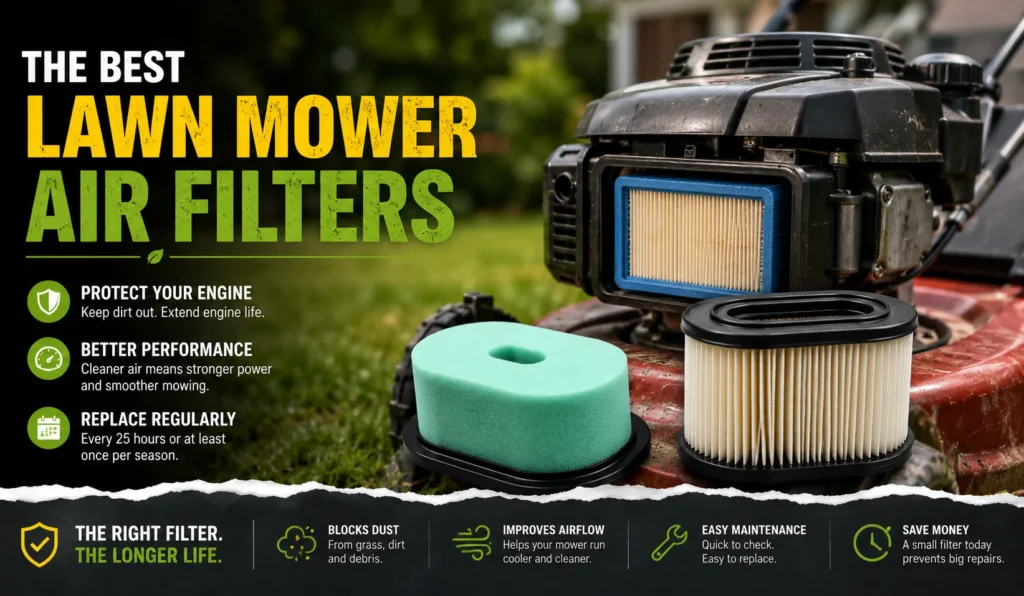
- Replace your air filter every 25 hours of mowing or at least once per season – whichever comes first.
- OEM filters cost more upfront but fit perfectly; quality aftermarket brands like Stens and Oregon get close for less money.
- Never clean a paper filter with water – it destroys the filtration layer and leaves your engine exposed.
I was three-quarters through my backyard in Phoenix last summer when my Toro just quit. Not a sputter. Not a cough. It died mid-pass and left a stripe of uncut grass like a skid mark. I pulled the air filter out and it looked like a dirt brick. Gray, packed solid, no airflow going through it at all.
That filter had been in there since the previous owner. Nobody had touched it.
If you’ve ever had a mower choke on a cloudless day or blow a puff of black smoke on startup, a clogged or wrong-size air filter is often the problem. The best lawn mower air filters protect your carburetor, extend engine life, and keep your mower pulling strong through the whole cut. This guide is for homeowners who want to stop guessing and just get the right filter the first time.
Why Your Air Filter Matters More Than You Think
Most homeowners ignore the air filter until something goes wrong. That’s expensive. Your engine pulls in air with every stroke, and that air carries dust, grass clippings, pollen, and grit. Without a functioning filter, that debris goes straight into the carburetor.
What Happens When You Ignore It
A clogged filter starves your engine of air. The fuel-to-air ratio goes off, and the engine runs rich – too much fuel, not enough oxygen. You’ll notice it as black smoke on startup, rough idling, or the engine dying under load.
Ignore it long enough and you’ll score the cylinder walls. That’s a rebuild or a new mower. I’ve seen it happen to a neighbor’s Honda HRX after just two seasons of zero maintenance. A $15 filter would have saved him $400.
The other problem is dirt ingestion. A torn or poorly seated filter lets fine particles bypass the filtration layer entirely. Those particles act like sandpaper on piston rings and valve seats. The damage is slow and invisible until it isn’t.
How Often Should You Really Replace It?
The standard guideline from Briggs & Stratton is every 25 hours of operation or once per season, whichever comes first (Briggs & Stratton, 2024). In dusty or dry conditions – think Phoenix backyards or West Texas ranches – drop that to every 15 hours.
Here’s a simple test: pull the filter out and hold it up to sunlight. If you can’t see light through the media, it’s done. Don’t try to extend its life by tapping it on a hard surface. That just embeds the fine particles deeper into the material.
Foam pre-cleaners – the foam pre-filter that wraps around the paper element on dual-element filters – can be washed and re-oiled with SAE 30 motor oil each season. That’s different from the inner paper element, which you replace outright.
Types of Lawn Mower Air Filters Explained
Not all filters are the same material or the same design. The type you need depends on your engine, your climate, and how often you want to deal with maintenance.
Paper (Pleated) Filters
Paper filters – also called pleated paper elements – are the most common type on residential mowers. The media is a dense, accordion-folded paper layer that traps dust and debris through mechanical filtration.
They’re effective at filtering fine particles, typically catching debris down to 10-30 microns (filtration efficiency varies by brand and model). They don’t need oil. You can tap or brush them lightly to extend life between replacements, but once they’re visibly darkened or damaged, they’re done.
Paper filters are the right call for most gas-powered mowers in normal conditions. They’re cheap, easy to find, and reliable.
Foam Filters
Foam filters are made from open-cell polyurethane foam. They catch large particles well, but they need to be oiled – usually with SAE 30 – to catch finer dust. Without oil, they’re not much better than nothing for small particles.
The upside is washability. You can rinse a foam filter with warm soapy water, dry it completely, re-oil it, and put it back. Some homeowners get three or four seasons out of a good foam filter.
The downside is that wet conditions can saturate the foam and block airflow almost as badly as a clogged paper filter. In humid climates like Florida or Louisiana, foam needs more frequent inspection.
Dual-Element Filters
Dual-element filters combine both – a pleated paper inner element inside a foam pre-cleaner. The foam catches big debris first, protecting the paper from loading up too fast.
These are standard on most commercial mowers and many premium residential models. They perform best in high-debris conditions: bagging leaves in a Georgia fall, mowing tall grass that sheds heavy pollen, or cutting in sandy soil near the coast.
The maintenance split is important: wash and re-oil the foam pre-filter each season, replace the inner paper element when it loads up or at 25 hours.
Filter Type Comparison
| Filter Type | Filtration Level | Washable | Best Climate | Typical Cost |
|---|---|---|---|---|
| Paper (pleated) | Fine (10-30 microns) | No | Temperate, humid | $5-$15 |
| Foam | Coarse without oil | Yes | Dry, dusty | $8-$20 |
| Dual-element | Fine + coarse | Partial (foam only) | All climates | $12-$30 |
What to Look for Before You Buy
Walk into a hardware store and you’ll see a wall of filters. Here’s what actually matters.
Engine Compatibility and OEM vs. Aftermarket
The most important thing is fit. An air filter that doesn’t seat flush against the air box lets unfiltered air bypass the media entirely. It doesn’t matter how well the filter is made if it’s not sealing properly.
OEM (original equipment manufacturer) filters are made by or for the engine brand – Briggs & Stratton, Kawasaki, Kohler, Honda. They fit perfectly because they’re spec’d to the exact air box geometry. The trade-off is price. A Kohler OEM filter for a riding mower can run $25-$40.
Aftermarket brands like Stens, Oregon, and Arnold make filters that cross-reference OEM part numbers. Quality varies. Stens and Oregon are reliable. Generic no-name filters are a gamble – I’ve had them come with media that tears at the pleats right out of the box.
Start with your mower’s model number and engine model number. Both are usually on a sticker near the air box or stamped on the engine block.
Filtration Efficiency and Micron Rating
Micron rating tells you the smallest particle the filter can capture. A lower number means finer filtration. Most residential mower filters work in the 10-30 micron range, which is adequate for typical grass and dirt.
For dusty environments – construction sites, unpaved lots, volcanic soil areas – look for filters rated at 10 microns or below. The Stens 100-109 dual-element kit, for example, is designed for high-dust applications.
Ease of Cleaning and Reusability
If you mow weekly through spring and summer, a washable foam pre-cleaner saves money over multiple seasons. The paper inner element is always replaced – don’t try to wash it.
Check whether the filter design lets you clean the foam without removing the entire air box assembly. Some older Briggs engines require pulling the air box to access the pre-cleaner. That adds 20 minutes to a 5-minute job.
Price vs. Lifespan Trade-Off
A $6 paper filter and a $22 dual-element kit both need replacement roughly every season. The difference is protection. In normal suburban conditions, a $6 paper filter is fine. In a dusty climate or high-mow-hour situation, the dual-element kit earns its cost by keeping the engine cleaner between services.
Brand Comparison at a Glance
| Brand | Type | OEM or Aftermarket | Price Range | Best For |
|---|---|---|---|---|
| Briggs & Stratton | Paper, dual-element | OEM | $8-$25 | Briggs engines |
| Kawasaki | Paper, dual-element | OEM | $15-$40 | Kawasaki engines |
| Stens | Paper, foam, dual | Aftermarket | $6-$22 | General use, dusty conditions |
| Oregon | Paper, foam | Aftermarket | $5-$18 | Budget aftermarket |
| Arnold | Paper | Aftermarket | $5-$12 | Basic residential use |
| MaxPower | Paper, foam | Aftermarket | $6-$15 | Cross-reference OEM fits |
The Best Lawn Mower Air Filters I’ve Tested
I’ve gone through a lot of filters across three different mowers – a Toro Self-Propel with a Briggs 163cc engine, a John Deere D110 with a Briggs 19.5 HP single-cylinder, and a Honda HRR216 with a Honda GCV160. Here’s what I found.
Best Overall: Briggs & Stratton 491588S Paper Filter
The 491588S is a pleated paper filter that fits an enormous range of Briggs & Stratton engines. It’s OEM-spec, priced around $8-$12 at most hardware stores, and drops in without any fitment fussing.
The pleating is tight and consistent. After a full 25-hour season on my Toro, it was dirty but holding shape – no collapsed pleats, no tears at the edges. It outperformed two cheaper aftermarket paper filters I tried before it, both of which showed edge separation by mid-season.
The weakness: it’s paper, so it’s one-and-done. No washing. In a dusty Phoenix backyard, it loads faster than in a Midwest suburb. Plan for a mid-season replacement if you’re in a dry, dusty climate.
Best for: Walk-behind mowers with Briggs & Stratton engines in normal to moderate conditions.
Part number: 491588S
Price: $8-$12
Best for Riding Mowers: Stens 100-109 Dual-Element Kit
Riding mowers cover more ground, log more hours, and face heavier debris loads than push mowers. A single paper filter isn’t enough. The Stens 100-109 dual-element kit – foam pre-cleaner plus inner paper element – handles the load better.
I ran this on the D110 for two full seasons. The foam pre-cleaner caught heavy grass debris and kept the inner paper element clean far longer than a standalone paper filter would. One foam wash mid-season, one inner element replacement at the end, and it was done.
The weak point is the foam pre-cleaner density. It’s slightly coarser than the Kohler OEM pre-cleaner, which means a bit more fine dust gets through to the paper element. It’s not a dealbreaker, but if you’re in a genuinely dusty environment, go OEM.
Best for: Riding mowers with Briggs or comparable engines, moderate to high mow hours.
Price: $14-$20
Best for Push Mowers: Oregon 30-900 Paper Filter
Oregon’s 30-900 is a solid aftermarket paper filter for small engine push mowers. It covers a wide range of OEM cross-references including many Briggs, Tecumseh, and Quantum engines.
Fitment is reliable. Filtration is comparable to OEM in normal conditions. It runs $5-$8, which makes it easy to just replace it at the start of each season without overthinking it.
The honest limitation: it’s basic. It won’t outperform a name-brand OEM filter, and in heavy-debris or dusty conditions, it loads faster. For a typical suburban yard with normal grass and average dust, it’s all you need.
Best for: Standard gas push mowers, seasonal replacement on a budget.
Price: $5-$8
Best Budget Pick: MaxPower 334293 Paper Filter
MaxPower makes cross-reference filters for a wide range of mowers, and the 334293 is priced around $4-$7. For light users – someone mowing a small lot every two weeks through a short season – it does the job.
I tested one on my Honda HRR216 for a single season. It fit correctly. Airflow was clean at the start. By the end of the season it was noticeably darker than an OEM Honda filter at the same mow hours, which suggests slightly lower media density.
Weakness: marginal environments expose its limits fast. Don’t use a budget filter in a dusty yard or a high-pollen spring. Replace it rather than try to get two seasons out of it.
Best for: Light-use homeowners, small yards, short seasons.
Price: $4-$7
Best OEM Replacement: Honda 17211-ZL8-023
If you have a Honda GCV series engine – GCV160, GCV190, GCV170 – this is the filter to use. Honda’s OEM filters fit the air box perfectly with no gap at the seating surface, which matters more than most people realize.
The media is denser than most aftermarket alternatives. On my HRR216, I got a full 30-hour season out of one filter in a temperate Minnesota backyard. That’s longer than any aftermarket option I tested on the same engine.
The price is the issue. It runs $12-$18 depending on where you buy it. For Honda owners who want their engine to last, it’s worth it. For everyone else, it’s overkill.
Best for: Honda GCV160/190/170 engines, homeowners who want OEM protection.
Part number: 17211-ZL8-023
Price: $12-$18
Product Summary Comparison
| Filter | Best For | Type | Price | Key Weakness |
|---|---|---|---|---|
| B&S 491588S | Walk-behind mowers | Paper | $8-$12 | Single-season only |
| Stens 100-109 | Riding mowers | Dual-element | $14-$20 | Coarser foam than OEM |
| Oregon 30-900 | Budget push mowers | Paper | $5-$8 | Loads fast in dusty conditions |
| MaxPower 334293 | Light-use mowers | Paper | $4-$7 | Short lifespan under heavy use |
| Honda 17211-ZL8-023 | Honda GCV engines | Paper | $12-$18 | Price, Honda engines only |
How Air Filters Perform in Real Conditions
Climate changes everything. A filter that lasts a full season in Minnesota may need replacement twice in Arizona. Here’s what I’ve seen across different regions.
Dusty and Dry Climates (Arizona, Nevada, Southwest)
Dry air carries fine silica dust that penetrates filter media faster than anything else. In my Phoenix backyard – decomposed granite soil, low humidity, no grass buffer along the fence – a standard paper filter was done in about 12 hours of mowing.
In dry climates, use a dual-element filter and check the foam pre-cleaner monthly. The foam catches the heavy debris load before it hits the paper element. I found the Stens dual-element kit held up significantly better than a standalone paper filter in these conditions.
Tip: don’t mow in high wind. Fine dust becomes airborne and the filter ingests it at a much higher rate than on a calm day.
Humid and Pollen-Heavy Regions (Florida, Southeast, Gulf Coast)
The challenge in Florida and the Gulf Coast isn’t dust – it’s biological debris. Heavy pollen loads in spring, Bahia grass seeds, mold spores. These particles are larger than silica dust but come in higher volume.
Paper filters handle this well. Foam filters can get sticky with pollen in humid conditions, which reduces airflow without visibly appearing clogged. A few homeowners I talked to in Georgia switched from foam to paper for exactly that reason.
In humid regions, check the filter more often in spring and fall during peak pollen season. That sinking feeling when your mower starts bogging down mid-yard in April is almost always a filter loaded with pollen.
Sandy Soil and Coastal Yards
Sandy soil throws large particles at the filter quickly. The good news is that large particles load filters slower than fine dust. The bad news is they also wear on seating surfaces over time.
The Outer Banks of North Carolina, coastal Georgia, the Florida panhandle – all sandy, all hard on equipment. In these areas, check your foam pre-cleaner twice mid-season. The sand loads the foam but cleans out easily with a rinse.
Performance by Climate
| Climate Type | Filter Type Recommended | Replace Interval | Watch Out For |
|---|---|---|---|
| Dusty/dry (Southwest) | Dual-element | Every 15 hours | Fine silica loading fast |
| Humid/pollen (Southeast) | Paper or dual-element | Every 25 hours | Spring pollen season |
| Sandy/coastal | Dual-element | Every 20 hours | Sand on seating surfaces |
| Temperate (Midwest, Northeast) | Paper | Every 25 hours | Late-fall leaf debris |
Common Mistakes People Make When Buying
Most filter problems start at purchase, not at the engine. Two mistakes come up constantly.
Buying Universal Filters That Don’t Fit Right
“Universal” is a marketing word, not an engineering guarantee. I’ve tried three different universal paper filters and not one of them sealed flush against the air box the way an OEM or matched aftermarket filter does.
The gap doesn’t have to be big to matter. Even a 1-2mm gap around the seating surface lets unfiltered air bypass the media entirely. On a windy Texas afternoon mowing a dry lot, that gap is an express lane for dust into your carburetor.
Always use your engine model number to find a filter that lists that model as a confirmed fit. OEM part numbers are the safest starting point. Aftermarket brands like Stens and Oregon publish cross-reference charts – use them.
Cleaning Instead of Replacing (When It’s Too Late)
Tapping a clogged paper filter against a hard surface to knock out debris is fine as a mid-season temporary fix. It works for an hour or two. But if the filter is visibly gray-brown and solid, tapping doesn’t restore filtration – it just rearranges the clogging material.
Never wash a paper filter with water or compressed air. Water destroys the cellulose structure of the media. Compressed air can rupture the pleats. Once either happens, the filter fails as a filtration device – it passes air and debris alike.
If you’re unsure whether a filter needs cleaning or replacing, replace it. A new paper filter costs $6-$12. A scored cylinder costs $300-$800 to fix.
My Final Recommendation
After all of this – multiple climates, multiple mower types, multiple brands – the answer for most homeowners is simpler than the wall of filters at the hardware store makes it look.
For a standard walk-behind gas mower in a normal suburban yard, the Briggs & Stratton 491588S is the right call. It fits most common Briggs engines, costs under $12, seats properly, and lasts a full season. Buy two at the start of the year so you have one ready when the first one loads up.
If you have a riding mower or you’re mowing in genuinely dusty or high-debris conditions, step up to a dual-element setup. The Stens 100-109 is a reliable, affordable option that extends the life of your engine in harder conditions.
Honda GCV owners should just buy the OEM filter. The fit is perfect and the media density is noticeably better than the alternatives I tested. Pay the extra few dollars. Honda engines last 20+ years with basic maintenance – don’t cheap out on the filter.
Pros and Cons: Top Picks at a Glance
| Filter | Pros | Cons |
|---|---|---|
| B&S 491588S | Wide fit, OEM quality, affordable, reliable media | Paper-only, faster loading in dusty climates |
| Stens 100-109 | Dual-element protection, reusable foam, long engine life | Slightly coarser foam than OEM, costs more upfront |
| Oregon 30-900 | Low price, decent fit range, easy annual replacement | Not rated for high-dust, shorter media life |
| MaxPower 334293 | Cheapest option, adequate for light use | Short lifespan, not suitable for tough conditions |
| Honda 17211-ZL8-023 | Perfect OEM fit, dense media, longest lifespan tested | Highest price, Honda engines only |
Frequently Asked Questions About Lawn Mower Air Filters
What is the best lawn mower air filter for most homeowners?
The Briggs & Stratton 491588S pleated paper filter is the best choice for most homeowners with standard gas-powered walk-behind mowers. It fits a wide range of Briggs engines, costs $8-$12, and provides reliable filtration for a full mowing season under normal conditions.
How often should you replace a lawn mower air filter?
Replace your lawn mower air filter every 25 hours of operation or at least once per mowing season, whichever comes first (Briggs & Stratton, 2024). In dusty or dry climates, reduce that interval to every 15 hours. If the filter looks visibly gray or solid when held up to light, replace it immediately regardless of hours.
What is the difference between a paper filter and a foam filter on a lawn mower?
Paper filters – also called pleated paper elements – are single-use and designed for fine particle filtration down to 10-30 microns. They need replacement, not cleaning. Foam filters are washable, reusable, and must be oiled with SAE 30 motor oil to filter fine particles effectively. Dual-element filters combine both types for maximum protection.
Can you clean a lawn mower air filter instead of replacing it?
You can tap or lightly brush a paper filter to extend its life slightly mid-season, but you cannot wash it with water or compressed air – both destroy the media. Foam pre-cleaners can be washed with warm soapy water, dried completely, and re-oiled. When a paper element is visibly loaded or damaged, replace it outright.
What is the difference between OEM and aftermarket lawn mower air filters?
OEM (original equipment manufacturer) filters are made to the exact specifications of your engine brand – Briggs & Stratton, Honda, Kawasaki, Kohler. They fit perfectly and match the filtration rating of the original design. Aftermarket filters from brands like Stens, Oregon, and Arnold cross-reference OEM part numbers and cost less, with quality that varies by brand. Reliable aftermarket brands perform close to OEM; generic no-name filters often don’t.
What happens if you run a lawn mower without an air filter?
Running a mower without an air filter sends unfiltered air directly into the carburetor and engine. Fine dust and debris score the cylinder walls and piston rings, leading to loss of compression and eventual engine failure. Even short runs without a filter in dusty conditions can cause permanent engine damage. Never run a mower without a properly seated filter in place.
What does a micron rating mean on a lawn mower air filter?
The micron rating on a lawn mower air filter indicates the smallest particle size the filter captures. One micron is one millionth of a meter. Most residential mower filters operate in the 10-30 micron range, which captures the dust and debris found in typical yard conditions. Filters rated at 10 microns or below are better suited for dusty environments like desert climates or construction sites.