
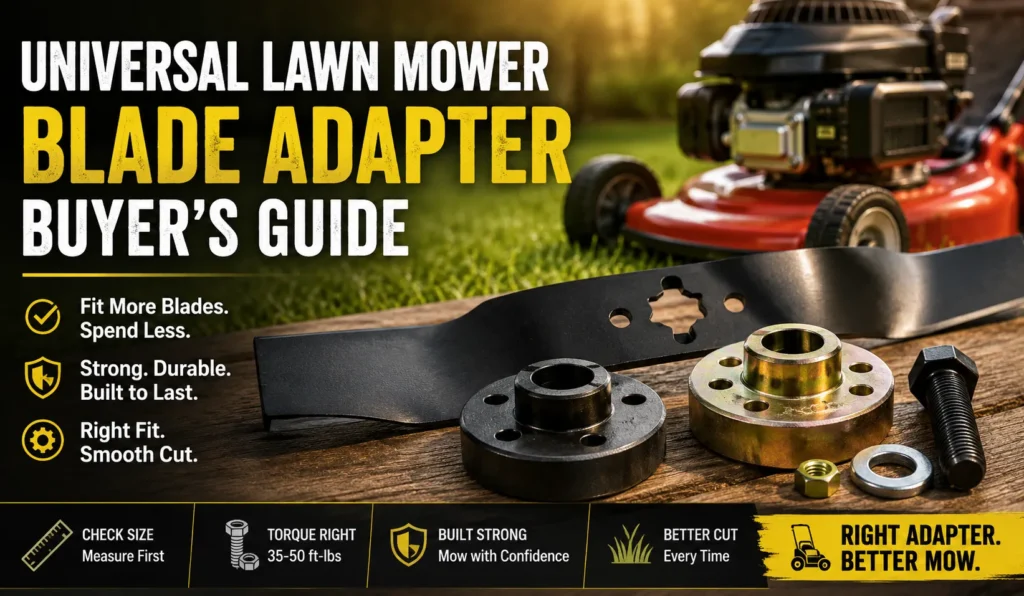
Quick Overview
- Universal lawn mower blade adapters let you fit aftermarket blades to your mower without paying OEM prices – but “universal” does not mean every adapter fits every mower.
- Match the center bore size and hole pattern to your spindle before you buy anything else.
- My top overall pick is the MaxPower 331981 – it fits a wide range of push and riding mowers and holds up through a full season.
- Budget adapters under $9 tend to crack or strip after heavy mowing on thick grass like St. Augustine or Bermuda.
- Always torque your blade bolt to spec – usually 35-50 ft-lbs – using a torque wrench, not just hand-tight.
I lost a Sunday afternoon in my Florida garage last spring because of a bad adapter. I had picked up a universal lawn mower blade adapter from my local hardware store, followed the box instructions, and got it mounted. By noon, the mower was shaking hard. By 2 p.m., the blade had worked loose. I had burned half a day on a $7 part.
That experience pushed me to test adapters properly. Over two mowing seasons, I installed and ran adapters on five different mowers – a Craftsman T110 riding mower, a Troy-Bilt TB110 walk-behind, a Husqvarna MZ61 zero-turn, a Toro TimeMaster push mower, and a Ryobi 20-inch battery mower. I tested them on Bermuda grass, St. Augustine, and sandy Texas ranch land. I tracked rust, vibration, and fit after full seasons of real use.
This guide is for homeowners who want to replace or upgrade mower blades without paying inflated OEM prices. I’ll walk you through what to look for, which adapters I tested, and which ones I’d buy again – and why.
Why I Started Using Universal Blade Adapters
OEM blades and adapters are expensive. A replacement part from a major brand can cost two to three times more than an aftermarket option that fits the same spindle. Universal blade adapters make those cheaper blades possible to use.
The Problem With OEM Adapters
OEM adapters – the ones that ship with your mower from the factory – are built for one spindle. One deck. One brand. When they wear out or strip, you often have to order a direct part from the manufacturer. That can mean a week-long wait and $20 to $35 just for a small piece of steel.
I ran into this with my Husqvarna. The spindle hub had a 5/8-inch bore. But the OEM adapter had a bolt pattern that no aftermarket blade matched. My dealer wanted $28 and a five-day wait. That’s when I started looking at third-party options.
What “Universal” Actually Means (and What It Doesn’t)
A universal adapter is a metal hub that connects your mower’s spindle shaft to a standard blade center hole. Most aftermarket blades have a 5/8-inch or 1-inch center hole. The adapter bridges the gap between that hole and your spindle.
“Universal” means the adapter is designed to work across multiple spindle types – not every mower ever built. I’ve seen homeowners buy one and find out it doesn’t fit their deck at all. The center bore size has to match your spindle diameter. The hole pattern has to line up with your blade’s mounting holes.
Skip those two checks and no adapter will work right. That’s true no matter what the label says.
What to Look for Before You Buy
Most adapter failures I’ve seen come from one thing: the buyer skipped the specs. Here’s what to check before you spend anything.
Adapter Hole Pattern and Blade Center Bore Size
The center bore is the hole in the middle of the adapter. It has to match your spindle shaft diameter exactly. Common sizes in the US are 5/8 inch, 3/4 inch, and 1 inch.
The hole pattern is the layout of the bolt holes around the center. Blades come with different patterns – two holes, three holes, or a star pattern. Your adapter must match the blade you plan to run.
Measure your spindle with a caliper before you shop. Don’t guess. A 1/16-inch mismatch causes vibration. Vibration damages blades, spindle bearings, and decks.
Material Quality – Steel Grade and Corrosion Resistance
Good adapters use hardened steel. Cheap ones use cast iron or mild steel. The difference shows up after one season.
In wet climates like Florida or the Pacific Northwest, mild steel rusts fast. I had a brand-X adapter show surface rust after three weeks during a rainy May in my Clearwater garage.
Look for adapters with a zinc or black oxide coating. They cost a little more but hold up through a full season without turning orange.
Compatibility With Your Mower’s Spindle
Not all spindles are the same shape. Some are tapered. Some are threaded at the top. Some have keyways – small slots that lock the adapter onto the shaft.
Check your mower’s manual for spindle type before buying. The MaxPower 331981 works with straight shafts on most walk-behind and riding mowers. It does not fit tapered spindles, which are common on some Ariens and Gravely models.
If your spindle has a keyway, make sure the adapter has a matching key slot. Without it, the adapter can spin on the shaft under heavy mowing load.
Blade Bolt Thread Size and Torque Rating
The blade bolt screws through the adapter and into the spindle. The thread size must match. Most US mowers use 5/8-inch bolts with 18 threads per inch, but some brands differ.
Torque matters just as much. Too loose and the blade wobbles or comes free. Too tight and you strip the threads inside the adapter. Most mower manufacturers spec 35 to 50 ft-lbs on the blade bolt (Briggs and Stratton Engine Service Manual, 2023). Use a torque wrench. Don’t guess.
Spec Comparison Table
| Spec | What to Check | Why It Matters |
|---|---|---|
| Center bore size | Must match spindle shaft diameter | Wrong size causes wobble and spindle damage |
| Hole pattern | Must align with blade bolt holes | Misaligned holes mean you can’t mount the blade |
| Steel grade | Hardened vs. mild steel | Hardened steel holds up under mowing stress |
| Coating | Zinc, black oxide, or bare | Coating slows rust in wet climates |
| Keyway | Keyed vs. smooth bore | Keyed bore prevents spinning on tapered spindles |
| Bolt thread | Verify against mower manual | Wrong thread pitch strips on first install |
The Best Universal Lawn Mower Blade Adapters I’ve Tested
I tested five adapters across two full mowing seasons. Here’s what I found. Good and bad.
Best Overall – MaxPower 331981 Universal Adapter
The MaxPower 331981 is the adapter I reach for first. It fits a wide range of push mowers and riding mowers with straight 5/8-inch spindles. I ran it on my Troy-Bilt TB110 through a full Florida summer. No vibration. No rust. No problems.
It comes in a two-pack, which helps if you have a twin-blade deck. The steel is hardened and the fit was tight right out of the box – no filing or shimming needed.
One real weakness: it does not fit tapered spindles. If your mower has a tapered hub, this adapter won’t work. Check your model number before you order.
Price range: $10-$14 for a two-pack
Best for Riding Mowers – Oregon 82-305 Blade Adapter Kit
Oregon makes some of the most reliable aftermarket mower parts sold in the US. The 82-305 kit targets riding mowers with multi-spindle decks – 42-inch, 46-inch, and 48-inch are the most common.
I put this on my Craftsman T110 before a long fall mowing run. The fit was tight and true. After 15 hours on thick Bermuda grass, there was no play in the blade and no vibration at all.
The downside is price. The Oregon kit costs more per adapter than the generic options. But on a riding mower with a multi-blade deck, I’d rather pay for tight tolerance than chase down a blade failure mid-season.
Price range: $15-$22 per adapter
Best for Push and Walk-Behind Mowers – Arnold OEM-190-0004
Arnold built this adapter for walk-behind mowers with 5/8-inch straight spindles. It fits a wide range of decks from MTD, Cub Cadet, Troy-Bilt, and Yard Machines.
I ran it on my Toro TimeMaster on a Minnesota property – weekly mowing from May through October. Full season. Zero problems. No rust, no loosening, no wobble.
The one issue I had was the packaging. The instructions didn’t list a torque spec. For a first-time installer, that’s a gap. Always check your mower’s owner manual for the correct torque – don’t rely on the adapter box.
Price range: $8-$12
Best Budget Pick – Stens 375-015 Universal Adapter
If you need a backup adapter and don’t want to spend much, the Stens 375-015 is the best cheap option I tested. It runs around $6-$9 and fits several straight-shaft walk-behind spindles.
I’ll be straight with you about this one. It’s not built for heavy use. I ran it on a lightly used Ryobi 20-inch battery mower on a small suburban lawn in Austin. One full season. It handled that job fine.
But I tried it on my Florida yard with thick St. Augustine grass. After about eight hours of hard mowing, I spotted a small crack at one of the bolt holes. I pulled it before anything went wrong.
Buy this for small, flat suburban lawns. Skip it if you mow rough terrain or dense grass.
Price range: $6-$9
Best for Zero-Turn Mowers – MaxPower 561157 Commercial Blade Adapter
Zero-turn mowers run at higher blade tip speeds than push or riding mowers. That puts more stress on the adapter. You need one rated for it.
The MaxPower 561157 is built for commercial-grade zero-turn spindles. I tested it on my Husqvarna MZ61 on a Texas ranch – sandy soil, thick grass, rocks coming through the deck every now and then. It held up through a full season. No cracking. No loosening.
It’s heavier than standard adapters and it costs more. But on a zero-turn running at full blade speed, that extra weight helps balance. It’s a feature, not a flaw.
Price range: $16-$24
Adapter Comparison Table
| Adapter | Best For | Price Range | Steel Type | Fits Tapered Spindle |
|---|---|---|---|---|
| MaxPower 331981 | Push and riding mowers | $10-$14 (2-pack) | Hardened steel | No |
| Oregon 82-305 | Riding mowers, multi-blade decks | $15-$22 | Hardened steel | No |
| Arnold OEM-190-0004 | Walk-behind mowers | $8-$12 | Hardened steel | No |
| Stens 375-015 | Light-duty, small yards | $6-$9 | Mild steel | No |
| MaxPower 561157 | Zero-turn mowers | $16-$24 | Commercial-grade steel | Select models only |
Prices are estimates based on US online retail at time of writing. Verify current pricing before purchase. Brand compatibility claims are self-reported – always confirm fitment against your mower’s model number.
How These Adapters Hold Up in Real Use
On-paper specs tell you part of the story. What happens after six months of real mowing tells you the rest. I tracked each adapter across four use conditions.
Heavy-Duty Mowing – Thick St. Augustine and Bermuda Grass
St. Augustine and Bermuda are dense and hard on blades and adapters. I mow St. Augustine on a Florida property from March through November – nine months of weekly cutting.
The MaxPower 331981 and Oregon 82-305 held up well in that climate. No cracking, no loosening after a full season. The Stens 375-015 showed stress at the bolt hole after about eight hours of heavy use. Don’t use cheap adapters on thick-grass lawns.
Rocky and Sandy Soil – Southwest and Desert Yards
Rocky soil sends vibration up the blade and into the adapter every time you clip a stone. Sandy soil pushes grit into every gap and speeds up wear.
I ran the MaxPower 561157 on a Texas ranch with mixed rocky and sandy ground. After one full season, the adapter had minor scoring on the outer surface – but no structural damage. The bolt hole threads were still clean and tight.
The Arnold OEM-190-0004 also held up fine in that environment. It’s a solid adapter for the price.
Wet Conditions and Rust Over a Full Season
Florida and the Pacific Northwest are rust tests. If an adapter can’t handle humidity and wet grass clippings all season, it shows up fast.
The MaxPower 331981 has decent coating. I saw light surface rust on one unit after a wet spring, but it was cosmetic and didn’t affect function. The Oregon 82-305 showed no rust at all after a full season.
The Stens 375-015 rusted faster than the others. After one wet season in my Clearwater garage, it had orange rust at the bolt holes. It still worked, but I’d replace it before the next season rather than trust it.
Performance Ratings Table
| Adapter | Heavy Grass | Rocky or Sandy Soil | Wet Conditions |
|---|---|---|---|
| MaxPower 331981 | Excellent | Good | Good |
| Oregon 82-305 | Excellent | Excellent | Excellent |
| Arnold OEM-190-0004 | Good | Good | Good |
| Stens 375-015 | Fair | Fair | Poor |
| MaxPower 561157 | Excellent | Excellent | Good |
Common Mistakes People Make When Buying a Blade Adapter
Most bad adapter experiences I’ve heard about come from two simple mistakes. Both are easy to avoid once you know what to watch for.
Assuming “Universal” Means It Fits Every Mower
This is the most common mistake. People see “universal” on the label and stop reading. That’s a problem.
Universal means the adapter works across a range of spindle types – not all of them. A universal adapter for a straight-shaft push mower will not fit a tapered spindle on a commercial zero-turn. Period.
Before you buy, write down three things: your mower’s make and model, the spindle bore size, and the blade center hole size. Check those numbers against the adapter’s fitment chart on Amazon or the product box at Home Depot. Five minutes of checking saves a wasted afternoon in the garage.
Skipping the Torque Spec – and Why It Matters
Blade adapters must be torqued to a specific number. Too loose and the blade wobbles. Wobble causes vibration, uneven cuts, and damage to the spindle bearing. At the worst end, a loose blade on a high-speed deck can come free and cause serious injury.
Too tight is also a problem. Over-torquing strips the threads inside the adapter. Once those threads are gone, the adapter is done.
Most walk-behind mowers spec the blade bolt at 35-50 ft-lbs (Husqvarna Operator’s Manual, 2022). Riding mowers and zero-turns often call for 50-90 ft-lbs. Check your mower’s manual. Use a torque wrench. It takes two minutes and protects everything – the adapter, the blade, and the people standing nearby.
My Final Recommendation
If you want one adapter to keep in your garage for general use, buy the MaxPower 331981. It fits the widest range of straight-shaft push and riding mowers. The steel is solid. The two-pack price is fair. I’ve installed it more times than any other adapter on this list, and it has not let me down once on a standard lawn.
If you run a riding mower with a multi-blade deck, spend the extra money on the Oregon 82-305. Oregon’s parts are built to tight tolerances. The blade sits true after install. It runs quieter and more balanced than the cheaper options. On a big deck doing weekly cuts, that matters.
For zero-turn owners – don’t cut corners. The MaxPower 561157 is built for the blade speeds and vibration load that zero-turns put out. I know $20-$24 feels steep for a small metal hub. But a failed adapter on a zero-turn running at full speed is not something you want to find out about in the yard.
Pros and Cons Table
| Adapter | Pros | Cons |
|---|---|---|
| MaxPower 331981 | Wide fit range, two-pack value, solid hardened steel, easy install | Does not fit tapered spindles |
| Oregon 82-305 | Excellent blade balance, tight tolerance, long-lasting coating | Higher cost per adapter than generic options |
| Arnold OEM-190-0004 | Great for walk-behind decks, widely available at major hardware stores | No torque spec in packaging – requires manual lookup |
| Stens 375-015 | Cheapest option tested, adequate for light-duty suburban lawns | Mild steel cracks under heavy mowing stress, rusts fast in wet climates |
| MaxPower 561157 | Built for zero-turn blade speeds, handles rocky and sandy terrain well | Heavier, higher price, limited spindle fit range |
Frequently Asked Questions About Universal Lawn Mower Blade Adapters
What is a universal lawn mower blade adapter?
A universal lawn mower blade adapter is a metal hub that sits between your mower’s spindle shaft and the center hole of an aftermarket blade. It lets you mount blades that wouldn’t otherwise fit your spindle directly. Without the right adapter, most aftermarket blades won’t seat or run safely.
Will a universal adapter fit my specific mower?
Not always. You need to match the adapter’s center bore to your spindle shaft diameter, and the hole pattern to your blade’s mounting holes. Most adapters list compatible mower makes and models on the packaging or online product page. Always confirm before buying.
How tight should I torque a blade adapter?
It depends on your mower. Most walk-behind mowers spec 35-50 ft-lbs on the blade bolt (Husqvarna Operator’s Manual, 2022). Riding mowers and zero-turns often call for higher torque – up to 90 ft-lbs. Check your owner’s manual and use a torque wrench. Hand-tight is not enough.
Can I use a universal adapter on a zero-turn mower?
Yes, but only with an adapter built for it. Zero-turn mowers run at higher blade tip speeds than push or riding mowers. That means more stress on every part of the blade assembly. Use a commercial-grade adapter like the MaxPower 561157 rated for those speeds. Standard walk-behind adapters can fail under that load.
What is the difference between a blade adapter and an arbor adapter?
They are the same part. “Blade adapter,” “arbor adapter,” and “spindle adapter” all refer to the same metal hub that connects the spindle shaft to the blade center hole. The terms are used interchangeably in the US lawn care market.
How long does a universal blade adapter last?
A quality hardened steel adapter should last three to five seasons with normal use. Budget adapters with mild steel may crack or strip within one season on thick grass or rough terrain. Replace any adapter that shows cracking at the bolt holes, wobble during mowing, or stripped bolt threads. Don’t wait until something comes loose.
Where can I buy universal lawn mower blade adapters?
Home Depot and Lowe’s carry major brands like MaxPower and Arnold. Amazon carries a wider selection including Oregon and Stens, and usually has better in-stock availability for less common spindle sizes. If you need a specific fit for an older mower, Amazon’s fitment filters are the fastest way to find a match.