

Quick Overview
- Most four-stroke walk-behind mowers run best on SAE 30 in warm weather or 10W-30 if you mow in varying temperatures.
- The wrong oil — or too little of it — can seize a small engine in under an hour on a hot July afternoon.
- Your mower’s oil spec is printed on the dipstick cap or in the owner’s manual; always check it first.
- Synthetic oil is worth the cost if you mow in extreme heat or extreme cold — not mandatory for average conditions.
- Change your oil every 50 hours of use or once per season, whichever comes first.
A few summers ago, a guy brought me a Briggs & Stratton 190cc engine on a Toro self-propelled mower. Seized solid. He’d been running 5W-20 motor oil from his car — the kind he bought in bulk at Walmart. He figured oil was oil.
It wasn’t. That engine was toast.
Knowing what type of oil a lawn mower uses isn’t the most exciting topic. But it’s the difference between a mower that runs for 15 years and one that dies in its third season. This guide is for homeowners who are tired of guessing at the hardware store. I’ll tell you exactly what to use, when to switch it up, and what mistakes I’ve watched people make again and again.
Why Oil Type Actually Matters More Than Most People Think
Small engines are not car engines. They run hotter, they don’t have the same filtration systems, and they operate under load for long stretches — sometimes 45 minutes straight in 95-degree Florida heat. The oil you choose has to handle all of that.
What Happens When You Use the Wrong Oil
The wrong oil thins out too fast under heat, or it stays too thick in cold weather and won’t coat the cylinder walls fast enough on startup. Either way, metal meets metal.
I’ve pulled apart engines where the piston skirt was scored from one bad oil decision. One customer in Phoenix ran straight 10W-40 car oil — the high-mileage kind — for two seasons. The detergent additives in that oil aren’t balanced for small engines, and the extra viscosity modifiers broke down fast in 110-degree dry heat. He needed a new short block.
The damage usually shows up as a knocking sound first. Then the engine gets hard to start. Then it won’t start at all. By that point, the repair often costs more than the mower.
How Oil Protects a Small Engine Differently Than a Car
A car engine runs through a full lubrication system — oil pump, filter, multiple passages. A small four-stroke mower engine is simpler. The crankshaft dips into an oil reservoir and splashes lubricant onto the cylinder walls and bearings with every rotation.
That splash system works well, but it means the oil takes a beating. It gets hot fast, it picks up combustion byproducts, and there’s no big oil filter pulling out contaminants every few seconds. The oil has to stay stable longer and protect more aggressively than what your Honda Civic needs.
That’s why small engine oil ratings and change intervals exist — and why following them matters.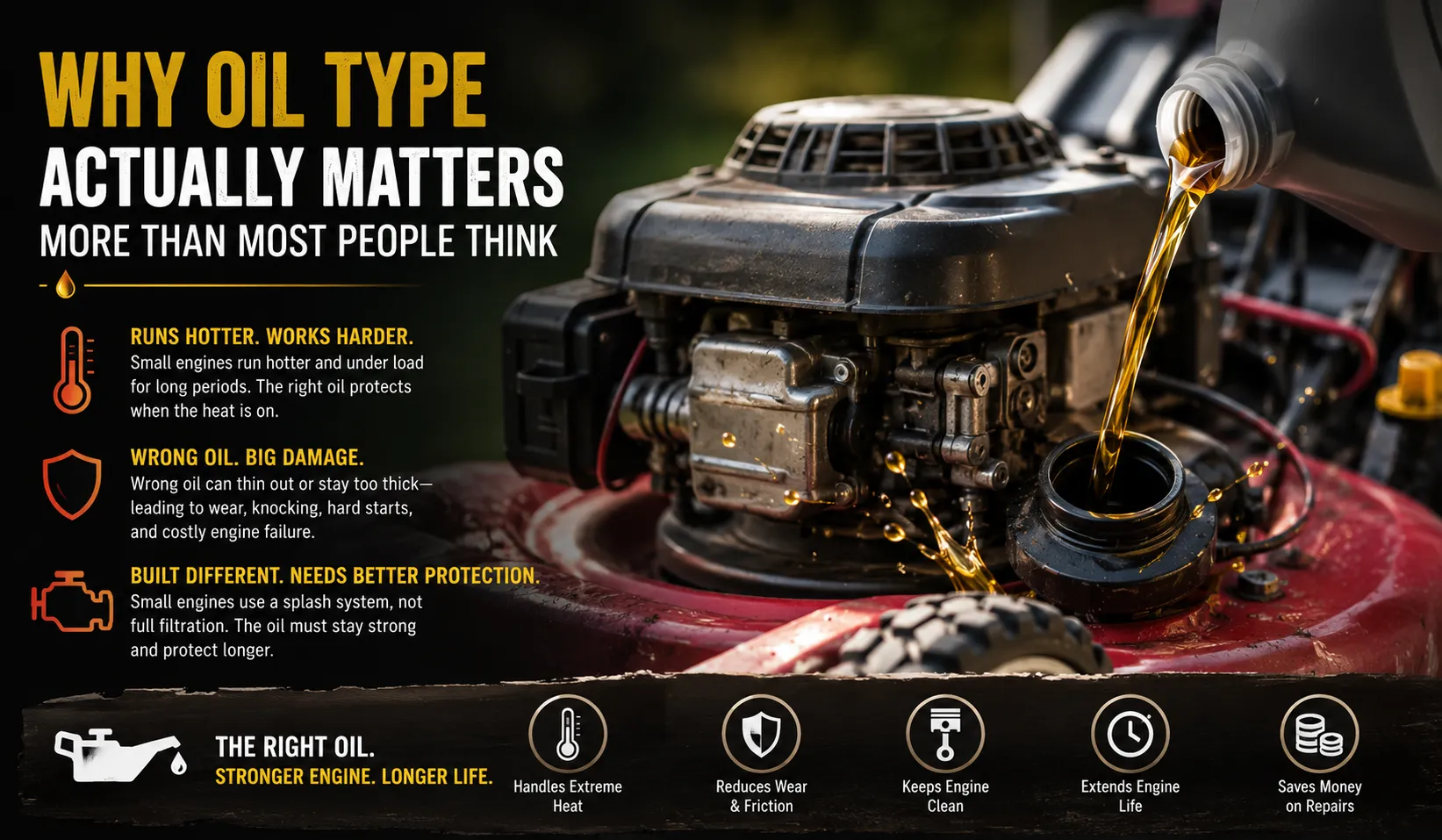
The Main Types of Lawn Mower Oil Explained
Most gas-powered walk-behind and riding mowers use four-stroke engines, and those engines need a specific oil weight. Here’s what each one actually means for your mower.
SAE 30 – The Classic Choice
SAE 30 is a single-grade oil with one viscosity rating: 30. It’s the traditional choice for small engines, and it works well when air temperatures are consistently above 40°F.
If you mow in Georgia from April through October, SAE 30 is probably all you need. It’s inexpensive — around $4–$6 a quart at AutoZone — it’s easy to find, and it’s what a lot of older Briggs & Stratton and Kawasaki engines were designed around.
The downside: it gets too thick when cold. If you try to start a mower on a 35-degree Minnesota morning with SAE 30 in it, you’ll stress the engine on every startup. Single-grade oils just don’t perform well across a wide temperature range.
10W-30 – The All-Season Option
10W-30 is a multi-grade oil. The “10W” means it flows like a 10-weight oil when cold; the “30” means it behaves like SAE 30 once the engine warms up. That range makes it the most flexible choice for most US homeowners.
Honda recommends 10W-30 for most of their GCV and GX series engines across a temperature range of 0°F to 100°F. Briggs & Stratton also lists it as acceptable for most climates. If you live somewhere with cool spring mornings and hot summer afternoons — which covers most of the country — 10W-30 covers you year-round without switching oils seasonally.
One honest note: 10W-30 burns off slightly faster than SAE 30 in very hot engines. Check your dipstick more often during summer if you run this grade.
5W-30 – For Cold Climates and Winter Storage
5W-30 flows even more freely in cold weather than 10W-30. The “5W” rating means better cold-start protection at temperatures down to -22°F.
If you’re in Minnesota or Wisconsin and you use a mower in late September when mornings are near freezing, 5W-30 is worth switching to. It also works well as a final oil fill before winter storage — it’ll protect the engine through months of sitting in a cold garage.
The downside: in heat above 90°F, 5W-30 can thin out more than SAE 30 will. It’s not the right call for an all-day mow in July in Louisiana.
Synthetic vs. Conventional Oil – Is It Worth It?
Full synthetic lawn mower oil — brands like Briggs & Stratton Synthetic, Honda Genuine, or Mobil 1 Small Engine — costs about $8–$12 a quart versus $4–$6 for conventional. Is it worth doubling the price?
For most homeowners mowing a suburban lawn once a week in moderate temperatures: no. Conventional oil changed on schedule protects a well-maintained engine just fine.
Synthetic is worth it in two situations. First, if you mow in extreme heat — Phoenix, Las Vegas, South Texas in August — synthetic holds its viscosity better and doesn’t break down as fast. Second, if you want longer change intervals. Some synthetic small engine oils are rated for up to 100 hours versus the standard 50 hours for conventional.
One thing synthetic will not do: save a neglected engine. I’ve seen people switch to synthetic after running an engine oil-low for two seasons. By that point, the wear is already done.
Oil Type Comparison Table
| Oil Type | Viscosity Range | Best Temp Range | Best For | Avg. Cost/Qt | Downside |
|---|---|---|---|---|---|
| SAE 30 | Single-grade | 40°F–100°F+ | Warm climates, older engines | $4–$6 | Poor cold-start performance |
| 10W-30 | Multi-grade | 0°F–100°F | Most US climates, year-round | $5–$7 | Burns off faster in extreme heat |
| 5W-30 | Multi-grade | -22°F–85°F | Cold climates, winter storage | $5–$7 | Thins out in high heat |
| Full Synthetic | Multi-grade | -20°F–100°F+ | Extreme temps, extended intervals | $8–$12 | Higher cost, less necessary for average use |
What Oil Does Your Specific Mower Need?
The right oil also depends on your mower type. Different engines have different capacities, oil specifications, and change intervals. Here’s how to match them.
Walk-Behind Push Mowers
Most residential push mowers use a small four-stroke engine — usually between 140cc and 190cc. These engines hold between 15 and 20 oz of oil (roughly half a quart).
Briggs & Stratton recommends SAE 30 or 10W-30 for most of their residential engines. Honda recommends 10W-30 for the GCV160 and GCV190, which are found on many Honda, Toro, and Craftsman mowers. Check your dipstick cap — the oil spec is often printed right on it.
Self-Propelled Mowers
Self-propelled mowers run the same engine types as push mowers. The oil spec doesn’t change because the mower has drive wheels. What changes is how hard the engine works — a self-propelled mower on a hilly yard is under more load, so oil quality matters slightly more. Stick to the manufacturer’s spec and don’t stretch change intervals.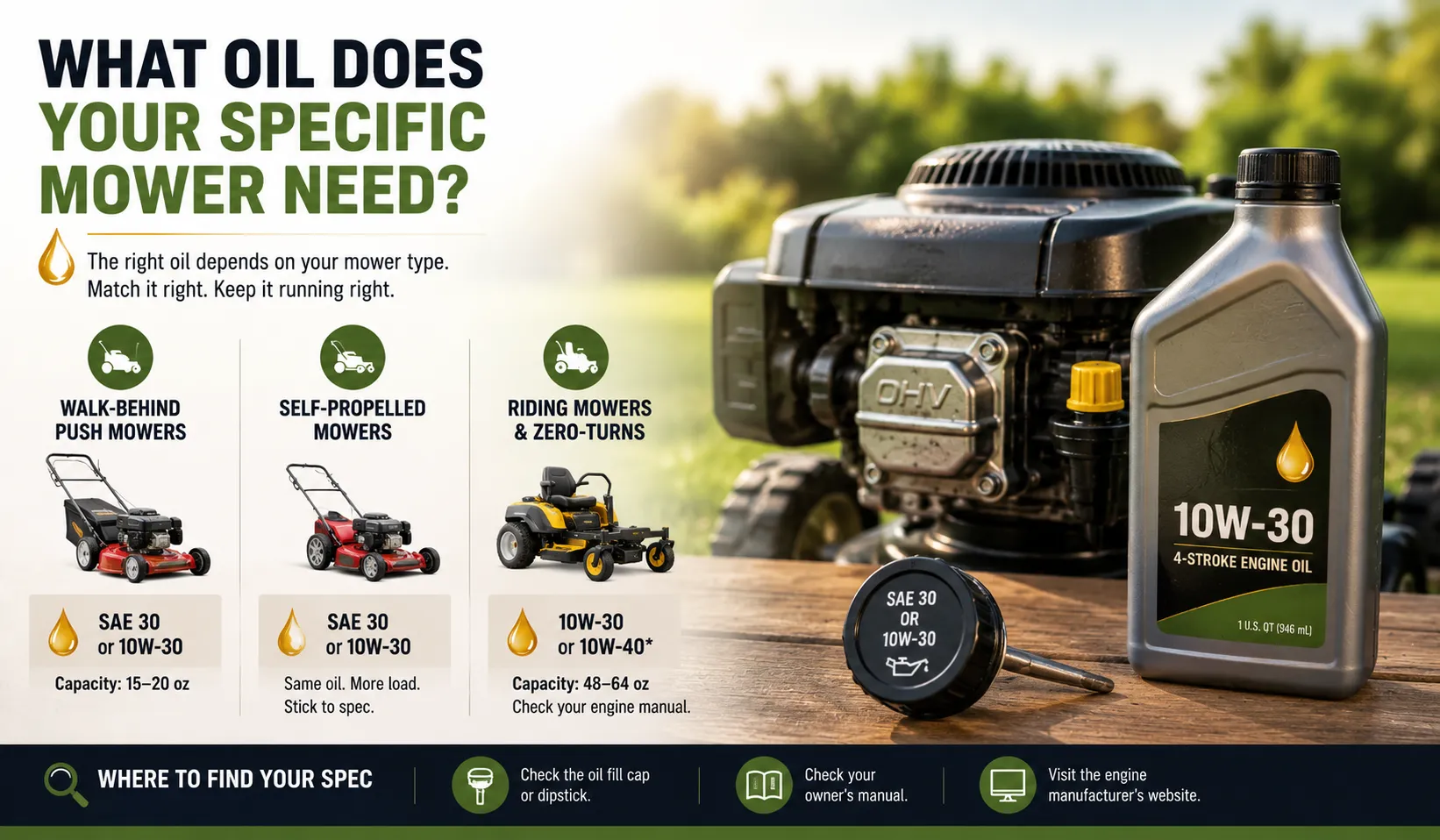
Riding Mowers and Zero-Turns
Riding mowers and zero-turns run larger engines — Kawasaki FR and FX series, Briggs & Stratton Professional series, and Kohler Command Pro are common. These engines hold 48 to 64 oz of oil (1.5 to 2 quarts), and many have an oil filter that should be replaced at every oil change.
Kawasaki FR600V engines specify 10W-40 in some temperature ranges — different from most walk-behind specs. Kohler Command engines often call for 10W-30 or SAE 30. If you’re running a zero-turn with one of these engines and you’ve been using whatever oil you grabbed at the store, stop and check the manual.
Where to Find Your Mower’s Oil Specification
Three places: the oil fill cap or dipstick cap (it’s often stamped right on it), the owner’s manual, or the engine manufacturer’s website. Look up your engine model — not your mower brand — for the most accurate spec. If the manual is long gone, search “[engine brand] [model number] oil specification” and you’ll find it in 30 seconds.
Mower Type Reference Table
| Mower Type | Typical Engine | Oil Capacity | Recommended Oil | Change Interval |
|---|---|---|---|---|
| Push mower | B&S 140–190cc | 15–20 oz | SAE 30 or 10W-30 | 50 hrs or 1x/season |
| Self-propelled | Honda GCV160/190 | 13–18 oz | 10W-30 | 50 hrs or 1x/season |
| Riding mower | Kohler Command, B&S Pro | 48–56 oz | 10W-30 or 10W-40 | 50 hrs + filter change |
| Zero-turn | Kawasaki FR/FX series | 56–64 oz | 10W-30 or 10W-40 | 50 hrs + filter change |
How Climate and Season Change What Oil You Should Use
Temperature is the single biggest variable in oil selection. The same mower needs different oil depending on where you live.
Hot and Humid Climates (Florida, Texas, Southeast)
If you’re in Tampa or Houston, your mower runs in air that can hit 95°F with 80% humidity. Engines in these conditions run hotter, oil thins out faster, and you need an oil that holds viscosity under sustained heat.
SAE 30 or 10W-30 work fine here. If you’re running a riding mower for several hours on a Florida summer afternoon, consider full synthetic — it holds up better in heat than conventional oil does. Change intervals matter more in hot climates too; don’t stretch past 50 hours.
Cold Starts in the Midwest and Northern States
A mower sitting in an unheated garage in Minnesota will see oil that’s thick as molasses by October. Trying to start an engine with SAE 30 at 35°F is hard on the cylinder walls — the oil doesn’t reach them fast enough before the engine builds heat.
For spring startups below 40°F or late-season mowing when temperatures drop, switch to 10W-30 or 5W-30. The lower cold-temperature rating means the oil flows to critical engine parts within the first few seconds — which is when most startup wear happens.
Year-Round Mowing in the Southwest
Phoenix and Tucson have a different problem: extreme dry heat with almost no cold-start issues. Temperatures swing from cool mornings (55°F in winter) to 110°F afternoons in summer.
10W-30 synthetic handles this range well. The multi-grade viscosity covers the cool morning starts, and the synthetic base oil holds its thickness in afternoon heat. Conventional 10W-30 works too — just check it more frequently, as it can burn off faster in sustained high heat.
Climate vs. Oil Grade Reference Table
| Climate Zone | Typical Temp Range | Recommended Oil | Notes |
|---|---|---|---|
| Southeast (FL, GA, AL) | 50°F–95°F+ | SAE 30 or 10W-30 | Consider synthetic in summer |
| Midwest (MN, WI, IL) | 30°F–85°F | 10W-30 or 5W-30 | Switch to 5W-30 for fall mowing |
| Southwest (AZ, NV) | 45°F–110°F | 10W-30 synthetic | Dry heat strains oil faster |
| Mid-Atlantic / Northeast | 35°F–90°F | 10W-30 | Multi-grade covers the range |
| Pacific Northwest | 40°F–80°F | 10W-30 or SAE 30 | Mild climate, either works |
How to Change Your Lawn Mower Oil (Step-by-Step)
Changing your mower’s oil takes about 10 minutes once you’ve done it once. Here’s how to do it right.
Tools You’ll Need
- Oil drain pan or old container
- Funnel
- Socket wrench (if your mower has a drain plug)
- Clean rags
- The correct replacement oil (see tables above)
- Oil filter wrench (for riding mowers with filters)
Some mowers don’t have a drain plug — you tip them instead. More on that below.
How to Drain the Old Oil Safely
First, run the engine for 2 minutes before draining. Warm oil flows out completely; cold oil leaves sludge behind. Then shut it off, disconnect the spark plug wire, and let it cool for 5 minutes.
If your mower has a drain plug (usually on the underside of the deck or engine base), place your drain pan underneath and remove it with a socket wrench. Let the old oil drain fully — dark, sludgy oil is normal if it’s been sitting a season. It smells burnt and looks nothing like what went in.
If there’s no drain plug, tilt the mower with the air filter side facing up and the oil fill port facing down, over your drain pan. Tip it slowly to avoid letting oil into the air filter.
How Much Oil to Add – and How to Check It
After draining, replace the drain plug (hand-tight, then 1/4 turn with the wrench — don’t overtighten). Add your fresh oil slowly through the fill port using a funnel. Use the amount listed in your owner’s manual as a starting point.
Then check the dipstick. Pull it out, wipe it clean, reinsert it fully, pull it out again, and read the level. The oil should sit between the two marks on the dipstick — at or near the upper mark. If it’s low, add a small amount. If it’s over the upper mark, you’ve overfilled it (see below).
How Often Should You Change It?
Every 50 hours of use, or once per season — whichever comes first. If you mow for an hour a week, that’s roughly one oil change per mowing season, which most people do in spring before the first mow.
For a new engine, change the break-in oil after the first 5 hours of operation. Briggs & Stratton and Honda both recommend this. Metal particles from the machining process get into the oil during break-in, and you want them out before they cause wear.
Common Oil Mistakes That Kill Engines
After years in the shop, the same mistakes show up over and over. These are the three I see most.
Overfilling the Oil
More oil is not better. An overfilled crankcase causes the crankshaft to whip through the oil, creating foam. Foam doesn’t lubricate — it just coats parts without protecting them. You’ll also see oil being pushed out through the breather and into the air filter, which causes white smoke and rough running.
The fix is to drain out the excess until the dipstick reads at the upper mark, not above it.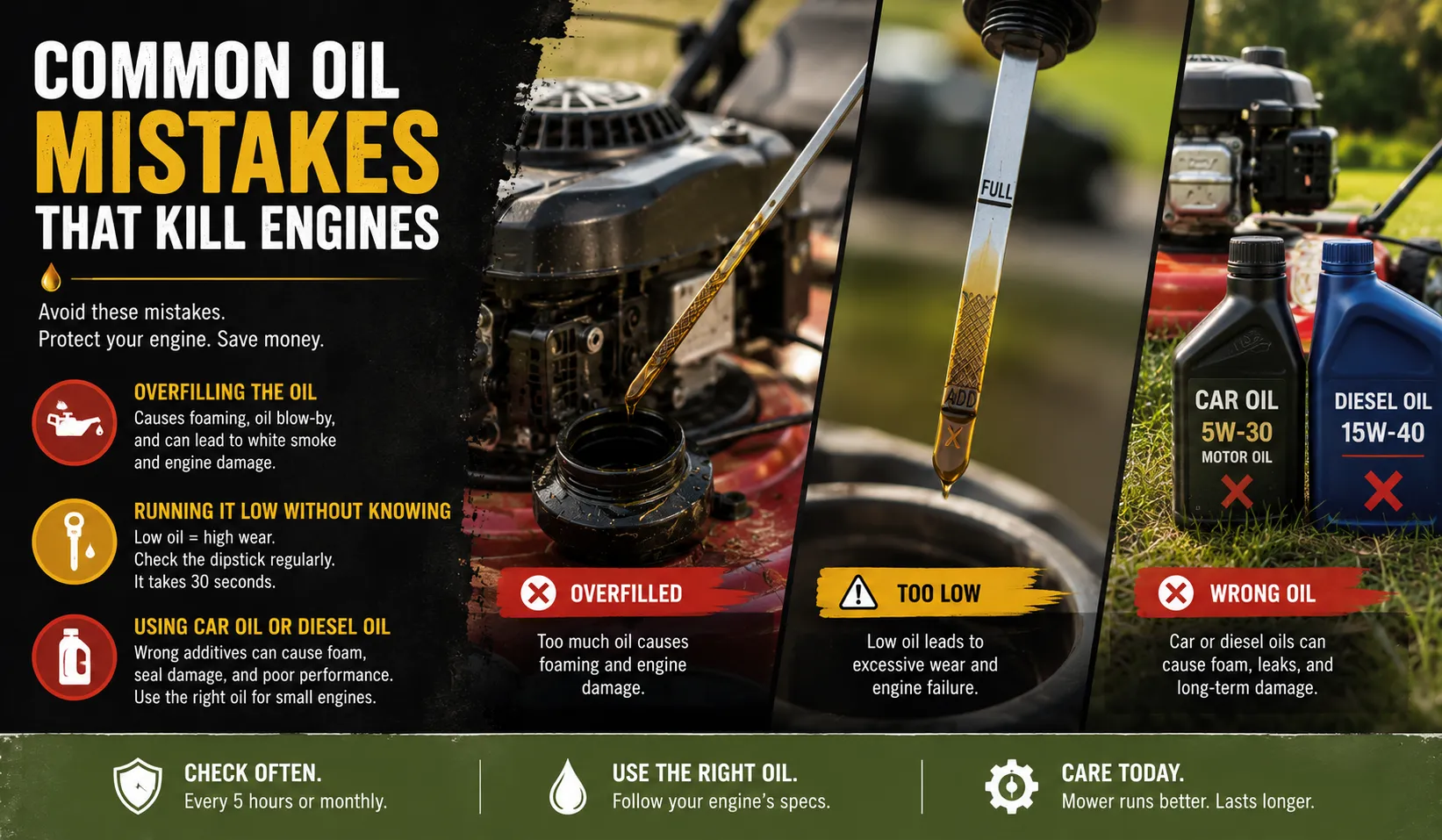
Running It Low Without Knowing
Oil burns off slowly during operation. A mower running 50 hours over a season can lose half a quart without ever showing a leak. If no one checks the dipstick, the engine starts running oil-low — and small engines don’t have a warning light.
Check the oil level every 5 hours of use, or once a month during mowing season. It takes 30 seconds. I can’t count how many customers have told me they never checked it once.
Using Car Oil or Diesel Oil by Mistake
Car motor oil and diesel engine oil have additive packages not designed for small engines. High-detergent car oil can cause oil consumption issues and foam in a splash-lubricated small engine. Some additives attack seals over time.
Stick to oil labeled “small engine” or “four-stroke engine” oil, or one that meets the API SJ or SL service classification and matches the viscosity your engine calls for. If you’re in a pinch and can only find standard motor oil, 10W-30 or SAE 30 with API SJ or higher service rating will work temporarily — but switch to the proper stuff at the next change.
My Final Recommendation
For most homeowners in the US mowing a residential lawn from spring through fall: use 10W-30 conventional small engine oil. It covers you from early spring cool mornings to midsummer heat, it’s available everywhere from Walmart to AutoZone, and it’s cheap enough that you won’t skip oil changes because of the cost. Briggs & Stratton sells their own-branded 10W-30 for around $6 a quart; Honda sells theirs for a similar price. Both are fine.
If you’re in Florida, Texas, or Arizona running a riding mower or zero-turn for multiple hours at a stretch, spend the extra money on full synthetic 10W-30. Briggs & Stratton Synthetic or Kawasaki’s own synthetic oil will hold up better in sustained heat. You’ll also get a little more time between changes, which matters if you’re mowing a large property.
And please — check your dipstick before every mow. I’ve seen more engines die from neglect than from wrong oil. A two-minute check is the cheapest maintenance you’ll ever do.
Oil Type Pros and Cons
| Oil Type | Cost Per Qt | Temp Range | Availability | Engine Compatibility | Change Interval | Main Downside |
|---|---|---|---|---|---|---|
| SAE 30 | $4–$6 | 40°F–100°F+ | Wide | Older B&S, Kawasaki, most small engines | 50 hrs | Won’t work in cold climates |
| 10W-30 | $5–$7 | 0°F–100°F | Very wide | Most four-stroke mower engines | 50 hrs | Burns slightly faster in extreme heat |
| 5W-30 | $5–$7 | -22°F–85°F | Wide | Most four-stroke engines | 50 hrs | Not ideal for sustained high-heat use |
| Full Synthetic 10W-30 | $8–$12 | -20°F–100°F+ | Wide | All four-stroke engines | 100 hrs | Higher upfront cost |
Frequently Asked Questions About Lawn Mower Oil
What type of oil does a lawn mower use?
Most four-stroke gas mowers use SAE 30 or 10W-30 engine oil. SAE 30 works best in warm climates above 40°F. 10W-30 is the better choice if you mow across a range of temperatures from early spring through summer. Always check your engine’s dipstick cap or owner’s manual for the specific spec.
Can I use car oil in my lawn mower?
Technically, yes in a pinch — but it’s not a good long-term choice. Car motor oil has additive packages built for automotive engines, not splash-lubricated small engines. If you have to use car oil temporarily, choose an API SJ or higher rated 10W-30 or SAE 30 and change it at the next scheduled interval.
How often should I change lawn mower oil?
Change your oil every 50 hours of use or once per mowing season, whichever comes first. If you have a new engine, change the break-in oil after the first 5 hours. Riding mowers with oil filters need the filter replaced at every oil change.
Is synthetic oil better for lawn mowers?
Synthetic oil is better in extreme conditions – sustained heat above 90°F or cold startups below 40°F. For average suburban mowing in moderate temperatures, conventional 10W-30 changed on schedule works just as well and costs half as much.
What happens if I put the wrong oil in my lawn mower?
Using the wrong viscosity can cause oil to thin out too fast in heat or stay too thick for cold startups, leading to poor lubrication and accelerated engine wear. Running the wrong oil for a full season can score cylinder walls, damage bearings, and eventually seize the engine. If you’ve used the wrong oil, drain it and refill with the correct type before running the engine again.
How do I know if my lawn mower is low on oil?
Check the dipstick before every mow. Pull it out, wipe it, reinsert it fully, pull it out again, and check where the oil film stops in relation to the two marks. If it reads below the lower mark, add oil before starting. A knocking sound at startup, white smoke, or a burning smell can all indicate low oil — but by the time those symptoms appear, damage may already be happening.