

Quick Overview
- A gas push mower lasts 8-10 years with basic care; a riding mower can hit 15-20 years.
- Battery-powered mowers typically last 5-8 years before battery degradation becomes a real problem.
- Skipping oil changes is the single fastest way to kill any gas mower engine.
- Use the 50% rule: if repair costs exceed half the mower’s current value, buy new.
- Brands like Honda, Toro, and Husqvarna consistently outlast budget brands by 3-5 years in my experience.
Average Lifespan by Mower Type
The lifespan gap between mower types is bigger than most people expect. A cheap gas mower and a premium riding mower are not even close. Here’s what I’ve seen play out in real yards over the years.
Gas Push Mowers
A solid gas push mower lasts 8-10 years under normal use. That means mowing once a week during the season, changing the oil annually, and storing it properly in winter.
I had a Honda HRX217 run for 14 years. It needed a carburetor cleaning at year nine and a new air filter every couple of seasons. That’s it. I also watched a neighbor’s no-name brand die in year three because he never changed the oil. Same climate, same grass type, wildly different outcomes.
The engine is usually what fails first on a push mower – not the deck, not the wheels. Briggs & Stratton engines are everywhere, and they can last well over a decade if you treat them right.
Riding Mowers and Zero-Turns
A riding mower should last 15-20 years – or roughly 500-1,000 engine hours – if maintained. Zero-turns on the commercial end can go well beyond that.
The key word is “maintained.” I’ve seen John Deere riding mowers with 1,200 hours on them still going strong. I’ve also seen a Craftsman riding mower with 300 hours that was already burning oil, because the owner ran it in Texas summer heat without ever checking the oil level.
Engine hours matter more than calendar years for riding mowers. A mower used lightly for 15 years might have 400 hours. A lawn care crew might put that on a machine in two seasons.
Battery-Powered Mowers
Battery mowers are newer, so there’s less long-term data. From what I’ve seen and read, expect 5-8 years before the battery becomes the limiting factor.
The mower itself – the deck, the motor, the wheels – can last longer. But lithium-ion batteries degrade. After 500-700 charge cycles, you’ll notice shorter run times. Replacement battery packs from EGO or Ryobi often cost $150-300, which can push you toward buying a whole new unit.
EGO batteries have impressed me the most. The 56V packs hold up better than the cheaper Ryobi 40V packs in my observation.
Corded Electric Mowers
Corded electric mowers can honestly last 20+ years. There’s no battery to degrade and no fuel system to gum up.
The trade-offs are obvious – cord management is annoying, and they’re only practical for small yards. But if you have a quarter-acre or less and don’t mind the cord, a corded mower is one of the most durable tools in the shed. I’ve seen 1980s corded Black & Decker mowers still cutting grass in 2010.
The motor is the weak point. If water gets in or the motor overheats from pushing through thick grass, it can burn out. Otherwise, these things just run.
Mower Type vs. Average Lifespan
| Mower Type | Average Lifespan | Key Limiting Factor |
|---|---|---|
| Gas push mower | 8-10 years | Engine wear, oil neglect |
| Riding mower / zero-turn | 15-20 years (500-1,000 hrs) | Transmission, engine hours |
| Battery-powered mower | 5-8 years | Battery degradation |
| Corded electric mower | 15-25 years | Motor failure |
What Actually Kills a Lawn Mower Early
Most mower deaths are preventable. I say that bluntly because it’s true. The three mowers I’ve watched die before their time all had the same pattern – neglect, not mechanical failure.
Skipping Oil Changes and Basic Maintenance
This is the number one killer. Low or dirty oil destroys engines. It’s that simple.
On a gas push mower, change the oil once a season – or every 50 hours of use. On a riding mower, every 50-100 hours depending on the manufacturer (check your manual). Fresh oil costs $5. An engine rebuild or replacement costs $200-500. It is not a close decision.
I once bought a used Husqvarna riding mower cheap because the owner thought the engine was shot. I drained the thick black sludge that passed for oil, put in fresh SAE 30, and the mower ran for three more years. The oil hadn’t been changed in five years. The engine was fine. Just filthy.
Leaving Gas in the Tank Over Winter
Old gasoline is one of the most common causes of carburetor failure.
Modern ethanol-blended gas starts going stale after 30 days. By spring, it can leave a sticky residue in the carburetor that blocks the fuel jets. Then the mower won’t start, or it runs rough and surges.
Fix: before storing for winter, either run the tank dry or add a quality fuel stabilizer like Sta-Bil. In Minnesota, where mowers sit from October to April, this step is non-negotiable. I’ve skipped it once. I paid $80 for a carburetor cleaning I didn’t need to pay for.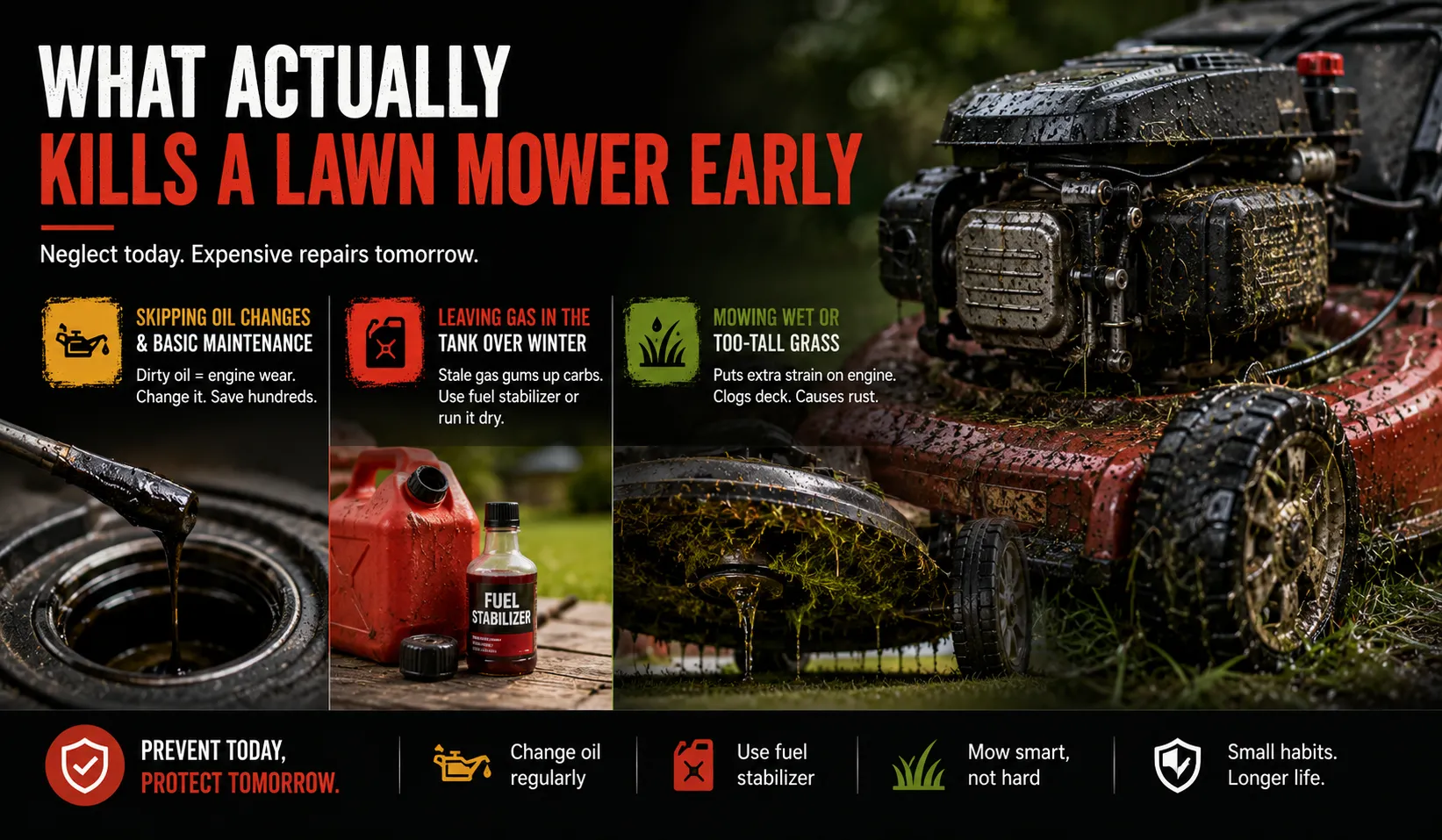
Mowing Wet or Too-Tall Grass
Wet grass clumps under the deck. It strains the engine and can cause overheating. It also clogs the discharge chute and speeds up deck rust.
Tall grass is even harder on the engine. If you let your lawn go three weeks without mowing and then try to cut it at normal height, the engine has to work twice as hard. I always double-cut tall grass – raise the deck for the first pass, then lower it for the second. It’s gentler on the machine.
In Florida, where grass grows fast year-round and afternoon showers are daily, this is a bigger issue than in drier states. Wait a few hours after rain if you can.
Ignoring the Air Filter and Spark Plug
A dirty air filter starves the engine of air. A fouled spark plug misfires or prevents starting. Both are cheap fixes that people ignore.
Replace the air filter once a year – or more often if you’re mowing in dusty conditions. A paper filter costs $5-10. A foam pre-filter can be washed and reused.
The spark plug is the same story. After a season, check it. If the electrode is black and sooty, or eroded and worn, replace it. A new spark plug costs $3-5. It’s the first thing I check when a mower won’t start.
How to Make Your Mower Last Longer
Good maintenance isn’t complicated. It’s mostly about doing a few simple things consistently. Every mower I’ve seen reach 10+ years had an owner who followed a basic routine.
End-of-Season Storage Tips
Storage matters more than most people realize. A mower that sits outside through a Minnesota winter, uncovered, is going to have rust and rodent problems by spring.
Before storing:
- Run the tank dry or add fuel stabilizer
- Change the oil while the engine is warm – dirty oil sitting all winter is corrosive
- Scrape the underside of the deck clean
- Disconnect the spark plug wire for safety
- Store in a dry place – a garage or shed, not outside under a tarp
If you’re in a warmer climate like Texas or Florida and mow year-round, adjust this routine seasonally. Clean the deck and change the oil at least once a year regardless.
Blade Sharpening and Deck Cleaning
Dull blades don’t just cut badly – they make the engine work harder. A sharp blade slices through grass. A dull blade tears it, which takes more power and stresses the engine.
Sharpen blades every 25 hours of mowing, or at least once per season. You can do it yourself with a bench grinder or file, or pay $10-15 at a small engine shop.
After every mow, scrape grass clippings off the underside of the deck. Clippings hold moisture against the steel and speed up rust. A deck scraper or putty knife works fine. Five minutes now saves a rusted-out deck in four years.
Battery Care for Electric Mowers
Lithium-ion batteries hate two things: full discharge and high heat.
Don’t run the battery completely dead every time. Try to plug in before it hits 10-15% charge. And don’t leave the battery in a hot shed all summer – heat accelerates degradation. Store batteries inside your home when possible.
EGO recommends storing their batteries at around 50% charge for long-term storage. I do this with all my cordless tools. It genuinely extends pack life.
When to Service vs. When to DIY
Simple jobs are easy to DIY: oil changes, air filter swaps, spark plug replacement, blade sharpening, cleaning the carburetor air passages.
Call a shop for: carburetor rebuilds, engine compression testing, transmission problems on riding mowers, or anything electrical beyond the spark plug. A good small engine shop charges $50-80 per hour. Some jobs aren’t worth your time or the risk of doing them wrong.
Maintenance Task vs. Recommended Frequency
| Task | Frequency | DIY or Shop |
|---|---|---|
| Oil change | Every season / 50 hrs | DIY |
| Air filter replacement | Every season | DIY |
| Spark plug replacement | Every season or 100 hrs | DIY |
| Blade sharpening | Every 25 hrs | DIY |
| Carburetor cleaning | As needed (surging, hard start) | Either |
| Drive belt inspection (riding) | Every season | DIY |
| Full service (riding mower) | Every 1-2 years | Shop |
Signs Your Mower Is Near the End
Even a well-maintained mower eventually shows its age. Here’s how to read the warning signs before the machine quits on you mid-lawn.
Repair Costs Are Adding Up
One repair is normal. Two in the same season is a yellow flag. Three starts to change the math.
If you’re spending $100-200 per year on repairs for a mower worth $250, that’s a decision point. The 50% rule (explained in the next section) is a clean way to think about this.
It Won’t Start Reliably Anymore
A mower that starts hard occasionally usually just needs a spark plug or fresh fuel. A mower that needs 15-20 pulls every time, or that requires choke tricks to get going, has deeper issues.
Repeated hard-starting is often a sign of compression loss. You can test compression with a cheap gauge from any auto parts store. A gas push mower should read 90-120 PSI. Below 90 and the engine is worn.
The Cut Quality Has Gotten Worse
Scalping, uneven cutting, and streaks in the lawn aren’t always about blade sharpness. On older mowers, a wobbly blade spindle or a warped deck can cause the same problems. Both are repairs – and on an old machine, they may not be worth doing.
If you’ve sharpened and balanced the blade and the cut still looks uneven, have a shop check the spindle and deck.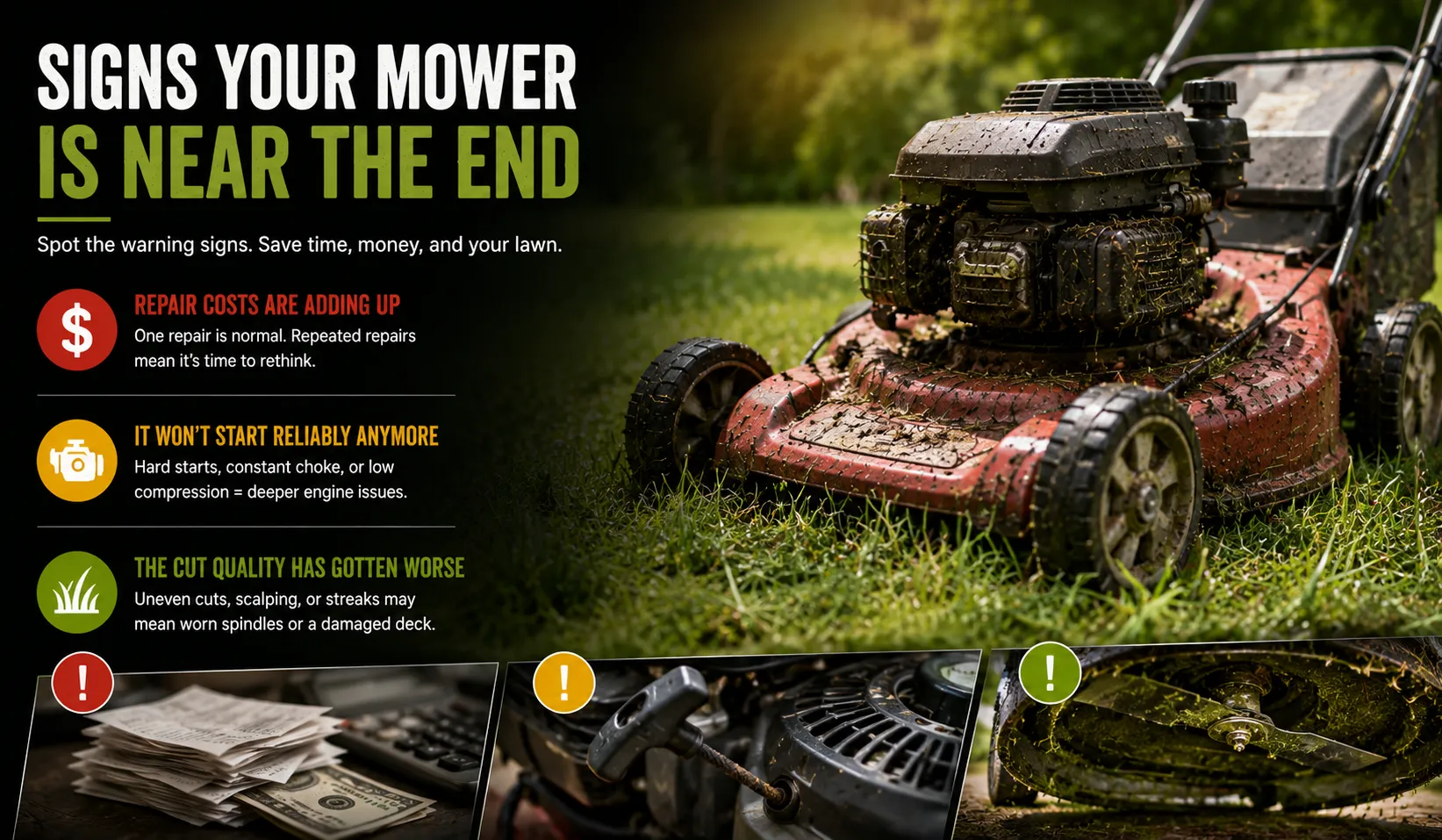
Symptom vs. What It Means
| Symptom | Likely Cause | Serious? |
|---|---|---|
| Hard to start | Old plug, stale fuel, choke issue | No – cheap fix |
| Runs rough / surges | Dirty carburetor | Medium – $50-150 to fix |
| Smoke (white/blue) | Burning oil – worn rings or seals | Yes – expensive |
| Loss of power on slopes | Compression loss | Yes – possible engine end |
| Uneven cut after sharpening | Bent spindle or warped deck | Medium – get a quote |
| Won’t move (riding) | Transmission or drive belt | Medium to serious |
Repair or Replace? How I Make the Decision
This is the question everyone asks when a mower breaks. There’s no single right answer, but there are clear rules that make it easier.
The 50% Rule Explained Simply
If the repair costs more than 50% of what the mower is currently worth, replace it.
A push mower worth $200 that needs a $150 carburetor rebuild? That’s borderline – I’d replace it. A $1,200 Toro self-propelled that needs an $80 drive cable? Fix it without question.
The 50% rule is especially useful with riding mowers. A riding mower worth $2,000 can absorb a $600 transmission repair and still make financial sense. A $400 old Craftsman that needs $300 in engine work – buy new.
Parts Availability and Age of the Machine
Parts availability is a real issue once a mower passes 10-15 years. If you can’t find a carburetor kit or an air filter, the mower is effectively retired whether you like it or not.
Older Briggs & Stratton engines are usually well-supported. Parts are available from NAPA, Amazon, or small engine suppliers for engines going back 20+ years. But some off-brand mowers – especially no-name units from big-box stores – have proprietary parts that disappear fast.
What a Shop Mechanic Told Me
I asked a mechanic I’ve used for years what his rule was. He said: “If I have to open the engine, I tell people to think twice. If it’s outside the engine, I tell them to fix it.”
That’s a good way to think about it. External repairs – cables, belts, blades, wheels, air filters, carburetors – are finite costs on finite parts. Internal engine repairs – rings, valves, cylinders – are either very expensive or a signal the engine is simply tired.
Brands That Tend to Last the Longest
Not all mowers are built equally. I’ve used or seen most of the major US brands, and there are real differences in build quality and longevity.
Best for Longevity in Gas Mowers
Honda is the standard. Their GCV and GXV engines have a reputation for lasting well beyond 10 years even with inconsistent maintenance. The HRX series is the one I’d buy again without question.
Toro is close behind, especially their Personal Pace self-propelled models. The Briggs & Stratton engines they use are solid if maintained.
Husqvarna makes some of the most durable riding mowers available to homeowners. Their Swedish-made units from the 1990s and 2000s are still running on farms across the Midwest.
Best for Longevity in Battery Mowers
EGO is leading the pack right now. Their 56V platform, battery management system, and build quality are ahead of the competition. The EGO LM2102SP is the model I’d buy for a medium-to-large yard.
Greenworks has also improved significantly in the last few years, especially their 60V commercial line.
Brands I’ve Seen Fail Early
I’m not going to single out specific names unfairly – but broadly, the cheapest end of big-box store house brands tends to fail earlier. Thin deck steel, undersized engines, and plastic components that crack after one or two seasons in heat.
Price is usually a reliable signal. A $179 mower is not built the same as a $379 mower. The difference shows up in year three.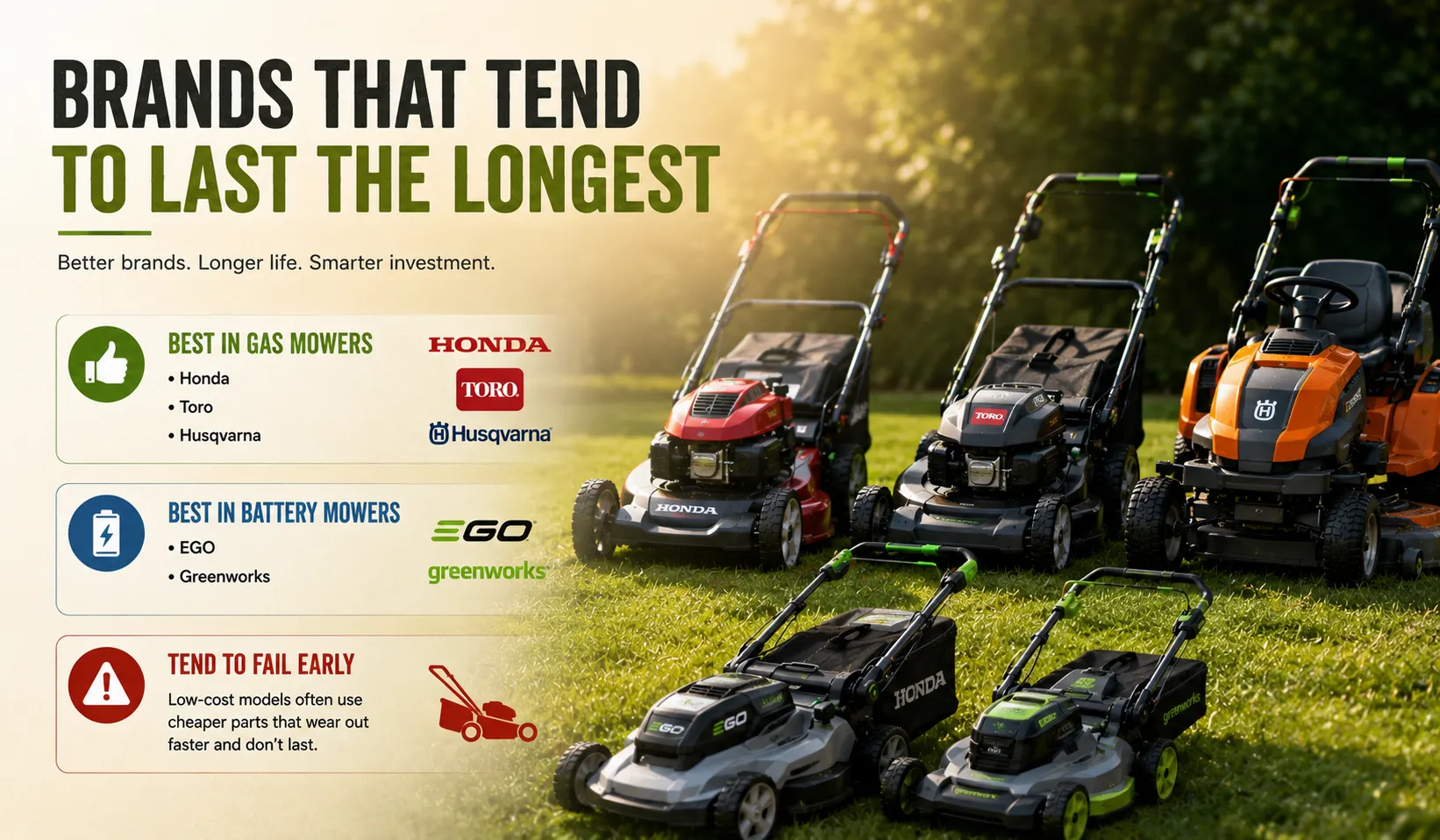
Brand vs. Typical Lifespan and Reliability
| Brand | Type | Typical Lifespan | Reliability Notes |
|---|---|---|---|
| Honda | Gas push / self-propelled | 12-15+ years | Best-in-class engine longevity |
| Toro | Gas push / self-propelled | 10-14 years | Solid mid-range to premium |
| Husqvarna | Gas / riding | 12-20 years | Excellent for riding mowers |
| John Deere | Riding / zero-turn | 15-20+ years | Strong dealer support network |
| EGO | Battery | 7-10 years | Best battery platform available |
| Ryobi | Battery | 5-7 years | Good value, battery degrades faster |
| Budget big-box brands | Gas / battery | 3-6 years | Build quality varies widely |
My Final Recommendation
After years of owning, repairing, and watching other people’s mowers die, I’ve come down to a few core beliefs.
Buy the best mower you can reasonably afford. A $350 Honda push mower will likely outlast two or three $179 budget mowers. That math almost always works out in the Honda’s favor, even before you count the repair bills.
Maintenance is the single biggest variable. I have seen cheap mowers outlast expensive ones because of good care. I have seen excellent machines die in five years because of neglect. Change the oil. Replace the air filter. Sharpen the blade. Run fresh fuel or use stabilizer. Those four habits alone will add years to any mower’s life.
The hardest part is knowing when to walk away. When repair costs start chasing each other, when the engine won’t start reliably, when you smell burning oil on a muggy August morning – that’s the machine telling you something. Listen to it. A new mower is a better investment than pouring money into a tired engine.
Repair vs. Replace: Honest Trade-Offs
| Factor | Repair the Old Mower | Buy a New Mower |
|---|---|---|
| Cost | Lower upfront if repair is simple | Higher upfront cost |
| Long-term value | Good if mower has years left | Better if old mower is near end |
| Parts availability | May be limited on old machines | Full warranty coverage |
| Familiarity | You know how it runs | Learning curve on new unit |
| Environmental impact | Keeps machine out of landfill | New manufacturing footprint |
| Risk | Repair may not fix the root issue | Known condition from day one |
| Best if… | Repair costs under 50% of value | Costs exceed 50% or engine is worn |
 Frequently Asked Questions About Lawn Mower Lifespan
How long does a lawn mower last on average?
A gas push mower lasts 8-10 years with basic annual maintenance. Riding mowers and zero-turns can last 15-20 years or 500-1,000 engine hours. Battery mowers typically last 5-8 years before battery degradation becomes a problem.
How many hours does a lawn mower engine last?
Most consumer-grade gas engines are built for 500-750 hours. Commercial-grade engines in riding mowers and zero-turns can reach 1,500-2,000 hours with proper care. Honda and Kawasaki engines are known for hitting the high end of those ranges (Briggs & Stratton, Engine Service Manual, 2023).
When should I replace my lawn mower instead of repairing it?
Use the 50% rule: if the repair costs more than half the mower’s current market value, replacement is usually the smarter choice. Also replace it if the engine shows signs of internal wear – burning oil, low compression, or repeated hard starting after external fixes have been tried.
How do I make my lawn mower last longer?
Change the oil once per season or every 50 hours, replace the air filter annually, sharpen the blade every 25 hours, and drain the fuel or add stabilizer before winter storage. These four habits add years to any mower’s life regardless of brand.
Does brand matter for lawn mower lifespan?
Yes, significantly. Honda, Toro, and Husqvarna consistently outlast budget brands in both homeowner reviews and small engine shop data. Build quality – deck steel thickness, engine internals, component materials – varies a lot between price points. A $350 mower is not built like a $179 mower.
Why won’t my old lawn mower start after winter?
The most common cause is stale fuel gumming up the carburetor. Drain the old gas, add fresh fuel, and try again. If it still won’t start, replace the spark plug – they’re cheap and often the issue after months of storage. If that doesn’t work, a carburetor cleaning is the next step.
Is it worth fixing a 10-year-old lawn mower?
It depends on the repair and the mower. A $50-80 external repair on a Honda or Husqvarna that’s run well for 10 years? Probably worth it – those machines can run another 5 years with care. A $200+ engine repair on a budget brand at 10 years? Replace it. The machine likely won’t give you enough additional years to justify the cost.