
Key Takeaways
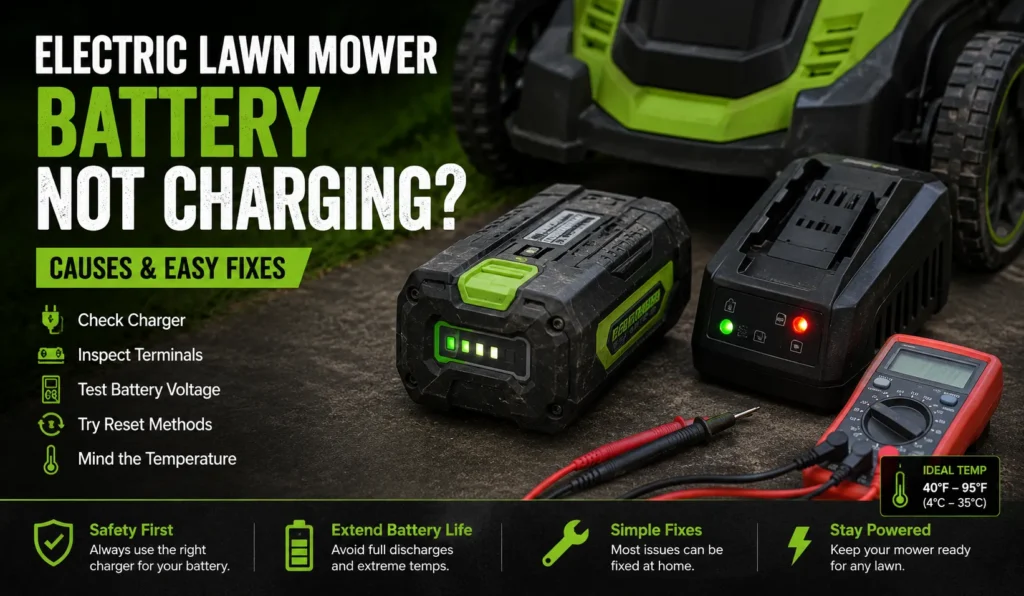
- An electric lawn mower battery not charging is almost always caused by one of four things: a faulty charger, dirty terminals, deep discharge (battery fell to 0%), or a triggered battery management system (BMS).
- Start by checking the charger light – if it stays red or won’t turn green, the charger itself is often the problem.
- Most batteries can be revived with a simple reset or terminal cleaning – no tools beyond a multimeter and a cotton swab.
- Heat above 95°F and cold below 40°F both stop lithium-ion batteries from charging safely – climate matters more than most people think.
- If the battery won’t hold a charge after two full charge cycles, it’s likely dead and needs replacing.
Why Your Electric Lawn Mower Battery Stops Charging
Battery problems are frustrating because they happen at the worst time – Saturday morning, grass already long, and you’ve got plans. The good news is that most charging failures have a clear cause. Once you know where to look, the fix usually takes less than 30 minutes.
The Most Common Causes – A Quick Overview
Most electric lawn mower charging failures trace back to one of these:
- Dead charger – The charger looks fine but puts out no power. This is the most common cause I see, and the easiest to test.
- Corroded or dirty terminals – A thin layer of oxidation between the battery and charger breaks the connection.
- Deep discharge – The battery drained completely to 0%. The BMS shuts it down as a protection measure and it won’t accept a normal charge.
- Temperature lock – Lithium-ion batteries won’t charge safely below 40°F or above 95°F. The BMS blocks charging entirely.
- Failed battery cells – After 3-5 years and 300-500 charge cycles, individual cells inside the battery pack die. At that point, no fix will bring them back.
How Batteries Fail Over Time
Lithium-ion batteries in lawn mowers degrade with every charge cycle. A cycle is one full charge and discharge. Most batteries are rated for 300-500 cycles (EGO, 2023). After that, capacity drops fast.
The battery management system (BMS) is the small circuit board inside every pack. It monitors cell voltage, temperature, and current. When something goes out of range, the BMS cuts power. That protection is good – it prevents fires and extends battery life. But it also means the battery can appear completely dead even when the cells still have some life left.
Deep discharge is the biggest killer I see in the field. Leave a battery on the shelf for six months and it will drain itself slowly. Drop below roughly 2.5 volts per cell and the BMS locks the battery out permanently – unless you know how to reset it.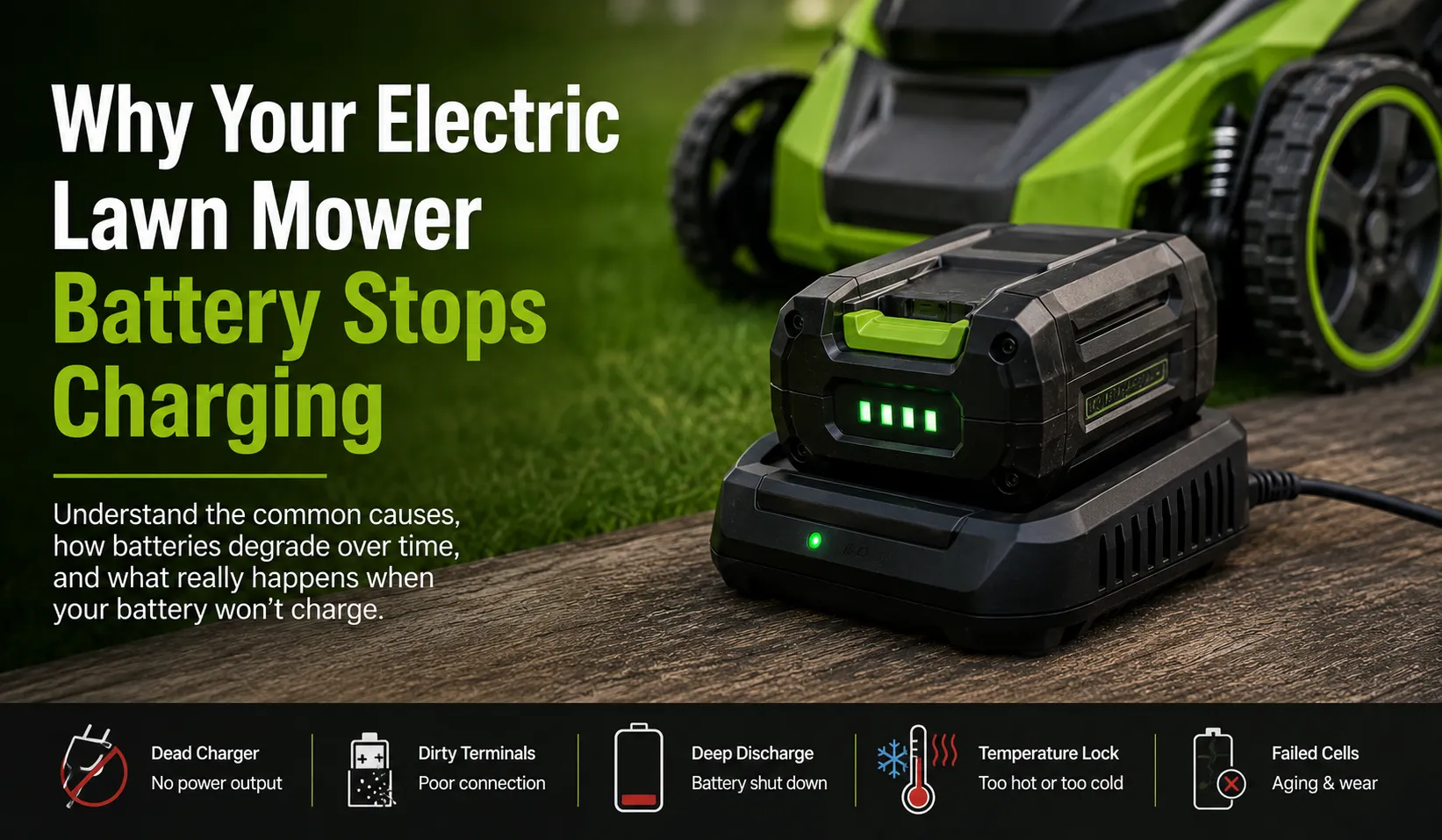
How to Diagnose the Problem at Home
You don’t need to be an electrician to find the cause. You need three things: a working outlet, a multimeter, and about 20 minutes. Work through these steps in order.
Check the Charger First
Plug the charger into the wall and connect it to the battery. Watch the indicator light.
- Green light = battery is full or charging normally
- Red light = charging in progress (this is normal on most brands)
- Blinking red = fault condition – check the manual for your specific blink pattern
- No light at all = charger has no power or has failed
If the charger light won’t come on at all, test the outlet with something else first. Then try the charger on a different battery if you have one. A charger that works on one battery but not another points to a battery problem, not a charger problem.
I replaced the charger on a Greenworks 40V mower for a homeowner in Phoenix last July – the charger had sat on a hot concrete floor all summer and the internal components failed from heat. The battery was perfectly fine. Don’t assume the battery is the problem until you rule out the charger.
Inspect the Battery Terminals
Pull the battery off the mower and look at the metal contacts – both on the battery and on the charger port. You’re looking for:
- White or green powder (corrosion)
- Black carbon buildup
- Bent or pushed-in pins
- Debris or grass clippings packed into the port
Any of those can break the connection completely. The charger thinks it’s connected. The battery thinks it’s connected. But no power flows.
Test the Battery Voltage With a Multimeter
A $15 multimeter from any hardware store tells you the actual condition of the battery. Set it to DC voltage, put the red probe on the positive terminal (+) and the black probe on the negative terminal (-).
Here’s what the reading means for a standard 40V lithium-ion battery:
- 40-42V = Fully charged, battery is healthy
- 30-39V = Partially discharged, should accept a charge
- 20-29V = Deeply discharged, needs a reset before charging
- Below 20V = Likely damaged, may not recover
- 0V = BMS has completely shut down the battery
Write down your reading. You’ll need it when you get to the fixes.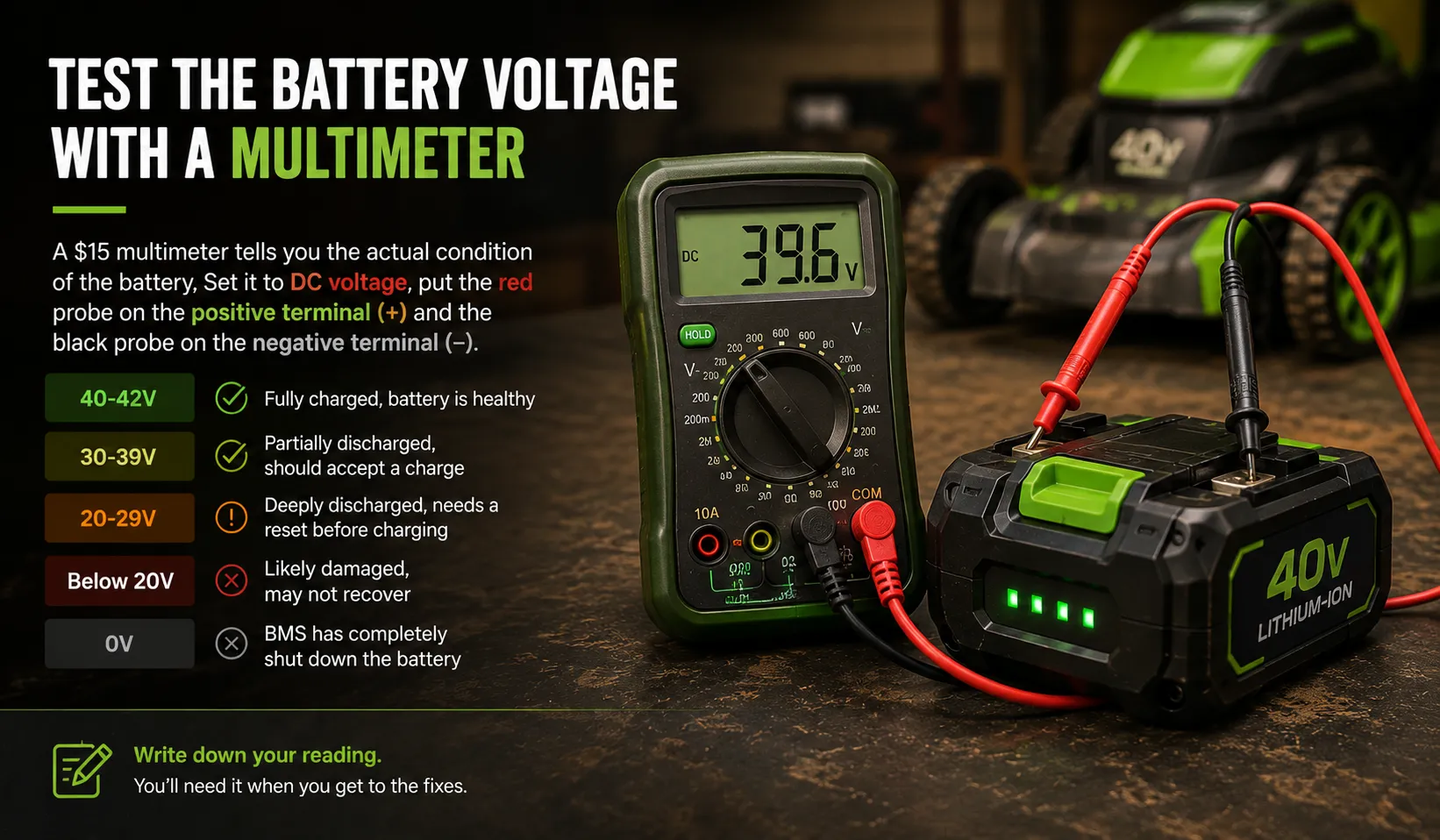
Symptoms vs. Likely Cause
| Symptom | Likely Cause | Next Step |
|---|---|---|
| Charger light never turns on | Faulty charger or dead outlet | Test the outlet, then replace charger |
| Charger blinks red continuously | BMS fault or deep discharge | Check voltage, attempt battery reset |
| Battery charges but drains in 10 minutes | Failed cells | Replace battery |
| Charger gets hot and shuts off | Overheating, blocked vents | Charge in cooler location |
| Nothing happens at all | Deep discharge below 20V | Attempt deep-sleep reset |
| Works in summer, fails in winter | Temperature lock (below 40°F) | Bring battery inside to warm up |
Step-by-Step Fixes You Can Try Right Now
Try these in order. Start with the simplest fix before spending money on a replacement.
Fix 1 – Reset a Battery in Deep Sleep Mode
When a lithium-ion battery drops too low, the BMS puts it in deep sleep mode. Standard chargers can’t wake it up. Here’s what to do.
First, check your battery voltage with the multimeter. If it reads between 10V and 25V, the deep sleep reset has a good chance of working.
Connect the battery to the charger and leave it for 30 minutes without touching anything. Some chargers have a “trickle charge” mode that slowly feeds power to a sleeping battery. Watch the indicator light. If it eventually changes from a fault blink to a steady red, the battery is accepting charge again.
If the standard charger won’t wake it, check if your brand sells a battery activator. EGO sells one for their 56V system. Some Ryobi chargers have a “recall” function built in – check the charger face for a small button labeled “recall” or “recovery.”
This fix works about 60% of the time in my experience. If the battery won’t respond after 45 minutes on the charger, move on.
Fix 2 – Clean Corroded or Dirty Terminals
You’ll need a cotton swab, rubbing alcohol (90% or higher), and a pencil eraser.
First, make sure the battery is disconnected from everything.
Use the eraser to gently scrub the metal contacts on the battery. Rubber removes oxidation without scratching the metal. Wipe clean with the alcohol-soaked swab. Let it dry completely – at least five minutes – before reconnecting.
Do the same to the charger port. Use a dry swab to get into the port without getting liquid inside the electronics.
Reconnect and try charging again. In a Florida garage in August, I’ve seen terminal corrosion stop a brand-new battery from charging. Humidity accelerates oxidation fast.
Fix 3 – Check and Replace a Faulty Charger
If the battery voltage is in the normal range (30V or above) but the charger won’t respond, the charger is almost certainly the problem.
Borrow a charger from a neighbor or friend with the same brand. EGO, Ryobi, Greenworks, and HART all have specific charger models that match their battery platforms – don’t mix brands.
If the borrowed charger works, you’ve found your problem. Replacement chargers run $25-$60 depending on the brand. Check the manufacturer’s website first – some brands include the charger in the warranty.
Fix 4 – Revive a Battery Drained From Long Storage
This is the situation I see most in early spring. The mower sat in a Minnesota shed since October. The battery slowly self-discharged over the winter. Now it reads 5V or less.
At this voltage, most BMS units won’t accept any charge at all. The recovery rate is low – I’d say about 30% in my experience. Here’s the best approach.
Place the battery at room temperature (65-75°F) for at least two hours before attempting to charge it. Cold batteries in deep discharge almost never recover. Warmth gives the cells a better chance.
Connect to the charger and watch for any sign of life – even a brief flicker on the charge indicator. Leave it for an hour. If absolutely nothing happens, the battery is likely gone.
Do not attempt to charge a battery that smells burnt, feels hot to the touch, or has a swollen or cracked casing. Those are signs of a damaged cell that can’t be safely revived.
Fixes at a Glance
| Fix | Tools Needed | Time | Difficulty |
|---|---|---|---|
| Deep sleep reset | Charger only | 30-45 min | Easy |
| Terminal cleaning | Cotton swab, alcohol, eraser | 10 min | Easy |
| Charger replacement | Replacement charger | 5 min | Easy |
| Storage revival | Multimeter, warm room | 1-2 hours | Easy |
| Battery replacement | None (purchase) | 10 min | Easy |
How Climate Affects Charging – What I’ve Seen in the Field
Temperature is the most underestimated factor in battery problems. The BMS in every lithium-ion pack monitors temperature constantly. Outside the safe range, it blocks charging entirely – not to annoy you, but to prevent a fire or a damaged cell.
Hot and Humid Conditions – Florida, Gulf Coast, Southeast
A garage in Tampa in August can reach 110°F by midday. At temperatures above 95°F, most BMS units refuse to accept a charge. The battery may feel warm to the touch even before you plug it in.
In humid climates, terminal corrosion happens fast. I’ve seen a battery develop enough oxidation to block charging in just six weeks during a Florida summer.
What to do: Store batteries inside your home – not in the garage. Charge them indoors in air conditioning. Let a hot battery cool for 30 minutes before connecting the charger.
Extreme Heat and Dry Air – Arizona, Nevada, Southwest
Dry heat is actually harder on batteries than humid heat. Extreme dry heat accelerates electrolyte evaporation inside the cells. A battery stored on a Phoenix driveway in July can hit 130°F inside the pack.
I’ve seen EGO 56V batteries that looked physically fine but tested at nearly zero capacity after a single Arizona summer left in the shed. The cells were essentially cooked.
What to do: Bring batteries inside when temperatures exceed 90°F. Never leave them in a car or truck bed.
Cold Weather and Midwest Winters
Lithium-ion chemistry slows down in cold. Below 40°F, the BMS blocks charging to prevent lithium plating – a process where lithium builds up on the anode in a way that permanently damages the battery (Battery University, 2023).
In January in Minnesota, a battery left in an unheated garage overnight may show a completely dead charger light. It’s not broken – it’s just cold.
What to do: Bring the battery inside and let it warm to at least 50°F before charging. Usually 30-60 minutes at room temperature is enough. Never use a heat gun or any external heat source to speed this up.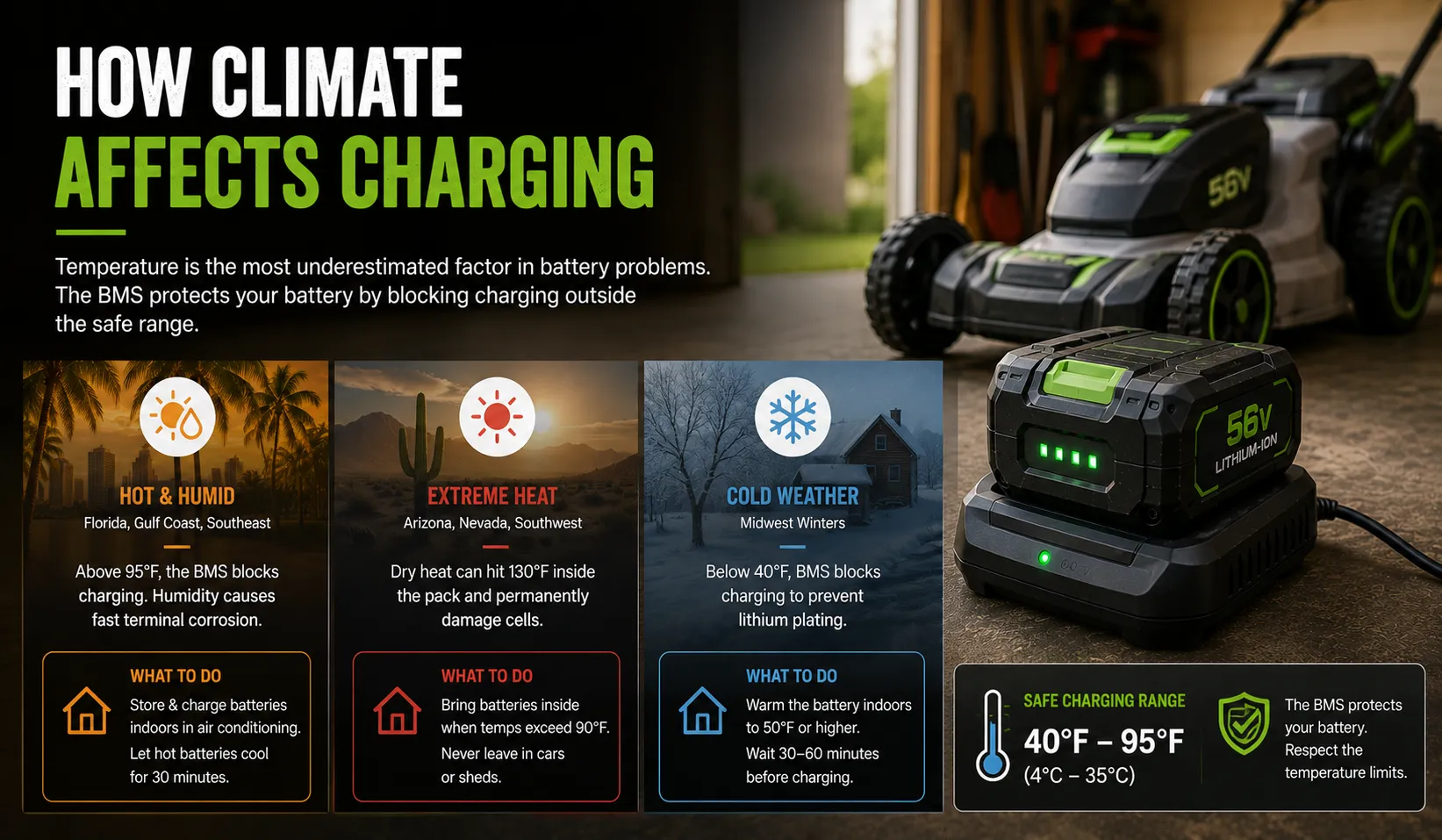
Climate, Risk, and Prevention
| Climate | Main Risk | Prevention |
|---|---|---|
| Hot and humid (FL, Gulf Coast) | Corrosion + heat lockout | Charge indoors, inspect terminals monthly |
| Hot and dry (AZ, NV, Southwest) | Cell damage from heat | Store inside, never in vehicles |
| Cold (MN, WI, ND winters) | Temperature lock, lithium plating | Warm battery indoors before charging |
| Mild and temperate (PNW, CA) | Long storage self-discharge | Charge to 60% before storage |
When the Battery Is Just Dead – And What to Do
Sometimes a battery can’t be saved. Knowing when to stop trying saves you time and frustration.
Signs Your Battery Can’t Be Saved
- Voltage reads 0V and won’t change after 45 minutes on the charger
- Battery gets warm or hot within two minutes of connecting to the charger
- Casing is swollen, cracked, or deformed
- Burn smell when connected
- Battery accepts a charge but loses it within 10-15 minutes of use
- You’ve had it for 4-5+ years and used it regularly
A swollen battery is a sign of gas buildup inside the pack. Do not try to charge it. Do not store it in an enclosed space. Take it to a battery recycling drop-off at Home Depot or Lowe’s.
Replacement Options by Brand
| Brand | Platform | Replacement Battery (4.0 Ah) | Approx. Price | Where to Buy |
|---|---|---|---|---|
| EGO | 56V ARC Lithium | BA2800T or BA4200T | $150-$250 | Home Depot, EGO website |
| Greenworks | 40V or 60V | Varies by model | $80-$180 | Lowe’s, Greenworks website |
| Ryobi | 40V HP | RY40L40A | $100-$150 | Home Depot |
| HART | 40V | HPBA40 | $80-$130 | Walmart |
| Kobalt | 40V or 80V | KLB 4040-06 | $100-$160 | Lowe’s |
Always match your battery voltage and platform exactly. A 40V battery won’t work on a 56V mower, even from the same brand.
Is It Worth Replacing or Time to Upgrade?
If your mower is less than three years old and runs well otherwise, a replacement battery makes sense. Most batteries cost $80-$250 – less than a new mower.
If your mower is five years or older, check whether the battery is still available. Older platforms sometimes get discontinued. EGO has generally kept good backward compatibility. Some older Greenworks platforms are harder to find batteries for.
If both the battery and the mower are aging, it might be a better move to upgrade the whole unit. A new mower with a new battery gives you the latest cell technology and a full warranty reset.
Mistakes That Kill Your Battery Faster
These habits shorten battery life significantly – and most people don’t know they’re doing them.
Leaving It on the Charger Too Long
Most modern lithium-ion chargers stop charging when the battery reaches 100%. But some older or cheaper chargers – especially off-brand ones – keep a trickle charge running. That slow constant current generates heat and degrades cells over time.
Don’t leave any battery on the charger for days at a time. Charge it, unplug it, store it. EGO and Ryobi both recommend this in their user manuals.
For long-term storage (more than 30 days), store the battery at 40-60% charge. A full battery stored for months degrades faster than a partially charged one.
Storing It in the Wrong Conditions
The two worst storage conditions are heat and full discharge.
A battery stored at 0% for several months is very likely to enter deep sleep mode – or die permanently. A battery stored in a hot shed all summer loses capacity faster than one stored inside.
The ideal storage spot: inside your home, in a climate-controlled space, at about 50-60% charge. A basement shelf or a closet works well.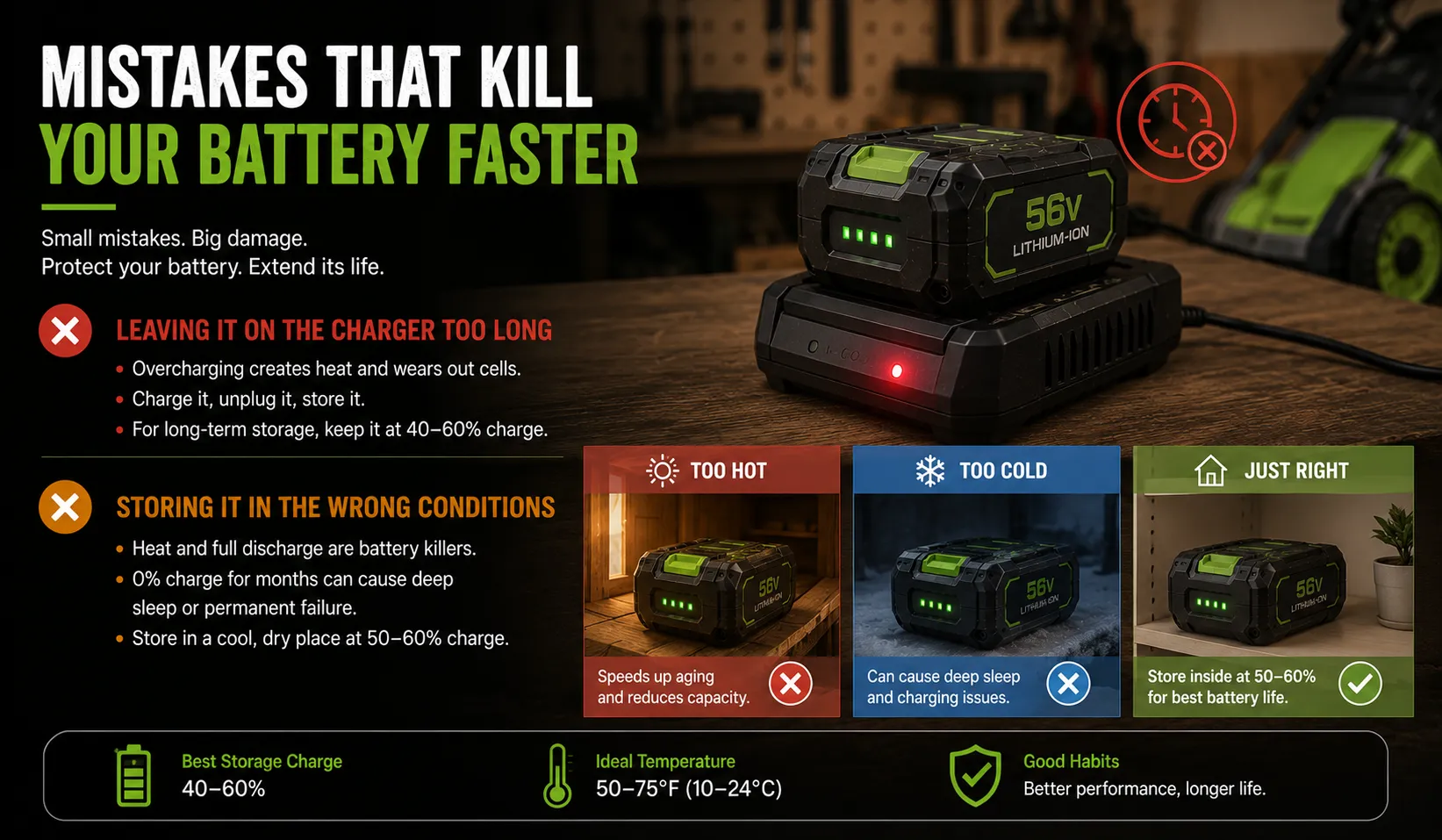
My Final Recommendation
When someone comes to me with a battery charging problem, I always start with the charger, not the battery. It’s the most common culprit and the cheapest fix. Swap the charger first. Test with a multimeter second. Attempt a reset third.
If you’ve gone through every fix here and the battery still won’t charge – or it charges but drains in minutes – it’s time for a replacement. Don’t spend hours on a battery that’s past its useful life. A new battery from the same brand is straightforward to install and gives you a fresh 300-500 cycle clock.
One more thing: write the purchase date on your battery with a marker right now. Most people have no idea how old their battery is when problems start. Knowing the age tells you immediately whether you’re dealing with a fixable problem or a battery that’s simply at the end of its life.
Quick Reference – Charging Problems and Solutions
| Problem | Most Likely Cause | First Fix | When to Replace |
|---|---|---|---|
| Charger light won’t come on | Faulty charger | Test with another charger | If second charger also fails to wake it |
| Charger blinks red non-stop | BMS fault / deep discharge | Deep sleep reset (45 min) | If no response after two reset attempts |
| Battery charges but dies fast | Failed cells | None – cells are gone | Immediately |
| Won’t charge in cold weather | Temperature lock | Warm battery to 50°F+ | Not needed – just warm it up |
| Won’t charge in hot weather | Heat lockout | Cool battery to below 90°F | Not needed – let it cool |
| Swollen or cracked battery | Internal cell failure | Do not charge | Immediately – take to recycling |
| Charges fine, won’t start mower | Mower issue, not battery | Test battery on another device | Only if battery also fails elsewhere |
| 0V reading on multimeter | Deep discharge or dead cells | Attempt recovery charge | After one failed recovery attempt |
Frequently Asked Questions About Electric Lawn Mower Battery Not Charging
Why is my electric lawn mower battery not charging even though the charger light is on?
A charger light coming on means the charger has power, not that the battery is receiving it. The most likely cause is dirty or corroded terminals blocking the connection. Clean the metal contacts on both the battery and the charger port with a pencil eraser and rubbing alcohol, let them dry, then try again. If the light still won’t change state, test your battery voltage with a multimeter – a reading below 20V means the battery is in deep sleep mode and needs a reset.
How do I know if my electric mower battery is dead or just needs charging?
Test it with a multimeter. A healthy lithium-ion battery reads 30V or above even when low on charge. A reading below 20V after a full charge attempt means the cells have likely failed. Other signs of a dead battery: it charges to full but drains within 10-15 minutes, it gets warm immediately when connected to the charger, or the casing appears swollen. Any of those points to replacement.
Can a completely drained electric lawn mower battery be revived?
Sometimes. If the battery drained to near 0V due to long storage, a deep sleep reset is worth trying – leave it on the charger for 45 minutes and watch for any sign of life on the charge indicator. The success rate is roughly 30-60% depending on how long the battery sat and how low it got. A battery that drained to 0V regularly over several years is unlikely to recover.
Does cold weather stop a lithium-ion lawn mower battery from charging?
Yes. Below 40°F, the battery management system (BMS) blocks charging to prevent a damaging process called lithium plating. If you store your mower in an unheated garage and live somewhere cold – think Minnesota, Wisconsin, or the northern plains – bring the battery inside and let it warm to at least 50°F before connecting the charger. This alone solves most winter charging problems.
How long do electric lawn mower batteries last before needing replacement?
Most lithium-ion batteries in lawn mowers last 3-5 years under normal use, or 300-500 charge cycles (Battery University, 2023). After that, capacity drops fast – the battery may still charge but won’t run the mower for as long. EGO, Ryobi, and Greenworks all offer replacement batteries within their platform. If your battery is older than five years and showing charging or runtime problems, replacement is almost always the right call.
Is it safe to leave my lawn mower battery on the charger overnight?
Modern smart chargers from major brands like EGO and Ryobi stop charging automatically when the battery hits 100%. Leaving it overnight occasionally is fine. Leaving it plugged in for days at a time is not recommended – even low-level trickle charging generates heat and reduces battery life over time. Unplug once charging is complete and store the battery at room temperature.
What does it mean when my lawn mower battery charger blinks red?
A steady red light usually means charging is in progress – that’s normal. A blinking or flashing red light typically means a fault condition: the battery is too hot, too cold, too deeply discharged, or has a BMS fault. Check your battery temperature first. If it’s at room temperature and still blinking red, attempt a deep sleep reset by leaving it on the charger for 30-45 minutes. Check your specific brand’s manual for the exact blink pattern codes.