

Quick Overview
- A smoking lawn mower is most often caused by too much oil, a clogged air filter, or oil that has spilled onto a hot engine part – not a blown engine.
- White or blue smoke usually means an oil problem. Black smoke usually means an air/fuel problem.
- Most causes are fixable in under 30 minutes with no special tools.
- Check the oil level first – nine times out of ten, that is the culprit.
- If the smoke is heavy, continuous, and smells like burning metal, stop the engine and call a small engine mechanic.
You pull the starter cord on a Saturday morning. The engine fires, you take a breath of that familiar exhaust smell, and then you see it – a thin curl of smoke rising from under the deck or drifting out of the exhaust. Your stomach drops.
I have been there. I have seen it in my own Florida backyard on a muggy August morning, and I have watched my neighbor in Phoenix nearly throw his Craftsman to the curb over it. Most of the time, a lawn mower is smoking for a reason that takes less than 10 minutes to fix. This guide is for homeowners who just saw smoke and want to know if they should shut everything down or keep mowing. Not mechanics – you.
Let me walk you through what the smoke is telling you, what caused it, and what to do next.
Should You Panic When Your Lawn Mower Smokes?
The short answer is: it depends on the smoke. Some smoke is normal and goes away on its own. Other smoke is a sign to stop the engine right now.
Here is how to tell the difference.
When Smoke Is Harmless and Goes Away on Its Own
If you see a small puff of white or blue smoke in the first 30 to 60 seconds of startup – and then it clears – you probably do not have a problem. This happens when a small amount of oil has settled into the cylinder overnight or dripped onto the exhaust manifold during storage.
I see this constantly in spring in the Midwest, when mowers come out of the garage after sitting all winter. The smoke shows up for a minute, then disappears. If you tilted your mower on its side during cleaning or storage (I will get to why that matters later), a little oil may have shifted where it should not be. Once it burns off, you are fine.
The test is simple: let the engine run at idle for two to three minutes and watch. If the smoke stops, mow your lawn.
When Smoke Is a Warning Sign You Cannot Ignore
Stop the engine if you notice any of these:
- The smoke is thick, heavy, and does not clear after two to three minutes of running.
- The smoke has a sharp, burning chemical smell – not just exhaust.
- You hear knocking, sputtering, or a change in engine pitch alongside the smoke.
- The exhaust is producing black smoke while the engine runs rough.
- You can smell something like hot metal or burning rubber.
These are not “wait and see” situations. Continuing to run the engine can turn a $30 fix into a $300 repair or a paperweight.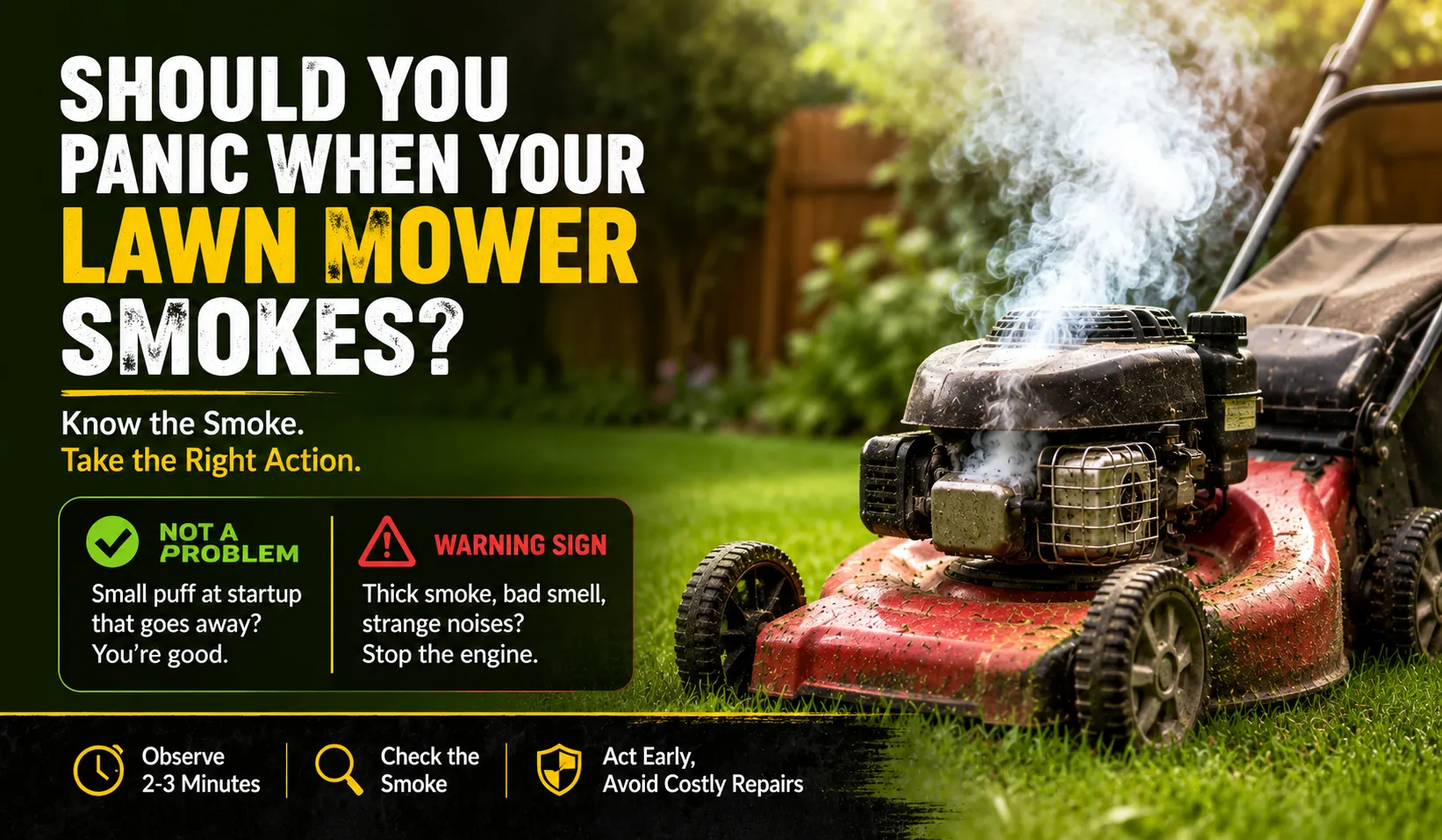
What the Smoke Color Is Telling You
Smoke color is the fastest way to narrow down what is wrong. Pay attention to it before you do anything else.
The color tells you what is burning inside the engine, which points directly to the cause.
White or Blue Smoke – What It Usually Means
White smoke and blue smoke both mean the same thing: oil is burning where it should not be.
On a four-stroke engine (which is what most walk-behind mowers use – your Honda HRX, your Briggs and Stratton 675, your Husqvarna HU800AWD), white or blue smoke comes from oil entering the combustion chamber. That oil then burns along with the fuel.
The most common reason is a too-high oil level. I overfilled a Briggs and Stratton engine once by maybe half an inch past the full mark. Within 30 seconds of startup, my backyard in Tampa looked like a fog machine had gone off. Drained some oil, restarted – smoke was gone.
Other causes include a tilted mower that let oil seep past the piston rings, or a worn head gasket letting oil into the cylinder.
Black Smoke and What Causes It
Black smoke means the engine is burning too much fuel relative to the air coming in. This is called running “rich.”
The most common cause is a clogged air filter. When the filter is blocked, the engine cannot pull in enough air. Fuel burns incomplete and comes out black. A dirty carburetor can do the same thing.
In Phoenix or Tucson, where dust is everywhere in summer, I have seen air filters clog in a single season. A Toro recycler I serviced out there had a filter so packed with fine red dust it looked like felt. Fifteen minutes to clean it, and the black smoke was gone.
Smoke Color vs. Likely Cause vs. Urgency Level
| Smoke Color | Likely Cause | Urgency |
|---|---|---|
| White or light blue | Oil in combustion chamber | Medium – check oil level first |
| Heavy blue or gray | Head gasket or worn rings | High – stop engine, call mechanic |
| Black | Clogged air filter or rich fuel mixture | Medium – clean filter before next use |
| White + sweet smell | Coolant leak (rare on small engines) | High – stop engine immediately |
| Thin white puff on startup only | Normal burn-off from storage or tilt | Low – monitor and continue |
The Most Common Reasons a Lawn Mower Smokes
Most smoking problems fall into five categories. I have dealt with every one of these in the field. Here they are from most to least common.
Too Much Oil or the Wrong Oil Type
This is the number one cause of white or blue smoke in a gas mower, by a long stretch.
Every four-stroke engine has a specific oil capacity. For most walk-behind mowers, that is between 15 and 20 ounces. When you put in too much, the excess oil gets into the cylinder and burns. The engine smokes, runs rough, and sometimes fouls the spark plug too.
The fix is to drain the oil down to the correct level. Check your owner’s manual for the right capacity. Then use a dipstick to verify – oil should sit between the MIN and MAX marks, not above them.
Oil type matters too. Using 10W-30 when the engine calls for SAE 30 in hot weather can cause smoking, especially in summer in Texas or Florida. Briggs and Stratton recommends SAE 30 for temperatures above 40 degrees Fahrenheit. Check your manual.
A Clogged Air Filter
A clogged air filter cuts off the air supply to the engine. Less air means incomplete fuel combustion. The result is black smoke and a rough-running engine that loses power on thick grass.
Pull the filter out and look at it. If it is gray, packed with debris, or you cannot see light through it when you hold it up, it needs cleaning or replacement. Foam filters can be washed with dish soap and water, then dried and re-oiled. Paper filters should be replaced – they cost about $5 to $8 at any hardware store.
I change my air filter every season. If I am mowing in dusty or dry conditions, I check it mid-season too.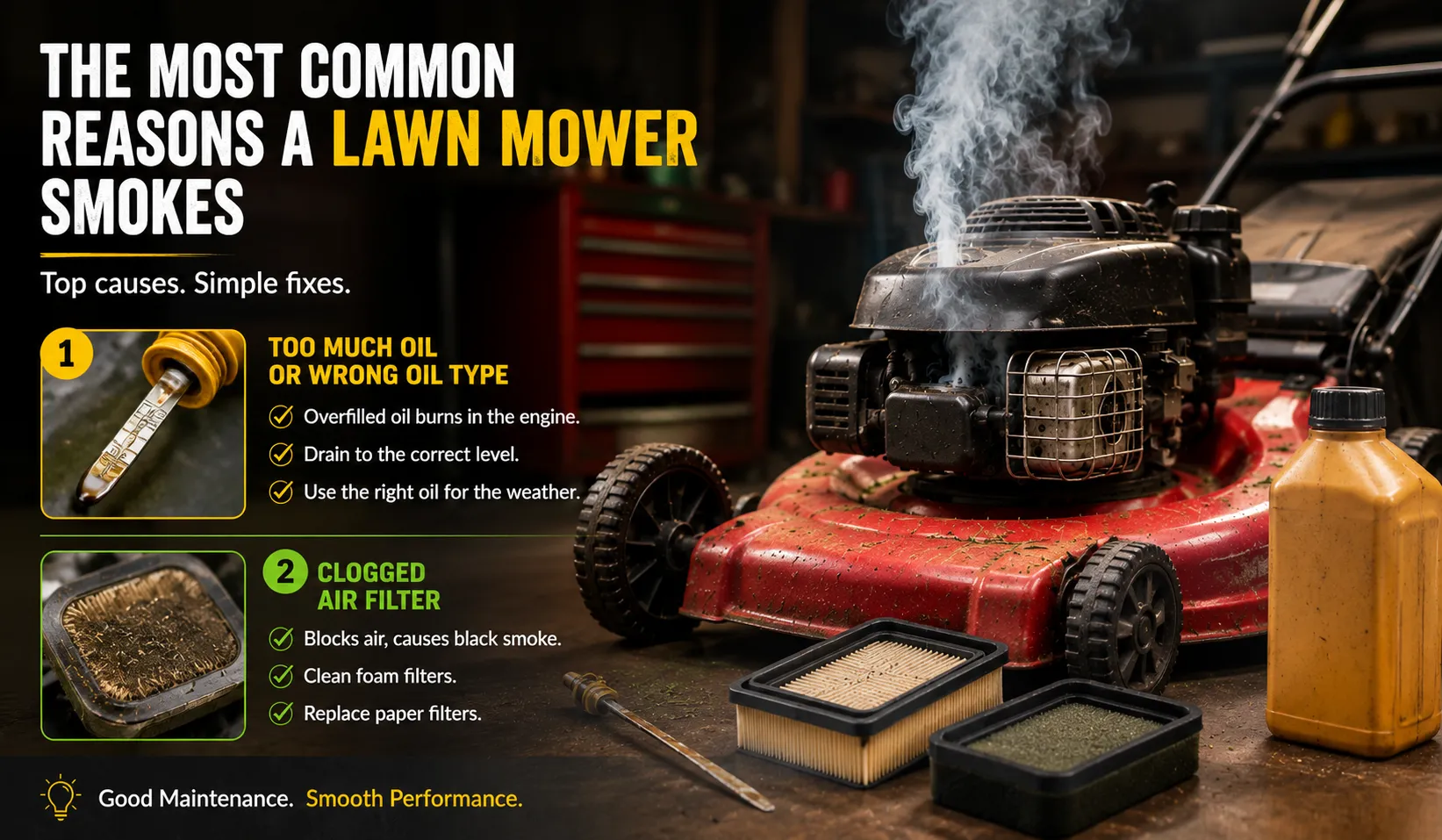
Overheating from Thick Grass or a Dull Blade
When the engine has to work too hard, it overheats. A dull blade makes the engine strain on every pass. Tall, thick, wet grass in spring does the same thing.
Overheating can cause blue or white smoke as oil gets forced past seals under higher-than-normal pressure. The engine may also smell hot.
If you are cutting grass that has not been mowed in three weeks, raise the deck height and make two passes instead of one. Sharpen your blade at least once per season – twice if you mow an acre or more. A sharp blade is the single best thing you can do for your engine’s temperature.
Oil Leaking onto the Engine or Exhaust
Sometimes the oil is not in the engine – it is on the outside of it. Oil can leak from a loose drain plug, a bad gasket, or a cracked oil cap and drip onto the hot exhaust muffler or engine block. It hits the heat and immediately smokes.
This produces a sharp, acrid smell and sometimes visible drips or staining on the outside of the engine. The fix is to find and seal the leak, then wipe down any oil residue from external surfaces before restarting.
Do not run the engine until you clean it up. The oil on a hot muffler can, in the worst case, ignite.
A Blown Head Gasket – the Expensive One
The head gasket seals the combustion chamber from the rest of the engine. When it fails, oil or coolant (on liquid-cooled engines) can enter the cylinder and burn.
Symptoms include heavy, persistent blue or white smoke that does not stop, loss of engine power, and oil consumption that goes up week to week. Sometimes you will see bubbles in the oil or a milky, creamy appearance in the oil reservoir.
A head gasket repair on a small engine typically costs $80 to $150 at a small engine shop. On an older or lower-value mower, that may cost more than the machine is worth. I will be honest: if your mower is 10 or more years old and showing these symptoms, pricing out a replacement is worth doing.
Cause vs. Fix vs. DIY or Pro?
| Cause | Fix | DIY or Pro? |
|---|---|---|
| Too much oil | Drain to correct level | DIY – 10 minutes |
| Wrong oil type | Drain and refill with correct oil | DIY – 15 minutes |
| Clogged air filter | Clean or replace filter | DIY – 5 minutes |
| Oil on exhaust | Wipe down and fix leak source | DIY – 20 minutes |
| Overheating | Sharpen blade, mow in two passes | DIY – ongoing |
| Head gasket failure | Gasket replacement | Pro – unless you have small engine experience |
| Worn piston rings | Engine rebuild or replacement | Pro – not cost-effective on older mowers |
How to Fix a Smoking Lawn Mower – Step by Step
Work through these steps in order before assuming anything major is wrong. Most smoking mowers are fixed at step one or two.
Checking and Correcting the Oil Level
Turn off the engine and wait five minutes. Oil needs to settle before you get an accurate reading.
Locate the oil fill cap – on most Briggs and Stratton and Honda engines, it is on the side of the engine block, usually with a yellow or black dipstick attached. Remove it, wipe it clean, reinsert fully without threading it in, then pull it out and read the level.
If oil is above the MAX mark, you need to drain some. The easiest method: use a turkey baster or oil extractor pump (available at any auto parts store for about $10) to pull oil from the fill tube until you hit the correct level.
If the oil looks black and gritty rather than amber or golden, change it entirely. Fresh oil is cheap; engine damage is not.
Cleaning or Replacing the Air Filter
Remove the air filter cover – usually held on by one or two screws or a simple clip. Pull the filter out.
For a foam filter: wash it with warm water and dish soap, squeeze gently (do not wring), let it dry fully, then apply a thin coat of clean engine oil before reinstalling. Give it 30 minutes to dry before starting the engine.
For a paper/pleated filter: tap it gently on a hard surface to knock loose debris free. If it is still dark or visibly clogged, replace it. Paper filters are not meant to be washed.
Letting the Engine Cool Down and Clearing Debris
If the mower overheated, let it sit for at least 20 to 30 minutes before doing anything else.
While it cools, check around the engine for grass clippings, leaves, or debris packed around the cooling fins. On air-cooled engines (which is almost every residential mower), those fins are what keeps the engine from getting too hot. Blocked fins mean heat has nowhere to go.
Clear them out with a stiff brush or compressed air. Then check that the grass discharge chute is not packed solid – a blocked chute creates back-pressure and makes the engine work harder.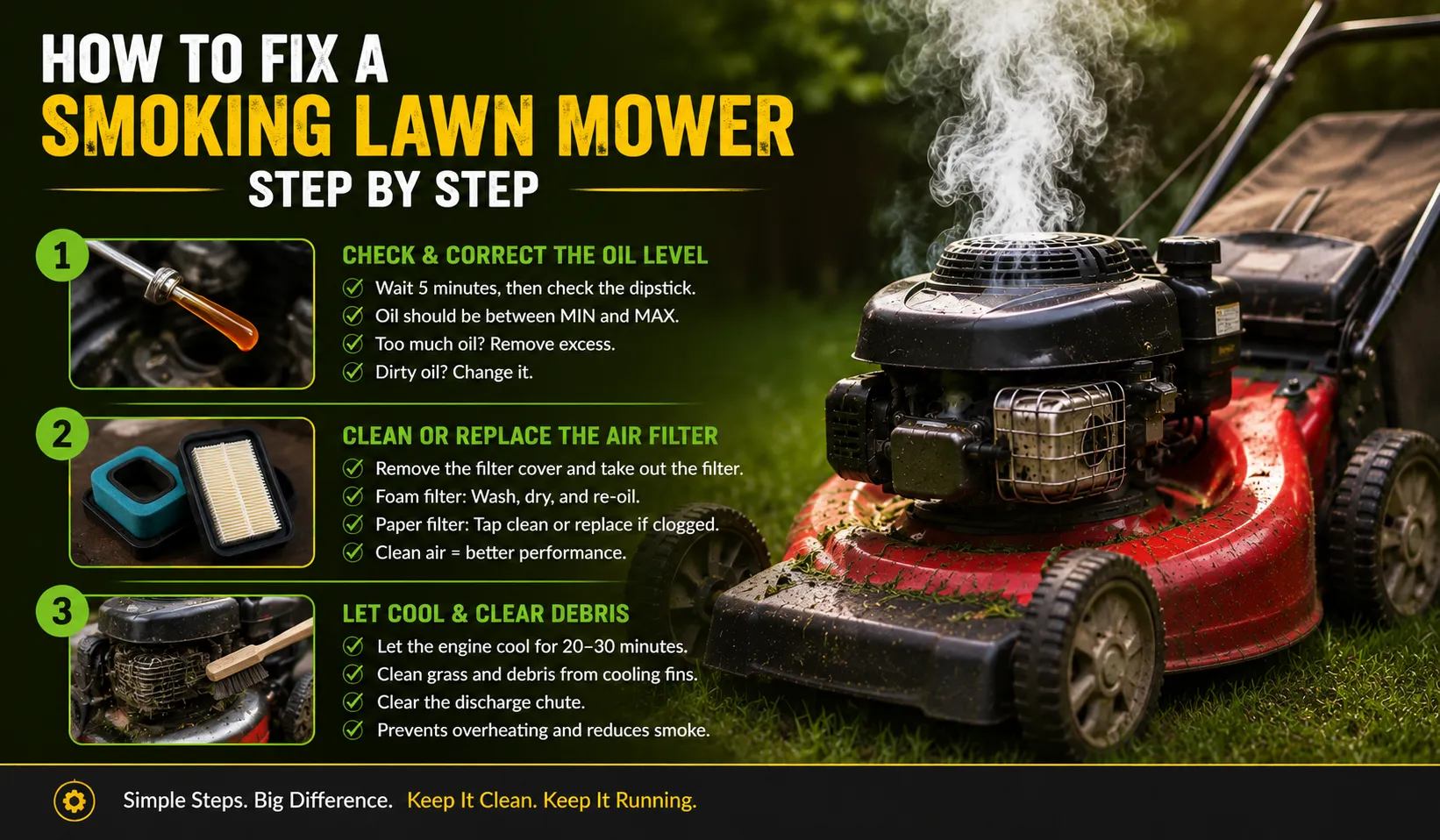
When You Need to Call a Small Engine Mechanic
Stop the DIY work and call a mechanic if:
- The smoke is heavy and does not stop after 2 to 3 minutes of running.
- The engine makes a knocking sound you have never heard before.
- Oil is burning at a rate where you need to add oil every one or two mowing sessions.
- The oil looks milky or has a foam-like consistency – this suggests water or combustion gases are mixing with the oil.
- The engine loses power noticeably and also smokes.
A diagnostic visit to a small engine shop typically runs $40 to $60 and is money well spent before you start tearing into a carburetor or head.
How Climate and Conditions Make Smoking Worse
Where you live changes how your mower behaves. Climate affects oil viscosity, air filter clogging rates, and how hard the engine has to work on each pass.
High Heat and Humidity – Florida, Texas, the Southeast
In Florida, I mow from March through November – sometimes year-round. The heat and humidity push engine temperatures higher and make oil thinner. Thin oil does not lubricate as well and is more likely to slip past seals.
In these climates, use the oil viscosity your manual recommends for high temperatures. For many small engines, that means SAE 30 or 10W-30. Check the oil level more often in summer – heat causes faster consumption.
Dusty and Dry Conditions – Arizona, the Southwest
The fine mineral dust in the Southwest is hard on air filters. It packs into paper filters fast and can even get past foam filters if they are not oiled correctly.
In these conditions, check your air filter every four to six mowing sessions rather than once a season. I learned this the hard way watching a Toro mower in Scottsdale start blowing black smoke in July after only three months of use. The filter was the color of red clay.
Long Overgrown Grass – Midwest, Pacific Northwest
Coming into spring in Minnesota or Oregon, the grass can be thick, wet, and six inches tall. That combination puts more load on the engine than anything else in this list.
Mow at the highest deck setting first. Then lower to your normal height on a second pass. This two-cut method cuts engine strain significantly and keeps temperatures in a safe range.
Climate vs. Risk vs. Prevention Tip
| Climate Type | Biggest Risk | Prevention Tip |
|---|---|---|
| Hot and humid (Southeast) | Oil thinning, faster oil consumption | Check oil every 2 to 3 mowing sessions in summer |
| Hot and dry (Southwest) | Air filter clogging | Inspect filter every 4 to 6 mowing sessions |
| Cool and wet (Pacific Northwest) | Wet grass overloading engine | Mow in two passes when grass exceeds 4 inches |
| Midwest spring | Thick grass after winter | Sharpen blade in March before first mow |
Mistakes People Make That Cause the Smoking Problem
Two specific mistakes cause more lawn mower smoking than anything else I have seen. Both are easy to avoid once you know about them.
Overfilling the Oil Reservoir
People assume more oil is better. It is not. Every small engine has a maximum capacity for a reason. Overfill past the MAX line on the dipstick and the excess oil gets pushed into places it does not belong – including the cylinder.
The fix after overfilling is simple: drain it down. But I have talked to homeowners who did not know they had overfilled, kept running the engine, and fouled the spark plug or damaged the rings. A $4 spark plug is fine. Damaged rings mean a rebuild.
When you change your oil, fill slowly. Add a bit, check the dipstick, add more. Stop when you hit the MAX line.
Tilting the Mower the Wrong Way During Storage or Cleaning
This one surprises people. When you tip a four-stroke mower on its side to clean the underside or replace the blade, the direction you tilt it matters.
Always tilt the mower so the air filter side faces up. If you tilt it the other way – with the air filter facing down – oil from the crankcase flows directly into the air filter housing and carburetor. The next time you start the engine, it burns that oil off as a cloud of white or blue smoke.
I see this every spring. Someone cleans their mower deck in the fall, tilts it the wrong way, stores it for five months, and then thinks the engine is dying when it smokes on the first start in April. Nine times out of ten, it is just the oil burning off. But if enough got into the filter, the filter needs replacing before you continue.
Toro, Honda, and Husqvarna all specify the correct tilt direction in their owner’s manuals. If you lost yours, the correct direction is: carburetor and air filter facing up.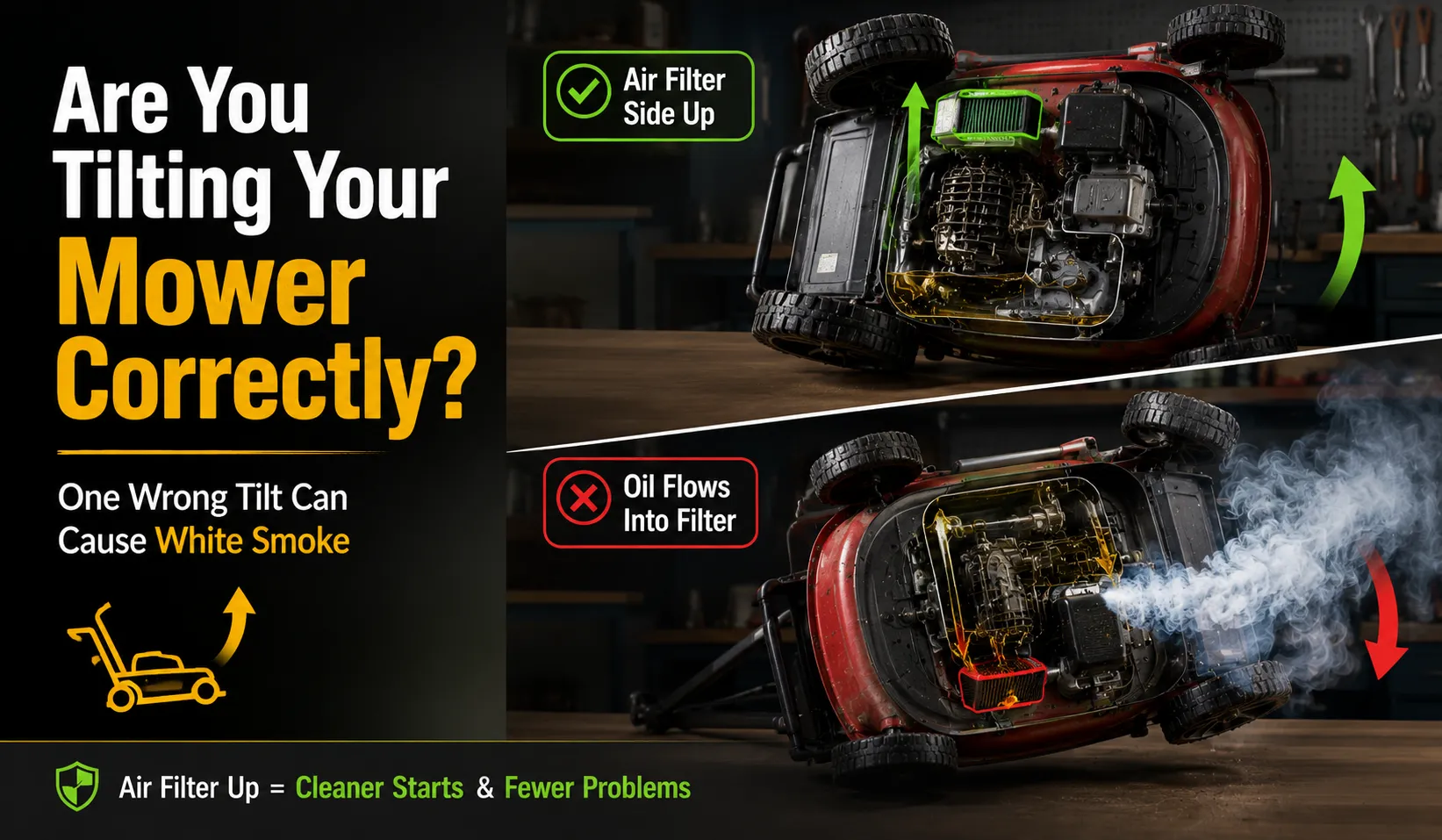
My Final Take
If your lawn mower is smoking right now, start with the oil level. That is the right first move almost every time. Shut the engine off, let it cool for five minutes, pull the dipstick, and check. If the level is above MAX, drain some out. If the oil is black and gritty, change it. Then restart and watch what happens.
If the oil is fine, pull the air filter next. A five-minute check can save you a lot of guessing. After that, think back to how you stored the mower and whether you tilted it the wrong way at any point. Most smoking problems trace back to one of those three things.
The situation I tell every homeowner to take seriously is heavy, persistent smoke that does not clear, combined with any change in engine sound. That combination means something internal is wrong, and continuing to run it makes the repair more expensive. A $60 shop visit is a lot cheaper than a new mower. I have sent mowers to the shop and had them come back with a $45 repair. I have also kept mowing past the point I should have and paid for it. Know when to stop.
Quick Reference – Pros and Cons of DIY Diagnosis
| Factor | Pro | Con |
|---|---|---|
| Cost | Free to under $20 for parts | Risk of misdiagnosis if you skip steps |
| Time | Most fixes take under 30 minutes | Serious problems (head gasket) need professional tools |
| Tools needed | Dipstick, wrench, maybe an oil extractor | Engine teardown requires torque wrenches and specs |
| Best cases for DIY | Oil level, air filter, oil on exhaust | Head gasket, worn rings, carburetor rebuild |
| When to call a pro | Any time you hear knocking or smoke is heavy and continuous | – |
Frequently Asked Questions About Lawn Mower Smoking
Why is my lawn mower smoking white smoke?
White smoke from a lawn mower almost always means oil is burning in the combustion chamber. The most common causes are an overfilled oil reservoir, oil that shifted into the cylinder from tilting the mower the wrong way, or a failing head gasket. Check the oil level first – if it is above the MAX mark on the dipstick, drain some out and restart.
Is it safe to keep mowing if my mower is smoking?
It depends on the smoke. A small puff that clears in one to two minutes after startup is usually safe – it is just oil burning off. Thick, heavy smoke that continues while the engine runs is a sign to shut it off immediately. Running the engine through heavy smoke can cause serious internal damage.
What does black smoke from a lawn mower mean?
Black smoke means the engine is burning too much fuel and not enough air. The most common cause is a clogged air filter. Pull the filter and inspect it. If it is dirty, clean it or replace it before running the engine again. A dirty or stuck carburetor can also cause black smoke.
Can I fix a smoking lawn mower myself?
Yes, in most cases. Overfilled oil, wrong oil type, a clogged air filter, and oil on the exhaust are all DIY fixes that take under 30 minutes and cost little to nothing. A head gasket failure or worn piston rings need professional repair and are generally not worth fixing yourself unless you have small engine experience.
How often should I check my mower’s oil to prevent smoking?
Check the oil level before every mowing session, or at minimum every five hours of use. In hot climates like Florida or Texas in summer, check it every two to three sessions since heat increases oil consumption. Change the oil at least once per season, or every 50 hours of use, whichever comes first.
What oil should I use in my lawn mower to avoid smoking?
Most four-stroke walk-behind mowers use SAE 30 for temperatures above 40 degrees Fahrenheit or 10W-30 for a wider temperature range. Briggs and Stratton, Honda, and Toro all specify the correct oil type in their owner’s manuals. Using the wrong oil – especially a lighter viscosity oil in hot weather – can cause it to thin out and smoke.
Why does my mower only smoke when I start it?
Startup-only smoke is almost always harmless. It usually means a small amount of oil settled into the cylinder or onto the exhaust muffler during storage. The engine burns it off in the first minute or two. If it clears and does not return, you are fine. If you stored the mower tilted the wrong way, this is very likely what happened.