

Quick Overview
- The single biggest fertilizing mistake is applying at the wrong time – timing matters more than which bag you buy.
- Cool-season grasses (Kentucky bluegrass, fescue) need their main feeding in fall; warm-season grasses (Bermuda, St. Augustine) need it in late spring through summer.
- A soil test costs $15-$25 and tells you exactly what your lawn needs – skipping it means you’re guessing with every application.
- Fall is the most important fertilizer application of the year for cool-season lawns, not spring.
- Over-fertilizing does real damage: it burns grass, pushes excessive blade growth, and weakens root systems over time.
I pulled into my driveway one May afternoon and noticed my neighbor’s lawn looked like a golf course. Mine looked tired – pale green, thin in patches, with a few spots going yellow near the curb. I had a bag of Scotts Turf Builder sitting in my garage that I’d bought in March and never opened.
That moment is why I started taking my lawn fertilizing schedule seriously. Not because I wanted the best lawn on the block, but because I was clearly doing something wrong – and I had no idea what.
This guide is for homeowners who want a healthy lawn without spending a fortune or memorizing a chemistry textbook. I’ll share what I’ve learned fertilizing lawns in Florida’s sandy soil, Arizona’s brutal summer heat, and Minnesota’s short growing seasons. Some of it took me years to figure out. Most of it is simpler than the bag labels make it seem.
Why Timing Matters More Than the Fertilizer Itself
The fertilizer aisle at any hardware store will overwhelm you. Dozens of bags, different NPK numbers, slow-release, fast-release, organic, synthetic. Here’s what no one tells you: the brand matters less than when you apply it.
Feed your grass at the wrong time and you get one of two outcomes – burned turf or wasted money. Get the timing right and even a basic bag does its job.
What Happens When You Fertilize at the Wrong Time
Fertilizing dormant or stressed grass is like force-feeding someone who’s asleep. The grass can’t use the nutrients, so they either wash off into storm drains or accumulate as salts in the soil. Both outcomes hurt your lawn.
I fertilized a Bermuda lawn in Phoenix in late October one year – a warm-season grass heading into winter dormancy. By December the grass was brown and patchy, and I spent the next spring recovering ground I had damaged. The fertilizer pushed a burst of soft, leafy growth right before cold weather hit. That new growth had no time to harden. The first cold snap killed it.
Applying nitrogen when grass is drought-stressed is just as bad. Dry grass has a shallow root system that can’t absorb nutrients efficiently. The fertilizer sits near the surface and burns the crown of the plant. You’ll see it as orange-brown scorching that shows up 48-72 hours after application.
The rule: fertilize when your grass is actively growing and has access to water – either from rain or irrigation.
Cool-Season vs. Warm-Season Grass – Why They Need Completely Different Schedules
This is the most important thing to understand before you buy anything.
Cool-season grasses – Kentucky bluegrass, tall fescue, fine fescue, perennial ryegrass – grow most actively in spring and fall when temperatures stay between 60-75°F. They slow down in summer heat and can go semi-dormant. Their prime feeding window is September through November.
Warm-season grasses – Bermuda, St. Augustine, Zoysia, Centipede – thrive in heat. They go completely dormant in winter and green up in late spring when soil temperatures hit 65-70°F. Their main feeding window runs from May through August.
Applying a warm-season schedule to cool-season grass is one of the most common mistakes I see. Homeowners load up on nitrogen in early spring because the lawn looks green and they’re excited. What they’re doing is pushing top growth while the root system is still shallow. The lawn looks great in April and exhausted by July.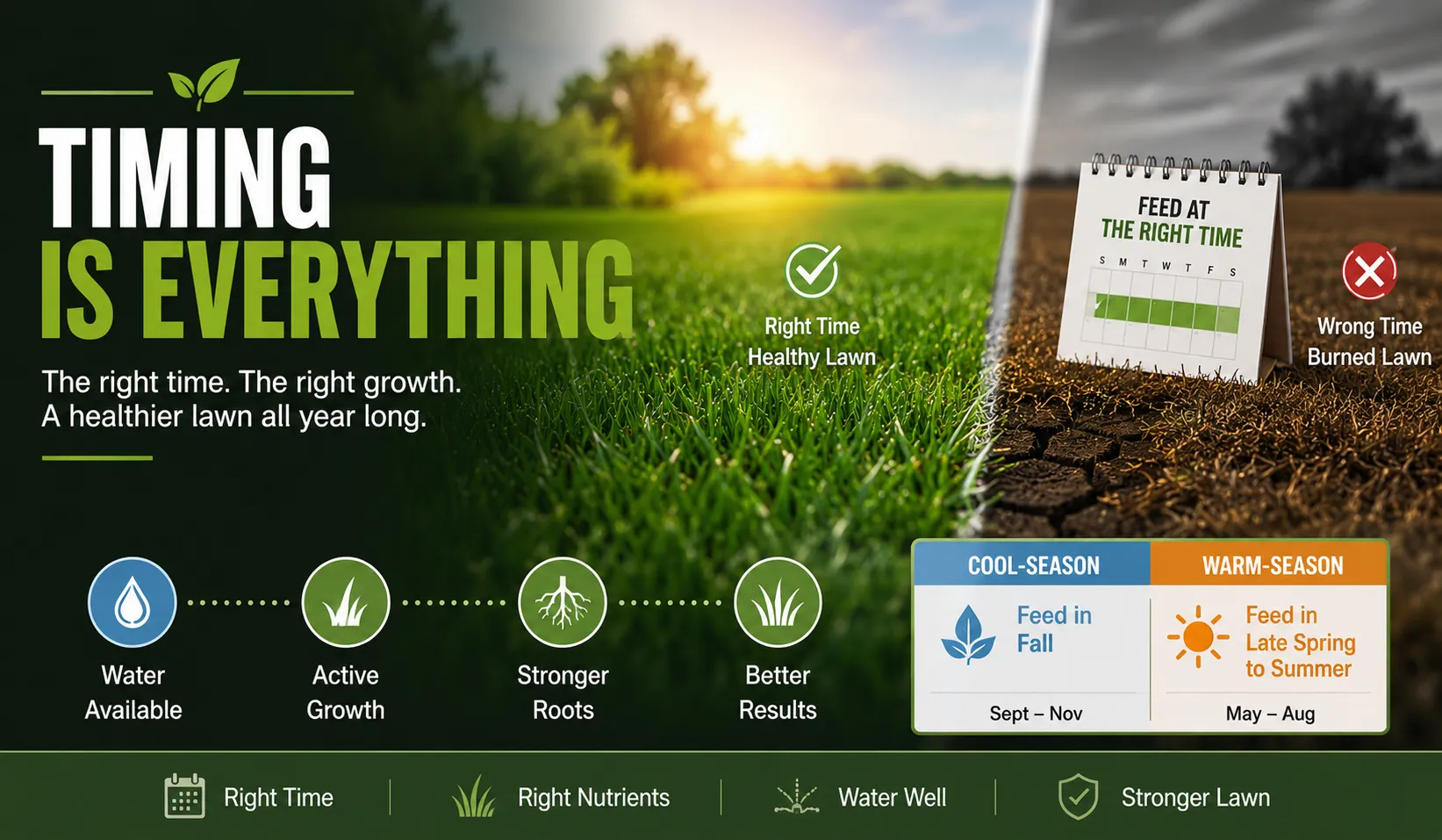
What to Know Before You Start Fertilizing
Before you open a single bag, spend 20 minutes understanding what your lawn actually needs. Most fertilizing problems come from skipping this step and just guessing.
Understanding NPK Ratios in Plain English
Every fertilizer bag shows three numbers separated by dashes – something like 28-0-6 or 10-10-10. These are the NPK numbers: nitrogen (N), phosphorus (P), and potassium (K), shown as percentages by weight.
Nitrogen drives blade growth and gives grass its green color. Too little and the lawn looks pale. Too much and you get soft, fast-growing grass that’s more vulnerable to disease and drought.
Phosphorus supports root development. Many established lawns already have enough phosphorus in the soil. In fact, applying extra phosphorus to a lawn that doesn’t need it is illegal in several US states, including Minnesota and New York, because of water quality concerns.
Potassium helps grass handle stress – heat, drought, cold, and foot traffic. Think of it as the grass’s immune system support.
For most established lawns, a high-nitrogen, low-phosphorus formula works well. Something like Scotts Turf Builder (32-0-6) for cool-season grass, or a 16-4-8 for warm-season varieties that need a bit more balanced feeding.
Soil Testing – Why Most People Skip It and Regret It
I skipped soil testing for years. I figured my lawn looked fine most of the time, so I’d just follow the bag directions. Then I had a persistent problem with thin, pale grass in my backyard near an old concrete pad. I tried four different fertilizers over two seasons. Nothing worked.
Finally got a soil test from my local cooperative extension office. Results came back: pH of 5.2. Way too acidic. Grass couldn’t absorb nutrients at that pH no matter how much I applied. Twenty pounds of lime later, the problem was gone.
A basic soil test runs $15-$25 through your state’s cooperative extension service – search for “[your state] cooperative extension soil test.” It tells you pH, existing nutrient levels, and often gives you specific amendment recommendations. Do it once every 2-3 years.
Without it, you might be buying fertilizer your soil doesn’t need, while ignoring the actual problem.
Granular vs. Liquid Fertilizer
Granular fertilizer is the standard choice for most homeowners. You apply it with a spreader, water it in, and it breaks down slowly into the soil. It’s forgiving – small application errors don’t cause immediate damage. A 40-pound bag covers 12,000-15,000 square feet and typically costs $25-$50.
Liquid fertilizer works faster. You dilute it and apply it with a hose-end sprayer or backpack sprayer. Grass absorbs some of it directly through the blades, which means you see results in a few days rather than weeks. The downside: it’s easier to over-apply, it costs more per square foot, and you need to reapply more frequently.
For most homeowners, granular is the right choice. Liquid is useful when you want a quick green-up before an event, or when you’re treating a small problem area.
Slow-Release vs. Fast-Release Formulas
Fast-release fertilizer gives grass a quick shot of nitrogen. The lawn greens up fast – sometimes within a week. The problem is that the nitrogen moves through the soil quickly, so you need to reapply every 4-6 weeks during the growing season. It also carries a higher burn risk if you misread the spreader settings.
Slow-release fertilizer – often labeled as sulfur-coated urea, polymer-coated, or IBDU – breaks down gradually over 8-12 weeks. The grass gets a steady, moderate supply of nitrogen rather than a sudden spike. Less burn risk, longer window between applications, and generally better for root health.
Milorganite is the best-known organic slow-release option in the US. It’s made from heat-dried microbes and works gently over 8-10 weeks. Costs more per bag but applies less frequently. I use it on my home lawn specifically because it’s nearly impossible to burn grass with it, even in midsummer.
Fertilizer Type Comparison
| Type | Cost per 1,000 sq ft | Ease of Use | Longevity | Best For |
|---|---|---|---|---|
| Granular fast-release | $1-$2 | Easy | 4-6 weeks | Quick green-up, budget applications |
| Granular slow-release | $2-$4 | Easy | 8-12 weeks | Main seasonal feedings, low burn risk |
| Liquid fast-release | $3-$5 | Moderate | 2-4 weeks | Spot treatments, quick results |
| Organic (Milorganite) | $3-$5 | Easy | 8-10 weeks | Families with kids/pets, low-maintenance lawns |
| Synthetic blend | $2-$3 | Easy | 6-8 weeks | Balanced performance, most popular choice |
The Lawn Fertilizing Schedule I Actually Follow (By Season)
No schedule works for every lawn. What I’m sharing is what I use for my own grass and what I recommend to most homeowners as a starting point. Adjust based on your soil test and how your lawn responds.
One thing to keep consistent: always water after applying granular fertilizer unless rain is in the forecast within 24 hours. This activates the fertilizer and reduces burn risk.
Spring Fertilizing – When and How to Start
For cool-season lawns, resist the urge to fertilize as soon as you see green in March. Early spring nitrogen pushes leaf growth before the root system is ready for it. The grass looks good, then fades hard in summer heat.
Wait until your lawn has been mowed at least twice – typically late April in the Midwest and Northeast. At that point, apply a low-nitrogen starter fertilizer or a balanced blend like 10-10-10. This feeds without forcing the grass to sprint when it should be building roots.
For warm-season lawns in Florida, Georgia, or Texas, hold off until the grass fully greens up – usually mid-April to mid-May depending on your location. Soil temperature should be above 65°F before you apply. I use a cheap soil thermometer (around $10 at any garden center) to check rather than guessing by the calendar.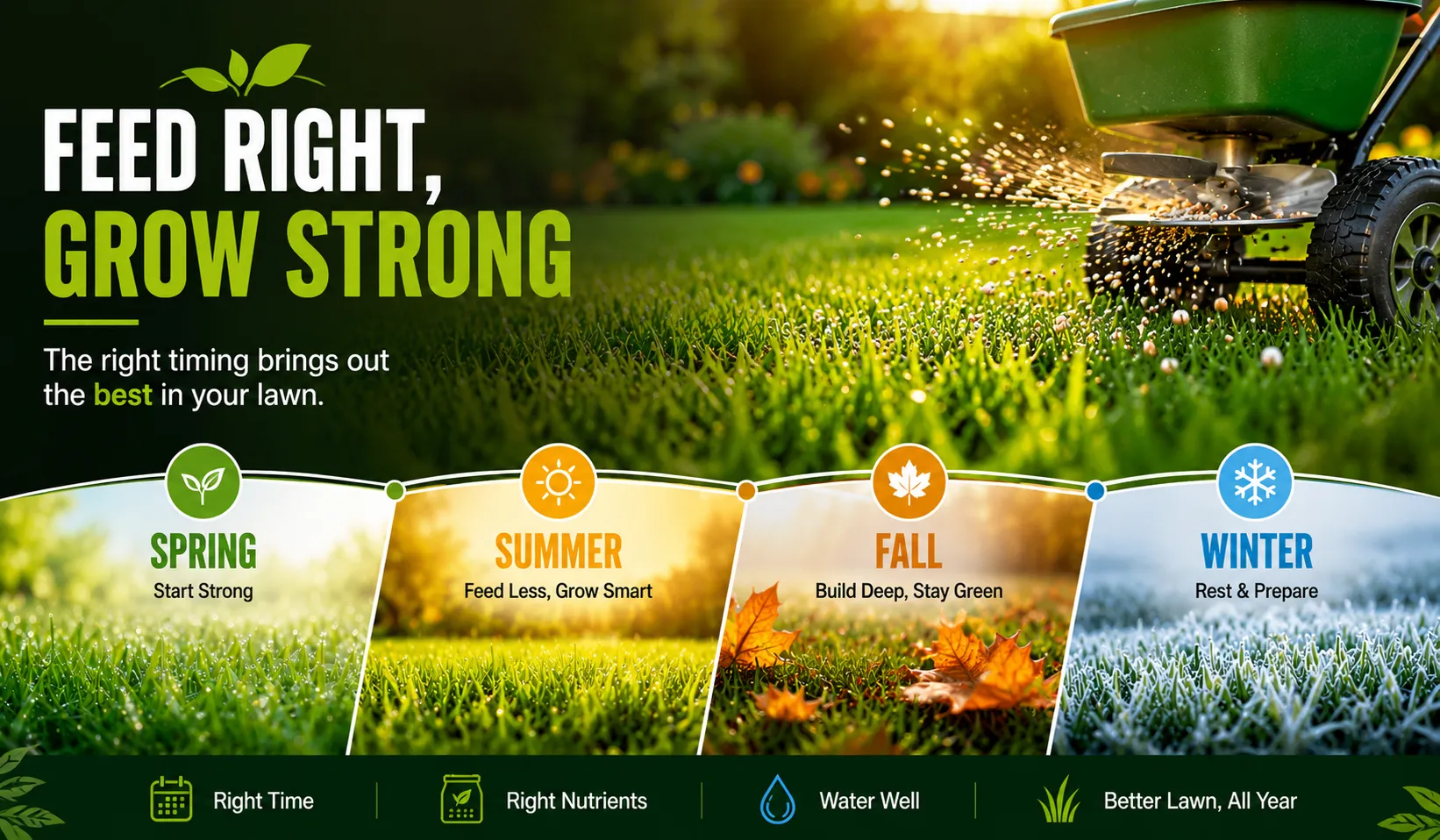
Summer Feeding – Less Is More
This is where most homeowners over-do it. Cool-season grass is under heat stress in July. Applying high-nitrogen fertilizer to stressed grass is asking for trouble – you’ll see burn marks or push a flush of disease-vulnerable growth.
If you feed cool-season lawns in summer at all, use a light application of slow-release fertilizer at half the recommended rate. Or skip it entirely and just keep up with watering.
Warm-season grasses are the opposite – summer is their growing season. Bermuda and Zoysia in Phoenix or Atlanta respond well to a full feeding in June and again in mid-July. Don’t push it past early August, though. You want the grass to slow down and harden before fall.
Fall Fertilizing – The Most Important Application of the Year
For cool-season lawns, fall is everything. September through early November is when Kentucky bluegrass and fescue repair summer damage, grow deeper roots, and store energy for winter. A strong fall feeding means a faster, healthier green-up the following spring.
I apply a higher-potassium fertilizer in late September – something like 24-0-10 – to support root growth and cold hardiness. Then one more application in late October or early November, often called “winterizer” fertilizer. Scotts and Jonathan Green both make dedicated fall formulas.
Don’t skip the November application because it feels late. Grass roots continue absorbing nutrients even after the blades stop growing. That last fall feeding is the single highest-return thing you can do for a cool-season lawn.
For warm-season grasses, stop fertilizing 6-8 weeks before your first expected frost. Feeding Bermuda in September in Atlanta is fine. In Minnesota, where Bermuda barely survives anyway, stop in late July.
Winter – What to Do (and What to Skip)
Short answer: don’t fertilize in winter. Cool-season grass is dormant or nearly dormant. Warm-season grass is fully dormant. Neither can use the nutrients.
In mild climates – Central Florida, coastal Southern California – some warm-season grasses stay green year-round. Even there, growth slows dramatically and nitrogen needs drop. A light application of slow-release in December is the most you’d ever need, and only if the grass is actively growing.
The one winter task worth doing: aerate compacted soil in late fall before the ground freezes. It costs nothing if you rent a machine and share it with a neighbor, and it sets up better nutrient absorption in spring.
Month-by-Month Schedule
| Month | Cool-Season Grass | Warm-Season Grass |
|---|---|---|
| January | No application | No application |
| February | No application | No application |
| March | No application | No application (wait for green-up) |
| April | Light feeding if lawn is mowed 2x | Begin feeding after full green-up |
| May | Optional light feeding | Full feeding (primary) |
| June | Skip or half rate | Full feeding |
| July | Skip | Full feeding |
| August | Skip | Light or skip (4-6 weeks before frost) |
| September | Primary fall feeding | Light or skip |
| October | Second fall feeding | No application |
| November | Winterizer application | No application |
| December | No application | No application (or very light in FL) |
How Climate Zones Change Everything
Your neighbor’s schedule might be completely wrong for your lawn – even if they’re three blocks away and have the same grass type. Climate controls when grass goes dormant, how fast nutrients move through soil, and how long your feeding window actually is.
Hot and Humid Regions (Florida, Gulf Coast, Southeast)
St. Augustine is the most common grass in Florida. It’s a warm-season grass that stays green most of the year in South Florida, but still slows down in December and January even in Tampa and Orlando.
The main challenge in humid climates is disease pressure. High nitrogen in humid summer conditions promotes fungal diseases like brown patch and dollar spot. In a Florida backyard, I’ve seen homeowners apply heavy nitrogen in August, then wonder why they have 8-inch circles of dead grass in September.
In the Southeast, use slow-release or organic fertilizers in summer to reduce disease risk. Keep nitrogen applications moderate from June through August. Spring and fall are your windows for heavier feeding.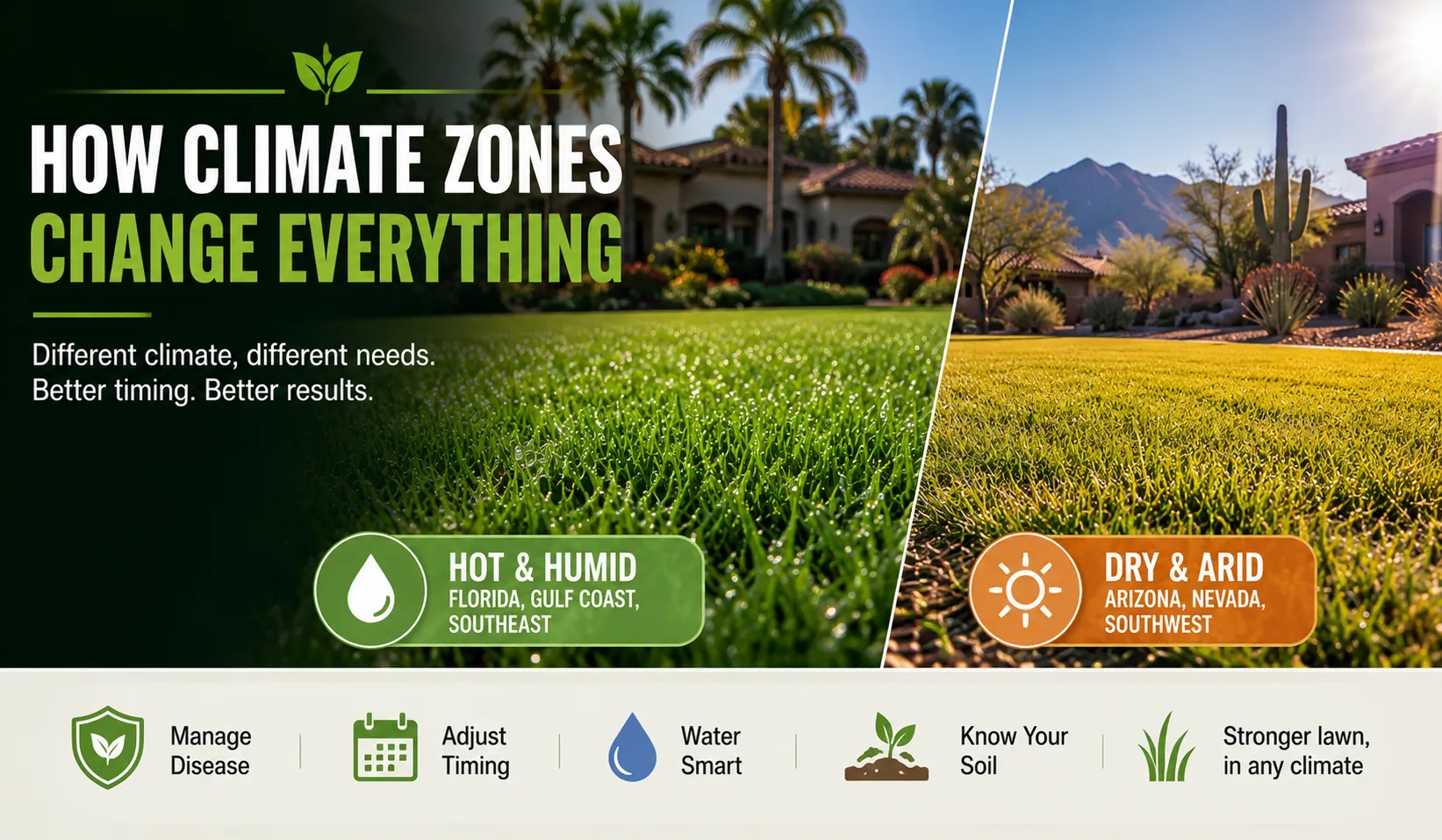
Dry and Arid Climates (Arizona, Nevada, Southwest)
Bermuda grass is king in Phoenix and Las Vegas. The good news: desert heat is exactly what warm-season grasses love. The bad news: desert soil is often alkaline (pH 7.5-8.5), which limits nutrient availability even when you’re applying plenty of fertilizer.
In arid climates, iron chlorosis – yellowing caused by the grass’s inability to absorb iron – is more common than nitrogen deficiency. If your Bermuda looks pale in Phoenix despite regular feeding, get a soil test before adding more fertilizer. You may need iron sulfate or a pH-adjusting amendment, not more nitrogen.
Water deeply before applying granular fertilizer in the desert. Dry soil in 110°F heat will burn grass roots fast if you apply fertilizer without adequate moisture.
Cold Winters and Short Seasons (Midwest, Northeast, Pacific Northwest)
A Minnesota lawn has maybe 5-6 months of active growing season. That compresses the entire fertilizing schedule.
Cool-season grasses dominate here – Kentucky bluegrass in the Midwest, tall fescue and fine fescue in the Northeast and Pacific Northwest. The fall feeding window matters enormously because spring is short and summer heat arrives fast.
In the Pacific Northwest, heavy rainfall means nutrients leach out of soil faster. Seattle-area lawns often need more frequent, lighter applications rather than fewer heavy ones. A slow-release granular applied every 6-8 weeks during the March-October growing season works better than two heavy applications.
One thing I always stress for Midwest lawns: don’t apply fertilizer to frozen or saturated ground. If the soil is still frozen in early April, wait. Fertilizer applied to frozen Minnesota ground in March isn’t feeding the lawn – it’s feeding the nearest lake.
Regional Schedule Comparison
| Region | Primary Grass | Main Feeding Window | Applications per Year | Key Risk |
|---|---|---|---|---|
| Southeast / Gulf Coast | St. Augustine, Bermuda | April-August | 3-4 | Fungal disease from high N in humidity |
| Southwest / Desert | Bermuda, Zoysia | May-August | 3-4 | Alkaline soil, iron deficiency |
| Midwest | Kentucky bluegrass | April-May, Sept-Nov | 3-4 | Late spring over-fertilizing |
| Northeast | Tall fescue, bluegrass | April-May, Sept-Nov | 3-4 | Nutrient leaching in clay soils |
| Pacific Northwest | Tall fescue, fine fescue | March-May, Sept-Oct | 4-5 | Leaching in wet soil, moss competition |
Common Fertilizing Mistakes I’ve Made (So You Don’t Have To)
I’ve made most of the classic mistakes over the years. These aren’t theoretical – each one cost me time, money, or a section of dead grass.
Over-Fertilizing – The “More Is Better” Trap
My worst mistake was in a backyard in suburban Minneapolis. I was trying to thicken up a thin lawn before a family party. I applied Scotts Turf Builder at 1.5 times the label rate, thinking the extra push would help. Three days later, I had orange-brown streaks across the entire back lawn.
Fertilizer burn happens when excess nitrogen creates a salt concentration high enough to pull moisture out of grass roots – basically dehydrating the plant from the inside. In hot, dry weather, it happens fast.
Recovery from fertilizer burn means soaking the area with water for several days to flush the salts, then waiting 2-3 weeks for the grass to recover. In serious cases, you’re reseeding dead patches.
Stick to the label rate. If your spreader settings are between two recommended settings, choose the lower one. You can always apply again in 6-8 weeks. You can’t un-burn a lawn.
Fertilizing Drought-Stressed or Dormant Grass
Drought stress shuts down grass’s ability to move nutrients from soil to plant. The root system contracts and the grass goes into survival mode. Applying fertilizer to a lawn that’s brown and crispy doesn’t revive it – it adds salt stress to an already struggling plant.
The visible sign of drought stress is grass that doesn’t spring back when you walk on it. Footprints stay visible for more than a few seconds. If you see this, water deeply for several days before even thinking about fertilizer.
Same logic applies to dormant warm-season grass in winter. It looks dead. It’s not – it’s just dormant. But dormant grass has no active root function. Fertilizer applied to dormant Bermuda in December will sit in the soil through winter and either wash away or cause a chemical imbalance that affects green-up in spring.
My Final Recommendation
If I had to give one piece of advice to someone starting from scratch, it would be this: get a soil test, identify your grass type, and match your schedule to those two facts. Everything else – which brand to buy, granular versus liquid, organic versus synthetic – matters much less than those two fundamentals.
A simple 3-4 application schedule handles most lawns without obsessing over every product detail. For cool-season grass: one light feeding in spring, one main feeding in early fall, one winterizer in late fall. For warm-season grass: start in late spring after full green-up, feed every 6-8 weeks through summer, stop 6 weeks before frost. That’s it.
Don’t let the fertilizer aisle convince you that you need a specialized product for every season, every grass type, and every soil condition. Scotts, Jonathan Green, Espoma, and Milorganite all make reliable products. A $28 bag of the right fertilizer, applied at the right time, will outperform a $55 premium product applied at the wrong time.
The lawns I’m proudest of aren’t the ones where I spent the most. They’re the ones where I kept the schedule consistent, adjusted when the lawn told me something was off, and didn’t panic in a dry July.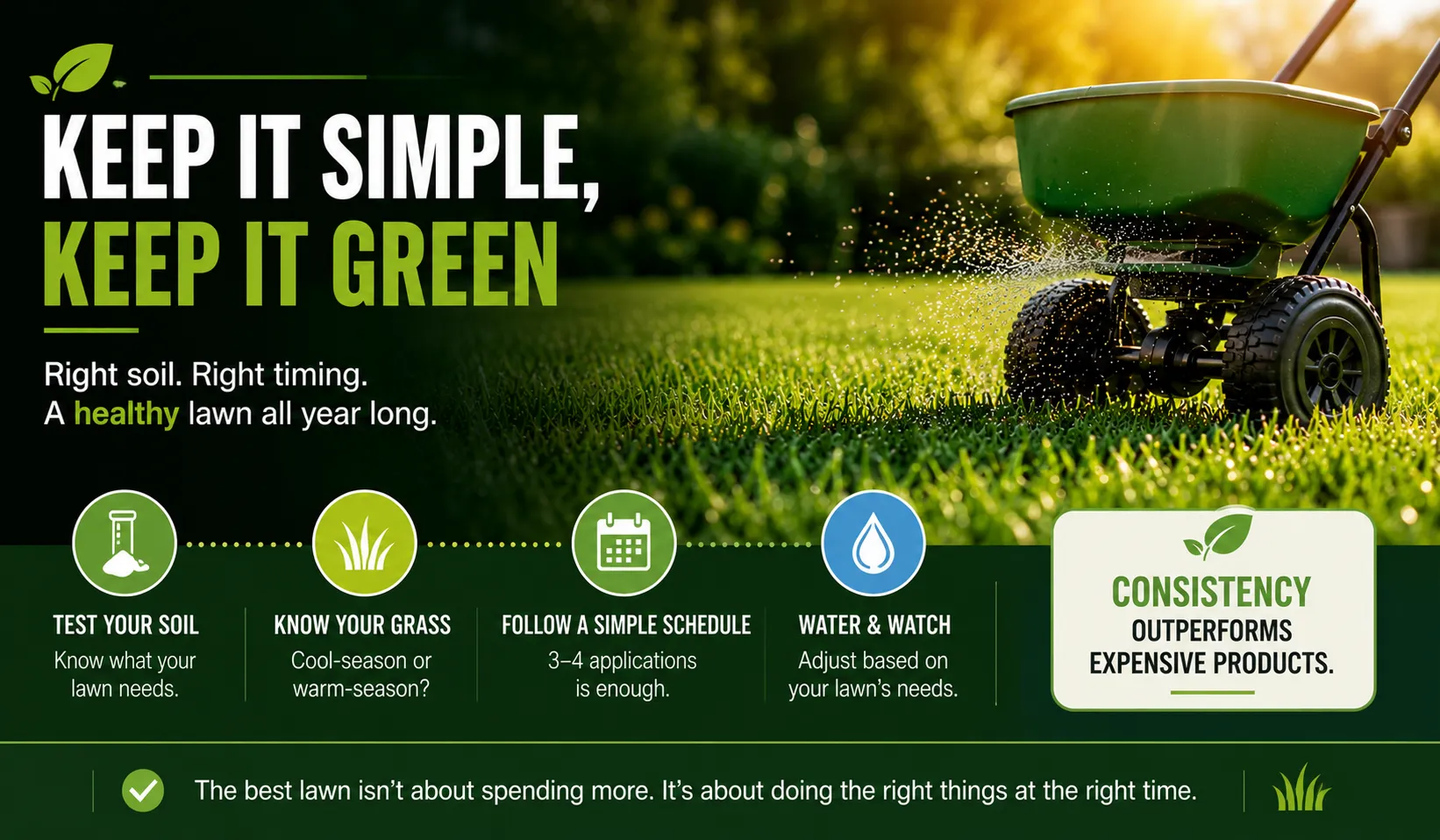
Pros and Cons: Main Fertilizer Approaches
| Approach | Pros | Cons |
|---|---|---|
| Synthetic fast-release granular | Affordable, fast results, widely available | Higher burn risk, needs frequent reapplication |
| Synthetic slow-release granular | Lower burn risk, 8-12 week coverage, easy to use | Costs more per bag, slower visible results |
| Organic (Milorganite) | Near-zero burn risk, improves soil biology over time | Slower results, higher cost, lower N content requires more product |
| Liquid fertilizer | Fast uptake, precise spot treatment | Expensive per sq ft, easier to over-apply, frequent reapplication |
| Balanced NPK blends (10-10-10) | Good for establishing new lawns or unknown soil | Often unnecessary phosphorus for established lawns; may violate local regulations |
Frequently Asked Questions About Lawn Fertilizing Schedules
What is a lawn fertilizing schedule?
A lawn fertilizing schedule is a seasonal plan that tells you when, how often, and with what type of fertilizer to feed your grass. The right schedule depends on your grass type (cool-season or warm-season) and your climate zone. Most lawns need 3-4 applications per year, timed to match active growth periods.
How often should I fertilize my lawn?
Most lawns need 3-4 fertilizer applications per year. Cool-season grasses like Kentucky bluegrass and tall fescue benefit from spring and fall feedings – fall is more important. Warm-season grasses like Bermuda and St. Augustine need feeding from late spring through midsummer. Over-fertilizing causes more damage than under-fertilizing, so more frequent applications aren’t better.
What is the best time of year to fertilize a lawn?
For cool-season grasses, fall is the most important fertilizing window – September through November. For warm-season grasses, late spring through midsummer (May through July) is the primary feeding period. Both types of grass should be actively growing and have access to water at the time of application.
Can I fertilize my lawn in summer?
It depends on your grass type. Warm-season grasses (Bermuda, Zoysia, St. Augustine) should be fertilized in summer since that’s their main growth period. Cool-season grasses (Kentucky bluegrass, fescue) are heat-stressed in summer and generally should not be fertilized heavily – a light slow-release application at half rate is the most you’d apply, and skipping summer entirely is reasonable for stressed lawns.
What does NPK mean on a fertilizer bag?
NPK stands for nitrogen (N), phosphorus (P), and potassium (K) – the three main nutrients in fertilizer. The numbers on the bag show the percentage of each by weight. A bag labeled 28-0-6 is 28% nitrogen, 0% phosphorus, and 6% potassium. For most established lawns, a high-nitrogen formula with low or zero phosphorus is appropriate. Phosphorus is mainly needed for new lawn establishment or when a soil test confirms deficiency.
Should I do a soil test before fertilizing?
Yes – a soil test is the most useful thing you can do before fertilizing. It tells you your soil’s pH and existing nutrient levels, so you buy what your lawn actually needs instead of guessing. Tests run $15-$25 through your state’s cooperative extension service and are worth doing every 2-3 years. Low pH (below 6.0) is a common reason fertilizer doesn’t work, and no amount of additional fertilizer fixes a pH problem.
What is the difference between slow-release and fast-release fertilizer?
Fast-release fertilizer delivers nitrogen to the grass quickly – you see results within a week but need to reapply every 4-6 weeks. It also carries a higher burn risk if over-applied. Slow-release fertilizer (sulfur-coated urea, polymer-coated, or organic options like Milorganite) breaks down gradually over 8-12 weeks, feeds the lawn more steadily, and is much harder to burn. Slow-release is the better choice for most homeowners doing their own lawn care.