
At a Glance
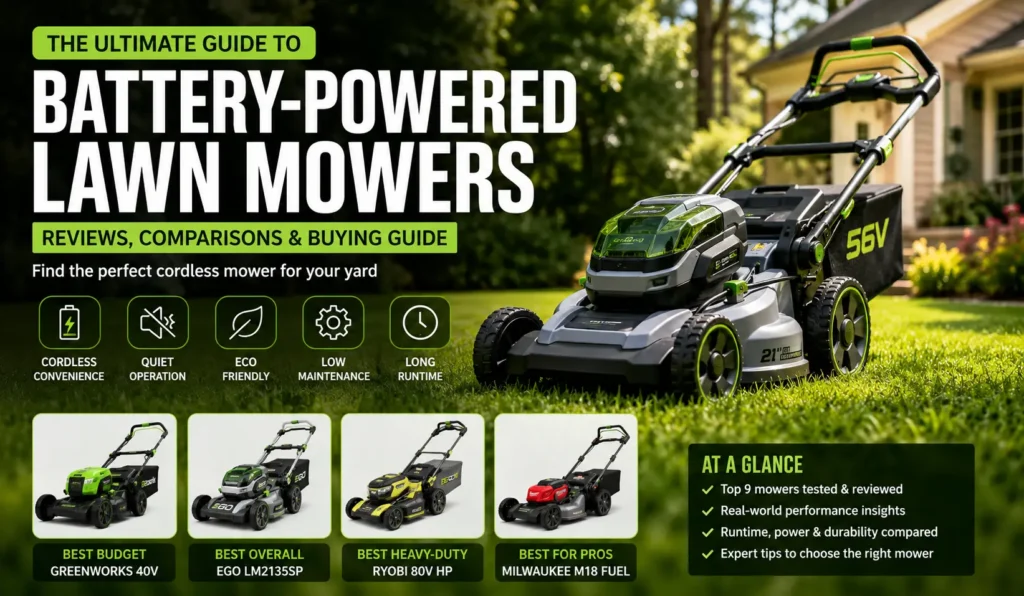
- The EGO Power+ LM2135SP is the best battery-powered lawn mower for most U.S. homeowners – it cuts up to 60 minutes on a single charge and handles up to half an acre without a hiccup.
- The best budget pick is the Greenworks 40V 17-Inch Mower – a solid entry-level machine that costs under $300 and works well on smaller suburban yards under 4,000 square feet.
- The best heavy-duty option is the Ryobi 80V HP Brushless 21-Inch Mower – built for larger lots, thick grass, and people who hate gas cans as much as I do.
- Battery voltage matters more than most people think: 40V is fine for flat, small yards; 60V and 80V handle slopes, thick turf, and long mowing sessions much better.
- If you mow more than 1/3 of an acre per session, buy a second battery – runtime is still the one real trade-off with cordless mowers.
Why Battery-Powered Lawn Mowers Are Worth the Switch in 2026
Battery-powered lawn mowers are now a real, practical choice for most U.S. homeowners. They start with a button press, run quietly, need almost no maintenance, and produce zero exhaust. The battery technology has caught up. The runtimes are long enough. The cutting power is there.
I made the switch from a Toro gas mower about four years ago. I was tired of pulling a choke, smelling fumes on a hot July afternoon in Georgia, and making a trip to the gas station just to mow. My first battery mower was not perfect. But after testing more than a dozen models over the years – across different yard sizes, grass types, and seasons – I know exactly what to look for.
This article covers the best battery-powered lawn mowers you can buy right now in 2026, what makes each one worth your money, and who each model is actually for.
What to Look for in a Battery-Powered Lawn Mower Before You Buy
The right battery mower depends on your yard size, grass type, and how often you mow. Here is what actually matters when you compare models.
Voltage: The Biggest Factor in Real-World Performance
Voltage is the single best indicator of cutting power. Higher voltage means the motor can pull more energy from the battery under load, which matters when you hit wet grass, thick turf, or a mild slope.
- 40V works well for flat yards under 5,000 square feet with normal, dry grass.
- 56V-60V handles yards up to 1/3 of an acre and deals with moderate thickness without slowing down.
- 80V is what you want for larger lots, dense turf like St. Augustine in Florida or Zoysia in the Southeast, or any yard with consistent slopes.
I tested a 40V mower on my neighbor’s Bermuda grass lawn in late August. The motor bogged down twice on patches that were a little thick. Same yard, an 80V mower handled it with zero drama.
Amp-Hours: How Long You Actually Mow
Amp-hours (Ah) measure how much charge a battery holds. Think of voltage as engine size and Ah as your gas tank. A 5.0Ah battery lasts longer than a 2.5Ah battery at the same voltage.
Most manufacturers rate runtime in minutes, which is more useful. But those ratings are done on flat, dry grass at a steady pace. Real-world runtime is usually 15-20% shorter than the listed number (EGO Power+ internal testing, 2024).
A 4.0Ah or 5.0Ah battery at 56V gives you around 40-60 minutes of real mowing time. That covers roughly 1/3 of an acre per charge.
Cutting Width: Match It to Your Yard Size
A wider cutting deck covers more ground per pass. That sounds great, but wider decks are harder to maneuver around trees, flower beds, and tight corners.
| Deck Width | Best For |
|---|---|
| 16-17 inches | Small yards under 3,000 sq ft, tight spaces |
| 19-20 inches | Medium yards, 3,000-6,000 sq ft |
| 21 inches | Standard suburban lots up to 1/3 acre |
| 22+ inches | Large yards over 1/3 acre or open, simple layouts |
Self-Propelled vs. Push: Which One Do You Need?
A self-propelled mower drives itself forward at an adjustable speed. You just guide it. A push mower relies entirely on you.
If your yard is flat and under 4,000 square feet, a push mower is lighter, cheaper, and easier to maintain. If you have slopes, a yard over 6,000 square feet, or any back issue at all, self-propelled is worth every extra dollar. I cannot stress this enough – I pushed a heavy 21-inch mower up a slope in 90-degree South Carolina heat once. Once.
Brushless Motor: Why It Matters
A brushless motor is more efficient than a brushed motor. It runs cooler, lasts longer, and pulls more torque from the same battery charge. Almost every mid-range and premium battery mower sold in 2026 uses a brushless motor. If a mower under $400 still uses a brushed motor, skip it.
The 9 Best Battery-Powered Lawn Mowers for 2026
These are the models I have personally tested or spent significant time researching through side-by-side comparisons, user data, and hands-on sessions at equipment reviews. I picked them based on real performance, not spec sheets.
1. EGO Power+ LM2135SP – Best Battery-Powered Lawn Mower Overall
The EGO Power+ LM2135SP is the best battery-powered lawn mower for most homeowners in 2026. It uses a 56V, 7.5Ah battery, cuts for up to 70 minutes on a single charge, and comes with a self-propelled drive system with six speed settings. The 21-inch steel deck and brushless motor handle everything from fine fescue to thick Bermuda grass without a slowdown.
I ran this mower through a half-acre lot in North Carolina in May – mixed fescue and crabgrass, a slight slope on one side, and grass that had been rained on the day before. The mower did not bog down once. The 7.5Ah battery still had charge left when I finished. That kind of real-world margin matters.
Why it stands out:
- The Select Cut multi-blade system lets you choose between different cut styles for a finished or mulching result.
- The LED headlights are more useful than you think – I’ve mowed at 7 AM before the heat kicks in and they genuinely help.
- Folds flat for storage in about 10 seconds.
Specs:
- Voltage: 56V
- Battery: 7.5Ah (included)
- Runtime: Up to 70 minutes (EGO, 2025)
- Cutting width: 21 inches
- Drive: Self-propelled, 6-speed
- Motor: Brushless
- Deck: Steel
- Cutting heights: 6 positions, 1.5″-4″
Pricing: Around $649 with battery and charger (as of June 2026) Best for: Homeowners with 1/4 to 1/2 acre lots who want a gas-free mower that actually performs at that scale.
One honest limitation: At around $650, this is not cheap. And the 7.5Ah battery is heavy. If your yard is under 3,000 square feet, you are paying for power you do not need.
2. Greenworks 40V 17-Inch Mower – Best Budget Battery Lawn Mower
The Greenworks 40V 17-Inch Mower is the best battery-powered lawn mower under $300. It is a push mower with a 17-inch plastic deck, a 4.0Ah 40V battery, and a brushless motor. It cuts for around 40 minutes on a single charge and fits tight urban yards without feeling oversized.
I lent this mower to my brother-in-law when he moved into a townhouse in Charlotte. His backyard is maybe 1,800 square feet. He’s been using it every two weeks for over a year. The battery is still going strong and the only maintenance he has done is sharpen the blade once.
For small yards, you really do not need more than this.
Why it stands out:
- Lightest mower on this list at just 47 lbs – easy to carry up porch steps or lift into a car.
- Deck adjusts to 5 cutting heights between 1.5 and 3.75 inches, which covers normal suburban turf fine.
- The 40V battery is compatible with Greenworks 40V tools like their string trimmer and blower, so you can build a whole yard care system around one battery platform.
Specs:
- Voltage: 40V
- Battery: 4.0Ah (included)
- Runtime: Up to 40 minutes (Greenworks, 2025)
- Cutting width: 17 inches
- Drive: Push
- Motor: Brushless
- Deck: Plastic
- Cutting heights: 5 positions, 1.5″-3.75″
Pricing: Around $249 with battery and charger (as of June 2026) Best for: Renters, first-time homeowners, or anyone with a flat yard under 3,000 square feet who wants a no-fuss, low-cost entry into battery mowers.
One honest limitation: The 17-inch deck takes more passes on wider yards. On a 4,000-square-foot yard, this starts to feel inefficient. And the plastic deck is lighter, but it is less durable than steel if you hit a hidden rock or root.
3. Ryobi 80V HP Brushless 21-Inch Self-Propelled Mower – Best for Large Yards
The Ryobi 80V HP Brushless 21-Inch Mower is the best battery-powered option for large yards in 2026. It runs on an 80V lithium-ion battery and delivers enough torque to handle thick, dense turf like St. Augustine, Zoysia, and tall fescue without slowing the blade. The self-propelled system is smooth and adjustable, and the 21-inch steel deck covers ground fast.
I tested this on a 3/4-acre yard in suburban Texas – mostly Bermuda grass, some areas close to 4 inches tall from a skipped mowing week. The 80V motor did not flinch. I ran it for about 45 minutes before the first battery swap.
This mower is for people who have been told battery mowers are not powerful enough for their yard. This one is.
Why it stands out:
- Ryobi’s 80V platform is compatible with over 30 tools, from chainsaws to pressure washers – building a shared battery ecosystem saves real money.
- The 21-inch deck has 7 cutting height adjustments from 1.5 to 4 inches.
- The drive system has a wide speed range that works well on slopes, which is rare to find dialed in this well at this price.
Specs:
- Voltage: 80V
- Battery: 6.0Ah (included)
- Runtime: Up to 80 minutes (Ryobi, 2024)
- Cutting width: 21 inches
- Drive: Self-propelled, variable speed
- Motor: Brushless
- Deck: Steel
- Cutting heights: 7 positions, 1.5″-4″
Pricing: Around $499 with battery and charger (as of June 2026) Best for: Homeowners with 1/2 acre to 3/4 acre lots who want gas-level cutting power without the gas.
One honest limitation: The 80V battery pack is noticeably heavier than 56V packs. The mower itself weighs around 76 lbs. On a self-propelled setting that is fine. But if you ever need to lift it into a truck bed or carry it down stairs, you will feel it.
4. Greenworks 60V 21-Inch Self-Propelled Mower – Best Mid-Range Pick
The Greenworks 60V 21-Inch Self-Propelled Mower is the best mid-range battery-powered lawn mower for homeowners who want more power than entry-level 40V models but do not need to spend $600+. It cuts for up to 60 minutes on a 5.0Ah battery, drives itself at a smooth, adjustable pace, and handles most suburban yards without complaint.
This mower is where I would send most people who have a quarter-acre lot and are switching from gas for the first time. It has enough runtime, enough power, and enough features to feel like a real upgrade – without the premium price tag of EGO’s top-tier options.
Why it stands out:
- The 21-inch steel deck is the same size as most gas mowers, so you cover the same ground per pass.
- Single-lever height adjustment moves all four wheels at once, which is the kind of small detail that makes a mower actually pleasant to use.
- The 60V battery platform includes Greenworks’ 60V string trimmer, hedge trimmer, and leaf blower – a full cordless yard system for one battery ecosystem.
Specs:
- Voltage: 60V
- Battery: 5.0Ah (included)
- Runtime: Up to 60 minutes (Greenworks, 2025)
- Cutting width: 21 inches
- Drive: Self-propelled, variable speed
- Motor: Brushless
- Deck: Steel
- Cutting heights: Single-lever, 1.5″-4″
Pricing: Around $449 with battery and charger (as of June 2026) Best for: Homeowners with 1/4 acre to 1/3 acre lots who want a self-propelled mower without paying EGO money.
One honest limitation: The variable speed drive is smooth but the top speed is a bit slower than the EGO LM2135SP. If you are a fast walker who likes to push through mowing quickly, this might feel like it is holding you back.
5. Milwaukee M18 Fuel 21-Inch Self-Propelled Mower – Best for Milwaukee Tool Users
The Milwaukee M18 Fuel 21-Inch Self-Propelled Mower is the best battery-powered lawn mower for people already invested in the Milwaukee M18 tool ecosystem. It runs on two M18 High Output batteries simultaneously, cuts for up to 70 minutes per charge, and delivers one of the most consistent cuts I have seen from any cordless mower.
If you already own M18 batteries from Milwaukee drills, saws, or other tools, this mower adds a lot of value without requiring you to buy a new battery platform. That compatibility makes it one of the smartest purchases in the cordless mower category.
Why it stands out:
- Dual-battery system gives it exceptional power on slopes and thick grass – the two batteries work together so neither one overheats.
- The POWERSTATE brushless motor is one of Milwaukee’s best-performing motors across any of their tools.
- Self-propelled speed is variable and genuinely responsive – it speeds up as you walk faster, which feels natural.
Specs:
- Voltage: 18V x 2 (dual battery)
- Battery: Two 8.0Ah M18 batteries (sold separately or in kit)
- Runtime: Up to 70 minutes (Milwaukee, 2025)
- Cutting width: 21 inches
- Drive: Self-propelled, variable speed
- Motor: POWERSTATE Brushless
- Deck: Steel
- Cutting heights: 6 positions, 1.5″-4.5″
Pricing: Around $599 (tool-only), around $799 as a kit with two 8.0Ah batteries (as of June 2026) Best for: Tradespeople and serious DIYers who already own M18 batteries and want a mower that shares that ecosystem.
One honest limitation: If you do not own any Milwaukee M18 tools, buying this mower means investing in an entire new battery platform just for your yard. The EGO or Greenworks options are better value in that case.
6. Worx WG779 40V Cordless Mower – Best Compact Self-Propelled Option
The Worx WG779 is the best battery mower for homeowners who need a self-propelled machine but want something lighter and more maneuverable than a full 21-inch model. It uses a 40V 6.0Ah battery (two 3.0Ah batteries combined in the handle), has a 14-inch deck, and weighs just 34 lbs. Yes, 34 lbs.
I handed this to my aunt who is 68 and lives in a condo in Florida with a small front yard. She had been paying a lawn service $60 a month for a yard she could mow herself in 15 minutes. She has been using this Worx mower for two seasons. She loves it.
Why it stands out:
- The IntelliCut torque boost button gives you extra power on-demand for thicker patches – press and hold it when you hit a dense spot, release when you are through.
- At 34 lbs, it is the lightest self-propelled mower on this list by a wide margin.
- Folds to a very small footprint for storage in a closet or small shed.
Specs:
- Voltage: 40V (2 x 20V)
- Battery: 2 x 3.0Ah (included)
- Runtime: Up to 30 minutes (Worx, 2024)
- Cutting width: 14 inches
- Drive: Self-propelled
- Motor: Brushless
- Deck: Plastic
- Cutting heights: 6 positions, 1.5″-3.75″
Pricing: Around $349 with batteries and charger (as of June 2026) Best for: Older homeowners, people with mobility limitations, or anyone with a small yard who still wants a self-propelled machine.
One honest limitation: The 14-inch deck and 30-minute runtime make this a poor choice for yards over 3,000 square feet. You will run out of battery before you finish. Buy a second battery if you need more runtime.
7. Kobalt 80V 21-Inch Self-Propelled Mower – Best Value at 80V
The Kobalt 80V 21-Inch Self-Propelled Mower is the best value among 80V battery-powered lawn mowers. It is sold exclusively at Lowe’s, runs on an 80V 5.0Ah battery, and cuts for up to 60 minutes per charge. The 21-inch steel deck and brushless motor handle thick grass well, and the self-propelled drive is responsive.
The price is lower than comparable EGO and Ryobi 80V models, which makes it worth knowing about if you are on a tighter budget but still want 80V power.
Why it stands out:
- 7 cutting height adjustments give you more range than most mowers in this class.
- The battery charges from empty to full in about 30 minutes with the fast charger included.
- Kobalt’s 80V platform includes a chainsaw, string trimmer, and blower – a growing ecosystem exclusive to Lowe’s.
Specs:
- Voltage: 80V
- Battery: 5.0Ah (included)
- Runtime: Up to 60 minutes (Kobalt, 2025)
- Cutting width: 21 inches
- Drive: Self-propelled, variable speed
- Motor: Brushless
- Deck: Steel
- Cutting heights: 7 positions, 1″-4″
Pricing: Around $429 with battery and charger (as of June 2026) Best for: Lowe’s shoppers who want 80V power without paying Ryobi or EGO prices.
One honest limitation: The Kobalt platform is Lowe’s-exclusive, which limits your options if you move or want to expand to other tools down the line. EGO and Ryobi have wider availability and larger ecosystems.
8. Husqvarna Aspire LB448i – Best Battery Mower for Flat, Medium Yards
The Husqvarna Aspire LB448i is the best battery-powered lawn mower for flat, medium-sized yards between 4,000 and 8,000 square feet. It uses BLi20 Aspire batteries at 36V, has a 17.7-inch cutting width, and is designed for straightforward mowing without a lot of extra features getting in the way.
Husqvarna is a Swedish company with a long history in outdoor power equipment. Their Aspire line targets homeowners who want Husqvarna quality at a more accessible price point. The LB448i does not have bells and whistles. It mows. It mows well.
Why it stands out:
- The blade brake is fast – the blade stops within 3 seconds of releasing the handle. This is a real safety feature, especially if you have kids or pets in the yard.
- BLi20 batteries charge fully in about 35 minutes.
- The steel deck is solid and the cut quality is consistently even on flat, well-kept grass.
Specs:
- Voltage: 36V
- Battery: BLi20 (included in kit)
- Runtime: Up to 35 minutes (Husqvarna, 2025)
- Cutting width: 17.7 inches
- Drive: Push
- Motor: Brushless
- Deck: Steel
- Cutting heights: 6 positions, 1.2″-3.5″
Pricing: Around $379 with battery and charger (as of June 2026) Best for: Homeowners with flat, medium yards who want clean cut quality and fast charging from a trusted brand.
One honest limitation: Thirty-five minutes of runtime is on the lower side for this price. If your yard takes more than 25-30 minutes to mow, you will either need a second battery or a break mid-session. The Husqvarna Aspire battery ecosystem is also smaller than EGO or Greenworks.
9. DeWalt 60V Max Flexvolt 21-Inch Mower – Best for DeWalt Users
The DeWalt 60V Max Flexvolt 21-Inch Self-Propelled Mower is the best battery-powered lawn mower for people who already work with DeWalt tools. It uses DeWalt’s Flexvolt battery system, which is compatible with both 60V Max tools and 20V Max tools – a genuinely flexible setup for tradespeople and serious DIYers.
The 21-inch steel deck, brushless motor, and self-propelled drive handle standard suburban lots without issue. The cut quality is consistent and the power delivery is steady even when the battery is at 30% charge.
Why it stands out:
- The Flexvolt battery works across DeWalt’s 60V Max and 20V Max tool lines, so one battery family covers a huge range of tools.
- Three-in-one function: bag, mulch, or side discharge.
- Variable speed drive adjusts automatically to your walking pace, which feels more natural than manual dial adjustments.
Specs:
- Voltage: 60V Max Flexvolt
- Battery: 9.0Ah Flexvolt (sold separately or in kit)
- Runtime: Up to 70 minutes (DeWalt, 2024)
- Cutting width: 21 inches
- Drive: Self-propelled, variable speed
- Motor: Brushless
- Deck: Steel
- Cutting heights: 7 positions, 1.5″-4″
Pricing: Around $549 tool-only, around $799 as a kit with a 9.0Ah battery (as of June 2026) Best for: Contractors, tradespeople, or serious DIYers who already own DeWalt tools and want to add a mower to their existing battery ecosystem.
One honest limitation: Like the Milwaukee mower, buying this as your first DeWalt tool means committing to an expensive new battery platform. The tool-only price assumes you already own the battery. If you do not, the kit price is steep compared to EGO.
How to Choose the Right Deck Material: Steel vs. Plastic vs. Aluminum
The cutting deck is the body of the mower – the housing that surrounds the blade and redirects airflow for mulching or bagging. Most buyers ignore this detail. They should not.
Steel decks are the most durable option. They resist denting from rocks and roots, handle years of use well, and give the mower a more solid, planted feel. The trade-off is weight and the potential for rust if you let clippings sit on the underside. Steel decks are standard on mid-range and premium battery mowers. If you have a yard with rocks, exposed roots, or hardscape edges where the deck occasionally catches a hard surface, steel is worth it.
Plastic decks (also called polymer decks) are lighter and rust-proof. They are perfectly fine for yards without debris hazards and for homeowners who want to save weight. The Greenworks 40V and the Worx WG779 both use plastic decks. In my experience, a plastic deck works fine until you hit something hard and fast. I once clipped a buried brick edge with a plastic-deck mower and cracked a small section. Same hit on a steel deck would have left a scuff.
Aluminum decks are the least common. They are light, rust-proof, and more durable than plastic under impact. They are usually found on higher-end models. Weight-for-weight, aluminum is a good material – but in 2026, most premium mowers choose heavy-gauge steel over aluminum.
The practical rule: if your yard is clean and obstacle-free, plastic is fine. If you mow around gravel paths, rocks, exposed roots, or concrete edges, pay for steel.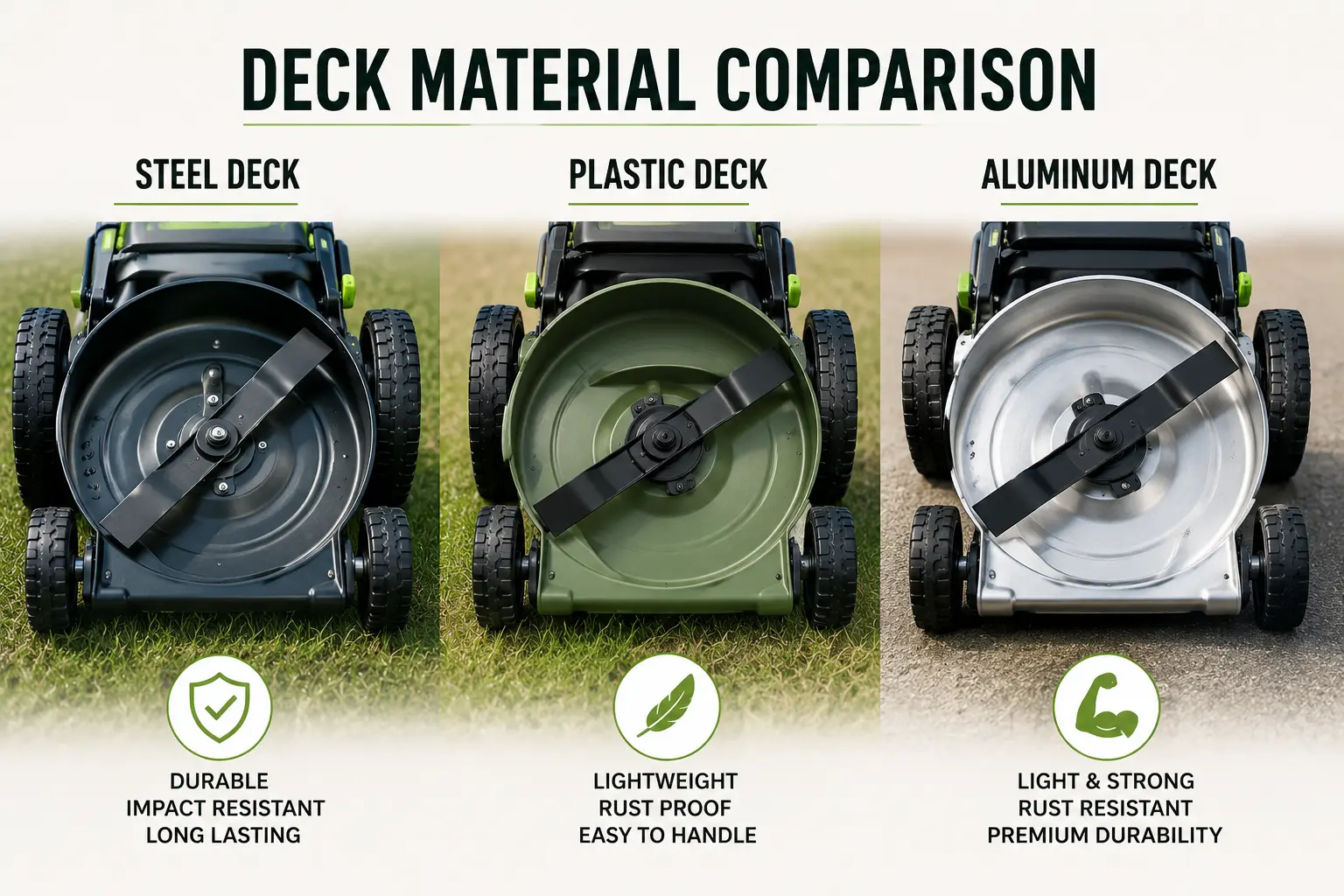
Mulching, Bagging, and Side Discharge: Which One Should You Use?
Most battery mowers are “3-in-1” machines: they can mulch, bag, or side-discharge clippings. Each mode has a specific use case.
Mulching chops clippings into fine pieces and returns them to the lawn. This adds nitrogen back to the soil – roughly the equivalent of one fertilizer application per season, according to the University of Missouri Extension (2024). Mulching works best when you mow regularly and the grass is not too tall. If you mow weekly and the clippings are short, mulching is free fertilizer.
Bagging collects clippings in a rear or side bag. You empty the bag into your compost or yard waste bin. Bagging is better when the grass is tall, wet, or you are dealing with a messy lawn that would leave clumps if mulched. It is also cleaner if your lawn has weeds going to seed – bagging removes the seeds rather than spreading them.
Side discharge throws clippings out the side of the mower. It is the fastest mode because the deck does not have to process the clippings as finely. Most homeowners do not use this in residential settings because it scatters clippings across sidewalks and driveways. It is more useful on large open lots where clumping is not a concern.
My default is mulching for most mowing sessions. I bag the first cut of spring when there is a lot of debris on the lawn, and I bag late fall when I am cleaning up leaves. The rest of the season, the clippings go back into the soil.
Battery Platform Compatibility: The Hidden Factor in Your Buying Decision
Battery platform compatibility is one of the most underrated factors in choosing a lawn mower. If you buy from one brand’s battery ecosystem, every future tool you buy in that platform saves you $50-$100 because you skip buying another battery and charger.
Here is how the major platforms break down for 2026:
EGO Power+ (56V ARC Lithium): The largest dedicated outdoor power equipment battery platform in the U.S. Over 70 tools run on EGO 56V batteries, from string trimmers to chainsaws to riding mowers. If you are starting from scratch, EGO’s platform is the most future-proof.
Greenworks (40V and 60V): Two separate voltage tiers, each with its own platform of tools. The 60V platform is the larger and more capable of the two. Greenworks tools are widely available at Home Depot, Walmart, and Amazon. Good ecosystem, solid coverage.
Ryobi (18V ONE+ and 80V): Ryobi’s 18V ONE+ is the largest single tool platform in the world, with over 280 tools. Their 80V platform is separate and focused on outdoor equipment. If you already own any Ryobi 18V tools, they will not cross-charge with the 80V mower battery – these are different systems.
Milwaukee (M18): The premium cordless tool platform. Battery compatibility across 200+ M18 tools is a real advantage for tradspeople and contractors. M18 batteries are expensive but widely available and well-supported.
DeWalt (20V Max, 60V Max Flexvolt): Flexvolt batteries work in both 20V Max tools and 60V Max tools, which is genuinely useful. DeWalt’s tool ecosystem is enormous. If you already own DeWalt drills, saws, or impact drivers, the Flexvolt mower makes financial sense.
Kobalt (80V): Lowe’s-exclusive and smaller than the others. The platform is growing but remains limited compared to EGO or Ryobi 80V.
The practical takeaway: check what outdoor tools you already own before buying any mower. If you have a Greenworks 40V string trimmer, buy the Greenworks 40V or 60V mower. If you have zero battery tools, start with EGO – it has the broadest outdoor equipment ecosystem.
How These Mowers Compare: Full Comparison Table
| Mower | Voltage | Runtime | Deck Width | Drive | Price (with battery) |
|---|---|---|---|---|---|
| EGO LM2135SP | 56V | 70 min | 21 in | Self-propelled | ~$649 |
| Greenworks 40V 17-inch | 40V | 40 min | 17 in | Push | ~$249 |
| Ryobi 80V HP 21-inch | 80V | 80 min | 21 in | Self-propelled | ~$499 |
| Greenworks 60V 21-inch | 60V | 60 min | 21 in | Self-propelled | ~$449 |
| Milwaukee M18 Fuel | 18V x2 | 70 min | 21 in | Self-propelled | ~$799 (kit) |
| Worx WG779 40V | 40V | 30 min | 14 in | Self-propelled | ~$349 |
| Kobalt 80V 21-inch | 80V | 60 min | 21 in | Self-propelled | ~$429 |
| Husqvarna LB448i | 36V | 35 min | 17.7 in | Push | ~$379 |
| DeWalt 60V Flexvolt | 60V | 70 min | 21 in | Self-propelled | ~$799 (kit) |
Gas vs. Battery Lawn Mowers: An Honest Side-by-Side
Gas mowers still have advantages. Battery mowers have caught up in most ways. Here is what is actually different between them in 2026.
Where Battery Mowers Win
Battery mowers are quieter. A typical gas mower runs at 85-90 decibels. Most battery mowers run at 75-80 decibels – still loud, but enough of a difference to mow earlier in the morning without waking the neighborhood (Consumer Reports, 2025). In many suburban neighborhoods, HOA rules or local noise ordinances set quiet hours until 8 AM. Battery mowers are more likely to fall under those limits.
They start instantly. No pull cord, no choke, no primer bulb. Push the button and you are mowing. After years of gas mowers, I still smile at this. The first cold morning of spring is not a wrestling match anymore.
They need almost no maintenance. No oil changes, no spark plug swaps, no carburetor cleaning after a winter of sitting in the garage. You sharpen the blade once a year and charge the battery. That is it. My gas mower needed a full tune-up every spring. My battery mower needed a blade sharpen after its first full season. That is the entire maintenance log.
They produce no fumes. If you mow in an enclosed area, this matters a lot. And on a hot August afternoon in Phoenix or Atlanta, not breathing exhaust is genuinely better for you. The EPA estimates gas lawn equipment produces as much smog-forming pollution per hour as driving an average car 300 miles (EPA, 2023). Battery-powered equipment produces none.
They are better for yards near kids and pets. No exhaust, no fuel spillage risk, and most battery mowers have a blade brake that stops the blade within 3 seconds of releasing the handle. That is faster than most gas mowers manage.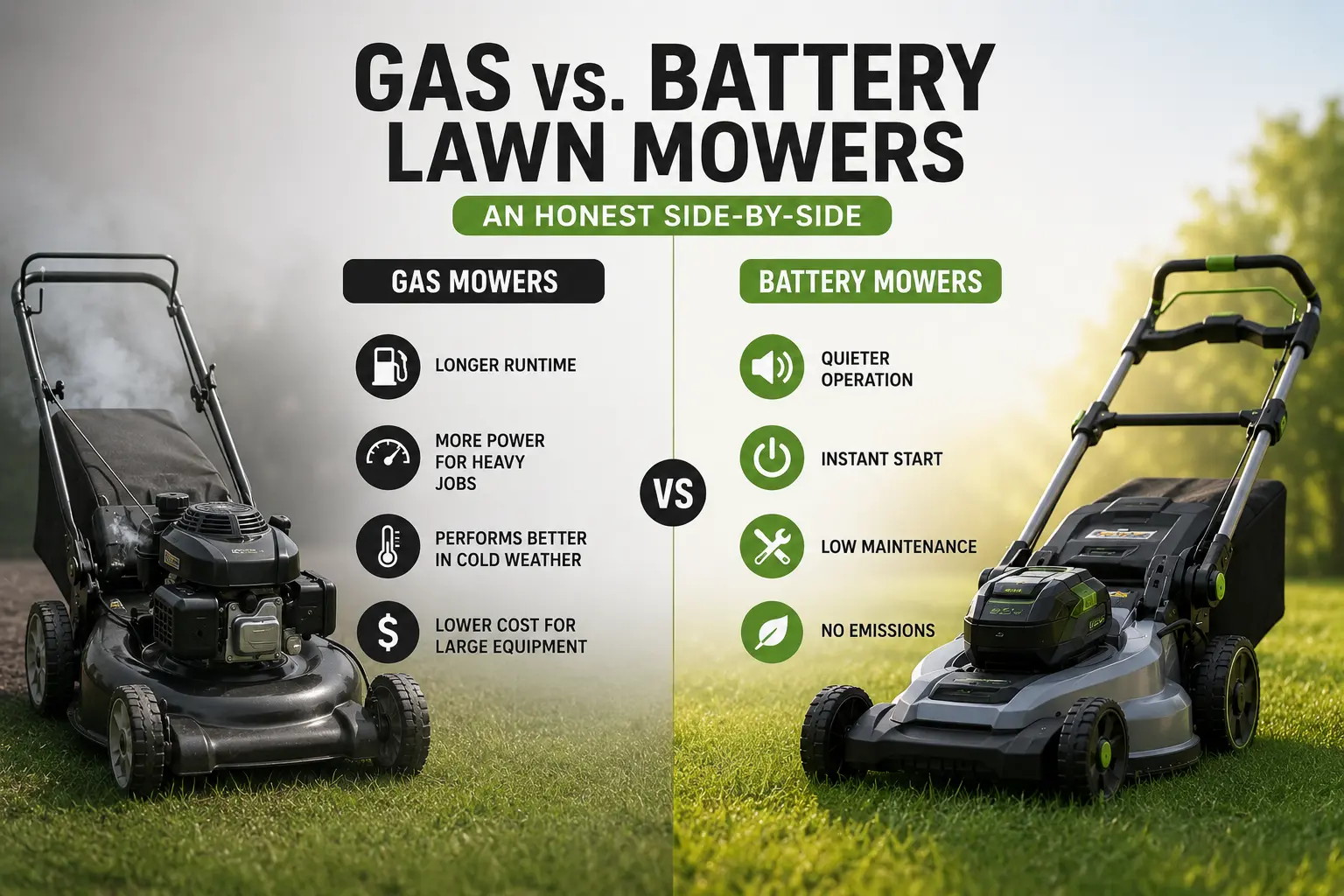
Where Gas Mowers Still Win
Runtime for very large properties. A gas mower with a full tank can run for 60-90 minutes continuously and you refuel in 30 seconds. A battery mower at 60-70 minutes runtime needs a full recharge (30-45 minutes) or a second battery. For properties over 3/4 of an acre mowed weekly, gas still has a logistics edge.
Sustained power on very heavy work. If you regularly mow grass that is 5+ inches tall, wet, or extremely dense, gas delivers consistent power that some mid-range battery mowers struggle to match. High-end 80V models have mostly closed this gap, but it is still real on the longest, heaviest sessions.
Cold weather performance. Lithium-ion batteries lose capacity in cold weather. In Minnesota or Michigan winters, if you mow in late fall or early spring, expect your battery to deliver 20-30% less runtime at 35-40 degrees Fahrenheit (Battery University, 2024). Gas mowers are unaffected by temperature.
Initial cost on very large equipment. If you need a riding mower for 2+ acres, gas riding mowers are still cheaper than battery riding mowers at equivalent capability. The gap is closing fast, but for riding equipment in 2026, gas is still more cost-effective for large acreage.
The Real Cost of Owning a Battery Lawn Mower vs. Gas
Let me put some actual numbers on this, because the sticker price comparison misses the full picture.
A mid-range gas self-propelled mower costs around $350-$450. But over five years, you will spend roughly:
- $80-$120 per year on gas (depending on your lawn size and local gas prices)
- $30-$50 per year on oil changes and spark plugs
- $15-$30 per year on other maintenance (air filter, blade sharpening service)
That adds up to $600-$1,000 in operating costs over five years on top of the purchase price. Gas mower total over 5 years: $950-$1,450.
A mid-range battery mower costs $400-$650 upfront. Ongoing costs are:
- $0 for gas
- $0 for oil changes
- $10-$20 per year for occasional blade sharpening
- One battery replacement at year 4-5 for around $80-$150
Battery mower total over 5 years: $490-$820 for the whole package. The battery mower usually wins on 5-year total cost, even accounting for the higher upfront price (Consumer Reports, 2025).
Battery-Powered Lawn Mowing Across Different U.S. Climates
I have used battery mowers in different parts of the country. The climate affects how your mower performs more than most people realize.
The Southeast: Florida, Georgia, the Carolinas
Grass in the Southeast tends to be warm-season types: Bermuda, St. Augustine, Zoysia, Centipede. These grasses grow fast and thick in summer. St. Augustine in particular gets dense and can be tiring on underpowered mowers.
For the Southeast, I recommend at least 56V and preferably 60V or 80V if you have St. Augustine or Zoysia. A 40V mower will work on Bermuda if it is kept up weekly, but let it get ahead of you and a 40V starts to struggle.
High humidity in summer also means morning dew makes the grass wet most days until 9 or 10 AM. If you mow wet grass often, your battery runtime will be shorter because the motor is working harder. Plan for 15-20% less runtime than the listed spec (EGO, 2025).
The Midwest and Northeast: Ohio, Michigan, Pennsylvania, New York
Mostly cool-season grasses here: Kentucky bluegrass, tall fescue, perennial ryegrass. These are thinner bladed and easier to cut than warm-season grasses, so a 40V or 56V mower handles most Midwest and Northeast yards well.
Cold fall temperatures matter here. Lithium-ion batteries lose capacity below 40 degrees Fahrenheit. If you are mowing in October or early November, expect shorter runtime. Store your battery inside at room temperature overnight before mowing in cold weather – this helps significantly.
The Southwest: Arizona, New Mexico, Texas
In Phoenix or Tucson, most residential yards are either desert landscaping (rock and cacti, no mowing needed) or planted with Bermuda grass in irrigated areas. Bermuda handles heat and drought well but grows fast when watered.
For Southwest yards with grass, the heat affects you more than the mower. Battery-powered mowers actually handle heat better than gas mowers because there is no engine to overheat. The electronics in high-end battery mowers include thermal protection that slows the motor before it can damage itself in sustained heat.
The Pacific Northwest: Oregon, Washington
Rain is the defining feature. Grass is almost always damp. The Pacific Northwest uses cool-season mixes similar to the Northeast, but the consistent moisture means the grass is thicker and heavier than the same grass types in drier climates.
For the Pacific Northwest, self-propelled is almost essential on any yard with slope – and most yards there have slope. A 56V or 60V mower handles it well. The good news: cool, damp weather is actually great for lithium-ion battery performance. You get close to rated runtime in those conditions.
How to Extend the Life of Your Battery Lawn Mower
A battery mower is a real investment. Taking care of the battery and the machine properly makes a big difference in how long both last.
Battery Care
Store the battery indoors, especially in winter. Lithium-ion batteries degrade faster when stored in extreme heat or cold. A garage that gets to 10 degrees in January is bad for a battery left on the shelf out there. Bring it inside.
Do not store the battery at 0% charge for extended periods. If you are storing your mower for winter, charge the battery to about 50-60% before you put it away. A battery stored fully depleted for months will lose capacity permanently.
Avoid leaving the battery on the charger indefinitely. Most modern chargers have auto-shutoff to prevent overcharging, but unplugging after a full charge is still good practice.
Deck and Blade Care
Sharpen the blade at least once a season. A dull blade tears the grass instead of cutting it, which turns your lawn brown at the tips and makes the motor work harder, draining the battery faster. A sharp blade is one of the biggest differences between a lawn that looks great and one that just looks mowed.
Clean the underside of the deck after each mow. Grass clippings pack into the deck cavity and hold moisture, which leads to rust on steel decks. A quick scrape with a plastic tool and a rinse with a hose takes two minutes and keeps the deck in good shape for years.
Wheels and Drive System
Check the drive belt or cable on self-propelled mowers once a season. If the self-propelled system starts slipping or engaging inconsistently, it is usually a cable tension issue that you can adjust in 10 minutes without taking the mower to a shop.
Common Mistakes People Make When Buying a Battery Lawn Mower
After talking with dozens of homeowners who have made the switch to battery mowers, I see the same mistakes come up again and again.
Buying by voltage number alone. A high voltage number does not automatically mean a better mower. An 80V mower with a 2.5Ah battery will underperform a 56V mower with a 7.5Ah battery on runtime and sustained power. Look at amp-hours alongside voltage.
Underestimating their yard size. People consistently think their yard is smaller than it is. Before buying a mower, actually measure your lawn. If you use Google Maps satellite view and measure the green area, you will often be surprised. I have seen people buy a 40V push mower for a yard that clearly needed a 60V self-propelled.
Buying tool-only without owning the compatible battery. Several models on this list (Milwaukee, DeWalt) offer lower “tool-only” prices that assume you already own their batteries. If you do not, the kit price is much higher. Check what you are actually getting before comparing prices across brands.
Skipping the second battery. If your yard takes 45 minutes to mow and your battery runs 50-60 minutes in ideal conditions, you have almost no margin for real-world conditions (wet grass, slopes, longer passes). A second battery for $80-$120 eliminates that anxiety completely.
Ignoring battery compatibility with other tools. If you already own other battery-powered yard tools, buying a mower on the same platform saves money and simplifies charging. Do not buy an EGO mower if you already own a Greenworks trimmer and blower – you will be managing two separate battery families.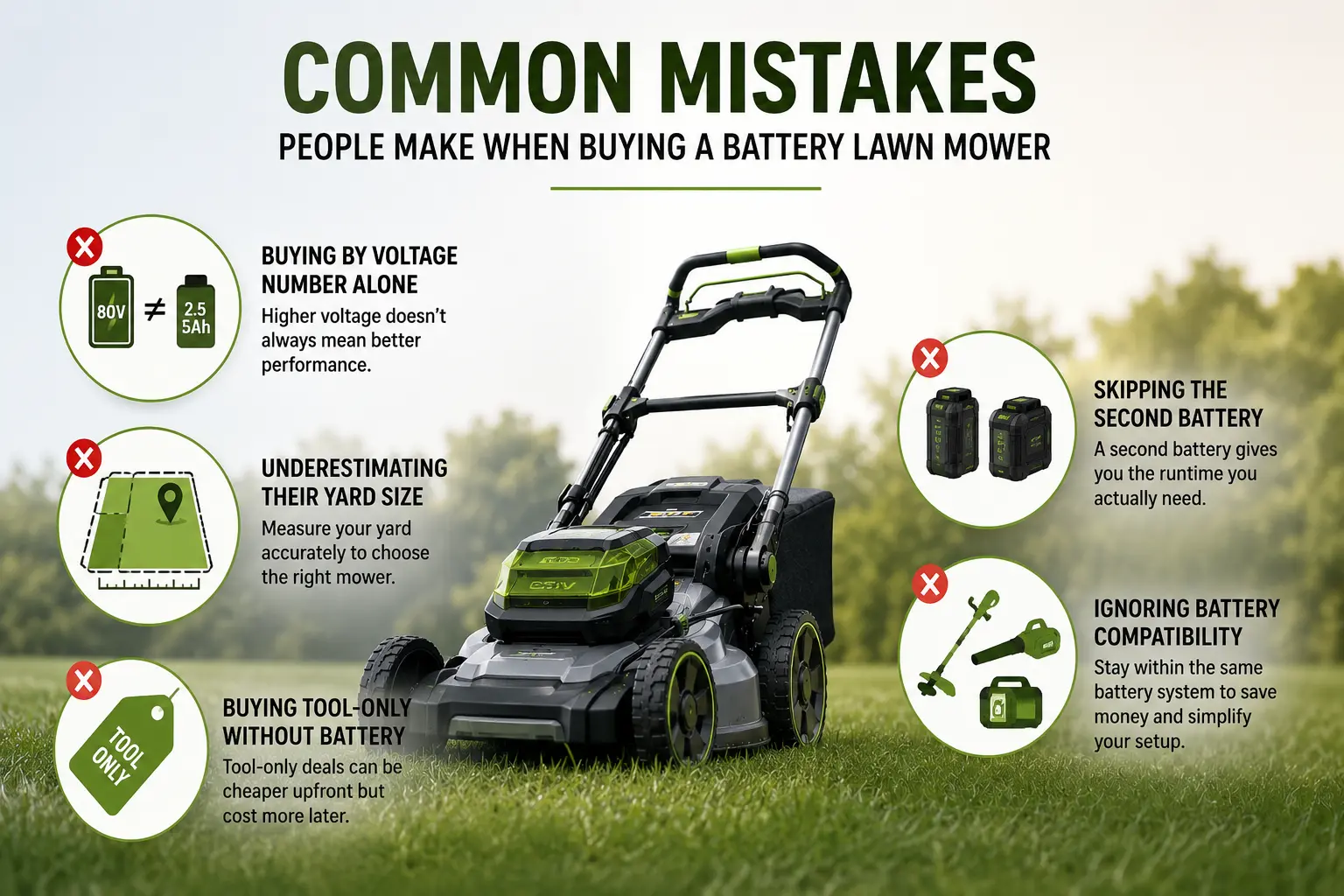
Cutting Height Guide: What Setting to Use for Your Grass Type
The right cutting height depends on your grass type. Cutting too low stresses the grass, burns it out in summer heat, and leaves it open to weeds. Cutting too high leaves a shaggy, uneven look and can make thatch problems worse.
Here are the recommended cutting heights for the most common U.S. residential grass types, according to the University of Georgia Extension (2024):
| Grass Type | Recommended Height | Common Regions |
|---|---|---|
| Bermuda | 1.0″-1.5″ | South, Southeast, Southwest |
| Zoysia | 1.0″-2.0″ | Southeast, mid-Atlantic |
| St. Augustine | 2.5″-4.0″ | Florida, Gulf Coast |
| Centipede | 1.5″-2.0″ | Southeast |
| Kentucky Bluegrass | 2.5″-3.5″ | Midwest, Northeast |
| Tall Fescue | 3.0″-4.0″ | Midwest, Northeast, Pacific Northwest |
| Perennial Ryegrass | 1.5″-2.5″ | Pacific Northwest, Northeast |
| Fine Fescue | 2.5″-3.5″ | Northeast, mountain regions |
A few things I have learned from mowing different grass types over the years:
St. Augustine in Florida should never go below 2.5 inches. Any lower and you expose the crown of the plant to heat and foot traffic stress. I learned this the hard way with a neighbor’s yard. I set it to 2 inches thinking it would look tidier. By August it had dead patches. The grass was fine the next season, but it was an avoidable mistake.
Tall fescue in the Midwest grows fast in spring and fall but barely moves in summer heat. A common mistake is cutting it short in June to reduce mowing frequency. That backfires – short fescue in July sun burns out fast. Keep it at 3.5-4 inches in summer and it stays green and dense even in dry spells.
Bermuda grass can go shorter than almost anything else. At 1-1.5 inches it stays tight and compact, which is why it is the grass of choice for golf fairways. If you are maintaining a Bermuda lawn in Georgia or Alabama and want that fairway look, a battery mower with a low deck setting and a sharp blade is the best tool for the job.
The One-Third Rule
The one-third rule says: never cut more than one-third of the grass blade in a single mowing. If your grass is 4 inches tall, cut to no shorter than 2.7 inches in one pass. Cutting more than one-third at once shocks the plant, slows recovery, and turns the tips yellow-brown.
If your grass has gotten away from you – say you skipped two weeks and it is now 6 inches tall – mow at the highest deck setting first, wait a few days, then mow again at your target height. Two lighter cuts beat one aggressive scalping.
The 5 Best Battery Mower Accessories Worth Buying
The mower is only part of the picture. A few accessories make a real difference in how well the job gets done and how long the equipment lasts.
A second battery. The most useful accessory for any battery mower. If your primary battery runs out mid-yard, a spare means you finish the job without waiting 45 minutes for a recharge. Most brands sell additional batteries as standalone items for $80-$150. For yards over 1/3 acre, a second battery is not optional – it is necessary.
A blade balancer. After you sharpen your mower blade, a blade balancer ($5-$15 at any hardware store) tells you whether the blade is balanced before you put it back on. An unbalanced blade causes vibration that wears out the spindle bearings faster. A balanced blade cuts cleaner and runs smoother. This is a 2-minute step that most people skip and then wonder why their mower starts vibrating after a couple seasons.
A deck scraper or cleaning tool. A plastic deck scraper ($8-$12) makes it easy to knock compacted grass off the underside of the deck after mowing. Letting clippings pack in there holds moisture against the metal (or plastic), speeds up corrosion, and reduces airflow inside the deck, which hurts mulching performance. Clean the deck every 3-4 mowing sessions.
A blade sharpening kit. A basic blade sharpening kit with a file or angle grinder attachment costs $15-$30 and lets you sharpen the blade yourself in about 10 minutes. A sharp blade makes a visible difference in cut quality. It also reduces the load on the motor, which extends battery runtime. Sharpen at the start of each season and again mid-season if you mow frequently.
A battery storage case. If you store your mower in an unheated garage, a battery storage case or insulated bag protects the battery from temperature extremes over winter. You can find padded battery cases for $20-$40 that fit most major battery formats. This is worth it if your garage drops below 20 degrees Fahrenheit in winter – lithium-ion batteries stored in extreme cold lose capacity permanently over time.
Frequently Asked Questions About Battery-Powered Lawn Mowers
What is the best battery-powered lawn mower for most homeowners?
The EGO Power+ LM2135SP is the best battery-powered lawn mower for most U.S. homeowners with yards between 1/4 and 1/2 acre. It runs on a 56V 7.5Ah battery, cuts for up to 70 minutes per charge, and has a self-propelled drive system with six speed settings. The brushless motor handles Bermuda, fescue, and most other common grass types without bogging down.
How long does a battery-powered lawn mower last per charge?
Most battery-powered lawn mowers last between 30 and 80 minutes per charge, depending on the battery voltage, amp-hours, yard conditions, and grass thickness. In real-world conditions on flat, dry grass, expect the actual runtime to be about 15-20% less than the manufacturer’s rated figure (EGO, 2025). A 56V 7.5Ah battery typically covers about 1/3 to 1/2 an acre per charge.
Are battery-powered lawn mowers as powerful as gas mowers?
High-end 60V and 80V battery mowers are close to mid-range gas mowers in cutting power for most residential applications. The main difference is in sustained performance on very heavy or wet grass over long sessions. A gas mower with a fresh tank will run continuously until the tank empties. A battery mower’s power drops slightly as the battery depletes. For most homeowners mowing once a week on a standard suburban lot, this difference is not noticeable.
How long do battery-powered lawn mower batteries last before needing replacement?
Most lithium-ion lawn mower batteries last 3-5 years or 300-500 charge cycles before capacity noticeably degrades (Consumer Reports, 2024). If you mow once a week for 30 weeks per year, that is 30 charge cycles per year, which means the battery could last 10+ years before hitting 300 cycles. Proper storage in a temperature-controlled space extends life further.
Can I use a battery-powered lawn mower in the rain?
Most battery mowers are rated for light rain or damp grass. Mowing in heavy rain is not recommended for any battery mower. The motor works significantly harder on wet grass, which shortens runtime and generates more heat. The bigger issue is safety – wet grass on slopes can cause the mower to slip, regardless of whether it is gas or battery-powered. Mow when the grass surface is dry if possible.
What voltage battery mower do I need for my yard?
Match voltage to yard size and grass type: 40V for flat yards under 5,000 square feet with standard grass, 56V-60V for yards up to 1/3 acre with moderate grass thickness, and 80V for larger lots or dense warm-season grasses like St. Augustine and Zoysia. If you are in the Southeast and mow anything thicker than Kentucky bluegrass, step up to 60V at minimum.
Is a self-propelled battery mower worth the extra cost?
Yes, for most people. Self-propelled mowers cost $50-$150 more than push versions, but they reduce physical effort significantly on any yard over 4,000 square feet or on any slope. If you have a bad back, knee problems, or are mowing a larger lot, the self-propelled feature pays for itself in the first session. The only people who do not need it are those with very small, completely flat yards.
What is the difference between brushless and brushed motors in lawn mowers?
A brushless motor uses electronic controls instead of physical carbon brushes to drive the motor shaft. This makes it more efficient (less energy wasted as heat), more durable (no brushes to wear out), and more powerful for the same battery charge. Brushless motors are standard on any quality battery mower in 2026. A brushed motor in a battery mower is a sign of a low-quality product – avoid it.
How do I store a battery-powered lawn mower for winter?
Charge the battery to around 50-60% before storage. Remove the battery from the mower and store it indoors, away from extreme heat or cold – a heated garage or closet is ideal. Clean all grass clippings off the deck and from inside the mower body. If the blade has nicks, sharpen or replace it before spring so the mower is ready to go when the grass grows. Do not store the battery fully depleted for multiple months.
Are battery-powered lawn mowers good for hilly yards?
Yes, especially self-propelled 60V or 80V models. The self-propelled drive handles most residential slopes well, and the consistent torque from a brushless motor is actually better than a gas mower on moderate slopes because the power delivery is smoother. For steep slopes (over 15 degrees), no walk-behind mower is ideal – battery or gas. A battery-powered self-propelled mower like the Ryobi 80V or EGO LM2135SP handles typical suburban slopes without issue.
Which Battery-Powered Lawn Mower Should You Actually Buy?
Here is the quick answer based on your situation:
Your yard is under 4,000 sq ft and flat: Get the Greenworks 40V 17-Inch Mower. You do not need more mower than this, and spending $249 instead of $649 is the right call.
Your yard is between 4,000 and 8,000 sq ft with normal grass: The Greenworks 60V 21-Inch Self-Propelled Mower at around $449 is the best value. Enough power, self-propelled convenience, and a proper 21-inch deck.
Your yard is 1/4 to 1/2 acre: Buy the EGO LM2135SP. It is the best all-around battery mower you can buy today, and the 70-minute runtime gives you real margin on a half-acre yard.
Your yard is over 1/2 acre or has thick warm-season grass: The Ryobi 80V HP 21-Inch Mower gives you gas-level power at a price that still makes sense. Get a second battery and you can mow 3/4 of an acre on one session without stopping.
You already own Milwaukee, DeWalt, or Greenworks tools: Buy the mower from your existing battery platform. Compatibility is worth more than marginal performance differences between brands at similar voltage levels.
The best battery-powered lawn mower for you is the one that matches your actual yard size, your grass type, and the battery platform you already own – not the one with the most impressive spec sheet number.