
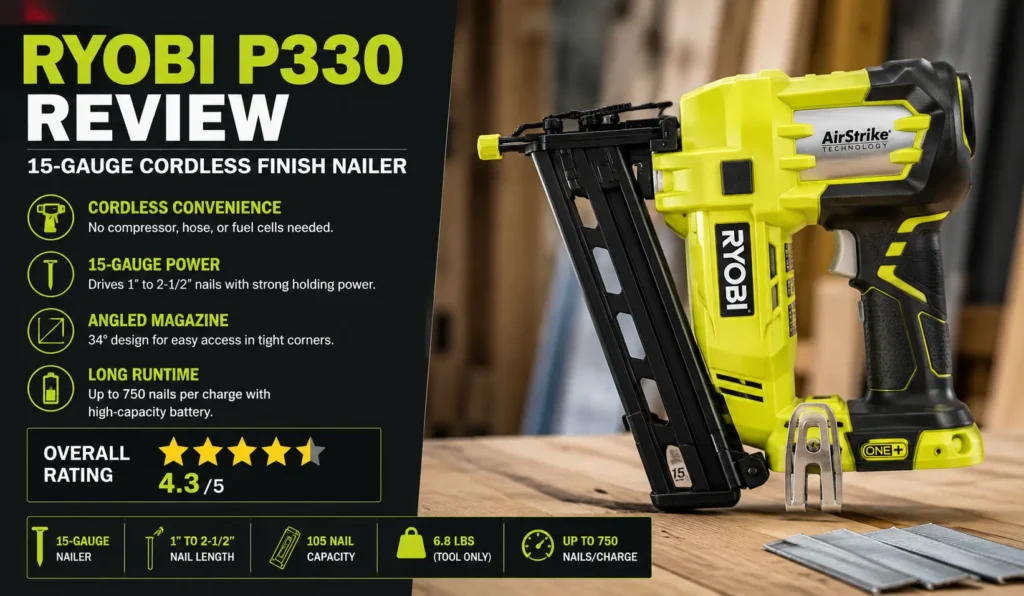
If you are tired of dragging an air compressor across your garage just to nail some trim, the Ryobi P330 review you are about to read might change the way you work. I picked up this 18V cordless finish nailer for a big baseboard project, and I was honestly surprised by how well it held up. After using it across several home improvement jobs, I can say it is one of the best cordless options in its class, though it does have a few quirks worth knowing before you buy. Read on and I will walk you through every detail.
Table of Contents
- What Is the Ryobi P330?
- Key Specifications at a Glance
- What I Like About the Ryobi P330
- What Could Be Better
- My Personal Experience with the Ryobi P330
- Ryobi P330 Performance: How It Handles Real Jobs
- Ryobi P330 Battery Life and AirStrike Technology
- Comparing the Ryobi P330 with Other Brands
- Who Should Buy the Ryobi P330?
- Recommendation
- FAQs for Ryobi P330 Review
What Is the Ryobi P330?
The Ryobi P330 is an 18V ONE+ cordless angled finish nailer that uses 15-gauge nails. It runs on Ryobi’s AirStrike technology, which means no compressor, no hose, and no fuel cells. You just pop in a battery and start nailing. It is designed for trim work, door casings, baseboards, crown molding, and even light cabinetry. The P330 is sold as a bare tool, so you need a battery and charger separately, but if you are already in the Ryobi ONE+ system, that is not a big deal.
The angled magazine is what sets this nailer apart from earlier Ryobi AirStrike models. It lets you get into tight inside corners easily. 15-gauge nails are also thicker than the 16 or 18 gauge nails in other cordless nailers, so you get a stronger hold. That makes the P330 a smart pick for heavier trim and structural finish work.
Key Specifications at a Glance
Here is a quick look at the core specs for the Ryobi P330:
| Feature | Details |
| Model | Ryobi P330 |
| Voltage | 18V (ONE+ Battery System) |
| Nail Gauge | 15 Gauge Angled Finish Nails |
| Nail Length Range | 1 inch to 2.5 inches |
| Magazine Capacity | 105 nails |
| Nails Per Charge (4.0Ah) | Up to 750 nails |
| Tool Weight (no battery) | 6.8 lbs |
| Firing Modes | Single fire and bump fire |
| LED Work Light | Yes, with 10-second auto-off |
| Jam Clearing | Tool-free |
| Depth Adjustment | Yes, dial and lever |
| Belt Clip | Included |
| Battery Included | No (bare tool) |
| Price Range (USA) | Around $150-$230 depending on retailer |
What I Like About the Ryobi P330
The Ryobi P330 review would not be complete without talking about what makes this nailer genuinely good. Here are the things that stood out to me after using it on real projects.
- No compressor needed: This is the biggest win for me. I used to haul out my Porter-Cable pancake compressor every single time I needed to nail trim. With the Ryobi P330, I just grab the nailer and a charged battery. Setup time went from 10 minutes to about 30 seconds. For weekend DIY jobs, that alone is worth the price.
- Angled magazine makes corners easy: The angled design of the magazine lets you tilt the nailer into tight spots. I was nailing baseboard in a narrow hallway and got into the inside corners without fighting the tool. Straight-magazine nailers simply cannot do that as cleanly.
- Drives nails like a pneumatic tool: I was skeptical that a battery-powered nailer would feel like my old air nailer. But the AirStrike technology compresses air internally and the shot feels solid. It drives 2-inch nails cleanly into pine and even into the older, harder wood in my 1960s-era home walls.
- Dual firing modes are super handy: Single fire is great for precise placement. Bump fire mode lets me move along a long baseboard run fast. Holding the trigger and bumping the tip each time saves real time on big jobs.
- LED work light is actually useful: The light kicks on just from gripping the tool. In low-light spaces like closets or under cabinets, it genuinely helps you see your nail line. It stays on for 10 seconds after you let go, which is perfect.
- Tool-free jam clearing: I did not get any jams in my main testing, but I did have one double-fire early on. Opening the magazine and clearing it was dead simple. No tools, no frustration.
- Depth adjustment is precise: The combination of a lever for gross adjustment and a fine-tuning dial lets you sink nails exactly where you want them, flush or just below the surface. On softer pine it went in perfectly. On harder wood I just dialed it up.
- 750 nails per charge is impressive: I installed trim around three windows and put up about 15 feet of baseboard on a single 4.0Ah battery and still had most of the charge left. Ryobi’s 750-nail claim with that battery is believable from my experience.
- Works with the whole Ryobi ONE+ system: If you already have Ryobi batteries for a drill or circular saw, they all work here. That interoperability is a huge value add, especially in the US where Ryobi tools are widely available at Home Depot.
What Could Be Better
No tool is perfect. The Ryobi P330 has real strengths, but being honest means sharing the downsides too.
- It is heavier than pneumatic nailers: At 6.8 lbs without the battery, and over 7.5 lbs with a 4.0Ah pack, this nailer is noticeably heavier than a comparable air nailer. For overhead work like crown molding on tall ceilings, your arm will feel it. I had to take more breaks during overhead nailing than I would with a lighter tool.
- There is a slight trigger delay: Because the tool builds air pressure before each shot, there is a brief pause between pressing the trigger and the nail firing. It is not a deal-breaker, but it takes some getting used to if you are coming from a pneumatic nailer. You also have to hold the trigger the whole time the tool is building pressure, or the nail will not fire.
- Belt clip placement is limited for right-handers: The angled magazine sticks out to the left, which means the belt clip can only go on the right side of the handle. For right-handed users, you have to flip the nailer around to hang it on your right hip, which feels awkward. Left-handers actually have the advantage here.
- Cannot stand upright on its own: The long angled magazine prevents the nailer from standing on end. You have to lay it down, which is a minor annoyance on a cluttered worksite but worth knowing.
- Some users report receiving fewer nails than listed: The product states 500 nails included, but some buyers have noted receiving only 200. This seems to be a fulfillment inconsistency rather than a design flaw, but worth checking your box when it arrives.
- Bare tool only adds to the cost: If you are new to Ryobi, you will need to budget for a battery and charger separately. A 4.0Ah battery and charger combo can add $60-$100 to the total cost, so keep that in mind when comparing prices with other brands.
My Personal Experience with the Ryobi P330
I first used the Ryobi P330 when I was finishing out my home office renovation. I had about 80 feet of baseboard to install, plus door casing on two doors and a window surround. Here is what that experience was really like.
- Setup was the fastest I have ever had with a finish nailer. Battery in, dial set, and I was shooting nails in under a minute.
- The first few shots on the medium depth setting were nearly perfect. I only had to adjust the fine dial once to get nails sitting just below the surface on the MDF baseboard.
- I noticed the delay on the trigger right away. It is maybe half a second. Once I adjusted my rhythm, it felt natural and I stopped thinking about it.
- On an inside corner in a closet, the angled magazine was a game changer. I tilted the nailer at about 45 degrees and drove the nail cleanly. My old straight-magazine brad nailer could not do that at all.
- I worked for about 3 hours total and the battery indicator still showed three out of four bars. Battery life was excellent.
- The weight was noticeable when I had the nailer up high to nail the top of door casing. I switched to my left hand a few times to give my right arm a break.
- I had one double-fire incident early on. I think I was not holding the trigger fully. After that I was more deliberate and it did not happen again.
- The LED light helped me see pencil marks in the closet without extra lighting. Small thing but appreciated.
- At the end of the job, the baseboard and casing looked clean and tight. The 15-gauge nails held everything firmly without splitting the MDF.
- Overall, I would use this nailer again for any finish trim project. It made a solo job fast and clean without any compressor noise or trip hazards from hoses.
Ryobi P330 Performance: How It Handles Real Jobs
Baseboard and Interior Trim
The Ryobi P330 performs extremely well on baseboard and interior trim work. This is where it shines. The 15-gauge nail gives a strong grip in both softwood and medium-density fiberboard, which is what most modern baseboards are made of. Nail placement is consistent once you dial in the depth setting, and the angled magazine helps at the ends of runs where you need to drive a nail at a slight angle to avoid splitting.
Door and Window Casing
For door and window casing, the P330 is a strong performer. The extra holding power of the 15-gauge nail over a brad nail means the casing stays put even if the house shifts slightly. I ran nails at about 16-inch intervals on the casing and the fit was tight with no gaps. The non-marring tip protects finished surfaces, and removing it for angled shots is quick.
Crown Molding
Crown molding is where the weight becomes a real factor. Holding a 7.5-pound nailer overhead for extended periods is tiring. That said, the nailer does the job well. The bump fire mode helps speed up the process so you can lower your arm between bursts. If you are doing a small room with crown, it is manageable. For a whole house, you may want to pace yourself more than with a lighter pneumatic tool.
Hardwood vs. Softwood
On pine and MDF, the P330 drives nails with ease at the medium depth setting. On older hardwood, I needed to turn the pressure lever to the higher setting and use the fine dial to get full penetration. The tool handled it, but the delay on the trigger becomes slightly more pronounced on very hard material. No jams occurred on any material I tested.
Ryobi P330 Battery Life and AirStrike Technology
The AirStrike system is the heart of the Ryobi P330. Understanding how it works helps explain both its strengths and its quirks. Rather than a mechanical flywheel or an external air compressor, the P330 builds a small charge of compressed air internally every time you fire. That internal compression is what gives the shot its pneumatic-like feel.
The result is a nailer that does not need fuel cells like DeWalt or Milwaukee cordless nailers require. There is no ongoing consumable cost beyond the nails themselves. For US homeowners who do occasional trim work, this is a real saving over time.
Battery life is one of the P330’s best features. Ryobi rates it at 750 nails per charge using a 4.0Ah 18V battery. In my testing across multiple projects, I never came close to draining a fully charged 4.0Ah pack in a single session. Even a 2.0Ah battery gives solid performance for smaller jobs. The trade-off is that the AirStrike motor draws more power than a simple brad nailer, so lighter batteries will deplete faster.
One tip: always use a 4.0Ah or larger battery if you are doing a big job. The extra capacity gives you consistent firing power throughout the charge, and the nailer performs more reliably when the battery is not low.
Comparing the Ryobi P330 with Other Brands
I have also used the DeWalt DCN650 20V cordless finish nailer and the Metabo HPT NT65MA4 pneumatic finish nailer on different projects. Both are well-regarded tools in their categories, and comparing them to the Ryobi P330 helps show where each tool fits best.
Ryobi P330 vs DeWalt DCN650: Quick Comparison
| Feature | Ryobi P330 | DeWalt DCN650 |
| Gauge | 15-gauge angled | 15-gauge angled |
| Power Source | 18V battery (AirStrike) | 20V battery (brushless motor) |
| Fuel Cells Required | No | No |
| Weight (no battery) | 6.8 lbs | 7.3 lbs |
| Nail Length Range | 1 inch to 2.5 inches | 1.25 inches to 2.5 inches |
| Nails Per Charge | ~750 (4.0Ah) | ~1,100 (2.0Ah) |
| Magazine Capacity | 105 nails | 110 nails |
| Dry-Fire Lockout | No | Yes |
| Battery Ecosystem | Ryobi ONE+ | DeWalt 20V MAX |
| Price (Bare Tool) | ~$150-$230 | ~$250-$349 |
| Best For | DIY, light trim work | Pro or heavy DIY use |
Ryobi P330 vs Metabo HPT NT65MA4: Quick Comparison
| Feature | Ryobi P330 | Metabo HPT NT65MA4 |
| Gauge | 15-gauge angled | 15-gauge angled |
| Power Source | 18V battery | Pneumatic (compressor) |
| Portability | High, no hose needed | Limited by hose and compressor |
| Weight (no battery/hose) | 6.8 lbs | 4.8 lbs |
| Nail Length Range | 1 inch to 2.5 inches | 1 inch to 2.5 inches |
| Drive Speed | Slight delay per shot | Instant, rapid fire |
| Noise Level | Moderate | Loud (compressor adds to it) |
| Operating Cost | Battery charging only | Compressor electricity + maintenance |
| Setup Time | Under 1 minute | 5-10 minutes |
| Price | ~$150-$230 | ~$80-$130 (tool only) |
| Best For | Home DIY, no compressor | High-volume pro work |
Ryobi P330 vs Milwaukee 2741-20: Quick Comparison
| Feature | Ryobi P330 | Milwaukee 2741-20 |
| Gauge | 15-gauge angled | 15-gauge angled |
| Power Source | 18V battery (AirStrike) | 18V battery (POWERSTATE brushless) |
| Fuel Cells Required | No | No |
| Weight (no battery) | 6.8 lbs | 7.2 lbs |
| Nail Length Range | 1 inch to 2.5 inches | 1 inch to 2.5 inches |
| Nails Per Charge | ~750 (4.0Ah) | ~700 (2.0Ah HIGH DEMAND) |
| Sequential / Bump Fire | Both modes | Both modes |
| Dry-Fire Lockout | No | Yes |
| Battery Ecosystem | Ryobi ONE+ | Milwaukee M18 |
| Price (Bare Tool) | ~$150-$230 | ~$279-$349 |
| Best For | Budget-friendly DIY | Heavy-duty finish work |
Bottom line: The Ryobi P330 competes well on price and convenience. If you are already in the Ryobi ecosystem or want a capable nailer without spending DeWalt or Milwaukee money, the P330 delivers solid results. For professionals doing high-volume work daily, the DeWalt or Milwaukee tools offer higher throughput and build quality. For the average US homeowner doing seasonal trim projects, the Ryobi P330 is hard to beat at its price point.
Who Should Buy the Ryobi P330?
This nailer is a great fit for you if:
- You are a DIY homeowner who does seasonal trim, baseboard, or casing work and wants to skip the compressor setup.
- You are already in the Ryobi ONE+ battery system and want to add a finish nailer without buying new batteries.
- You are doing small to medium renovation projects like one or two rooms of baseboard, window trim, or door casing.
- You want cordless convenience at a price well below premium brands like DeWalt or Milwaukee.
- You are a first-time finish nailer buyer in the US who wants a reliable, easy-to-use tool available at Home Depot.
You may want to research further if:
- You are a professional contractor nailing trim all day. The weight and trigger delay will slow you down compared to a pneumatic nailer.
- You need to do a lot of overhead crown molding. The weight will tire your arm faster than lighter alternatives.
- You do not already own Ryobi batteries and want to factor in the full cost with a battery and charger kit.
- You need instant, rapid-fire shots with zero delay. Pneumatic nailers will always be faster for high-volume production work.
Recommendation
My honest recommendation after using the Ryobi P330 on multiple projects is straightforward. If you are a homeowner looking for a capable, hassle-free finish nailer and you want to ditch the compressor, this is the tool for you. It is not the lightest nailer on the market and it is not the fastest, but it gets the job done cleanly and reliably without all the setup hassle.
I especially recommend it for people who already own Ryobi ONE+ tools. Adding the P330 to an existing battery collection makes the value case even stronger. In the US, you can find it at Home Depot stores or online, usually in the $150 to $230 range for the bare tool, which is fair for what you get.
If you are a first-time finish nailer buyer, start with the P330. Learn how to set depth, practice your firing rhythm, and get comfortable with the angled magazine. Once you understand those basics, this nailer will serve you well on a wide range of home projects for years.
If you are a seasoned pro who runs a nailer for 8 hours a day, look at pneumatic options or bump up your budget to the DeWalt DCN650 or Milwaukee 2741-20. Those tools are built for that kind of volume. But for the rest of us doing weekend projects and seasonal renovations, the Ryobi P330 is a smart, practical buy.
FAQs for Ryobi P330 Review
Is the Ryobi P330 good for beginners?
Yes. The Ryobi P330 is a great first finish nailer. The depth dial is easy to set. The firing modes are simple to switch. And you do not need to manage a compressor or air hose. Just charge the battery and go. It is forgiving for new users and the tool-free jam clearing means minor issues do not become big problems.
What nails does the Ryobi P330 use?
The Ryobi P330 uses 15-gauge angled finish nails at a 34-degree angle. Nail length ranges from 1 inch to 2.5 inches. Make sure you buy nails labeled for 34-degree nailers and not 25-degree nailers, as they are not the same. The tool ships with 500 two-inch 15-gauge nails in most packages.
How long does the battery last on the Ryobi P330?
With a 4.0Ah 18V battery, Ryobi rates the P330 at up to 750 nails per charge. In real use across trim and baseboard projects, I found this claim accurate. A single charge easily covers most single-room jobs. Smaller 2.0Ah batteries will give fewer nails per charge but still handle light work well.
Does the Ryobi P330 need a compressor?
No. The Ryobi P330 uses AirStrike technology to build air pressure internally. It runs entirely on an 18V battery. There is no compressor, no air hose, and no fuel cells needed. This is one of its biggest advantages over traditional finish nailers and makes it ideal for home use where a compressor is not practical.
How does the Ryobi P330 compare to the DeWalt DCN650?
The DeWalt DCN650 fires more nails per charge, has a dry-fire lockout to protect surfaces, and is built for heavier professional use. The Ryobi P330 is lighter on price and works well for DIY projects. If budget is a concern and you do occasional trim work, the P330 is the smarter buy. For daily professional use, the DeWalt offers better long-term value.
Can the Ryobi P330 drive nails into hardwood?
Yes, but you need to adjust the settings. Turn the pressure lever to the higher setting and dial in the depth adjuster for full penetration. The P330 handled older, harder wall studs and dense MDF in my testing without jamming. On very dense hardwoods like oak, you may need to use the maximum pressure setting and fire slowly with the single-fire mode.
Is the Ryobi P330 worth the price?
For a DIY homeowner, yes. The Ryobi P330 delivers cordless convenience, solid nailing performance, and good battery life at a price well below premium competitors. In the US, it is widely available at Home Depot and online retailers. If you already have Ryobi ONE+ batteries, the bare tool price makes it an especially strong value. For professional daily use, the investment in a DeWalt or Milwaukee may pay off better over time.